SJSU ScholarWorks
Master's Projects
Master's Theses and Graduate Research
Spring 5-24-2019
Learning for Free – Object Detectors Trained on
Synthetic Data
Charles Thane MacKay
San Jose State University
Follow this and additional works at:
https://scholarworks.sjsu.edu/etd_projects
Part of the
Artificial Intelligence and Robotics Commons
This Master's Project is brought to you for free and open access by the Master's Theses and Graduate Research at SJSU ScholarWorks. It has been accepted for inclusion in Master's Projects by an authorized administrator of SJSU ScholarWorks. For more information, please contact
Recommended Citation
MacKay, Charles Thane, "Learning for Free – Object Detectors Trained on Synthetic Data" (2019).Master's Projects. 738. DOI: https://doi.org/10.31979/etd.e4vb-qdwk
by
Charles Thane MacKay
A dissertation submitted in partial satisfaction of the
requirements for the degree of
Master of Science
in
Computer Science
in the
Graduate Division
of the
San Jos´
e State University
Committee in charge:
Professor Teng Moh, Advisor
Professor David Anastasiu
Professor Christopher Pollett
Copyright 2019
by
Trained on Synthetic Data, is approved:
Advisor
Date
Date
Date
A picture is worth a thousand words, or if you want it labeled, it’s worth about four cents per bounding box. Data is the fuel that powers modern technologies run by artificial intelligence engines which is increasingly valuable in today’s industry. High quality labeled data is the most important factor in producing accurate machine learning models which can be used to make powerful predictions and identify patterns humans may not see. Acquiring high quality labeled data however, can be expensive and time consuming. For small companies, academic researchers, or machine learning hobbyists, gathering large datasets for a specific task that are not already publicly available is challenging. This research paper describes the techniques used to generate labeled image data synthetically which can be used in supervised learning for object detection. Technologies such as 3D modeling software in conjunction with Generative Adversarial Networks and image augmentation can create a realistic and diverse image dataset with bounding boxes and labels. The result of our effort is an accurate object detector in an environment of aerial surveillance with no cost to the end user. We achieved a best average precision score of 0.76 to classify and detect cars from an aerial perspective using a mix of GAN-refined data along with randomized synthetic data.
I would like to thank Nightingale Intelligent Systems for the donation of the real datasets, pre-trained object
detection models, and Sharan Duggirala for collaboration on YOLO training and scripting. A special thank
List of Figures viii
List of Tables ix
1 Introduction 1
2 Background and Related Work 5
2.1 The challenge of getting data . . . 5
2.2 Object Detection using Convolutional Neural Networks . . . 6
2.3 Neural Network Training Techniques . . . 8
2.4 Generative Adversarial Networks . . . 10
2.5 Training with synthetic data . . . 11
2.6 Refining synthetic data by domain or style transfer . . . 13
2.7 YOLO algorithm for object detection on aerial photography . . . 15
2.8 Summary and objective . . . 16
3 Creation of Synthetic Data 17 3.1 3D Model Rendering . . . 17
3.2 Spins dataset – camera orbits with all encompassing views . . . 18
3.3 Improvements in 3D modeling . . . 19
3.4 Texturing Cars . . . 23
3.5 Performance increases for massive dataset generation . . . 26
3.6 Surreal Dog Dataset – True Negative Examples . . . 26
3.7 Generation of bounding boxes, labels, and metadata . . . 27
4 Using GANs to Refine Synthetic Data 30 4.1 Pre-processing of the synthetic data . . . 30
4.2 CycleGAN Training . . . 31
4.3 Making use of the CycleGAN model to refine synthetic data . . . 34
5 Training the Object Detector 36 5.1 Architecture and training strategy . . . 36
5.2 Training from scratch . . . 37
6 Results and discussion 40 6.1 Test criteria to evaluate object detector performance . . . 40
6.2 More challenging test set; Rooftop Parking . . . 42
6.3 Discussion of GAN Refinement . . . 43
6.4 Overall consensus . . . 45
7 Conclusion and Further Research 47
A Datasets used for testing, training, and evaluation 54
1.1 Synthetic dataset generation pipeline . . . 4
2.1 Image demonstrating different views of the same object [20] . . . 9
3.1 Audi Spin Dataset – 3D rendering of an Audi R8 at different angles of rotation . . . 19
3.2 HDRI images . . . 20
3.3 Dodge Challenger in an empty HDRI garage with shadows casted . . . 21
3.4 Screenshot of Blender software demonstrating the X, Y, Z vector of the camera . . . 23
3.5 Screenshot of Blender software visualizing the paths the camera was allowed to take by the spherical black lines. Notice the radius of the sphere is fixed, this results in the object appearing the same size at all times . . . 24
3.6 Various Textures . . . 25
3.7 The surreal dog dataset had two primary achievements: Being extremely amusing, and reducing the amount of false positives by dulling activations . . . 28
4.1 Image texture mapped into the real domain . . . 32
4.2 Lighting was the most prominent feature transferred . . . 33
4.3 GAN refinement and image substitution process. . . 34
4.4 result of the substitution process which leaves a square boundary, but with a realistic looking car 35 4.5 before and after GAN-refined substitution . . . 35
6.1 Comparison of detector performance on the Newark gt test set . . . 41
6.2 Sample of the more difficult rooftop test set with a sample prediction . . . 43
6.3 Image augmentation with great positive effects on recall of rotated images (newark gt) . . . 44
6.4 GAN-refined trained model, with false positive suppression . . . 46
6.1 Results on the benchmark datasets dataset for the Tiny YOLO models . . . 40 6.2 Rooftop parking lot test sets . . . 42 6.3 Analysis of synthetic data . . . 46
What if there was a way to obtained labeled data at no cost or human effort? The implications of a technique
that could produce infinite amounts of labeled data for rare or difficult datasets would be tremendous. This
paper discusses how to create synthetic data that is both realistic by using Generative Adversarial Networks
(GANs) and diverse using Blender Python API to randomize properties. This allows the object detector to
become both sensitive to the test set and robust to various conditions outside of the training set.
Many times in a machine learning engineer’s career they will encounter a desperate need for high quality
data. Publicly available datasets are sometimes insufficient or inapplicable for the user’s end goals. Manually
produced data involves the steps of first gathering, then annotating the data in order to produce supervised
data. This can be very expensive and time consuming. As a personal example, the 2017 NVIDIA IEEE AI
City Competition required contestants to personally label over 1000 key frames of traffic intersections [4].
With each frame taking 30 seconds to upwards of a few minutes to label, contestants had to spend hours
painstakingly drawing bounding boxes.
Image annotation services such as Amazon Mechanical Turk can be cheap but of poor quality and requires
manual review. Other services can be of better quality but are more expensive and require a minimum
purchase order which can be in the range of tens of thousands of dollars. The goal of this paper is to avoid
human annotations all together, and create a system to produce unlimited labeled data of any shape, pose,
texture, lighting, or environment imaginable.
To demonstrate the use of synthetic data, this project trained an object detector to be used in an aerial
drone platform used to detect cars. This simple goal was met with many challenges by the lack of publicly
available data and the high variation of object pose, rotation, tilt, and altitude. Identifying and localizing
cars is a very common task in object detection applications, however, the aerial perspective is unique for
the car needs to be identified not only in 360◦ rotations, but from 0 to 90◦ camera tilt, with common flying
altitudes as well.
Due to the lack of a publicly available aerial dataset that is suitable for this specific application, one was
manually created for this project. This dataset was captured by a DJI phantom 3 drone around various
locations, and was pre-labeled using an already trained object detector then reviewed by hand for accuracy.
This dataset was used as a ground truth to benchmark the detectors as well as being an input to the GAN to
learn realistic features. These datasets are explained in detail in chapter A. Only recently, there has been a
release of a drone aerial photography with decent quality called VisDrone [35]. This paper runs the detectors
on this validation set for completeness, but was not used for other than the purpose of validation.
Almost all object detectors use a convolutional neural net (CNN) architecture, which have outstanding
performance on image recognition and localization tasks. However, CNNs are not pose invariant as said best
by Geoffrey Hinton in his talk “Whats Wrong with CNNs” [18]. What this implies is that in order for a
CNN to learn the object of interest well, it requires a unique training example for each of the possible pose
transformations the object can take. This leads to a large domain space for training, making it even more
expensive and difficult to acquire a labeled training set.
The generation and experimentation of synthetic labeled data is divided into 3 stages. First the generation
of the base synthetic data, which uses Blender [5] 3D modeling software. The second stage was training object
detectors using the YOLO [26] object detection algorithm with unrefined or “pure” synthetic data to get a
baseline. The final stage used the CycleGAN framework [34] to transfer realism taken from a real dataset
onto the synthetic computer generated car models. Comprehensive results were gathered to benchmark
object detector performance on a variety of dataset sources. Results of these experiments are discussed in
chapter 6.
This paper also strives to evaluate how synthetic datasets affect object detector training, and to learn
software allowed the application of a variety of realistic and unrealistic image textures, inspired by the work
of Tremblay et al. in “Domain Randomization” which intentionally abandons realistic textures [33]. In
addition, the work of Geirhos, et al. noted that object detectors perform better when they have a bias
towards shape instead of texture [13].
This paper aims to answer the following questions:
• How can we overcome the problem of acquiring large amounts of labeled image data used to train convolutional neural networks?
• How can we avoid relying on manual labor to produce labeled data for supervised learning?
• How can synthetic data be used to improve a neural network when the available datasets are lacking in pose variation?
• How can we use Generative Adversarial Networks to transfer realism from a “real-world” dataset onto a synthetic dataset?
• What data is most important in producing high precision and recall, while reducing false positives in object detection applications?
This papers shows it was able to train object detectors using only synthetic data to detect cars from
an aerial perspective resulting in 0.74 AP and F1 score of 0.79. With GAN refinement, a score of 0.76 AP
was achieved. On the downwards angle portion of the test set, the GAN-refined model was able to nearly
match the real-data model with a difference of only 0.02 AP. This demonstrates it is possible to train and
develop deep learning based computer vision applications without any expensive or time consuming human
annotated datasets.
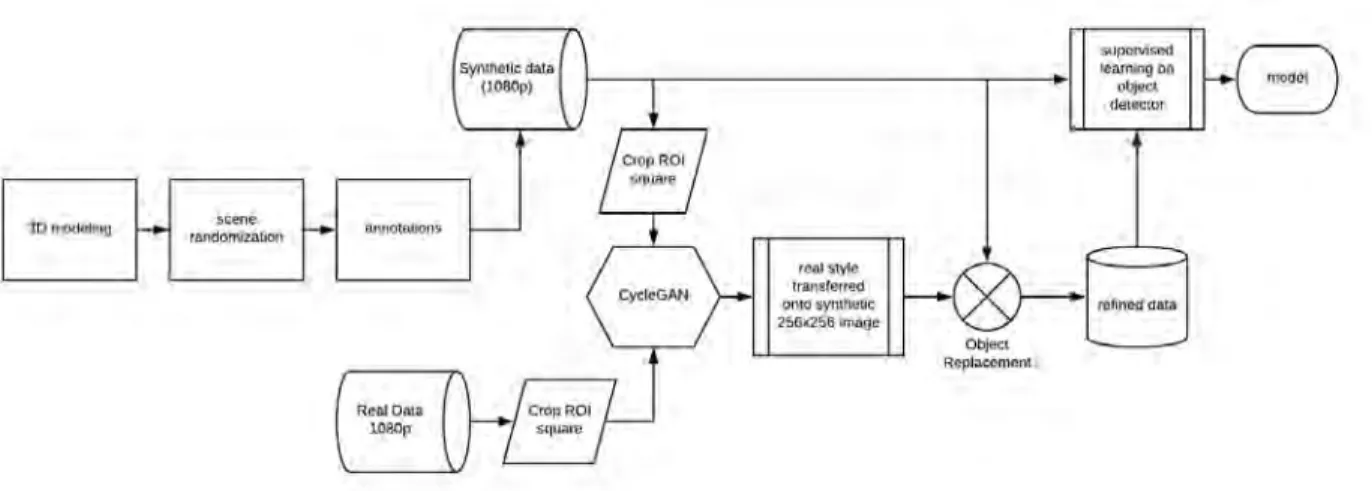
The need for vast amount of data in object detection applications can be satisfied by the proposed
dataset generation pipeline shown in Figure 1.1. This pipeline combines modern techniques of 3D modeling
This section will discuss the relevant background regarding the training of convolutional neural networks
(CNNs) in an object detection application via supervised learning methods with real and synthetic data.
The goal is to understand how it is possible to train CNNs with limited or no data real data by using
synthetic data. This project revolves around 5 main premises derived from the research questions mentioned
in Chapter 1:
1. High-quality labeled data for a specific application can be hard to get
2. Deep learning requires lots of data, convolutional neural networks require unique examples for pose
variations
3. Synthetic data can be used to supplement real data
4. GANs can refine synthetic data to match the test set to improve model performance
5. Object detectors used in an aerial photography application can be trained with synthetic data alone
2.1
The challenge of getting data
The particular use case and inspriation for this project was the application of aerial object detection from a
drone. During the inception of the project in fall 2017, a public dataset that was useful to classify common
vehicles from an aerial perspective did not exist. A search for datasets lead to the discovery of the Stanford
Drone Dataset [27]. The Stanford Drone dataset was of enormous volume clocking in at 69 GB of video, but
of little value due to its perspective which was of a locked 90◦downwards view angle, height that made people
appear as specs only a few pixels across, and high compression that did not extract discernable features from
the objects. This made it difficult to use SSD and YOLO object detection algorithms due to their poor
performance on small object as stated by Hui in his article describing SSD models [19].
Since then, datasets such as VisDrone, UAVDT have been published to the public as of April 2018 [35,
10]. These datasets are of higher quality and contain numerous examples. VisDrone has recently been turned
into a competition for object detection. This resource was not discovered until recently and after significant
effort was spent to circumvent the problem. This scenario is common for many machine learning researches.
Although the amount of high quality data available to the public data is growing, there will always be an
special niche application to which data is difficult to acquire. Models trained for this project were evaluated
using the VisDrone test set for a datapoint on how synthetic models stack up against other test sets.
If no suitable dataset is available online, one has to construct the dataset from scratch. For example
to gather a sufficient aerial dataset, it takes numerous hours of flight time across different times of day,
different weather, altitude, and camera angle to produce a comprehensive dataset. In addition to the long
hours of recording and acquiring raw data, the effort to slice the and annotate each individual frame can be
tremendous. Researchers and engineers in this situation could turn to image annotation companies such as
Crowdflower (Figure-Eight) and Scale. When queried, these companies required minimum orders of 10,000
to 100,000 images and were in the range of 12,000.00 - 60,000.00 US dollars. Cheaper alternatives such as
Mechanical Turk are enticing, but a lack of quality control, and the right for Amazon to re-use the labeled
data for their own purposes [3] makes a strong argument to find alternatives.
2.2
Object Detection using Convolutional Neural Networks
Object detection is the task of first localizing objects, identifying where the object is, then classifying that
object which is identifying what the object is, or what category it belongs to. Object detection methods
extract image features in order to make predictions. Popular classical methods use a feature extractor such
as histogram of oriented gradients (HOG) followed by a classification stage using support vector machines
(SVM). Deep learning models are different by the way the learn how to extract important image features on
their own [14]. For example, they first learn how to distinguish raw pixels into shapes, and edges, and curves
as well as color, texture, and lighting, then encode these features into layers that will determine which class
the input belongs to.
The convolutional neural network (CNN) is a deep neural network architecture which has outstanding
performance on image classification tasks. The hierarchical structure of the convolutional layers, which start
by low-level features in beginning layers which gets built upon to construct a high-level representation of the
image in deeper layers. Yann LeCun pioneered the first convolutional neural network trained using gradient
descent to recognize handwritten digits [22]. AlexNet changed the game for image recognition in the 2012
ImageNet Large Scale Visual Recognition Challenge with the use of a CNN for image classification, beating
out the runner up by 10.8 percentage points [21]. Since then, CNNs have become the standard approach to
image classification and localization.
Whether it is a single-shot approach like YOLO by Redmon and Farhadi [25], or two stage detection
like Faster R-CNN and RetinaNet by Girshick et al. [23], modern object detectors define regions of object
proposals in the scene, or a grid cell used in YOLO [26], then evaluates the extracted features to determine
the probability the region contains an object of interest. In either of these cases object detectors use CNNs
as feature extractor backbones. Transfer learning is commonly done to transfer pre-trained convolutional
weights from one model to another. Most object detectors start training using convolutional weights that
have been trained from the ImageNet dataset as stated By Redmon and Farhadi in YOLO9000 [9, 25]. This
saves training time and resources such that the convolutional layers do not have to learn how to extract
image features from scratch, but are retrained to be sensitive to the object of interest. This project will
compare the use of pretrained convolutional weights from ImageNet as well as starting from scratch and only
Disadvantages of convolutional neural networks
CNNs have trouble understanding pose and rotation, meaning that if object is rotated or moved, the network
will have difficulty recognizing it as the same object. CNNs have information flow from the input to the
top layer of the network leading to a class prediction. As the image data passes through the network layers,
unimportant information is discarded through max pooling layers, that only keep the highest activations.
This leads to translation invariance, meaning the exact position of the target object is not important.
However, CNNs do not have rotation, size, viewpoint, or illumination invariance visualized in figure 2.1.
This implies that a training example needs to be provided for each major modification of the objects pose
(orientation and position) in order for the CNN to recognize the object from different viewpoints and lighting
conditions.
Geoffrey Hinton, nicknamed the “godfather of deep learning”, is a large opponent of the pooling
opera-tion in convoluopera-tional neural networks due to translaopera-tional invariance and lack of pose informaopera-tion. Hinton
developed an architecture to replace the shortcomings of CNNs called Capsule Networks. The advantage
of the capsule network is to retain more information of 3D space inside the capsules leading to understand
objects from multiple view angles without additional training examples. Capsule networks, only understood
after the publication of the paper Dynamic Routing Between Capsules [29] in 2017, are still in the
experi-mental stage and have not met any widespread adoption for use in object detection. Until the pose-invariant
property of capsule networks can be exploited, large amounts of training examples will be needed to fill the
knowledge gap in convolutional neural networks.
2.3
Neural Network Training Techniques
Most object detectors are trained using supervised learning where each training example has a correct answer
or label. Although the supervised learning method is the most straight forward to implement, it is the most
expensive due to the dependence of labeled data which can be can be rare, time consuming and expensive
Figure 2.1: Image demonstrating different views of the same object [20]
There are other learning techniques that can supplement the lack of available labeled data.
Semi-supervised and unSemi-supervised learning makes use of unlabeled data which can be used to increase accuracy
in neural network models especially when real data is limited. These techniques however, are not applicable
for most classification and localization tasks, but more so used for object discovery as done in Croitoru,
Instead of using unlabeled data, there is the process of creating labeled data synthetically. Synthetic
data has the advantage of being able to produce an infinite number of training examples with numerous
variations and permutations. The use of 3D modeling software can create accurate representations of real
world objects, but can suffer from unrealistic textures and lighting, and can lack subtle low-level details such
as blur, reflection, and graininess that are present in an traditional photograph. This gap between real and
synthetic images can cause a network to not generalize well on real world data, or cause models to overfit to
’unrealistic’ details as claimed by Shrivastava et al. in their work refining synthetic data through adversarial
training [30].
2.4
Generative Adversarial Networks
Realistic features can be learned and applied to images by the means of generative models. Generative
Adversarial Networks (GANs) introduced by Goodfellow et al. in 2014 [15] is a powerful generative
mod-elling approach consisting of two neural networks competing against each other. GANs play a zero-sum
game, that is, one network benefits when the other network makes a mistake. This generative model can
generate convincing “fake” outputs starting from random noise, permuting the input vector until it becomes
indistinguishable from the “real” dataset it set to mimic.
The framework consists of two neural networks: a generator, which generates new samples that mimics
the real data, and a discriminator that gives a probability whether the data is real or fake. An analogy
Goodfellow [15] uses to describe this framework is a team of counterfeiter vs the police. The counterfeiters
(generator) produce realistic looking money to pass off as real, and the police (discriminator) try to identify
and reject the fake productions. The discriminator is typically employed as a standard convolutional neural
network in when used on image data. The generator is a “deconvolutional” network, which does transposed
convolutions that up-sample the input from a vector to a NxN image. The result of this novel network, if
trained correctly, is the ability to produce images or other sample data that are nearly indistinguishable to
data.
2.5
Training with synthetic data
The use of synthetic data has a longstanding history in computer vision. Peng and Gaidon [24, 11] make use
of virtual worlds and 3D generated models to supplement neural network training. Sixt, et al. describe the
need for a synthetic dataset due to a niche dataset of barcodes attached to honeybees in their RenderGAN
project [31]. Shrivastava, et al. describe a process to greatly improve a human gaze estimator with a synthetic
dataset made of computer generated eyeballs with added realism by the use of GANs in a refining process
[30]. One approach is the use of 3D CAD models; however, these alone can achieve sub-par performance due
to the lack of realism. Tremblay, et al. [33] argue that realism is not necessary and is intentionally avoided
in their technique of Domain Randomization, of which they trained a very accurate object detector using
the Unreal Engine with cartoonish and unrealistic textures.
Using Synthetic Data on CNNs
Gaidon, et al. experimented with virtual worlds [11] and produced evidence that there is a small gap from
the perspective of a computer vision algorithm between the virtual and real world, providing confidence
synthetic data training is feasible. Peng, et al. [24] discusses possibilities of training a deep object detector
with 3D CAD models for networks that were lacking sufficient data for novel classes. Their research shows
that 3D CAD models capture the shape of a target object but are lacking low level clues such as realistic
object texture and background. Although 3D CAD models lack realistic texture, they show that deep CNNs
are mainly invariant to these low level cues, and can be used to augment training of CNNs especially when
Is realism necessary?
Synthetic data does not have to be perfectly realistic. Tremblay, et al. claim that unrealistic or cartoonish
training data is an advantage since it can include variations that force the deep neural network to focus on
the important structure of the problem at hand rather than details that may or may not be present in real
images at test time [33]. Instead of focusing on realism, Tremblay, et al. uses the technique of “Domain
Randomization”, in which the parameters of the synthetic data, such as lighting, pose, and object textures,
are randomized in non-realistic ways to force the neural network to learn the essential features of the object
of interest.
Tremblay, et al. used Unreal Engine 4 to generate 100000 low fidelity renders rapidly with randomized
modifications of each example. Their technique highlighted the importance of the 4 major elements of domain
randomization being: lighting, texture, data augmentation, and “flying distractors” - abstract shapes to
mislead the object detectors. Each of these components were removed in an ablation study to determine
which parameter contributed the most to precision. Lighting was deemed most important when observing
that a fixed light source dropped the AP by 6.1 when compared to using randomized light sources. Their
major contribution came from demonstrating accurate object detectors can be trained using synthetic data
alone, achieving 46.3 AP using an single shot detector model, greatly exceeding the VKITTI dataset by 10.2
AP.
As humans, we identify objects based primarily on their shape, for example a car can be distinctly
recognized as a car from its wheels, doors and windows. The color of the paint, graphics or size of the
wheels on the car does not change its designation as a car. As discussed by Geirhos, et al. humans surveyed
accurately identified pictures of cats 75 and 87 percent of the time when shown only silhouettes and edges
respectively. In comparison, a state of the image classifier, GoogLeNet achieved 49% and 28% on the same
data set due to the bias of texture in most object detectors [13]. Geirhos demonstrated that object detection
performance and robustness towards a wide range of image distortions increased when it was biased towards
2.6
Refining synthetic data by domain or style transfer
Synthetic data can be augmented for realism to better match the test set. Generative adversarial networks
can create realistic images from random noise as image inputs. Using this fact, researchers Shrivastava and
Sixt, used 3D CAD models as input instead of random noise into a GAN that acts as a refiner network to
transfer the realistic properties of real data [30, 31]. Shrivastava, et al. note that this refining process can be
done in an unsupervised manner in their SimGAN process, due to the refiner networks job of only transferring
style features from real data onto the 3D models. The real data observed does not need to be labeled, only
inspected for visual features. Key contributions from their work include the use of a self-regularization
term that penalizes large changes between the synthetic and refined images, allowing the synthetic data to
retain their label. Their approach also achieves state of the art results on the MPIIGaze dataset with an
improvement of 21% without any labeled real data [30].
Neural Style Transfer using CNNs
One of the earliest papers surveyed on style transfer was the work of Gatys, Ecker, and Bethge [12]. Their
approach was to exploit the feature extraction qualities of specific layers that contribute content and style.
The deeper layers of CNNs extract higher level, more general features, where as the earlier layers extract
primitives such as shapes, edges, corners, and colors. Using the feature extractors of the middle layers, Gatys
et al. were able to transfer textures and color schemes, while using the deeper layers they can transfer overall
structure of the image.
Neural style transfer has been shown to transfer the style of famous artists to everyday images, creating
beautiful creations. However, for the use of synthetic dataset refining, this approach has limited value. Due
to the nature of the loss function and the extraction of arbitrary middle convolutional layers of the style
network, “realism” is difficult to pinpoint and transfer accurately onto the target image. A better technique
to transfer realism is by using GANs which the loss function is dependent on how well it matches the
instead of just style and content features computed in the loss function in order to make the image match
its target.
Using GANs to transfer realism
This paper makes use of the research done by Zhu, Park, Isola, and Efros in their paper “Unpaired
Image-to-Image Translation using Cycle-Consistent Adversarial Networks”, and their implementation known as
CycleGAN. The CycleGAN framework is an approach that is similar in practice to SimGAN, by which style
features are transferred but with retaining the original input image. CycleGAN uses unpaired images to
do cross-domain transfer. This can be used to transform images from one domain to another. For example
a outdoors scene in the summer can be transformed into winter, and vice versa. This application can be
used to transfer desired features such as photo-realism from a real dataset to a synthetic dataset. Instead of
starting from random noise, a synthetically generated training example along with its label can be enhanced
to contain features present in the domain of the source image, which was lacking in the original.
The CycleGAN architecture makes use of 4 networks, two generators G and F, and two discriminators
Dx and Dy. The objective function has a adversarial loss, the result of the discriminators and generators
competing, accompanied by a cycle consistency loss, which ensures the mapping from domain A to B is
reversible. The cycle is maintained by the two generators G and F that learn a mapping to transform the
image from B back to A. This cycle forces the model to be constrained, such that the output image closely
resembles the input image only with the domain specific features modified. The benefit of having paired
examples is that the generators learn which features are unique to the two domains, but CycleGAN learns
this relationship even with unpaired examples due to the cycle constraint.
A major advantage of using CycleGAN compared to other transformation implementations is the use of
unpaired examples. This allows the their open source implementation in Pytorch to be used “out of the
2.7
YOLO algorithm for object detection on aerial photography
The YOLOv3 [26] algorithm is one of the most popular object detection frameworks due to its speed and
accuracy. This algorithm was a breakthrough by viewing object detection as a regression problem instead
of a classification problem as stated by Dalal and Moh [8]. The YOLO object detection framework is not
only excellent in terms of speed and accuracy, it is also very easy to train and deploy. To demonstrate the
use of synthetic data, a task of detecting objects from aerial viewpoint was chosen.
YOLO divides the image into an SxS grid, with each grid having a vector of class probabilities and
bounding box offsets. YOLOv2 and YOLOv3 make use of anchor boxes to predict coordinates of bounding
boxes. Anchor boxes are expected shape of the boxes the objects will fit in. During the classification
step, offsets, how much the anchor boxes will shrink or expand, are predicted instead of predicting exact
coordinates. This simplifies the problem of localization and makes it easier for the network to learn as stated
by Redmon in YOLO9000 [25]. These will be important when constructing a model that can learn from the
training set and localize well on the test set.
AlexeyAB, the author of a very popular fork of the Darknet YOLO object detection framework, lists
that 2,000 images per class is a recommended minimum for sufficient detector performance [1]. This object
minimum is multiplied by various changes in object pose, orientation, and altitude. During the flight of the
drone, the objects of interests (cars in this experiment) change dramatically in appearance from a
straight-on, to a tilted, and from a direct overhead view. These major variations could be seen as separate classes
to an object detector since some of their distinct characteristics, such as wheels, disappear during variations
of camera position. This implies that 2,000 training examples are needed for each major change in altitude
rotation or view angle, which can quickly add up to tens of thousands of annotations, becoming a large
2.8
Summary and objective
Research surveyed contains conflicting statements whether realism contributes or hinders object detection
performance. Depending on the application, there might be a use-case where realism is necessary such as
human gaze estimation in Shrivastava’s work [30], or where realism is avoided in Domain Randomization
[33]. This paper will explore the use of both, and determine which model is suitable for the application of
aerial based object detection.
This paper aims to answer which technique is best to train object detectors without the use of any
human annotated data. This paper uses techniques described by the previous works, but with the following
differences: Randomly initialized weights with no-pretraining, an aerial dataset with a multitude of views
ranging with camera angles from 0 - 90◦, and objects from 0 - 360◦rotations and the use of GANs to transfer
The advantage of using synthetic data is that we can represent a real world object, with a replaceable and
highly mutable 3D counterpart. Our goal is to have synthetic training data close enough to the test set such
that the object detector could learn to recognize key features of our target class, Car, without ever seeing the
real thing. Since our goal is to detect from a drone’s perspective, we want the detector to perform robustly
from all possible viewpoints; meaning 0 - 360◦rotations of the vehicle, as well as 0 - 90◦variations of camera
tilt. The use of 3D modeling software with a Python API allowed the generation large amounts of labeled
data from these desired viewpoints on a variety of car models. Techniques and theory are discussed below.
3.1
3D Model Rendering
Creation of the synthetic data was done using Blender 3D software, a free and open-source 3D computer
graphics software tool set [5]. This application can be used to create detailed and realistic renders of a
variety of shapes and scenes with complex lighting effects. Rendered cars can look identical to their real
world counterparts, at the expense of long render times and a mastery of the full breadth of 3D modeling
techniques and options available. One of the goals of the project was to streamline the time it takes to setup
and start producing labeled synthetic data without requiring a mastery of digital arts or long render times.
The Python interface was used to script a sequence of renderings with variations in camera orientation,
environmental properties, lighting, and object texture. The API was also used to calculate the 2D bounding
box coordinates of the object of interest in relation to the camera’s perspective in the final rendered image.
The algorithm to compute the bounding box is described in algorithm 1.
Free to use car models with an open license were downloaded from a popular online 3D community
known as TurboSquid [32]. The site also contains many high-poly car models which look identical to their
real-world counterparts, but were for purchase only, and restrictively expensive. Over 50 different free car
models were inspected for accuracy to their real-world counterpart. After quality control, 12 car models
were chosen amongst 46 models. The models hosted were in various formats created from miscellaneous 3D
modelling software. These models were imported into a Blender readable format and cleaned up by applying
base texture, and grouping components, and removing extraneous polygon faces. The meshes were then
joined into a single object in order for the bounding box to encompass the entire car. The car models used
were: a Mercedes Benz 190 SL, Audi A5, Audi R8, Bugatti Veyron, 1970 Chevy Camaro, Dodge Challenger
SRT-10, Mitsubishi Lancer Evolution X, VW GTI MK5, Lamborghini Aventador, VAZ-2106 Zhiguli, and a
Geo Metro.
After obtaining the minimum level of skill to use Blender adequately, the synthetic dataset factory was
operational. The first datasets were created as experiments to test the bounding box calculations and camera
scripting procedures. Animations were used in order make a sequence of movements, and with each frame,
the bounding box was recorded. YOLO training was attempted after a few hundred samples were created,
with obviously dismal results. However, the proof of concept was ready, and could begin to build gigantic
datasets.
3.2
Spins dataset – camera orbits with all encompassing views
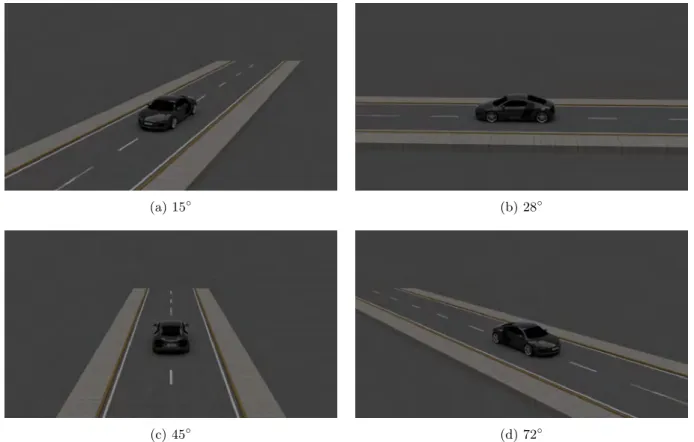
The “Spins” dataset achieved the goal of having an orbiting camera from 0 - 360◦ and 0 - 90◦tilt increments.
The camera was constrained to track the cars position and no regardless of camera position or height, the
car would be in the center of the frame. Orbits were done in increments of 4◦ resulting in 90 images per
orbit, and 0 - 90◦ in increments of 1◦ for a total of 8,100 images per sequence. This dataset achieved the
goal of being able to have labeled data for “every possible view angle” of the car (at a fixed altitude). The
shows images of the dataset at four different angles. This dataset was expected to be an solid baseline for
a car object detector, but as shown in Chapter 5 the result of training on this dataset alone proved to be
inadequate.
(a) 15◦ (b) 28◦
(c) 45◦ (d) 72◦
Figure 3.1: Audi Spin Dataset – 3D rendering of an Audi R8 at different angles of rotation
3.3
Improvements in 3D modeling
After the Spins dataset alone failed to train an object detector, a number of improvements were made leading
to the creation of the “2.0” dataset. The first improvement the 2.0 dataset had over the Spins dataset was
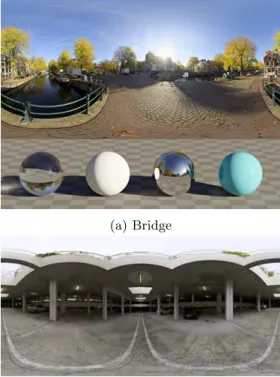
the use of environment backgrounds. An assortment of 24 distinct HDRI (High Dynamic Range Imaging)
images were chosen as the background environment of the scene. Spherical HDRI environments appear
square in aspect ratio, but can be wrapped in a 3D world such that when rendering from any camera angle,
HDRI images such as car garages, parking lots, grass fields, and forest roads were used to generate
realistic environments for the 3D car models to live in. Examples of a HDRI images are given in Fig. 3.2.
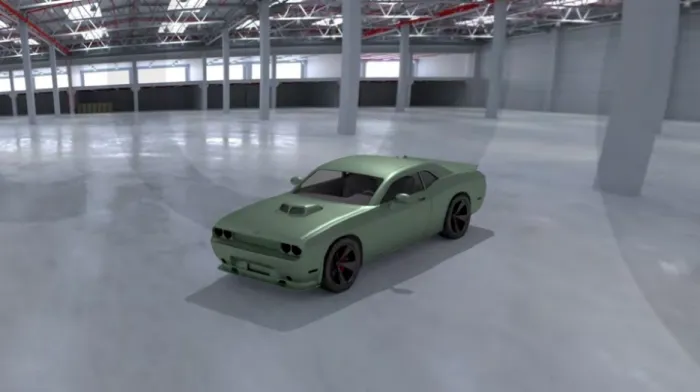
The use of HDRI images gave the benefit of not needing to model the entire environment with object shapes,
but instead apply a single image texture. An example of an empty garage with shadow catching is shown in
Fig. 3.3.
(a) Bridge
(b) Garage – note the presence of cars, making this scene unusable since they are unable to be labeled, causing the detector to learn them as true negatives
Figure 3.2: HDRI images
Random Lighting
Tremblay, et al. showed the importance of randomized lighting from multiple sources in their Domain
Randomization paper, [33], by noting an increase in 6.3 AP compared to fixed lighting. This project followed
that advice and used randomized lighting of point sources that cast shadows and reflections across the 3D
Figure 3.3: Dodge Challenger in an empty HDRI garage with shadows casted
distance and was evenly distributed across the objects. The 2.0 datasets used multiple small lamp sources
that had a clear direction, with individual intensities that could cast a distinct shadow and highlight different
regions of the vehicle. Although the impact of randomized lighting was not entirely clear due to the multiple
changes the 2.0 dataset had over the Spins dataset, it was a visual and subjective improvement. During
experimentation and reproducton of the SimGAN project [30], the appearance and reflection of light in the
eyes of the refined images was the most noticeable effects the GAN produced from synthetic images.
Random X-Y positioning, and random rotations of car objects
The Spins dataset was all encompassing of every possible view angle by the use of an orbiting camera locked
to the car. This required the use of animation procedures which are more difficult to script. The 2.0 dataset
rotated the object of interest itself instead of the car. This achieved the same effect of orbiting the camera,
but had the advantage of no animation sequence and allowed the object to move laterally in the X-Y plane.
car to be in front various environmental objects or behind other cars.
Along with random positioning, the 2.0 dataset included multiple cars in one frame. Depending on how
many cars were in the scene, the cars translation were fixed into regions such that the meshes would not
intersect, but still come close enough such that one car would occlude the other. Occlusion is important for
the detector to learn since it is very common in the test set, where cars are densely packed when parked in
parking spaces.
Rotations were done by placing an invisible “empty axis” as the camera’s focal point, and the car object
would randomly move in the 2D plane of X and Y, but not protruding 50% of its area out of the frame. The
camera tracked the center of the frame, and as the camera rose in height, its tilt automatically adjusted to
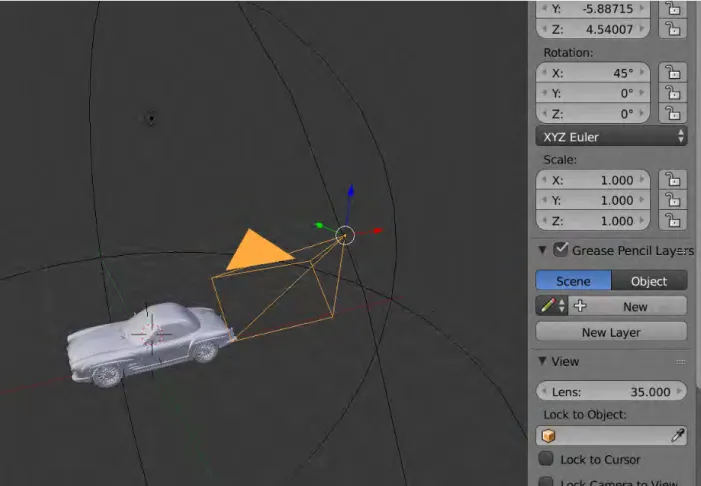
keep focus on the ground at all times. A simple slope intercept equation was created such that Y and Z
increased at the same rate, which allowed the object of interest to be in focus and at a fixed distance as the
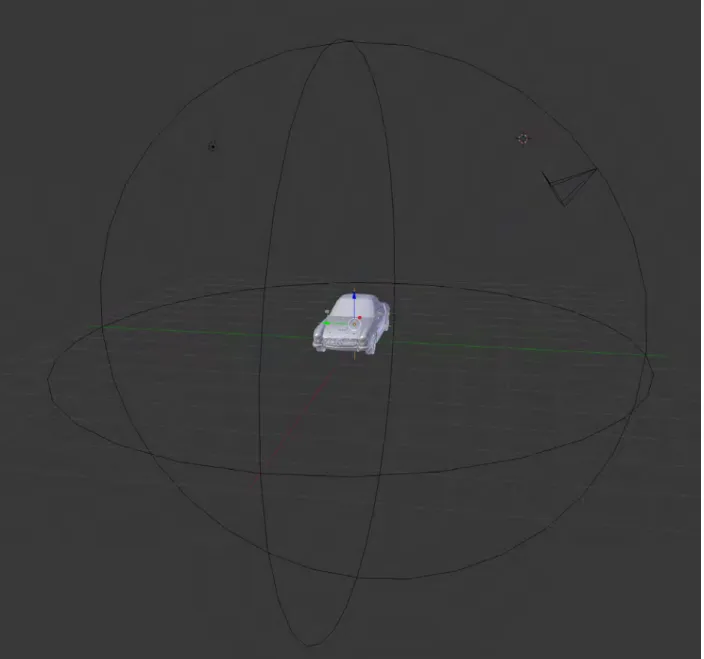
camera moved (listing 3.1). The camera moved in a circular fashion such that the total distance to the car
was fixed as visualized in figure 3.5. After observing training with this camera setup, it clearly explained
why cars significantly further away in the distance had trouble being detected as discussed in results section
of Chapter 6. Also, a undiscovered pitfall at the time, the lack of camera roll on the X axis led to difficulties
during inference which is also discussed in Chapter 5.2.
Listing 3.1: Tracking equation used to keep the camera focused on a point of interest as the camera moves
def c o m p u t e c a m e q u a t i o n ( s t a r t , end , m a x s t e p s ) : s l o p e = ( end − s t a r t ) / m a x s t e p s def f ( x ) : return s l o p e ∗ x + s t a r t return f def i t e r a t e c a m e r a ( ) : f z = c o m p u t e c a m e q u a t i o n ( 2 , 9 0 , 9 0 ) f y = c o m p u t e c a m e q u a t i o n (−70 , 0 , 9 0 ) n u m s t e p s = 90
f o r c a m s t e p in range( 0 , n u m s t e p s ) :
cam ob . l o c a t i o n . z = f z ( c a m s t e p )
cam ob . l o c a t i o n . y = f y ( c a m s t e p )
Figure 3.4: Screenshot of Blender software demonstrating the X, Y, Z vector of the camera
3.4
Texturing Cars
Texturing of the cars was originally designed to be as realistic as possible. Metallic paint was applied to the
body, with transparent glass for the windshield and tail lights, as well as chrome for the fender and grill for
each of the car models. The base color of the cars were varied with randomized RGB values and intensities,
but was kept to a reasonable range to appear realistic.
Figure 3.5: Screenshot of Blender software visualizing the paths the camera was allowed to take by the spherical black lines. Notice the radius of the sphere is fixed, this results in the object appearing the same size at all times
detectors can perform better when texture is “unrealistic” and the neural net relies on object shape as its
primary classification means [33]. As humans, we identify objects based primarily on their shape, for example
a car can be easily recognized as a car by its 4 wheels, doors, and windows. The color of the paint or graphics
object detection performance and robustness towards a wide range of image distortions increased when it
was biased towards shape-based representations [13].
Following this theory, the 2.0 Dataset applied the following material textures to the body of the car
objects, adopting a mix of realism along with a variety of colors and odd textures for the body paint:
• Glossy (reflective) paint with randomized RGB values
• Diffuse (matte) paint with randomized RGB
• Magic texture (“psychedelic” wave patterns)
• Image textures (common real-world textures) – from the describable textures dataset [6]
Examples of each can be seen in Figure. 3.6.
(a) Glossy BSDF (b) Diffuse BSDF
(c) Image Texture (d) Magic Texture
3.5
Performance increases for massive dataset generation
Blender is a high performance 3D modeling software able to produce realistic renders. However, because
it was designed for high amounts of sophistication, the render times can be significantly long. In order to
speed up render times below 5 seconds the following tweaks were done:
• Use the Cycles render engine with GPU rendering
• Render using a Hilbert Spiral with tile size of 256x256 pixels
• Restrict number of light bounces
• Turn on multiple importance for light sources
• Reduce number of samples but turn on de-noising to reduce graininess and “fireflies” effects
The most significant render time improvements are from using the GPU and the render tile size of
256x256. Blender’s Cycle engine uses light sources, and light bounces to calculate how the scene will look.
This can have a tremendous effect visually, but also these computations can be expensive. Reducing the
amount of light bounces can decrease render times, but glass and other light sensitive materials can become
opaque and rough and unable to transmit or reflect light accurately which ruins realism. It is recommended
to keep minimum of four light bounces for balance of realism and performance.
3.6
Surreal Dog Dataset – True Negative Examples
Training the object detector with synthetic data had a side effect of a large amount of false positives.
Training using transfer learning from pre-trained weights reduces false positives, but were still present in all
test examples. The neural networks trained with synthetic data are very sensitive to any kind of shape that
seemed to protrude from the background. This is theorized due to the contrast of a vehicle on a somewhat
neutral background. CNNs feature extractors are trained to be sensitives to edges, and because of the neutral
different from the background. Even oddly shaped objects such as picket fences or bushes were commonly
detected as Cars, the only class to be detected. In order to reduce the high amount of false positives, a new
dataset was generated to produce a large amount of abstract and generic shapes that had no label associated
with them. This allowed these abstract shapes and textures to be unlearned during training.
Taken in inspiration from NVIDIA’s Domain Randomization paper, [33], they used “flying distractors”,
abstract shapes that randomly appeared in the scene to cover up portions of the cars, which improved their
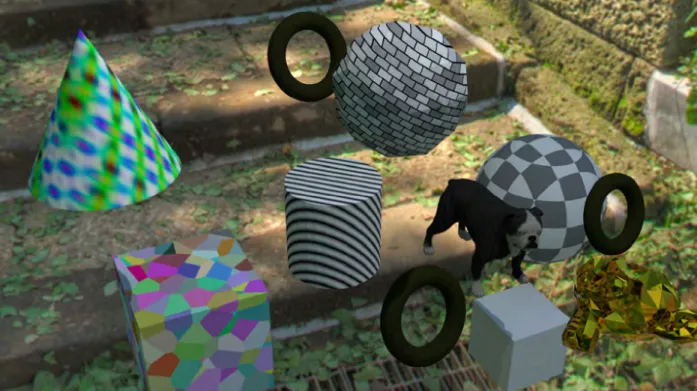
AP by 1.1%. The true negatives dataset used in this paper, nicknamed Surreal Dog, included over 15,000
images containing a variety of randomly oriented shapes across 24 HDRI environments. Objects included
were: cones, spheres, cubes, 2D planes, cylinders, toroids, and a British Bulldog. Each object was given
one of the 4 types object textures shown in 3.6 that were the same as those applied to cars. Toroids were
specifically designed to have a dark grey to black matte texture, and a circumference and thickness to
resemble a car tire. This was to suppress “circle detector” behavior commonly discovered during evaluation
of test sets that contained rooftop buildings with air ventilation units, manholes, and other circular objects
that are falsely identified as cars. This behavior can be explained by the wheel is a key identifying features
of the car, and has a large activation weight when they are present. Impact of the Surreal Dog dataset is
discussed in detail in Chapter 6. Visualization of the Surreal Dog dataset can be seen in Fig. 3.7.
3.7
Generation of bounding boxes, labels, and metadata
Computing the bounding box of the object was crucial in order to make useful labeled data. The use of
Blender 3D modeling software Python API allows the extraction of any kind of information desired about
the scene or object in focus. The minimum goal is to achieve the 2D bounding box of the object, but having
control of the entire domain allows us to extract metadata such as current camera tilt, object rotation, and
camera distance. This metadata can be used in multi-modal applications where auxiliary numerical data is
fed in along with image data in order to maximize detection accuracy. This project did not have the correct
Figure 3.7: The surreal dog dataset had two primary achievements: Being extremely amusing, and reducing the amount of false positives by dulling activations
7. The algorithm to calculate the 2D bounding box encompassing the mesh object is shown in Algorithm 1.
For each car in each frame, the bounding boxes were computed, and written to a text file associated
with the image render. Coordinates were converted into “YOLO” format which are relative with respect to
the image size. Each text file contains one row per bounding box annotation, in the form <class-number x-center y-center box-width box-height>. For this project, all of the objects generated were cars, with a class label of “1”.
Result: 4 X,Y coordinates that encompass the object inspected normalized from 0 to 1 initialization: join separate components (door, windows, tires) into a single mesh
Input: scene, camera object, mesh object, image resolution
begin
compute camera perspective in relation to scene and camera orientation.
compute matrix of mesh coordinates projected into 2D plane as rendered by the camera. initialize two empty arrays lx, and ly
lx = [ ] ly = [ ]
foreachv in mesh vertices do
extract the X, Y position of each vertex lx.append(X) ly.append(Y) end min x = Min(lx, 0.0) min y = Min(ly, 0.0) max x = Max(lx, 1.0) max y = Max(ly, 1.0)
pixel min x = img width * min x pixel min y = img height * min y pixel max x = img width * max x pixel max y = img height * max y
end
Output: bounding box: pixel min x, pixel min y, pixel max x, pixel max y
In review, Generative Adversarial Networks (GANs) use a generator network to produce samples from
random noise that are indistinguishable from a target distribution to a discriminator network. GANs can
also be fed labeled data instead of random noise such that the GAN will learn how to morph the image
to match the desired domain while keeping the general content of the image. GANs are notoriously hard
to train, so this project will use a GAN framework that have the most stability in terms of training and
inference. CycleGAN was chosen for this exact reason, since it allows the ability to retain the original image’s
content, while only transferring domain specific features, such as the stripes of a zebra onto a horse, using
unpaired training examples.
Previous works, such as the SimGAN project [30] have made use of refiner networks that take in a labeled
synthetic input image and is modified only to transfer desired features such as photo-realism. This has the
benefit of preserving the original input image’s characteristics, such as bounding box coordinates and label.
This project is similar in the work of SimGAN but replacing the refiner network with CycleGAN and will
be focusing on object detection with localization in addition to classification.
4.1
Pre-processing of the synthetic data
The synthetic and real car datasets were processed such that the cars were cropped by their bounding box
coordinates with a padding of 5 pixels. The purpose was twofold, to reduce the size of the input image from
1920x1080 to around 256x256 as done in the CycleGAN paper, and to allow the GAN to only focus on the
details of the cars instead of the environment. This reduces the networks receptive field to relevant regions
instead of processing the whole image.
Cropping the car to fit exactly the bounding box resulted in a paired car to car translation but at the cost
of not maintaining aspect ratio consistency between image shapes. CycleGAN upsampling transformation
outputs a square region of 256x256. however even with oddly shaped crops, the pre-processing stage of does
a resize to 286x286 and a crop to 256x256 before training. An additional experiment to crop the synthetic
objects with square shapes in order to prevent any image distortion was done, but was of similar quality.
During inference on square images, the output was not distorted, and the GAN still learned domain specific
features.
An experiment was done by feeding in the entire scene, but with downscaling instead of cropping. An
experiment with CycleGAN nicknamed spins-2-spins, tried to align a 360 degree dataset of 2299 cars in a
automotive trade show with bright lights, numerous reflections, and other difficult features to model to the
synthetic “Spins” dataset. This led to poor results, since the GAN was trying to understand a complicated
real-world translated into a very bleak synthetic world.
The real aerial cars dataset used for this project contained 2,164 frames, with a total of 29,257 annotations
and bounding boxes around cars. As noted by the large count from a small amount of frames, the cars were
densely packed in the frame allowing overlap and obfuscation. The entire synthetic dataset of over 85,000
frames containing cars were cropped to a total of 111,058 car images. Additional details of these datasets
are described in appendix A.
The first experiment of using CycleGAN used the entire synthetic dataset containing all of the textures
described and shown in Figure 3.6. These unique textures were attempted to be mapped onto the real
images. This resulted in interesting looking transformations from B to A as seen in Figure 4.1.
4.2
CycleGAN Training
The CycleGAN environment was setup for the domain A to contain synthetic images, and with domain B
Figure 4.1: Image texture mapped into the real domain
it did not matter whether the real cars were sorted in A or B. A forward pass on the network done done
from A (synthetic) to B (real). Domain B contained the “real world” images, consisting of drone datasets
gathered from the DJI Phantom 3 in various locations. The majority of which was taken from the rooftop
parking garage, which was captured at 6 PM, casting shadows and distinct lighting over the cars, which were
noticeably present after CycleGAN transferred features from the real domain onto the synthetic image.
Training was done on a pair of NVIDIA RTX 2070 GPUs with 8 GB RAM each. The batch size was
increased to 4 from 1 to stabilize training loss as demonstrated by the CycleGAN github page, and as
stated in Smith, et al. paper “Don’t decay the learning rate, increase the batch size” [34]. Another benefit of
increasing the batch size was to fully utilize all available memory of the GPUs. Zhu, the author of CycleGAN,
recommended the training to be done with a single GPU with a batch size of 1 for best results. However,
Zhu also used 200 epochs to train the example models such as horse to zebra, and winter to summer, which
had a dataset sizes of around 2,000 images with approximately 1,000 images in each domain. This project
used many more samples in order to best align the pose of each car to one in the real domain, and was
An additional experiment was done on a smaller sample size of 2,000 in each domain using a single NVIDIA
GTX 1080 with a batch size of 1 to replicate the CycleGAN paper, however image quality was severely
degraded with no realistic looking features. It is suspected the low number of examples and viewpoints did
not allow the pairing of domain A and B; thus not allowing the generator network to learn how the two
domains can be mapped to each other.
The GAN models were saved every five epochs, and evaluated periodically by visually inspecting the
produced faked images. In CycleGAN, like most other GAN frameworks, the loss functions are not always
correlated to image quality, thus random sampling and observations must be done instead. The images were
very fascinating to look at. The GAN learned extremely realistic features such as: capturing shadows, a
non-uniform lighting with sunlight bright spots being reflected in the paint, refraction of sunlight through
glass, revealing a previously non-existent interior, and amusingly the inclusion of parking lot space markings
on the ground. CycleGAN learns very low-level cues such as blurring and compression of digital images, as
well as field of view and low resolution of an object that appears far away.
Figure 4.3: GAN refinement and image substitution process.
4.3
Making use of the CycleGAN model to refine synthetic data
After the generative models were of satisfactory performance, it was time to refine massive amounts of
synthetic data to be used in object detector training. The original idea was to refine the entire scene, such
that the original labels did not need to be modified. However, noted in earlier chapters, it was not possible
to refine the entire scene at once. For the training to work, the images had to be cropped to 256x256 or
smaller images to reduce the receptive field of the GAN network.
After the cropped regions of interest were fed through the refining network, it was then stitched back
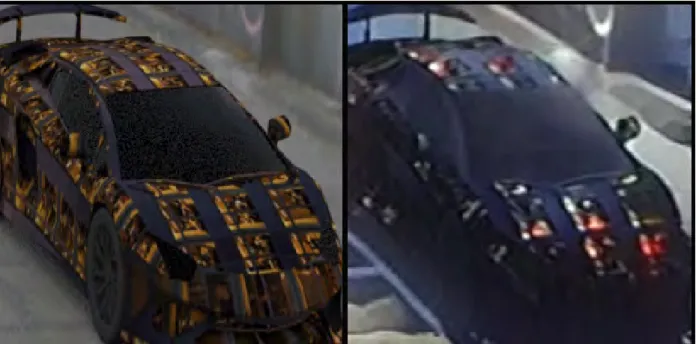
into the original frame as shown in Figure 4.3. This resulted in having a square boundary of a GAN-refined
background mixed into a synthetic background. Although the image portion was cropped seamlessly, due to
the color changes, the substitution transition is noticeable as shown in Figures 4.4 and 4.5. This substitution
can possibly be improved and is expected that it increased the detectors sensitivity to background and
foreground objects. The result of this method are discussed in chapter 6 and further work is discussed in
section 7. This technique however is better than the alternative of feeding the entire image through the
Figure 4.4: result of the substitution process which leaves a square boundary, but with a realistic looking car
Training was done in incremental stages as more and more data was synthetically produced and refined.
The beginning stages started by training on a few hundred samples, and tweaking the synthetic data as
trends emerged. Eventually 101,671 synthetic images were created, consisting of 85,952 positive examples,
and 15,719 true negative examples. Image augmentations doubled the dataset size to over 200k images.
5.1
Architecture and training strategy
All of the object detection experiments used YOLOv3, but with variations in the network architecture. A
“deep” model was trained using the Darknet-53 backbone as a feature extractor. This feature extractor uses
3x3 and 1x1 convolutional layers with skip connections which allows very deep networks to converge easier as
discovered by Kaiming He et al. in the Residual Networks architecture [17]. The deep architecture had more
difficulty converging on the synthetic dataset with or without pretraining, and produced a large amount of
false positives even when pretrained convolutional weights were used. It is expected that the deeper network
would need many more training iterations and a much larger number of synthetic data training samples due
to the complexity of the model. The YOLOv3 deep architecture was overkill due to the single class Car to be
detected. It is suspected that the very deep model was overfitting the training set, as stated in Goodfellow’s
Deep Learning Book, models with high capacity can simply memorize the training set [14]. Results will be
discussed in chapter 6.
A shallow network known as “Tiny YOLO” was used in replacement of deep YOLO. This model uses
15 convolutional layers with route connections which concatenate the output of two or more layers together.
This model differs from the deep network with the addition of maxpooling layers as well as fewer convolutional
layers and no skip connections.
Tiny YOLO hyper-parameters for Blendernet 2.0
• Width: 960 • Height: 544
• Max batches: 50000 • Learning rate: 0.001
• Steps 40000, 45000 (each step decreases the learning rate by a factor of 10) • Anchors = 30,32, 65,36, 90,45, 72,88, 119,60, 166,104
5.2
Training from scratch
To determine if the synthetic dataset was sufficient enough to completely replace real image data a model was
trained using randomly initialized weights instead of transfer learning. The pretrained weights of Darknet
YOLO was trained on the ImageNet [28] dataset comprised of 1000 different classes, including trucks and cars.
Using the pretrained weights would be giving a head start to the feature extraction of cars, which would make
it unclear how much the synthetic data contributed to the classification accuracy. If the detector only trained
with synthetic data was able to identify cars in a real world test set, this would indicate the synthetic data is
either realistic enough, or gave enough high level features for the detector learn how to localize and identify
vehicles. Also as pointed out by He, Girshick, and Doll in their “Rethinking ImageNet Pre-Training” paper
[16], transfer learning is not necessary as long as a sufficient amount of training iterations are performed.
Using the tiny YOLO model architecture, training was done on the Spins dataset with no pretraining.
However, due to the lack of variation between each training example of the spins dataset, it did not allow
the object detector to generalize. The lack of a complex background, a grey void, did not let the detector to
of car types (mostly all sports cars), did not allow the detector to translate any knowledge to the real world.
Training loss rapidly decreased below the single digit range, approximately 0.05, after only a few hundred
iterations. However, when running on the test set, it achieved an AP of 0, unable to localize any reals car
and with random false positives everywhere.
A second attempt at training was using the 2.0 dataset in addition to the Spins dataset comprising of
approximately 80K images. The same Tiny YOLO network architecture was trained for 96,000 iterations to
which the net started showing signs of knowledge of car object features. However the false positive rate was
very high, lowering the average precision. When the 15,000 images of the “Surreal Dog” dataset was added,
the false positive rate dropped to zero with the side effect of the recall rate dropping significantly as well.
The Surreal Dog dataset accomplished the task of reducing false positives, but on closer inspection, the
HDRI background used for a portion of the frames contained real images of cars. Since the dataset had no
labels, everything contained inside the frame was considered “not a car”, penalizing the the network when
it sees any cars. This erroneous section of the dataset was removed, and training was continued again from
96,000 to 115,000 iterations. The detector was at its best performance qualitatively when run on a video
provided from the test set. It achieved 0.65 AP and 0.74 F1 after being evaluated on the ground truth aerial
dataset “newark gt”.
Training with image augmentations for further AP gains
During visual inspection of the test set, it was observed that rotations of the frame completely fooled the
object detector as shown in Figure 6.3. It came as a surprise since it was assumed the synthetic dataset had
all possible rotations of the car itself, however it did not take into account camera rotations on the X axis.
The object itself was allowed to rotate freely in the X-Y plane, but the camera was fixed and could not roll.
It was apparent that a drone’s gimbal can move unexpectedly mid flight, and was not accounted for during
synthetic dataset generation. However, instead of re-rendering thousands of images with camera rolls, a
standard image augmentation library named imgaug [2], written in Python, was able to perform dozens of
Image Augmentations
• Contrast variation
• Frame rotation from -25 - 25◦
• Blurring
• Pixel dropout
• Salt and pepper noise
Image augmentation allowed the synthetic dataset to be rotated and modified much faster than
re-rendering the entire dataset with variations in camera roll. Image augmentation increased precision and
recall by a large margin. As shown visually in Fig. 6.3, the detector went from detecting all of the cars
in the frame when faced head on, but loses all of the cars when the camera was rolled by approximately
15◦. After image augmentation was applied to all of the frames, including rotations of -25 to 25◦, the object
The results below show that is it possible to train YOLOv3 with synthetic data only, or using transfer
learning with pre-trained weights. A total of 5 Datasets were used to evaluate performance. Rooftop - which
contained 3 distinct view angles, Newark gt, which was a simple drone flight around an industrial office
facility, and VisDrone, a new public dataset and competition from drone based object detection. These
datasets are described in detail in the appendix section A.
Table 6.1: Results on the benchmark datasets dataset for the Tiny YOLO models
model name AP F1-score architecture training set test set
ng-tiny-real 0.91296 0.936269 tiny yolo v3 real aerial only newark gt pt-blendernet-3-tiny 0.737134 0.788764 tiny yolo v3 synthetic with pretraining newark gt nosurreal-blendernet 0.764551 0.606936 tiny yolo v3 synthetic without true negative suppression newark gt GAN-refined 0.757427 0.591793 tiny yolo v3 GAN-refined synthetic data newark gt ng-tiny-real 0.306202 0.425792 tiny yolo v3 real aerial only VisDrone pt-blendernet-3-tiny 0.201432 0.341029 tiny yolo v3 synthetic with pretraining VisDrone pure-synthetic 0.163719 0.290751 tiny yolo v3 synthetic with no pretraining VisDrone GAN-refined 0.216196 0.360963 tiny yolo v3 GAN-refined synthetic data VisDrone
6.1
Test criteria to evaluate object detector performance
The test set known as Newark Ground Truth, newark gt was used as a baseline for object detection on
common cars. This basic dataset was used as a typical application use case, which contained a small amount
of cars alongside circular and boxy looking objects that could possibly trigger false positives from the detector.
As shown in table 6.1, the real model performed very well on the newark gt dataset, achieving an AP of
0.91 and an F1 score of 0.94. All of the synthetic models achieved similar performance, the best of which
was trained with synthetic data with image augmentations, along with transfer learning. The GAN-refined
network was very sensitives to localizing objects but came with a large amount of false positives which
![Figure 2.1: Image demonstrating different views of the same object [20]](https://thumb-us.123doks.com/thumbv2/123dok_us/9709421.2852469/19.918.210.699.145.830/figure-image-demonstrating-different-views-object.webp)