pasture Development/
Seeding Rates
Spring Pasture Development
Spring pasture normally will consist of exotic (tame) cool-season grasses that reach grazing readiness by early to mid-May . See the “Pasture and Hayland Plant Selection” section on those species that can be grown on the soil type in your area . Recommended cool-season grasses include: crested wheatgrass (early May), intermediate or pubescent wheatgrass (mid-May), and meadow bromegrass (early to mid-May) . Legumes (alfalfa, clover) may be added for potential improvement of diet quality, soil fertility and overall long-term
productivity of the stand .
Summer Pasture Development
Summer pasture is intended for summer use (June to September) and consists of native warm-season grasses, but mixtures of native warm and cool-season grasses sometimes are used . Grazing readiness for warm-season grasses usually occurs during the second to third week of June . See the “Pasture and Hayland Plant Selection” section on those species that can be grown on the soil type in your area . Recommended warm-season grasses include: big bluestem (can be seeded alone or with a mixture of other warm-season grasses), side-oats grama (recommended as a part of a warm-season grass mixture) and switchgrass (recommended to be seeded alone) .
When developing a pasture, one first must decide on the intended season of
use for the pasture (spring grazing, summer grazing, full-season grazing) and
soil types . Once you have fully recognized your objectives for the land being
developed and classified the soil type, see the section “Pasture and Hayland
Plant Selection” for recommended alternatives for plant species to seed . The
following guidelines are suggested for spring pasture, summer pasture, fall
pasture and full-grazing season pasture .
Fall Pasture Development
Fall pasture normally will consist of exotic (tame) cool-season grasses for fall use (October to December) . See the “Pasture and Hayland Plant Selection” section on those species that can be grown on the soil type in your area . Recommended cool-season grasses include: altai wildrye (seeded alone, October to mid-November) and Russian wildryre (seeded alone, October to December) . Note: Altai wildrye is usually 50 to 100 percent more productive than Russian wildrye; however, Russian wildrye has a 2 to 3 percent higher crude protein content than altai wildrye in November and December . Neither grass will support sufficient nutritional quality for a lactating cow after mid-October . For fall-calving herds, consider utilizing cover crop mixtures for improved forage quality and production .
Full-grazing Season Pasture Development
The first decision a rancher must make is whether to plant a native or exotic (tame) grass/legume mixture . We recommend you do not mix native and exotic grasses due to palatability (taste) differences, the highly competitive nature of exotic grasses and the difficulty of properly managing these native/exotic mixtures .Full-grazing season pastures normally will consist of: 1) a native cool- and warm-season grass mixture or 2) an exotic cool-season grass/legume mixture using a proper rotational grazing system (June to October) . Grazing readiness for cool- and warm-season grass mixtures
usually occurs in late May to early June . See the “Pasture and Hayland Plant Selection” section on those species that can be grown on the soil type in your area . Recommended cool- and warm-season grass options for a full-season seed mixture include a combination of the following: big bluestem, side-oats grama, blue grama, prairie sandreed and switchgrass for warm-season grasses; and western wheatgrass and green needlegrass as cool-season grasses . The rancher should try to achieve a balanced mixture of warm- and cool-season grasses to maintain the full season of grazing . Legumes that could be added to the mixture include: purple and white prairie clover, cicer milkvetch (light rate) and Canada milkvetch .
Recommended cool-season exotic grasses and legume options for a full-season seed mixture include the following: meadow bromegrass and alfalfa, and intermediate/pubescent wheatgrass and alfalfa . Note: Bloat (a deadly condition associated with ruminant animals) must be addressed before grazing pasture with more than 30 percent alfalfa . Ranchers must learn how and when to graze alfalfa, particularly with animals unaccustomed to grazing it . Once ranchers gain experience in managing grazing animals on alfalfa safely, the risk of bloat is reduced and they can achieve potential returns from higher livestock performance .
n
Guidelines for Seeding
Seedbed preparation
The seedbed must be essentially free of competing vegetation, firm enough to permit seed placement at the desired depth (¼ to ¾ inch) and protected against erosion. A firm seedbed hardly should reveal adult footprints. Seeding may be done into standing stubble from the previous crop, provided that weeds and volunteers of the previous crop are controlled properly, and an appropriate seeding drill is used to penetrate the crop residue properly and place the seed at the proper depth while achieving good seed-soil contact. If seeding into crop residue, be sure to consider herbicide carryover effects.
Seeding equipment
A drill designed to seed grass is highly recommended . These drills have agitators and feeder mechanisms to provide a uniform flow of seed at the desired rate . They are equipped with double disc furrow openers with depth bands or other depth-control devices .
Grain drills may be used to seed most of the tame grass species, legumes and some native grasses . Having a properly prepared, firmly packed seedbed is critical to achieving successful stands when using a grain drill .
Seeding dates
Southern third of Northern two-thirds North Dakota of North Dakota Southern two-thirds Northern third of Minnesota of Minnesota
Cool-season grasses
Spring Before May 10 Before May 20
Late summer Aug . 10 to Sept . 15 Aug . 10 to Sept . 1 Late fall (dormant)1 After Nov . 1 After Oct . 20
Warm-season grasses
Spring May 10 to June 25 May 10 to June 25
Legumes
Spring Before May 10 Before May 20
Late summer Aug . 10 to Aug . 25 Aug . 10 to Aug . 25 Late fall (dormant)1 After Nov . 1 After Oct . 20
TIp:
Legumes seeded during the late fall(dormant) seeding period may be subject to injury if early germination occurs followed by a late spring freeze, reducing stand establishment.
TIp:
If cool- and warm-season grasses are mixed, use the recommended seeding dates that correspond to the dominant grass type.Seeding rates
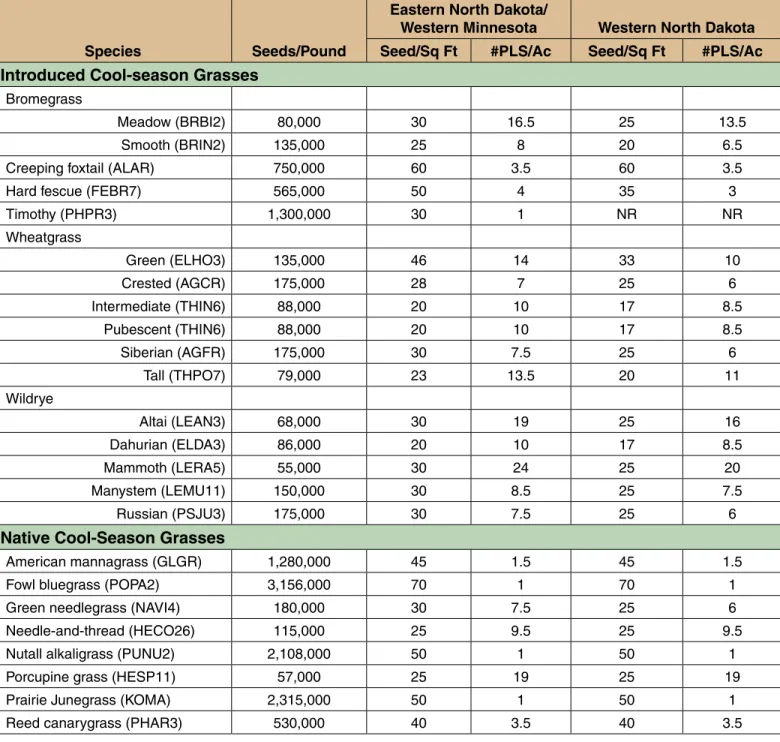
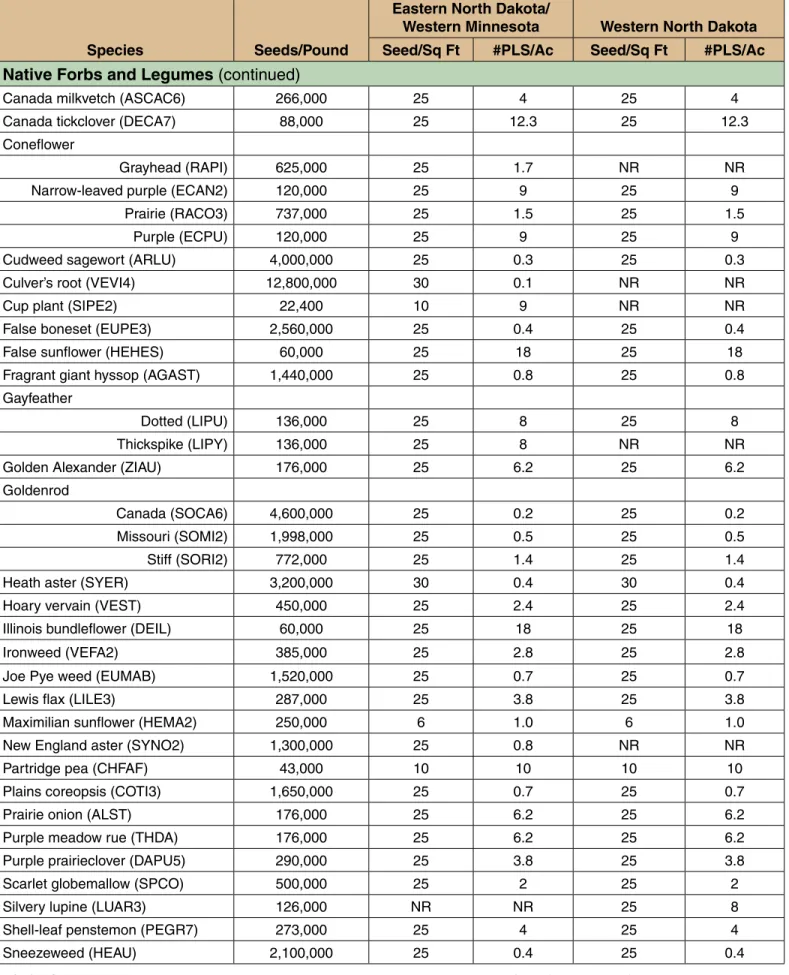
Most grass species in North Dakota and western Minnesota are seeded at a rate of 25 to 30 seeds per square foot (see Table 1: Full Seeding Rates) . The lower rates generally are recommended in western North Dakota or on drier sites . The higher rates generally are recommended in eastern areas on sites with more favorable moisture conditions . Adjustments are made for
some species based on seed size, seedling vigor and seed conditioning . These rates are for drill planting with a row spacing of 12 inches or less, the recommended row spacing for most grass planting purposes . Seeding rates are shown in pure live seed (PLS) pounds per acre .
Table 1. Full Seeding Rates 1, 2
Species Seeds/Pound
Eastern North Dakota/
Western Minnesota Western North Dakota Seed/Sq Ft #PLS/Ac Seed/Sq Ft #PLS/Ac
Introduced Cool-season Grasses
Bromegrass
Meadow (BRBI2) 80,000 30 16 .5 25 13 .5
Smooth (BRIN2) 135,000 25 8 20 6 .5
Creeping foxtail (ALAR) 750,000 60 3 .5 60 3 .5
Hard fescue (FEBR7) 565,000 50 4 35 3
Timothy (PHPR3) 1,300,000 30 1 NR NR Wheatgrass Green (ELHO3) 135,000 46 14 33 10 Crested (AGCR) 175,000 28 7 25 6 Intermediate (THIN6) 88,000 20 10 17 8 .5 Pubescent (THIN6) 88,000 20 10 17 8 .5 Siberian (AGFR) 175,000 30 7 .5 25 6 Tall (THPO7) 79,000 23 13 .5 20 11 Wildrye Altai (LEAN3) 68,000 30 19 25 16 Dahurian (ELDA3) 86,000 20 10 17 8 .5 Mammoth (LERA5) 55,000 30 24 25 20 Manystem (LEMU11) 150,000 30 8 .5 25 7 .5 Russian (PSJU3) 175,000 30 7 .5 25 6
Native Cool-Season Grasses
American mannagrass (GLGR) 1,280,000 45 1 .5 45 1 .5
Fowl bluegrass (POPA2) 3,156,000 70 1 70 1
Green needlegrass (NAVI4) 180,000 30 7 .5 25 6
Needle-and-thread (HECO26) 115,000 25 9 .5 25 9 .5
Nutall alkaligrass (PUNU2) 2,108,000 50 1 50 1
Porcupine grass (HESP11) 57,000 25 19 25 19
Prairie Junegrass (KOMA) 2,315,000 50 1 50 1
Reed canarygrass (PHAR3) 530,000 40 3 .5 40 3 .5
1 FOTG – Section 1 – Reference subject – Plant Materials Herbaceous Vegetation Establishment Guide (February 2012) 2 For additional information see USDA PLANTS
Table 1. Full Seeding Rates 1, 2
Species Seeds/Pound
Eastern North Dakota/
Western Minnesota Western North Dakota Seed/Sq Ft #PLS/Ac Seed/Sq Ft #PLS/Ac
Native Cool-Season Grasses (continued)
Wheatgrass Bluebunch (PSSP6) 140,000 NR3 NR 25 8 Slender/awned/bearded (ELTR7) 155,000 25 5 .5 17 5 Streambank/Thickspike (ELLAL) 155,000 NR NR 25 7 Western (PASM) 112,000 25 10 20 8 Whitetop (SCFE) 191,000 11 2 .4 11 2 .4 Wildrye Basin (LECI4) 140,000 NR NR 25 8 Canada (ELCA4) 115,000 20 7 .5 17 6 .5 Virginia (ELSU) 96,000 20 10 NR NR
Native Warm-season Grasses
American sloughgrass (BESY) 1,150,000 25 0 .9 25 0 .9
Bluestem Big (ANGE) 176,000 30 7 .5 25 6 Little (SCSC) 286,000 30 4 .5 25 4 Sand (ANHA) 113,000 30 12 25 9 .5 Buffalograss (BODA2) 50,000 30 26 25 23 Grama Blue (BOGR2) 750,000 40 2 .5 30 2 Sideoats (BOCU) 180,000 30 7 .5 25 6
Indian ricegrass (ACHY) 235,000 30 5 .5 25 4 .5
Indiangrass (SONU) 193,000 30 7 25 5 .5
Prairie cordgrass (SPPE) 183,000 30 7 30 7
Prairie sandreed (CALO) 275,000 30 5 25 4
Prairie dropseed (SPHE) 224,000 25 5 25 5
Sand dropseed (SPCR) 5,680,000 70 0 .5 70 0 .5
Switchgrass (PAVI) 390,000 40 4 .5 30 3 .5
Native Grasslikes
Fox sedge (CAVU2) 1,600,000 37 1 37 1
Slough sedge (CAAT2) 230,490 25 4 .7 25 4 .7
Native Forbs and Legumes
American vetch (VIAM) 30,000 25 36 25 36
Black-eyed susan (RUHI2) 1,450,000 25 0 .8 25 0 .8
Blanket flower (GAAR) 157,000 25 7 25 7
Blue vervain (VEHA2) 1,488,000 34 1 34 1
Blue aster (SYLAL3) 880,000 30 1 .5 30 1 .5
Table 1. Full Seeding Rates 1, 2
Species Seeds/Pound
Eastern North Dakota/
Western Minnesota Western North Dakota Seed/Sq Ft #PLS/Ac Seed/Sq Ft #PLS/Ac
Native Forbs and Legumes (continued)
Canada milkvetch (ASCAC6) 266,000 25 4 25 4
Canada tickclover (DECA7) 88,000 25 12 .3 25 12 .3
Coneflower
Grayhead (RAPI) 625,000 25 1 .7 NR NR
Narrow-leaved purple (ECAN2) 120,000 25 9 25 9
Prairie (RACO3) 737,000 25 1 .5 25 1 .5
Purple (ECPU) 120,000 25 9 25 9
Cudweed sagewort (ARLU) 4,000,000 25 0 .3 25 0 .3
Culver’s root (VEVI4) 12,800,000 30 0 .1 NR NR
Cup plant (SIPE2) 22,400 10 9 NR NR
False boneset (EUPE3) 2,560,000 25 0 .4 25 0 .4
False sunflower (HEHES) 60,000 25 18 25 18
Fragrant giant hyssop (AGAST) 1,440,000 25 0 .8 25 0 .8
Gayfeather
Dotted (LIPU) 136,000 25 8 25 8
Thickspike (LIPY) 136,000 25 8 NR NR
Golden Alexander (ZIAU) 176,000 25 6 .2 25 6 .2
Goldenrod
Canada (SOCA6) 4,600,000 25 0 .2 25 0 .2
Missouri (SOMI2) 1,998,000 25 0 .5 25 0 .5
Stiff (SORI2) 772,000 25 1 .4 25 1 .4
Heath aster (SYER) 3,200,000 30 0 .4 30 0 .4
Hoary vervain (VEST) 450,000 25 2 .4 25 2 .4
Illinois bundleflower (DEIL) 60,000 25 18 25 18
Ironweed (VEFA2) 385,000 25 2 .8 25 2 .8
Joe Pye weed (EUMAB) 1,520,000 25 0 .7 25 0 .7
Lewis flax (LILE3) 287,000 25 3 .8 25 3 .8
Maximilian sunflower (HEMA2) 250,000 6 1 .0 6 1 .0
New England aster (SYNO2) 1,300,000 25 0 .8 NR NR
Partridge pea (CHFAF) 43,000 10 10 10 10
Plains coreopsis (COTI3) 1,650,000 25 0 .7 25 0 .7
Prairie onion (ALST) 176,000 25 6 .2 25 6 .2
Purple meadow rue (THDA) 176,000 25 6 .2 25 6 .2
Purple prairieclover (DAPU5) 290,000 25 3 .8 25 3 .8
Scarlet globemallow (SPCO) 500,000 25 2 25 2
Silvery lupine (LUAR3) 126,000 NR NR 25 8
Shell-leaf penstemon (PEGR7) 273,000 25 4 25 4
Sneezeweed (HEAU) 2,100,000 25 0 .4 25 0 .4
1 FOTG – Section 1 – Reference subject – Plant Materials Herbaceous Vegetation Establishment Guide (February 2012) 2 For additional information see USDA PLANTS
Table 1. Full Seeding Rates 1, 2
Species Seeds/Pound
Eastern North Dakota/
Western Minnesota Western North Dakota Seed/Sq Ft #PLS/Ac Seed/Sq Ft #PLS/Ac
Native Forbs and Legumes (continued)
Spiderwort (TROC) 166,000 25 7 25 7
Stiff sunflower (HEPAS) 85,000 5 2 .5 5 2 .5
Swamp milkweed (ASIN) 72,000 25 15 25 15
Western yarrow (ACMIO) 2,800,000 25 0 .4 25 0 .4
White prairieclover (DAAL) 278,000 25 3 .9 25 3 .9
Wild bergamot (MOFI) 1,200,000 25 0 .9 25 0 .9
Introduced Legumes
Alfalfa (MESA) 210,000 30 6 .5 25 5 .5
Birdsfoot trefoil (LOCO6) 418,000 50 5 NR NR
Black medic (MELU) 280,000 25 4 25 4
Cicer milkvetch (ASCI4) 134,000 30 10 25 8
Clover
Alsike (TRHY) 680,000 50 3 50 3
White clover (TRRE3) 800,000 25 1 .5 25 1 .5
Red (TRPR2) 275,000 30 5 NR NR
Strawberry (TRFR2) 300,000 25 3 .5 25 3 .5
Sweet (MEOF) 260,000 25 4 20 3
Hairy vetch (VIVI) 20,000 15 30 10 20
Sainfoin (ONVI) 18,500 15 35 (hull) 15 35 (hull)
Native Shrubs
Buffaloberry (SHAR) 41,000 4 4 .2 4 4 .2
Chokecherry (PRVIV) 5,000 3 26 3 26
False indigo (AMNA) 52,000 30 25 25 21
Fourwing saltbush (ATCA2)
Dewinged 52,000 7 6 7 6
Gardner saltbush (ATGA) 110,000 30 12 25 10
Golden currant (RIAU) 240,000 30 5 .5 25 4 .5
Juneberry (AMAL2) 82,000 30 16 25 13
Leadplant (AMCA6) 200,000 30 6 .5 25 5 .4
Prairie rose (ROAR3) 45,000 30 29 25 24
Western snowberry (SYOC) 74,400 30 17 .5 25 14 .6
Winterfat (KRLA2) 150,000 30 8 .5 25 7
WY big sagebrush (ARTRW8) 2,466,000 NR NR 28 0 .5
1 FOTG – Section 1 – Reference subject – Plant Materials Herbaceous Vegetation Establishment Guide (February 2012) 2 For additional information see USDA PLANTS