Energy efficient offloading techniques
for heterogeneous networks
Vasileios Miliotis
ADVERTIMENT La consulta d’aquesta tesi queda condicionada a l’acceptació de les següents condicions d'ús: La difusió d’aquesta tesi per mitjà del r e p o s i t o r i i n s t i t u c i o n a l UPCommons (http://upcommons.upc.edu/tesis) i el repositori cooperatiu TDX (h t t p : / / w w w . t d x . c a t /) ha estat autoritzada pels titulars dels drets de propietat intel·lectual
únicament per a usos privats emmarcats en activitats d’investigació i docència. No s’autoritza la seva reproducció amb finalitats de lucre ni la seva difusió i posada a disposició des d’un lloc aliè al servei UPCommons o TDX. No s’autoritza la presentació del seu contingut en una finestra o marc aliè a UPCommons (framing). Aquesta reserva de drets afecta tant al resum de presentació de la tesi com als seus continguts. En la utilització o cita de parts de la tesi és obligat indicar el nom de la persona autora.
ADVERTENCIA La consulta de esta tesis queda condicionada a la aceptación de las siguientes condiciones de uso: La difusión de esta tesis por medio del repositorio institucional UPCommons (http://upcommons.upc.edu/tesis) y el repositorio cooperativo TDR ( http://www.tdx.cat/?locale-attribute=es) ha sido autorizada por los titulares de los derechos de propiedad intelectual
únicamente para usos privados enmarcados en actividades de investigación y docencia. No se autoriza su reproducción con finalidades de lucro ni su difusión y puesta a disposición desde un sitio ajeno al servicio UPCommons No se autoriza la presentación de su contenido en una ventana o marco ajeno a UPCommons (framing). Esta reserva de derechos afecta tanto al resumen de presentación de la tesis como a sus contenidos. En la utilización o cita de partes de la tesis es obligado indicar el nombre de la persona autora.
WARNING On having consulted this thesis you’re accepting the following use conditions: Spreading this thesis by the i n s t i t u t i o n a l r e p o s i t o r y UPCommons (http://upcommons.upc.edu/tesis) and the cooperative repository TDX ( http://www.tdx.cat/?locale-attribute=en) has been authorized by the titular of the intellectual property rights only for private uses placed in investigation and teaching activities. Reproduction with lucrative aims is not authorized neither its spreading nor availability from a site foreign to the UPCommons service. Introducing its content in a window or frame foreign to the UPCommons service is not authorized (framing). These rights affect to the presentation summary of the thesis as well as to its contents. In the using or citation of parts of the thesis it’s obliged to indicate the name of the author.
Ph.D. Thesis
Energy Efficient Offloading
Techniques for Heterogeneous
Networks
Author:
Vasileios Miliotis
Advisors:
Luis Alonso, Ph.D.
Associate Professor
Universitat Polit`ecnica de Catalunya (UPC)
Christos Verikoukis, Ph.D.
Senior Researcher
Telecommunications Technological Center
of Catalonia (CTTC)
Department of Signal Theory and Communications
Universitat Polit`ecnica de Catalunya
Abstract
Mobile data o✏oading has been proposed as a solution for the network congestion problem that is continuously aggravating due to the increase in mobile data demand. The concept of o✏oading refers to the exploitation of network heterogeneity with the objective to mitigate the load of the cellular network infrastructure. In this thesis a multicast protocol for short range networks that exploits the characteristics of physical layer network coding is presented. In the proposed protocol, named CooPNC, a novel cooperative approach is provided that allows collision resolutions with the use of an indirect inter-network cooperation scheme. Through this scheme, a reliable multicast protocol for partially overlapping short range networks with low control overhead is provided. It is shown that with CooPNC, higher throughput and energy efficiency are achieved, while it presents lower delay compared to state-of-the-art multicast protocols. A detailed description of the proposed protocol is provided, with a simple scenario of overlapping networks and also for a generalised scalable scenario. Through mathematical analysis and simulations it is proved that CooPNC presents significant performance gains compared to other state-of-the-art multicast protocols for short range networks. In order to reveal the performance bounds of Physical Layer Network Coding, the so-called Cross Network is investigated under diverse Network Coding (NC) techniques. The impact of Medium Access Control (MAC) layer fairness on the throughput performance of the network is provided, for the cases of pure relaying, digital NC with and without overhearing and physical layer NC with and without overhearing. A comparison among these techniques is presented and the throughput bounds, caused by MAC layer limitations, are discussed. Furthermore, it is shown that significant coding gains are achieved with digital and physical layer NC and the energy efficiency performance of each NC case is presented, when applied on the Cross Network.
In the second part of this thesis, the uplink o✏oading using IP Flow Mobil-ity (IFOM) is also investigated. IFOM allows a LTE mobile User Equipment (UE) to maintain two concurrent data streams, one through LTE and the other through WiFi access technology, that presents uplink limitations due to the inherent fairness design of IEEE 802.11 DCF. To overcome these limitations, a weighted proportion-ally fair bandwidth allocation algorithm is proposed, regarding the data volume that is being o✏oaded through WiFi, in conjunction with a pricing-based rate allocation algorithm for the rest of the data volume needs of the UEs that are transmitted through the LTE uplink. With the proposed approach, the energy efficiency of the
iv
UEs is improved, and the o✏oaded data volume is increased under the concur-rent use of access technologies that IFOM allows. In the weighted proportionally fair WiFi bandwidth allocation, both the di↵erent upload data needs of the UEs, along with their LTE spectrum efficiency are considered, and an access mechanism is proposed that improves the use of WiFi access in uplink o✏oading. In the LTE part, a two-stage pricing-based rate allocation is proposed, under both linear and exponential pricing approaches, with the objective to satisfy all o✏oading UEs re-garding their LTE uplink access. The proposed algorithms are theoretically analysed and their performance is evaluated through simulations. Through the evaluation of energy efficiency, o✏oading capabilities and throughput performance, it is proved that the proposed uplink access scheme for UEs that operate with IFOM for uplink o✏oading presents higher performance compared to other state-of-the-art access schemes. The existence of a malicious UE is also considered that aims to exploit the WiFi bandwidth against its peers in order to upload less data through the en-ergy demanding LTE uplink and a reputation based method is proposed to combat its selfish operation. This approach is theoretically analysed and its performance is evaluated, regarding the malicious and the truthful UEs in terms of energy ef-ficiency. It is shown that while the malicious UE presents better energy efficiency before being detected, its performance is significantly degraded with the proposed reaction method.
Resumen
La derivaci´on del tr´afico de datos m´oviles (en ingl´es data o✏oading) ha sido prop-uesta como una soluci´on al problema de la congesti´on de la red, un problema que empeora continuamente debido al incremento de la demanda de datos m´oviles. El concepto de o✏oading se entiende como la explotaci´on de la heterogeneidad de la red con el objetivo de mitigar la carga de la infraestructura de las redes celulares. En esta tesis se presenta un protocolo multicast para redes de corto alcance (short range networks) que explota las caracter´ısticas de la codificaci´on de red en la capa f´ısica (physical layer network coding). En el protocolo propuesto, llamado CooPNC, se implementa una soluci´on cooperativa que permite la resoluci´on de colisiones me-diante la utilizaci´on de un esquema indirecto de cooperaci´on entre redes. Gracias a este esquema, se consigue un protocolo multicast fiable i con poco overhead de control para redes de corto alcance parcialmente solapadas. Se demuestra que el protocolo CooPNC consigue una mayor tasa de transmisi´on neta (throughput) y una mejor eficiencia energ´etica, a la vez que el retardo se mantiene por debajo del obtenido con los protocolos multicast del estado del arte. La tesis ofrece una de-scripci´on detallada del protocolo propuesto, tanto para un escenario simple de redes solapadas como tambi´en para un escenario general escalable. Se demuestra medi-ante an´alisis matem´atico y simulaciones que CooPNC ofrece mejoras significativas en comparaci´on con los protocolos multicast para redes de corto alcance del estado del arte. Con el objetivo de encontrar los l´ımites de la codificaci´on de red en la capa f´ısica (physical layer network coding), se estudia el llamado Cross Network bajo dis-tintas t´ecnicas de Network Coding (NC). Se proporciona el impacto de la equidad (fairness) de la capa de control de acceso al medio (Medium Access Control, MAC), para los casos de repetidor puro (pure relaying), NC digital con y sin escucha del medio, y NC en la capa f´ısica con y sin escucha del medio. La tesis presenta una comparaci´on de todas estas t´ecnicas y analiza los l´ımites del throughput, causados por las limitaciones de la capa MAC. Adem´as, se muestra que con NC digital y NC en la capa f´ısica se consiguen ganancias de codificaci´on significativas. Para cada uno de estos casos, se presenta la eficiencia energ´etica cuando se utiliza Cross Network. En la segunda parte de la tesis se investiga el o✏oading en el enlace ascendente mediante IP Flow Mobility (IFOM). El IFOM permite a los usuarios m´oviles de LTE mantener dos flujos de datos concurrentes, uno a trav´es de LTE y el otro a trav´es de la tecnolog´ıa de acceso WiFi, que presenta limitaciones en el enlace ascen-dente debido a la equidad (fairness) inherente del dise˜no de IEEE 802.11 DCF. Para
vi
superar estas limitaciones, se propone un algoritmo proporcional ponderado de asig-naci´on de banda para el volumen de datos derivado a trav´es de WiFi, junto con un algoritmo de asignaci´on de tasa de transmisi´on basado en pricing para el volumen de datos del enlace ascendente de LTE. Con la soluci´on propuesta, se mejora la efi-ciencia energ´etica de los usuarios m´oviles, y se incrementa el volumen de datos que se pueden derivar gracias a la utilizaci´on concurrente de tecnolog´ıas de acceso que permite IFOM. En el algoritmo proporcional ponderado de asignaci´on de banda de WiFi, se toman en consideraci´on tanto las distintas necesidades de los usuarios en el enlace ascendente como su eficiencia espectral en LTE, y se propone un mecanismo de acceso que mejora el uso de WiFi para el tr´afico derivado en el enlace ascendente. En cuanto a la parte de LTE, se propone un algoritmo en dos etapas de asignaci´on de tasa de transmisi´on basada en pricing (con propuestas de pricing exponencial y lineal) con el objetivo de satisfacer el enlace ascendente de los usuarios en LTE. Los algoritmos propuestos son analizados te´oricamente y su funcionamiento es evaluado mediante simulaciones. Mediante la evaluaci´on de la eficiencia energ´etica, la capaci-dad de o✏oading y el rendimiento del throughput se demuestra que el esquema de acceso propuesto para el enlace ascendente para usuarios que utilizan IFOM pre-senta mayor rendimiento en comparaci´on con otros esquemas del estado del arte. Tambi´en se contempla la existencia de usuarios maliciosos, que pretenden utilizar el ancho de banda WiFi contra sus iguales para transmitir menos datos a trav´es del enlace ascendente de LTE (menos eficiente energ´eticamente). Para ello se propone un m´etodo basado en la reputaci´on que combate el funcionamiento ego´ısta (selfish). Esta propuesta se analiza te´oricamente y su rendimiento se eval´ua, en t´erminos energ´eticos, para los usuarios maliciosos y honestos (truthful). Se demuestra que los usuarios maliciosos presentan una eficiencia energ´etica mejor antes de ser de-tectados, pero su rendimiento se degrada significativamente con el m´etodo reactivo propuesto.
Stouc gone–c mou K∏sta kai Eun–kh
Acknowledgements
It has been a long and rocky path towards this PhD. It was a life changing experience in many aspects and it would never be possible for me without the contribution of the people that I am grateful to and I will never forget.
First of all, I would like to thank my supervisors Professor Christos Verik-oukis and Professor Luis Alonso for their detailed guidance throughout our weekly GREENET meetings. Their uncompromising devotion to detail and their persis-tence for high quality work has been a great influence for my future. The interaction with them has deeply a↵ected my perception of research.
I would also like to express my gratefulness to the Professors Leandros Tas-siuilas, Iordanis Koutsopoulos and Thanasis Korakis, in the order I met them, that introduced me in the world of research and inspired my passion for research and technology, each one with his own unique way.
I could not forget to thank Melani Gurdiel Garc´ıa that efficiently managed every non-technical detail during my PhD and gladly provided all her help during my stay in Barcelona. I will never forget our short co↵ee breaks in UPC.
During a PhD you also live your life, although you do not usually have much time. For the bad times that get even harder when you are abroad, I would like to thank my friends Dimitris Chandolias and Stathis Tsolakidis for their full support. I would also like to thank once more my supervisor Professor Christos Verikoukis for his sincere understanding and his discreet interest during these hard times.
I am deeply thankful to the Greek State Scholarship Foundation (IKY), as this thesis was funded by IKY, following a procedure of individualised assessment of the academic year 2011-2012, through the resources of the educational program “Education and Lifelong Learning” of the European Social Fund (ESF) and the NSRF 2007-2013.
Last but not least, I would like to thank my parents Evniki and Kostas, and my sister Christina for their full support and understanding. Words are not enough to express how grateful I am to my family!
Contents
List of Tables xiii
List of Figures xv
Acronyms xvii
1 Introduction 1
1.1 Motivation . . . 1
1.2 Structure of the Thesis and Contributions . . . 3
1.3 Research Contributions . . . 4
2 O✏oading with Cooperative Physical Layer Network Coding 7 2.1 Introduction . . . 7
2.2 MAC Protocols for Reliable Multicast Communications . . . 9
2.2.1 Non-Cooperative Multicast . . . 9
2.2.2 Cooperative Multicast . . . 11
2.3 Cooperative Network Coding Techniques . . . 12
2.3.1 Digital Network Coding and RNLC . . . 13
2.3.2 Hybrid Channel/ Network Coding . . . 14
2.3.3 Physical Layer Network Coding . . . 14
2.3.4 MIMO Network Coding . . . 16
2.4 CooPNC: A Cooperative Multicast Protocol Exploiting Physical Layer Network Coding . . . 17
2.4.1 CooPNC Overview . . . 17
2.4.2 Performance of the CooPNC Scalable Scenario . . . 21
2.4.3 Peripheral Networks Performance . . . 25
2.4.4 CooPNC Performance Evaluation . . . 29
2.4.5 Performance Evaluation of the Central Network . . . 30
2.4.6 Performance Evaluation of the Peripheral Networks . . . 32 3 Digital and Physical Layer Network Coding Performance in the
xii CONTENTS
Context of Enforced Fairness 39
3.1 Background . . . 40
3.2 System Under Investigation . . . 40
3.3 Evaluation of Di↵erent Network Coding Techniques . . . 45
4 Uplink O✏oading with IP Flow Mobility 51 4.1 Introduction . . . 51
4.2 O✏oading Techniques for Heterogeneous Networks . . . 54
4.3 System Model for Uplink O✏oading . . . 56
4.3.1 LTE Uplink Power Model . . . 58
4.3.2 IEEE 802.11 DCF Energy Consumption in the Uplink . . . . 58
4.3.3 Uplink O✏oading Energy Consumption . . . 60
4.4 Weighted Proportionally Fair WiFi Access . . . 61
4.4.1 Implementation Consideration . . . 62
4.4.2 Energy Efficiency of PFB . . . 63
4.4.3 O✏oading Index . . . 64
4.5 LTE Pricing Scheme . . . 64
4.5.1 LTE Uplink Rate With Linear Pricing . . . 65
4.5.2 LTE Uplink Rate With Exponential Pricing . . . 66
4.6 Evaluation of Uplink O✏oading with IP Flow Mobility . . . 67
4.6.1 Energy Efficiency with Linear Pricing . . . 68
4.6.2 Energy Efficiency with Exponential Pricing . . . 68
4.6.3 Evaluation of O✏oading Capabilities . . . 69
4.6.4 Trade-o↵Between Spectrum Efficiency and Data Volume Needs 69 4.7 Combating Selfish Misbehavior with Reputation Based O✏oading . 78 4.8 Energy Efficiency of UEs . . . 79
4.8.1 Energy Efficiency of the Truthful UEs . . . 79
4.8.2 Energy Efficiency of the Malicious UE . . . 79
4.9 Performance Evaluation Under Selfish Misbehavior . . . 80
4.9.1 Performance Evaluation Under Linear Pricing . . . 80
4.9.2 Performance Evaluation Under Linear Pricing . . . 82
5 Conclusions 87
List of Tables
2.1 Simulation Parameters . . . 29 2.2 Performance Gain of Network 1 for Diverse Traffic Levels of the
Pe-ripheral Networks . . . 34 2.3 Impact of Network 3 traffic on the Performance Gain of Network 4 . 34 4.1 List of notations and their physical meanings. . . 56 4.2 Simulation Parameters . . . 68
List of Figures
1.1 O✏oading mobile data traffic forecast [2]. . . 2
2.1 Multicast Procedures of (a) ELBP, (b) BMMM and (c) RAMP. . . 11
2.2 Proposed protocols for the two-way relay topology. . . 13
2.3 Comparison of DNC and the three main approaches of PNC [33]. . . 15
2.4 ZigZag decoding with two successive collisions of the same packets [50]. 16 2.5 Multicast Transmission Scenario. . . 18
2.6 Distinguishing Symmetrical Collision Cases. . . 18
2.7 One Relay Collision Resolution. . . 19
2.8 Scalable Multicast Scenario. . . 21
2.9 Decomposed Approach with Equivalent Network. . . 26
2.10 Evaluation scenario of one central and 3 overlapping networks (N = 4). 30 2.11 Throughput of the central network for N = 4, with (p1, p3, p4) = (0.95,0.5,0.5) and p2 2(0,1). . . 31
2.12 Delay of the central network forN = 4, with (p1, p3, p4) = (0.95,0.5,0.5) and p2 2(0,1). . . 32
2.13 Energy efficiency of the central network forN = 4, with (p1, p3, p4) = (0.95,0.5,0.5) and p2 2(0,1). . . 33
2.14 Throughput of Network 4 forN = 4, with (p3, p4) = (0.5,0.95) and (p1, p2)2(0,1). . . 35
2.15 CooPNC gain(%) in energy efficiency compared to CRTC. . . 36
2.16 Throughput of Network 4 for (p1, p3, p4) = (0.75,0.5,0.95) and p2 2 (0,1). . . 36
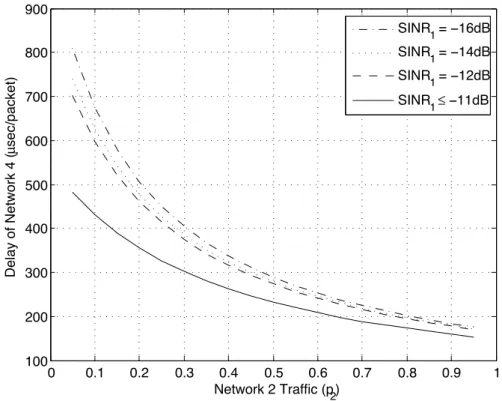
2.17 Delay of Network 4 for (p1, p3, p4) = (0.75,0.5,0.95) and p22(0,1). . 37
2.18 Energy efficiency of Network 4 for (p1, p3, p4) = (0.75,0.5,0.95) and p2 2(0,1). . . 37
2.19 Impact of the capture e↵ect on the throughput of Network 4. . . 38
2.20 Impact of the capture e↵ect on the delay of Network 4. . . 38
3.1 The Cross Scenario. . . 41
3.2 PNC in pairs with overhearing. . . 43 xv
xvi LIST OF FIGURES
3.3 Throughput comparison of the di↵erent NC cases. . . 46
3.4 Coding gain of the di↵erent NC cases. . . 47
3.5 Performance of the di↵erent NC cases for optimized throughput. . . 48
3.6 Energy efficiency of node A for optimized throughput for di↵erent NC cases. . . 48
3.7 Energy efficiency of the relay for optimized throughput for di↵erent NC cases. . . 49
4.1 Uplink o✏oading scenario with IP Flow Mobility (IFOM). . . 57
4.2 Schematic representation of the system model. . . 58
4.3 Degradation of per user throughput in IEEE 802.11 DCF. . . 59
4.4 Degradation of per user energy efficiency in IEEE 802.11 DCF. . . . 60
4.5 An example of the PFB algorithm for two UEs. . . 63
4.6 Energy efficiency and energy efficiency gain for✓i 2[0.8,1] with linear pricing. . . 71
4.7 Energy efficiency and energy efficiency gain for ✓i 2 [0.6,0.8] with linear pricing. . . 72
4.8 Energy efficiency and energy efficiency gain for ✓i 2 [0.8,1] with exponential pricing. . . 73
4.9 Energy efficiency and energy efficiency gain for ✓i 2 [0.6,0.8] with exponential pricing. . . 74
4.10 Energy efficiency comparison between linear and exponential pricing scheme. . . 75
4.11 O✏oading Index for di↵erent number of UEs. . . 75
4.12 Throughput comparison for KN = (5,10,15) MB and ✓i 2 [0.8,1] with linear pricing. . . 76
4.13 Impact of the trade-o↵between spectrum efficiency and data volume needs. . . 77
4.14 Uplink o✏oading scenario with IFOM and a malicious UE. . . 78
4.15 Energy efficiency during malicious operation (✓i2[0.8,1]). . . 81
4.16 Energy efficiency after reputation vector update (✓i2[0.8,1]). . . 81
4.17 Energy efficiency during malicious operation (✓i2[0.6,0.8]). . . 82
4.18 Energy efficiency after reputation vector update (✓i2[0.6,0.8]). . . . 83
4.19 Energy efficiency for ✓i 2[0.8,1]. . . 84
Acronyms
3GPP 3rd Generation Partnership Project
ACK Acknowledgement
AF-PNC Amplify and Forward Physical layer Network Coding
AP Access Point
ARQ Automatic Repeat reQuest
BMMM Batch Mode Multicast MAC Protocol
BMW Broadcast Medium Window
BS Base Station
CFC Call For Cooperation
CSMA/CA Carrier Sense Multiple Access with Collision Avoidance
CTS Clear To Send
DBP Delayed Feedback-based Protocol
DCF Distributed Coordination Function
DF-PNC 1/ 2 Decode and Forward Physical layer Network Coding type 1/ 2
DPMM Double Piggyback Mode Multicast
EDGE Enhanced Data rates for GSM Evolution
ELBP Enhanced LBP
eNodeB Evolved Node B
HSPA High Speed Packet Access
IEEE Institute of Electrical and Electronics Engineers
IFOM IP Flow Mobility
IP Internet Protocol
LAN Local Area Network
LBP Leader Based Protocol
LIPA Local IP Access
xviii ACRONYMS
LTE Long Term Evolution
MAC Medium Access Control
MANET Mobile Ad-hoc Network
MCTS Multicast CTS
MIMO Multiple Input and Multiple Output
MIMO NC MIMO Network Coding
MRTS Multicast Request to Send
NAK Negative Acknowledgment
NAV Network Allocation Vector
NC Network Coding
PNC Physical layer Network Coding
QoE Quality of Experience
QoS Quality of Service
RAMP Reliable Access Multicast Protocol
R-DSTC Randomized Distributed Space Time Codes
RLNC Random Linear Network Coding
SEQ Sequence
SETL Smart Exponential-Threshold-Linear
SIPTO Selected IP Traffic O✏oad
SNR Signal to Noise Ratio
STA Station
UDP User Datagram Protocol
UE User Equipment
UFM Unicast-Friendly Multicast
Chapter 1
Introduction
1.1
Motivation
The explosion of the data demand that we are already witnessing is the main reason that drives cellular network operators into the upgrade of cellular access to 4G systems like LTE-A aiming to be able to serve the requested traffic by their users. Due to the dramatic increase in population density in both residential and business areas, even with the upgrades of the cellular infrastructure the pace of the increase of data traffic demand requires further improvements besides the infrastructure upgrades, that will take advantage of the diversity of access through the exploitation of heterogeneous networks. Aiming to confront this “Tidal E↵ect”, as described in [1], the research community has proposed o✏oading techniques, that will help to mitigate the overload of the cellular network spectrum.
Mobile data o✏oading pertains to traffic, created or requested from dual-mode devices and support cellular and WiFi connectivity, when it is routed over WiFi and small-networks. Mobile o✏oading occurs the user device leven when switched from a cellular connection to WiFi/ small-cell access or when both technologies are being used concurrently. According to cisco’s global mobile data traffic forecast, as seen in Fig. 1.1 [2], as a percentage of total mobile data traffic from all mobile-connected devices, mobile o✏oad increases from 45 percent (1.2 exabytes/month) in 2014 to 54 percent (28.9 exabytes/month) by 2019. Without o✏oad, Global mobile data traffic would grow at a compound annual growth rate (CAGR) of 62 percent instead of 57 percent. O✏oad volume is determined by smartphone penetration, dual-mode share of handsets, percentage of home-based mobile Internet use, and percentage of dual-mode smartphone owners with WiFi fixed Internet access at home.
The objective of this thesis is dual. First, to present medium access control algorithms for heterogeneous networks that will provide e↵ective ways to avoid con-gestion conditions at the cellular infrastructure and second to provide to the end users energy efficient access without compromising in terms of throughput and
2 1.1. Motivation
Figure 1.1: O✏oading mobile data traffic forecast [2].
lay. Towards this objective, the considered models in this thesis are composed by concurrent LTE/ WiFi connectivity of the mobile users and the proposed o✏oading schemes are based on connection sharing for cooperative downlink and on propor-tional fair sharing access on the uplink combined with pricing strategies. In addition to the classic network performance metrics of throughput and delay, the energy effi -ciency of the network operation is presented, using the network bit delivery energy efficiency metric. This metric focuses on the amount of energy spent per delivered bit and is measured in bits per Joule.
This thesis provides a contribution to the field of MAC layer protocol design for energy efficient o✏oading for heterogeneous networks, by proposing and evaluating mechanisms that enhance di↵erent aspects of the network performance. The main motivation for this work has stemmed from the following two factors:
• Cooperative communications can achieve spatial diversity gains by requesting from neighboring stations to retransmit the overheard information to the final destination. By combining cooperation with Physical Layer Network Coding (PNC), further gains in terms of throughput, delay and energy efficiency are achieved. The density of short range networks in urban environments creates more room for improvement in the context of partially overlapping wireless networks that can be used to further enhance cellular communications by mit-igating user created congestion and at the same time augmenting the network lifetime by reserving energy at the user-end.
• The support of multiple access technologies in contemporary personal wireless devices in conjunction with the evolution of modern cellular technologies that include heterogeneity, create challenges on fair and e↵ective access schemes. Already mature technologies like WiFi need to be adapted to serve better new o✏oading techniques. Aspects like data volume needs and challenge conditions have to be considered for fairness in the increasing complexity of access. In ad-dition, economic tools like pricing can also give insights and solutions towards more efficient and fair utilization of the network resources.
Chapter 1. Introduction 3
The main contributions of this work and the structure of the thesis will be discussed in detail in the following section.
1.2
Structure of the Thesis and Contributions
In this thesis we focus on two di↵erent methods of exploiting short range networks for the leverage of mobile data o✏oading. The first method refers to the use of cooperative networking for partially overlapping short range networks where users that are interested in the same information form a short range network. Instead of maintaining multiple sessions with the cellular network, one user is receiving the requested information and concurrently disseminates the data to its neighbor-ing stations through multicast transmission. In the overlappneighbor-ing areas, collisions are solved by means of Physical Layer Network Coding. The second method is focused on the uplink o✏oading with the concurrent use of short range and cellular com-munication. While most of the users would prefer to o✏oad all their mobile data through a more energy efficient and less expensive short range network, a fair ap-proach is proposed, where users’ data volume needs and channel conditions are the weighting factors for the fair access. In addition, pricing schemes are proposed to distributively control the uplink access of the cellular network.
The remaining part of the thesis consists of three chapters. Chapter 2 is focused in o✏oading with cooperative Physical Layer Network Coding. In Section 2.2 the state-of-the-art regarding reliable multicast MAC protocols is presented. In Section 2.3 a literature overview and categorization of cooperative network coding tech-niques is presented. The basic model and characteristics of CooPNC protocol are analysed in Section 2.4, where the proposed cooperative mechanism for collisions resolution is also described for the simple scenario of two partially overlapping net-works. In the same Section, a scalable scenario ofN partially overlapping networks is presented. In this scenario one central and N 1 peripheral networks are con-sidered. The mathematical analysis of the performance of the central network in this scalable scenario, operating under the CooPNC protocol and a problem de-composition approach to explore the performance of the peripheral networks, is also included. Subsections 2.4.4 to 2.4.6 contain the evaluation of CooPNC. The part of the thesis that refers to network coding is finalised with Chapter 3 with an investigation of the upper performance bounds of diverse digital and physical layer network coding techniques in the context of enforced fairness, regarding throughput and energy efficiency.
Chapter 4 is focused on uplink o✏oading through concurrent WiFi and LTE transmissions. In Section 4.2 the state-of-the-art on o✏oading algorithms using WiFi networks is presented and in Section 4.3 the system model of our proposal. An analytical presentation of the proposed weighted proportionally fair WiFi access algorithm is in Section 4.4 and in Section 4.5 the analysis of the two proposed LTE pricing schemes. Section 4.6 includes the evaluation of the proposed uplink o✏oading scheme with IFOM. In Section 4.7 we a system model, where a UE presents malicious operation is described and in Section 4.8, the impact of the malicious operation on
4 1.3. Research Contributions
the energy efficiency of the uplink o✏oading scheme is investigated. The Chapter is finalised in Section 4.9 where the performance evaluation in terms of throughput and energy efficiency under selfish misbehavior is presented.
1.3
Research Contributions
The novel proposals discussed in this thesis have been published in several research contributions. The work presented in Chapters 2 and 3, has been published in two journals and four international conferences, cited next:
[J1] V. Miliotis, L. Alonso, and C. Verikoukis, “Combining Cooperation and Phys-ical Layer Network Coding to Achieve Reliable Multicast,” Recent Advances in Communications and Networking Technology, vol. 2, pp. 41–49, Aug. 2013. [J2] V. Miliotis, L. Alonso, and C. Verikoukis, “CooPNC: A Cooperative Multicast Protocol Exploiting Physical Layer Network Coding,” Ad Hoc Networks, vol. 14, pp. 35–50, Mar. 2014.
[C1] V. Miliotis, L. Alonso, and C. Verikoukis,, “Multicast Performance Bounds Exploiting Cooperative Physical Layer Network Coding,” in IEEE 17th In-ternational Workshop on Computer Aided Modeling and Design of Commu-nication Links and Networks (CAMAD), pp. 135–139, Sep. 2012, Barcelona, Spain.
[C2] V. Miliotis, L. Alonso, C. Skianis, and C. Verikoukis, “The Impact of Coop-erative Physical Layer Network Coding on Multicast Short Range Networks,” in Proc. of IEEE International Conference on Communications (ICC 2013), pp. 3547–3551, June 2013, Budapest, Hungary.
[C3] V. Miliotis, L. Alonso, and C. Verikoukis, “Cooperative Multicast Exploiting Physical Layer Network Coding: A Performance Analysis,” in Proc. of IEEE International Conference on Communications 2013: IEEE ICC’13 - 3rd IEEE International Workshop on Smart Communication Protocols and Algorithms (SCPA 2013), pp. 1010–1014, June 2013, Budapest, Hungary.
[C4] V. Miliotis, L. Alonso, and C. Verikoukis, “Digital and Physical Layer Network Coding Performance in the Context of Enforced Fairness,” in Proc. of 21st International Conference on Telecommunications (ICT), pp. 72–76, May 2014, Lisbon, Portugal.
The proposed uplink o✏oading schemes, presented in Chapter 4 of this thesis, have been submitted in two journal papers under review and published in three international conferences:
[J3] V. Miliotis, L. Alonso, and C. Verikoukis, “Weighted Proportional Fairness and Pricing Based Resource Allocation for Uplink O✏oading Using IP Flow Mobility,” Under Review in Elsevier Ad Hoc Networks
Chapter 1. Introduction 5
[J4] V. Miliotis, L. Alonso, and C. Verikoukis, “Resource Allocation Techniques for Heterogeneous Networks Under User Misbehavior,” Under Review in IEEE Communication Letters
[C5] V. Miliotis, L. Alonso, and C. Verikoukis, “Energy Efficient Proportionally Fair Uplink O✏oading for IP Flow Mobility,” in IEEE 19th International Workshop on Computer Aided Modeling and Design of Communication Links and Networks (CAMAD), pp. 6–10, Dec. 2014, Athens, Greece.
[C6] V. Miliotis, L. Alonso, and C. Verikoukis, “O✏oading With IFOM: The Uplink Case,” in Proc. of IEEE GLOBECOM’14, pp. 2661–2666, Dec. 2014, Austin, Texas.
[C7] V. Miliotis, L. Alonso, and C. Verikoukis, “Combating Selfish Misbehavior with Reputation Based Uplink O✏oading for IP Flow Mobility,” to appear in
IEEE International Conference on Communications (ICC 2015), June 2015, London, UK.
Chapter 2
O
✏
oading with Cooperative
Physical Layer Network
Coding
2.1
Introduction
We have been recently witnessing a rapid transition on the way internet is being used. New web-based applications appear frequently, providing social networking services, multimedia streaming, content sharing, remote storage space and remote processing of several instances of the everyday computer-aided activity. The need for being connected has started to be considered as a basic need. Social networks like Facebook and Twitter lead people to transform their social life from a con-ventional to an on-line type, sharing large amounts of data concerning their lives. The tremendous progress of connectivity speed along with the high storage spaces in the continuously deploying data centers opened the way for streaming services and cloud computing. Activities like watching videos, listening to the music, storing everyday work files and even processing files are no longer connected to local stored data in a user’s personal computer but to transparent hardware accessed by web applications.
In parallel to the transition of the use habits of internet users, the wide spread of smart-phones surges the cellular networks’ subscribers to access mobile internet services, providing them the opportunity to transfer large amount of data through wireless networks. This fact places a substantial pressure on operator’s network capacity. As operators will not likely be able to follow the current pace of mobile data demand, they respond by rolling out WLANs to public areas to o✏oad data traffic. WLANs are an appropriate solution, as they are easy to deploy and cost less than upgrading the existing cellular infrastructure gear. Despite the fact that the heterogeneity in the design and deployment of the networks tries to give a solution
8 2.1. Introduction
to mitigate the pressure of mobile data demand, there is not yet any cooperative approach in connectivity, adopted to alleviate the pressure on the capacity of the operator’s networks. Most devices act selfishly and frequently, separate requests from a 3G or LTE network are sent for the same streaming services from users close to each other that are interested in the same information. This fact not only creates redundant traffic to the cellular infrastructure, but it is also energy inefficient, while short range communication networks can be used for the same functionality. Instead of separate requests for streaming services, one connection could be established with the concurrent dissemination of the information through short range communica-tion, exploiting a multicast scheme. At the same time, the intense augmentation of the density of short range networks in urban environments exacerbates the phe-nomenon of collisions, as most of the short range networks su↵er from the fact that they partially overlap with other analogous neighbouring networks that operate in the same channel. This phenomenon is analyzed in [3] for realistic workload in un-planned multi-cell WLANs through testbed experimentation. In this Chapter, we focus on the performance of an o✏oading scheme for data dissemination and we provide analysis of a central network that su↵ers from collisions provoked by par-tially overlapping peripheral networks. We present our basic concepts as published in [4–7] and a generalised scalable scenario that is titled CooPNC (Cooperative mul-ticast exploiting Physical Layer Network Coding) published in [8], and we compare its performance to other state of the art multicast protocols. The motivation behind our work is the o✏oading of the cellular networks, in cases where multiple requests for the same content originate from personal devices of a group of people that are close to each other. For example, when a group of friends is willing to watch a video (live streaming or stored to a server) at the same time. Instead of multiple connec-tions to the cellular network, one connection with the concurrent dissemination of the information to the group would be adequate and as proven hereby more energy efficient. The main contributions of this Chapter are:
• The proposal of CooPNC protocol, a novel reliable multicast protocol that exploits the features of PNC to resolve collisions of partially overlapping mul-ticast networks.
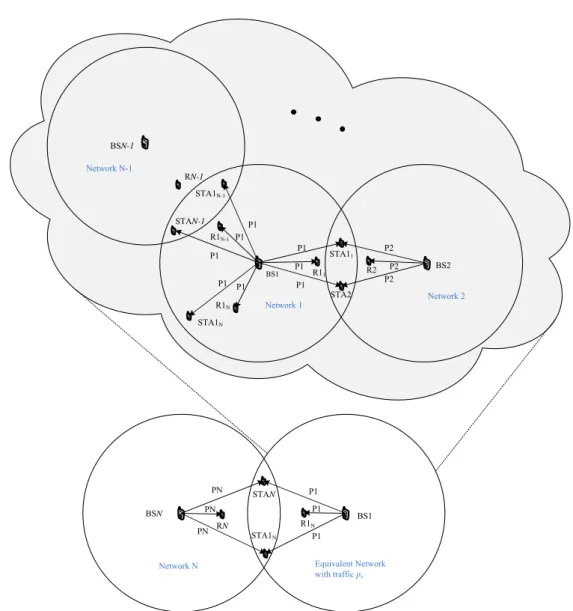
• The presentation of a scalable scenario that operates under CooPNC and consists of N neighbouring partially overlapping networks. Specifically one central and N 1 peripheral networks
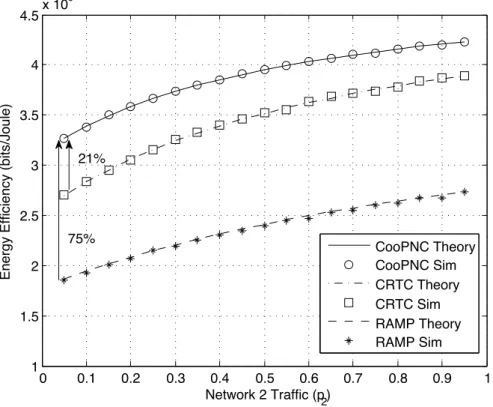
• The analysis of the performance of CooPNC for the central and one peripheral network, in terms of throughput, delay and energy efficiency metrics, which are evaluated through extensive simulations and through comparison to state of the art multicast protocols.
The Chapter is organized as follows. In Section 2.2 we present a literature overview regarding reliable multicast MAC protocols and in Section 2.3 the related work and categorization of cooperative network coding techniques. In Section 2.4, we present the basic characteristics of CooPNC protocol and the cooperative mechanism for collisions resolution. We also provide the mathematical analysis of the performance
Chapter 2. O✏oading with Cooperative Physical Layer Network Coding 9
of the central network in a scalable scenario operating under the CooPNC protocol and a problem decomposition approach to explore the performance of the peripheral networks. We finalise this Chapter with the evaluation of our proposal in Sections 2.4.4 to 2.4.6.
2.2
MAC Protocols for Reliable Multicast
Com-munications
Multicast communication in short range wireless networks represents the operation of sending data to a group of recipients, which are scattered in the range of the transmitter. The source address is a unicast address, whereas the destination address is a group address of some specific type. Unlike broadcasting, multicasting allows every member to choose whether to be part of the multicast group or not. Both broadcast and multicast communication protocols, as described in IEEE 802.11 [9], are not reliable. Nevertheless, research e↵orts have led to solutions that add reliability in such communication paradigms. In [10], a network coding-based reliable broadcast protocol for wireless mesh networks is proposed, that succeeds high packet delivery ratio with low delay. In [11] several routing metrics are studied for high-throughput in multicast communications. The authors also propose a low-overhead adaptive algorithm to incorporate link-quality metrics to a representative multicast routing protocol and they investigate the performance improvement achieved by using di↵erent link-quality-based routing metrics.
Multicasting is a way to reduce network load and end-to-end delay. It is there-fore beneficial to the source of the transmission as well as to users interested in the same information. However, efficient multicast communication demands for special capabilities and specific algorithms at various layers of the protocol stack. The fact that, in prevalent short range communication protocols like IEEE 802.11, MAC layer retransmissions are not present in multicasting, has led the research commu-nity towards the proposal and design of several multicast MAC protocols. These protocols try to add reliability to this type of communications. Recently, several MAC protocols have been proposed to enhance the reliability and the efficiency of the IEEE 802.11 multicast protocol. These protocols can be categorized into two main categories: Non-cooperative and Cooperative MAC layer multicast protocols for short range communication networks.
2.2.1
Non-Cooperative Multicast
The non-cooperative MAC layer multicast protocols that have been proposed to enhance the reliability and the efficiency of the standard’s multicast scheme can be classified into two main subcategories. The first is based on negative feedback [12–14] and the other is based on positive feedback [15–18]. In [12], the Leader Based Protocol (LBP) attempts to extend the IEEE 802.11 multicast protocol with a handshaking mechanism and a recovery mechanism. The protocol assumes that a
10 2.2. MAC Protocols for Reliable Multicast Communications
receiver is selected as the leader. Only the leader transmits a multicast CTS (MCTS) frame in reply to the sender. If the data are correctly received, the leader sends an ACK, otherwise sends a NACK. If any other receiver detects a transmission error, a NACK is also sent. This NACK frame will collide with the ACK, if any, sent by the leader. This leads to the AP not hearing any ACK, and thus retransmitting the lost frame. Applying LBP to IEEE 802.11 su↵ers from some problems. If an error occurs at any non-leader receiver, it will send a NACK, regardless of whether this erroneous frame has been received successfully before or not, which results in potential redundant retransmissions. In [14], the Enhanced LBP (ELBP) is proposed to solve this problem. In ELBP the MCTS transmitted from the leader is followed by a control frame named SEQ (sequence) from the AP, which informs the multicast group for the sequence number of the frame that will be transmitted. A di↵erent approach named 802.11MX, also based on negative feedback, is proposed in [13]. An extension to the IEEE 802.11 MAC protocol is proposed, aiming to provide reliability to multicast data communications. The extension is NACK based and uses tones, instead of conventional packets, to signal a NACK.
One of the most referenced positive feedback based protocol is proposed in [15]. The Broadcast Medium Window (BMW) is introduced to provide a reliable broad-cast MAC. The basic idea of BMW is to treat each broadbroad-cast request as multiple unicast requests. BMW protocol is reliable but not very efficient. In order to improve the efficiency, Batch Mode Multicast MAC Protocol (BMMM) is proposed in [16]. To achieve that, in BMMM the sender uses RTS frames to sequentially instruct each intended receiver to transmit a CTS. In [17], the Double Piggyback Mode Multicast (DPMM) protocol is proposed to address the extra overhead problem. The protocol piggybacks the ACK in the CTS frame and also piggybacks the priority information in multicast data aggregated frames. Another reliable multicast MAC protocol is proposed in [18]. This protocol aims at providing high packet delivery ratio as well as low control overhead. The Reliable Access Multicast Protocol (RAMP), is fully compliant with the IEEE 802.11 protocol and is suitable for both infrastructure and wireless multihop networks. The key points of the RAMP scheme are that sender and receivers carry out an efficient handshaking procedure to ensure reliability and that nodes receiving or overhearing a frame on the channel can properly update their NAV so as to increase the channel utilization without increasing the collision probability on the wireless medium. In Fig. 2.1, we present the multicast trans-mission procedure of three key protocols. Namely, the ELBP, the BMMM and the RAMP protocols are presented. In ELBP the AP unicasts to a selected leader a RTS packet (u-RTS) and the leader responds with a MCTS packet. Following, a sequence packet (SEQ) is multicasted by the AP for the prevention of duplicates and then the multicast data packet is transmitted. In BMMM, the reliability is ob-tained by the exchange of unicast RTS - CTS pairs with allnsubscribed multicast receivers. In RAMP, a MRTS that contains information on the response sequence of the multicast receivers is followed by unicast CTS by all subscribed receivers. After this handshake procedure the multicast data packet is transmitted.
The majority of the protocols and algorithms that have been proposed in non-cooperative MAC layer multicast mainly focus on the reliability of multicast trans-mission networks in terms of packet delivery ratio. Towards this aim in the BMMM,
Chapter 2. O✏oading with Cooperative Physical Layer Network Coding 11
a. ELBP Backoff u-RTS SIFS MCTS SIFS SEQ SIFS m-DATA DIFS Busy b. BMMM Backoff u-RTS SIFS u-CTS SIFS SIFS DIFS Busy u-RTS SIFS u-CTS SIFS ... n pairs c. RAMP Backoff MRTS SIFS ACK-1 SIFS SIFS DIFS Busy ACK-n SIFS ... n ACKs m-DATA m-DATA
Figure 2.1: Multicast Procedures of (a) ELBP, (b) BMMM and (c) RAMP.
BMW and RAMP protocols, extra control packets are introduced to assure that a multicast frame is successfully received by all subscribed users in the multicast service. RAMP protocol presents the higher reliability among the non-cooperative multicast protocols. Nonetheless, the control overhead of the existing state of the art algorithms remains high, as all proposals present a high control to payload ra-tio. Our target in CooPNC is to preserve high reliability with high energy efficiency and low control information exchange. The low control overhead is achieved by only including in the protocol a Call for Cooperation (CFC) packet, as proposed in [19], to request a retransmission of the lost data due to a collision. The CFC packets are control packets of the same length and structure as the RTS packets with the di↵erence being that the empty field for address 4 is exploited, as done in [20], to distinguish the packet from a normal RTS. The additional functionality of the CFC packets is that a retransmission is asked by a relay while concurrently the base station is informed for a collision.
2.2.2
Cooperative Multicast
In order to increase the reliability, to allow for higher data rate transmission from the AP and to increase the coverage range, cooperative communications can prove useful by allowing nodes to receive or recover lost data from surrounding nodes. An AP may transmit multicast data packets to the relay nodes and the relay nodes for-ward them to the surrounding nodes, so that the AP may transmit at a higher data rate. Moreover the relay nodes may forward data to nodes that did not experience a successful reception. In the survey in [21], a broad spectrum of research e↵ort is presented on the analysis of multicasting over wireless access networks from the late nineties onwards. Though, little attention is given to cooperative multicast commu-nications. In [22] a joint relay node and channel selection algorithm is proposed to ensure that, within an interference range, each relay node uses a unique channel. In [23], the authors proposed that the source and the relays are allocated di↵erent subcarriers in order to transmit data at the same time. In certain circumstances, like video transmission over multicast in wireless infrastructure networks, errors are frequently location dependent. Hence, each user in the multicast group will most
12 2.3. Cooperative Network Coding Techniques
likely lose di↵erent packets. Therefore, a simple Automatic Repeat reQuest (ARQ) based scheme is not appropriate for video multicast over wireless channels, since it will induce a large volume of retransmissions. In conventional multicast design, the receivers with a good channel quality unnecessarily su↵er and experience a lower quality of service than the one they would have if the system were targeted at good receivers. In [24] a cooperative multicast mechanism is proposed, where the receivers are divided into two groups according to the average channel quality. Receivers lo-cated close to the sender, experience better conditions and receive data in higher rate. Thereafter they act as relays and transmit the received data to the rest of the intended receivers that present lower channel quality. This approach transforms the problem into a two layer multihop scheme and with this strategy substantial gain in signal quality is achieved. In [25], the cooperation at the medium access control (MAC) layer is explored and a new protocol called CoopMAC is proposed. CoopMAC is based upon the existing IEEE 802.11 DCF mode and is verified that it can achieve substantial throughput and delay performance improvements, with-out incurring significant complexity overhead in the system design. In conventional multicast wireless communications the rate of the transmission is bottlenecked by the data rate of the weakest client, degrading system performance. It is noteworthy that, neither for non-cooperative, nor for cooperative MAC layer multicast proto-cols proposed in the literature, energy efficiency is scarcely considered in the design and evaluation of the proposed approaches.
2.3
Cooperative Network Coding Techniques
Multicast, as a bandwidth efficient mechanism to provide wireless services for a group of terminals/ users, has been continuously investigated and combined with new ideas and techniques in networking. Augmenting the concept of cooperation in multicast communications, Network Coding (NC) has given new potentials. In the literature, research on Network Coding based cooperative multicast presents an augmenting pace. With the seminal work of R. Ahlswede et al [26], a simple but important observation was made, that in communication networks nodes can be allowed to not only forward but also process the incoming independent information flows. At the network layer for example, intermediate nodes can perform binary addition of independent bit-streams, whereas at the physical layer, intermediate nodes can receive superimposed incoming signals. In other words, data streams that are independently produced and consumed do not necessarily need to be kept separate when they are transported through the network. There are ways to combine and later extract independent information [27]. The research e↵ort on exploitation of Network Coding concept in cooperative communications has led in the following categories:
1. Digital Network Coding and Random Linear Network Coding (RNLC) 2. Hybrid Channel/ Network Coding
Chapter 2. O✏oading with Cooperative Physical Layer Network Coding 13 R B A 1 2 3 4 R B A 1 2 3 3 R B A 1 1 2 2
(a) Traditional routing
R B A 1 2 3 4 R B A 1 2 3 3 R B A 1 1 2 2
(b) Digital network coding and RNLC R B A 1 2 3 4 R B A 1 2 3 3 R B A 1 1 2 2
(c) Analog network coding and PNC
Figure 2.2: Proposed protocols for the two-way relay topology.
4. MIMO Network Coding
Certainly, the use of NC techniques in cooperative communications reduces the number of needed steps for data delivery from source to destination through relays. In Fig. 2.2(a)-2.2(c), di↵erent protocols for the two-way relay topology are depicted and as shown, the needed slots for a successful frame transmission from each node can be reduced from four to two.
2.3.1
Digital Network Coding and RNLC
The intense research activity on the field of Network Coding firstly led in the concept of Digital Network Coding (DNC) and Random Linear Network Coding (RNLC). Digital NC and RNLC have broadly found field for applications in cooperative net-works. In [28], the properties of the wheel network and diverse cooperative schemes of relaying are presented. The three schemes of cooperation are: (i) pure relaying (ii) pure network coding and (iii) network coding in teams. The energy efficiency of the implementation of digital network coding in relaying networks is also analysed. An application layer NC scheme for photo exchange is proposed in [29]. This work evaluates the wireless capacity used, the time needed for exchange of data and the energy consumption. The benefits of letting more groups work cooperatively for data dissemination, exploiting NC in short range communications, aiming to miti-gate the traffic of cellular network access, are explored in [30], while in [31] and [32], the use of a short range scheme as an error recovery secondary network is proposed, in order for the nodes to be able to exchange missing data from a broadcast trans-mission of a primary network (e.g. LTE network). Consider a system that operates as information relay, such as a router, a node in an WLAN network, or a node in a peer to peer distribution network. Traditionally, when forwarding an information packet destined to some other node, the relay simply repeats it. With RNLC, a node is allowed to combine a number of packets it has received or created into one or several outgoing packets. This combination is linear. The reason for choosing a lin-ear framework is that the algorithms for coding and decoding are well understood.
14 2.3. Cooperative Network Coding Techniques
Linear combination is not concatenation. If we linearly combine packets of length L, the resulting encoded packet also has sizeL. An encoded packet generally carries information about several original packets, but in contrast to concatenation, just by itself it does not allow to recover any part of the original packets. One can think of linear network coding as a form of information spreading. This is also a reason why RNLC is considered a method that induces security in the communication.
2.3.2
Hybrid Channel/ Network Coding
The combination of channel coding and network coding in a cooperative network has led into this hybrid category of network coding. Commonly, the network code is designed independently from the channel code and the decoding of the channel code is carried out separately from the decoding of the network code [33]. Further improvements are expected when a joint design of the network and the channel code is applied and joint decoding is performed. The studies on hybrid channel/ network coding have come to a few important inferences. Firstly, the performance gap between separate and joint channel/ network coding is about 2-3 dB according to [34–36]. Also, the usage of incorrectly decoded frames to generate additional redundancy leads to bandwidth expansion [37]. Finally, the achievable diversity order increases as the code rate is decreased [36, 38].
2.3.3
Physical Layer Network Coding
Analog NC or Physical layer NC (PNC) [39] has attracted much research attention. In multiple access phase of PNC, two nodes are allowed to transmit simultaneously as depicted in Fig. 2.2(c). The channel additivity that happens during collisions naturally computes a linear combination of two frames and this outcome may then be broadcasted to the two nodes by a relay. The clear advantage is that just 2 slots are required to deliver the frames, rather than 3 in DNC or 4 in traditional routing. According to [33], in ANC three main approaches have emerged:
1. Amplify and Forward PNC (AF-PNC), also known as Analog Network Coding (ANC) [40–43]. According to this idea, the relay deals only with the analog signals that have collided during the frames reception. The resulting signal is amplified and broadcasted and the two colliding nodes decode the intended frame after subtracting the frame that they sent. The advantage of this scheme is its simplicity, but the relay also amplifies the noise with which the final destinations must cope.
2. Decode and forward PNC type 1 (DF-PNC 1), also known as compute and forward [44, 45]. This strategy suggests decoding the sum of two colliding frames at the relay, but neither the one nor the other frame individually. This strategy is more complex and extremely sensitive to timing and carrier synchronization. In other words, the colliding frames must be symbol and phase synchronous when received by the relay, which is hard to achieve.
Chapter 2. O✏oading with Cooperative Physical Layer Network Coding 15
IEEE Wireless Communications • February 2011 18
than ANC. However, lattice-based schemes are extremely sensitive to timing and carrier syn-chronization; that is, A and B must be symbol and phase synchronous at R, which may be hard to achieve.
•Decode and forward PNC type 2 (DF-PNC 2): In this approach [13] the relay decodes X and Y out of their superimposed signal by means of multiuser detection. While ANC and DF-PNC 1 base their transmission on a complex linear com-bination of the transmitted signals X and Y, DF-PNC 2 separately decodes the two superimposed frames. After that, R transmits a linear combina-tion of the digital packets. This approach is not affected by noise propagation (which besets ANC), but requires to decode more information than DF-PNC 1. As we will show, this matter can heavily affect the system performance.
In order to compare these three approaches, we have computed the achievable capacities for ANC, DF-PNC 1 and DF-PNC 2 for the two way relay network with AWGN channels (see also [17]). Let us assume, for simplicity, that both A-R and B-R links are subject to the same SNR?. The maximum rate for each flow is the minimum between the capacity of the multiple access phase and the capacity of the broadcast phase. The four protocols to be compared are DNC, ANC, DF-PNC 1 and DF-PNC 2, and their capacities can be computed as follows: 1. DNC
2. ANC [10, 11, 13, 14, 16]
3. DF-PNC 1 [12, 15]
4. DF-PNC 2 [13]
The results are plotted in Fig. 3. As can be noticed, DF-PNC 1 is the overall winner, because it can successfully suppress the noise at the relay (hence it is not affected by error propagation, unlike ANC). On the other hand, the necessity for DF-PNC 2 to decode both X and Y induces a big performance loss also with respect to DNC. As a final remark, despite these works, some important matters have not been dealt with yet. For instance, all these ideas work for frequency flat channels, and it is unknown how to modify them in a frequency selective channel. In addi-tion, tight symbol synchronization is often assumed (i.e., the packets must be symbol- and often also phase-synchronized at the relay). An exception is [10], which was able to overcome some of these problems, although in some very simple, standard topologies where these issues are not as troublesome as in a generic, random network. Finally, almost all the aforementioned papers study information-theoretic based met-rics, such as the achievable rate regions, while an actual MAC protocol that could work in a vari-ety of settings has not yet been designed beyond the first steps of [10, 16].
In spite of these open issues, physical layer network coding has the inherent and paramount merit of truly merging Network Coding and the multiple access channel: the benefits of Network Coding for the multicast/broadcast channel have received immense attention by the NC commu-nity and this situation is well understood. How-ever, it is less clear how NC impacts multiple access schemes, whereas physical layer network coding provides an original and new point of view on this issue, although many challenges are still ahead.
MIMO NETWORKCODING
Network coding is inherently a MIMO scheme. It codes together multiple information units (the inputs) to yield multiple coded packets (the out-puts), and all techniques to recover the informa-tion units (e.g., the Gaussian eliminainforma-tion procedure) are effectively vector detection algo-rithms. Recovering a vector of received informa-tion units from a vector of received samples is one of the key issues in MIMO, and some papers have investigated how ideas drawn from MIMO can be used to improve some aspects of NC [9, 18, 19]. For instance, MIMO is well known to provide diversity and power gains and hence it is robust to errors and noise. Given this property, MIMO may also be able to retrieve information even if some of the antennas are subject to strong fading. Such features are especially desir-able in NC, as the loss of a coded packet may delay the whole decoding process. Since this area is still rather unexplored, it has been left as the last in this article.
CDF PNC− 2=min⎛⎝⎜41log(1 2+ Λ), log(12 1+Λ)⎠⎟⎞
CDF PNC− 1= ⎛⎝⎜ + ⎞⎠⎟ 1 2 1 2 log Λ CANC= + + ⎛ ⎝ ⎜ ⎞ ⎠ ⎟ 1 2 1 3 1 2 log Λ Λ CDNC=13log(1+Λ)
Figure 3.Comparison of DNC and the three main approaches to PNC.
SNR (dB) -5
-10 0.5
0
Max throughput (bits/s/Hz)
1 1.5 2 2.5 3 3.5 4 0 5 10 15 20 25 DNC ANC DF-PNC 1 DF-PNC 2
ROSSETTO LAYOUT 2/7/11 10:35 AM Page 18
Figure 2.3: Comparison of DNC and the three main approaches of PNC [33].
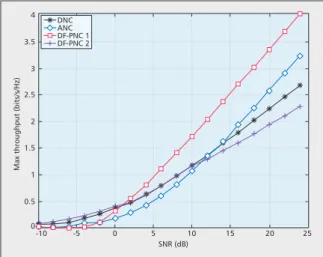
3. Decode and forward PNC type 2 (DF-PNC 2). In this approach the relay decodes both the superimposed signals by means of multiuser detection [46]. After that, it transmits a linear combination of the digital packets. This approach is not a↵ected by noise propagation but requires decoding more information than DF-PNC 1 and this fact can heavily a↵ect the system per-formance.
In Fig. 2.3 [33], a comparison between the main four protocols of NC is presented. Namely DNC is compared to ANC, DF-PNC 1 and DF-PNC 2. As it can be noticed, DF-PNC 1 is the overall winner, because it can successfully suppress the noise at the relay, hence it is not a↵ected by error propagation, unlike ANC. On the other hand, the necessity for DF-PNC 2 to decode both the superimposed signals induces a big performance loss also with respect to DNC.
Up to our knowledge, little research has been done on applying PNC features in a suitable MAC protocol for multicast traffic. The seminal work of S. Zhang et al [39] led the research community to focus its attention to practical implementations of this topic. According to [47], “PNC was originally proposed as a way to exploit the network coding operation that occurs naturally in superimposed electromag-netic (EM) waves”. The first implementation of PNC for a two-way relay network was presented in [48] and [49]. In these works the relay has to deal with symbol and carrier-phase asynchronies of the concurrent signals received from the two end nodes. A simple implementation case of PNC called Analog Network Coding (ANC) was presented in [40]. In ANC the assumption of perfect collision synchronization is relaxed. The decoding is performed by combining a two-packet collision with a priori information of one of the two packets, gained by previous clean reception. One proposal that builds on the idea of ANC is ZigZag decoding [50]. ZigZag is a new form of interference cancellation that exploits asynchrony across successive col-lisions. Specifically, 802.11 retransmissions, in the case of hidden terminals, cause successive collisions. These collisions have di↵erent interference-free stretches at
16 2.3. Cooperative Network Coding Techniques
Figure 2.4: ZigZag decoding with two successive collisions of the same packets [50].
their start, as shown in Fig. 2.4 [50], which ZigZag exploits to bootstrap its decod-ing. ZigZag makes no changes to the 802.11 MAC and introduces no overhead when there are no collisions. In the cases that senders frames collide, ZigZag attains the same throughput as if the colliding packets were a priori scheduled in separate time slots. The idea is based on a hidden terminal scenario, where two users are out of the transmission range of each other and at the same time they are associated with the same AP, hence their uplink transmissions present high probability of collisions. The retransmission of the collided packets will provoke a new collision with di↵erent interference-free stretches at their start. While PNC and ANC collision resolution only applies for two collided packets, ZigZag is able to decode more than two col-lided packets under the assumption that it receives an equal number of di↵erently overlapped collisions. In [51], a cooperative protocol allows two interfering senders to retransmit selected lost packets forcing a collision and using Analog Network Coding (ANC) to resolve the collision when having a priori information for one of the two colliding packets. This Cooperative Retransmission Through Collision (CRTC) protocol, which we use for comparison with our proposed scheme, presents higher throughput compared to traditional ARQ retransmission schemes. While ZigZag, from which we were partly inspired, is proposed to resolve collisions during the uplink transmissions of stations (STAs) to their base station (BS), we follow a di↵erent approach in downlink, where the collisions are provoked from multicast transmissions of di↵erent BSs in their overlapping areas. The cooperative approach we propose aims at the leverage of the collision resolution using ANC.
2.3.4
MIMO Network Coding
MIMO is well known to provide diversity and is robust to errors and noise. Given this property, MIMO is able to retrieve information even if some of the antennas are subject to strong fading. Such features are especially desirable in NC, as the loss of a coded packet may delay the whole decoding process. This area is still rather unexplored. In [38], the usage of coherent MIMO signal processing for NC detec-tion is investigated. The underlying principle is to use the channel state estimates and NC coefficients to perform joint demodulation and NC decoding based on the received analog signals. A straightforward application of this principle is Phoenix [52], where MIMO-NC is proposed. This work has shown how to get the diversity gain of cooperation with the throughput efficiency of NC by means of signal pro-cessing techniques borrowed from MIMO. Through MIMO-NC it was shown that
Chapter 2. O✏oading with Cooperative Physical Layer Network Coding 17
separation of network coding and channel coding implies non-negligible performance degradations. Combining these two techniques entails more complexity in the sys-tem, and the question of what is the trade-o↵ between performance, redundancy, and complexity has only been partly investigated and is still an open territory.
2.4
CooPNC: A Cooperative Multicast Protocol
Exploiting Physical Layer Network Coding
2.4.1
CooPNC Overview
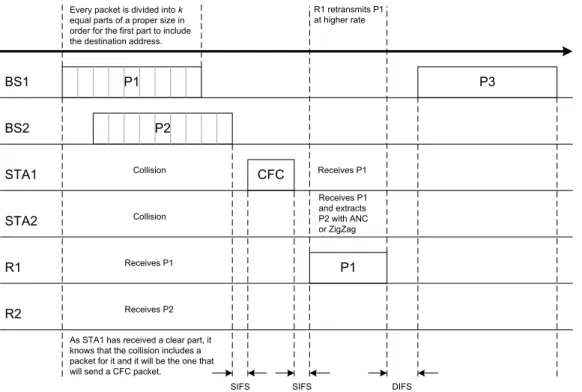
For the sake of simplicity in the description of the basic operation of CooPNC, we firstly consider only two partially overlapping short range communication networks. Each network consists of a multi-radio Base Station (BS) that receives data through a cellular network connection (e.g. 3G, LTE) and disseminates the information through a short range multicast scheme to its associated users, which are the stations (STAs) of each network. As presented in Fig. 2.5, STA1 and STA2 are associated with BS1 and BS2 respectively, and lie in an overlapping section of the transmission ranges of the two BSs. Each network also includes other STAs, like R1 and R2 that are subscribed to the multicast address and can also act as relays to carry out the resolution of collisions. The relay selection problem is out of the scope of this work. Every STA is associated with one BS but at the same time it is able to receive frames from other adjacent networks. This functionality can be implemented using for example the promiscuous mode in IEEE 802.11. As in IEEE 802.11 [9] that supports multicast transmissions by simply transmitting without any feedback, we assume that there is also no use of acknowledgements in this multicast scenario. In this situation there is a high probability of collisions within neighbouring short range communication networks. The collisions occur in the overlapping areas like area C in Fig. 2.5. This fact leads to a lower QoS in terms of throughput and delay for wireless applications that are based on the UDP transport layer protocol. It is worth mentioning that STAs located in area C su↵er from the exact same collisions, as BS1 is hidden to BS2 and vice versa. The relays R1 and R2, that are situated outside the collision area, may facilitate the reliable reception of collided packets P1 and P2 originated from BS1 and BS2 respectively, by retransmissions at a higher rate than the multicast transmissions. In a conventional cooperative scheme, STA1 and STA2 would wait for an exponentially increasing back-o↵time and then send a control packet, namely a CFC packet, to request a retransmission of the lost data, while the BSs receiving a CFC packet would infer that a collision has occurred and will defer from transmitting new packets, invoking the execution of their own back-o↵ algorithms. This conventional cooperative approach would induce high delay in the successful retransmission of the lost packets and at the same time the idle time of the network would be noticeably extended due to the back-o↵ algorithms running in STAs and BSs. Both e↵ects would a↵ect negatively the overall throughput and energy consumption of the neighbouring networks.
18
2.4. CooPNC: A Cooperative Multicast Protocol Exploiting Physical Layer Network Coding BS1 BS2 STA1 STA2 R2 R1 LTE LTE A C B P2 P2 P2 P1 P1 P1
Figure 2.5: Multicast Transmission Scenario.
P1 from BS1 to STA1 k k 2k-1 P2 from BS2 to STA2 P1 from BS1 to STA1 k k 2k-1 P2 from BS2 to STA2
Figure 2.6: Distinguishing Symmetrical Collision Cases.
of the network through indirect inter-group cooperation, by exploiting ANC. In the scenario presented in Fig. 2.5, let’s assume that there is a collision of Packet 1 (P1) and Packet 2 (P2) originated from BS1 and BS2, respectively. In order to solve this collision, we propose to use Zag or ANC, depending on the conditions the collision has occurred, and we assume that CFC packets are always sent by the STA that had first started receiving its packet before the collision occurred. This is why we consider the symmetrical collisions depicted in Fig. 2.6 as di↵erent collision cases, as in the first case a CFC packet will be transmitted by STA1, while in the second case by STA2. In case both packets arrive almost at the same time instant, resulting in a situation where none of the STAs is able to identify its own address in the Destination Address (DA) field, we introduce the use of a register, stored in the wireless interface card’s driver of each STA, that is OFF for the last STA that sent a CFC during the previous collision, and ON for the STA that had benefit in resolving the collision by a relay of the neighbouring network. In these cases, the CFC packet will be only sent by the STA having its register set to ON and the values of the registers will change. With this mechanism we ensure that only one CFC will be sent by colliding STAs after each collision. In Fig. 2.7 STA1 has sent a CFC and a cooperation with R1 is in progress. When R1 transmits P1 to STA1, it is overheard by STA2, which now can exploit the ANC feature and export its own packet (P2) from the last collision. In the case that STA2 resolves the collision by a