Using fleets of electric-drive vehicles for grid support
Jasna Tomi´c
∗, Willett Kempton
University of Delaware, Newark, DE 19716, USA
Received 15 January 2007; received in revised form 6 March 2007; accepted 6 March 2007 Available online 12 March 2007
Abstract
Electric-drive vehicles can provide power to the electric grid when they are parked (vehicle-to-grid power). We evaluated the economic potential of two utility-owned fleets of battery-electric vehicles to provide power for a specific electricity market, regulation, in four US regional regulation services markets. The two battery-electric fleet cases are: (a) 100 Th!nk City vehicle and (b) 252 Toyota RAV4. Important variables are: (a) the market value of regulation services, (b) the power capacity (kW) of the electrical connections and wiring, and (c) the energy capacity (kWh) of the vehicle’s battery. With a few exceptions when the annual market value of regulation was low, we find that vehicle-to-grid power for regulation services is profitable across all four markets analyzed. Assuming now more than current Level 2 charging infrastructure (6.6 kW) the annual net profit for the Th!nk City fleet is from US$ 7000 to 70,000 providing regulation down only. For the RAV4 fleet the annual net profit ranges from US$ 24,000 to 260,000 providing regulation down and up. Vehicle-to-grid power could provide a significant revenue stream that would improve the economics of grid-connected electric-drive vehicles and further encourage their adoption. It would also improve the stability of the electrical grid.
© 2007 Published by Elsevier B.V.
Keywords: Electric-drive vehicles; Energy storage; Vehicle-to-grid power; Ancillary services; V2G
1. Introduction
Several recent studies[1–6]show that electric-drive vehicles (EDVs) may profitably provide power to the grid when they are parked and connected to an electrical outlet. We call this vehicle-to-grid power (V2G). In other studies[7,8], we analyzed V2G from three types of electric-drive vehicles – battery, fuel cell, and plug-in hybrid – and analyzed the economic potential for individual vehicles to provide power for baseload, peak power, and for the electric grid services known as ancillary services (A/S), as well as storage for renewable energy sources[9]. The focus of the current paper is a more near-term opportunity, using fleets of battery-electric vehicles to provide ancillary services. We focus here specifically on one type of ancillary service-regulation. We decided to analyze utility fleets because they have in-company expertise in, and need for, ancillary services. Also,
∗Corresponding author. Present address: WestStart-CALSTART, 48 S Chester
Ave, Pasadena, CA 91106, United States. Tel.: +1 626 744 5695; fax: +1 626 744 5610.
E-mail addresses:[email protected](J. Tomi´c),[email protected]
(W. Kempton).
URL:http://www.udel.edu/V2G (W. Kempton).
compared to individual vehicles, fleets are more easily accom-modated within existing electric market rules, which typically require power blocks of 1 MW. We selected battery-electric vehi-cles over plug-in hybrids and fuel cell vehivehi-cles because battery vehicles already must be grid connected (in order to recharge the batteries) and because such fleets already exist. Among the ancillary services, we analyze regulation because: (a) it has the highest market value for V2G among the different forms of elec-tric power (much higher than peak power, for example), (b) it minimally stresses the vehicle power storage system, and (c) because battery-electric vehicles are especially well suited to provide regulation services.
We begin the paper with a section that explains why battery-electric vehicles are a good source of power for ancillary services. First, we describe ancillary services in general and, in more detail regulation. Then we describe the main principles and components of vehicle-to-grid power as well as the advantages of using EDVs for regulation services.
Section2provides the general equations used in the calcu-lations of the value and cost of V2G for regulation. Cost and revenue calculations are introduced in this section as well. Then the electrical power capacity for V2G and the costs of providing V2G power are quantitatively defined.
0378-7753/$ – see front matter © 2007 Published by Elsevier B.V. doi:10.1016/j.jpowsour.2007.03.010
In Section3, we present two case studies of battery EDV fleets providing V2G power for regulation. The results of the economic value created by each fleet are presented based on the general equations described. We then expand these two cases to calculate the economic value that these two fleets costs are presented in US$ would offer in different A/S markets across the country. All cost and revenue calculations in this article are in US$. 2. Vehicle-to-grid power for ancillary services 2.1. Ancillary services
In the electric power system, ancillary services are neces-sary for maintaining grid reliability, balancing the supply and demand, and supporting the transmission of electric power from seller to purchaser. They are not widely known because prior to restructuring of the power sector, they were bundled with the energy supply and the cost of ancillary services was hidden in the overall energy rates and operating expenses. With deregula-tion however, some jurisdicderegula-tions have created separate markets for ancillary services, making their costs more apparent.
We are concerned here with regulation ancillary service. The main purpose of regulation is to adjust the grid, specifically the local control area, to the target frequency and voltage. Regu-lation helps maintain interconnection frequency, balance actual and scheduled power flow among control areas, and match gen-eration to load within the control area[10]. The required amount of regulation service is determined as a percentage of aggre-gate scheduled demand. In California for example, regulation requirements range between 5 and 10% of the scheduled load
[11].
Generators providing regulation are operated differently from generators providing just bulk power. For regulation, generators ramp up and down to match the needs of fluctuation in the grid. Regulation is provided continuously (24 h a day) by genera-tors that are online, equipped with automatic generation control (AGC) and will respond quickly (within minutes) to control cen-ter requests to increase or decrease power output. In states with Independent System Operators (ISOs), the ISO may purchase ancillary services and/or require individual utilities to provide
an amount commensurate with their loads. The important char-acteristic of the ancillary services market price is that it has two parts—a capacity price and an energy price. The capacity price is the price paid to have a unit available for a specified service while the energy price is the price paid for the energy output when a unit is called in real time to supply incremental or decremental energy.
2.2. Vehicle-to-grid power: an improved power source for ancillary services
The basic concept of vehicle-to-grid power is that EDVs pro-vide power to the grid while they are parked. The EDV can be a battery-electric vehicle, hybrid, or a fuel cell vehicle connected to the grid. Details on the economic analysis for all three types of EDVs can be found elsewhere[7,8]. Battery EDVs provide their stored electricity for V2G power.
Each vehicle must have three required elements for V2G: (a) a power connection to the grid for electrical energy flow, (b) control or logical connection necessary for communication with grid operators, and (c) precision metering on-board the vehicle.
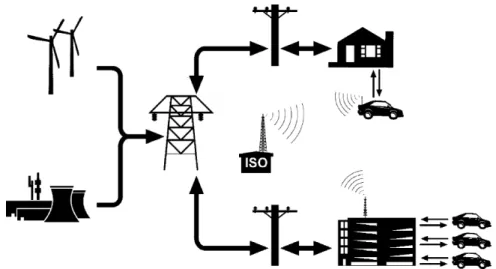
Fig. 1is an illustration of connections between vehicles and the electric power grid. The control signal from the grid operator is shown schematically as a radio signal, but this might be through the medium of a cell phone network, direct internet connection, or other media. In any case, the system operator (ISO or util-ity) sends requests for ancillary services to a large number of vehicles. The signal may go directly to each individual vehicle, schematically in the upper right ofFig. 1, or via a fleet’s home office to vehicles centralized in a fleet parking lot, schematically shown in the lower right ofFig. 1.
To understand why V2G makes sense, one must under-stand the scheduling and economic value of V2G. In order to schedule dispatch of power, a grid operator needs to rely that enough vehicles are parked and potentially plugged in at any minute during the day. In the US, an average personal vehi-cle is on the road only 4–5% of the day, which means that a great majority of the day the vehicles are parked. Our prior analysis estimates that at least 90% of personal vehicles are parked even during peak traffic hours[7]. For fleet vehicles
dictability of using V2G is excellent because they follow a daily schedule.
The economics question is second. While electricity from V2G is not cheap when compared to bulk electricity from large power plants (e.g. US$ 0.30/kWh versus $ 0.05/kWh), it can be competitively used for ancillary services because of the two parts that make up the price of power in the ancillary service market—capacity price and energy price. When a generator, in this case a battery-vehicle, provides ancillary services it is paid a capacity price for being available to respond on a minute’s notice, and an energy price for the actual energy output. The energy output may be quite small, making the cost to produce each kWh of little consequence for the overall economics. More important factors than cost per kWh are: (a) the capital cost of generation or storage equipment, (b) ability to vary output quickly, and (c) ability to operate in these modes without serious maintenance penalties. Vehicles are better than central genera-tors on all three counts, as we detail elsewhere[8]. The capital cost of vehicles can be attributed to their transportation function, since our proposed operating modes for ancillary services do not affect vehicle operation.
To add V2G capability to a battery EDV, two capabilities must be added. First, the on-board (vehicle) power electron-ics designed for V2G and second, real-time control so that the ISO or grid system operator can request power exactly when needed. Electric system operator control is essential because V2G has value greater than its cost only if the buyer (the elec-tric system operator) can determine the precise timing of the dispatch. Of course the dispatch would be within limits set by the driver or fleet operator and such that the driver or fleet oper-ator would have always sufficient power left in the battery for driving.
Unlike large generators, battery EDV’s energy storage and power electronics are already designed to provide large and fre-quent power fluctuations over short time periods, due to the nature of driving. This makes these vehicles especially well engi-neered for regulation. Once a signal is received, the vehicle can respond in less than a second to change its power output. A “reg-ulation up” signal would cause the vehicle to provide power to the grid (V2G) and a “regulation down” signal would cause a decrease in the power output or even draw power from the grid (the regular battery charging mode). Brooks[12]successfully demonstrated use of a single battery electric vehicle to respond to a regulation signal.
3. Value of V2G power for regulation
This section develops the equations used to calculate the value of V2G for regulation. In separate subsections, we introduce the calculation for revenue, cost, and electrical power capacity for V2G. These general equations are subsequently used to calculate the values of V2G for our case study fleets.
3.1. Revenue of V2G power for regulation
Calculations for revenue and cost for regulation services make the following assumptions. Regulation is purchased by
a distribution company, and cost and revenue are calculated on an annual basis. Payments for regulation are based on two com-ponents: (a) a contract payment for availability (in US$/MWh) plus (b) an energy payment per kWh when power is produced.
Yearly revenue from regulation up is calculated using Eq.(1)
rReg−up=(pcapP tplug)+(pelP tplugRd-c) (1) where pcap is the capacity price in US$/kW-h,tplug the time in hours the EDV is plugged in, pel the market (selling) price of electricity (US$/kWh) andPis the power of the vehicle or power of the line in kW (described later in a separate section). The capacity prices for regulation up and regulation down (pcap) are obtained from system operator data for each region being analyzed. We use the market clearing prices in the day-ahead markets to derive the average price in a year (in US$/MW-h). Note that the unit US$/MW-h refers to a power capacity con-tracted for 1 h and should not be confused with MWh, a unit of energy produced. This contract payment value is determined by the particular power market or ISO region and varies from region to region.
The termtplugis determined directly as the time that the vehi-cle is plugged-in, or potentially plugged, and available for V2G. The term (Rd-c) is the dispatch to contract ratio, which in com-bination withtplugdefines the dispatch of V2G power. TheRd-c is defined by Eq.(2) Rd-c= E disp Pcontrtcontr = Edisp P tplug (2) This ratio is defined by the energy dispatched for reg-ulation as a proportion of contracted power and contracted time (kWh/kW*h). In the case of regulation, tcontr=tplug and Pcontr=P, where Pis power of vehicle or power of line (dis-cussed later). We requested the data for the ratio from multiple utilities and grid operators but found that this ratio is not tracked or recorded[7–9]. Therefore, theRd-cratio was calculated based on a signal available for frequency regulation from California ISO (CAISO) during a course of a day[13]and modeling the response of one EDV. The result is a value of 0.10 forRd-cwhich we use in the present analysis.
Battery EDVs are best suited to provide both regulation up and down, as the result is no net change in battery charge. How-ever, a near-term approach would be to simplify controls and approval by providing regulation down only, so power flows only from grid to vehicle. Yearly revenue from regulation down only is defined by Eq.(3):
rReg-down=(pcapP tplug) (3)
If the EDV is providing only regulation down, (battery is only charging) the battery may become fully charged and therefore tplugwill be shorter than when the EDV is performing both reg-ulation up and down. In our calcreg-ulations we assumed that the battery is at 50% state of charge at the start of regulation down mode. More details on calculatingtplugin this case are shown later in Section3.3.
3.2. Cost of providing V2G power for regulation
The cost to produce regulation up is calculated as the cost to produce each kWh times the number of kWh produced per year. Cost for regulation down is considered zero because regulation down is the same as charging the battery, thus it is “free charging” at times when the vehicle is providing regulation down. Yearly cost for regulation up is:
cReg-up=(cenP tplugRd-c)+cac (4) Yearly cost from regulation down is:
cReg−down=0 (for regulation up and regulation down) (5) or
cReg-down=cac(for only regulation down) (6) wherecReg-upandcReg-downstand for total cost of regulation up or regulation down,centhe cost per energy unit in US$/kWh and includes cost of electricity, losses, plus battery degradation costs, andcacis the annualized capital cost for additional equipment needed for V2G.
The economic viability of V2G depends critically on the cost to the vehicle owner to produce V2G power. Eq. (7) is used to calculate the per kWh cost to the battery EDV owner for providing power to the grid and Eq.(8)is used to calculate cost of battery degradation cen= c pe ηconv+cd (7) cd= cbat LET = (Escb)+(cltl) LCEsDoD (8) wherecpeis the cost of purchased electricity for recharging in US$/kWh (in most cases equal to $0.05/kWh),cdcost of battery degradation in US$/kWh calculated as shown in Eq.(8),ηconv the conversion efficiency of fuel or electricity—in this case it is the two-way electrical efficiency (electricity to battery storage and back to electricity), which for a more efficient than aver-age battery EDV is 0.73, cbat the battery replacement cost in US$ (capital and labor costs),LETthe battery lifetime energy throughput for a particular cycling regime in kWh,Esthe total energy storage of the battery in kWh,cbcost of battery replace-ment in US$/kWh,cl the cost of labor in US$/h,tl labor time required for battery replacement, andLCis battery lifetime in cycles. We assume here that battery replacement is determined by its cycle life, not calendar life. (For some batteries and driv-ing cycles, calendar life would be reached first, in which casecd would be a zero cost rather than the values we calculate here.)
Regulation requires a modification regarding the battery degradation costs which will be lower as a result of the shallow type of cycling for regulation rather than deep charge/discharge cycling that battery degradation tests usually assume. It has been shown that shallow cycling has much less impact on battery energy throughput than more common deep cycling. For exam-ple, test data on a Saft lithium-ion battery show a 3000-cycle lifetime at 100% discharge, and a 1,000,000-cycle lifetime at 3% discharge[14]. If we use these data to calculate throughput
(see Eq.(8),LET=LCEsDoD), then at 3% DoD the throughput is 10 times greater than the throughput at 100% DoD. A sim-ilar relationship of throughput and DoD is also suggested by Miller and Brost[15]. Their Fig. 8 suggests that at 3% DoD the throughput is about 28 times greater than at 80%. The relation-ship of DoD and throughput depends on the electrochemistry of the battery. In lack of data specific to the battery types consid-ered in this paper, and to be conservative, we choose to use here a factor of 3 greater throughput at shallow cycling compared to deep cycling.
The other cost component of delivering V2G power is the fixed cost, expressed as annualized capital costcacfor additional equipment required for V2G. A simple way to annualize a single capital cost is to multiply the cost by the capital recovery factor (CRF) as in Eq.(9)
cac=cc×CRF =cc× d
1−(1+d)−n (9) whereccis the capital cost (the one-time investment) in US$,d the discount rate, andnis the time during which the investment is amortized in years.
Fixed costs can be incurred on the vehicle’s power electron-ics and connectors, and off-board due to charging station or wiring upgrades. Battery EDVs already must have electrical connections for recharging their batteries. To add V2G capa-bilities requires little modification to the charging station and no modification to the cables or connectors, but the on-board power electronics must be designed for this purpose. AC Propul-sion, Inc. has designed and built a power electronics system that allows charging from and discharging to the grid and includes extensive control and safety to ensure no back feeding of power onto the grid during an outage[16]. The incremental cost of the power electronics system is reported to be US$ 400, assuming moderate production runs[17,13]. Another fixed cost is that we assume the necessity of on-board metering of electrical flow for billing purposes. We assume use of a chip available from Analog Devices, Inc with original equipment manufacturer (OEM) cost of US$ 3.00[18]. With additional parts and labor, we estimate that the total incremental cost for an on-board electric metering system is US$ 50. A wireless communication system would be necessary to allow communication with the ISO. The cost of a wireless system installed in production scale is estimated around US$ 100[17]. Thus, for battery EDVs, the total capital cost is equal to US$ 550. This capital cost annualized according to Eq.
(10)using a discount rate of 10% over a period of 10 years, amounts to US$ 90 per year, per vehicle.
When the vehicle is providing only regulation down, the capi-tal cost is lower. In this case, power flows only from the grid to the vehicle and the vehicle would require only the on-board meter-ing device (US$ 50) and the wireless interconnection (US$ 100). The incremental capital cost is only US$ 150 and the annualized cost (using Eq.(9)) is US$ 25 per vehicle.
3.3. Electrical power capacity
The electrical power capacity available for V2G is deter-mined by two factors: (a) the limitation of the electrical circuit
where the vehicle is connected, and (b) the stored energy in the battery divided by the time it is used. The electrical cir-cuit limit is computed from the circir-cuit’s ampere capacity (A), multiplied by the circuit’s voltage (V). This term we call the power capacity of the line or Pline. For example, with home wiring at 240 V AC, and a 50 A circuit rating typical for a large-current appliance such as an electric range, the power capacity is 50 A×240 V, or 12 kW. Based on practical limits on typical home and commercial circuits, here we use 15 kW as thePline limit.
The limit imposed on the electrical power capacity for V2G by the vehicle (Pvehicle) is a function of the energy stored onboard (i.e.in the batteries), the dispatch time needed, and the driver’s requirement for driving range. The formula for calculatingPveh for battery EDVs is shown in Eq.(10):
Pveh = EsDoD−ddηveh+drb ηinv tdisp (10) wherePvehis power capacity in kW,Esthe stored energy avail-able in kWh, DoD the maximum depth of discharge of the battery, usually 80% for NiMH and 100% for Li-Ion batteries, ddthe distance driven in miles since the battery was full (we use 16 miles as half of the US average daily vehicle miles traveled
[19],drbthe range buffer required by the driver in miles and is equal to 20 miles based on the minimal range required by US drivers[20],ηvehthe vehicle driving efficiency in miles kWh−1,
ηinv the efficiency of the inverter and other power electronics (dimensionless) with a value of 0.93, andtdispis the dispatch time in h. The dispatch time will be a fraction of the plugged-in time.
The electrical power capacity for regulation is determined by the limits imposed byPlinerather than thePveh. When V2G is used for regulation Pveh is a much higher value than Pline due to short instantaneous dispatch time (usually on the order of 1–4 min). More details on this can be found in our recent paper[8]. In the calculations in the present paper, we use sev-eral values for power capacity. We use 15 kW as the upper limit of typical wiring circuits, 6.6 kW as the limit given by Level 2 chargers, and any lower limits imposed by the electronics on the vehicle itself (as we will see in the example of Th!nk City vehicles). When the vehicle is providing regulation down only (power flowing from grid to vehicle), the power capacity will be defined by wiring and the electronics (Pline), but stor-age capacity of the battery and DoD will determine how long the vehicle will be plugged-in (tplug) before the battery is full. SubstitutingEdisp=EsDoDηchargerandP=Plineinto Eq.(2)and then rearranging it, we arrive at Eq.(11)
tplug= Es
DoDηcharger
PlineRd-c
(11) whereηchargeris the efficiency of the charger, or efficiency of line AC to battery charge, with a value of 0.93. In regulation down only mode, we assume that DoD is 50% at the start so after the battery is fully charged, the vehicle will not be available to provide regulation down.
Table 1
Vehicle characteristics of Th!nk City
Vehicle characteristics Th!nk City
Battery type NiCd, 100 Ah 19 modules 6 V
Energy stored (kWh) 11.5
Maximum depth of discharge (%) 80 Maximum power to motor (kW) 27
Effveh(miles/kWh) 5.71
Max range (miles) 53
Battery cycle life (cycles)a 1500 Battery cost OEM ($/kWh) 300b(600c)
Replacement labor (h) 8
aAt 80% depth of discharge.
bOEM cost, from verbal communication Lipman[21].
cRetail cost that individual customers pay for replacing the battery pack[22].
Table 2
Comparison ofPlineof Th!nk City depending on the limit of the vehicle and
station electrical connections
Types of electrical connections Ampere capacity (A)
Voltage (V) Pline(kW)
Th!nk City connected at a station 14 208 2.9 Station electrical connection 30 208 6.2 4. Value of V2G power using utility fleets
Using the general equations defined in the previous section, we use two actual utility fleets as case studies and calculate the net revenue from those fleets selling regulation from V2G. 4.1. Fleet Case A
This fleet consists of 100 Th!nk City cars leased by Ford Company to commuters in New York State, under management of New York Power Authority (NYPA).1Participants drive the vehicles from their home to the commuter station in the morning, charge up at the station using charging stations there, and com-mute home in the afternoon. Chargers are also being installed at the homes. The specifications of the Th!nk City are listed in
Table 1.
The electrical power capacity available for regulation for this vehicle fleet is limited by the electrical connections on the vehi-cle and at the station, in other words byPline. The Th!nk City has on-board electrical connections of 14 A while the station elec-trical connections are at 30 A. Table 2lists the differentPline capacities based on the limit of the vehicle’s electrical connec-tions or the limit of the station’s electrical connecconnec-tions. In our calculations, we use both power capacities of 2.9 and 6.2 kW.
Using Eqs.(7)–(9)and cost of purchased electricity of US$ 0.05/kWh we calculate the cost of energy for regulation (cen). Cost of energy for regulation up and down is US$ 0.16/kWh and the annualized capital cost per vehicle is US$ 171. For
reg-1The program was launched in 2002 with the actual number of vehicles in
operation varying with the gradual phase-in and phasing-out. Although the cur-rent number of vehicles in operation may be smaller, we base the analysis on the 100 vehicles.
Table 3
Cost of energy and annualized capital cost for V2G power using Th!nk City Ancillary service cen(US$ kWh−1) cac(US$)
Regulation up and down 0.16 171
Regulation down only 0 25
ulation only, the cost of energy is 0 and annualized capital cost per vehicle is much less, only US$ 25. The results are listed in
Table 3.
To calculate the value of V2G power for regulation we use market data from New York ISO.Table 4lists the average market values for regulation for 4 consecutive years. The values shown are average yearly values in the day-ahead market expressed in US$/MW-h, and apply to both regulation up and regulation down. In some markets, there are separate prices for regulation up and for regulation down, as we will see later.
The market price for regulation in the NYISO ranges from US$ 11–27/MW-h with 1 year having the lowest value (i.e. US$ 11/MW-h in 2001). As we will see later, this will affect the results. The use of the commuter vehicles is estimated at 1 h each day and thus their availability for V2G, or tplug, is 23 h per day. Using the market value for regulation and Eqs.(1)–(4)
we calculate the annual profit for the Th!nk City fleet providing regulation up and down. The cost and net profit values for the 4 years are shown inTable 5. The costs include annualized capital costs for providing regulation.
Regulation up and down from this fleet is profitable in all years with the exception of 2001 when the market clearing price was very low causing negative profits. The market price of regu-lation in 2001 was too low making V2G power for reguregu-lation not profitable. On the other hand this vehicle fleet at 2003 market prices would net over US$ 20,000 at 2.9 kW, and around US$ 70,000 if upgraded to 6.2 kW. The profits for this particular fleet are more interesting at higher power capacity of 6.2 kW.
We can use the same fleet for regulation down only. The availability of the vehicle to provide regulation down is smaller and restricted by the state of charge of the battery at the point of starting to provide regulation down. We assumed in our cal-culations that the battery is 50% charged at the initial point of connecting for V2G. Using Eq.(11), we obtaintplugof 18 h (per day) at 2.9 kW and 8.6 h at 6.2 kW. This is the maximum num-ber of hours this vehicle can provide regulation down before the battery is fully charged. Using Eqs.(3)and(6), we obtain the annual cost and net profit for this fleet providing only regulation down. The results are listed inTable 6for 4 different years.
The cost amount comes directly from the annualize capital cost per vehicle (US$ 25, seeTable 3) and is independent of the
Table 4
New York ISO average market prices for regulation
Year Regulation price (US$/MW-h)
2000 20.9
2001 10.9
2002 19.7
2003 27.5
power capacity of the vehicle. The net profits span from a low of US$ 19,000 to a high of US$ 51,000 reflecting the different market prices of regulation in the 4 years analyzed and are not sensitive to the power capacity of the vehicle. The reason that the profits are not sensitive to power capacity is because the number of hours that the vehicle can be plugged in each day decreases with the increase in power capacity. Based on the above results and the values from Table 5for regulation up and down, we conclude that for this EDV fleet it is more lucrative to provide only regulation down.
4.2. Fleet Case B
Our second case study is an investor-owned utility with a substantial fleet of battery EDVs. This utility’s EDV fleet con-sists of 252 Toyota RAV4 EDVs.2The fleet vehicles are in use
mostly for meter reading during the day and are parked after 3 p.m. when their state of charge is between 30 and 50%. They are thus available for V2G from 3 p.m. to 8 a.m., or a total 17 h per day. The specifications of Toyota RAV4 EDVs are listed in
Table 7.
The power capacity for regulation is limited by the capacity of the electrical connections or in this case primarily it is limited by the charger or limits of home or commercial circuits. We use two capacities: 6.6 kW reflecting today’s (Level 2) vehicle chargers and 15 kW based on practical limits on a home or typical commercial circuit. At the 6.6 kW the total power capacity of this fleet is 1.67 MW and at 15 kW it is 3.78 MW. The cost of energy and annualized capital costs for RAV4 providing V2G power are listed inTable 8.
The historical market clearing prices for regulation up and down for the California ISO (CAISO) are listed inTable 9. The prices are the average yearly values of the day-ahead market clearing prices in US$/MW-h with separate prices for regulation up and regulation down.
Separation of the regulation up and regulation down also allows for the EDVs to bid into both markets simultaneously. Based on the above data and Eqs.(1)and(3), we first calculate the net annual profit for providing regulation up and down from this battery EDV fleet. The results are shown inTable 10.
The profits range between roughly US$ 150,000 and 2.1 mil-lion. This large span reflects fluctuations in the market price for regulation, but even in the year with the lowest market prices, the calculated profit for the fleet is considerable—around US$ 150,000 at 6.6 kW and around US$ 350,000 at 15 kW. Provid-ing V2G power for regulation services (up and down) is very profitable for this particular case.
Another option is for the vehicle fleet to provide only regula-tion down service. Thetplugwill depend on the power capacity and using Eq.(11)we calculate thattplugis 19 h for 6.6 kW (same as the total available time of the vehicles) and 8.5 h for 15 kW. Using Eqs.(3)and(6)we calculate the value of providing reg-ulation down only.Table 11lists the calculated annual cost and
2 The actual number of vehicles may vary from year to year depending on
Table 5
Annual profit for Th!nk City fleet of 100 vehicles providing regulation up and down
Power per vehicle (kW) Cost fleet (US$) Fleet annual net profit (US$)
Year 2000 Year 2001 Year 2002 Year 2003
2.9 55,500 7,300 −17,000 4,300 23,200
6.2 99,500 35,300 −16,800 28,700 69,400
Table 6
Annual net profit for Th!nk City fleet of 100 vehicles providing regulation down only Power per vehicle (kW) Cost (US$) Annual net profit (US$)
Year 2000 Year 2001 Year 2002 Year 2002
2.9 2,500 38,600 18,900 36,100 51,500
6.2 2,500 38,500 18,800 36,000 51,300
Table 7
Technical characteristics of the Toyota RAV4 EDV
Vehicle characteristics Toyota RAV4
Battery type NiMH
Energy stored (kWh) 27.4
Maximum depth of discharge (%) 80
Effveh(miles/kWh) 3.65
Maximum range (miles) 80
Battery cycle life (cycles)a 1750 Battery cost OEM (US$/kWh)b 350
Replacement labor (h) 10
aFrom Battery Panel Report 2000[23]. b More recent Ni–metal hydride models.
Table 8
Cost of energy and annualized capital cost for V2G power using Toyota RAV4 Ancillary service cen(US$/kWh) cac(US$)
Regulation up and down 0.15 90
Regulation down only 0 25
Table 9
Average annual CAISO market prices for regulation
Year Regulation up (US$/MW-h) Regulation down (US$/MW-h) 2000 54.5 15.4 2001 62.5 39.7 2002 12.9 14.0 2003 19.5 20.3 Table 10
Value of V2G power from the RAV4 EDV fleet for regulation up and down in CAISO market
Fleet power (kW)
Cost (US$)
Annual net profit (US$) Year 2000 Year 2001 Year 2002 Year 2003 At 6.6 kW 1,683 180,000 584,900 912,000 144,800 277,600 At 15 kW 4,233 380,000 1,358,000 2,102,000 358,000 659,700 Table 11
Value of V2G power from the RAV4 EDV fleet for regulation down only in CAISO market
Fleet power (kW)
Cost (US$)
Annual net profit (US$) Year 2000 Year 2001 Year 2002 Year 2003 At 6.6 kW 1,683 6,300 150,800 397,700 135,700 200,900 At 15 kW 4,233 6,300 172,300 452,800 155,100 229,200
annual net profit for the fleet of 250 RAV4 providing regulation down only.
The range of profits is from US$ 135,000 to 450,000 per year. The profits are much lower when providing only regulation down, but nonetheless may be attractive given that equipment changes and certification would be reduced.
In summary, this vehicle fleet could profitably provide V2G power for regulation up and down or for regulation down only. Most profitable though is regulation up and down because it pro-vides twice as much regulation due to the battery not filling up. 5. Value of V2G power from fleets in other A/S markets
The two cases evaluated these two fleets in their home ISOs, that is, in the ancillary service markets they actually would par-ticipate in. In order to evaluate the potential and profitability of V2G power for regulation services in other A/S markets (other ISO areas), we take the same two fleet cases and calculate the net profits if these fleets were providing regulation in other A/S market regions. The four ISO markets we examined are NYISO, CAISO, ERCOT (Texas), and PJM (Pennsylvania, New Jersey, and Maryland ISO)3. The market clearing prices for regula-tion for 4 years in these four different A/S markets are listed inTable 12.
3In the US currently there are two other ISOs: New England ISO and Mid
Table 12
Market clearing prices for regulation in several A/S markets (in US$/MW-h)
Year NYISO regulation CAISO ERCOT PJM regulationa
Regulation up Regulation down Regulation up Regulation down
2000 20.9 54.5 15.4 –b –b 35.9
2001 10.9 62.5 39.7 7.7 7.2 34.3
2002 19.7 12.9 14.0 6.5 5.1 31.7
2003 27.5 19.5 20.3 22.1c 7.9c 38.2
aThe data are for the PJM East market. Regulation in PJM West is not yet provided via a competitive market. b The ERCOT market started in summer of 2001.
cIncludes data January–March 2003.
We examine a fleet of 100 Th!nk City vehicle providing V2G power for regulation services in the four different A/S markets. All the costs and revenue calculations are the same as in Case A with the exception of changing the market clearing price for regulation depending on the specific A/S market. The results are presented inFig. 2with case (a) for power level of 2.9 kW, if limited by vehicle’s electrical connections, and case (b) for power level of 6.2 kW, if limited by station electrical connections (for details on electrical connections seeTable 2) (Fig. 3).
The results show that a fleet of 100 Th!nk City EDVs could provide regulation services with a net profit in three of the four markets. The ERCOT and the NYISO showed lower profits, and in few instances negative profits, when the market price of regulation was relatively low in a particular year. The other three
Fig. 2. Annual net profits in different ISO markets for a 100 Th!nk City fleet providing regulation up and down at (a) 2.9 kW and (b) at 6.2 kW.
markets seem relatively similar, with a range from around US$ 40,000 and the high around US$ 450,000. The CAISO market showed very high net profits in 2000 which was not a typical year for this market. The 2003 prices are more typical and the profits more similar among the four markets. As expected, the profits are larger at higher power levels.
Encouraged by the results for providing regulation down only, we analyzed this option in different A/S markets. The results are summarized inFig. 4with case (a) power level of 2.9 kW and case (b) power level 6.2 kW.
The earlier conclusions for providing regulation down only are supported in other A/S markets as well. While the maximum profits are lower in this case, they are consistently positive across the different markets and years making this a clearly interesting
Fig. 3. Annual net profits in different ISO markets for a 100 Th!nk City fleet providing regulation down at (a) 2.9 kW and (b) at 6.2 kW.
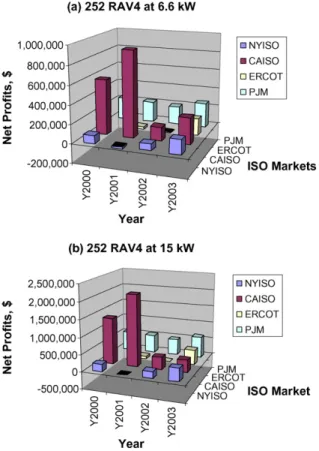
Fig. 4. Annual net profits in different ISO markets for a fleet of 252 RAV4 providing regulation up and down at (a) 6.6 kW and (b) at 15 kW.
option for this particular fleet. However, each market should be evaluated on its own to determine if it is economically more inter-esting to provide both regulation up and down or only regulation down.
We also calculated the net profits of a fleet of 252 Toyota RAV4 EDVs in these four different A/S markets. The results are presented inFig. 4with case (a) at 6.6 kW power level and case (b) at 15 kW power level.
The results are very positive with high net profits in most of the examined A/S markets. For the years we examined, the weakest market for V2G power seems to be ERCOT and NYISO. However, the other two A/S markets (CAISO and PJM) show very high profits for V2G power (e.g. US$ 2 million and 600,000). Overall these results are very encouraging for the prospects of V2G power from fleets of EDVs for regulation services.
6. Making V2G possible
Our calculations show that V2G power from EDV fleets is economically feasible. To allow implementation of V2G sev-eral barriers should be addressed. On the technical side these are related to batteries. First, the current batteries are not specif-ically designed and optimized for EVs. Second is the issue of battery cycle life which needs to be higher than in current bat-tery designs to support a greater number of charge/discharge cycles. The recent increased interest in hybrid and even plug-in hybrid vehicles will likely plug-increase the rate of progress
in battery development and address the abovementioned challenges.
A number of institutional barriers should be addressed as well. These include: (1) lack of vehicles aggregators to manage multiple fleets and individual vehicles, (2) regulation signal is not broadcast by all ISOs, (3) rates for regulation services are not available at the retail level, (4) no mass production of V2G capable vehicles, and (5) need for standards for V2G provision quality.
7. Conclusions
We have analyzed the use of V2G power from battery-electric fleets to provide regulation, which is a short-duration but high-value power market. The results vary across fleets and A/S markets which demonstrates the importance of fleet and region-specific analysis of economic attractiveness. Factors that emerge as important variables are: (a) the value of ancillary services in the area, (b) the power capacity (kW) of the electrical connec-tions and wiring, and (c) the kWh capacity of the vehicle battery. The amount of time the vehicles were on the road or discharged did not turn out to be a major variable. The results show that battery EDV fleets have significant potential revenue streams from V2G. In general, larger profits come from providing V2G power for regulation up and down but regulation down only option can be more attractive for certain vehicles and/or A/S markets. This should be evaluated for the specific fleet and A/S market combination.
EDVs can provide regulation of higher quality than cur-rently available—fast response to a signal, available in small increments, and distributed. From the perspective of the electric power sector, this is a new source of high quality grid regula-tion. For the EDV owners this is a significant revenue stream that would improve the economics of grid-connected EDVs and fur-ther encourage their adoption. The additional use of clean EDV vehicles not only for transportation but as a source of power has benefits for both the electric grid sector and the transportation sector.
Acknowledgements
Sections of the paper are drawn from a paper presented at the 20th International Electric Vehicle Symposium and Exposition, (EVS2); this article has been greatly modified and expanded. This work was funded in part by a grant from Steven and Michele Kirsch Foundation. We are grateful to the fleet managers and util-ity staff who provided data. Prior analysis of individual vehicles, upon which part of this article is based, was funded by the Cal-ifornia Air Resources Board and the Los Angeles Department of Water and Power. We also would like to acknowledge sup-port from Conectiv (now Delmarva Power). The statements and conclusions are those of the authors and not necessarily those of the funders.
References
[1] W. Kempton, S. Letendre, Transportation Research D 2 (1997) 157–175. [2] W. Kempton, T. Kubo, Energy Policy 28 (2000) 9–18.
[3] S. Letendre, W. Kempton, Public Utilities Fortnightly 140 (2002) 16–26. [4] D. Hawkins, Presentation at the EVAA Electric Transportation Industry
Conference, Sacramento, CA, 13 December, 2001, Presentation slides available at: http://www.acpropulsion.com/reports/Hawkins ETI.pdf. [5] A. Brooks, Presentation at the EVAA Electric Transportation Industry
Conference, Sacramento, CA, 13 December, 2001, Presentation slides available at: http://www.acpropulsion.com/reports/A%20Brooks% 20ETI%20conf.pdf.
[6] T. Lipman, J. Edwards, D. Kammen, Economic Implications of Net Metering for Stationary and Motor Vehicle Fuel Cell Systems in California, University of California, Berkeley, 2002, Available at: http://socrates.berkeley.edu/∼rael/papers.html#fuelcells.
[7] W. Kempton, J. Tomi´c, S. Letendre, A. Brooks, T. Lipman, Vehicle-to-Grid Power: Battery, Hybrid, and Fuel Cell Vehicles as Resources for Distributed Electric Power in California, Davis, CA. Institute for Transportation Stud-ies Report # UCD-ITS-RR-01-03, 77+xiv pages, June, 2001. PDF also available athttp://www.udel.edu/V2G.
[8] W. Kempton, J. Tomi´c, J. Power Sources 144 (2005) 279–285. [9] W. Kempton, J. Tomi´c, J. Power Sources 144 (2005) 280–294. [10] K. Brendan, E. Hirst, The Electricity Journal 14 (2001) 48–55.
[11] CAISO, California Independent System Operator, Weekly Market Watch (2001), available athttp://www.caiso.com/marketanalysis.
[12] A. Brooks, Final Report: Vehicle-To-Grid Demonstration Project: Grid Regulation Ancillary Service with a Battery Electric Vehicle, Contract number 01-313, Prepared for the California Air Resources Board and the
California Environmental Protection Agency, December 2002, available at:
http://www.acpropulsion.com/white papers.htm. [13] A. Brooks, unpublished data.
[14] N. Raman, K. Chagnon, K. Nechev, A. Romero, T. Sack, M. Saft, Proceed-ings of the 20ThInternational Electric Vehicle Symposium and Exposition,
EVS 20, Long Beach, CA, 15–19 November, 2002.
[15] J. Miller, R. Brost, Presented at the Advanced Automotive Battery Confer-ence, Las Vegas, NV, February, 2001.
[16] AC Propulsion AC-150 Gen-2 EV Power System: Integrated Drive and Charging for Electric Vehicles, available January 2007 at:
http://www.acpropulsion.com/technology/gen2.htm. [17] A. Brooks, Personal Communications (2001).
[18] A. Coolins, W. Koon, A temper-resistant watt hour energy meter based on the AD7751 and two current sensors, 2002, available at:
http://www.analog.com.
[19] P. Hu, J. Young, 1995 Nationwide Personal Transportation Survey, US Department of Transportation, 1999, available at: http://www-cta.ornl.gov/npts/1995/Doc/trends-report.pdf.
[20] K. Kurani, T. Turrentine, D. Sperling, Transport Policy 1 (1994) 244–256. [21] T. Lipman, Personal Communications (2000).
[22] H. Schon, Personal Communications (2001).
[23] M. Anderman, F. Kalhammer, D. MacArthur, Report: Advanced Bat-teries for Electric Vehicles: An Assessment of Performance, Cost, and Availability, Prepared for California Air Resources Board Battery Panel, Sacramento, CA, 2000.