E
S
E
A
R
C
H
R
E
P
R
O
R
T
I
D
I
A
P
D a l l e M o l l e I n s t i t u t e f o r P e r c e p t u a l A r t i f i c i a l I n t e l l i g e n c e•P. O. B o x 5 9 2• Martigny•Valais•Switzerland phone +41−27−721 77 11 fax +41−27−721 77 12 e-mail [email protected]internet http://www.idiap.ch
J
OINT
S
PEECH AND
S
PEAKER
R
ECOGNITION
Mohamed Faouzi BenZeghiba
aIDIAP RR 05-28
February 2005
TO APPEAR AS
BenZeghiba, M. F. (2005). Joint speech and speaker recognition. Docteur `es Sciences thesis, Swiss Federal Institute of Technology Lausanne (EPFL),
Lausanne, Switzerland.
awith the Dalle Molle Institute for Perceptual Artificial Intelligence (IDIAP), CH-1920 Martigny,
Switzerand, and with the Swiss Federal Institute of Technology Lausanne (EPFL), CH-1015 Lau-sanne, Switzerland
Abstract
The goal of the thesis is to investigate different approaches that combine and integrate Automatic Speech Recognition (ASR) and Speaker Recognition (SR) systems, with applications to (1) User-Customized Password Speaker Verification (UCP-SV) systems, and, (2) joint speech and speaker recognition.
Unlike text-dependent speaker verification systems, in UCP-SV systems, customers can choose easily their own password, which has to be pronounced a few times during enrollment to create a customer specific model that will be subsequently used for verification. The main assumption in such systems is that no a prioriknowledge about the password (such as its phonetic transcrip-tion) is available. However, although more user-friendly and more secure, UCP-SV systems are less understood and actually exhibit several new challenges, including: automatic inference of Hidden Markov Model (HMM) password (using a speaker-independent ASR system), fast speaker adap-tation of the resulting acoustic models, score normalization, and verification of both lexical and speaker characteristics. Development and evaluation of such systems are then based on their abil-ity to jointly verify: (1) the identabil-ity of a claimed speaker, (2) pronouncing the correct password, and thus rejecting all other possible alternatives.
In this thesis, two different speaker acoustic modeling approaches are investigated: HMM/GMM approach (based on Gaussian Mixture Model, GMM) and hybrid HMM/MLP approach (based on Multi-Layer Perceptron, MLP). In the case of HMM/GMM approach, the background model used for likelihood normalization was the main difficulty, and several solutions were investigated to improve the baseline system. In the HMM/MLP approach, MLP adaptation was also a problem. In that context, we found that the modeling capability of the adapted MLP was more towards learning the lexical content of the password than the customer’s voice characteristics. Therefore, a probabilistic framework that combines the hybrid HMM/MLP systems and GMM is proposed and extensively investigated. In this case, the HMM/MLP system is used for utterance verification, while GMM is used for speaker verification.
Since UCP-SV involves both speech recognition (ASR) and speaker verification (SV), a natural extension of our work was to also investigate new approaches towards using ASR together with Speaker Recognition (SR) to improve both ASR and SR systems. In this framework, we show in this thesis that optimization and recognition based on a joint ASR-SR posterior probability crite-rion yields better ASR and SR performance, beyond what could be achieved from the two systems independently, as well as from a ”sequential” approach (e.g., first performing speaker identifica-tion/clustering, followed by speech recognition).
This work resulted in a PC-based real time implementation of an HMM based UCP-SV system available for demonstration.
Version abr´eg´ee
L’objectif de cette th`ese est d’explorer differentes approches qui combinent et int`egrent les syst`emes de la reconnaissance automatic de la parole (ASR) et la reconnaissance du locuteur (SR), avec comme applications la v´erification du locuteur bas´ee sur un mot de passe personnalis´e (UCP-SV) et la reconnaissance jointe de la parole et du locuteur.
Contrairement aux syst`emes de v´erification du locuteur d´ependant du texte, dans les syst`emes UCP-SV, les utilisateurs peuvent choisir facilement leur propre mot de passe qui va ˆetre prononc´e un petit nombre de fois pendant l’enregistrement du client pour cr´eer un mod`ele qui va ˆetre utilis´e pendant l’acc`es au syst`eme. L’hypoth`ese principale dans tels syst`emes est qu’aucune connaissance a priori sur le mot de passe n’est disponible (comme example la transcription phon´etique). Ce-pendant, bien qu’ils soient facile d’utilisation et plus s´ecuris´es, les syst`emes UCP-SV posent des nouveaux d´efis, comme : l’inf´erence automatique du mod`ele HMM du mot de passe, l’adaptation ra-pide du mod`ele inf´er´e aux caract´eristiques du client, la normalisation des scores et la v´erification. Le d´eveloppement et l’´evaluation d’un tel syst`eme reposent sur son aptitude `a v´erifier conjointe-ment : (1) l’identit´e proclam´ee par le locuteur (2) qu’il prononce le mot correct et pas un autre. Cela demande l’exploration de diff´erentes approches utilisant conjointement la v´erification du locuteur et la reconnaissance automatique de la parole.
Dans cette th`ese, deux approches diff´erentes pour la mod´elisation acoustique du locuteur sont ´etudi´ees : les syst`emes HMM/GMM et les syst`emes HMM/MLP. Dans le cas des syst`emes HMM/GMM, la difficult´e principale r´eside dans le mod`ele de normalisation utilis´e pour normaliser la vraisem-blance des donn´ees telle qu’estim´ee par le mod`ele client. Plusieurs solutions sont explor´ees pour am´eliorer la comp´etitivit´e du mod`ele de normalisation et ainsi d’am´eliorer les performances du syst`eme de base. Dans le cas des syst`emes HMM/MLP, l’adaptation du MLP est le probl`eme princi-pal. On a observ´e qu’en pratique le processus d’adaptation mod´elise plus le contenu lexical du mot de passe que les caract´eristiques vocales du client. Pour surmonter ce probl`eme, un cadre proba-bilistique qui combine les avantages des syst`emes hybrides HMM/MLP et des GMMs est propos´e. Dans ce cadre, le syst`eme HMM/MLP est utilis´e pour la v´erification de l’´enonc´e et le GMM pour la v´erification du locuteur.
Puisque le UCP-SV comprend `a la fois la reconnaissance de la parole et la v´erification du lo-cuteur, une extension naturelle de l’´etude pr´ec´edente est d’ explorer une nouvelle approche o `u les syst`emes de reconnaissance de la parole sont utilis´es avec les syst`emes de reconnaissance du locu-teur, dont le but d’am´eliorer les performances des deux syst`emes. Dans ce cadre, on a montr´e que l’optimisation et la reconnaissance bas´ees sur le crit`ere de la probabilit´e a posteriori conjointe du ASR-SR produit des performances meilleures que celles obtenues par une approche “s´equentielle” . Ce travail a abouti `a une impl´ementation d’un syst`eme UCP-SV temps r´eel bas´e sur les mod`eles HMM et disponible pour une d´emonstration.
Contents
1 Thesis Overview 1
1.1 Introduction . . . 1
1.2 Topics of the thesis . . . 2
1.2.1 User-Customized Password Speaker Verification (UCP-SV) . . . 2
1.2.2 Combination of speech and speaker recognition . . . 3
1.3 Contributions . . . 4
1.4 Thesis outlines . . . 5
2 Speaker Recognition Systems 7 2.1 Introduction . . . 7
2.2 Speech recognition systems . . . 7
2.3 Speaker recognition systems . . . 8
2.3.1 Speaker recognition components . . . 9
2.3.2 Speaker identification versus speaker verification . . . 9
2.3.3 Text-dependent versus text-independent . . . 10
2.4 Hypothesis testing . . . 11 2.5 Performance evaluation . . . 12 2.5.1 Error measure . . . 12 2.5.2 Decision threshold . . . 13 2.6 Feature extraction . . . 14 2.6.1 Pre-processing . . . 14 2.6.2 Cepstral analysis . . . 15 2.6.3 Post-processing . . . 16
2.7 Databases and experimental set-up . . . 17
2.7.1 PolyPhone database . . . 17
2.7.2 PolyVar database . . . 17
2.7.3 Experimental protocols . . . 18
2.8 Conclusion . . . 18
3 Speaker Acoustic Modeling 19 3.1 Introduction . . . 19
3.2 Generative models . . . 20
3.2.1 Gaussian mixture models . . . 20
3.2.2 Hidden Markov models . . . 22
3.2.3 Speaker adaptation . . . 23
3.2.4 Score normalization . . . 25
3.3 Discriminative models . . . 26
3.4 Hybrid HMM/MLP systems . . . 27 v
3.4.1 MLP as posteriori probabilities estimator . . . 28
3.4.2 Hybrid HMM/MLP for speech recognition . . . 28
3.4.3 Speaker MLP adaptation . . . 30
3.5 Speaker acoustic modeling in UCP-SV: related works . . . 32
3.6 Conclusion . . . 34
4 HMM/GMM based UCP-SV 35 4.1 Introduction . . . 35
4.2 Decision rules . . . 36
4.3 Methodology . . . 37
4.4 Text-dependent speaker verification (reference system) . . . 38
4.4.1 Speaker enrollment . . . 38
4.4.2 Speaker verification . . . 39
4.4.3 Performance evaluation . . . 39
4.5 Phonetic transcription inference . . . 40
4.6 Single reference HMM based UCP-SV: baseline system . . . 42
4.6.1 Speaker enrollment . . . 42
4.6.2 Speaker verification . . . 43
4.6.3 Performance evaluation . . . 43
4.6.4 Analysis . . . 45
4.7 Multiple reference models . . . 46
4.7.1 Speaker enrollment . . . 46
4.7.2 Speaker verification . . . 46
4.7.3 Dynamic model selection techniques . . . 46
4.7.4 Verification score fusion . . . 49
4.7.5 Partial decision fusion . . . 51
4.8 Real time prototype . . . 54
4.9 Conclusion . . . 55
5 HMM/MLP based UCP-SV 57 5.1 Introduction . . . 57
5.2 Related works . . . 58
5.3 HMM/MLP baseline system for UCP-SV . . . 58
5.3.1 Speaker enrollment . . . 58
5.3.2 Speaker verification . . . 60
5.3.3 Using confidence measures . . . 62
5.3.4 Performance evaluation . . . 63
5.4 Improving the baseline system . . . 68
5.4.1 Reducing the number of adapted parameters . . . 68
5.4.2 Enrichment of the adaptation data . . . 71
5.4.3 Embedded training . . . 73
5.5 Discussion . . . 73
5.6 Modeling speaker information . . . 74
5.6.1 Joint decision rules . . . 75
5.6.2 Speaker acoustic modeling . . . 77
5.6.3 Results and discussion . . . 77
CONTENTS vii
6 Joint Speech and Speaker Recognition 81
6.1 Introduction . . . 81
6.2 Task description . . . 82
6.2.1 Speaker identification enhanced by ASR . . . 82
6.2.2 Speaker clustering enhanced by ASR . . . 82
6.3 Problem Statement . . . 83
6.4 Database and experimental setup . . . 83
6.5 Approaches . . . 84
6.5.1 Speaker identification system . . . 84
6.5.2 Baseline approach . . . 84
6.5.3 Sequential decision . . . 85
6.5.4 Combined decision . . . 85
6.6 Experiments and results . . . 86
6.6.1 Closed set results . . . 87
6.6.2 Open set results . . . 88
6.6.3 ASR based speaker clustering . . . 89
6.7 Conclusion . . . 89
7 Conclusion 91 7.1 User-customized password speaker verification . . . 91
7.1.1 HMM/GMM approach . . . 91
7.1.2 HMM/MLP approach . . . 92
7.2 Combined speech and speaker recognition . . . 93
7.3 Future directions . . . 93
A List of passwords 95
B Acronyms 97
List of Figures
1.1 A block diagram for speech and speaker scores combination . . . 4 2.1 Block-diagram showing the main speech recognizer components: First, the speech
sig-nal is asig-nalyzed to extract acoustic features which then used in the acoustic model (sec-ond block) to estimate the local probabilities of each sub-word unit. These probabilities are then used by the decoder for the temporal alignment using some constraints repre-sented by the lexicon and the language model. The results is a sequence of recognized words. . . . 8 2.2 Block diagram showing the main components of speaker recognition systems. . . . 9 2.3 The DET curve: The false acceptance (FA) is plotted against false rejection (FR). The
circle corresponds to the EER. . . . 12 2.4 The ROC curve corresponding to the DET curve shown in Figure 2.3, false acceptance
(FA) is plotted against false rejection (FR). The circle corresponds to the EER. . . . 13 3.1 A3-states ergodic HMM model. . . 22
3.2 Block-diagram for speech recognition uses a hybrid HMM/ANN system: for each frame xt(withcframes on the left and right), the MLP estimates the posteriori probabilities P(qt
k|xt)for each stateqk, which will be divided by the prioriP(qk)to obtain the scaled likelihood. These scaled likelihoods are then used as HMM states emission probabili-ties for Viterbi decoding. . . . 31 4.1 Block-diagram of the enrollment process in the UCP-SV baseline system: For each
enrollment utterance Xc`, we first extract MFCC features which are then fed to the MLP inputs with parametersΘto estimate phone posterior probabilities, which will be
converted to scaled likelihood. A Viterbi decoding through an ergodic HMM/MLP is then performed to search for the most probable phonetic string associated with each utterance. The best phonetic stringMc`
c is then parameterized byλ, correspond-ing to speaker-independent GMMs, resultcorrespond-ing in a left-to-right speaker-independent HMM/GMM model(Mcc`, λ), which will be kept and use as background model. Finally, a MAP adaptation procedure is applied to (Mcc`, λ) to create the speaker-dependent HMM/GMM model(Mc`
c, λc).. . . 41 4.2 EER variations of the reference TD-SV and different baseline UCP-SV systems as a
function of the combined parameterαusing the first protocolP1 . . . 44
4.3 DET curves comparing the performance of the reference TD-SV and different base-line UCP-SV systems using the second protocolP2. PP, SL and L mean, respectively,
posteriori probability (HMM/MLP), scaled likelihood (HMM/MLP) and likelihood (HMM/GMM) . . . 44
4.4 Distribution of utterance verification scores (U V S) according to (4.20) against speaker verification score (SV S) according to (4.24). . . . 50
4.5 EER variations of the UCP-SV system as a function of the combined parameterαusing the verification score fusion technique (4.27) andP1 . . . 51
5.1 Block-diagram of the enrollment process in the hybrid HMM/MLP based UCP-SV system: After the inference of the best phonetic string Mcc` (see Figure 4.1), a forced
Viterbi is applied using scaled likelihood derived from the MLP outputs to generate the segmentation (desired outputs). This segmentation is then used to adapt the MLP
Θresulting in a customer dependent MLP parameterized withΘc. . . . 59 5.2 DET curves showing the performance of the baseline HMM/MLP system using P1 with
the standard posterior probability CM to estimate the verification score. . . . 64 5.3 DET curves showing the performance of the baseline HMM/ANN system using P1 with
the double normalization CM to estimate the verification score. . . . 64 5.4 DET curves showing the performance of the baseline HMM/ANN system using P2 with
the standard posterior probability CM to estimate the verification score. . . . 64 5.5 DET curves showing the performance of the baseline HMM/ANN system using P2 with
the double normalization CM to estimate the verification score. . . . 64 5.6 Distribution of customer and impostor scores using (a) LPP (b) CLPPR and (c) ULPPR
scoring criteria with standard posterior probability confidence measure . . . 66 5.7 Distribution of customer and impostor scores using (a) LPP (b) CLPPR and (c) ULPPR
scoring criteria with double normalization confidence measure . . . 66 5.8 Different types of LIN connections: (a) fully connected (LIN1), (b) frame-to-frame
con-nections (LIN2), and (c) node-to-node concon-nections (LIN3). . . . 69 5.9 DET curves showing the performance of different UCP-SV systems with different MLP
adaptation techniques on the protocol P1 using LPP scores with the standard posterior confidence measure. . . . 70 5.10DET curves showing the performance of different UCP-SV systems with different MLP
adaptation techniques on the protocol P1 using ULPPR scores with the standard pos-terior confidence measure. . . . 70 5.11DET curves showing the performance of different UCP-SV with different MLP
adap-tation techniques on the protocol P2 using LPP scores with the standard posterior confidence measure. . . . 70 5.12DET curves showing the performance of different UCP-SV systems with different MLP
adaptation techniques on the protocol P2 using ULPPR scores with the standard pos-terior confidence measure. . . . 70 5.13Distribution of customer and impostor scores using (a) LPP and (b) ULPPR scores
with standard posterior (SP). An SLP is used for adaptation without adding examples for unseen phonemes to the adaptation data. . . . 72 5.14Distribution of customer and impostor scores using (a) LPP and (b) ULPPR scores with
standard posterior. An SLP is used for adaptation. the adaptation data is enriched with speaker-independent examples corresponding to the unseen phonemes.. . . 72 5.15EER variations as a function of the combined parameterαfor the UCP-SV
(HMM/SLP+GMM-UBM) and TD-SV systems. Both standard posterior (SPCM) and relative posterior (RPCM) confidence measures are used. . . . 77 5.16Distribution of the posteriori probability against likelihood ratio: Blue points
corre-spond to customer accesses with expected password (C-EP), magenta points correcorre-spond to impostor accesses with expected password (I-EP), red points correspond to customer accesses with invalid password (C-IP) and green points correspond to impostor ac-cesses with invalid password (I-IP). . . . 78
LIST OF FIGURES xi 6.1 Speaker, speech and joint recognition rates as a function of the size of the N-best list. . 88 6.2 False acceptance (FA), false rejection (FR) and confusion acceptance (CA) variations
as a function of the threshold for baseline and sequential approaches . . . 88 6.3 False acceptance, false rejection and confusion acceptance variations as a function of
List of Tables
2.1 Number (for each speaker and each password) of customer (C) and impostor (I) accesses with expected password (EP) and invalid passwords (IP) . . . 18 4.1 Phone accuracy obtained by the hybrid HMM/MLP system (Θ) and HMM/GMM
sys-tem (Ω) on PolyPhone and PolyVar databases. . . . 38
4.2 EER of the reference text-dependent speaker verification system usingP1and P2 . . . 40
4.3 EER of the reference TD-SV and different baseline UCP-SV systems using the first protocolP1(see Section 2.7.3 for a description ofP1) . . . 43
4.4 EER of the reference TD-SV and different baseline UCP-SV systems using the second protocolP2(see Section 2.7.3 for a description ofP2) . . . 45
4.5 EER of the UCP-SV system usingP1with different dynamic model selection criteria.
The scaled likelihood is used for HMM inference. The second and the third raw report the EER, respectively, of the reference TD-SV and the baseline UCP-SV systems. . . . . 48 4.6 EER of the UCP-SV system using P2 with different dynamic model selection criteria,
The second and the third raw report EERs, respectively, of the reference TD-SV and the baseline UCP-SV systems. . . . 48 4.7 EER of the UCP-SV system using verification score fusion technique (4.27), compared
to the reference TD-SV and the baseline UCP-SV systems. Evaluation is done usingP1. 51
4.8 EER of the UCP-SV system using verification score fusion technique (4.27), compared to the reference TD-SV and the baseline UCP-SV systems. Evaluation is done usingP2. 52
4.9 EER of the UCP-SV system with its optimal local and global thresholds using partial decision fusion technique (4.29) with the first and second protocols. . . . 53 5.1 The EER of the HMM/MLP based UCP-SV baseline system using different scoring
criteria with standard posterior probability (SPP) and double normalization (DN) CM (see Section 2.7.3 for a description ofP1andP2). . . . 63
5.2 The EER of the UCP-SV systems using different MLP adaptation techniques on the first protocol P1. The LPP and ULPPR scores are estimated using the standard poste-rior CM.. . . 69 5.3 The EER of the UCP-SV systems using different MLP adaptation techniques on the
second protocol P2. LPP and ULPPR scores are estimated using the standard posterior CM. . . . 69 5.4 The EER of the HMM/SLP based UCP-SV system before and after the enrichment of
the adaptation data.LP P andU LP P Rare estimated using standard posterior CM. . 72
5.5 The EER of the optimized HMM/SLP based UCP-SV baseline system obtained using an embedded adaptation.. . . 73
5.6 EER of the combined (HMM/SLP + GMM-UBM) UCP-SV system using different scor-ing criteria with standard posterior and relative posterior CM to estimate the utterance verification score. The EER obtained using only GMM-UBM is also reported.. . . 77 6.1 Speech, speaker and joint recognition rates using different approaches with optimized
α1 . . . 87
Chapter 1
Thesis Overview
1.1 Introduction
Speech recognition aims to extract the lexical information from a speech signal. Speaker recogni-tion aims to recognize (identify or verify) the speaker’s identity from a speech signal. Both tasks take the same signal as input but for two different purposes. As a results, and ideally, speech recog-nizers are designed to ignore or remove the information in the signal that may be useful for speaker recognition, while speaker recognition should mainly extract features that are characteristics to the speaker (Heck, 2002). However, the recognition outputs of both recognizers might contain comple-mentary information that can be combined to improve the performance of each of the systems used independently or to improve the joint speech and speaker recognition rate.
This thesis investigates two complementary areas involving both Automatic Speech Recognition (ASR) and Speaker Recognition (SR), i.e., text-dependent speaker verification systems, with the assumption that users can choose their own passwords and the combination of speech and speaker recognition systems with the goal of improving the performance of both systems.
Speaker Verification (SV) is the task of automatically accepting or rejecting a claimed identity based on the voice characteristics of a speaker (Furui, 1994). In Text-Dependent Speaker Verifi-cation (TD-SV) systems, and to get enrolled into the system, the user is prompted to pronounce a predefined password selected from a limited vocabulary (e.g., a digit string corresponding to an account number). A model which represents both the lexical content of the password as well as the speaker voice characteristics is then created from this enrollment data. In this case, the sys-tem knows in advance the transcription (in terms of phonemes or digits) of the password. Because the user has no freedom to choose the predefined password, TD-SV systems are usually not fully appreciated by the users.
In this thesis, a particular type of text-dependent speaker verification system, referred to as User-Customized Password Speaker Verification (UCP-SV), is investigated. The main assumption in this system is that noa prioriinformation about the password is available to the system at the time of enrollment. The customer can choose any password, on which the identity verification will be done later, without any constraint. In this case, the lexical content of the password should be extracted automatically (in terms of subword units such as phonemes) from the enrollment data. Furthermore, the decision to accept or reject a speaker will involve the joint verification of (1) the pronounced password and, (2) the claimed identity.
As a natural extension to our work in UCP-SV systems, we have also investigated a new prob-abilistic framework towards using ASR systems together with SR systems. In this framework, the goal is to maximize the joint posteriori probability of the pronounced word and the speaker identity
given the observed data.
1.2 Topics of the thesis
1.2.1 User-Customized Password Speaker Verification (UCP-SV)
In this thesis, a language dependent UCP-SV system is studied, where speakers (customers) have the possibility to choose their own password on which identity verification can be performed without any lexical constraint. Consequently, it will be more difficult for an impostor to guess the customer’s password. For increased security, customers can also change their passwords easily at any time. However, to make the system practical, the enrollment session should be short, simply requiring a few repetitions of the password. Consequently, UCP-SV systems should exhibit some properties, such as:
1. Password length: For practical reasons, customers have the tendency to choose a short pass-words. This might affect the accuracy and the robustness of the system, since the customer acoustic modeling and the decision making will be then based on a very limited speech data which usually yielded lower performance.
2. Multiple references modeling: Unlike most TD-SV systems, where each customer is modeled by one reference model (corresponding to the correct phonetic transcription of the password), in UCP-SV systems each repetition of the password can be used as an alternative pronuncia-tion model for the customer’s password. This allows customer to be represented by multiple reference models. The few repetitions of the password can be considered as a high-level infor-mation about how the customer pronounces his/her password. This inforinfor-mation can be useful in reducing the mismatch between train and test data due to the pronunciation variability which increases the robustness of the UCP-SV system1.
The decision to accept or reject a speaker then involves two hypothesis tests (see Section 2.4): (1) hypothesis testing of the customer password where the null hypothesis is the pronounced word corresponds to the customer’s password and (2) hypothesis testing of speaker identity where the null hypothesis is the speaker identity corresponds to the customer.
However, UCP-SV systems present new challenges. First the system has to automatically infer the topology of the Hidden Markov Model (HMM) (see Section 3.2.2) associated with the password simply based on a few utterances. To achieve this, we need a well trained speaker-independent phone recognition system. Once the topology of the password has been extracted, we then have to parametrize the inferred model in terms of speaker-independent parameters that can be easily adapted to the customer.
HMM inference
The HMM model associated with the password should be inferred automatically in terms of phone-like sub-units from a few utterances of the customer password. The inferred phonetic transcriptions (PT) should be representative of the lexical content of the password. The accuracy of the inferred phonetic transcriptions depends on the accuracy and the consistency of the speech recognizer. Ide-ally, the inferred phonetic transcriptions should be almost the same for all utterances of the same password, but in practice, this is never the case. Therefore, we have to find a way to consolidate all resulting models or to pick the one that best represents the enrollment data.
1.2. TOPICS OF THE THESIS 3 In this thesis, the HMM inference step is performed using a speaker independent phoneme based speech recognizer derived from a standard large vocabulary continuous speech recognition system and an ergodic lexical model to map each of the enrollment utterances into a phonetic se-quence. We have compared the use of a speaker-independent hybrid Hidden Markov Model/Artificial Neural Network (HMM/ANN) system (see Section 3.4) and a speaker-independent Hidden Markov Model/Gaussian Mixture Models (HMM/GMM) system. In HMM/GMM systems, a GMM is used to estimate HMM state emission probabilities, while in HMM/ANN systems a ANN is used to estimate HMM state posterior probabilities. The hybrid HMM/ANN systems have been successfully used in speech recognition and are known to consistently yield better accuracy at the frame level com-pared to HMM/GMM systems, thus being better suited to recognize utterances in terms of phone sequences.
Speaker adaptation
Having inferred the HMM topology associated with the customer password, the next step is to create the customer specific acoustic model. Since in UCP-SV systems, the amount of enrollment data is very limited, a solution is to start from a speaker-independent speech recognizer that will be used as a prioriinformation about the acoustic space, and adapt its parameters to the speaker specific characteristics. The adaptation process requires us to consider an appropriate parameter adaptation scheme as well as the number of parameters that will be updated.
In this thesis, two approaches were investigated: hidden Markov models and hybrid HMM/ANN models.
1. Hidden Markov models are the current state-of-the-art in text-dependent speaker verification systems. In these models, Gaussians Mixture Models (GMM) (see Section 3.2.1) are used to estimate the HMM state emission probabilities. The speech data provided by the customer is used to adapt the parameters of these GMMs to create a customer-dependent HMM model. Within this approach, two UCP-SV systems were compared. In the first system, the best in-ferred phonetic transcription was used to create the customer HMM model. Consequently, each customer was modeled by one HMM model. In the second system, each inferred phonetic transcription was used to create a customer HMM model. Consequently, each customer was represented by multiple HMMs. The performances of these two systems are compared with a TD-SV system where the correct phonetic transcription of the password is known. This com-parison allowed us to evaluate the effect of the accuracy of the inferred phonetic transcription on the performance of the UCP-SV system and to identify some problems of UCP-SV systems. 2. In the hybrid HMM/ANN approach, a supervised adaptation technique was used to adapt the parameters of a ANN model for each customer. The adapted ANN is then used to estimate the inferred HMM state posterior probabilities instead of GMMs. Due to the amount and the nature of the adaptation data, different MLP adaptation techniques were tested. Because the ANN was adapted to discriminate between phone classes and not between customer and impostors, most of the information used to make the decision to accept or reject a speaker was based on the lexical content of the test access. Consequently, the performance of the UCP-SV was lower from what we have expected.
1.2.2 Combination of speech and speaker recognition
Speech signal conveys different kind of information, including the spoken language, the dialect, the lexical content of the utterance, the transmission channel and information about the speaker (such as age and gender). Ideally, the processing and the analysis of the speech signal should be differ-ent depending on the final application. Only information that is useful for the application should
be extracted while the other information will be discarded. For example, in speaker-independent speech recognizers, we are more interested in information that is useful to characterize the lexical content of the speech segment, independently of the speaker. So, the effect of inter-speaker variabil-ity is often reduced through speaker normalization techniques. Similarly, in speaker recognition, the lexical content of the speech segment is usually considered as unnecessary information (Heck, 2002). Because the type of information extracted from the signal for speech and speaker recogniz-ers is different, they might contain complementary information that can be beneficial to improve the performance of each system individually or to perform joint speech and speaker recognition. The combination of speech and speaker recognition systems could also be beneficial when both sys-tems are trained with two different criteria, even if they use the same feature set, as illustrated in Figure 1.1. Extraction Features Speech Recognition System Speaker Recognition System Speech Recognition score score Speaker Recognition score Combined
Figure 1.1.A block diagram for speech and speaker scores combination
Finally, joint speech and speaker recognition is important for many applications, such as in-teraction with an automated voice systems, verbal information verification (Li et al., 2000), and information retrieval from audio data. In general, joint speech and speaker recognition can be use-ful in any application where we are interested in who is speaking and what was said. For this purpose, new probabilistic approach combining in a principle way the speech recognition score and the speaker recognition score was investigated. The speech recognition score isposteriori probabil-itybased and, is estimated through a speaker-dependent hybrid HMM/ANN system. The speaker recognition score islikelihoodbased and, is estimated through a text-independent speaker recog-nition system. This approach was first used to improve the performance of the hybrid HMM/ANN based UCP-SV system described above, and then tested for different applications, including: closed-set speaker identification, open-closed-set speaker identification2, and speaker clustering3. For closed-set
and open-set speaker identification, the goal was to enhance the speaker identification performance, so the joint speech and speaker recognition performance will improve. In speaker clustering, the goal was to find from a set of reference speakers the one whose voice characteristics are the closest to the actual speaker in order to perform a speaker-independent speech recognition task.
1.3 Contributions
In the following, I briefly discuss what I believe are the main contributions resulting from the present thesis.
2See the next Chapter, for a definition of closed-set and open-set speaker identification 3See Chapter6for a definition of speaker clustering
1.4. THESIS OUTLINES 5
User-customized password speaker verification
• TD-SV systems: To verify the lexical content of the test utterance, most TD-SV systems use an HMM word model with independent parameters. In this thesis, the speaker-dependent password HMM was used. This improved the discriminative capabilities of the utterance verification part between customer and impostors.
• Baseline HMM/GMM based UCP-SV system:A baseline UCP-SV system based on HMM/GMM was developed. A comparison with a reference TD-SV system allowed us to draw the main problems of this baseline system.
• Multiple reference models: Based on the previous comparison, the use of multiple reference models to reduce the pronunciations variability effect and increase the discriminant capabili-ties of the system between the customer and impostors was investigated and several speaker verification score estimation criteria were proposed and compared. These proposed criteria included: dynamic model selection techniques, score fusion techniques and decision fusion techniques.
The resulting best system was implemented on a PC-based real time version available for demo.
• Hybrid HMM/ANN based UCP-SV systems: The use of hybrid HMM/ANN for UCP-SV sys-tems was also investigated. This investigation included: ANN adaptation and posteriori prob-ability based score estimation. Our conclusion was that the posteriori probabilities estimated at the outputs of the speaker-dependent ANN are more dependent on the lexical content of the pronounced password than the speaker characteristics. Consequently, the use of hybrid HMM/ANN for speaker verification task has appeared to be not effective.
• Probabilistic framework for utterance and speaker verification:Based on the above conclusion, a probabilistic framework was developed, where both the password content and the speaker voice characteristics are modeled separately. In this framework, the hybrid HMM/ANN was used only for modeling the customer password, while a Gaussian mixture model was used to capture the speaker voice characteristics.
Combination of speech and speaker recognition
• Joint speech and speaker recognition:The above probabilistic framework was extended to per-form joint speech and speaker recognition. By combining the speaker recognizer and speech recognizer scores, it was shown that it is possible to simultaneously improve both the speech and speaker recognition performance.
• Speaker identification: Applications to closed-set and open-set speaker identification were shown that the proposed framework outperform the standard approaches.
• Speaker clustering: This framework was also tested to perform speaker clustering (to select the closest speaker) for speaker-independent speech recognition task in a open set applica-tion. The obtained word recognition rate was the best among others obtained using standard approaches.
1.4 Thesis outlines
Chapter2will review the basis of speech recognition and speaker recognition systems, with strong
some basic speaker verification tools such as performance evaluation and thresholding will be given. A description of the cepstral feature extraction process, typically used for speech and speaker recog-nition systems as well as the databases used to curry out our experiments will be given.
Chapter3will discuss some of the speaker acoustic modeling approaches (such as Gaussian mixture
models, hidden Markov models and artificial neural network) and how they are used in a speaker recognition task. Some of the model-based adaptation techniques and likelihood ratio based score normalization techniques will also be described. This chapter will describe the use of the hybrid HMM/ANN models for speech recognition task. This includes the description of ANN training procedure and the decoding procedure within HMM framework using state posterior probabilities estimated by the artificial neural network.
Chapter 4 will discuss the development of a baseline HMM based UCP-SV system, including a
description of the HMM inference procedure and speaker adaptation. This system uses the best phonetic transcription to create the customer HMM password model. A comparison with a reference TD-SV system where the correct phonetic transcription of the password is known shows that the main issue in HMM based UCP-SV system stem in the background model. That is a model used to normalize the likelihood estimated by the customer model. This chapter will then, investigate the use of multiple reference models to improve the performance of the baseline system. This investigation includes mainly the description of some speaker verification scoring criteria. This will be the main contribution of this chapter.
Chapter5will discuss, investigate and analyze the use of the hybrid HMM/ANN systems for
UCP-SV. These systems will be used in the same way they are used for speech recognition. The investiga-tion will focus on the MLP adaptainvestiga-tion and the estimainvestiga-tion of the verificainvestiga-tion score. The conclusion of this investigation is that the hybrid HMM/ANN are not effective for a speaker verification task as they are for a speech recognition. Their drawback is that they do not capture properly the speaker characteristics. This chapter will end up with a novel probabilistic framework that combines the advantages of the hybrid HMM/ANN system and GMMs. The use of this framework for UCP-SV as well as the obtained results will be discussed and analyzed. This framework is the most important contribution in this chapter.
Chapter6will extend the framework developed in chapter5to allow performing joint speech and
speaker recognition. Three different task on which this framework is tested and compared with standard approaches will be described. These tasks are closed-set speaker identification, open set speaker identification and speaker clustering for speaker-independent speech recognition.
Chapter 2
Speaker Recognition Systems
2.1 Introduction
This chapter reviews the principals of both speech and speaker recognition systems with an empha-sis on speaker recognition systems. We will describe the functional components of these systems. We will review briefly the notions of hypothesis testing, decision threshold and performance evalua-tion. We will describe the feature extraction procedure to extract the low-level acoustic parameters from the speech signal that form the basis for speaker specific acoustic modeling. Finally, a descrip-tion of databases used to carry out the experiments and evaluate our modeling approaches will be given.
2.2 Speech recognition systems
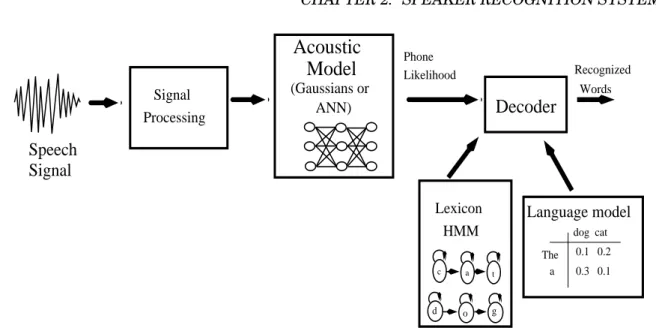
The aim of speech recognition systems is to extract the lexical content from a speech signal. This procedure is performed in several successive steps. More details about this subject can be found in (Rabiner and Juang, 1993; Gold and Morgan, 2000; Huang et al., 2001). A block diagram of a typical speech recognition system is shown in Figure 2.1.
• Feature extraction:First, acoustic feature vectors are extracted from the speech signal (wave-forms). These features convey the relevant information that is useful to characterize a word unit (typically phonemes) to be recognized and distinguished from other different sub-word units. This information should be also robust to different sources of variations such as noise, articulator effects and pronunciation variation. That means, this information should be almost the same for the same sub-word unit even if this subword unit is pronounced by the same speaker or different speakers in different conditions.
• Acoustic modeling: The acoustic features are then used to create an acoustic model for each subword unit. This step is known astraining. The goal of training is to estimate the parame-ters of the acoustic model that best represent the training data and minimize the recognition error on unseen data. There are many factors that affect the acoustic model and make it less robust when the recognizer is running in real applications. Among them, the amount of train-ing data and the mismatch between train and test data are the important factors. Several acoustic modeling approaches exist, but today’s speech recognizers use a HMM model where the state emission probabilities are estimated using either Gaussian mixture models (Ra-biner, 1989) or artificial neural networks (ANN) (Bourlard and Morgan, 1994). In this thesis,
d o g c a t HMM Lexicon The dog cat a 0.1 0.2 0.3 0.1
Signal
Speech
(Gaussians or ANN)Decoder
Processing Signal Phone Likelihood Words RecognizedAcoustic
Model
Language model
Figure 2.1. Block-diagram showing the main speech recognizer components: First, the speech signal is analyzed to extract acoustic features which then used in the acoustic model (second block) to estimate the local probabilities of each sub-word unit. These probabilities are then used by the decoder for the temporal alignment using some constraints represented by the lexicon and the language model. The results is a sequence of recognized words.
the former approach will be referred to as HMM/GMM approach, while the later approach will be referred to as hybrid HMM/ANN approach.
• Decoding: The speech recognition task consists of finding the sequence of words that best matches the speech data according to a certain criterion. This task is known as decoding pro-cess. The decoding is performed using local similarity (distance) measure (Gold and Morgan, 2000) expressed in terms of likelihoods (HMM/GMM) or posteriori probabilities (HMM/ANN) that can be converted toscaled likelihood(see Section 3.4). This similarity measure indicates how good an acoustic vector belongs to each sub-word unit. The decoder uses this similar-ity measures with the temporal information embedded in the acoustic model (like transition probabilities between different sub-word models) to search through the acoustic space to find the best sequence of sub-word units corresponding to the sequence of recognized words. In the case of HMM/GMM or HMM/ANN approaches, the decoding is performed using Viterbi alignment (Viterbi, 1967).
To improve the recognition accuracy, somea priorilinguistic knowledge about the sequences to be recognized can be used during the decoding. This knowledge is usually embedded into a language model.
2.3 Speaker recognition systems
Speaker recognition is the process of recognizing people by their voices. The goal is to extract the information in the speech signal which conveys speaker characteristics. Indeed, the speech signal contains many characteristics that are specific to the speaker and are difficult to reproduce by any other speaker. Such characteristics are independent of the linguistic message.
2.3. SPEAKER RECOGNITION SYSTEMS 9
2.3.1 Speaker recognition components
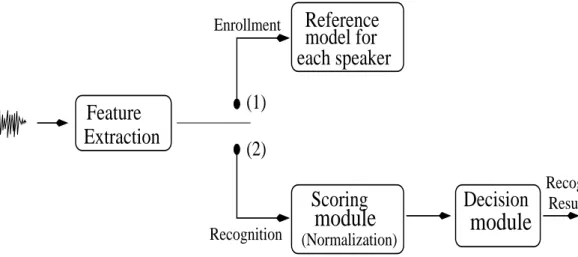
As illustrated in Figure 2.2, the first step in building a speaker recognition system is known as theenrollment stepwhich consists of creating an acoustic model for the speaker using some speech data provided by the speaker. The effectiveness of the speaker model depends upon, among other factors, the amount and the quality of the training data available for that speaker, which is usually very limited in real applications.
During testing, the recognition step consists mainly of three modules:
each speaker
model for
Reference
Extraction
Feature
Recognition
Results
Recognition
Decision
module
Scoring
(Normalization)
module
Enrollment
(2)
(1)
Figure 2.2.Block diagram showing the main components of speaker recognition systems.
1. Feature extraction:For speaker recognition, feature extraction consists of extracting the infor-mation that is useful to characterize a speaker’s voice to be recognized and distinguished from other different speakers. It follows that features that exhibit high inter-speaker variability and low intra-speaker variability are desired (Campbell, 1997). Some of feature extraction techniques will be described in Section 2.6.
2. Scoring module: This module estimates the recognition score that represents the reliability of the hypothesis that the speech segment comes from the claimed identity. Depending on the task (speaker identification or verification) and the modeling approach, we might need an additional model known asanti-speakermodel to estimate the score.
3. Decision module:Based on the estimated recognition score, this module makes the decision to confirm (in the case of speaker verification) or establish (in case of speaker identification) an individual’s identity.
Speaker recognition can be categorized depending on the task (speaker identification or speaker verification) and the text used for verification (text-dependent or text-independent). For more de-tails, some general overview papers on speaker recognition are (Doddington, 1985; Furui, 1994; Campbell, 1997; Bimbotet al., 2004).
2.3.2 Speaker identification versus speaker verification
Depending on the application context, speaker recognition can be divided into speaker identification and speaker verification tasks. They have the same feature extraction module but different scoring and decision modules.
• Speaker identification systems:
In Speaker IDentification (SID) system, no identity claim is provided, the test utterance is scored against a set of known (registered) references for each potential speaker and the one whose model best matches the test utterance is selected. In speaker identification, we have to distinguish betweenclosed-setand open-setspeaker identification. In closed-set, the test utterance belongs to one of the registered speakers. During testing, a matching score is es-timated for each registered speaker. The speaker corresponding to the model with the best matching score is selected. This requiresN comparisons for a population ofN speakers. In open-set, any speaker can access the system, those that are not registered should be rejected. This requires another model referred to as “garbage model” which is trained with data pro-vided by other speakers different from the registered speakers. During testing, the matching score corresponding to the best speaker model is compared with the matching score estimated using the “garbage model” in order to accept or reject the speaker, making the total number of comparisons equal toN + 1. Speaker identification performance tends to decrease as the
population size1increases.
• Speaker verification systems:
In Speaker Verification (SV) systems , the speaker is classified as having the purported iden-tity or not. That is, the goal is to automatically accept or reject an ideniden-tity that is claimed by the speaker. During testing, a verification score is estimated using the claimed speaker model (and theanti-speakermodel in case of using generative models like Gaussian mixture models). This verification score is then compared to a threshold. If the score is higher than the threshold, the speaker is accepted, otherwise, the speaker is rejected. Thus, speaker ver-ification, involves an hypothesis test requiring a simple binary decision: accept or reject the claimed identity regardless of the population size. Hence, the performance is quite indepen-dent of the population size, but it depends on the number of test utterances used to evaluate the performance of the system.
2.3.3 Text-dependent versus text-independent
Speaker recognition can be based on text-independent, text-dependent and text-prompted utter-ances, depending on whether there is a constraint or not on the text during the enrollment and/or recognition phases.
• Text-dependent:
In Text-Dependent (TD) speaker recognition system, the enrollment process requires the pass-word (which is usually a sequence of digits corresponding to the account number) to be pre-defined or its transcription (in term of phonemes or digit) to be available to the system. In other words, the system has a prioriknowledge about the password. The training and the test text are the same. For each individual, there is a model that encodes the speaker’s voice characteristics associated with the phonemic or syllabic content of the password. Since recog-nition is based on the speaker characteristics as well as the lexical content of the password, text dependent speaker recognition systems are generally more robust and achieve good per-formance. The text-dependent system studied in this thesis has the particularity that the user (and not the system) who chooses the password.
• Text-Independent:
In the case of Text-Independent (TI) speaker recognition, the lexical content of the utterance used for recognition can not be predicted. To access the system, the test utterances can be
2.4. HYPOTHESIS TESTING 11 different from those used for enrollment, hence, text-independent speaker verification needs a large and rich training data set to model the characteristics of the speaker’s voice and to cover the phonetic space. Consequently, without a large training set and long test segments, the performance of a text-independent speaker recognition system is usually below that of their text-dependent equivalent (Liet al., 1999).
• Text-prompted:
Both text-dependent and text-independent systems are susceptible to fraud, since for typical applications the voice of a speaker could be captured, recorded, and reproduced. To limit this risk, a particular kind of text-dependent speaker verification systems based onprompted text have been developed. In this case, a recorded or synthetic prompt asks the user to utter a different random sentence each time the system is used (Higgins et al., 1991; DeVeth and Bourlard, 1995; Cheet al., 96). The underlying lexicon which could either be very large or lim-ited to just10digits, would then be used to generate random sentences. During recognition,
speaker-dependent phoneme models are concatenated according to the prompted-text and a verification score is then estimated. The advantage of such an approach is that impostors can-not predict the prompted sentence. Consequently, pre-recorded utterances from the customer are of no use to the impostor. As in the case of text-independent systems, the text-prompted systems also need a large and rich training data set for each registered speaker to create a robust speaker-dependent models.
2.4 Hypothesis testing
Speaker verification is a classification problem, in which we have to make a decision whether to accept or reject a speaker based on the verification score obtained by a measurement process. The goal here is to determine if a speech segmentX belongs to the claimed speaker or not. There is a
choice between two hypotheses. The null hypothesis, denoted byH0states that the speech segment
belongs to the claimed speaker and the alternative hypothesis, denoted byH1states that the speech
segment does not belong to the claimed speaker and belongs to somebody else. The choice between
H0andH1is simply made based upon theposteriori probabilityof each hypothesis given the test
utteranceX. That is:
S=Sc if P(H0|X)≥P(H1|X) (2.1)
whereS andSc are the test speaker and the claimed speaker identities, respectively. These pos-teriori probabilities can be rewritten as a function of the conditional Probability Density Function (PDF) or likelihoods defined as {p(X|Hi)}i∈{0,1}. and a priori probabilities using Bayes rule as
follows2: S = Sc if p(X|H0).P(H0) P(X) ≥ p(X|H1).P(H1) P(X) (2.2)
SinceP(X)is common to both sides of the inequality, the decision rule can be simplified to:
S = Sc if p(X|H0) p(X|H1) ≥ P(H1) P(H0) (2.3) where p(X|H0)
p(X|H1) is called thelikelihood ratio, and
P(H1)
P(H0) is called thethreshold. This is the optimum
test according to the Bayes decision rule (Fukunaga, 1990). If we assume the twoprioriprobabilities
P(H0)andP(H1)to be equal, then the theoretical value of the threshold is equal to one.
The likelihood ratio based decision rule is optimal if we know exactly the PDF for both hypothe-ses. In practice, this is not the case and the PDFs of both hypotheses are assumed to be a parametric representations estimated from training data. Since the true PDFsp(X|H0)andp(X|H1)and the
a prioriprobabilities, P(H0) and P(H1), are often unknown, generally P(H1)
P(H0) is replaced with an
experimental thresholdT determined to satisfy the application requirements. So, the decision after
taking the logarithm of the likelihoods becomes:
S=Sc if logp(X|H0)−logp(X|H1)≥logT (2.4) The central questions now is how to evaluate the performance of speaker verification systems? and how to determine the threshold?
2.5 Performance evaluation
2.5.1 Error measure
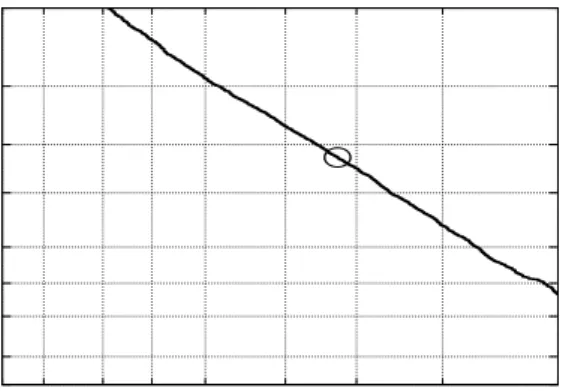
A speaker verification system could make two types of errors; the false rejection (FR) occurring when an authorized speaker is classified as an impostor and is rejected, and the false acceptance (FA) occurring when an impostor is accepted as a valid target speaker. Consequently, the decision should be made to minimize both FA and FR errors. In real application, we should take into ac-count the application requirements, which is a trade off between these two types of errors. In a more secure system, it may be desired to have a low FA rate at the expense of higher FR rate, and vice-versa for a more convenient system. The various costs and impacts of these two types of errors as well as other factors must be taken into account to evaluate the utility of the system. The system performance can be depicted using a graphical representation such as a Receiver Operating Characteristic (ROC) or Detection Error Trade-off (DET) (Martinet al., 1997) curve. In both repre-sentations, the probability of false acceptance (horizontal axis) is plotted versus the probability of false rejection (vertical axis) for varying decision threshold. The better the system, the closer to the origin the curve will be. Figures 2.3 and 2.4 are examples of DET and ROC curves, for the same system performance. 0.1 0.2 0.5 1 2 5 10 20 40 0.10.2 0.5 1 2 5 10 20 40 FR [%] FA [%] DET curve
Figure 2.3. The DET curve: The false acceptance (FA) is plotted against false rejection (FR). The circle corresponds to the EER.
The difference between the ROC and DET curves is that, the ROC plot is on a linear scale while the DET plot is on a normal deviate scale. That is instead of plotting the percentage of false
2.5. PERFORMANCE EVALUATION 13 0 5 10 15 20 25 30 35 40 0 5 10 15 20 25 30 35 40 FR [%] FA [%] ROC curve
Figure 2.4.The ROC curve corresponding to the DET curve shown in Figure 2.3, false acceptance (FA) is plotted against false rejection (FR). The circle corresponds to the EER.
acceptance and false rejection rates, these two values are expressed as the number of standard deviations from the mean of a normal distribution (Wan, 2003). If the scores of impostor and target accesses are Gaussian distributed, then the result is a linear DET curve with a slope equal to −1. For system comparison, the performance is often reported in terms of EER (equal error rate),
corresponding to the decision threshold where the False Rejection Rate (FRR) is equal to the False Acceptance Rate (FAR). Another error that is often reported to compare systems performance is known as HTER (Half Total Error Rate), corresponding to the arithmetic mean of FAR and FRR associated with an operating point.
HT ER=F A+F R
2 (2.5)
The performance of a speaker verification system depends on the amount of the training data, training and testing conditions and the length of the test segment, hence, it is important to also report such information during the performance evaluation (Kunget al., 2004).
2.5.2 Decision threshold
The robustness of a speaker verification system depends among other factors, on the reliability of the decision threshold which can be speaker-dependent or speaker-independent. The estimation of the optimal threshold is a critical problem and it depends closely on the application. A low threshold will result in a high FAR while a high threshold will result in a high FRR, each of which can pose problems for the service provider and user. Therefore , the threshold should be set according to the importance associated with each type of error. Often the performance of speaker verification system is reported using a posterioriEER threshold. That is, the threshold is estimated by assuming that the distributions of the test scores under the null hypothesis and alternate hypothesis are Gaussians and computing the resulting EER point (FRR = FAR).
In real task, the threshold should be determined a priori. Many a priori threshold setting techniques have been proposed (Pierrotet al., 1998; Zhanget al., 1999; Surendran and Lee, 2000; Chen, 2003). A common method to estimate a priori threshold is to conduct an experiment on a development dataset composed of train and test data provided by speakers different from the actual client population. The estimated a posteriorithreshold is then used asa priorithreshold
for the current application. It is clear that if the development dataset is not representative of the application conditions then the reliability of the estimated threshold can not be ensured.
Another method for threshold estimation is to divide the enrollment data provided by each speaker into two parts. One part is used to create the speaker model and the other part to estimate the threshold. The difficulty here arises from the fact that usually very limited data is available. Consequently, estimating the threshold on a half portion of the data is detrimental to the accuracy of the speaker model.
Thea priorithreshold gives a feasible way to create a real speaker verification system, while thea posteriorithreshold gives a good way to evaluate the discrimination capabilities of the client speaker model and to compare objectively the modeling performance (Chen, 2003).
2.6 Feature extraction
In speech recognition system, the goal of feature extraction is to extract the acoustic information that is representative of the lexical content and invariant to the speaker. Speaker verification systems require acoustic features that are representative of speaker’s voice characteristics and independent (in case of text-independent speaker verification) on the lexical content of a particular word (Gold and Morgan, 2000). We can distinguish between two types of speaker information conveyed in the speech signal (Doddington, 1985), low-level information and high-level information. Low-level information denotes the information such as pitch and magnitude spectrum. Automatic speaker recognition systems typically use low-level information. High-level information denotes information such as dialect, accent, the way the speaker pronounces specific words and speaking style. Such speaker specific traits are often used by human beings to recognize people, but they are less used in speaker recognition systems, because they are very difficult to quantify.
Current speaker recognition systems use acoustic features that have been developed for use in speech recognition. They are based on the short-term spectral analysis. These features do not capture long-term prosodic information such as fundamental frequencyF0and which provide more
speaker specific information. Experimental results showed that fundamentatl frequency featureF0
is robust for speaker recognition in noisy conditions and the performance of a speaker verification system can be improved if it is added to the conventional short-term spectral features (Jankowski et al., 1995; Sarma, 1997; Kajarekar et al., 2003). Unfortunately, this feature is often difficult to estimate reliably, particularly for a short enrollment period such as in UCP-SV systems.
It is worth to note here that the search for the best features is not the subject of this thesis. Therefore, we have used the most current signal representation for speech and speaker recognition, namely MFCC features.
Feature extraction process consists of several consecutive steps and can be summarized as fol-lows: pre-processing, cepstral analysis and post-processing (Rabiner and Juang, 1993; Bimbotet al., 2004).
2.6.1 Pre-processing
The sampled speech (sampling frequency is typically 8 kHz for telephone quality speech) is
pre-emphasized to enhance the high frequency components of the spectrum. High frequency formants have low amplitude as compared to low frequency formants. Pre-emphasis of the high frequencies is done to obtain similar amplitude for all formants. This is performed by applying a first order FIR filter to the speech signal:
2.6. FEATURE EXTRACTION 15 whereais the pre-emphasis coefficient, and is kept in the range of0.9≤a≤1. A typical value for
ais0.95.
Most of signal analysis techniques assume that the signal is stationary. For speech signal, this is valid only within a short-time intervals. Therefore awindowingof the signal is performed, that is a window whose length is typically between20and30ms is applied to the beginning of the signal and
moved every10ms until the end of the signal is reached. This results in a succession of windowed
sequences calledframes:
y(n) =w(n).sp(n) (2.7)
wherew(n)is the impulse response of the window. The most commonly used window in speech and
speaker recognition isHammingwindow, whose impulse response is defined as follows:
w(n) =
(
0.54−0.46 cosN2πn−1 n= 0,1, ...N−1 0 otherwise
whereN is the total number of samples in the frame. Hamming window is preferred over
rectan-gular window because it reduces the effect of sidelobes.
2.6.2 Cepstral analysis
MFCC parameters
A Discrete Fourier Transform (DFT) of the windowed signal is used to extract the frequency content (the spectrum) of the current frame. To reduce the number of obtained spectral parameters and to get the gross shape of the spectral envelope, a smoothing of the spectrum is performed. This is done by applying a number of triangular filters with different center frequencies and bandwidth. Each of these filters extracts the average of the spectral energy in a particular frequency band. Typically, the Mel scale which is an auditory scale similar to the frequency scale of the human ear is used. The outputs of these filters form the spectral envelope. We take the logarithm of this spectral envelope to obtain the log spectral vectors.
Finally, Discrete Cosine Transform (DCT) is applied to the log spectral vectors to obtain the Mel-Frequency Cepstral Coefficients (MFCC) (Davis and Mermelstein, 1980).
Ci= K X k=1 Skcos i k−1 2 π K i= 1, ..., d (2.8)
where K is the number of filter banks (the log spectral vectors dimension),Sk is the logarithm of the kth filter bank’s outputs anddis the number of cepstral coefficients (d ≤ K). The MFCC features are used in (Careyet al., 1991; Reynoldset al., 2000; Auckenthaleret al., 2000) for speaker verification.
LPCC parameters
The Linear Prediction (LP) (Makhoul, 1973) based cepstral parameters extraction can be divided into two steps. First, LP-analysis of the speech is performed to compute a set of predictor coeffi-cients. Second, these predictor coefficients are then transformed into cepstral feature vectors.
For each frame, LP analysis assumes that the current speech sample y(n) can be predicted
approximately by a linear combination of the pastP samples plus an excitation term: y(n)≈y˜(n) =
P X k=1
whereak, k= 1, ..., P are the LP coefficients,P is the LP analysis order,Gis the gain andu(n)is the normalized excitation.
The goal of LP analysis is to find the predictor coefficientsak that minimize the mean squared error between the actual valuey(n)and the predicted valuey˜(n)of the samples in a frame.
TheseP predictor coefficients represent the spectrum envelope of the speech signal and they are
used to compute the Linear Prediction Cepstral Coefficients (LPCC). Thus, the first dLPCCs are
obtained as follows: Ci=ai− i−1 X k=1 k i Ckai−k 1≤i≤P and 1≤k≤d (2.10) Ci= i−1 X k=1 k i Ckai−k i≥P (2.11)
Resulting in a d-dimensional cepstral vector:
Ci= [C1, C2, ..., Cd]
The LPCC features are used in (Matsui and Furui, 1992b; Rosenberg and Parthasarathy, 1996) for speaker verification.
The cepstral coefficients LPCC or MFCC are usually augmented by adding the log of the signal energy computed as follows:
E= log
N X n=1
s2(n) (2.12)
whereN is the number of speech samples in the frame.
2.6.3 Post-processing
• Cepstral mean subtraction:In telephone quality speech applications, which is the case of many speaker recognition systems, the transmission channel variations are considered as a source of signal degradation. To compensate the channel effects, cepstral mean subtraction(CMS) technique is applied. In this technique, the mean vector of cepstral coefficients is estimated and subtracted from each cepstral vector.
• Dynamic information:The cepstral coefficients do not take into account the spectral variations along time. It is well known that the speech recognition performance can be enhanced by adding information about the temporal dynamism of the signal (Sonng and Rosenberg, 1988; Rabiner and Juang, 1993; Huanget al., 2001). Thus, first and second order time derivatives of the cepstral coefficients are also computed using polynomial approximations (Furui, 1981) and are appended to the cepstral features.
δCt= Pl k=−lkCt+k Pl k=−l|k| (2.13) δδCt= Pl k=−lk2Ct+k Pl k=−lk2 (2.14) wheretis a frame at time instant and2lis the context withtthframe in the center.
2.7. DATABASES AND EXPERIMENTAL SET-UP 17 • Speech/non speech segmentation:The set of acoustic vectors extracted for each frame, do not carry the same level of information for speech or speaker recognition tasks. Feature vectors corresponding to a speech segment are more important than feature vectors corresponding to a silence segment. These silence segments do not carry any useful information and can degrade the performance of the system. For example, in a Gaussian mixture model based speaker recognition systems, it is important to remove the silence segments from the train and test data. In this thesis, we have used a bi-Gaussian model of the log energy distribution trained in an unsupervised manner. The Gaussian with low log energy will represent the silence segments and the Gaussian with high log energy will represent the speech segments.
2.7 Databases and experimental set-up
In this thesis, two databases were used:
1. ThePolyPhone (Cholletet al., 1996) database to train different speaker-independent speech recognizers.
2. The Swiss-FrenchPolyVardatabase (Cholletet al., 1996) to carry out the speaker verification experiments.
2.7.1 PolyPhone database
The Swiss-FrenchPolyPhonedatabase contains telephone calls from about4,500speakers recorded
over the Swiss telephone network. The calling sheets were made up of 38 prompted items and
questions and were distributed to people from all over the French speaking part of Switzerland. Among other items, each speaker was invited to:
• Read10 sentences selected from different corpora to ensure good phonetic coverage for the
resulting database.
• Simulate a spontaneous query to telephone directory, given the name and the city of subject. Different kinds of irregularities (i.e; noise in the recording, strange utterances) were discovered, and the training set was finally reduced to3,272sentences, corresponding to approximately5hours
of speech.
2.7.2 PolyVar database
For capturing intra-speaker variability and to address inter-speaker variability issues, thePolyVar telephone database was also designed and recorded at IDIAP as a complement to the Swiss French PolyPhone database. It is particularly relevant for speaker verification research. This database comprises telephone recordings from143speakers (85male speakers and58female speakers). Each
speaker recorded between1and229sessions. Several speakers pronounced among other items the
same set of17touristic application words (InfoMartigny) several times. This makes the database
particularly well suited to test user-customized speaker verification systems, i.e., by: • Assigning each of the words to one specific customer, thus
• Providing enrollment utterances of that word, and test utterances, as well as many impostor utterances pronouncing the right password.
• Providing several utterances associated with words different than the chosen password, from both the customer and potential impostors.