Procedia Engineering 15 (2011) 4266 – 4270 1877-7058 © 2011 Published by Elsevier Ltd. doi:10.1016/j.proeng.2011.08.800
Procedia
Engineering
Procedia Engineering 00 (2011) 000–000 www.elsevier.com/locate/procediaAdvanced in Control Engineeringand Information Science
Classifiers selection for ensemble learning based on accuracy
and diversity
Liying Yang
*School of Computer Science and Technology, Xidian University, Xi’an, 710071, China
Abstract
Ensemble learning is a learning method where a collection of a finite number of classifiers is trained for the same classification task and thus it can gain better performance at the cost of computation. Previous research has proved that it may be better to ensemble manyinstead of allof classifiers at hand. Thus classifiers selection became a crucial problem for ensemble learning. To select the best classifier set from a pool of classifiers, the classifier diversity is the most important property to be considered. In this paper, a kind of selection method based on accuracy and diversity is proposed in order to achieve better classification performance. Classifiers correlation in our method is calculated using Q statistics diversity measures based on correlation between errors. Experiments were carried out on five data sets from UCI Machine Learning Repository. Twenty classifiers and six combination rules were included in our experiments. The experimental results are encouraging and validate the effectiveness of the proposed classifiers selection method.
© 2011 Published by Elsevier Ltd. Selection and/or peer-review under responsibility of [CEIS 2011]
Keywords: Ensemble learning; classifier selection; accuracy; diversity
1. Introduction
Given a pattern recognition problem, the traditional approach is to evaluate a set of different algorithms against a representative validation set and select the best one. In order to achieve the best possible classification performance, we need to design many algorithms. It is now recognized that the key
*E-mail address
: [email protected] Open access under CC BY-NC-ND license.
to recognition problems does not lie wholly in any particular solution. No single model exists for all pattern recognition problems and no single technique is applicable to all problems. Furthermore, the sets of patterns misclassified by the different algorithms would not necessarily overlap, which suggested that different algorithms potentially offered complementary information [1]. This led to the emergence of ensemble learning. Ensemble learning is a learning method where a collection of a finite number of classifiers is trained for the same classification task and thus it can gain better performance at the cost of computation. In recent years, ensemble learning has been employed to increase the accuracy in classification beyond the level achieved by individual classifiers. Typically, ensemble learning involves either statistical parametric classifiers or neural networks trained on the same data, and a method that combines their outputs into a single one. If one could pick the best classifier to use for every sample, the misclassified samples in the output would be the ones that were wrongly classified by all methods. It is also true that, in combining classifiers, one can also run in a situation where the selection of classifiers is so bad that the combined result is worse than any of the individual classifiers. A lot of literature dedicated to identifying optimal ways to combine classifiers. However, the selection of the classifiers to be combined is equally, if not more, crucial if improvement is to be made [2].
In Zhou’s work, the relationship between the ensemble and its component neural networks is analyzed from the context of both regression and classification, which reveals that it may be better to ensemble
manyinstead of allof the neural networks at hand [3]. Our previous work also provided similar results. A weighted combination model based on particle swarm optimization (PSO-WCM) is proposed, in which we just recombined the remained classifiers after rejecting weak classifiers artificially [4]. This inspired us with a problem that is there a better method to select the classifiers. Further, selecting and combining classifiers simultaneously with particle swarm optimization was given in [5]. In this paper, a selection strategy, based on classifiers’ accuracy as well as diversity, is proposed.
2. Measures of Diversity in Classifier Ensembles
It is well known that combining several identical classifiers makes no sense because the sets of misclassified patterns would not overlap only when they were produced by different classifiers. Thus diversity has been recognized as a very important characteristic in classifier combination. There exist many measures of dependency between classifiers while Q statistic is one of them [6]. Research on selection for Arabic handwritten recognition was carried on diversity [7]. There is other classifier selection method in literature [8]. “Good” and “Bad” Diversity in Majority Vote Ensembles was investigated in [9]. Q statistic is a pair wise diversity measure, which is used as the measure of dependency in this research due to its easy interpretation for independence, positive/negative dependences, and calculation. We carried out our work based on Q statistic.
3. Classifiers selection algorithm based on accuracy and diversity
For ensemble learning, it has been proven that better performance could be obtained by rejecting weak classifiers. Then we can improve the performance by combining accurate classifiers only, which we called Selection by Accuracy (SA). The procedure is as follows.
Step 1.Training a set of different classifiers;
Step 2. Evaluate each classifier’s accuracy on validation set; Step 3. Remove weak classifiers out of the ensemble; Step 4. Combining the remained classifiers;
Since diversity plays an important role in ensemble learning, classifiers selection can also be made by taking both accuracy and diversity into account. The algorithm of classifiers selection based on accuracy and diversity, which we called Selection by Accuracy and Diversity (SAD), is as follows.
Step 1.Training a set of different classifiers;
Step 2. Evaluate each classifier’s accuracy on validation set;
Step 3. Select one most accurate classifier or several top accurate classifiers;
Step 4. Calculate the diversity between the most accurate classifier and those that have not been selected;
Step 5. Select classifiers with strong diversity into the ensemble, repeat the selection process until the ensemble size meeting requirement;
Step 6. Combining classifiers in the ensemble;
Step 7. Evaluate the performance of ensemble learning. 4. Experiments and discussion
4.1. Individual classifiers and combination methods
Six combination rules were included in our experiments for the sake of comparison: vote rule, max rule, min rule, mean rule, median rule and product rule [10]. We trained twenty classifiers and then combined them to clarify the relationship between individual classifiers and ensemble learning, together with the validation of the selection method proposed in this work. Classification algorithms used in this paper are LDC, QDC, KNNC, TREEC, KLLDC, PCLDC, UDC, LOGLC, NMC.NMSC, PERLC, SUBSC, MOGC [11]. Note that some are used twice or more with different parameters to get different classifiers.
4.2. Datasets
Experiments were applied to five real world problems from the UCI repository: Iris, Thyroid, Wine, Glass, Waveform [12]. For each dataset, 2/3 examples were used as training data, and 1/3 test data. All experiments were repeated for 10 runs and averages were computed as the final results. Note that all subsets were kept the same class probabilities distribution as original data sets.
4.3. Experiments 1: correlation of diversity and performance of ensemble learning
In order to study the correlation of diversity and performance of ensemble learning, without losing universality, we carried out eight trials on Thyroid. Q statistics were used as diversity measure and all the twenty classifiers take part in ensemble learning. The experimental results were listed in Table 1. It is shown that the ensemble performance decreases with the increase of Q statistics, which means the drop of diversity. So we can try to enlarge the diversity to obtain better ensemble performance.
Table 1. Effect of diversity on performance of ensemble learning
Q Prodc Meanc Medianc maxc minc votec
0.6885 0.028 0.042 0.042 0.042 0.042 0.042 0.6948 0.099 0.085 0.085 0.085 0.085 0.085 0.7292 0.099 0.085 0.085 0.085 0.085 0.085 0.757 0.056 0.042 0.085 0.056 0.042 0.085 0.7761 0.07 0.042 0.056 0.07 0.07 0.056 0.8216 0.07 0.042 0.056 0.07 0.07 0.056 0.8591 0.056 0.056 0.042 0.07 0.056 0.042 0.9273 0.056 0.056 0.056 0.056 0.056 0.056
4.4. Experiments 2: performance comparison of classifiers selection algorithm based on accuracy only and that based on accuracy as well as diversity
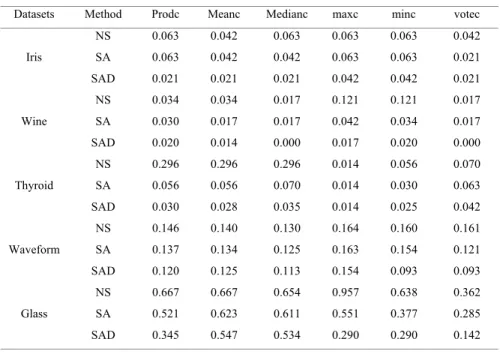
Here the two classifiers selection algorithms, SA and SAD presented in section 3, were compared from the point of classification error rate. In SA, the five weakest classifiers were removed from the ensemble and fifteen classifiers were combined. While in SAD, two most weak classifiers were removed firstly. Then the most accurate classifier was selected as benchmark to calculate the diversity with each other one in ensemble. Another three classifiers with lowest diversity were removed and the remained fifteen classifiers were combined for ensemble learning. We also used all the twenty classifiers to perform ensemble learning for the sake of comparison, which we called No Selection algorithm (NS). Experimental results were listed in Table 2.
Table 2. Error rate comparison of three methods
Datasets Method Prodc Meanc Medianc maxc minc votec Iris NS 0.063 0.042 0.063 0.063 0.063 0.042 SA 0.063 0.042 0.042 0.063 0.063 0.021 SAD 0.021 0.021 0.021 0.042 0.042 0.021 Wine NS 0.034 0.034 0.017 0.121 0.121 0.017 SA 0.030 0.017 0.017 0.042 0.034 0.017 SAD 0.020 0.014 0.000 0.017 0.020 0.000 Thyroid NS 0.296 0.296 0.296 0.014 0.056 0.070 SA 0.056 0.056 0.070 0.014 0.030 0.063 SAD 0.030 0.028 0.035 0.014 0.025 0.042 Waveform NS 0.146 0.140 0.130 0.164 0.160 0.161 SA 0.137 0.134 0.125 0.163 0.154 0.121 SAD 0.120 0.125 0.113 0.154 0.093 0.093 Glass NS 0.667 0.667 0.654 0.957 0.638 0.362 SA 0.521 0.623 0.611 0.551 0.377 0.285 SAD 0.345 0.547 0.534 0.290 0.290 0.142
From Table 2, it was shown that both SAD and SA perform better than NS, and SAD outperform SA and NS. Rejection of classifiers based on both accuracy and diversity benefits ensemble learning greatly. This demonstrates that both accuracy and diversity are important for ensemble learning.
5. Conclusions
In this paper, we presented a classifiers selection method, i.e. SAD, based on both accuracy and diversity to improve the classification performance in ensemble learning. Firstly, the approach consists of generating a number of different classifiers. Each classifier’s accuracy was evaluated on validation set, followed by selecting one most accurate classifier or several top accurate classifiers. Then Q statistics were calculated between the most accurate classifier and those that have not been selected in order to remove most relevant classifiers from the ensemble. Finally, the remained classifiers were combined to carry out ensemble learning. Experiments were carried out on five real world problems from the UCI repository. We observed that SAD works rather well than SA, a selection method based on classifier’s accuracy only, and NS which uses all available classifiers.
6. Acknowledgements
This work was supported by the Science and Technology Research Development Program in Shaanxi province of China (No.2009K01-56) and the Fundamental Research Funds for the Central Universities (No.K50510030007).
References
[1] Ghosh, J.. Multiclassifier systems: back to the future. In: Roli, F., Kittler, J. (eds.): Multiple Classifier Systems. Lecture Notes in Computer Science 2002; 2364:1–15.
[2] P. Michalis, A.B. Jon K. Ioannis, The Effect of Classifier Agreement on the Accuracy of the Combined Classifier in Decision Level Fusion, IEEE Transactions On Geoscience and Remote Sensing 2001;11:2539-2546.
[3] Zhou Z..H., J. Wu and W. Tang, 2002. Ensembling neural networks: Many could be better than all. Artif. Intel 2002; 137(1-2): 239-263.
[4] Yang L,Y. and Z. Qin. Combining Classifiers with Particle Swarms. Lecture notes in computer science 2005; 3611: 756-763. [5] Li Ying Yang, Jun Ying Zhang and Wen Jun Wang .Selecting and Combining Classifiers Simultaneously with Particle Swarm Optimization, Information Technology Journal 2009;8(2):241-245.
[6] L.I. Kuncheva, C.J. Whitaker, Measures of Diversity in Classifier Ensembles, Machine Learning 2003; 51:181-207. [7] Nabiha Azizi, Nadir Farah, Mokhtar Sellami, and Abdel Ennaji. Using Diversity in Classifier Set Selection for Arabic Handwritten Recognition. N. El Gayar, J. Kittler, and F. Roli (Eds.): MCS 2010, LNCS 5997:235–244.
[8] Nan Li and Zhi-Hua Zhou. Selective Ensemble under Regularization Framework. J.A. Benediktsson, J. Kittler, and F. Roli (Eds.): MCS 2009, LNCS 5519: 293–303.
[9] Gavin Brown and Ludmila I. Kuncheva. “Good” and “Bad” Diversity in Majority Vote Ensembles. N. El Gayar, J. Kittler, and F. Roli (Eds.): MCS 2010, LNCS 5997:124–133.
[10] Kittler, J., Hatef, M., Duin, R.P.W., Matas, J.: On combining classifiers. IEEE Transactions On Pattern Analysis and Machine Intelligence 1998; 3:226-239.
[11] R.P.W. Duin, P. Juszczak, P. Paclik,et al. PRTools4: A Matlab Toolbox for Pattern Recognition, Version 4.1, August 2007. [12] Frank, A. & Asuncion, A. UCI Machine Learning Repository [http://archive.ics.uci.edu/ml]. Irvine, CA: University of California, School of Information and Computer Science. 2010.