Motivations for Dual-enrollment from a Student Perspective: A Qualitative Study
A Dissertation submitted to the Graduate School Valdosta State University
in partial fulfillment of requirements for the degree of
DOCTOR OF EDUCATION
in Leadership
in the Department of Curriculum, Leadership, and Technology in the Dewar College of Education and Human Services
November 2017
Stephen G. Daniel
M.S.H.R.M, Troy University, 2007 B.B.A., University of Georgia, 1983
© Copyright 2017 Stephen G. Daniel All Rights Reserved
FAIR USE
This dissertation is protected by the Copyright Laws of the United States (Public Law 94-553, revised in 1976). Consistent with fair use as defined in the Copyright Laws, brief quotations from this material are allowed with proper acknowledgement. Use of the material for financial gain without the author’s expressed written permission is not allowed.
DUPLICATION
I authorize the Head of Interlibrary Loan or the Head of Archives at the Odum Library at Valdosta State University to arrange for duplication of this dissertation for educational or scholarly purposes when so requested by a library user. The duplication shall be at the user’s expense.
Signature
I refuse permission for this dissertation to be duplicated in whole or in part.
i ABSTRACT
Due to workforce skill gaps in the modern economy, our nation is focused on college and career readiness (Hughes, Rodriguez, Edwards, & Belfield, 2012). In a world where most jobs at a living wage require at least some postsecondary education or
training, earning a high school diploma is a necessary but insufficient step toward supporting oneself and one’s family (Carnevale, Strohl, Chea, & Ridley, 2017). Participation in dual-enrollment programs has been found to help individuals view themselves as college students, leading to increased student enrollment in post-secondary programs after high school (Hooker & Bland, 2010). Although dual-enrollment options cannot assure a student’s success, insights from the dually enrolled students in this study can play a role in understanding barriers such as costs of enrollment, student apathy, advising missteps, and distrust among educational partners (Howley, Howley, Howley, & Duncan, 2013). This study is one of the few conducted in a technical college
environment, and distinctive in its focus at a college and career academy setting. This qualitative study was designed to describe dual-enrollment experiences at a technical college, and identify factors that motivate or inhibit high school students’ decisions to participate in dual-enrollment classes in such an environment. The study addressed perceptions and experiences of students who were currently enrolled in such programs through one technical college. Semi-structured, open-ended interviews were utilized to gather perspectives on this topic among participants in dual-enrollment classes at a technical college/career academy. The findings of this study suggest the positive value of dual-enrollment programs at a technical college as perceived through the lens of currently enrolled students.
ii
TABLE OF CONTENTS
Chapter I: INTRODUCTION. ...1
Statement of the Problem…..………...………2
Conceptual Framework.………...………....3
Research Design……….…..………...………...…..7
Definition of Terms….………...………..…..11
Organization of the Study………..………13 Chapter II: LITERATURE REVIEW ...……….15
History of Dual-enrollment Programs.…….……….……...…….16 Relevant Theories of Achievement Motivation.………...……….19 Achievement Motivation Theory………...……19 Internal Motivation/Self-Worth Theory……..………...…………21 External Motivation/Incentive Theory..……….…...……….22 Creating a Successful College-Going Culture………..……….……23 Dual-enrollment………....……….…...……….24 Impact on Academic Success in College..……….…...……….25 Social Engagement………....……….…...……….26 Successful Early College/Dual-enrollment Programs………..……….30
Increased Demand for A College Degree…………..………..…………..33
Employer Perspectives………..……….35 Summary……….………..……….37 Chapter: III METHODS ...…...…...37
iii
Setting………..……..……..…….………….…....40
Participants………..……...……….…...40
Dual-enrolled Students in Eleventh Grade….………….…...……..…….41
Dual-enrolled Students in Twelfth Grade……….…...………..42 Data Collection………..………...……….…....44
Permission to Initiate Study…………..……….…...……….44
Interviews………..……….…...……….44
First Interview………...……….…...……….45
Second Interview.……….………....……….45
Interview Questions/Research Question Alignment…………..……..…….…….46
Interviewer/Research/Process………..……….…….49
Data Processing and Analysis……….……..………..…….……..50
Trustworthiness.………..………..…….…....52
Member Checking……….……….…...……….53
Summary………....………..………..53
Chapter IV: RESULTS ...55
Results of Interviews with Dual-enrolled Students………..…….55
Brief Profiles of the Interviewed Students……..….………..………...57
Themes from Student Interviews..…………..………..…….63
Dual-enrollment Experiences/Independence………….………….……...64
Motivational Factors..……….……...68
Summary……….………...71
iv
Introduction.……….………..73
Discussion………..…………..………..73
Research Question 2………..………..………..80
Limitations of the Study…….……….………..85
Implications for Practice….……….………....………...………...86 Recommendations for Future Research.…………..………..87
Conclusions………....………..………..87
REFERENCES……….…..………...90
APPENDIX A: Interview Session Questions/Protocol……..………..………105 APPENDIX B: (IRB) Expedited Protocol Approval……….………..…...109
APPENDIX C: Parental Consent Form……….………..112
v
LIST OF TABLES
Table 1: County School System Characteristics…...………..……….…..43 Table 2: Sample Characteristics of Participants………...…..……….…..44 Table 3: Participant Demographics ...56 Table 4: Increased Independence ...65 Table 5: Motivational Factors and Impressions ...68
vi
LIST OF FIGURES
1 Chapter I INTRODUCTION
A rapid shift in our national economy from industry dependency to a more complex technology-based, information-age economy has amplified the demand for advanced skills and postsecondary credentials. Declining high school graduation rates and evidence of students unprepared for postsecondary options have commanded the attention of the federal government, educators, and the general community (Krueger & Lindahl, 2006). One solution to these challenges is implementation of a robust dual-enrollment program. In dual-dual-enrollment or dual credit programs, high school students are enrolled in a course or courses at a postsecondary institution while still in high school. These college courses earn students both high school and college credit simultaneously (Andrews, 2003; Bailey, Karp & Columbia University, 2003). The value of earning college credit in high school is recognized by employers as a way to accelerate workforce development initiatives and get future employees prepared at an earlier age.
When compared with their peers, dual-enrollment students were 12 percent more likely to enter college within seven months of graduation from high school (Hooker & Bland, 2010). Allowing youth to participate in programs providing access to college campuses and classes through dual-enrollment is a way to help students gain college experience and see themselves as college students (Hooker & Bland, 2010). Although researchers have provided some information about student success, very little is known about perceptions, attitudes, and motivations for dual-enrollment from a high school
2
student’s perspective. This study was designed to understand the dual-enrollment experience at a two-year technical college and identify factors that motivate or inhibit students’ motivations to participate in dual-enrollment programs situated in technical colleges.
Statement of the Problem
Between 2003 and 2011, enrollment in dual credit courses almost doubled to two million students in public high schools (Thomas, Marken, Gray, Lewis, National Center for Education, & Westat, 2013). Researchers have highlighted improved study habits, academic rigor in early college preparation, changes to a student’s motivation and other social-psychological changes, such as the confidence to perform in college and the socialization process of being a college student, as central functions of dual-enrollment (Hughes, Bailey, & Karp, 2002). Some studies have revealed participation in
dual-enrollment is positively related to college GPA, persistence, and degree attainment (Karp, Calcagno, Hughes, Jeong, & Bailey, 2007). Participation in dual-enrollment programs has been found to help individuals view themselves as college students, leading to increased student enrollment in post-secondary programs after high school (Hooker & Bland, 2010).
While these findings certainly attest to the strength of dual-enrollment, the majority of research draws on the mechanisms affirming dual-enrollment influences on academic performance rather than explicitly defining the motivational elements causing a student to choose dual-enrollment. As a result, research is still lacking when it comes to understanding motivational factors for dual-enrollment selection from a student’s perspective. Additionally, very little is known about high school students’
dual-3
enrollment experiences in technical college dual-enrollment courses. Since technical colleges have a workforce development mission, it is likely the motivation to enroll, and the experience of taking dual-enrollment courses at a technical college would be
distinctly different from students experiencing dual-enrollment at four-year institutions. Without an understanding of the factors influencing student decisions to register for dual-enrollment classes, administrators and teachers are left to “guess” what factors motivate students’ decisions. Data on student decision-making and perceptions of experiences related to dual-enrollment programs in technical colleges can inform recruitment efforts and guide educators in their efforts to close the achievement gap as they seek to better support high school students.
Conceptual Framework
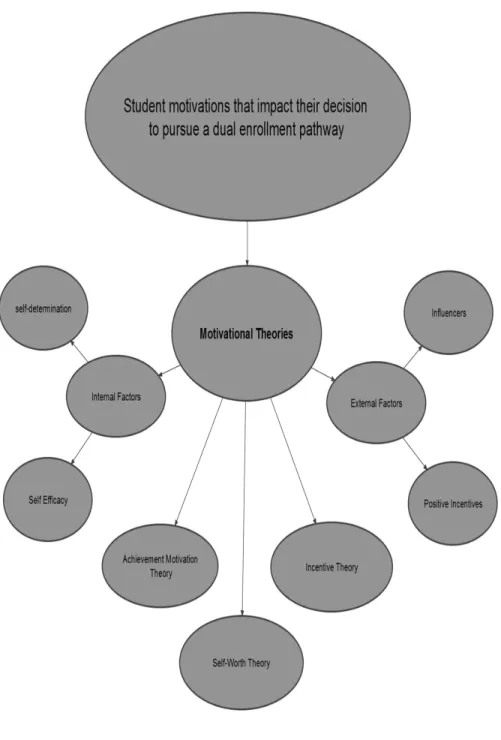
For this study, a conceptual model was developed from theory and research surrounding the internal/external motivational elements possibly contributing to a
student’s decision to enroll in the dual-enrollment pathway. Motivation theories provided the conceptual framework for this qualitative study, with foundational principles having roots from earlier theories of motivation, such as a learned drive for achievement (McClelland, Atkinson, Clark, & Lowell, 1953). This theory suggests achievement-oriented activity is undertaken by an individual with the expectation his/her performance is being evaluated in terms of some standard of excellence. It is presumed any situation arousing expectancy by presenting a challenge to achieve must offer opportunities to succeed as well as the threat of failure (McClelland, Clark, Roby, & Atkinson, 1949). Through such challenges a student can naturally gain confidence as he/she pursues and accomplishes tasks that develop self-esteem. Success at post-secondary levels has been
4
linked to a student’s perception of self-worth (Covington, 1984). Such motivational aspects suggest there is a direct correlation between levels of self-efficacy and motivation ultimately being one of the most important predictors of students’ academic success (Bandura, 1997).
Motivational theories include aspects of autonomy, interest, competence or self-worth, relatedness, drive reduction, arousal, and self-determination (Murray, 2011; Ormrod, 2008). These theories of motivation shape the way students feel about learning and fuels their drive for learning. Murray (2011) believed interest was a key feature of intrinsic motivation and self-determination. Motivational and self-worth theories are related because the actions of driven individuals are built on self-determination to succeed (Deci, Vallerand, Pelletier, & Ryan, 1991). When actions or behaviors are self-determined, the governing process is choice and individuals make decisions based on self (Deci et al., 1991). Successful students are self-determined and self-regulated (Cohen, 2012; Deci et al., 1991). Students who internalize educational values, and are intrinsically motivated, often experience optimal outcomes in education (Deci et al., 1991).
Motivation can be derived internally or externally with a multitude of factors influencing human behavior. Scientists have concluded students have more capacity for lifelong learning than previously thought and a student’s environment can affect his/her mindset (Dweck, 2009). Additionally, external motivators for dual-enrollment students may be associated with incentives for completion such as the promise of a better career. Incentive theory suggests people are drawn to behaviors offering positive incentives and push away from behaviors associated with negative incentives (Bernstein, 2011).
5
The conceptual framework for this study was developed to include external motivational elements that might contribute to a student’s decision to enroll in the dual-enrollment pathway at a technical college. Student success has been defined as “the degree to which individuals meet their educational goals” (Hirschy, Bremer, &
Castellano, 2011, p. 312) and has been measured by a broad array of potential outcomes. Consideration of student characteristics, institutional best practices, and identifying factors have been developed, but no one comprehensive theory exists to predict or explain the motivations from a student perspective. The focus population of this
conceptual framework was on dual-enrolled students at a public technical college setting in Georgia. The concept map framing this study is depicted below in Figure 1.
6 Figure 1. Concept Map
7 Purpose
The purpose of this qualitative study is to describe dual-enrollment experiences at a technical college, and identify factors that motivate or inhibit high school students’ decisions to participate in dual-enrollment classes at a technical college.
Research Design
An interpretive qualitative methodology was used to discover perceptions and experiences of current students who had chosen to participate in dual-enrollment
programs at a technical college. Semi-structured, open-ended interviews were utilized to gather perspectives on this topic. Fifteen dual-enrolled students were selected to
participate in two individual interview sessions. The first set of interviews was designed to elicit a rich description of the dual-enrollment experiences of high school students at a technical college. The second interview session sought to explore students’ perceptions of factors that motivate and those that inhibit the decision of high school students to
participate in dual-enrollment courses at a technical college. Research Questions
Two primary research questions were posed in this study with the intent of gathering data to further understand student perceptions in this specific educational setting:
RQ1: How do high school students describe their dual-enrollment experiences at a technical school?
RQ2: What are the perceptions of dual-enrolled high school students about
8
Significance of the Study
Feedback from employers across the country, as cited throughout this study, pointed to a growing need for a skilled workforce with technical knowledge to support the high level of automation in society. In both the United States and other industrialized countries, the proportion of jobs requiring high skill workers is increasing substantially (Manyika, Lund, Auguste, & Ramaswamy, 2012). Surveys indicated employers in fields such as advanced manufacturing cite skill shortages as reasons for why they cannot expand or improve productivity (Morrison, Maciejewski, Giffi, DeRocco, McNelly, & Carrick, 2011).
Dual-enrollment programs at technical colleges can play a key role in resolving this issue since high school students will graduate with college credentials while being immersed in the workforce culture found at this type of institution. Finding the
motivational aspects students consider most prominent when choosing to pursue such pathways can provide educators and employers valuable insights to more effectively recruit and inspire future students.
Many states see dual-enrollment as one more approach in addressing factors students cite as reasons for not remaining in school (Kennedy, 2008). There is strong evidence graduation rates at the secondary level are enhanced greatly when students take dual-enrollment pathways (Complete College America, 2012). The alignment of early college programs into the K-12 system is clearly focused on improving this statistic. Preparation of students for college-level work is needed to address postsecondary access and success issues. Almost 20 percent of entering freshman at four-year universities are placed in remedial classes (Complete College America, 2012).
9
This study is one of the few conducted in a technical college environment, and distinctive in its focus at a college and career academy setting. Previously, the most comprehensive statewide study of high school and technical college dual-enrollment in Georgia was initiated ten years earlier. The purpose of this multi-year, multi-method study was to investigate the transition of students from secondary schools to the technical colleges in Georgia to better understand the outcomes, process, facilitators, and barriers to high school student access to and continuation in postsecondary education (Harnish & Lynch, 2005). The State of Georgia has authorized funds for such secondary-level charter college and career academies positioned regionally and partnered with a postsecondary community or technical college on-site. This is a model of seamless education predicated upon physical placement near one of the strategic industry clusters in the state (Lakes & Burns, 2012). Most dual-enrollment studies are narrowly focused, and look at student experiences as they relate to a program of study (i.e. whether college instructors are more challenging, whether classes are useful and rigorous, etc.); grade point averages and retention rates once students graduate and matriculate into postsecondary education; and time to degree completion in college (Kennedy, 2008). Since technical colleges have a distinct workforce development mission, the motivations and experiences of
dual-enrolled students in this environment are likely to be unique. Results from this study may also serve to further the acceleration of dual-enrollment participation, and enable a faster transition of young adults into careers.
Limitations
This study was limited by population size and the physical setting for research in only one college and career academy. The established academy has been in operation for
10
over a decade, and it was well known by students within the local school system. The student perceptions throughout the school district could potentially be affected by the established reputation and success of this particular charter school. Such perceived “bias” is recognized by me and I will interpret participant responses accordingly. What is important is to understand is how one is influencing what the interviewee says and how to most productively and ethically use this influence to answer the research questions (Maxwell, 2013, p. 243).
Reactivity was also a concern given my role as a college administrator linked to the high school setting within this study. My relationship with school system personnel and students could cause some guarded or unnatural responses in the data collection phase. The approach to reactivity in most quantitative research, of trying to “control” the effect of the researcher, is appropriate from a “variance theory” perspective. The goal in a qualitative study is not to eliminate this influence but to understand it and use it
productively. For participant observation studies, reactivity is generally not as serious a validity threat as many people might insist (Maxwell, 2013). Becker (1970) points out in natural settings an observer is generally much less of an influence on participants’
behavior than is the setting itself. In contrast, for all types of interviews the researcher has a powerful and inescapable influence on the data collected. What the interviewee says is always a function of the interviewer and the interview situation.
Given my involvement as a higher education administrator, there was potential for a perceived bias relating to this topic. My prior knowledge of dual-enrollment through various administrative roles with the Technical College System of Georgia has
11
has served as a starting point for my research; however, I did make every effort to be cognizant of my prejudices that could impair the study going forward. This was further mitigated through the open-ended format of the participant interviews, field notes, and member checks throughout the study.
Definition of Terms
Chief Executive Officer (CEO). In any organization, the CEO serves as the senior leader who links the organization, or the inside, with the society, the economy,
technology, markets, customers, collaborators, the media, and public opinion, or the outside (Edersheim, 2007).
College and Career Academy. As defined in SB 161 (OCGA 20-4-37), signed by Governor Nathan Deal on May 11, 2011, a “College and Career Academy” is a
specialized charter school established by a partnership which demonstrates a collaboration between business, industry, and community stakeholders to advance workforce development between one or more local boards of education, a private
individual, a private organization, or a state or local public entity in cooperation with one or more postsecondary institutions (Georgia College and Career Academies, 2017).
Complete College America.Established in 2009, CCA is a national nonprofit (notably backed by the Lumina Foundation) with a single mission: to work with states to significantly increase the number of Americans with quality career certificates or college degrees and to close attainment gaps for traditionally underrepresented populations (Complete College America, 2010).
Dual-enrollment Programs.These collaborative efforts between high schools and colleges allow high school students, usually juniors and seniors, to enroll in college
12
courses and get dual credit. If successful the student gets credit for a high school requirement and credit for a college course. These programs provide students with a challenging academic experience and the opportunity to earn college credit prior to high school graduation. Unlike in other programs such as Advanced Placement (AP) and International Baccalaureate (IB), dual-enrollment students take actual college courses with a college syllabus, often on a college campus, rather than a college-level course intended to be taken by high school students (Karp et al., 2007).
Dual-enrolled student. This is a student who has taken one or more dual-credit courses in high school.
Move On When Ready Program. The new MOWR Dual-enrollment Program streamlines the existing dual-enrollment options in Georgia (Accel, HOPE Grant, etc.) into one program with one funding source. MOWR also includes provisions to help remove some of the financial barriers that may prevent students from participating in dual-enrollment (Technical College System of Georgia, 2015).
RESA. Acronym for Regional Educational Service Agency. There are 16 RESAs serving the 180 school systems across the State of Georgia. Their purpose is to better promote the spread of successful practices to all schools and create shared learning communities for multiple school districts (Georgia Department of Education, 2017). Skills gap. This term defines the national phenomenon relating to the problem of finding the right workers with the right skills and credentials exists even in an era of persistent unemployment (Boettcher, 2014).
STEM education. This term refers to an interdisciplinary approach to learning where rigorous academic concepts are coupled with real-world lessons as students apply
13
science, technology, engineering, and mathematics in contexts that make connections between school, community, work, and the global enterprise enabling the development of STEM literacy and with it the ability to compete in the new economy (Tsupros, Kohler, & Hallinen, 2009).
Organization of the Study
This chapter introduced the background, problem, purpose, significance, research questions and hypotheses, delimitations, assumptions, and definitions of key terms in the study. Post-secondary student retention and success rates are challenging obstacles for all involved stakeholders in education. Offering more students opportunities to participate in dual-enrollment programs could potentially increase this retention rate. Prior research has shown community college students who have taken dual credit courses in high school are more likely to enter, be successful, and continue on to their second year of college
(Hoffman, Robins, & Jobs for the Future, 2005).
In Chapter 2, the conceptual framework for the study is outlined along with key research relating to student success surrounding dual-enrollment and early college practices to offer a broad overview of this topic. The chapter is divided into nine general sections: (a) key research related to dual-enrollment, (b) the lack of skilled workers in this country, (c) increased demand for a college degree, (d) employer perspectives related to this issue, (e) predictors for college achievement, (f) motivational aspects related to college success, (g) academic success related to dual-enrollment, (h) social engagement relating to dual-enrollment, and (i) benefits of dual-enrollment.
Chapter 3 provides an outline of the methodology used in the study to assess the issue of student motivations for dual-enrollment participation. Chapter 4 presents the
14
results gathered from the explanatory interview questions along with analyses. Chapter 5 includes a discussion of the results, conclusions and recommendations for future
15 Chapter II
LITERATURE REVIEW
Dual-enrollment programs are true collaborative efforts between high schools and colleges in which high school students, usually juniors and seniors, are permitted to enroll in college courses. These programs provide students with a challenging academic experience and the opportunity to earn college credit prior to high school graduation. Unlike other programs such as Advanced Placement and International Baccalaureate, dual-enrollment students take actual college courses with a college syllabus, often on a college campus, rather than a college-level course intended to be taken by high school students (Karp et al., 2007). History has shown dual-enrolled students are less likely to take a remedial course than nonparticipants, and adds to their chance of success in future college courses (Bragg et al., 2009).
While the baseline outcomes of dual-enrollment participation have been well established with respect to college performance and completion, limited research has been conducted to explain how or why these postsecondary outcomes tend to occur (Karp et al., 2007). The basis for increased rates of college completion for dual-enrollment students takes different perspectives. One logic advanced in the research is early college course-taking experiences are tied to increased familiarity and understanding of various aspects of college, academic and otherwise (Karp & Hughes, 2008). Karp et al.’s (2007) qualitative study of dually enrolled high school students revealed early experiences in a
16
college course led to earlier development of a college student identity helping foster educational aspirations among students.
A few studies have examined students’ motivations and one in particular, conducted with students enrolled in technical college dual-enrollment programs in Georgia, found the most common motivation for participation centered on the desire to obtain college credit for courses and to increase wage-earning potential both during and after college (Harnish & Lynch, 2005). Students reported other reasons for participating in dual-enrollment: learning a skill, taking different or interesting courses the high school may not offer, or to attend classes during the school day at a college with state-of-the-art equipment (Kennedy, 2008). Some stated they took the dual-enrollment option because someone (often a friend) suggested it (Harnish & Lynch, 2005).
History of Dual-enrollment Programs
Although dual-enrollment began as an option for academically advanced students, similar to AP and IB, it is now seen as a mechanism to promote college access for a wider range of students. Some programs focus specifically on students traditionally underserved in college. Dual-enrollment originated in the United States in the 1970s with the intent of providing a more challenging curriculum to advanced high school students. The original purpose was to resolve the issue of senioritis, the boredom experienced by senior-year students who completed most of their diploma requirements by their junior year (Delicath, 1999). Around the time of its inception, too many students were coasting through their senior year and not being academically challenged. They were merely taking the minimum number of credits needed to complete the high school requirements. As a result, an educational gap was identified, as well as a need to maintain the
17
intellectual intensity for these students as high school graduation approached (Andrews, Fonseca, & Association of American Geographers, 1998).
The first secondary/postsecondary dual-credit partnership arose in 1973 with the Syracuse University Project Advance (SUPA). Syracuse University, through the Center for Instructional Development, proposed a cooperative project based on existing college courses which had gone through an instructional development process with field testing and evaluation on campus. The intent of the initial proposal was to provide a new option for academically able seniors (Holloway, 1975). Other institutions began to implement their version of dual credit, but it was not until the 1980s that dual-credit partnerships began to truly proliferate (Fincher-Ford, 1997).
Comprehensive school reform came into being during the 1980s but grew in importance during the late 1990s with the support of Congress, which created the
Comprehensive School Reform Demonstration Program (later the Comprehensive School Reform Program), and with the sponsorship of New American Schools. Although not a centerpiece of No Child Left Behind, it nevertheless remained a reform approach which has garnered the support of major foundations and remains of interest to the education community (Fleischman & Heppen, 2009). One of the most comprehensive studies of dual-enrollment and other accelerated learning options was conducted by the National Center on Educational Statistics (NCES) for the 2002-2003 school year. At that time, it was estimated more than 87 percent of America’s public high schools offered their students the opportunity to earn college credit prior to graduation (Hoachlander, Sikora, & Horn, 2003). Regardless of the specific types and scope of dual-enrollment options promoted, there was a preponderance of state policies designed to provide advanced
18
educational programs for high–achieving students. This has been illustrated by the fact that many state policies include specific eligibility requirements for student participation in dual-enrollment programs, including minimum grade point averages and/or scores on college placement exams (Barnett & Stamm, 2010).
Funding of dual-enrollment programs was a major impetus in driving more students and parents to consider this pathway. The Blackboard Institute Report (Barnett & Stamm, 2010) highlighted this recruitment strategy as states began to fund dual-enrollment programs through a variety of approaches, including the following:
x In Georgia, students were able to apply for tuition support from the HOPE Grant fund, established with revenues from the state lottery.
x In California, the Board of Governors of the California Community Colleges created a tuition waiver for dual-enrollment students to ensure that no high school student pays for college attendance.
x The City University of New York (CUNY) has had a long-standing partnership with the New York Department of Education to provide a range of college preparation and dual-enrollment options to New York City high school students. The CUNY system waives tuition for students taking college courses.
x In Ohio, the Post-Secondary Options Program financed college tuition, fees and other costs (e.g. books) for high school students in dual-enrollment courses by transferring a portion of the state’s public school per-pupil allocation to the college.
Dual-enrollment was initiated in Georgia in 2009, and took a dramatic leap forward in 2015 with the backing of legislation by Governor, Nathan Deal and Lt.
19
Governor Casey Cagle. The creation of the new Move on When Ready Program
(MOWR) streamlines the process for high school student participation with the following program enhancements:
(1) The MOWR program makes it easier for students, parents and schools to understand by streamlined funding through one source with one set of eligibility requirements and regulations.
(2) In addition, MOWR aims to expand dual-enrollment opportunities by increasing the number of courses students can take for college credit and removing financial barriers to student participation.
(3) The goal of MOWR is to increase college access and completion, and prepare students to enter the workforce with the skills they need to succeed (Technical College System of Georgia, 2015).
Relevant Theories of Achievement Motivation
All contemporary theories of achievement motivation have evolved from earlier drive theories emphasizing the satisfaction of basic needs such as hunger and thirst as among the most powerful organizers of behavior. Because of the obvious limitations of a strictly physiological approach to a general theory of human behavior, researchers eventually broadened their focus to include learned drives or psychological motives such as the need for approval, belongingness, and achievement.
Achievement Motivation Theory
This work began with a simple physiological tension which the majority community would accept as a need or drive (McClelland, Clark, Roby, & Atkinson, 1949). The most sophisticated of these early theories of motivation as a learned drive is
20
still influential today and was developed in the 1950s and early 1960s by David
McClelland and John Atkinson (Covington, 1984). This foundational achievement theory assessed the satisfaction of success and arousal by failure in the same way that hunger is satisfied by food and aroused by deprivation of food. If manipulation of the conditions of ego-involvement produces the same kind of effects on projection as manipulation of hours of food deprivation, there would be some basis for considering the psychogenic state aroused as a need. Motivation is generally regarded as the drive to achieve targets and the process to maintain the drive. Motivation provides an important foundation to complete cognitive behavior, such as planning, organization, decision-making, learning, and assessments (Pintrich & Schunk, 1996).
When addressed in the educational setting, it is widely accepted that students form self-concepts, values, and beliefs about their abilities at a young age. Consequently, the development of early achievement motivation has significant implications for later academic careers. A great deal of research found that students high in achievement motivation were more likely to have increased levels of academic achievement and have lower dropout rates (Blank & Harwell, 1997).
Building on this research, a recent longitudinal study highlighted these issues by measuring achievement motives prior to the measurement of self-eƥcacy and
achievement goals. By measuring subsequent academic achievement at several stages of education, the design presents a more realistic investigation of how basic achievement motives predict self-eƥcacy and achievement goals during the course of the students’ education and how all of these motivational factors may predict both short- and long-term
21
subsequent academic achievement at several stages of education (Bjornebekk, Diseth, & Ulriksen, 2013).
Internal Motivation - Self-Worth Theory
Covington’s self-worth theory focuses attention on the pervasive need implied in the drive-theory model to approach success and avoid failure, which causes a sense of worthlessness and social disapproval. Our society recognizes personal worth depends largely on one's accomplishments. Because ability is seen as a critical component of success, and inability a prime cause of failure, self-perceptions of ability become a significant part of one's self-definition (Covington, 1992). Confidence to progress into post-secondary levels has been shown historically to link with a student’s perception of self-worth. Students' pursuit of educational goals for autonomous, relative to
heteronomous, reasons has been positively associated with value endorsement, behavioral persistence, conceptual understanding, personal adjustment, and positive coping. The “why” of goal pursuits does make a difference in terms of educational outcomes (Deci & Ryan, 2000).
This aligns with research surrounding self-efficacy. According to noted
psychologist Albert Bandura (1995), a strong sense of efficacy increases human success and personal well-being in a multitude of ways. People with confidence in their
capabilities tend to approach difficult tasks as challenges to be overcome rather than as things to be avoided. When children possess high levels of efficacy, they often possess a deeper interest in activities and maintain strong commitment towards them. They sustain their effort when facing obstacles and their sense of efficacy rapidly returns even after experiencing failures or setbacks. Bandura (1995) describes his belief that a strong sense
22
of efficacy directly influences the level of effort and persistence students exhibit towards accomplishing a task. His research also suggests an individual’s level of motivation is based primarily on what they believe can be accomplished rather than what they may truly be capable of achieving. His work suggests there is a direct correlation between levels of self-efficacy and motivation which may ultimately be one of the most important predictors of students’ academic success (Bandura, 1997).
External Motivation - Incentive Theory
Incentive theory of motivation proposes individuals are motivated to do things because of external rewards. Bernstein (2011) describes the theory as people pulled toward behaviors offering positive incentives and pushed away from behaviors associated with negative incentives. Differences in behavior from one person to another, or from one situation to another, can be traced to the incentives available and the value a person places on these incentives at the time (Bernstein, 2011, p. 17). Empirical findings pertaining to student motivation and particularly intrinsic motivation continue to evolve, contributing to understanding how external motivation can be harnessed to facilitate learning and positive learning outcomes (Deci & Ryan, 1985; Deci & Ryan, 2000). Further research has revealed an increased importance of student engagement, which is a construct referring to a student’s level of active involvement in a given learning activity (Christenson & Anderson, 2002; Fredricks, Blumenfeld, & Paris, 2004; Kahu, 2013). Together these two constructs play a vital role in enhanced learning and approaches to teaching. Evidence has revealed that engagement fully mediates the well-established relationship between external motivation and achievement (Reeve & Tseng, 2011).
23
Creating a Successful College-Going Culture
Successful college integration is affected by multiple pre-entry student perceptions and background in areas such as family support, existing skills, and prior education. These items, over time, interact with individual intentions and goals, as well as institutional, academic, and social experiences (Tinto, 1993). Key studies in education have found the following five elements to be central to the establishment of a successful college-going culture: (a) academic momentum, (b) an understanding of how college plans develop, (c) a clear mission statement, (d) comprehensive college services, and (e) coordinated and systemic college support (Corwin & Tierney, 2007). In terms of
postsecondary attainment, the United States is actually losing ground to its international peers. The baby boom generation ranked first in bachelor’s degree attainment and third in postsecondary attainment internationally, but today’s generation of young adults ranks 12th in bachelor’s degree attainment and 11th in postsecondary attainment overall. The largest room for growth is in career-focused associate’s degree programs, where the United States ranks 17th internationally, at 10 percent. By comparison, 25 percent of young adults in Canada earn a career-focused associate’s degree (Carnevale, Hanson, & Gulish, 2013). Some educators and researchers attribute the academic under-preparation of many students to the lack of alignment in terms of coursework, pedagogy, and
assessments between secondary and postsecondary systems (Venezia, Finney, & Callan, 2007). Almost 20 percent of entering freshman at four-year universities are placed in remedial classes (Complete College America, 2012).
24
Dual-enrollment
Participation in dual-enrollment programs can significantly impact a student’s motivation to pursue college in numerous ways. Cabrera and La Nasa (2000) conducted a comprehensive review of ten major factors that influence the college choice process. Among such factors were students’ educational and occupational aspirations, availability of information about college, cost of attendance, and financial aid. If curricular rigor is related to educational aspirations and those aspirations are a key predictor of students’ college choices, the completion of college-level coursework by high school students in dual-enrollment could play a salient role in those students’ decisions about whether and/or where to enroll in college (Museus, Lutovsky, & Colbeck, 2007). Given this analysis, information relating to college has been shown to affect a student’s choices to pursue postsecondary education. The amount of time and energy dual-enrolled students spend navigating their way through college environments and learning about student life could potentially impact those students’ college choice processes. In states, such as Georgia, where dual-enrollment is funded by the government or educational partners, it is feasible for students to complete credits via tuition-free dual-enrollment programs. This reduces dramatically the total cost of attaining a college diploma/degree while arming these students with experience to make a more informed decision on their choice and pathway into a post-secondary environment.
By providing teenage youth opportunities to participate in programs providing a link to college campuses and classes, there are certain defined practices helping to predict success. Dual-enrollment, early college models, and experiential learning opportunities are often perceived by educators as a way to help students gain college knowledge and see themselves as college students. Each school system’s leaders must also recognize that
25
offering a high quality, college and career experience for its students requires the incorporation of input from both teachers and business leaders (Cagle, 2016). When compared with their peers, dual-enrollment students were 12 percent more likely to enter college within seven months of graduation. Again, the high school readiness angle can be explored further to link transition into higher education (Hooker & Bland, 2010).
Impact on Academic Success in College
Robbins et al. (2004) found predictors for college achievement and success were best described within three constructs: motivation, academic-related skills, and social engagement. These constructs serve as a valid and helpful focus for framing investigation of dual-enrollment students’ perceptions of college readiness (Robbins et al., 2004). A major concern among educators and policy makers is whether college entrants are
prepared academically to handle college coursework. Studies show high school academic preparation is a key determinant for college entry and success (Nora & Oseguera, 2012). In a tri-state five-year study conducted by Kim and Bragg, research also found males and low-income students benefitted more from dual-enrollment than their peers (Chumbley II, 2015).
Dual-enrollment students persist in college and earn more credits three years after high school graduation than non-participants (Howley, Howley, Howley & Duncan, 2013). The cumulative GPA’s of dual-enrollment students three years after high school graduation are significantly higher than those of non-participants. Although dual-enrollment options cannot assure a student’s success, insights from dually enrolled participants can play a role in understanding barriers such as; costs of enrollment, student apathy, advising missteps, and distrust among educational partners (Howley et al., 2013).
26
Social Engagement
Dual-enrollment programs provide a transitional period in which students learn normative rules and behaviors of what it means to be a college student. The
transformation from a high school to a college student not only requires changes in the efforts students apply towards their academics, but they are also required to navigate a new social system (An, 2015). Such experiences allow students to learn normative rules and behaviors expected of a college student. Researchers also find that participation in dual-enrollment is positively related to college GPA, persistence, and degree attainment (An, 2013).
The transition period provided by dual-enrollment may improve students’ persistence in college because students who participated in dual-enrollment do not need to spend their initial time becoming acclimated with their new role (Karp, 2012). As a result, dual enrollees are better prepared to handle the expectations of their professors as soon as they enter college than non-participants, which potentially gives dual enrollees an edge over their peers (Bailey et al., 2003; Burns & Lewis, 2000). In her qualitative study of 26 dual enrollees, Karp (2012) uses role and socialization theory to explain how students shift their role conceptions during their first semester of college courses. Karp found that students at the start of the semester had vague notions of a college student. Such individuals would describe their perception of a college student in general terms, and they pursued strategies appropriate perhaps for high school students yet unacceptable for a successful college experience. By the end of the semester, however, most students had a clearer sense of the college student role. Students were able to describe the college student role in greater detail, such as students need to take greater ownership of their
27
learning and seek help, as well as describe concrete strategies for academic success. Karp’s (2012) findings are consistent with other studies showing that dual enrollees express less coddling in their college courses than in their high school courses (Huntley & Schuh, 2002–2003; Immerwahr & Farkas, 2006).
The results of one study found dual-enrolled students earned baccalaureate degrees at a much faster rate compared to other students which is consistent with two possible interpretations: either dual-enrollment experiences better prepare those students of average academic performance, or dual-enrollment students perform better than Advanced Placement (AP) students in terms of their unobservable characteristics such as motivation (Klopfenstein & Lively, 2012, p. 64). The Klopfenstein & Lively research compared the two most popular college-level programs, Advanced Placement (AP) and dual-enrollment, and explained how choosing between the two is likely to be contingent on such varied factors as a school’s geographic location and a student’s academic profile and postsecondary aspirations. In a study of Texas high school graduates from 1997, Klopfenstein (2010) found that college students who had participated in dual-enrollment graduated with a baccalaureate degree significantly faster than demographically and academically similar students with AP experience, and AP students graduated no faster than students who took no college-level courses in high school. Klopfenstein’s finding that dual-enrollment students earn baccalaureate degrees significantly faster than other students is consistent with two possible interpretations: either dual-enrollment does a better job bringing along middle-achieving students, or students who participate in dual-enrollment are stronger than AP students in terms of their unobservable characteristics, such as motivation. Although these two interpretations are not mutually exclusive, neither
28
is consistent with the notion that dual-enrollment is inferior to AP. Using Florida data, Speroni (2011) found that although dual-enrollment participants were more likely to go to college than similar students who took AP, the AP students were more likely to enroll in four-year colleges immediately following high school. However, using a measure of simple degree completion rather than time to degree, Speroni found little difference between the college graduation rates of AP and dual-enrollment students.
The transition period provided by dual-enrollment may improve students’ persistence in college because students who participated in dual-enrollment do not need to spend their initial time becoming acclimated in their new role (Karp, 2012). It is this unique blending of collegiate experiences while in high school that requires
dual-enrollment participants to reach for new social networks amidst their learning activities. To evaluate the framework, these researchers engaged in a semester-long study of dual-enrollment students. Data collected included a series of semi-structured interviews with twenty-six high school students enrolled in dual-enrollment courses offered through two community colleges in New York City and in-depth observations of those
dual-enrollment courses. Participants were first-time dual enrollees, which enabled the
researchers to examine their understanding of the role of college student prior to and after dual-enrollment participation. Students were juniors and seniors and enrolled in one of five dual-enrollment courses. The sample included 15 males and 11 females. Four students were white, two were black, seven were Hispanic, twelve were Asian (primarily southeast Asian), and one was multiethnic. All participants took their college courses on a high school campus and were taught by high school instructors certified as college adjuncts. These students were interviewed three times: at the beginning of the semester to
29
gauge initial perceptions of what it means to be a college student, at the middle of the semester to document their dual-enrollment experiences, and at the end of the semester in order to revisit their understanding of the role of college student. In total, this study drew on 76 student interviews and 18 classroom observations. Data were analyzed using a case-construction method in order to determine changes in role conceptions.
Both role rehearsal and anticipatory socialization helped students learn about the college student role by exposing them to role-related expectations. This exposure came from the explicit and implicit demands made by their dual-enrollment instructor, the feedback students received on their course performance from the instructor and their peers, and classroom norms developed by the instructor and peers. Students generalized these experiences to their broader image of “college student.” It should be noted that, although authentic courses were more effective in transmitting this type of learning, students in all dual-enrollment courses in this study increased their role-related learning, and no student ended the semester with a more poorly formed or more inaccurate role conception than the one held at the beginning (Karp, 2012). The study also reminded practitioners to make sure the academic component of dual-enrollment courses mirrors those of on-campus college courses. Their findings further indicated broader attention should also be paid so that the normative, behavioral, and attitudinal expectations of dual-enrollment courses reflect well-implemented on-campus courses as well. Such studies affirm the value of exposing high school students to the college experience, and connect dual-enrollment engagement to college readiness based on such socialization.
30
Given the rise in early college/dual-enrollment programs, one might assume there is a clear roadmap for establishment and operation of a successful program. The
complexities and variations of policy, as well as the attitude of local boards of education, make such undertakings quite a challenge. The six year Stanford University Bridge Project, Betraying the College Dream – How Disconnected K-12 and Postsecondary Education Systems Undermine Student Aspirations, investigated how policy structures support, assist, or confuse students, their parents, and K-12 educators about the
requirements and options of postsecondary education. This research is considered a foundational study examining both structural gaps between secondary and postsecondary education systems in the American schooling process and the social value of college attendance linked to higher earning potential in the workplace (MacLellan, Gandy, & Stanford University, 2002). Collaborative partnerships in education create seamless pathways, increase access, reduce redundancy of coursework, and allow better management of resources (Bragg, Kim, & Barnett, 2006). Recognizing organizations wishing to collaborate needed assistance, Mattessich, Murray-Close, and Monsey (2001) identified communication, purpose, process and structure, environment, membership, and resources as the six common elements contributing to the success and longevity of the examined partnerships (Mattessich et al., 2001). Moving further towards a roadmap for collaboration, Amey, Eddy, and Ozaki (2007) provided community colleges with a model enabling them to examine partnerships. While the partnership development model does not provide step-by-step instructions, it does provide partners with a way to assess the partnership from beginning through sustainability or termination (Amey et al, 2007). Components for healthy collaboration include mutually beneficial and trusting
31
environments, and champions to sponsor and support the partnership (Amey et al., 2007). Champions do not necessarily need to be in a position of power or authority, but do need the support of the partnership leader devoted to student success. While most partnerships have one leader, educational partnerships most often have a leader from each entity involved in the partnership (Cunningham & Wagonlander, 2000).
One of the most important issues facing postsecondary institutions is the ability to provide effective developmental education allowing students to enroll in college courses. One of the most important issues facing high schools is identifying key competencies for college readiness and developing curricula and programming to ensure students graduate from high school prepared to enroll and succeed in college. Working together in the transitional space of dual-enrollment, high schools and colleges can create programs that not only better prepare students for postsecondary success by introducing them to the language, rigor, and skills necessary to complete college credit work, but allow both institutions to develop clearly-articulated benchmarks and standards (Hofmann & Voloch, 2012). In Georgia’s College and Career Academy network of charter schools, soft skills are regularly a part of the grading scale for students. This practice originated through direct input from partners in the charter system, such as industry professionals, who serve as the true job creators for society (Cagle, 2016).
The Kentucky Community and Technical College System (KCTCS) conducted a longitudinal study to explore the creation of dual-enrollment programs on their campuses and sought to study the key elements necessary to create and sustain collaborative dual-enrollment partnerships. Findings from this study offer evidence for implementing and sustaining institutional partnerships as well as guidance for similar educational
32
endeavors. When creating an educational partnership between P–12 and postsecondary education institutions, the presence of a champion was deemed essential by survey respondents. When asked to identify champions of the Bluegrass and West Kentucky programs, it was apparent the champions of these respective programs came from all levels and from both secondary and postsecondary education institutions (e.g., P–12 school district superintendents, college presidents, foundation representatives, and HS principals). Superintendents emphasized, through survey feedback, that funding should be institutionalized so programs do not depend on grant or private funding mechanisms that might run out over time (Stephenson, 2014).
Another feature present in successful dual-enrollment programs is some level of intervention into students’ educational experience. Such intervention is important given the varied developmental levels of students, and it often originates from friends,
counselors, and adults having influence in their lives. Other programs, such as the
College Academy at Broward Community College, show it is beneficial for some regular, mandatory “checking in” with a counselor, adviser, professor, or student group to take place. To allow time for regular checking in, dual-enrolled students at Broward do not have as rigidly scheduled a day as do the traditional high school students, but one more structured than that of a college student (Tinberg & Nadeau, 2011). Such cultural distinctions among high school and college students further reinforce the need for institutions to collaborate when creating early college experiences.
Coupled with suggestions from earlier research, another prominent study by Howley et al. (2013) pointed to several cultural strategies for establishing and sustaining early college and dual-enrollment programs: (a) breaking down hierarchical relationships
33
by encouraging shared leadership among participating educators, (b) developing secure and consistent lines of communication prior to program implementation, (c) ensuring educators use face-to-face communication to establish relationships before relying on email and other less personal modes of interacting, (d) creating an alignment of schedules and resources, (e) engaging in ongoing discussions of impediments and enablers within partnering institutions, (f) establishing policies that foster synergies and discourage competition, (g) using border crossers to help colleagues negotiate the different
institutional cultures, (h) expanding family and community awareness of the programs, and (i) developing long-term funding and budgeting plans. Insights from those studied in the research project suggest that these approaches may play a role in motivating students and faculty to overcome funding issues, sporadic communication, unequal power
relations, and distrust among partners (Howley et al., 2013, p. 101). Increased Demand for a College Degree
In August 2011, Governor Nathan Deal announced Georgia was one of 10 states to be awarded a $1 million grant by Complete College America (CCA) to fuel policy innovations and reforms aimed at significantly increasing college completion. Established in 2009, CCA is a national nonprofit with a single mission: to work with states to significantly increase the number of Americans with quality career certificates or college degrees and to close attainment gaps for traditionally underrepresented
populations. In conjunction with this grant, Governor Deal also introduced his Complete College Georgia initiative. In late 2011, both higher education systems became part of Complete College Georgia, which committed all colleges within the systems to produce more graduates by the year 2020. The Governor’s initiative set the goal of an additional
34
250,000 graduates by 2020 (Hodges, 2013). According to the Georgetown University Center on Education and the Workforce, 60 percent of U.S. jobs will require some form of postsecondary education by 2018. The Complete College initiatives were built around increasing retention and graduation rates across the country, and Georgia is preparing to bring government, employers, and educators together to focus on workforce development through this roadmap. Due to pressures in the modern economy, our nation is focused on college and career readiness (Hughes, Rodriguez, Edwards, & Belfield, 2012). For individual Americans, the consequences of not completing some form of postsecondary education are increasingly dire especially in this economy (Lumina Foundation for Education, 2012). The Complete College Georgia initiative championed by the current Governor, the Honorable Nathan Deal, has changed a number of paradigms within education. Most notably, it has highlighted the seamless transition model that supports continued education well beyond high school. In order to meet that challenge of this initiative, higher education partnerships must be strengthened. Secondary school systems must embrace the potential of dual-enrollment programs which allow qualifying juniors and seniors the chance to enroll in college level coursework. Dual-enrollment, early college models, and experiential learning opportunities, are reviewed as a way to help students gain college knowledge and see themselves as college students. Again, the high school readiness angle can be explored further to link transition into higher education (Hooker & Bland, 2010).
When compared with their high school peers in the Howley et al. (2013) study, those who participated in dual-enrollment were 12 percent more likely to enter college within seven months of graduation. Dual-enrollment students persisted in college and
35
earned more credits three years after high school graduation than non-participants. The cumulative GPA’s of dual-enrollment students three years after high school graduation were significantly higher than those of non-participants. Males and low-income students benefitted more from dual-enrollment than their peers, but the research found student support systems are essential both before and during college courses for middle- and low-achieving students (Howley et al., 2013).
Employer Perspectives
As one nationwide survey revealed, 98 percent of business leaders say they imagine a four-year degree when someone mentions college, 13 percent think of a two-year associate’s degree, and only 10 percent say the mention of college conjures thoughts of a career or technical credential (Galagan, 2010, p. 47). Today, there are two STEM economies. The professional STEM economy is closely linked to graduate school
education and maintains close links with research universities, but functions mostly in the corporate sector. It plays a vital function in keeping American businesses on the cutting edge of technological development and deployment. Its workers are generally
compensated extremely well. The second STEM economy draws from high schools, workshops, vocational schools, and community colleges. This area is where dual-enrollment can play an active role in closing the skills gap.
Workers today are less likely to be directly involved in invention, but they are critical to the implementation of new ideas, and advise researchers on feasibility of design options, cost estimates, and other practical aspects of technological development. Skilled technicians produce, install, and repair the products and production machines patented by professional researchers, allowing firms to reach their markets, reduce
36
product defects, create process innovations, and enhance productivity. These technicians also develop and maintain the nation’s energy supply, electrical grid, and infrastructure.
Conventional wisdom holds that high-skilled, blue-collar jobs are rapidly
disappearing from the American economy as a result of either displacement by machines or foreign competition. However, this is a more complex issue with high-skilled jobs in manufacturing and construction comprising an increasingly large share of total
employment, as lower-skilled jobs in those fields wane. Moreover, workers at existing STEM jobs tend to be older and will need to be replaced (Rothwell, 2014, p. 3). More than half (53%) of business leaders say their companies face a very or fairly major
challenge in recruiting non- managerial employees with the skills, training, and education their company needs despite unemployment close to 10 percent and millions of
Americans seeking jobs since 2011 (Bridgeland, Milano, & Rosenblum, 2011, p. 5). An overall loss of expertise and management skill is expected to result from the gradual departure from the workplace of the 77.2 million baby boomers, the oldest of whom turned 60 in 2006.
Results from the 2014 Brookings Institute Jobs Vacancy Report indicated skills common to STEM occupations remain in short supply relative to demand and are valued more by employers. Even Companies located in regions with low unemployment rates for STEM workers have greater difficulty filling their openings, all else being equal. It follows that increased training in STEM fields like computer science and medicine will ease hiring for employers and lead to high-paying career paths for workers (Rothwell, 2014). According to the Social Security Administration (SSA), over the next two decades almost 80 million Americans—more than 10,000 per day—will be eligible for social
37
security benefits (Galagan, 2010, p. 45). This trend alone is enough to create concern among major employers, especially those requiring technical workforce skills initiated through dual-enrollment pathways.
The search for talent is large according to the Georgetown University Center on Education, finding that since 1983, employers demand for college-educated workers has grown by an average rate of 3 percent each year (Merisotis, 2015). Driving this emphasis is the rapid advances in technology, leading to improvements in productivity and thus reducing the need for production workers. Meanwhile, the growing importance of technology in the overall economy has increased demand for educated workers who can utilize it. This increasing demand for highly educated workers has been a defining feature of our post-industrial economy (Merisotis, 2015, p.172). In a world where most jobs at a living wage require at least some postsecondary education or training, earning a high school diploma is a necessary but insufficient step toward supporting oneself and one’s family (Carnevale, Strohl, Chea, & Ridley, 2017).
Summary
The literature reviewed in this chapter provides a foundation for understanding the background of related motivational theories, successful early college programs, and student experiences in dual-enrollment. Literature is still limited regarding student motivations for selecting dual-enrollment as a pathway. More specifically, very few research studies exist that address student perceptions of dual-enrollment at a technical college. Researchers in the field of dual-enrollment typically explored the practice as a successful model for high school to college transition.
38
In Chapter 3 the overall methodology used in this study is described, followed by Chapter 4 which includes the results of the research. Chapter 4 provides the discussion of findings, implications for further research on this topic, and overall recommendations.
39 Chapter III METHODS
The purpose of this study was to describe dual-enrollment experiences at a technical college, and identify factors that motivate or inhibit high school students’ decisions to participate in dual-enrollment classes at a technical college. Participation in dual-enrollment programs that provide access to college campuses and classes has been found to help individuals view themselves as college students, while increasing student enrollment in post-secondary programs after high school (Hooker & Bland, 2010). Using an interpretive qualitative methodology, I gathered and interpreted interview data which described the perceptions and experiences of students who had chosen to participate in dual-enrollment programs. The resulting insights shall provide additional data for the further development of recruitment opportunities in the dual-enrollment arena.
Research Design
This study focused on understanding how students make sense of their
experiences and their decisions to enroll in dual-enrollment classes. The basic interpretive approach used in this study included inductive analysis that focuses on situations or people, with an emphasis on descriptions rather than numerical values. The essence of understanding the meaning for participants in the study creates a deeper understanding of the contexts that influence their actions (Maxwell, 2013). In this study I did attempt to understand (1) how people interpret their experiences, (2) how they construct their worlds, and (3) what meaning they attribute to their feelings (Merriam, 2009, p. 23). The