STUDENT EXPERIENCES WITH INSTRUCTIONAL VIDEOS IN ONLINE LEARNING ENVIRONMENTS
by
Melanie Cecile Hibbert
Dissertation Committee:
Professor Lalitha Vasudevan, Sponsor Professor Marjorie Siegel
Approved by the Committee on the Degree of Doctor of Education
Date 18 May 2016
Submitted in partial fulfillment of the
requirements for the Degree of Doctor of Education in Teachers College, Columbia University
STUDENT EXPERIENCES WITH INSTRUCTIONAL VIDEOS IN ONLINE LEARNING ENVIRONMENTS
Melanie Cecile Hibbert
Drawing upon qualitative methods of semi-structured interviews and observational talk-through interviews, this qualitative dissertation investigates the ways in which graduate students in an online course context experience online instructional videos. A conceptual framework of user experience and multimodality, as well as the framework of sense-making developed by McCarthy and Wright (2004) guided this study and data analysis. The findings of this dissertation have implications for how students are participating in, interacting with, and making sense of online learning environments. Some of the findings of this research include: (a) students do not necessarily experience course videos as discrete elements (or differentiate them with other aspects of the course); (b) the times and contexts in which students view instructional videos shifts (e.g., between home and commuting); (c) student motivations and expectations shape how they approach and orient themselves towards watching online course videos; and (d) multimodal design elements influence students’ meaning-making of online instructional videos. These data findings are all in support of the overarching conclusion of this dissertation, which is that students have significant agency in these online environments, and their meaning-making of online videos may not align with designers’ intentions. This conclusion argues against deterministic views of design. The emerging findings have
such as: (a) fully integrating videos within the broader instructional design of a course; (b) foregrounding the embedded context of instructional videos; and (c) accounting for the shifting times, places, and contexts in which viewers watch instructional videos. This dissertation is situated in the growing field of online education, in particular higher education, where significant money and resources are increasingly dedicated towards the development of online spaces while still much is unknown in relation to the design, experiences, and impact of these online learning environments.
ii
© Copyright Melanie Cecile Hibbert 2016 All Rights Reserved
iii DEDICATION
This doctoral dissertation is dedicated to my late grandfather, Gerard Blouin, an immigrant with a fourth-grade education who taught me to never stop learning.
iv
ACKNOWLEDGEMENTS
First of all, I would like to thank Teachers College and Columbia University, for giving me the opportunity to pursue graduate studies here, for offering me the chance to move to New York City, and for providing an engaging and fulfilling place of
employment.
I would like to thank my advisor, Lalitha Vasudevan, for her guidance, mentorship, support, kindness, sense of humor, patience, and thoughtful ways of approaching research and education. I would like to thank Marjorie Siegel for her advice, expertise, feedback, and generosity (especially related to furniture). I would like to thank Marni Baker Stein who has been supportive of my dissertation research and this topic from day one; I really appreciate your continued involvement even at a distance, and your insights and
experiences in the online education world. I have so much respect for you all. I would like to thank my fourth reader Anna Neumann, for your enthusiasm and encouragement for this project. I could not be more grateful for a committee comprised of such a powerhouse collection of inspiring women working in higher education.
I would like to acknowledge other professors at Teachers College with whom I have been fortunate to cross paths with, learn from, and get to know, including Susan Lowes, Chuck Kinzer, JoAnne Kleifgen, Michael Wilson, Yolanda Sealey-Ruiz, and Olga Hubbard. I’m also thankful to other professors who have supported me at previous education institutions, including Roger Beebe, Sylvie Blum, and Richard Burmeister.
I would like to thank my former workplace colleagues who supported this dissertation research. I am especially thankful to Brian Dashew, whose friendship,
v
support, humor, and collaboration was (and continues to be) a bright spot. I would also like to acknowledge the rest of the online team, in particular the media team, who are such a talented and wonderful group of people to work with. I would also like to thank my current workplace colleagues at Barnard College, especially Alexis Seeley and Abby Lee.
I am very grateful for, and could never have made it through graduate school without the wonderful friendships and support network of Ara Kim, Sonia Gugga, Laura Scheiber, Sophie Lam, Amanda Rosenburg, Adrienne Garber, Jess Mezei, Bruce
Burnside, Kristine Kerr, Jin Kuwata, Steve Welsh, Tiffany DeJaynes, and Gloria Diaz. I would also like to thank my former colleagues at EdLab at Teachers College, and everyone involved with the Reimagining Futures research team.
I would like to thank my family. My parents for always supporting me and leading by example; my sister Jenny for her energy and vivacity; my cousin Katie for always listening and being there for me; my cousin Karen; and my in-laws Betty, Lisa, and Bill for their love and encouragement.
I would especially like to thank my husband Dave (a.k.a. William David Hibler IV), without whose love and support I would be without anchor. You continually make me want to be the best version of myself.
vi
TABLE OF CONTENTS
Page
PREFACE ...x
Chapter I—INTRODUCTION ...1
Artifacts versus Experiences ...4
Online Learning as Emergent Space ...5
Instructional Videos ...8
Problem Statement ...11
Research Questions ...13
Significance of Dissertation ...14
Organization of Dissertation ...15
Chapter II—LITERATURE REVIEW ...18
Conceptual Framework: Multimodal User Experience ...19
User Experience (UX) ...21
Evolving Definitions of UX ...22
The User ...23
Definitions of Experience ...26
Meaning-making ...28
Designing for Experience ...31
Multimodality ...32
Social Semiotic Approach ...33
Semiosis ...36
vii
Summary ...40
Chapter III—METHODOLOGY ...42
Research Setting ...44
Role of the Researcher ...46
Participant Selection ...47
Interview Methods ...49
Semi-structured Interviews ...50
User Testing “Talk-Throughs” ...55
Data Analysis ...58
Validity ...62
Limitations ...64
Chapter IV—ANTICIPATING: PROFESSIONAL SELVES ...66
Enrollment Motivations ...68
Viewing Approaches ...70
Instructional Non-course Videos ...71
Instructional Course Videos ...73
Watching Habits Related to Work ...75
Knowledge Application ...78
Summary ...80
Chapter V—INTERPRETING: TRUSTWORTHINESS ...82
Presenters ...84
Social Context of Presenters ...84
viii Personalization ...88 Humor ...89 Institutional Branding ...91 Production Values ...93 Summary ...96
Chapter VI—RECOUNTING: BLURRED EXPERIENCES ...98
Blurring with Course Elements ...103
Blurred Contours of Videos ...105
Blurred Web Pages ...110
Summary ...113
Chapter VII—CONCLUSIONS AND IMPLICATIONS ...116
Findings ...117
Users = Students = Consumers (?) ...121
Implications for Design and Pedagogy ...123
Implications for Theory ...127
Future Research ...129
Closing Thoughts ...132
REFERENCES ...133
APPENDICES Appendix A—Interview Guide ...144
ix
LIST OF FIGURES
Figure Page
1 Screenshots from a "Breaking News" video simulation ...3
2 Screenshots from one of the videos that participants watched in a talk-through ...58
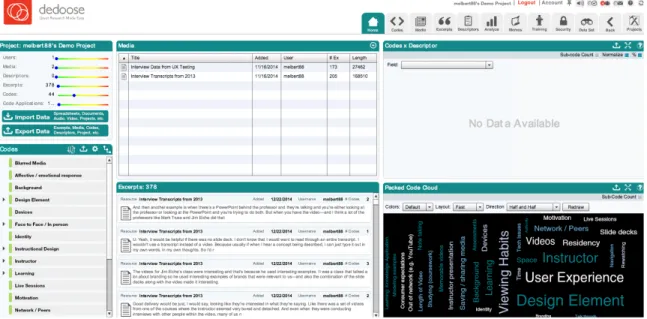
3 Screenshot from the cloud-based data management software Dedoose ...60
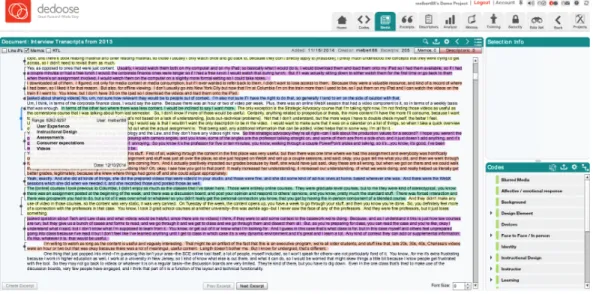
4 An example of one of the visualization tools that Dedoose offers ...60
5 A screenshot of the coding of the interview data ...61
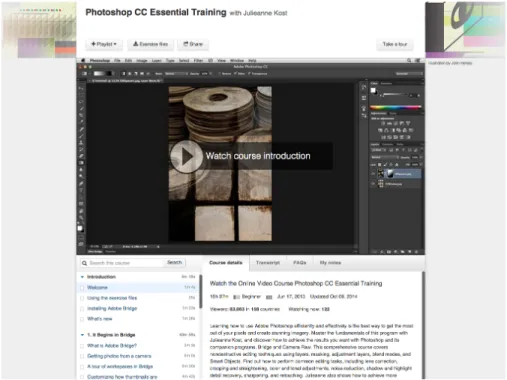
6 A screenshot of a Photoshop tutorial in Lynda.com ...72
7 Screenshot from video a participant referenced related to project management ...79
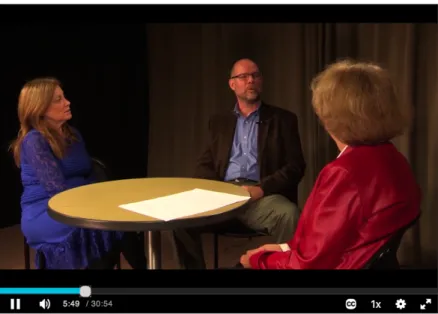
8 A screenshot from a guest speaker video ...86
9 An example of an instructor telling a joke in an online course video ...90
10 A screenshot from a video that could be considering having "high" production values ...94
11 Screenshot from a recorded participant "talk-through" ...111
12 Screenshot from discussion related to the scrub tool ...112
x PREFACE
Before I introduce this dissertation and the research questions, I begin with a vignette of my own personal experiences, mostly grounded in my professional
involvement working as a teacher in rural Alaska. This preface introduces my pathway to graduate school, and why I first became interested in the threads of inquiry that
developed into this dissertation. While this personal narrative does not concretely link to my dissertation methods and findings, I believe it is a way to frame this project, as it aims to invite the reader to consider the multiple pathways of knowing and communicating (especially in education spaces), as well as reflect on the trajectory of online and distance learning.
A few months after completing my undergraduate degree, I found myself on a dirt landing strip in rural Alaska, in an Athabascan Native village located on the Yukon River. This village was only accessible by airplane, a remote, 380-person town with a single post office, church, general store, and school. The inhabitants were almost all Alaska Natives, and the subsistence activities of moose hunting and salmon fishing persisted from traditional ways of living. Modernizations such as electricity, running water, and the Internet had arrived; but residents still kept dog teams, trapped and hunted, and practiced traditions such as Stickdance and potlatches.
xi
I was an Alaska Teaching Fellow, a participant in a program that places college graduates without teaching certification into high-needs schools. My position was the High School English and Social Studies teacher; I was one of three high school teachers working with 30 secondary students. My teaching load comprised of six different courses a day, including English grades 9-12; and various other classes, such as Alaska Studies, Geography, Drama, Art, Digital Photography, Yearbook, and Keyboarding.
It was a very challenging position for multiple reasons. The school’s resources were limited (the geography textbooks continued to list the USSR as a country). Classroom management was a challenge. There were gaping disconnects between the mandated curriculum and the local reality of this rural, Alaska Native context and the lived experiences of my students. This was especially apparent given the pressure we faced to raise test scores for No Child Left Behind accountability standards; we were explicitly instructed to “teach to the test” and spend class time on test practices. I
remember reading test questions about roller coasters and traffic signs, items nowhere to be found in this Interior village.
From an English teaching and literacy perspective, I found my job to be especially difficult. Most of my students were reading four years or more behind grade level. They were coming from a village where there was no print anywhere; no signs, no menus, no daily newspapers. Their grandparents’ first language was Athabascan, and print literacy had only been introduced in the past sixty years or so. The books required by the district office curriculum were by and large unrelated to the students’ culture and daily lives. There were some successes, however. All students passed the writing portion of their High School Qualifying Exam, and we created the first yearbooks the school had had in
xii
over a decade. Additionally, the school had many unique and inspiring elements. For example, when the school lunch program was running low on funding, members of the community went out and hunted a moose. The moose was brought to the school, and classes were cancelled for the day as students helped to pack and process the meat. Moose meat (including dishes such as mooseburgers and moose soup) became part of the lunch program for the rest of the year.
The second year I worked as a teacher at this school, an independent researcher from the “lower 48” received a large federal grant to implement a new computer lab. The lab included 50 new iMacs, a color printer, a scanner, and digital cameras. I began incorporating technology more often into my English classes. This began with word processing and research; then expanded into website authoring and visual slide show creations. Additionally, classes such as Digital Photography and Yearbook involved using computers, cameras, and web based tools on a daily basis. While there were still challenges, I found that using technology had a positive effect on my teaching.
Classroom management issues were not as significant. Students were able to produce multimedia artifacts (and in the process, learn English composition and computer skills), with less tension than writing five paragraph essays. From this experience grew a more serious interest in ways technology can teach and support literacy. From my classroom encounters, it made sense that participants from a traditional subsistence, oral culture would have stronger orientations toward visual modes. As Rupert Ross (1992) explains in his chapter “Being Indian is a State of Mind,” there is a mental process and attunement one must have to the surrounding environment when living a subsistence lifestyle—a person must constantly read the visual cues of the natural world, and cultivate an
xiii
awareness of how to be at the best place, “at the right moment.” Ross describes how this mentality is distinctly non-verbal:
Just as my fellow guides could not explain why they chose to fish some spots over others, and I could not explain how I knew a storm was
approaching, it is my guess that a great many things in the hunter-gatherer way of life might have similarly defied what we call "reasoned" explanation. I postulate, in fact, that the question "Why did you do that?" was rarely asked, simply because the only answer would be something close to "It felt right" or, in perhaps the ultimate expression of how the reasoner perceives his conclusions to be formed, by saying "It came to me." (p. 87)
While I can only surmise reasons why my Alaska Native students responded much better to digital photography and web design over print reading and writing, I found in my singular teaching practice that these activities were successful. The thread of
multimodality, and non-verbal ways in which learners create and express knowledge, is part of what led me to graduate school.
In addition to my experiences teaching high school, I also had my first experiences with online and distance education (2004-2006). As a participant in the Teaching Fellows program, I received state funding to earn my teaching certification and master’s degree in Education. This program was developed and executed through distance education, as it involved teachers working in bush Alaska, located in remote villages all over the state. My classes were held over the phone, over conference calls; we used the learning
management system Blackboard for discussions and posting files. Another dimension of distance learning that I gained exposure to was a video conferencing system installed to connect village schools through the district (which stretched across vast swaths of rural Alaska). This video conferencing system allowed for distance education classes; notably, one elder located in a village hundreds of miles away taught an Athabascan language
xiv
course which students could attend after school, watching the elder instructor through a large video monitor. A few times my English class was able to videoconference with an English class located a couple hundred miles away, and we could discuss books we were all reading. While distance education in general at that stage, from my perspective, remained largely underwhelming—marred with technical difficulties and un-engaging delivery platforms—its potential to collapse distances, draw in all types of students, and offer valuable resources was undeniable.
After I left Alaska, I continued with education and education research work. I also worked on a variety of projects in the field of media production. As a graduate student at Teachers College, I was employed at EdLab, a research and design lab at Teachers College, as a graduate assistant video producer. One of the primary projects I worked on was a weekly web video series based on scholarly research publications in Teachers College Record. These videos were three minutes long, emailed to a listserve reaching approximately 44,000 people, and essentially were video “summaries” of journal articles featuring the author(s) of the articles. There were many elements to consider in the production of these videos, including: how can visuals enhance the communication of the research ideas? What is a model use case of a “translation” from academic text to video? How could these videos be used in an educational context, such as undergraduate courses that introduce research? Is the main value really in the creation of researcher presence, so that viewers have a stronger social connection to the content? Additionally, I worked as a graduate research assistant on a multiyear, ethnographic project working with court-involved youth placed in an alternative-to-detention after-school program. In my role with this project, I was a participant-observer, both a facilitator of arts-based workshops
xv
and a researcher writing field notes and gathering participant artifacts. Along with the research team, some of the questions I investigated included: what modal resources do youth draw upon for meaning-making? What types of roles and social negotiations occur in informal video production workshops? What types of videos did youth create in these informal learning spaces, given various constraints? These questions and considerations continued my inquiry into multimodality and multimodal artifacts; distance and online education; and video and other forms of media.
After my role at EdLab, I began working full time as a media producer at a higher-education institution. My primary role in this position was to produce video content for a wide array of professional master’s degree online programs. This context is the basis for the following dissertation, and for my continued examination of multimodality, media, and education. While the online professional master’s programs at this elite university (with price tags ringing up to over $60,000 in tuition) are a far cry from the context of a 30-student, Alaska Native high school located on the Yukon River, there are overlapping threads. My teaching, research, and design experiences suggest that learners—whether from an indigenous culture or professional adult graduate students—have orientations towards different modalities, and gain educational value from different instructional modes. And while distance education continues to have the same problems I first encountered years ago—technical difficulties, uninteresting platforms and delivery systems, and lackluster pedagogical strategies—it is an area that continues to expand and merits more research. In this project, I aim to examine the student experiences in an online, multimodal environment; in particular, how students are making sense of their
xvi
experiences with instructional videos in online courses; that is, in what multisensory ways are they engaging, perceiving, and interacting with these semiotic artifacts.
Chapter I INTRODUCTION
This research study emerged from my first-hand, professional experiences as a media producer with a team at a higher education institution that develops online
programs, primarily online professional master’s degree programs. In my role as a media producer, I collaborated with the instructional design team, the media team, and faculty partners to strategize opportunities for video content in their online courses. Once we developed a plan, I worked on scripting, storyboarding, logistics; production; and post-production (editing, uploading, embedding). The media assets we developed
encompassed a wide range in production value and purposes. They included animated videos, scripted simulations with actors, “talking-head” lectures, screen-captured videos, and so forth, with purposes ranging from content delivery, to proposing a scenario for students to discuss, to guest speakers explaining industry experience, etc.
Throughout my tenure in this role, I began to form certain opinions about what comprised a “successful” video. Many of these opinions were subjective and anecdotal— there were certain videos I personally found more engaging, or interesting, or
aesthetically pleasing (recognizing of course my own biases since I was intimately involved in the production and creation of many of these videos). Some of these opinions
were also formulated based on data points, particularly from the analytics of our video hosting platform (the digital content management company Kaltura). While data analytics do not tell a full story, they carry certain implications; there is something to be deduced about a video, embedded in an online course with 30 students, that has 100 views in contrast with a video embedded in the same context that has 10 views. Similarly, there are inferences that can be made about a video that was watched, on average, at a play-through rate of 20% (for instance, the average viewer watched a 10-minute video for only 2 minutes) in contrast with a video that had a play-through rate average of 95%.
Based on these parameters, I began to form certain opinions about “successful” videos, or what were certain characteristics of “successful” videos. One such view was related to the length of the video—the analytics demonstrated that shorter videos had much higher play-through averages (so for instance, a 4-minute video might be watched for an average of 3 minutes and 45 seconds, as opposed to a 45-minute video, which might be watched an average of 7 minutes and 30 seconds). This, in turn, influenced our instructional design decisions; over time, we created video content that was shorter in nature (typically 5 minutes or less), or if we were producing longer-form lectures, we “chunked” out the longer form video into sub-videos. Another correlation demonstrated in the analytics is that videos directly connected to course assignments, especially course assessments, had the highest numbers of views. For example, one of the most-watched course videos during my time working with this team was a “Breaking News” simulation; this occurred in a communications course, where the instructor wanted to simulate a real-world situation. Students, working in groups, were tasked with formulating
they were messaged a “Breaking News” video (a simulated news broadcast), which contained new information they had to integrate into their plans in a short timeframe. This video received hundreds of views, which suggests it was watched and re-watched many times.
Figure 1. Screenshots from a “Breaking News” video simulation, a course video with some of the highest number of views throughout the 2012-2014 academic years
From my professional experiences working in this context, I held certain ideas and beliefs about “successful” videos (such as producing assets shorter in length, or
integrating videos directly with course assignments); these opinions derived from the video hosting analytics, or my own subjective perceptions about which videos were engaging or purposeful. However, over time I began to realize that the experiences and perspectives of students—the users, the learners, the audience for whom these video assets are designed for—were missing from these perceptions of online instructional videos. Additionally, assigning value to certain types of media assets—such as a video
with high view numbers—carries many unexamined assumptions. (High view numbers does not necessarily equate to meaningful learning experiences, for instance.)
On a daily basis, interfacing with designers and other media team members as well as the faculty, working on content slated to be launched at least a semester in the future— completing editing and other production tasks at my computer—it became easy to lose the perspective of the students, and to know exactly how this content was being taken up in their lives. As I started to think more deeply about the “success” of these videos, I realized a key viewpoint was missing: that of the students in this context (the learners, the users). The standpoint of wanting to know more about how students are actually engaging with these resources, and taking seriously their lived experiences with online courses; these inquiries became central to beginning this dissertation study.
Artifacts versus Experiences
I would also like to discuss how this project has changed over time, and how the focus has shifted. In earlier iterations of my research questions, the intent and purpose behind this project had a strong focus on the online videos. That is, what characteristics of instructional videos correlated with impact (whether that was measured through engagement, or student satisfaction, or discussion responses, or some form of
self-reported or observed learning). This emphasis on investigating the videos themselves was especially reflected in the methodologies. In earlier versions, the methods had a focus on the video artifacts, in the form of investigating the back-end data analytics from the video hosting platform (e.g., number of views and play-through rates); as well as artifact
examining the semiotic resources found in some type of “text” (such as a comic strip, or a website, or a video); it is a method that allows for a rich and close read of multiple modes (such as text, audio, framing, dialogue, and so forth). Multimodal analysis is a type of “yardstick” to measure and asses the diversity of the ways in which semiotic resources work in partnership to create meanings (Bauldry & Thibault, 2006).
However, as I conducted this research (especially as I carried out semi-structured interviews), I came to understand the true questions and focus of this dissertation
concerned the student experiences with the videos, and not the video artifacts. One of the benefits of qualitative research is that it allows for flexibility and change, and so this project iterated and shifted. The methods focused on the video artifacts (analytics and multimodal analysis) were eliminated from this study; the conceptual framework was also modified to incorporate the field of User Experience, an area of research that
considers the ways in which people interact with and experience technology. Thus, while this research study suggests certain design implications for online instructional videos, the focus is not on the video artifacts themselves or their characteristics; rather, it is on how students are experiencing the videos (harkening back to my original questions as a media producer).
Online Learning as Emergent Space
Online learning is a rapidly expanding field in education. Over 7.1 million postsecondary students are enrolled in at least one online course in the United States (over a third of all postsecondary students), according to a 2014 survey by the College Board and Babson Survey Research Group. Characteristics of many online courses in the
current moment include hybrid designs (a blended approach with both face-to-face and online instruction); interactive platforms that allow for social discussions and
collaborations; and adaptive tools that create customized learning. There are echoes and similarities in these online courses from earlier iterations of distance learning (examples of initial distance learning include video conferencing, educational television, and correspondence courses); however, the social and interactive elements of current online courses have created a different environment for students and instructors. The term “online course”1 is defined here as an educational course of study where more than 80% of course activities occur in online/web spaces (Babson Group, 2014).
The dimensions of online courses cited as beneficial include: the ability to reach different audiences such as nontraditional students, working professionals, and
international students; the variability and flexibility of online learning tools; and the potential reduction of costs, particularly salient due to the increasing tuition costs of higher education—the cost of an undergraduate degree increased by 1,120 percent between 1978 and 2012 (Jamrisko & Kolet, 2012). Online educational spaces have many affordances for collapsing distances and creating networks, engendering optimism that it has the potential to create entirely new learning spaces. “Traditional boundaries
(geographic, temporal, and pedagogic) have been crossed in ways hitherto unimaginable, and the result is unprecedented new forms of intellectual and social interaction”
(Harasim, 1996, p. 2013).
1I use the term “online” throughout this study to refer to course content (in particular,
course videos) that are hosted on course websites, accessed through password-protected, institutional log-ins. However, I believe the dichotomy between “online” and “offline” is a false one, as the two spheres blend into each other. (See the works of Turkle, 2009; 2011, or
This optimism of online learning—opening access and increasing equity to students; the networking, communication, and adaptive affordances of the online space previously unavailable in the traditional classroom; the more data-driven pedagogy, the more cost-effective credential—is often countered with critiques of online learning. Some of these counter-arguments include that online courses lack deep engagement and
become automated factory models (Feenberg, 2008). In his 1998 essay, “Digital Diploma Mills: The Automation of Higher Education,” David Noble argues that emerging online programs of study are impersonal and of low quality, and will contribute to growing inequities in education. Noble cites a 1959 study of diploma mills, prepared for the American Council on Education, which described the typical diploma mill with the following traits: “no classrooms,” “faculties are often untrained or nonexistent,” and “the officers are unethical self-seekers whose qualifications are no better than their offerings.” Noble argues that these qualifiers are “apt descriptions of the digital diploma mills now in this making.”
The current research on online learning suggests mixed results (Jaggars, 2014; Mentzer, Cryan, & Teclehaimanot, 2007; United States Department of Education, 2010; Wang, 2008; Xu & Jaggars, 2011), measured through assessments such as grades,
standardized test scores, and student satisfaction surveys. While there are emerging “best practices” for online courses, such as creating instructor presence, much remains
inconclusive. Fundamental questions about online learning are in the early stages of exploration, such as how students learn from online courses, and what impacts their motivation; what helps students retain knowledge; what is best taught online vs. face to face; how do the affordances and constraints of online tools influence learning; etc. Some
scholars have argued for a rethinking of educational variables in the online space, particularly related to MOOCs (massive open online courses), such as enrollment, participation, curriculum, and achievement (DeBoer et al., 2014).
Despite the mixed results of online education, it is clear that it is a trend that is not going away. Considering the changes emerging since the beginning of the 21st century, where entire industries and social behaviors have shifted online (publishing, music, banking, shopping, and so forth), it stands to reason that education will also increasingly shift into online and digital spaces, at least in certain dimensions. This dissertation aims to contribute to the larger questions and context around online education.
Instructional Videos
This study focuses on student experiences with videos (and not on instructional video artifacts), yet it is important to give context and background of instructional media in this project. Video has been a tool supporting education for many years (Sheppard, 2009). In World War II, filmstrips were studied as a resource for training soldiers
(Hovland, Lumsdaine, & Sheffield, 1949). Instructional television developed in the 1950s and 1960s, and Public Broadcasting Service (PBS) began in 1970, which created a wide range of educational television content such as Sesame Street. Video is a medium that has the ability to involve both auditory and visual symbol systems, creating a multisensory environment. There are many educational possibilities offered via video, such as simulations, dynamic modeling, conceptual visualizations, narrative content, and other formats (Baggett, 1984).
Contrasted with early film production, video is now much less complicated and less expensive to produce. Current mobile smartphones and computers are equipped with video recording tools, and videos can easily be uploaded and shared with others over online platforms. According to 2015 statistics of YouTube (a video sharing website), an estimated 300 hours of video are uploaded to YouTube every minute. This avalanche of content creation varies widely in subject, purpose, production values, intended audiences, and other characteristics. The trend of inexpensive and accessible tools for video
production—as well as inexpensive or free methods of uploading, displaying, and distributing—suggests that video creation will continue to increase, and that videos will have a growing presence in online spaces and sites.
When used in educational settings, video is often a method to convey content. The idea of the “flipped classroom” is a model where instructional material is delivered via video, online, during non-academic time, and subsequently class time can be used for homework, questions, discussions, and other activities separate from lecture delivery (Ronchetti, 2010). Khan Academy, started in 2006 by Salman Khan, is a YouTube channel featuring free online instructional videos on math and science topics that is closely associated with the “flipped classroom,” or “just-in-time learning” (the idea that an affordance of technology is that it offers access to instructional content right in the moment one “needs” it).
Often video has a prominent role in content delivery in online courses. (A cursory investigation of MOOCS—massive open online courses—hosted by the platform Coursera demonstrate that most courses have weekly video lectures). Because students are not present in a physical classroom, videos are often utilized to convey information
that would often be delivered during classroom time, such as instructional lectures. However, the online environment is a different space than the classroom environment, and many assumptions behind teaching, learning, and instructional content invite re-examination in the online educational sphere.
Instructional media has been primarily investigated from a cognitive studies standpoint, assessing learning on an individual level with pre-test and post-test study designs (Atkinson, Mayer, & Morrell, 2008; Mayer, 2001, 2008; Moreno & Mayer, 2004; Sweller, 2004). Much of this research implies that instructional videos are more impactful when cognitive load is reduced on the part of the end user—such as “the multimedia principles” (Mayer, 2008), which are a series of design principles based on the idea of minimizing working memory to decrease cognitive load. For instance, one of the
principles is the “modality principle,” which states that if animation is in an instructional video, it is better to use spoken text rather than written text, so the user is not
concentrating on both animation and words on the screen. Instructional media has also frequently been evaluated from a student satisfaction standpoint, using student
satisfaction surveys with Likert scales (Bennett & Glover, 2008; Choi & Johnson, 2005; Maag, 2004). This research (such as Mayer’s principles of multimedia) have influenced my professional work as a media producer, yet for this dissertation study, I aimed to pursue a qualitative project that considers students’ rich, lived experiences with instructional videos.
The aims of this dissertation are not to engender findings that are standardized and generalizable; rather, they are to describe the variability of student experiences of
resources. The intentionality of this research is such that recognizing students’ diverse interactions with online instructional videos will have implications for the design of online learning spaces.
Problem Statement
Not enough is known about how students experience online courses, and how students are experiencing online instructional environments. A qualitative exploration allows for a further investigation of student experiences, and how they are engaging, perceiving, and interacting with online artifacts; and how these online videos (or semiotic texts) are socially situated and taken up in their lives. To further explore how students are experiencing online instructional environments, additional questions considered include: how are students (in the specific context of this dissertation study, graduate students in online master’s degree programs) making sense of these artifacts? Where and when are they watching their course videos? How do they reflect on their learning experiences with these videos, and self-report how they have applied their learning? What modes and design resources within these instructional videos do they discuss, and focus their attention on? In short, what are students actually doing in online courses, with a particular focus on their interactions with instructional videos?
The development and deployment of online programs and courses has greatly increased since the early 2000s, and likely will continue to grow (Babson Survey Group, 2014). This expansion of education in the online space applies to all sorts of arenas: corporate training, higher education, K-12 education, informal learning, MOOCs (massive open online courses), and other realms. This widespread growth brings with it
an increased urgency to better understand online learning environments; the student experiences within these online learning environments; and the impact and implications of various design decisions on the student learning experience. As one cannot “xerox the classroom onto the Internet,” online environments invite us to reconsider assumptions commonly held about the classroom, such as: is the best format to deliver content via instructor lectures?
In addition, a focused examination of student experiences in these online spaces is applicable to diverse participants in the online education field, such as online instructors, program directors, administrators, and others involved in the education field. This inquiry carries particular relevance for educational content creators, such as instructional
designers and educational video producers because it connects the design of these environments to the student learning experiences. This dearth of research related to student experiences in online environments is, in part, due to the relative recency of online education. The consequences of this lack of research is manifest, especially when considering the scale and scope of online education—an estimated $107 billion industry (Global Industry Analysts, 2015). The field of educational technology has been
considered a “gold rush” in an education market “ripe for disruption” (Fang, 2014). This is an industry where new products, websites, and mobile applications frequently surface, especially since 2008, and billions of dollars in venture capital have been invested (CB Insights, 2014) as well as billions of dollars of public funds (Nagal, 2014).
Essentially, the size and scope of online education has increased at an extremely fast rate, and research and reflection into educational technology and online education has not kept pace. More specifically, there is a particular imperative related to the lack of research
around online instructional videos because often video is positioned as the method of “translating” educational content into an online learning space. (For example, creating videos of instructor classroom lectures, and requiring students to watch these videos as their primary method of engaging with course content.) A better understanding of the ways in which students experience instructional online videos has implications for instructional design, which therefore has implications related to resource allocation.
Research Questions
Attempting to describe the lived experiences of students enrolled in online courses, with a particular focus on their experiences with online instructional videos, this research project was guided by the following research questions:
(1) How do students make sense of their learning experiences from videos, in an online environment?
(a) How do students describe their experiences with course videos, in an online graduate course context?
(2) How do students engage with various modes and design elements of instructional videos in their process of meaning-making?
These questions served as guides throughout the data collection and data analysis stages, and serve as the overarching inquiries organizing the findings and implications.
Significance of Dissertation
The realm of online education is rapidly expanding for many contexts—K-12 education, higher education, and graduate education; corporate and workplace trainings; informal and just-in-time learning. The market research firm Global Industry Analysts estimates the online learning industry in 2015 is a $107 billion industry in the United States, and predicts this number to grow significantly over the next decade. This tectonic shift in education creates an increasing need for more research and understanding as to the ways in which these learning spaces are situated and experienced by learners. My hope for this study is to position student experiences at the forefront, and to gain greater comprehension and insight into the ways in which they are experiencing online
education.
The significance, in a broad sense, is related to the wider field of online education; more specifically, though, the focus of this dissertation is on the ways in which students are experiencing a specific type of educational content within online education—
instructional videos. Educational media production is also a significant industry, and frequently occupies a central role within online educational spaces. In online education, video is often used as the primary method of delivering education content such as instructor lectures (McConachie & Schmidt, 2015). Yet, despite the relatively high costs of video production, there is an absence of research as to the value of video in online courses; the research that does exist often focuses on engagement metrics such as views and play-through rates (Guo, Kim, & Rubin, 2014; McConachie & Schmidt, 2015). This raises several questions about the assumptions behind producing instructional videos for online courses: what are students’ perspectives of these videos? How are they engaging
and interacting with videos? How do these videos relate to their learning experiences and goals? This study has implications, particularly for designers of online learning spaces and producers of instructional videos, by considering that the ways in which students interact, engage with, watch, and make meaning from educational online content.
Organization of Dissertation
This introductory chapter aims to introduce the landscape of online learning, offering context for its growing role in many educational spheres. It gives a brief background of how video has been used for instructional purposes. In the problem statement, it aims to situate this dissertation study in a space where more research is needed related to how students are experiencing online courses; this occupies a research space that has implications for people involved in the growing sphere of online education, particularly designers of educational content.
Building upon Chapter I, Chapter II is a literature review of a few different areas. First, I begin by positing the conceptual framework of multimodal user experience, which offers a language and lens with which to answer my research questions. I follow with a review of user experience (or UX), wherein ideas of experience and sense-making are considered, as well as the ways in which the “user” has been defined. I explain the framework of sense-making developed by McCarthy and Wright (2004), which guided the data analysis and organization of the data chapters of this study. Then, I follow with a review of the literature around multimodality, and argue that multimodal user experience encompasses a broad frame to discuss meaning-making of digital spaces and artifacts.
Chapter III begins with a description and justification of the qualitative research methods and design of this dissertation study. I begin the chapter by explaining the research setting, offering background and context to the institution in which this study took place. I explain my role as a researcher at the site, and the implications related to my full-time employment at this location. This is followed by a description of the research methods employed, which drew upon semi-structured interviews and observational talk-through interviews. Participant recruitment and selection is explained. I provide details related to the iterative and ongoing data analysis stages that occurred during this research. I conclude the chapter by discussing the steps taken to ensure validity, and the limitations of the study.
Chapter IV discusses the ways in which student motivations and expectations shape how they approach watching online course videos. I first begin by exploring the motivations for enrollment that students expressed in interviews, which were primarily grounded in professional reasons. I then discuss the ways in which students discussed how they approached their viewing of instructional videos, finding that their self-reported viewing behaviors differed between instructional online course and non-course videos. I then discuss the times and spaces in which students self-reported their viewing habits, which were often framed in relation to their work; I follow this by explaining how students discussed applying their learning in workplace settings. I conclude the chapter by arguing that student motivations and expectations shape how they approach watching online course videos, and the times and contexts in which students view instructional videos shifts.
The themes explored in Chapter V focus on students’ sense-making and
interpretations of online instructional videos, with a focus on the theme of trustworthiness and the ways in which students assigned trustworthiness to their course videos. I frame this trustworthiness through the social contexts and associations of the presenter, as well as the multimodal elements found within the videos. I also discuss the ways in which participants conversed (and assigned meanings) towards multimodal design elements such as institutional branding and the production values of the videos.
Chapter VI focuses on the ways in which student experiences with online instructional videos blur with other course experiences. Drawing upon excerpts from interview data, I explain the ways in which student experiences with videos blurs with other course elements, such as live webinar sessions. I then continue to explore the ways in which the contours of videos were blurred, as well as how the interactions with instructional videos blurred with other web design elements. I conclude the chapter by building an argument for the overarching finding of this dissertation study, which is that recipients of multimodal artifacts have a lot of agency, and their meaning-making of online videos may not align with the designer’s intentions.
In the Conclusion section, Chapter VII, I return to the problem statement outlined in the Introduction, and summarize the findings from this dissertation study. I explore the ways this dissertation addressed the questions I raised, and aim to recontextualize this research in the field of online education. I then explain the implications for this dissertation research—implications for theory, and implications for designers. I then discuss areas for future research, and conclude with final thoughts.
Chapter II
LITERATURE REVIEW
In this review of the literature, I cover areas that offer theoretical and conceptual backgrounds to the research questions and setting of this study. To guide this review, I begin with the conceptual framework of Multimodal User Experience to offer language and a lens with which to investigate the research questions for this study:
(1) How do students make sense of their learning experiences from videos, in an online environment?
(a) How do students describe their experiences with course videos, in an online graduate course context?
(2) How do students engage with design elements of instructional videos in their process of meaning-making?
I outline the conceptual framework, and then follow with a review of User Experience (or UX), wherein ideas of experience and sense-making are considered, as well as how the field has investigated the ways in which “users” experience technology.
Subsequently, an exploration of the field of Multimodality is outlined, and I situate this study in a space where ideas from user experience and multimodality overlap.
Conceptual Framework: Multimodal User Experience
The conceptual framework that guides this study is Multimodal User Experience; that is, a lens that considers the overlap between the disciplines of multimodality and user experience (UX). User Experience, broadly speaking, is a field that investigates how people interact with technology; more specifically, how a single user navigates a technological system, such as a website. While the “gold standard” of UX (especially within the technology industry) is usability, and the ease with which users can complete a task (Hornbaek, 2010), more recent developments have accounted for affective qualities such as emotions, aesthetics, and perceptions (McCarthy & Wright, 2004; Roto et al., 2011). Multimodality, which has its lineage in semiotics, considers the ways in which multiple modal resources (such as image, gesture, sound, and so forth) are utilized in communication and meaning-making (Jewitt, 2006; Kress, 2000, 2009). Multimodality has particular relevance in relation to digital technologies, and the ways in which multiple modes are composed for communicative purposes; it also has implications for education spaces, as it considers the potential for meaning-making and learning via multiple modal resources (i.e., image, music, gestures).
In simplistic terms, these fields offer a language and a framework to answer the core research question, how do students make sense of their learning experiences from videos in an online environment? User experience allows consideration and
example, their experiences with online course websites and online instructional videos. Multimodality offers a way to frame and discuss how multiple modes relate to student’s meaning-making; for example, how non-verbal elements of videos (such as branding, or gestures, or music) relate to students’ learning experiences.
The conceptual framework of multimodal play (Vasudevan, 2006; Vasudevan, DeJaynes, & Schmier, 2010) combines the disciplines of play and multimodality, and considers the generative possibilities of play (such as humor and experimentation) with the generative possibilities of multimodality (such as digital compositions in blogs and other websites). Multimodal play is both a conceptual framework for examining digital literacies and practices; it is also a pedagogical stance, particularly salient in relation to youth and adolescent educational spaces. This framework served as the inspiration for my work, in the ways in which it brought together multimodality with other ideas,
particularly in the context of an emergent educational space.
The conceptual framework of multimodal user experience aims to offer an analytical “point of entry” when thinking about how people experience and make meaning from online spaces. By overlapping the fields of user experience and
multimodality, this lens offers a way to investigate how students are experiencing online course sites and online instructional videos. Multimodal user experience is a particularly useful framework that calls attention to both the “users” (or students) as well as the “designers” (or the digital content creators), when seeking to understand the meaning-making of digital spaces and artifacts. Thus, I use this framework to analyze the research questions around learning, experiences, and sense-making from online videos.
The research and practitioner fields related to educational technology and online learning are relatively new, and have accelerated rapidly since the early 2000s. These emerging spaces invite flexible and interdisciplinary approaches with research; it is also a rich space for practitioner research, or for practitioner or industry approaches to research. It is within this practice-based and emerging-field locale that I situate this dissertation study, and the multimodal user experience framework.
User Experience (UX)
“User experience” (also referred to as UX), broadly speaking, is a discipline that considers how people interact with technology. UX is an established domain within the technology industry; there are several professions and job titles currently related to UX and UI (user interface), such as UX/UI designers and UX researchers. There are also many undergraduate, graduate, and certificate programs in the UX field. UX is broadly considered to have emerged from the field of Human-Computer Interaction (or HCI), yet there is little consensus as to what “user experience” actually means. For instance, in a survey of 275 researchers and practitioners involved with UX research and industry, Law et al. (2009) found no consensus as to a common definition of user experience (although the majority agreed UX is dynamic, subjective, and context-dependent that can be predicted and therefore, engineered through design). Below is an overview of the changing field of UX as well as how it has been defined; then, ideas around “user” and “experience” are explored, as well as “sense-making.” I offer how UX is defined and taken up in this dissertation study.
Evolving Definitions of UX
User experience has roots in the field of Human-Computer Interaction (or HCI), which came about from the disciplines of psychology and computer science, which have orientations towards laboratory settings. The origins of UX are also based on task completion, removed from context and embeddedness; and task-oriented usability still remains the “gold standard” for UX (Hornbaek, 2010).
Early approaches of UX were developed to evaluate and design for the ease of use and learning for novice users. Gould and Lewis (1985) proposed three design principles of designing for usability: (1) early focus on users and tasks, (2) empirical measurement with actual users and a prototype system, and (3) iterative design and development. Shackel (1990) developed the “characteristics for usability” which include: effective, flexible, learnable, and satisfying. In Don Norman’s (1988) book, The Design of Everyday Things, Norman defines the term “user-centered design” to describe how design can fulfill requirements or needs of the user, in relation to human/object and human/computer interaction, recommending design features such as simplifying the structure for tasks and making things visible.
Framing human experiences with technology as task-oriented and utilitarian
neglects other dimensions of how people interact with and experience tools. For example, in a 2011 survey by Avira, an IT security company, 39% of participants reported cursing at their computers and 12% attempted or carried out physical assaults against the
machines they interact with. This survey suggests that technology can elicit the same emotions people have from interactions with other people (Desmet & Hekkert, 2007). More recent approaches and definitions of UX have expanded, including “non-utilitarian
aspects of interactions, shifting the focus to user affect, sensation, and the meaning as well as value of such interactions in everyday life” (Law et al., 2009, p. 719). As McCarthy and Wright (2004) explain, they are “heartened by the fact the consumer metaphor underlying notions of user experience treats activity as emotionally laden” (p. 11). In other words, one of the developments in user experience in the technology industry is that many affective qualities experienced by users are now often considered, such as—aesthetics, emotions, if something is fun, if something is frustrating—and while the focus in UX still remains on usability, task-oriented functionality, and optimizing “user flow” through a product (Kim, 2014), it is a broader framework than only task completion. The conception of UX has shifted to “encompass all aspects of interacting with a system” (Hassenzahl, 2003, p. 41), and considers the contextual, aesthetic, and emotional outcomes from using technology (Hassenzahl & Tractinsky, 2006). In Thoughts on Interaction Design, Jon Kolko (2011) states that user experience experts should “stop being advocates for simply usable designs and begin to herald the creation of more poetic, culturally rich design solutions” (p. 17).
The User
Kuutti (2001) traces the trajectory of the history of the “user” in HCI, and argues that the user started in the 1970s as a cog in a rational machine, became a source of error in the 1980s, a social actor in the 1990s, and is now positioned as a consumer. More recent developments have positioned “users” more broadly than task-oriented “subjects,” taking into account individual interests, practices, histories, and objectives (Bødker, 2006; Connolly et al., 2008). “The ‘user’ is reconstructed as a creator of actions who precedes an identity rather than a user with an identity that prescribes actions” (Wakkary
& Maestri, 2008, p. 490). While this view may have current prevalence, the importance of holistically understanding the user may have first been suggested by Hansen (1971), whose first principle of user engineering was “know thy user,” and he encouraged designers to understand the user’s “education, experience, interests, how much time he has, his manual dexterity, the special requirements of his problem, his reaction to the behavior of the system, his patience” (p. 527). Despite these early intonations of considering broader contexts of the user, in the 1970s and 1980s the predominant
approach to understanding relationships between people and technology assumed a single user sitting in front of a computer screen and a keyboard performing proscribed tasks (McCarthy & Wright, 2004).
Anthropologist scholars shifted the focus to considering “the user” as a social actor. This sociocultural work reframed technology as social and practical, situated in everyday activity (Lave, 1988, 1996; Lave & Wenger, 1991). These scholars questioned the validity of separating mental processes from context and historical traditions, thought from situated practice, or action from setting. Lave (1988, 1996) offered accounts of socially situated practice, maintaining that one’s practice and the social context in which it occurs cannot be separated. Subsequent scholars have taken up this work by positioning technology in community contexts (Brown & Duguid, 2000; Rheingold, 2000). In
Talking about Machines: An ethnography of a modern job, Julian Orr (1996) conducted fieldwork among Xerox technicians and documented the ways in which they constructed narratives around their repair work, such as diagnostics. Through the technicians’ “war stories,” they made sense of their experiences as well as created a socially distributed
knowledge network. In Orr’s work, technology is embedded within social and cultural practices.
The ethnographically-informed, or “user as social actor” perspective has been overshadowed by the positioning of user as consumer in more recent times (Kuutti, 2001), or user as isolated individual. The idea of “user as isolated individual” has been critiqued; Battarbee and Koskinen (2005) dispute the individual focus of the UX field, and argue for “co-experience,” which relates to how the experiences an individual has and how their interpretations are influenced by others. Norman (2002) has argued that by referring to people as “users,” designers and engineers depersonalize them, and that the implicit meaning of the term user is of someone who can only make use of what is given to them. Norman also makes the case that customization, personalization, and
personification make all users “designers.”
In the context of this research study, there are design and pedagogical implications of incorporating user experience frameworks in an educational setting. Specifically, by using a UX framework, this positions “students” as “users,” which may carry
connotations that learning is a transactional experience, or that students are positioned as consumers. The parallel of “user experience” to “consumer experience” is not
overlooked, as UX/UI is closely associated with industry, particularly the technology industry, and improving “site optimization” for products (Kim, 2014). For instance, the research and consulting company Nielson Norman Group or NN/g (started by user
experience researcher Don Norman) lists the following as their mission statement: “NN/g will help you create better experiences for real people and improve the bottom line for your business.” Within this dissertation study, I do not aim to position students as
consumers, by considering them as users. Rather, I consider students as users interacting with technology embedded within broader sociocultural contexts. They are users with personal experiences with technology in “real world” settings.
The consumer metaphor of “users” is acknowledged, as is the mechanistic and information-processing HCI relationship between people and computers, yet there are many productive ideas and approaches from the UX field around how people make sense of technology; in particular, the sensory, emotional, and affective responses students may have in their sense-making of online videos in online courses. Below, I explore more thoroughly how experience and meaning-making are positioned in this research study, anchored by the research question: how do students make sense of their learning experiences from videos, in an online environment?
Definitions of Experience
The term “experience” is both rich and elusive. There are also many inherent problems and difficulties in describing experience, as we are always involved in
experience (as the reader is in the moment of reading this text). There is no way to “step back” from experience and occupy an omniscient view. Yet despite the limitations of defining and describing experience, it is fundamental to our existence. As McCarthy and Wright (2004) offer: “we humans want to understand and interpret our experience…we live in a world that is not given to us whole cloth and so we have to make something of it” (p. 122).
In Art as Experience, Dewey (1934) argued against the way museums positioned art as separate from everyday experience, and instead offered that art should be part of ordinary and lived experience. Dewey positioned human action as situated and creative,
and made the case that every person brings his or her own histories, interests, and beliefs to a situation, and the self is engaged in a conversation with that experience. To quote Dewey, from 1938: “The principle of continuity of experience means that every
experience takes up something from those which have gone before and modifies in some way the quality of those which come after” (p. 35). In other words, experience is a process of sense-making that builds upon one’s histories and previous experiences; this then informs future experiences. Experience is also more holistic than simply actions or behaviors; it involves a person’s full relationship (sensory, emotional, and intellectual) with his or her physical and social environment.
In Technology as Experience, McCarthy and Wright (2004) build upon Dewey’s ideas of art and experience, as they similarly position technology and experience; they argue that technology is embedded in everyday experience (as Dewey positioned art) in ways that are both aesthetic and functional. McCarthy and Wright explain: “When we conceptualize technologies as experience, we are attempting to review technology by making visible aspects of experience of technology that would otherwise remain
invisible” (p. 20). They build upon the importance of emotions and sensory elements in human experience, and highlight components such as the spatial and temporal; they also make the case that any analysis of experience sense-making must make explicit social and interpersonal contexts. In this dissertation study, experiences with technology (and specifically, experiences with online instructional videos) are considered as embedded within everyday practices, and that these experiences are situated in social and cultural contexts.
Meaning-making
To define and give contours to “meaning-making,” that is, the ways in which students are describing and experiencing instructional videos in their online courses, I draw upon the six processes of sense-making that McCarthy and Wright (2004) outline. While there are limitations to addressing individual sense-making processes apart from the whole, these are boundaries to help describe and analyze the ways in which people interact with technology, and in this study, the ways in which they experience
instructional videos in their online courses. The personal meanings of an experience depend on one’s history and motivations; one of the characteristics of being human is the drive to interpret and understand our experiences (Bruner, 1986).
User Experience (UX) considers the ways in which people interact with technology from a functional perspective; it also takes into consideration the sensual, emotional, and spatial-temporal aspects of experience. As McCarthy and Wright (2004) argue, analysis must also attend to the past and the future; “the before and after that are folded into the present experience and that are themselves changed by the present experience” (p. 114).
The organization of the data chapters of this study are loosely based on the
processes of sense-making making (McCarthy & Wright, 2004), which are organized by the temporal guidelines of experience. These data chapters include Anticipating
(Professional Selves), Interpreting (Trustworthiness), and Recounting (Blurred
Experiences). These processes of sense-making take into consideration the situatedness in which people use technology; the sensory engagement with experiences that transcend language; and the continuous engagements with experiences which help understand how the past and future influence the present. This approach aligns with my research
questions, as it offers analytical contours to my research questions related to how students are making meaning from their experiences with online videos, and how they are making sense of multimodal design elements. Below I outline (and offer brief examples) of the six processes of sense-making.
Anticipating: The expectations, possibilities, and prior experiences with which one approaches an experience (or in this instance, an online instructional video). For example, a student preparing a notebook and paper in order to take notes before watching a course video. This is important to consider in terms of user experience in order to help frame and understand the ways in which a person is situating and framing their experience (before it even occurs). One’s past skills, motivations, understandings, and so forth influence their meaning-making.
Connecting: Connecting refers to the immediate sense of a situation encountered (which may be a sense of tension or relief at something happening). For instance, the moment a student clicks on the “play” button and the emotion that it engenders if it plays (or does not play, an unanticipated outcome). This might take into account affective or emotional aspects to the ways in which users encounter technology, such as frustration, or enjoyment. The visceral ways in which we react to experiences is something that UX considers as important to understanding sense-making of technology.
Interpreting: Interpreting is the process of understanding what is happening. For example, watching a video and decoding the narrative and people involved, such as recognizing the faculty member in the video, listening to the lecture, and viewing the graphics that accompany the lecture. This is a key facet to understanding the ways in which participants are verbalizing and meaning-making their experiences (such as