Lorenzo Casini† and Michael Baumgartner‡
Alexander Gebharter has recently proposed to use Bayesian network causal discovery methods to identify the constitutive dependencies that underwrite 5
mechanistic explanations. The proposal depends on using the assumptions of the causal Bayesian network framework to implicitly define mechanistic con-stitution as a kind of deterministic direct causal dependence. The aim of this paper is twofold. In the first half, we argue that Gebharter’s proposal incurs severe conceptual problems. In the second half, we present an alternative way 10
to bring Bayesian network tools to bear on the issue of understanding mecha-nistic constitution. More precisely, our proposal interprets constitution as the relation explaining why a target phenomenon has its characteristic causal role in terms of the causal roles of some of its spatiotemporal parts—where the notion of causal role is probabilistically understood.
15
1 INTRODUCTION
The mechanistic account of scientific explanation (Machamer et al., 2000; Bechtel and Abrahamsen,2005;Glennan,2002) holds that the explanandum, a higher-level phenomenon, is explained by the lower-level mechanism respon-sible for it. In a popular characterization,
20
[a] mechanism is a structure performing a function in virtue of its com-ponent parts, comcom-ponent operations, and their organization. The or-chestrated functioning of the mechanism is responsible for one or more phenomena. (Bechtel and Abrahamsen,2005, 423)
To make a simple but paradigmatic example, the phenomenon of amplification 25
in a two-stage amplifier is caused by a signal (e.g., current, voltage, power) re-ceived from an input source, and it causes in turn outer effects such as signal distortion, as produced by an output device (e.g., a loudspeaker). The phe-nomenon is explained by the augmentation of the signal by the two transistors of the amplifier arranged in series (seeWimsatt 2007, ch. 12). Another, often-30
cited example is the phenomenon of action potential in a neuron, namely the sudden rise and fall in the electric potential of a neuron’s membrane. The phenomenon is caused by the binding of neurotransmitters, which are released by a neighbouring, “presynaptic” neuron, to receptors of the “postsynaptic”
†
Dept. of Philosophy, University of Geneva. Email:[email protected] ‡Dept. of Philosophy, University of Bergen. Email:[email protected]
neuron, and it causes in turn the release of neurotransmitters into the synaptic 35
cleft. The phenomenon is explained by the activities of many components, most importantly by the opening and closing of voltage-gated ion channels in the neuron’s membrane (seeCraver 2007, chs. 2 and 4).
More generally, a mechanism is embedded in a causal context, where causal background conditions are operative that provide the external circum-40
stances relative to which certain parts of the system are responsible for the phenomenon. The relevant kind of responsibility is constitutive rather than causal. The system’s parts that mechanistically explain the phenomenon are the “component” (see above quote), or constituent, parts. The importance of the notion of constitutive relevance, or constitution, in mechanistic accounts 45
of explanation is emphasized by Craver, who maintains that “the very idea of a mechanism presupposes the idea of constitutive relevance” (Craver, 2007, 8). While causation has been at the centre of philosophical theorizing for cen-turies, the notion of constitution has only recently begun to attract philosoph-ical attention. In particular, it is still unclear what discovery method would 50
systematize the inference to constitution.
Gebharter has recently (2017b) suggested drawing on the resources of the Bayesian network (BN) framework, which is widely used to model causa-tion (Spirtes et al., 2000; Pearl, 2000), to address the task of constitutional discovery. He has claimed that, despite the differences between causation and 55
constitution, the BN axioms used to model causal relations also capture consti-tutive relations, and that constitution can be implicitly characterized as a form of direct deterministic causation—from which he infers that one may concur-rently use BN causal discovery algorithms for both causal and constitutional discovery.
60
In the first part of this paper, we argue that Gebharter’s intended use of BNs incurs severe conceptual problems. In paradigmatic cases, allowing determin-istic dependencies entails violations of a standard assumption (viz. Faithful-ness) of BN constraint-based algorithms (in particular, PC), which Gebharter proposes to exploit for constitutional discovery, leading to systematic mis-65
takes in causal and constitutional inference. In the second part of the paper, we propose a theory of constitution, which avoids these problems. In a nut-shell, our proposal is that the constituents are all and only those parts of a phenomenon, whose causal roles account for why the phenomenon has its characteristic causal role. This idea has been recently expressed, in one way 70
or another, by a number of authors (e.g.,Gillett 2002, 3191; see alsoFazekas and Kert´esz 2011andSoom 20122) but it has never been cashed out in detail 1Gillett(2002) proposes an account of “realization” as a relation between the causal powers individuating a phenomenon and those individuating its constituents.
2
The latter, contrary to the former, maintain that the causal role of the phenomenon is iden-tical to (rather than supervenient on) the causal role of its constituents. We do not endorse this assumption.
and with formal precision. We fill this gap by giving it a precise rendering in the framework of BNs, which is particularly suitable to explicate the notion of causal roles that figures in our account. In sum, the intended contribution of 75
our proposal is to provide an operational definition of constitution that brings a sophisticated machinery for causal discovery, viz.BNs, to bear on the task of constitutional discovery in a theoretically sound way.
The paper is organized as follows. After a brief introduction to causal BNs (§2), we review Gebharter’s proposal and find it flawed (§3). As an alternative, 80
we spell out our theory, sketch its operationalization, and discuss how it avoids the discovery problems incurred by Gebharter’s proposal (§4).
2 PRELIMINARIES
Let us begin by introducing the theory of causal BNs, as well as a notational convention on the variables of BNs representing mechanistic systems.
85
Traditionally, the BN formalism uses generic random variables, to repre-sent types (or degrees) of properties or behaviours independently of the enti-ties instantiating them. Here, however, we shall follow the mechanistic liter-ature in taking the variables as denoting the behaviours exhibited by specific entities (such as a system and its constituents), and consequently adopt the 90
following notational convention. We shall use calligraphic fonts to introduce specificrandom variablesA(S)andB(P1)(Spohn,2006), by which we
de-note the behaviourAof a specific systemSand the behaviourBof a specific
part P1. As we are only concerned with specific variables, we will leave the entity-relativity of our variables implicit and just write “A”, “B”, etc. for the
95
behaviour types “A(S)”, “B(P1)”, etc. This relativization to specific systems
and their parts entails that mechanistic phenomena are not multiply realized by different types of systems (e.g., amplification as realized by a two-stage se-rial amplifier and amplification as realized by a parallel amplifier are different phenomena), albeit they may be multiply realized by multiple configurations 100
of the values of the parts of systems of the same type (e.g., action potentials in the same neuron are overdetermined by multiple configurations of its ion channels’ states, which are jointly sufficient but not individually necessary to action potential).
A BN is a triple⟨V,E,Pr⟩of: a finite setV= {V1, . . . ,Vn}of variables,
105
each taking finitely many possible values; a set of edgesE, whose connected nodes are the variables inV, such that nodes and edges form a directed acyclic graph (DAG); and a probability distribution Pr, such that the probability of each variableViin the DAG obeys the Markov Condition (MC):
(MC) For anyVi∈V= {V1, . . . ,Vn},Vi⊥⊥Noni∣Pari,
V1 V2 H H H HHj V4 V3 * V5
Figure 1:A Bayesian network
whereParidenotes the set of parents ofVi, andNonidenotes the set of
non-descendants ofVi.3 In words, each variable is probabilistically independent of
its non-descendants, conditional on its parents. For instance, MC applied to the DAG in Figure1 implies thatV4⊥⊥ {V1,V5}∣{V2,V3}. In BN jargon,V2
andV3“screen off”V4fromV1 andV5.
115
When the BN is causally interpreted, no pair of variables denotes proper-ties in semantic, logical or mereological relations. In that case, the edges stand for direct causal relations, andMCis called Causal Markov Condition (CMC) (cf.Spirtes et al. 2000, §3.4.1, §3.5.1).
A precondition for a variable set to satisfyCMC is (causal) Sufficiency 120
(Zhang 2006, 8; cf.Spirtes et al. 2000, §3.2.2):
(Sufficiency) ⟨V,E,Pr⟩is such that every direct common cause of any two
variables inVis inV, or has the same value for all units in the popula-tion.
Sufficiencyis meant to guarantee that for any two variables inV, there is no 125
probabilistic dependence not due to a causal dependence—that is, no proba-bilistic dependence is spurious. The condition entails that, while there may be latent causes of modelled variables, there are no latentcommoncauses of any two modelled variables.
Finally, Faithfulness is standardly assumed in the causal BN literature 130
(Spirtes et al. 2000, §3.4.3), especially for purposes of causal discovery: (Faithfulness) ⟨V,E,Pr⟩is such that every conditional independence
rela-tion true inPris entailed byCMCapplied to⟨V,E⟩.
Faithfulnessguarantees that there is no causal dependence without probabilis-tic dependence—or, in other words, that the only probabilisprobabilis-tic independencies 135
in the graph are due to the absence of corresponding causal dependencies. For instance, the causal Faithfulness condition applied to the BN in Figure 1 implies that V4 ⊥⊥ V/ 2, that is, there is no exact cancellation ofV2’s effect
3
The “parents” ofViare the direct ancestors ofVi, namely those vertices on directed paths
intoVifrom whichVican be reached without mediation via other vertices. The “descendants”
onV4 due to, say, a positive influence along the direct pathV2 Ð→ V4 and a
negative influence along the indirect path V2 Ð→ V3 Ð→ V4. In particular,
140
Faithfulnessentails that all causal dependencies are detectable by conditional independence tests, as commonly performed by causal discovery algorithms (see, e.g.:Spirtes et al. 2000, 82, 88, 144; andPearl 2000, 50, 52).
3 SHORTCOMINGS OF GEBHARTER’SPROPOSAL
While BNs have a long tradition of successful applications in causal discovery, 145
they have played no role so far in constitutional discovery. The main reason is that constitution is commonly assumed to be characterized by (non-reductive) supervenience(see, e.g.,Glennan 1996, 61-2, andEronen 2011, ch. 11), which gives rise to deterministic dependencies: a complete set of constituents of a phenomenon forms a supervenience base of that phenomenon, and thus a suf-150
ficient condition for it—i.e., necessarily, there is no change in the phenomenon without a change in its supervenience base (but not vice versa). This sharply distinguishes constitution from causation, which in the BN framework is as-sumed to be non-deterministic, or “pseudoindeterministic” (cf. Spirtes et al. 2000, §3.3.2), due to latent, unmeasured causes.
155
To illustrate the difference, let us consider the amplification mechanism. LetGindicate the phenomenon of gain, or total voltage increase, of an
ampli-fier subject to a voltage inputI. Amplifiers are built by assembling a number
of active elements, usually transistors, in a circuit. Assume that the amplifier in question is a two-stage amplifier, such that the signal received by a first 160
transistor is amplified and fed to a second transistor, which further amplifies it. LetAandBbe the transistors’ individual gains.
Then, the amplifier’s overall gain in response to any given inputI = i is
some pseudoindeterministic function G = rGi − i + G, where rG indicates
a (constant) amplification ratio and G indicates some noise. For instance, if 165
I =2volts and the amplification ratio is8, thenG =2×8−2+Gvolts, where
14 (i.e.,2×8 − 2) volts andG volts, respectively, areG’s deterministic and
non-deterministic components. Analogously, the transistors’ absolute gains are given byA =rAi−i+Avolts andB =rBi−i+Bvolts. The composition
function determining the overall amplification ratio of a serial amplifier is the 170
product of its transistors’ amplification ratios. Assume that the first transistor amplifies by a ratio 2, and the second amplifies by a ratio 4, such that the overall ratio is 8. Then, when subject to an inputI =2volts, the first transistor
amplifies the signal by2×2−2+Avolts; and the second transistor receives
that signal and amplifies it further by4× (4+A) − (4+A) +Bvolts.
175
By contrast, the relation betweenGon the one hand, andAandBon the
other hand, is not pseudoindeterministic but deterministic:AandBdetermine G. This means that, whatever noisy component is present inG, this is
supervenience entails thatrGi −i +G = rB(rAi+A) −i +B. WhenI =2
180
volts,2×8 − 2 +G = 4× (4+A) −2 + B, that is,G = 4A +B.
The deterministic dependencies entailed by supervenience, in turn, tend to induce violations of one of the standard assumptions of BN discovery al-gorithms, viz. Faithfulness (Spirtes et al. 2000, §3.8; Glymour 2007, 236). Nonetheless,Gebharter(2017b) has recently contended that these algorithms 185
can be directly applied, with some restrictions, to variable sets featuring both constitutional and causal relations, such that the uncovered dependencies are then grouped into causal and constitutional dependencies using information about temporal overlap. As a result, so Gebharter claims, BN algorithms can be used to perform causal and constitutional discovery in one go.
190
Even though Gebharter is not concerned with explicitly defining constitu-tive relevance, he still argues (2017b, 2652–54) that constitution is implicitly characterized by the same axioms that the BN framework assumes for causa-tion. More specifically, he claims that the screening-off behaviour of complete sets of constituents is analogous to that of deterministic direct causes and that 195
the screening-off behaviour of incomplete sets is analogous to that of indeter-ministic direct causes (2653). From that, he infers that constitutional relations can be represented by BNs and uncovered by standard BN algorithms, just like causal relations.
However, in light of the failure ofFaithfulnessin the presence of determin-200
istic dependencies, the apparent conclusion to draw from Gebharter’s finding that constitutive relations behave like deterministic causation would be that BNs are notcapable of representing systems featuring constitutive relations (in addition to indeterministic causal relations), just as they are not capable of representing systems featuring deterministic causal relations, and that—a 205
fortiori—BN algorithms are not applicable to systems featuring constitutive relations. Gebharter attempts to diffuse these worries by introducing restric-tions on the applicability of his approach.
More specifically, he suggests (2017b, 2662) that violations of Faithful-nessinduced by deterministic constitutive relations can be avoided if the ap-210
plication of BN algorithms is restricted to mechanistic systems with two lev-els only. This amounts to using background knowledge on parthood relations between variable instances to only include parts of the phenomenon in the analysed variable set but not parts of parts of it. To illustrate, consider a mechanistic system with three levels, whereV1 constitutively determinesV2,
215
which constitutively determines a phenomenonV3. In that case, it holds that
Pr(V3∣ V1∧ V2) =Pr(V3∣ V1) =1,viz.that the indirect constituentV1 screens
offV3 from its direct constituentV2, which, however, is not entailed byCMC
and hence violatesFaithfulness. That is, mechanistic hierarchies with consti-tutive paths tend to violate Faithfulness. Without argument, Gebharter then 220
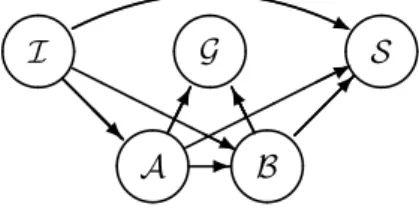
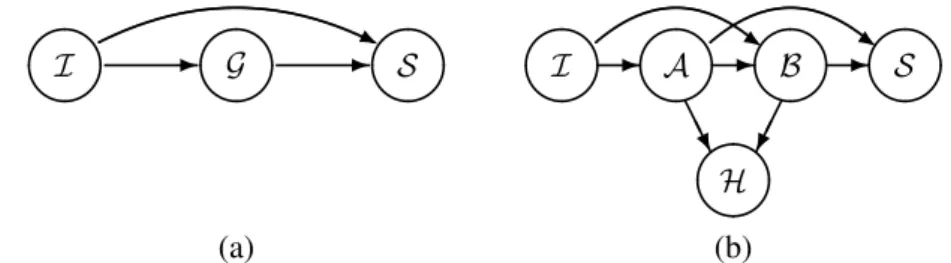
I G S A B @ @ @ R A A K AA H H H H HHj * @ @ @ j
Figure 2:Structure of a two-stage amplifier mechanism, for an epiphenomenalist*.
tems that induce failures of Faithfulness due to deterministic dependencies, and recommends that BN methods be applied to two-level mechanisms only.
Yet, Gebarther severely underestimates the problems induced by his pro-posal. First, note that, by the assumed supervenience of phenomena on their 225
constituents, every phenomenon has a complete set of constituents that de-termine it and, as a result of determination, screen it off from all other vari-ables. It follows that a complete graph (involving any number of levels) of any mechanistic system will not feature edges in and out of phenomena. A friend of macro-level causation will interpret this finding as yet another Faith-230
fulness violation induced by deterministic dependencies. On the assumption that phenomenacanbe caused and be causally efficacious, the screening-off relations in complete graphs of mechanistic systems exceed those entailed by CMC applied to the true graphs of these systems. What is more, this breach ofFaithfulnessobtains even in two-level systems, as may be illustrated by our 235
amplification example (Figure2). Let the variable set beV′= {I,G,S,A,B},
whereSdenotes a side-effect of the mechanism, namely the distortion of the
signal as received by an output device, say, a loudspeaker. Given superve-nience,{I,S } ⊥⊥ G ∣ {A,B}.
Opponents of macro-level causation can avoid this consequence. They 240
interpret the fact that phenomena are screened off from all incoming and out-going influences by their constituents as an argument in favour of a radical form of macro-level epiphenomenalism, call it epiphenomenalism*, viz. the view that non-fundamental properties are not only causally inert (as entailed by standard epiphenomenalism) but also uncaused. Against that background, 245
the absence of arrows in and out of phenomena in complete mechanistic graphs is entailed byCMCand, hence, does not violateFaithfulness. Accordingly, to maintain his claim that two-level systems do not violateFaithfulness, Gebhar-ter endorses epiphenomenalism* (cf.Gebharter,2017a).4 Plainly though, this consequence does not sit well with the intentions of most mechanists. While 250
4
Gebharter insists (2017b, 2660) that macro variables may still be involved in “inefficient” (or “unproductive”) causal relations, that is, causal relations that do not manifest themselves in difference-making patterns. Hence, Gebharter’s endorses epiphenomenalism* with respect toefficientcausation only. But his motivation for admitting inefficient relations in a formalism that takes difference making to benecessaryfor causation is unclear. For instance, it is unclear whether admitting inefficient relations delivers an advantage that outweighs their undetectabil-ity by standard BN methods and thus their indistinguishabilundetectabil-ity from spurious correlations.
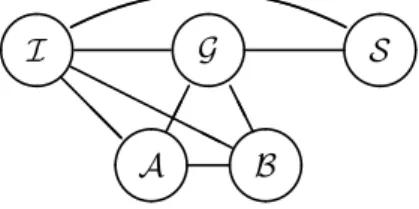
I G S A B AA
Figure 3:Graph overV′
= {I,G,S,A,B}inferred by PC.
there is a longstanding debate among philosophers on whether the notion of causation is dispensable in physics (Russell, 1913;Norton, 2003; Frisch, 2012), it is much less controversial to assume that causation is indispensable in other domains, such as the social and biomedical sciences, which routinely engage in testing and using causal claims. A characterization of constitution 255
that isa prioriincompatible with higher-level causation is at best undesirable. All the more so if macro relations pass the usual BN tests for causation in variable sets without variables in parthood relations with one another—tests the validity of which Gebharter does not dispute.
What is worse, allowing deterministic dependencies in BNs generates fur-260
ther problems, which—contrary to epiphenomenalism*—Gebharter cannot possibly accept. A first problem is that, in two-level systems, not only phe-nomena are screened off from all incoming and outgoing influences, but also constituents can be screened off in this way. To see this, reconsider the ampli-fication example (Figure3).Gis an additive function of its constituentsAand
265
B. Hence, not onlyGis screened off fromIandS(byAandB). SinceGand AdetermineB(e.g.,G =14 ∧ A =2determinesB =12), alsoBis screened off
fromIandS. Analogously, sinceGandBdetermineA(e.g.,G =14 ∧ B =12
determinesA =2), alsoAis screened off fromIandS. If the graph in Figure
2truly represents the underlying structure, these further conditional indepen-270
dencies are not entailed byCMC and, hence, violateFaithfulness. To avoid this consequence, Gebharter not only has to endorse the absence of causal in-fluences in and out ofGbut also the absence of causal influences in and out of
AandB.
The presence of such conditional independencies is not limited to the case 275
of additive composition functions, as may be illustrated with reference to one of Gebharter’s own examples. Consider the phenomenon of bidding in an auction, W, as constituted by raising either the left handLor the right hand
R,viz.W =1↔ (L =1 ∧ R =0) ∨ (L =0 ∧ R =1). Gebharter observes that
L andR are unconditionally independent (i.e.,L ⊥⊥ R), as they are caused
280
by the bidder’s free decision—call thisD—but become dependent conditional
on W (i.e.,L /⊥⊥ R ∣ W). From this, he concludes that “constitutive relations
[...] seem to behave exactly like they were direct causal relations” (2654) in a collider structure. However, Gebharter misses an important disanalogy. If
L andR caused (pseudoindeterministically) W, then W and R would not
determine L, such thatL /⊥⊥ D ∣ {W,R}, nor wouldW andL determine R,
such that R ⊥/⊥ D ∣ {W,L}. By contrast, in the constitutive case, not only L andR determine W, such that W ⊥⊥ D ∣ {L,R}; in addition, W and R
determine L,5 such thatL ⊥⊥ D ∣ {W,R}, andW andL determine R, such
thatR ⊥⊥ D ∣ {W,L}—again to the effect that not only the phenomenon but
290
also its constituents are screened off from all non-constituents.
In sum, to maintain his claim thatFaithfulnesscan safely be assumed for mechanistic systems with no more than two levels, Gebharter would have to contend that ever so many common mechanistic systems are causally iso-lated from the rest of the universe. He cannot plausibly accept this conse-295
quence, which in turn yields that the above screening-off relations must be interpreted to violate Faithfulness. All of this shows that restricting Gebhar-ter’s approach to two-level systems does not ensure thatFaithfulnessreliably holds for BNs featuring both causal and constitutive dependencies. In such cases, standard BN algorithms will erroneously conclude that mechanisms are 300
isolated from their environment. In particular, Gebharter proposes to use a spe-cific constraint-based algorithm,viz. PC (Spirtes et al.,2000, 84). PC infers to causation only from adjacencies, that is, from conditional dependencies. In the above cases, PC would remove all adjacencies between constituents and non-constituents, and thus find no causal relations between them (see again Figure 305
3).6 That is, PC may lead to mistaken inferences when applied to mixed sets of causal and constitutive dependencies.
In response to this objection, one might qualify the proposal by main-taining that Gebharter’s method is only guaranteed to work when applied to phenomena, which are multiply-realized even relative to specific systems— 310
viz. phenomena, whose values are overdetermined by multiple configurations of values of their parts. Phenomena like amplification are not so overdeter-mined: conditional on the value of the phenomenon and all but one con-stituents, the value of the remaining constituent is determined. As a result, both the phenomenon and the constituents are conditionally independent of 315
non-constituents, such thatFaithfulnessis violated. By contrast, when a nomenon is overdetermined, the constituents necessarily determine the phe-nomenon, but for any constituent, the phenomenon and all other constituents need not determine that one constituent. As a result, the phenomenon is inde-pendent of non-constituents conditional on all constituents, in line with Geb-320
harter’s epiphenomenalism*, whereas constituents are not independent of non-constituents, conditional on the phenomenon and all other non-constituents, such
5
In fact, any of the four possible value configurations ofWandLsuffice to fix the value ofR: W =0 ∧ R =0→ L =1;W =0∧ R =1→ L =0;W =1∧ R =0 → L =1; and W =1∧ R =1→ L =0. (The same point applies toWandRdeterminingL.)
6
Gebharter fails to see this. He implicitly assumes that, no matter the details of the com-position function relating phenomena to their constituents, PC will find dependencies between constituents and non-constituents (see2017b, 2656, Figure 2, step 3). As our argument shows, this assumption is not always justified.
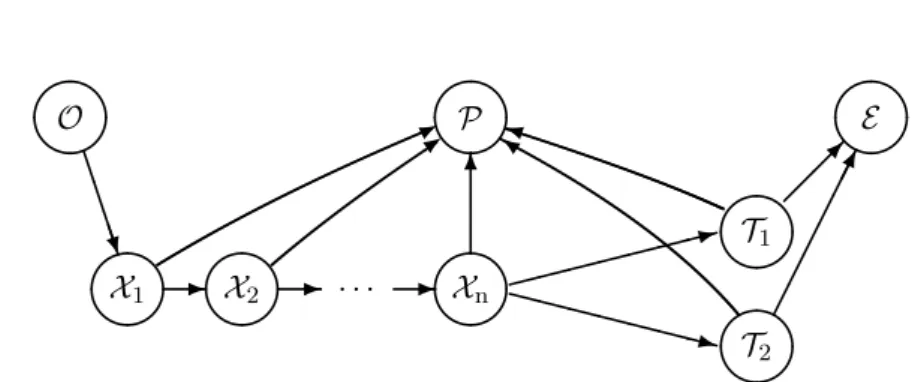
O P E X1 -B B B B N X2 - . . . Xn : XX XX XXXz T1 T2 i k * 3 6
Figure 4:An epiphenomenalist* model of the action potential mechanism.
thatFaithfulnessis satisfied. To illustrate, one may consider a modified ver-sion of the bidding example, where raising at least one between the left hand and the right hand constitutes bidding,viz.W ↔ L ∨ R. SinceW is
overde-325
termined byLandR, the bidder’s free decision to raise a hand,D, becomes
independent ofWconditional onLandR, whereas it remains dependent ofL
(resp.R) conditional onW andR(resp.L), such that theD–L(resp.D–R)
adjacency is not removed. Hence, Gebharter’s method would correctly anal-yse this revised bidding example, if its applicability were further restricted to 330
phenomena that are overdetermined by multiple sets of constituents.
Clearly though, a thus restricted discovery procedure would hinge on a distinction between redundantly constituted phenomena and non-redundantly constituted phenomena and, in consequence, would be doomed from the start because it would presuppose knowledgeof constitution. But not even if that 335
circularity threat could somehow be avoided, would the restriction to overde-termined phenomena yield an adequate method, because in other cases it leads to another kind ofFaithfulnessviolation.
To illustrate, consider the example of action potential. The mechanism works roughly as follows. Local changes in the electric potential of the neu-340
ron’s membrane cause the opening/closing of ion channels, and a flow of ions through the membrane; in turn, variations in ion concentrations between the inside and the outside of the membrane determine changes in electric poten-tial of neighbouring portions of the membrane, causing further channels to open/close; and so on. In particular, the mechanism is initiated when sodium 345
ions flow into the neuron’s body and bring the membrane’s potential over a threshold, which triggers a spike along the neuron’s axon. The mechanism terminates when, upon depolarization of the membranes of the neuron’s ter-minals, calcium ions flow into the terminals and bind to vesicles filled with neurotransmitters, causing them to travel to the membrane’s surface, such that 350
neurotransmitters are released into the synaptic cleft.
Figure 4 provides a simplified model of the mechanism. Let us de-note the action potential phenomenon by P. Let us denote the cause of
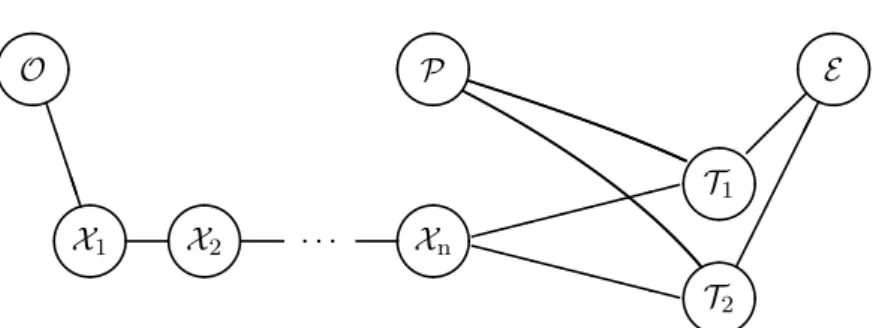
O P E X1 B B B B X2 . . . Xn XX XX XXX T1 T2
Figure 5:Graph overV′′
= {O,P,E,X1, . . . ,Xn,T1,T2}inferred by PC.
body—by O, and its effect—neurotransmitters being released by the axon
355
terminals—by E. Let us assume that O is the only exogenous cause of the
mechanism. In particular, the mechanism operates against a fixed background, where subject to a suitable difference in potential, ions flow through the mem-brane whenever the channels open, such that ion concentrations are not in-dependent, exogenous causes of the mechanism. To model the mechanism, 360
let us further denote by Xi the opening of sodium channels in the i-th
sec-tion of the axon’s membrane, where iranges from 1(closest to the hillock) ton(closest to the terminals). To account for the fact that action potential is multiply realized, in the sense that it may obtain irrespective of whether all of the ion channels open, let us assume that, in different halves of the terminals, 365
T1andT2, neurotransmitters are released with different probabilities, because calcium channels are differently distributed on their membranes, such that dif-ferent amounts of calcium ions flow intoT1 andT2and, as a result, different amounts of vesicles filled with neurotransmitters travel to the surface of T1 and T2. We use two distinct variables, T1 andT2, to represent the opening
370
of ion channels in T1 andT2. Finally, let us stipulate that, as long as T1 or T2 are in their open state, an action potential is completed. This satisfies the
further condition that the phenomenon be multiply realized, because a set of constituents includingT1 andT2 redundantly determines, or overdetermines, P.
375
Against this backdrop, an algorithm such as PC would infer thatPis
inde-pendent ofOandEconditional onT1andT2(Figure5). By contrast,P andT1
(resp.T2) do not determineT2(resp.T1), such thatT1(resp.T2) is not
indepen-dent ofOandE, in line with Gebharter’s epiphenomenalism*. Here, however,
the problem arises that the last two elements of the bottom-level causal path, 380
T1andT2, make any of their ancestors along the causal pathX1 Ð→ ⋯ Ð→ Xn
redundant to determineP, and thus to screen P off fromO andE. In other
words, no state ofX1, . . . ,Xn accounts for changes inP that are not already
accounted for by the states of T1 andT2. Consequently, tests of conditional
independence, as performed by causal discovery algorithms such as PC, will 385
Theories of constitution and methods for constitutive discovery rest on a criterion for distinguishing between constitutive and non-constitutive rela-tions. Gebharter’s (2017b, 2653) characterization of constitution as a kind of direct deterministic dependence—which, to recall, was meant to avoid 390
Faithfulnessviolations due to constitutive paths over more than two levels— commits him to the view that, whenSufficiencyis satisfied, only constituents are adjacent to the phenomenon; any variable that is screened off from it is a non-constituent. In particular, this entails that the behaviours of parts and wholes stand in a constitutive relation only if they are adjacent. When they are 395
not adjacent, they are not constitutively related.7 In this respect, Gebharter’s proposal (implicitly) entails that causal and constitutive dependencies are dif-ferent in that variables on directed causal paths are causes of their descendants even if they are not adjacent to them, whereas variables on directed causal-or-constitutive paths are not constituents of their descendants unless they are 400
adjacent to them. The problem with this assumption is that it is intuitively false. Some phenomena (e.g., G) are adjacent to all of their constituents, as
they would not be determined by any proper subset of them (onlyA, or only B). But not all phenomena are like this. For instance,P is adjacent toT1and T2but not toX1, . . . ,Xn, as only the former but not the latter are necessary to
405
determineP. Yet, intuitivelyallsuch activities are constitutive of action
poten-tial, as they allow the signal to propagate from the body to the axon terminals, notwithstanding the fact that not all produce conditional dependencies, such that the distribution is unfaithful to the structure in Figure 4. To generalize, Gebharter’s attempt to avoid Faithfulnessviolations in constitutive paths by 410
imposing that, in two-level variable sets, constitutive dependencies are direct immediately generates furtherFaithfulnessviolations: when a phenomenon is redundantly constituted by paths of activities, some constituents are not ad-jacent to it. In those cases, Gebharter’s proposed procedure systematically mistakes constituents for non-constituents.
415
In response to the aforementioned problems, one may be tempted to re-ply that the principle of Gebharter’s proposal can be saved, provided one does not employ the traditional PC algorithm, but a version of PC that accounts for Faithfulness violations due to deterministic dependencies, viz. PCD, as pro-posed for instance byGlymour(2007).8 In a nutshell, PCD differs from PC 420
in that it removes an adjacency between two variables Vi andVj only if nei-ther one can only be made independent of the onei-ther by conditionalizing on a subset of variables (excluding Vi andVj) that brings its probability up to 1. For instance, in the amplification example, PCD would not remove theI–A
adjacency, because I andA can only be made independent by
conditional-425
izing on the subset {G,B}, butPr(A ∣ G,B) = 1. Analogously, in the action
7To wit, in Gebharter’s (2017b) fictional example (Figure 1, 2650),X
4, which is a part of
X9but not a constituent ofX9, is not adjacent toX9.
8
I G S A B AA H H H H HH @ @ @
Figure 6:Graph overV′
= {I,G,S,A,B}inferred by PCD.
potential example, PCD would not remove theX1–P adjacency based on the
conditional independenceX1⊥⊥ P ∣ {T1,T2}, becausePr(P ∣ T1,T2) =1.
Here, however, the problem arises that other adjacencies may erroneously be removed, as may be illustrated by reference to the amplification case. Even 430
if S is a (non-determininistic) function of I, A, and B, it can be reduced
to a function of I and G only, simply because A and B determine G. As
a consequence, it holds thatPr(S ∣ I,G ) = Pr(S ∣ I,G,A) =Pr(S ∣ I,G,B),
meaning thatIandGsuffice to makeAandBindependent ofS, and bring the
probability of neitherS norAorBup to 1. Thus, PCD will removeA–Sand
435
B–S(Figure6). In contrast,I,A, andBmakeG independent ofS but bring
the probability ofG up to 1. Thus, PCD will not removeG–S. In this case,
not only isG not disconnected from the output of the mechanism, S. What
is more, the constituents A and B, which according to Gebharter ought to
do all the causal work, are actually made irrelevant by the phenomenon they 440
constitute, namely G.9 But clearly, they are not irrelevant. By assumption,
the amplifier causes distortion in virtue of the behaviours of its constituent transistors. In sum, neither PC nor PCD can deliver a sound method for causal-or-constitutive inference, as they both tend to erroneously eliminate causal or constitutive adjacencies.
445
We take the above arguments to undermine Gebharter’s proposed use of BN algorithms for constitutive discovery, and in particular, to show that im-plicitly defining constitution as a form deterministic causation is not a promis-ing way of brpromis-ingpromis-ing Bayesian methods to bear on the task of constitutional dis-covery. An alternative approach is required, which rejects the basic assump-450
tion that constitution is formally analogous to causation, such that probabil-ity distributions over variable sets including phenomena and their constituents cannot be interpreted in the light of the BN axioms for causation, and con-sequently, BN causal discovery methods cannot be applied to such variable sets.
455 9
This case should be distinguished from the one where epiphenomenalism* simply cannot be read off the graph, because the graph features adjacenciesA–SandB–S as well asG–S, such that it remains undecided which dependence is “productive” and which is “unproductive” (cf. fn. 4). Here, PCD eliminates the A–S and B–S adjacencies, which would falsify the epiphenomenalist* assumption.
4 AN ALTERNATIVE
Epiphenomenalism is not a very popular view. Actually, in the philosophy of the special sciences, it is common to assume that phenomena are causally identified (Fodor, 1974; Kim, 1999; Fazekas and Kert´esz, 2011). Here are two examples from (Kim, 1999). Being in pain is “being in some state (or 460
instantiating some property) caused by tissue damage and causing winces and groans” (13). Being a gene is, roughly, “the property of having some prop-erty (or being a mechanism) that performs a certain causal function, namely that of transmitting phenotypic characteristics from parents to offsprings” (10). Causally identified phenomena abound also in the scientific literature. To take 465
a textbook example, cancer is, roughly, that condition initiated by exposure to DNA-damaging factors and leading to unregulated cell growth (cf.King,2006, 1, 24). Or, to come back to our guiding examples, amplification and action po-tential are role fillers in a web of other phenomena (e.g., voltage input and signal distortion in the former case, binding and release of neurotransmitters 470
in the latter case).
Identifying the causal role of a target phenomenon with respect to other phenomena explains (ætiologically) why a given system displays that phe-nomenon (rather than some other phephe-nomenon) on a particular occasion. How-ever, it does not explain why the phenomenon has its characteristic role in 475
that system. This, we take it, is the job of a mechanistic explanation. In a mechanistic explanation, the whole system (e.g., the amplifier, the neuron) in-stantiating the phenomenon is decomposed into its spatiotemporal parts (e.g., transistors and other elements of the circuitry, ion channels in the neuron’s membrane) in order to identify the subset of parts, whose activities are con-480
stitutively responsible for the target phenomenon (e.g., amplification, action potential). What are, then, those parts? In a nutshell, our proposal is that they are all and only those parts, whose causal roles account for why the whole has its characteristic causal role. In this section, we formally spell out this intuition by offering a definition of constitution, which solves the problems 485
incurred by Gebharter’s proposal in a simple and elegant way.
Our proposal relativizes the notion of constitution to causally-identifiable phenomena. In particular, our proposal rejects Gebharter’s epiphenomenalist* assumption, which is not assumed to follow from the causal interpretation of probability distributions over variable sets including phenomena as well as 490
their constituents. Rather, we take at face-value the aforementioned talk of causally-identified phenomena and assume thefalsityof epiphenomenalism*: at least some phenomena have causes and effects. Our proposal analyses the notion of constitution as relevant to such phenomena, which—we take it— are widespread in the macro-level domains of investigation where mechanistic 495
I G S j (a) I A B S s s (b)
Figure 7:Causal roles (a) ofGoverV′∖PGand (b) ofAandBoverV′∖ {G }.
Implementing the above intuition requires—first—to identify the causal role of the phenomenon and the causal roles of its parts and—second—to identify those parts, whose causal roles account for the phenomenon’s causal role. To represent causal roles, we use the formalism of causal BNs, suitably 500
relativized to specific variables. In this context, and only in this context, we assume CMC andFaithfulness. More precisely, we do not require CMC or Faithfulnessto hold in variable sets comprising both the phenomenon and its parts, such that the resulting BN is not causally interpretable, but only in sub-sets including one but not the other. That is, contrary toGebharter(2017b), we 505
exclusively adoptCMCandFaithfulnessfor their traditional purpose, namely causalinference. For us, the notion of causal roles is more basic than the no-tion of constituno-tion. The latter is defined in terms of the former, but not vice versa.
Throughout our ensuing discussion we use the following definitions and 510
make the following assumptions. V1 denotes a (causally-identifiable)
phe-nomenon of interest. In1∪Out1 denotes the set of inputs and outputs that
identify its characteristic causal role, by which we shall mean that the causal relations between the elements of In1 ∪Out1 and V1 are the characteristic
causal role ofV1. Since the notion of causal role presupposes the existence of
515
at least one cause and one effect, we assume thatIn1≠ ∅andOut1≠ ∅.
Next,P1denotes the set of all and only the spatiotemporal parts ofV1in a
variable setVcontainingV1, meaning that for allViinP1, the
spatiotempo-ral region occupied by an instance ofV1 contains the spatiotemporal regions
occupied by the instances ofVi. We assume that no other variable besidesV1
520
has parts inV—which entails thatP1is free of mereological relations. Finally, the probability distributions inV∖ {V1}andV∖P1are causally
interpretable. LetAnc(Vi)andDes(Vi)denote the sets of, respectively,
an-cestors and descendants ofVi. Then, in the (true) graph overV∖P1, it holds
thatIn1 ⊆Anc(V1)andOut1 ⊆Des(V1). By contrast, the probability
dis-525
tribution over Visnotcausally interpretable. Hence,CMCandFaithfulness are assumed to hold inV∖ {V1}andV∖P1 but not inV.
To illustrate the first step of our analysis, which is concerned with identi-fying the causal roles of phenomena and their parts, one may again consider the amplifier example. The characteristic causal role of the phenomenon G,
530
which consists of its causal relations to its characteristic cause, voltage input
I, and effect, signal distortionS, may be identified in a variable set that does
I G S j (a) I A B S H A A U s s (b)
Figure 8:Causal roles (a) ofGoverV′′′∖PGand (b) ofA,B, andHoverV′′′∖ {G }.
ofG’s partsA andB relative toI andS may be identified in a variable set
that replacesGwith its parts (Figure7b). Notice that the first step presupposes
535
knowledge of parthood relations but not of constitutive relations.
It should also be emphasized that this first step does not presuppose that BN algorithms can always unambiguously single out the (true) graph rela-tive to which causal roles are identified. For instance, they will not single out the DAGs in Figure 7, and thus uncover the directed dependencies that 540
make up the causal roles of G in V′ ∖PG and of A and B in V′ ∖ {G }
(due to the absence of unshielded colliders into G and A). What we mean
here is that—conceptually—causal roles may be represented by a BN describ-ing the true causal structure over a variable set, irrespective of whether— methodologically—the discovery of that true structure is possible inthat vari-545
able set, or some larger set is necessary (including, say, a number of unshielded colliders, whose existence we take to be guaranteed by the complexity of the world).
The second step of the analysis consists in rendering formally precise the intuition anticipated in §1: constitution is a relation among behaviours, such 550
that the phenomenon’s causal role is accounted for by its constituents’ causal roles. Our proposal explicates this intuition as follows: all and only the parts ofV1on directed paths fromIn1 toOut1 in variable sets suitable for causal
modelling account for V1’s causal role, and are thereby constituents of V1.
More precisely, relative to a given variable setV,V1’s causal role with respect
555
toIn1∪Out1 inV∖P1 is accounted for by those ofV1’s parts that lie on
directed paths from In1 toOut1 inV∖ {V1}. All and only those parts are
constituents ofV1inV.
Illustrated with reference to our amplifier example,G’s causal role inV′∖
PG is accounted for by A’s andB’s causal roles with respect toInG = {I }
560
andOutG = {S }inV′∖ {G }, becauseAandBare on a directed path from
from I toS in V′∖ {G }. Thus, A andB are the constituents of G inV′.
By contrast, not all parts are constituents, as may be illustrated by reference to Figure8. Consider the variable setV′′′ = V′∪ {H}, which differs from
V′ only in that it contains a variable H, which denotes the temperature—
measured by a thermometer placed inside the amplifier—of the two transistors, such thatAandBcauseHinV′′′∖{G }.His what Craver would call a “sterile
effect” (Craver,2007, 143), that is, an effect of constituents that is not itself a constituent. Intuitively, AandBarerelevanttoG’s causal role, because A
andBare on a directed path fromItoS; by contrast,Hisirrelevant, because
570
it isnoton a directed path fromItoS.
Together, the above considerations yield the following, causal-role based (CR) definition of constitution:
(CR) LetV1’s causal role be identified byIn1∪Out1, whereIn1≠ ∅and
Out1≠ ∅. Let the (true) causal graph in V∖P1 be such that In1 ⊆
575
Anc(V1)and Out1 ⊆ Des(V1), where V1 is the only variable inV
with parts inV, andP1 is the set of spatiotemporal parts of V1 inV.
Then,ViconstitutesV1 if, and only if:
(i) Vi∈P1; and
(ii) in the (true) causal graph overV∖ {V1},Vi∈Des(In1)andVi∈
580
Anc(Out1).
Less formally, for a partViof a phenomenonV1—whose characteristic causal
role is identified by the causal structure over some setV∖P1—to constitute V1, it is necessary and sufficient that Vi is a part ofV1, and a descendant of
In1 and an ancestor ofOut1 in the causal structure overV∖ {V1}—that is,
585
thatViis a part ofV1on a directed path fromIn1 toOut1.
So, for instance,A(resp.B) constitutesG, because there exists a variable
setV′, which may be partitioned into two subsetsV′∖PGandV′∖ {G }, such
that the structures over those subsets contain, respectively, a pathI Ð→ G Ð→ S, and a path I Ð→ A Ð→ S (resp.I Ð→ B Ð→ S). It is easy to verify
590
that the definition applies also to the action potential example. In particular, any element on the causal pathX1 Ð→. . . Ð→ Xn is a constituent, because
there exist variable setsV′′′′= {O,P,E,X1},V′′′′′= {O,P,E,X2}, etc. that
satisfyCR, in the sense that the required directed paths exist in the structures overV′′′′∖PP,V′′′′∖ {P },V′′′′′∖PP,V′′′′′∖ {P }, etc.
595
To reiterate, not always are the correct graphs over the subsets V∖P1
andV∖ {V1}unambiguously singled out by BN algorithms (because certain
unshielded colliders may be missing fromV). To that end, expansions ofV may be necessary (containing the needed unshielded colliders). That, however, is a practical matter. Our proposal does not hinge on it: whatCRrequires is 600
that directed paths exist in the true structures overV∖P1andV∖ {V1}. At
the same time, relative to a variable setV∖P1, where a directed path fromIn1
toOut1 viaV1 exists in the causal BN inferred by BN algorithms (thanks to
the existence of suitable colliders inV∖P1), the required directed path from
In1toOut1 viaViwill also exist in the causal BN overV∖ {V1}(thanks to
605
Also, albeitCRrelativizes the notion of constitution to a variable setV, given the existence of a suitableV, constitutive dependencies remain invariant across expansions of thatVincluding, say, further parts or further causes and effects of the phenomenon. For instance, adding the behaviours of other ion 610
channels toV′′′′, such asT1 andT2, doesn’t turnX1into a non-constituent—
irrespective of whetherX1is unnecessary to screen offPfromOandE, given T1andT2.
Finally, whether a variable set V includes an “exhaustive set” of con-stituents of a phenomenon—which behave like a complete set of common 615
causes that screen off the phenomenon from its non-constituents—is irrele-vant to whether any one of them counts as a constituent. For instance, by assumption, in the amplifier’s case Aand Bexhaustively account for G. In
V′, both AandBare constituents ofGand arguably form an exhaustive set
of constituents. However, were Bremoved from V′,A would still count as
620
a constituent by the light ofCR, even though it does not suffice to screen off
G fromI andS inV′. The same point applies to cases where the notion of
an exhaustive set is more elusive, such as the action potential case, whereT1
andT2suffice to screen offP fromOandEinV′′, but intuitively do not form
an exhaustive set of constituents. According toCR,T1 andT2 count as
con-625
stituents ofPjust as much as their ancestors on the pathX1Ð→. . .Ð→ Xn.
Our theory lends itself to a straightforward implementation. The search target of a Bayesian discovery procedure inspired by our proposal amounts to a set C1 of constituents in the subsetP1 of spatiotemporal parts of a target phenomenonV1, such thatC1explainsV1’s causal role. To find a suitableC1,
630
one should first assign variables, whose values stand in mereological relations, to two distinct variable subsets. In particular, the subset includingV1 should
not include its parts in P1 and vice versa. Next, one should verify that the variablesIn1 andOut1 that identify the characteristic causal role ofV1 are
among, respectively, its ancestors and its descendants inV∖P1. Finally, one
635
should single out the parts that lie on directed paths from In1 to Out1 in V∖ {V1}. All and only such variables belong toC1, relative toV.
By rejecting the basic assumption that constitution is (analogous to) a form of causation, our proposal provides a simple and elegant solution to the two problems incurred by Gebharter’s approach. Since we do not assume Faith-640
fulnessoverV, our proposal is not subject to the problem that not all causal dependencies are identified. In particular, the identification of causal depen-dencies between the mechanism and its environment is guaranteed by the re-striction of BN causal discovery methods to suitable subsets of V. Nor is our proposal subject to the problem that constituents are mistaken for non-645
constituents when they are unnecessary to determine the phenomenon, and thus to screen it off from its non-constituents. What matters to constitution is whether, relative to a suitable subset ofV, a variable that is a spatiotemporal part of the phenomenon lies on a directed path from its causes to its effects.
Finally, we should emphasize that both our proposal and Gebharter’s 650
(2017b) proposal assume background knowledge of spatiotemporal parthood relations between values of variables. This parthood assumption is customarily made by all proposals on how to define or discover constitution in the literature (Craver,2007;Harbecke,2010;Couch,2011;Gebharter,2017b;Baumgartner and Casini, 2017;Krickel,2018). Gebharter uses the assumption to choose 655
variable sets with two levels of variables only; we use it to select variable sets, which may be partitioned into two subsets with variables on one level only. The sort of knowledge required to satisfy such assumptions is the same. With-out doubt, ensuring that the parthood assumption is satisfied involves impor-tant epistemic as well as conceptual challenges, which make the assumption 660
particularly “costly”. What we aimed to demonstrate in this paper, though, is that anyone who is attracted by Gebharter’s attempt to bring Bayesian tools to bear on the problem of constitutional discovery, should prefer our proposal to his, on the ground that it avoids its shortcomings at no additional cost. More-over, insofar asanycurrently available theory of constitution takes parthood 665
for granted, this point may be generalized. If one is attracted by any theory of constitution, one should be attracted by our proposal, or at least consider it a serious contender.
5 CONCLUSION
Gebharter has recently suggested that Bayesian causal discovery tools may 670
be fruitfully brought to bear on the problem of constitutional discovery. He proposes that they be used to infer to causal as well as constitutive dependen-cies in one go, in spite of the widespread view that causation and constitution are different kinds of relation. The first part of this paper argued that Geb-harter’s proposal incurs violations of one standard assumption of BN causal 675
discovery algorithms, viz. Faithfulness, leading to mistakes in causal or con-stitutive inference. It leads to mistakes in causal inference because, relative to certain mechanistic structures, it infers that the mechanism is isolated from its environment. And it leads to mistakes in constitutive inference because, relative to other mechanistic structures, it infers that some parts are not con-680
stituents. From this, we concluded that Gebharter’s starting point, viz. using the assumptions of the Bayesian network formalism to implicitly define con-stitution as a form of direct deterministic causation, is not a promising way of bringing Bayesian networks methods to bear on the task of constitutional discovery.
685
As an alternative, the second part of the paper proposed to exploit the intu-ition that, in a mechanistic explanation, the causal role of a target phenomenon is explained in terms of the more fundamental causal roles of some of the sys-tem’s parts. Our analysis cashed out this general intuition in the framework of Bayesian networks. More precisely, a constituent is the behaviour of a part 690
on a directed path from the causes to the effect that identify the characteristic causal role of the phenomenon. By not assuming Faithfulness (or any of the other BN assumptions for causation) to hold of variable sets including both phenomena and their parts, our proposal avoids in a simple and elegant way the problems of Gebharter’s proposal and, as a result, provides a theoretically 695
sound foundation to the application of BN methods to constitutional discovery.
REFERENCES
Baumgartner, M. and L. Casini (2017). An Abductive Theory of Constitution. Phi-losophy of Science 84(2), 214–33.
Bechtel, W. and A. Abrahamsen (2005). Explanation: a Mechanist Alternative.
Stud-700
ies in the History and Philosophy of the Biological and Biomedical Sciences 36, 421–41.
Couch, M. B. (2011). Mechanisms and Constitutive Relevance. Synthese 183, 375– 88.
Craver, C. F. (2007).Explaining the Brain. Oxford: Oxford University Press.
705
Eronen, M. I. (2011).Reduction in philosophy of mind: A pluralistic account. Frank-furt am Main: Ontos.
Fazekas, P. and G. Kert´esz (2011). Causation at Different Levels: Tracking the Com-mitments of Mechanistic Explanations.Biology and Philosophy 26, 365–83. Fodor, J. (1974). Special Sciences: Or the Disunity of Science as a Working
Hypoth-710
esis.Synthese 28, 97–115.
Frisch, M. (2012). No Place for Causes? Causal Skepticism in Physics. European Journal of Philosophy of Science 2(3), 313–336.
Gebharter, A. (2017a). Causal Exclusion and Causal Bayes Nets. Philosophy and Phenomenological Research 95(2), 353–75.
715
Gebharter, A. (2017b). Uncovering Constitutive Relevance Relations in Mechanisms.
Philosophical Studies 174(11), 2645–66.
Gillett, C. (2002). The Dimensions of Realization. Analysis 62, 316–23.
Glennan, S. (1996). Mechanisms and the Nature of Causation.Erkenntnis 44, 49–71. Glennan, S. (2002). Rethinking Mechanistic Explanation. Philosophy of
Sci-720
ence 69(3), S342–53.
Glymour, C. (2007). Learning the Structure of Deterministic Systems. In A. Gopnik and L. Schulz (Eds.),Causal Learning: Psychology, Philosophy, and Computation, pp. 231–40. Oxford University Press.
Harbecke, J. (2010). Mechanistic Constitution in Neurobiological Explanations.
In-725
ternational Studies in the Philosophy of Science 24, 267–85.
Kim, J. (1999). Making Sense of Emergence. Philosophical Studies 95(1-2), 3–36. King, R. J. B. (2006). Cancer Biology(3rd ed.). Pearson, Singapore.
Krickel, B. (2018). Saving the mutual manipulability account of constitutive rele-vance.Studies in History and Philosophy of Science Part A 68, 58–67.
730
Machamer, P., L. Darden, and C. Craver (2000). Thinking about Mechanisms. Phi-losophy of Science 67, 1–25.
Norton, J. D. (2003). Causation as Folk Science. Philosopher’s Imprint 3(4), 1–22. Pearl, J. (2000). Causality: Models, Reasoning, and Inference. Cambridge:
Cam-bridge University Press.
735
Russell, B. (1913). On The Notion of Cause. Proceedings of the Aristotelian Soci-ety 13, 1–26.
Soom, P. (2012). Mechanisms, Determination and the Metaphysics of Neuroscience.
Studies in History and Philosophy of Biological and Biomedical Sciences 43, 655– 64.
Spirtes, P., C. Glymour, and R. Scheines (2000). Causation, Prediction, and Search
(second ed.). Cambridge MA: MIT Press.
Spohn, W. (2006). Causation: An Alternative.The British Journal for the Philosophy of Science 57, 93–119.
Wimsatt, W. (2007). Re-Engineering Philosophy for Limited Beings. Cambridge,
745
MA: Harvard University Press.
Zhang, J. (2006). Causal Inference and Reasoning in Causally Insufficient Systems. Ph. D. thesis, Department of Philosophy, Carnegie Mellon University. Available at