Access Point Framework – towards a
more scalable ESB solution
SANJA JANKOLOVSKA
BOSHKO ZHERAJIKJ
Supervisor: Don Baldwin, CEO of Aurenav LLC. Examiner: Mihhail Matskin
Degree project in Software Engineering of Distributed Systems
Abstract
The aim of this project was to investigate the potential issues of existing ESB products and present how the Access Point Framework (an Enterprise Application Integration Framework developed within Aurenav LLC.), mitigates these problems. For this purpose, the framework was compared with two existing ESB solutions- Mule ESB and BizTalk® ESB Toolkit. In order to be able to present the simplicity of integration with the Access Point Framework, first, it was moved to open source underlying technologies. The two most important ones were the Message Oriented Middleware products –ActiveMQ and RabbitMQ, both of which are interchangeable, depending on the user needs. Additionally, after having the framework fully functional, two simple applications were integrated to exemplify the ease of integration. Currently, the Access Point Framework is synchronous and single threaded, however, the necessary improvements are discussed throughout the paper. The steps described paved the way for carrying out the performance testing that was done on the framework. The project serves mainly as a comparison and evaluation document but also as a base point for moving the APF to an open source solution, while preserving the configurability in order to extend the functionality in later releases.
Sammanfattning
Målet med detta project var att undersöka eventuella problem med existerande ESB produkter och visa hur Access Point Framework (en Enterprise Application Integration Framework utvecklad av Aurenav LLC.), mildrar dessa problem. För detta ändamål jämfördes ramverket med två existerande ESB lösningar, Mule ESB och BizTalk® ESB Toolkit. För att kunna påvisa enkelheten i integrationen med Access Point Framework flyttades det först till open källkod underliggande teknologier. De två viktigaste var Message Oriented Middleware produkter –ActiveMQ och RabbitMQ, vilka bägge är utbytbara beroende på användarens behov. Efter att ha skapat ett fullt fungerande ramverk infogades två enkla tillämpningar för att exemplifiera enkelheten i integrationen. För närvarande är Access Point Framework synkront och enkeltrådigt men nödvändiga förbättringar diskuteras I hela arbetet. De steg som beskrivs jämnade vägen för den funktionstest som gjordes på ramverket. Arbetet skall I första hand ses som ett jämförelse och utvärderingsdokument men också som en utgångspunkt för flytt av APF till en open källkodslösning med bibehållna konfigurationsmöjligheter som möjliggör utökad funktionalitet I senare releaser.
Acknowledgements
We would like to thank our supervisor, Don Baldwin, for giving us the opportunity to work on this project within Aurenav LLC., as well as his guidance, knowledge and experience sharing. We would also like to thank our examiner, Professor Mihhail Matskin, for his contribution, guidance and collaboration throughout the development of this project. We are thankful to our parents and families for giving us the opportunity to reach this point of life where we complete the Master degree with this project. And last but not least, to our friends that have been with us, giving their constant support. Thank you all!
Table of Contents
1. Introduction ... 1
2. Literature Review... 2
2.1. Background ... 2
2.2. Enterprise Application Integration (EAI) ... 2
2.3. Service Oriented Architecture (SOA) ... 5
2.4. Enterprise Service Bus (ESB) ... 7
2.4.1. Basic Functionalities of an ESB ... 7
2.4.2. Characteristics of an ESB ... 8
2.5. Normative Data ... 10
2.5.1. Canonical Model ... 10
2.5.2. Enterprise Data Model ... 12
2.6. Messaging Oriented Middleware (MOM)... 13
2.7. Related work ... 16
2.8. Existing ESB Solutions ... 17
3. Problem Definition and Methodology ... 19
3.1. Problems of existing integration solutions ... 19
3.2. Goals and Objectives ... 21
3.3. Methodology ... 22
3.3.1. Research ... 22
3.3.2. Investigating existing ESBs and MOMs ... 23
3.3.3. Choosing the ESB products ... 23
3.3.4. Comparison Criteria for the ESBs ... 24
3.3.5. Evaluating the APF ... 24
3.3.6. Choosing the MOMs ... 25
3.3.7. Feature evaluation for the MOMs ... 26
3.3.8. Evaluating the MOMs ... 26
4. The Access Point Framework ... 27
4.1. Components of the APF ... 27
4.1.2. Transformation and Validation Engine – TVE ... 29
4.1.3. Messaging Platform Adapter Service – MPAS ... 30
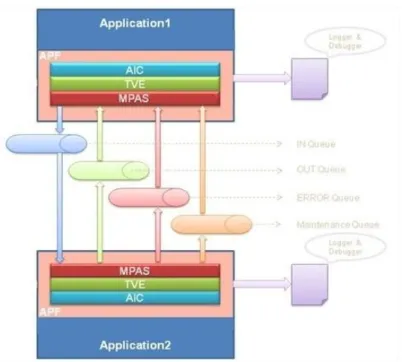
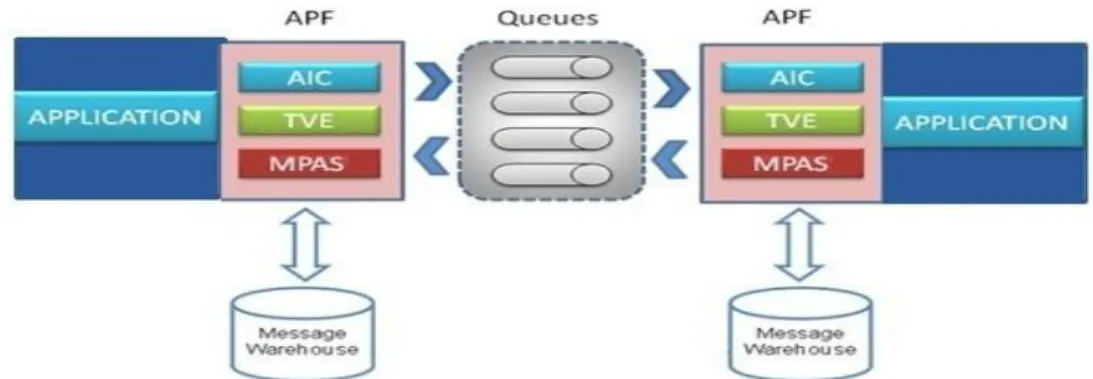
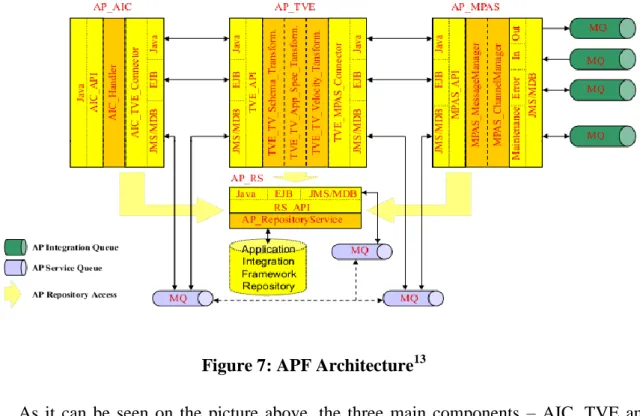
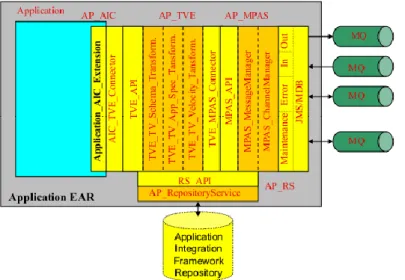
4.1.4. Repository Service – RS ... 32 4.1.5. Base Components... 33 4.1.6. Access Point – AP ... 33 4.1.7. Message Warehouse – MW ... 34 4.2. APF Architecture... 35 4.3. Discussion ... 39
5. Comparison with ESB Products... 41
5.1. Mule Architecture ... 41
5.1.1. Similarities with APF ... 44
5.1.2. Differences with APF ... 48
5.2. BizTalk® ESB Toolkit Architecture ... 52
5.2.1. Similarities among architectures ... 57
5.2.2. Differences with the APF... 59
6. Implementation ... 65
6.1. Database Replacement ... 65
6.2. Messaging Middleware Replacement ... 66
6.2.1. Feature Evaluation ... 66
6.2.1.1. ActiveMQ ... 66
6.2.1.2. RabbitMQ ... 67
6.2.2. Implementation of Messaging Functionality ... 69
6.2.2.1. ActiveMQ ... 69
6.2.2.2. RabbitMQ ... 70
6.3. Application Implementation and Integration ... 71
6.3.1. Implementation ... 72
6.3.2. Integration ... 73
7. Evaluation ... 78
7.1. Description of the benchmarking programs ... 79
7.1.1. Messaging solutions performance evaluation ... 79
7.1.2. APF performance evaluation ... 80
7.2.1. Message Queues... 82
7.2.2. Access Point Framework ... 82
7.3. Results ... 83
7.3.1. Message Queues... 83
7.3.1.1. Results from single machine ... 83
7.3.1.2. Results from two machines ... 86
7.3.1.3. Comparison one vs. two machines ... 88
7.3.1.4. Discussion on the Message Queues Performance ... 90
7.3.2. Access Point Framework Performance Results ... 90
7.3.2.1. Discussion on the APF’s Performance ... 92
8. Conclusion ... 94
9. Future Work ... 95
Table of Figures
Figure 1: Point-to-Point Messaging Model (Queue) ... 13
Figure 2: Publish/Subscribe Messaging Model (Topic) ... 14
Figure 3: Hub and Spoke Topology ... 19
Figure 4: Bus Topology ... 20
Figure 5: MPAS Channels ... 32
Figure 6: Message Warehouse ... 34
Figure 7: APF Architecture ... 35
Figure 8: Centralized Integration ... 37
Figure 9: Distributed Integration; EAI Approach ... 37
Figure 10: Fully Distributed Integration ... 38
Figure 11: Deployment Models functioning together ... 38
Figure 12: Mule ESB Architecture ... 41
Figure 13: Message Flow within Mule ESB ... 43
Figure 14: Enterprise Service Network Topology with Mule ... 46
Figure 15: APF ESB topology ... 47
Figure 16: APF Pipeline Topology ... 47
Figure 17: BizTalk® Server Architecture ... 53
Figure 18: BizTalk® ESB Toolkit ... 55
Figure 19: BizTalk® and ESB Toolkit components ... 56
Figure 20: BizTalk® Server Hosts and Host Instances ... 59
Figure 21: BizTalk® SQL Server Topologies ... 62
Figure 22: JMS Programming model Overview ... 69
Figure 23: Message Flow ... 77
Figure 24: Throughput measured for ActiveMQ and RabbitMQ ... 83
Figure 25: Average Lattency measured for ActiveMQ and RabbitMQ ... 84
Figure 26: Execution Time measured for ActiveMQ and RabbitMQ ... 84
Figure 27: Non-Persistent mode for ActiveMQ and RabbitMQ ... 85
Figure 28: Persistent mode for ActiveMQ and RabbitMQ ... 86
Figure 29: Throughput for consumer and producer on separate machines ... 86
Figure 30: Execution time for producer and consumer on separate machines ... 87
Figure 31: Execution flow for non-persistent consumer ... 87
Figure 32: Execution flow for persistent consumer ... 88
Figure 33: Persistent consumer on ActiveMQ-comparison on local and two machines ... 88
Figure 34: Persistent consumer on RabbitMQ-comparison on local and two machines ... 89
Figure 35: Non-persistent consumers-comparison on local and two machines ... 89
1
1.
Introduction
Nowadays, there is a great number of ESB products on the market, which facilitate the process of application integration within an enterprise. All of them offer the core ESB functionalities, and differentiate themselves mainly by their architecture. However, there are some common issues which arise when the throughput that needs to be handled by the ESB product drastically increases. Due to the complexity of some of the architectures, scalability is not their strongest point. Adding extra ESB instances does not only increase the cost, but also the maintenance becomes difficult to handle.
This is a common problem that arises in organizations with enormous number of transactions, and there are also similar problems that mainly arise from the architecture of the ESB products and their tight coupling between the building components. Of course, there is no perfect product when it comes to these issues, however, the Access Point Framework (APF), tries to address and mitigate them as much as possible through its flexible and simple design with loosely coupled components, easily plugable and interchangeable.
The APF is an enterprise application integration framework, which offers simple and elegant design, being built on the foundations of scalability, as the traffic within the enterprise increases. Therefore, the motivation behind this project would be to show how the APF offers solution to the existing problems, in comparison with specific ESB products, currently available on the market.
Besides this main purpose, throughout the project, the APF will be migrated to completely open source underlying technologies, in order to fully offer the benefit of low cost. As part of this process, two underlying messaging solutions will be integrated into the framework, and a comparison will be provided for the future users, to facilitate the choice of the more suitable messaging technology that will fit their needs.
The work done will be presented in this paper in the following order: Chapter 2 will provide all the background information, necessary for understanding the topic and the details discussed through the rest of the paper. Following will be Chapter 3 where the problem definition will be presented, together with the main goals and objectives accompanied with the methodology approach for achieving them. In Chapter 4 there will be a detailed presentation of the APF’s architecture and its building components. Chapter 5 will concentrate on the comparisons between the APF and the two chosen ESB products from the market. Further, Chapter 6 will discuss the implementation work done throughout the project, while Chapter 7 will contain the evaluation of the performance of both the APF and the integrated messaging solutions. The discussion will be finalized with some ideas about the potential future work and conclusion of the paper.
2
2.
Literature Review
2.1.
Background
It is rarely the case that a single application fits the needs for an enterprise. Thus, typically several best of breed proprietary software applications are used by an enterprise for successful operation. When using third party software, it might sometimes be impossible to change the data format of what the application is using. Legacy applications might prove still useful for enterprises and also it would be more expensive to develop everything from scratch. Thus, many businesses might add new functionality or connect various applications, depending on the need, in an ad-hoc manner, leading to an accidental architecture rather than having a standardized way of integrating on an enterprise level (Chappell, 2004; Hohpe & Woolf, 2004). At the same time, the world of business is changing rapidly and many applications require change in how business processes are performed. It is required to be able to add new or merge existing applications for achieving better performance but also for the business to stay competitive. In other cases the solution might be as simple as acquiring another application that might solve the problem of integrating, but not always that is the case.
2.2.
Enterprise Application Integration (EAI)
Enterprise application integration aims at merging and joining in various standalone applications or islands of functionality so that it can bring more value to the business. According to Linthicum, application integration is a strategic approach to binding many information systems together, at both the service and information levels, supporting their ability to exchange information and leverage processes in real time (Linthicum, 2000). In addition, according to (Lee, 2003), one can say that “EAI is a business computing term for plans, methods, and tools aimed at modernizing, consolidating, and coordinating the overall computer functionality in an enterprise”. Key objectives include connecting existing applications and making it possible to exchange data and processes across departments; this includes message acceptance, transformation, translation, routing, message delivery and business process management (Goel, 2006) which will be described later on. Besides these, it would also be desirable to offer better performance and scalability capabilities (Baldwin, 2012).
Integration should be achieved with as less programming and change to existing legacy applications as possible (Hohpe & Woolf, 2004). For this matter, another key term when it comes to EAI is loose coupling. The traditional approach to establishing communication between applications would be through the use of the RPC manner of programming that requires for each application to know what are the methods and the parameters that each method accepts. This is highly undesirable when it comes to EAI, since there is a need for
3
applications to communicate without the need of knowing all the details required by other applications (Chappell, 2004; Hohpe & Woolf, 2004). Also as soon as one application is required to be changed it would be hard for other applications to communicate since a method or the parameters might change as well. This would make the process of integration of applications harder as more change would be required.
Having established that loose coupling is highly desirable and needed when it comes to EAI, further on, the necessary elements for achieving loose coupling can be distinguished. When it comes to providing a loosely coupled solution two elements are essential. First is the
messaging channel that might utilize different technologies (for instance TCP/IP) that will be used to establish the communication between different applications (Hohpe & Woolf, 2004). The channel will be used to establish the necessary communication between various applications. Any data used by the collaborating applications can use the channel to communicate agreed set of messages that would contain the necessary data used by the concerned applications (Hohpe & Woolf, 2004). These two elements establish the basis for integrating two applications.
Typically there would be several disparate applications that need to communicate. Each of these applications might have a different representation format of the data that it’s using, making it harder for applications to communicate. Thus, what is needed is for the middleware to actually translate from one application format to another so that it would be understandable by the collaborating applications (Hohpe & Woolf, 2004).
When it comes to integrating more than two applications, one other aspect that needs to be taken in consideration is routing (Hohpe & Woolf, 2004). This is hard to achieve as more and more systems are integrated, if the initial approach was incorporating the information about other systems in one system. For instance, if there is one system responsible for keeping employee information and whenever new information was added the system would be responsible for disseminating the information to the integrated systems. If there was a new application added, the system would need to be updated. Thus, it would be desirable for the middleware to handle the routing of the messages as well.
Besides the named elements, another important aspect is the systems management
function (Hohpe & Woolf, 2004). The systems management function would ensure that all systems are running but also would be responsible for error handling and reports generation regarding the communication between various applications and components of the integration solution. Last but not least, having in mind that legacy, custom and packaged applications are not done in mind for achieving integration, what would be required is a message endpoint, to be able to connect the necessary application to the communication channel (Hohpe & Woolf, 2004).
Having identified the necessary elements that are required and typically encompass EAI, three integration styles can now be identified. Woolf and Hohpe (Hohpe & Woolf, 2004) suggest 4, these are file transfer, shared database, method and messaging level integration, while (Linthicum, 2000) states, at the data level, method, application interface
4
and Graphical User Interface (GUI) level. Based on the observations, three clear levels can be distinguished, which are integration at the data level, messaging level and GUI level. At the data level or shared database, integration is achieved through the use of technologies used for transforming and moving between data stores or databases (ex. ETL tools). GUI level encompasses the use of technology and techniques at using the information from the GUI as a common integration point (ex. screen scraping).
Last but not least, the messaging approach is what is going to be considered in a more detailed manner throughout this paper, based on both (Hohpe & Woolf, 2004; Baldwin, 2012) is considered as the most suitable approach to EAI. Asynchronous messaging is the main enabler for achieving loosely coupled interfaces (Chappell, 2004). Through the use of messages, only the concerned applications or services will be able to inspect and process the data that is of interest of the applications. Applications can remain as independent as possible by just exposing their interfaces and at the same time, when a calling application sends a message it does not need to wait instantly for a reply. It can continue performing its function knowing that when the called application (service) will be finished it will be notified for further processing. This might not always be desired or preferred but it does alleviate some problems like the necessity of having two systems up and ready at the same time. Asynchronous communication does have a downside, which is the complexity that surrounds it when designing, developing and debugging (Chappell, 2004; Hohpe & Woolf, 2004). Messaging also enables transformation during transit that is transparent to the applications that are using the data. This gives greater flexibility when it comes to making decision regarding how messages are being transferred among applications. However, these transformations could possibly create overhead or require for a lot of “glue” code for fitting everything together (Hohpe & Woolf, 2004).
Through the description one can see that EAI as a concept is very promising, however the actual reality is rather different, since typically the application integration is done through the use of hub and spoke integration brokers or EAI hubs (Chappell, 2004), implemented as Message Brokers. Having the hub and spoke architecture, integration is achieved by having a centralized mechanism for achieving integration between applications which is better than just merging everything in an ad-hoc manner. Another positive aspect is having an improved separation between business processes and integration code (Chappell, 2004). In an EAI hub, the main elements are included by having application adapters, data transformations, routing and connectivity functionalities. However, since it is a centralized approach every message needs to travel to a central hub that actually performs the processing and instructs the following routing destinations (Chappell, 2004). Another architectural pattern typically employed is the bus, more specifically through the use of an Enterprise Service Bus (ESB) products. The ESB pattern will be discussed in further detail in section 2.4.
In order to resolve the problem of tightly coupled applications, EAI aims at abstracting away the tight coupling by allowing applications to communicate in an asynchronous manner through messages introducing loosely coupled interfaces that are easier to integrate. The goal is to make the systems as loosely coupled as possible, but at the same time reasonably responsive and capable to share data (Hohpe & Woolf, 2004). One approach that has grabbed
5
the attention is the Service Oriented Architecture that will be presented in the following sections.
2.3.
Service Oriented Architecture (SOA)
Having EAI as an established business need of integrating applications, this section is going to elaborate the concept of Service Oriented Architecture (SOA). By the end of this section the aim is to have a clear distinction of how the two are related but also where the ESB as a product relates to the two. The Service Oriented Computing paradigm together with Web Services technologies have brought great interest in SOA (High, 2005; Keen, 2004).
Before proceeding with the explanations and definitions of the SOA, there needs to be a clear distinction on what constitutes a service. According to Keen, M., et al.: the most commonly agreed-on aspects of the definition of a service in SOA are (Keen, 2004):
● “Services are defined by explicit, implementation-independent interfaces.
● Services are loosely bound and invoked through communication protocols that stress location transparency and interoperability.
● Services encapsulate reusable business function.”
One other aspect that can be added is that in order for a function to become a service it should provide some value for the business or the business process (Lankhorst, 2005). Unless the service brings some value one can run into the problem of defining everything as a service. When it comes to services, typically the internal processes are kept as a black box and the service is only accessed through the interface since the consumer is only interested in the quality and the functionality that is going to be delivered by the service.
By specifying services as individual, self-containing pieces of functionality, the aim is to offer greater flexibility and loose coupling between components. The desirability can be related to the EAI concepts described in the previous section. Having the business functionalities defined as disparate components offers yet another benefit of grouping the functionalities as needed, rather than them becoming tightly related to the specific implementation. This leads to the term service orientation where the set of business processes that are linked through the use of services, compose an integration approach within the business (High, 2005).
The concept that encapsulates this behaviour is Service Oriented Architecture (SOA), that is
“In an SOA, all software components (or functional units that are visible for other entities to invoke or consume over the network) are modeled as services. That is, the architectural premise is that all business tasks or business processes that are built in software are designed as services to be consumed over a network (Goel, 2006).
6
SOA can be an architectural style for creating an Enterprise IT Architecture that exploits the principles of service orientation to achieve a tighter relationship between the business and the information systems that support the business (High, 2005). In this manner one can achieve a composite application that represents the integrated services that support a particular business process. It can be interpreted also as a set of design principles that enable units of functionality to be provided and consumed as services (Lankhorst, 2005). The key to SOA is that the service concept can be equally applied to both applications but also business.
In addition, Web services as a technology is a key enabler and has been widely adopted for realizing the concepts of SOA, even though it is not the only way of achieving it. It is important to note that Web services can be used both in an intra-network and over the Internet. A Web service is a software system that supports machine to machine interaction through the use of a set of technologies including the use of XML, HTTP, SOAP, UDDI and WSDL but also other Web related standards (Graham, 2004).
There are additionally three roles in a SOA, which are the service provider, service requester and service broker (Graham, 2004). The service provider is responsible for making access to a service description so that other services can access it, publishing the description in several service registries and accepting invocation messages from several service requestors. Service requester takes the responsibility of discovering a service description that is published in a service registry but also is responsible for the invocation of the Web service hosted by the service provider. Service registry is responsible for the advertisement of various service descriptions that are published by the service providers and allowing the service requesters to search for service descriptions.
Moreover, there are three operations that are included in SOA that define the interactions between the three roles defined previously, namely, publish, find and bind (Graham, 2004). The publish operation is when the service provider contracts with the service registry to advertise a service description that can later on be called by a service requestor. The find operation is a contract between the service requestor and the service registry for discovering a service that has been registered, with certain criteria (ex. type of service, quality). The registry then provides the requestor with a list of found service descriptions that match the criteria of the requestor. Last but not least, the bind operation marks the contract between the service requestor and service provider, enabling the service requestor to use the provided services.
Even though there are similarities between SOA and EAI, the main difference is how the separation is achieved in order to provide loose coupling. One can see that through the use of SOA, one could possibly achieve integration. SOA concentrates on the design and development of software as a service, whereas EAI is a more generic approach to application integration. Web services and SOA could be one way of achieving application integration, but traditional Message Oriented Middleware, message brokers and others are also tightly related to EAI. While SOA aims at describing how software is going to be build, EAI concentrates on building an architecture within and across the enterprise that will allow for
7
flexible inclusion of various applications and services, not just Web services, but also their coordination.
2.4.
Enterprise Service Bus (ESB)
When it comes to SOA there are many ways of realizing it, however the Enterprise Service Bus architectural pattern can serve as one example that can achieve a SOA. It uses some of the concepts that were discussed in EAI section in combination with Web services, SOA and other standards, to provide a common infrastructure backbone for services in a SOA (Chappell, 2004; High 2005). The bus actually serves as a communication medium between services, but also between clients and services rather than just establishing point-to-point communication (Desmet, 2007). The bus is actually similar to a communication bus in a computer system, and serves as the main point in enabling communication between CPU, memory, and peripherals (Hohpe & Woolf, 2004). The difference is that the ESB is a software abstraction or version of the system bus. Moreover, the ESB pattern takes on some of the practices described in the EAI section together with SOA standards to establish the basis for a more flexible architecture for accommodating future business changes and the integration of loosely coupled applications.
An ESB can be understood as a layer within the enterprise architecture, which is added on top of the messaging system (DiMaggio, 2008). A more formal definition of an ESB is that it is a (Chappell, 2004) “standards based integration platform that combines messaging, web services, data transformation and intelligent routing to reliably connect and coordinate the interaction of significant numbers of diverse applications across extended enterprises with transactional integrity”. The definition will be clearer within the following sections where the core functionalities of an ESB will be discussed together with some characteristics of an ESB.
2.4.1. Basic Functionalities of an ESB
There are certain functionalities that are essential for an ESB and are expected to be provided by it. They facilitate the integration process and contribute for the inter-operation of the connected applications. Considering the fact that an ESB is a specialized version of EAI, it can be said that these functionalities map to the ones discussed in section 2.2. Of course, different ESB realizations handle their implementation in various ways, but still maintain them as core functionality.
In that manner, some applications, which are not developed initially to communicate with other applications or with the existing messaging system used within the ESB, are not so straightforward to integrate. For that purpose adapters are introduced, which are used as interface to the messaging bus, and correspond to the concept of “endpoint” discussed in the Enterprise Application Integration section. The only difference between the two is that the endpoint is integrated within the application, while the adapter is a separate component
8
outside the application code. The adapters are used to convert the incoming messages to the application into its proprietary format and invoke the necessary methods through the application’s API. In addition, the adapters are listening to the internal events of the applications and putting the corresponding outgoing messages on the communication channel (Hohpe & Woolf, 2004).
In addition, one must take into consideration the fact that the applications which will be plugged in the ESB will not use the same communication protocols. Therefore, the ESB is required to provide the support for the variety of protocols and facilitate the communication between services with different protocols such as HTTP, SOAP, REST, FTP, etc. (Ibm.com, 2007; Hohpe & Woolf, 2004)
Furthermore, due to the versatility of the applications, it is common that they use different formats of representing the information they work with. In order to surpass the differences, data transformations are provided as functionality, which were briefly introduced in section 2.2 and are further elaborated in subsection 2.5.1 on Canonical Model.
In the lead, another important aspect of the ESB is its routing functionality mentioned in section 2.2. Routing reduces the necessity of the service requesters knowing about the location of service providers, by handling it separately. One advantage of the ESB compared to the centralized EAI broker, when it comes to routing, is that within the ESB there is no centralized engine responsible to relaying all the messages. Instead, specialized services take care of the message routing. One type of message routing common for an ESB is the so called
Content-Based Routing. It is characterized by the fact that it uses the message data in order to find out where to route the message next. In addition, there is also the Itinerary-Based Routing where the messages carry as metadata inside their headers, the intermediary addresses where they have to pass from, in order to reach their final destination (Chappell, 2004).
Besides the adapters, transformations and routing, there are additional functionalities which are characteristic for ESBs such as orchestration of services, support for an UDDI registry for locating and registering the services, support of essential security features such as authentication, authorization of applications and several more which are briefly elaborated in the following section as characteristics of an ESB (Kanetkar, 2006).
2.4.2. Characteristics of an ESB
The following section presents a summary of the fundamentals of an ESB, from the overlapping points of view of several professionals (Menge, 2007; Woolley, 2006, Chappell, 2004). There are certain characteristics that describe the functionalities which an ESB should provide, as well as how should it be designed and what advantages should it provide to the enterprise, if developed correctly. These characteristics are implemented with different levels of quality in the various existing ESB products, and will facilitate later on in the evaluation of these ESBs. Below is provided short elaboration of each feature:
9
● Invocation, routing and mediation - these are the three essential functionalities of an ESB, meaning that it will send requests and receive responses from service requesters to service providers, route the messages conveniently and transform them to different formats understandable by the services (Menge, 2007; Woolley, 2006);
● “Basic Connectivity” - should provide the possibility for new services using different technologies to be connected to the bus through the use of connectors such as J2EE Connectors, JMS, etc. (Craggs, 2003;Chappell, 2004);
● “Pervasiveness”- can be used to integrate applications all over the enterprise, on a global level, despite the geographical limitations and different application implementations (Chappell, 2004);
● “Standards-Based Integration”- ESBs should use and follow certain industry standards such as XML, for instance, to enable message transformation, or SOAP, WSDL, UDDI for web service communication, in order to simplify the integration process (Menge, 2007;Chappell, 2004);
● “Highly Distributed Integration and Selective Deployment”- ESBs should provide flexibility and scalability of message routing, transformation and similar integration services, by allowing them, at the same time, to operate independently and in transparent, distributed manner (Craggs, 2003;Chappell, 2004);
● “Distributed Data Transformation” - ESB should allow transformation from one data format to another, and the services responsible for the data transformation could be located and accessible from anywhere on the bus (Chappell, 2004);
● “Extensibility through layered services” - specialized processes can be separated in layered services, where each layer will have certain responsibilities which can be extended by adding more layers (Chappell, 2004);
● “Event-driven SOA” - the ESB exposes the applications and services to asynchronous events and hides the protocol and routing details from them; therefore, whenever they receive event as a message, they need to process it, without having to take care of the low level details of communicating with the other services (Menge, 2007;Chappell, 2004);
● “Process Flow”- The ESB is capable of orchestrating the process flow of simple and complex business processes using BPEL4WS or the messages’ metadata (Menge, 2007;Chappell, 2004);
● “Security and Reliability” - There should be a significant level of security support by the ESB, between itself and the applications, as well as between the ESB nodes themselves; this includes authentication, authorization, cryptography, etc. In addition, reliability is achieved by having Message Oriented Middleware within the ESB which will guarantee reliable data delivery (Menge, 2007;Chappell, 2004);
● “Autonomous but Federated Environment”- there is the necessity for different departments to take care of their data and business processes independently, without having to pass all the traffic through a centralized message broker. However, certain information need to be shared throughout the enterprise. For this purpose the ESB has to provide the ability for separate business units to operate autonomously, but still be able to share data on an enterprise level and compose a federated unity with the rest of the departments (Chappell, 2004);
10
● “Remote Configuration and Management”- it is not always necessary and possible to have an IT team on each location to manage the applications for that specific unit. For that purpose, it is necessary for the ESB to provide off-site management and configuration. This can be usually supplemented with logging, auditing and controlling process solutions (Menge, 2007;Chappell, 2004);
● “XML as the Native Data type of the ESB”- as discussed by Chappel, XML is the “ideal” format for storing data that are to be exchanged between the integrated applications (Woolley, 2006). Due to the many benefits of using XML, such as contributing to the self-descriptiveness of the data structures, it should be considered as the native data type for an ESB (Craggs, 2003;Chappell, 2004);
● “Real-Time Throughput of Business Data”- the ESB should provide real-time throughput of the data exchanged between the applications in order to avoid integration methods such as batch processing which are associated with certain problems (being error and delay prone) (Chappell, 2004);
● “Operational Awareness”- the ESB should facilitate a business analyst to check the operational state of the business processes ongoing within the ESB. This can be facilitated by adding “tracking points” which collect data that passes through and can be later revisited (Chappell, 2004);
● “Incremental Adoption”-the ESB should have the capability of being incrementally extended with new applications and services (Chappell, 2004);
2.5.
Normative Data
When it comes to application integration, it is highly desirable that all business information within an enterprise to be represented in a standardized manner across the enterprise in order to facilitate the integration process. This would eliminate any duplication and reduce redundancy while integrating applications or building services, for instance. Thus, normative data conforms to the standardized way of representing the information within the enterprise (Baldwin, 2012). A way of achieving normative data within the enterprise is through a Canonical model, or in case there are several Canonical models, through an
Enterprise Data Model. The following sections provide a more elaborate description of these two concepts.
2.5.1. Canonical Model
Considering the variety of applications that are plugged into the ESB, a common consequence is the fact that these applications have different data representations, which creates a difficulty when they have to “talk” to each other (Chappell, 2004). An example of such scenario might be the way two applications represent information about a person. One application might represent the name and surname in one field, while the other has two separate fields for that purpose. Therefore, a problem arises when one of the applications needs to communicate the person’s data to the other, having in mind that they are not representing the information in the same way (Ibm.com, 2008a).
11
In order to enable the applications to “understand” each other’s representational formats, there exist message translators, which translate one format to another, understandable by the application. One way of implementing this solution is having a message translator for each communication channel from one application to another. However, the number of translators will rise with the number of applications according to the formula . This means that if 5 applications are plugged in the bus, 20 translators will be needed, which is quite a high number and will become even more significant when the number of applications increases (Hohpe & Woolf, 2004).
In that manner, a more suitable approach, especially for enterprises with higher number of applications, is creating a Canonical Data Model which represents the information’s structure within the enterprise (Ibm.com, 2008b). Therefore, in order to avoid having translators for every channel between applications, the applications sending out the data will have to translate it into the Canonical Data Format and then the services which are supposed to receive the message will transform it from the canonical to the application specific format in order to further process it. In order to facilitate the creation of the Canonical Data Model within the organization, certain standard specifications can be used as foundations of the model such as HL7 in health care or FIX in financial services (Chappell, 2004).
However, one downside of using the Canonical Data Model is the fact that it requires double transformation, meaning that the sending application needs to transform the data to the canonical format and then the receiving application needs to transform it again from the canonical to its specific data format. Sometimes, when there are not a high number of applications, developing a canonical data model can be impractical, but as the number of application increases, the number of formats increases as well. This elevates the complexity of the integration process, since for every new application a translator to every other application is required. Nevertheless, if the canonical data model exists, the new application needs only a single translator to the canonical data model (Hohpe & Woolf, 2004).
In the lead, the canonical data model is further used to develop the canonical message model (CMM). The CMM represents the “standardized format” for exchanging the data on the ESB. It usually consists of types, attributes and elements representing the business objects (Ibm.com, 2008b). According to (Ibm.com, 2008a), there are four approaches of implementing a CMM in an ESB. One is the already discussed approach, where each requester service translates its specific message model to the CMM and then the provider translates from the CMM to its proprietary message model. An important characteristic of this approach is that the translation occurs within the ESB itself (Ibm.com, 2008a).
The second approach is having each provider/requester translate to and from a CMM compatible message within its own environment. The difference of this approach is that the transformation is not happening centrally within the ESB, which in this scenario is only responsible for routing the messages. This is a potential benefit of the approach, having the load of transformations removed from the ESB, however a negative aspect is that the transformations need to be implemented at the application side and in case of not-well documented legacy applications, this becomes too difficult to handle (Ibm.com, 2008a).
12
The third, and, as referred to, “ideal approach” advocates that all services have been defined using the CMM, therefore, there is no necessity of transformations in the ESB, nor on the applications’ side. The benefits of this approach are quite visible, when it comes to developing new applications, which are to be plugged into the ESB, since they can be developed to incorporate the CMM and completely removing the load of transformations. On the other hand, there are also some negative sides of this scenario. Having in mind that not all applications that need to be plugged already conform to the CMM, changes within their implementation will have to be done, and this becomes too expensive, especially with legacy applications (Hohpe & Woolf, 2004). Therefore, the suitable situations for implementing this approach are quite rare (Ibm.com, 2008a).
Last but not least, is the hybrid approach which combines all of the previously discussed scenarios. Some of the services can be better off without a CMM model, having a translator on their connection which will translate the messages between those two. Other services connected on the bus which will be difficult to modify will require the transformation to take place within the ESB. Others may be easier to modify, so will remove the transformation load from the ESB and move it in the service environment. And finally, some might have already implemented the CMM, so they will require no transformation. This way, the hybrid approach combines all the advantages from the previous solutions and produces the best result that will serve the organization most optimally. The only negative aspect of it is that for every new application that is to be plugged, a decision has to be made of which transformation approach will it use. This can be quite time consuming in environments when a lot of new applications are being introduced to the ESB constantly (Ibm.com, 2008a).
2.5.2. Enterprise Data Model
There are certain situations when there are several CMMs established already within the enterprise and there is the necessity of the applications to communicate with each other, although they belong to different domains (and thus different CMMs). For that purpose, the Enterprise Data Model comes in place, which can consist of several CMMs. It is a model which creates an “integrated view” of the data within the enterprise and enables for more than one canonical data model to coexist (Tdan.com, 2005). An example of how enterprise data model comes into practice can be observed, if an organization where group of applications conform to HL7 and another group conforms to FIX, need to communicate to each other. In such case, the Enterprise Data Model standardizes the data exchange between these two different domains.
13
2.6.
Messaging Oriented Middleware (MOM)
Message Oriented Middleware (MOM) is the underlying mechanism used by the ESB for relaying messages between the participating applications in the enterprise architecture. MOM separates the location details of the message senders and receivers, and therefore, they don’t need to be aware of each other. The communication between these two entities happens through the messaging system, which is usually a message broker that takes care of the message routing. Thus, whenever a message producer needs to send a message to message consumer, it uses the Messaging API to pass the message to the message client which further sends it to the message system. The message system identifies, from the message header, where to route the message, finally sending it to the message client of the designated message consumer. This way the communication takes place through the MOM (Curry, 2004; Chappell, 2004).
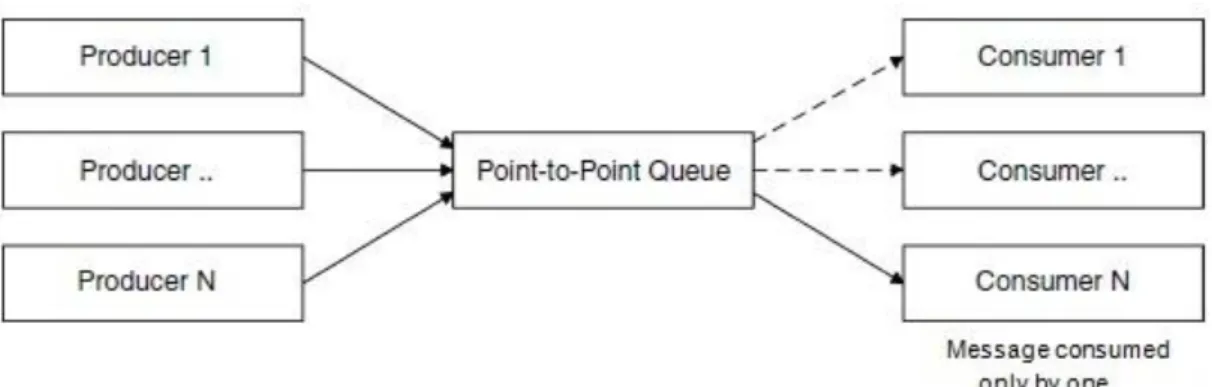
The two most common messaging models are point-to-point and publish-and-subscribe. In point-to-point, a producer sends a message to a queue, destined to only one consumer. Several consumers could exist, but the message is consumed only by one (Curry, 2004). Figure 1 depicts the model:
Figure 1: Point-to-Point Messaging Model (Queue)1
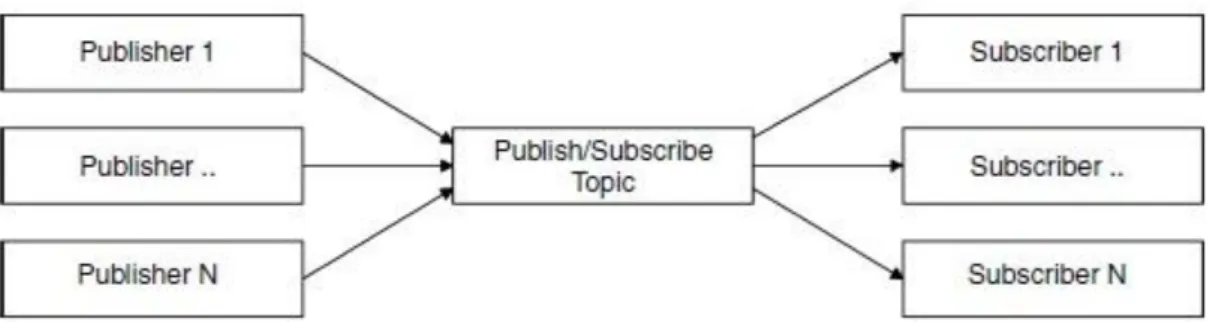
In a publish-and-subscribe model (Figure 2), several consumers are subscribed on a certain topic and each receives a copy of the message published by the producer of that topic (Chappell, 2004).
1 Image taken from: (Curry,2004)
14
Figure 2: Publish/Subscribe Messaging Model (Topic)2
The two messaging models are the key abstractions that enable decoupling and asynchrony among communicating applications
In the lead, loosely coupled interfaces and asynchronous interactions are the most important aspects of the bus (Chappell, 2004). Thus, MOM provides the opportunity for loosely coupled environment, where the applications do not need to know how to access each other's interfaces, since all this is handled by the middleware. In addition, loose coupling contributes to detaching the performance of the separate subsystems from the overall performance throughout the enterprise since the scalability for example of one system, does not need to affect the others (Curry, 2004).
Accordingly, asynchronous interactions facilitate the communication operations to be “standalone units of work” between the applications (Chappell, 2004). They enable the producer to just create a request, and continue working, expecting in the meanwhile to get a response without having to block and wait for it. In asynchronous messaging, there is still the need for reliability, which is typically employed by the MOM itself (Chappell, 2004). In order to ensure reliability, two concepts are important, which are persistence mode and acknowledgements.
In that manner, the messages that are passing through the MOM are marked either as persistent or nonpersistent. Having a message being marked as persistent, means that the message will stay in the queue and that the MOM needs to save the message to a disk. Having the persistent mode enabled, if the intended consumer or message system fails, later on when the consumer or system is running again, the message would be redelivered or forwarded. On the other hand, non persistent messages are kept only in the queue/topic. In case of failure or recovery of the messaging server or consumer, there is no guarantee that the message would be delivered to the intended recipients, thus the message could be potentially lost (Chappell,2004).
When it comes to reliability, another important concept is message acknowledgements (Chappell, 2004). This is how the messaging server is aware whether a message has been delivered successfully to a consumer or not. The producer of messages typically sends of a message to the server, having the MOM guarantee delivery rather than blocking and waiting
15
for a reply. The server then awaits an acknowledgement from the consumer to ensure that the message has been consumed and notifies the producer of the message.
Overall, it can be said that through loose coupling and asynchronous delivery, MOM offers several advantages. One is avoiding the rapidly increasing number of interfaces, common for tightly coupled architecture, where usually the applications need to have point to point interface in order to communicate with each other, and the number of interfaces is usually , where n is the number of nodes. In the case of loose coupling this exponential growth is replaced with linear, since only one interface is necessary for each application to be able to communicate with the middleware. Accordingly, the asynchronous messaging reduces the time necessary for the system to perform its operations since the producers do not need to block and wait for response, but they can continue executing while expecting it (Chappell, 2004).
There are number of both commercial and open source solutions when it comes to message oriented middleware. Some of the most well known are WebSphere MQ, TIBCO, SonicMQ and many other which are all proprietary systems that cause vendor lock-in (Curry, 2006). In addition, there is a great amount of problems when it comes to interoperability among MOM solutions, due to lack of standardization. A number of standards have emerged though, having Java Messaging Service as one widely established in the market. The notable difference is that JMS is an API, which by itself is an interface which does not provide any standardization. Its implementations vary among providers of the MOM solution, thus having no standardized protocol blocks interoperability among messaging systems (Chappell, 2004). This arguably will again cause vendor lock-in as well not elevating the problem of message systems interoperability. There might be afterwards a requirement for building a bridge between the two MOM systems (Chappell, 2004).
There are number of other protocols that try to solve the messaging problem such as, XMPP3 which is more appropriate for chatting systems, and also the two more important ones namely, STOMP4 and AMQP5 that strive for solving messaging interoperability. STOMP is also a wire level protocol, which has certain popularity due to its simplicity, which could impose as a change in the MOM world in the future. However, another protocol that is gaining market share, having a clearer goal of achieving high performance, flexibility, routing and delivery when it comes to messaging, is the Advanced Message Queuing Protocol (AMQP) (Vinoski, 2006).
In 2006, a working group was created between JPMorgan Chace (JPMC), Cisco systems, Envoy Technologies, Red Hat, Twist Process innovations and 29West which officially announced the formation of the Advanced Message Queuing Protocol (AMQP) (Vinoski, 2006). The goal of the working group is standardizing the wire format for allowing communication between different MOM systems. The details regarding these protocols are
3 http://xmpp.org/ 4
http://stomp.github.com/ 5 http://www.amqp.org/
16
out of the scope of this work. However, they are considered as an important factor when it comes to message oriented middleware. If a standardized protocol for interoperability among MOM exists, it would too contribute to enterprise application integration and ESBs since the MOM acts as the backbone technology.
2.7.
Related work
There is a substantial research that can be utilized when it comes to evaluating existing ESB products, according to specific criteria, and comparing them. One of the leading studies is done by Forrester Research, with their latest release on Enterprise Service Bus products evaluation for the second quarter of 2011 (Vollmer, 2011). They have performed the evaluation based on 109 criteria for number of commercial and open source products, summarizing it by defining the leading ones on the market. The evaluation criteria had been divided in three major groups: “current offering” (including orchestration, mediation, change and control, architecture, connection), “strategy” (in terms of vendor’s cost, product strategy, customer references, strategic alliances) and “market presence” (in terms of ESB revenue, new customers, etc.) (Vollmer, 2011). In that manner, overall can be said that the evaluation of Forrester was done taking into consideration numerous factors that would be useful for companies to also decide which vendor to go with, while this thesis research will be concentrated more on the technical issues of the ESB products implementations.
Furthermore, equally significant evaluation and comparison work has been done by (Woolley, 2006), although quite specialized for the State of Utah. Nevertheless, he offers interesting criteria for evaluation such as compliance with industry standards, ease of integration, security feature offering and several more.
In the lead, an interesting and closely related work is done by Desmet et.al, in their paper “Throughput of different ESB approaches”, where they have evaluated two commercial and two open source products, taking into consideration their architecture and implementation, provided ready-to-use features, and ease of use (Desmet, 2007). In addition, they have experimented with performance testing of the ESB products, which could complement this project in terms of providing ideas for how to convey the performance testing for the Access Point Framework. In that manner, the paper “Early Capacity Testing of an Enterprise Service Bus” can be also useful. It discusses the necessity of capacity testing in the early stages of the projects, but it also presents how it is done. It outlines the requirements and the testing conditions, such as putting the ESB under high load and introducing an enormous amount of messages passing through, in order to evaluate the performance (Ueno & Tatsubori, 2006).
Of similar interest is the paper “Evaluating Open Source Enterprise Service Buses”, where the authors have evaluated three open source implementations, according to the features they support and their performance, in terms of response time for invoking external services. They have conveyed two experiments with different conditions for testing the
17
performance. Accordingly, this can be as well quite relevant background for the proposed evaluation to be done further on within this project (García-Jiménez, 2010).
Another elaborate research was presented by (Macvittie, 2006) where 8 ESB products were rated and compared in order to find the one which in total provides the best service as an ESB. The evaluation was done based on the “core bus features”, such as routing, transformation, orchestration, protocol support and management; also, into consideration were taken “integration” feature support as adapter support, ease of web service integration and their management; and last but not least was the price of the products.
So overall, having the background of how ESB products have been evaluated, compared and having the results from the comparisons, helped in establishing the basis for the future research. These papers will be guiding points in the future analysis of the ESB products, as well as the performance testing of the APF.
2.8.
Existing ESB Solutions
There are number of both open source and proprietary products in the market that are presented as Enterprise Service Bus products. Each of these offer a various set of features and have different characteristics that encapsulate a different implementation to the concept of an ESB. When it comes to proprietary ESB products one can say that they originate from traditional EAI technologies and other proprietary software used for transformation and message routing capabilities (Rademakers & Dirksen, 2008). This leads typically to vendor locked solutions making it even harder to achieve integration but also can pose as a problem since many root in EAI principles of having message brokers or centralized functionalities (Baldwin, 2012; Rademakers & Dirksen, 2008). According to Forrester, commercial ESB products are being offered by IBM, Oracle, Progress Software, Software AG, Tibco (Vollmer, 2011). Their respective products are Websphere Enterprise Service Bus (WESB), Websphere Enterprise Service Bus Registry Edition (WESBRE), WebSphere Message Broker (WMB) provided by IBM, Oracle Service Bus by Oracle, Sonic ESB by Progress Software, webMethods ESB Platform by Software AG and ActiveMatrix Service Bus by Tibco, also Microfort BizTalk® ESB Toolkit and others.
Besides the existing commercial products there are also a number of open source ESB products that could be a solution due to the pricing of proprietary software as discussed further in the problem definition (Baldwin, 2012; Vollmer, 2011). In addition, according to Forrester, open source ESBs are said to offer greater functionality than previous years and are catching up with existing commercial solutions. The advantage also of open source solutions is their use of open standards such as Java Message Service (JMS), XML, J2EE Connector Architecture (JCA), and web services standards (Rademakers & Dirksen, 2008). Many open source solutions are based upon open integration specifications such as JBI or JMS. Some of the most notable open source ESB projects such as FuseSource6, MuleSoft7, Red Hat8,
18
WSO29 etc. Due to the necessary scope of this project, the evaluation is going to be based on some of these products/projects in order to accomplish the goal of the thesis.
7 http://www.mulesoft.org/
8
http://www.redhat.com/ 9 http://wso2.com/
19
3.
Problem Definition and Methodology
In the Literature Review, the background theory and basic concepts behind EAI, ESBs and MOM were discussed in details. The benefits offered by these approaches were presented as well, pointing out how they can facilitate in the application integration process. However, there are certain downsides that need to be discussed as well, which set the ground for the problem definition of this thesis. These downsides were taken into consideration when the Access Point Framework was developed, with the main goal of overcoming them as much as possible. The following section discusses these issues in greater details.
3.1.
Problems of existing integration solutions
One of the most problematic issues in Enterprise Application Integration has been to find an efficient and scalable way to transform the messages in formats understandable by the receiving applications and transmit them from one application to the other. There are two basic topologies for application integration: hub-and-spoke and bus (Goel, 2006) .
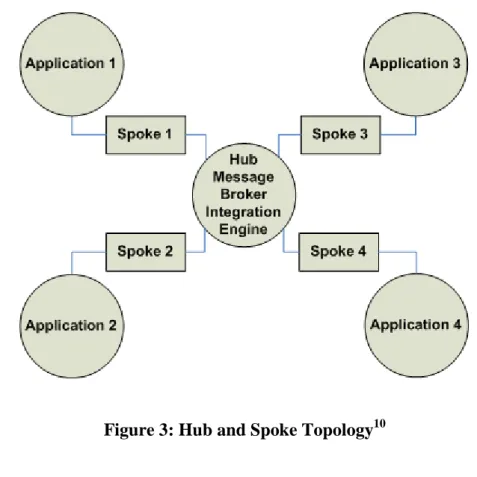
Figure 3: Hub and Spoke Topology10
As it can be seen from Figure 3, there is a centralized hub which is responsible for transforming the messages from a format acceptable by one application to a format understandable by another application; the other responsibility of the hub is to also route the
20
messages from the incoming spoke to the destined application via its corresponding spoke. The role of the spokes, meanwhile, is to transform the application specific format to a format understandable by the hub (Goel, 2006) . In that manner, three problems can be immediately identified with this topology:
● First, although this architecture “overcomes” the mess of point to point connection, what it actually does is putting all those connections into a centralized “black box” - the hub. This way, one single node has to take care of all the connections (e.g. maintaining routing tables) between the applications, which leads to the second problem
● Putting all the processing of messages and routing into a single hub eventually creates a bottleneck as the traffic increases, as well as single point of failure (Tutorials.jenkov.com, 2012) . Of course, having a more powerful machine doesn’t always solve the problem in practice (Goel, 2006) .
● The third problem related to this topology, are the transformations which the hub is responsible for. The fact that the hub has to transform every message into format understandable by the receiving application creates an enormous overhead and consumes great amount of the node’s processing power (Microsoft Corporation, 2004) .
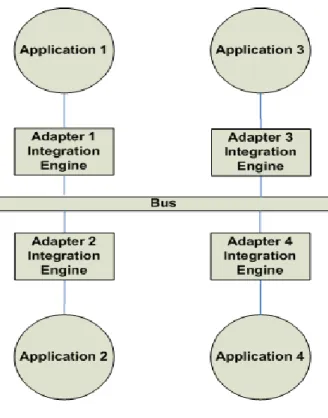
Another approach is the Bus topology, presented in Figure 4.
Figure 4: Bus Topology10
The difference here is that between the bus and the application, there is an adapter which takes over the transformation to application understandable format, while the bus is
21
used only for relaying messages. The adapters subscribe to the bus and pick up the messages for the associated application. Usually, the adapter and the application reside on a single node which completely removes the processing overhead of the transformations from the bus (Goel, 2006) .
A common way of implementing these two topologies can be illustrated with messaging services. Examples of the hub and spoke topology can be Message Brokers (MB) and Transaction Brokers (TB). An example of the bus topology is the Enterprise Service Bus (ESB). All of which will be responsible for the message routing, transformation, etc. Nevertheless, each of these technologies is limited in its capabilities, depending mainly on the vendor's implementation, and for certain companies that have a very high transaction volume, this becomes a serious issue. As potential solution for scalability of these technologies is adding more components, for example, adding more Message Brokers or additional ESBs in order to improve the transaction flow within the architecture. However, the downside to this solution is the pricing of these components, which means that by adding more components, the costs of the company for building the architecture will increase (Woolley, 2006) .
Moreover, adding more components, does not always promise increased scalability. In case there is a necessity for large data blocks to be transmitted, this will slow down the communication. The ESBs or MBs will still have to handle, both, the rest of the messages and the transmission of large files which consumes a fair amount of their capacity. Therefore, adding more such components is not the most convenient way. Even if the components can be obtained out of charge, in the case of open source implementations, appropriate hardware is required on which these components will run (Shaheen, 2010).
These are some of the problems which still exist with the current implementations of ESBs and the Access Point Framework (APF), mentioned previously, offers potential solutions to the aforementioned issues, through a simple and thus elegant design. The solutions provided by this framework will be discussed throughout this thesis paper, by comparing them, at the same time, with existing implementations in order to point out the advantages which the framework offers.
3.2.
Goals and Objectives
Having in mind the common issues of the application integration solutions, discussed in the previous section, the focus of this thesis will go in two directions and try to achieve the following two goals:
Compare the APF with two existing ESB solutions and point out how this framework avoids some of their potential drawbacks;
Integrate the APF with two open source MOMs and provide evaluation for both, that will help potential users to choose the more appropriate one, according to their specific needs
22
In order to achieve these two goals, the following objectives were set to assist the process:
Choose two ESB implementations and investigate their architecture and functionality Compare the characteristics of the two ESBs in relation to the APF and discuss the
advantages of the APF over them
Choose two open source MOMs to be integrated with the APF Integrate them in the existing implementation
Discuss their characteristics in comparison to each other
Evaluate the performance of the two MOMs in comparison to each other Integrate two applications using the APF
Evaluate the performance of the APF itself
Having summarized the goals and objectives of the thesis, in the next section the methodology devised to achieve them will be discussed.
3.3.
Methodology
In order to reach the discussed objectives, certain methods have to be devised that will facilitate this process. This section concentrates on discussing the methods used for investigating the existing ESB and MOM implementations, the criteria used for comparing the chosen ESBs with the APF, the evaluated features of the selected MOMs, as well as the guiding points for evaluation of the chosen MOMs and the APF itself.
3.3.1. Research
The research conveyed as part of this project was of both qualitative and quantitative nature. The qualitative part focuses on answering questions such as why is the APF important and how does it provide potential solutions to the problems discussed in the problem definition; what are the benefits of the APF compared to the existing ESB products. Additionally, it provides in-depth analysis of how well do the chosen MOMs support the features discussed in section 3.3.7. The answers of these questions were produced through gathering knowledge from both primary and secondary sources. Primary, in terms of discussions with the supervisor, who is an expert in this area, on his past experiences with the technologies taken into consideration; secondary sources in terms of articles presenting similar work or documentation on the technologies in place. Having elaborated answers on these questions throughout the thesis constitutes an overview of the qualitative research done on these topics.
On the other hand, in the evaluation part of the project, quantitative research took place. The performance evaluation relied on measurements taken through benchmark tests, which were further used for calculation of certain criteria (discussed in sections 3.3.5 and 3.3.8),