1
GREQAM
Groupement de Recherche en Economie Quantitative d'Aix-Marseille - UMR-CNRS 6579 Ecole des Hautes études en Sciences Sociales
Universités d'Aix-Marseille II et III
Document de Travail
n°2011-24
Estimation of the long memory parameter in
non stationary models: A Simulation Study
Mohamed Boutahar
Rabeh Khalfaoui
May 2011
Estimation of the long memory parameter in non stationary models:
A Simulation Study
M. Boutahar1, R. Khalfaoui2
Abstract
In this paper we perform a Monte Carlo study based on three well-known semiparametric estimates for the long memory fractional parameter. We study the efficiency of Geweke and Porter-Hudak, Gaussian semiparametric and wavelet Ordinary Least-Square estimates in both stationary and non stationary models. We consider an adequate data tapers to compute non stationary estimates. The
Monte Carlo simulation study is based on different sample size. We show that for d∈[1/4,1.25)
the Haar estimate performs the others with respect to the mean squared error. The estimation methods are applied to energy data set for an empirical illustration.
Key words: Wavelets, long memory, tapering, non-stationarity, volatility
1. Introduction
In recent years, studies about long memory have received the attention of statisticians and mathe-maticians. This phenomenon has grown rapidly and can be found in many fields such as hydrology, chimistry, physics, economic and finance. For instance, the studies of Diebold and Redebusch (1989) and Sowell (1992b) for real gross national product, Shea (1991) for interest rates, Lo (1991) and Willinger et al. (1995) for Ethernet traffic, Boutahar et al. (2007) for US inflation rate and Tsay (2009) for political time series. Moreover, Bollerslev and Mikkelsen (1996) proposed the FIGARCH model for modelling the persistence in the volatility in financial time series. The con-cept of long memory describes the property that many time series models possess, despite being stationary, higher persistence than short memory models, such as ARMA models.
Usually a long memory modelXt can be characterized by a single memory parameterd∈(0,1/2)
called the degree of memory of the model, which controls the shape of the spectrum near zero frequency and the hyperbolic decay of its autocorrelation function. More precisely, the spectral
1M. Boutahar GREQAM, Université de la Méditerranée 2 rue de la charité, 13236, Marseille cedex 02, France
e-mail: [email protected]
2R. Khalfaoui GREQAM, Université de la Méditerranée 2 rue de la charité, 13236, Marseille cedex 02, France
e-mail: [email protected]
density, fX(λ), of the long memory model is approximated in the neighborhood of the zero
fre-quency by
fX(λ)∼cλ−2d asλ →0+, 0<c<∞. (1.1)
thus, fX(λ)→∞asλ→0+. Under additional regularity assumptions of fX(λ),the autocorrelation
functionρ(k)of the long memory model has the following asymptotic behavior:
ρ(k)∼ck2d−1 ask→∞. (1.2)
As a consequence, for 0<d<1/2,∑−+∞∞|ρ(k)|=∞.This property of absolute nonsummability of
autocorrelations is often considered as definition of long memory and is satisfied by the ARFIMA models (Granger and Joyeux 1980 and Hosking 1981).
The properties of the model Xt depend on the parameter value d. Several estimation techniques
have been proposed in the literature for detecting the long memory phenomenon, in both time and frequency domains (Sowell 1992 and Beran 1994). These methods are grouped into three categories: the heuristic, the semiparametric and the parametric method. In the first group, we can cite for example Hurst (1951), Higuchi (1988) and Lo (1991). The second method focuses on the frequency domain estimation, in this context the most popular method is the one developed by Geweke and Porter-Hudak (1983). See also Reisen (1994), Chen et al. (1994), Robinson (1995a) and Robinson (1995b) among others. The third method based on the maximum likelihood function is proposed by Whittle (1951), Fox and Taqqu (1986), Dahlhaus (1989) and Sowell (1992). In
this class we estimate simultaneously all the parameters such as the long memory parameter d,
the short-runAR, theMAparameters and the scale parameter. Another semiparametric method for
estimating the long memory parameter is the so-called wavelet method proposed by McCoy and Walden (1996) and Jensen (1999a).
Some recent simulation studies comparing different techniques of estimation in stationary long memory models can be found in Taqqu et al. (1995), Reisen et al. (2006), Boutahar et al. (2007) and Tsay (2009).
We propose here a Monte Carlo study to compare the GPH, Gaussian semiparametric and wavelet OLS estimation method in both stationary and non stationary models. More specifically, our main objective is to determine the best estimation method of the long memory.
The rest of the paper is organized as follows. Section 2 describes the importance of fractional differencing. Section 3 briefly recalls definitions of long memory models. In section 4 we provide
a brief theoretical background of wavelets.3 Section 5 describes the GPH, the Local Whittle and
the wavelet estimation methods. Section 6 proposes a simulation study. An empirical application will be presented in section 7. Section 8 concludes.
3For a broader view of wavelet theory see Daubechies (1992, 1988), Mallat (1989) or Meyer (1993).
2. Fractional differencing
2.1. Importance of fractional differencing
Most financial and economic time series are non-stationary, with their means and covariance fluctu-ating in time. Therefore, how to transform a non-stationary time series into a stationary one became an important problem in the field of time series analysis. The point of fractional differencing mod-els is not merely to allow for the memory measure to be fractional, but to allow it to be unknown, and estimated from data.
LetXt be a time series, we can obtain a new seriesYt by differencingXt (i.e.Yt = (1−L)dXt). Let
fY(λ)be the spectral density ofYt. The spectral density ofXt is given by
fX(λ) = 1−e iλ −2d fY(λ). (2.1)
2.2. Meaning of fractional differencing
The fractional differencing method proposed in this paper illustrates the essence of long-term
mem-ory. It shows the connection between differencing parameterdand long-term memory.
Consider the ARFIMA(0,d,0) model often called fractional white noise which can be expressed as
(1−L)dXt =εt where(1−L)d=∑∞k=0δk(d)Lkand
δk(d) =
Γ(k−d)
Γ(k+1)Γ(−d), (2.2)
where Γ(.) denotes the gamma function. When d=0, Xt is merely a white noise, and its
auto-correlation function is equal to 0. When d =1, Xt is a random walk, whose value of
autocor-relation function is 1, and it can be regarded as a white noise after the first-order differencing.
Whendis non-integer,Xt=−∑+k=∞1δk(d)Xt−k+εt, and henceXtis influenced by all historical data
(Xt−1, Xt−2, . . .), this is just the characteristic of long-term memory.
3. Long memory
Researchers in several fields had noticed that the correlation between observations sometimes de-cayed at a slower rate than for data following classical ARMA models. Later on, as a direct result of the pioneer research of Mandelbrot and Van Ness (1968), self-similar and long memory models were introduced in the fields of statistics as a basis for inferences. Since then, this field is experienc-ing a considerable growth in the number of research results (for instance, see Franco and Reisen (2004); Boutahar et al. (2007); Reisen et al. (2006) and the references therein). The ARFIMA models are extension of ARMA models (short memory), thus we introduce a long memory charac-teristic by the fractional integration.
3.1. Definition and characteristics
A processXt,t≥0, is an ARFIMA(0,d,0) or I(d) model if:
(1−L)d(Xt−µ) =εt, (3.1)
whereεtis a white noise model anddis a real number such that|d|<1/2. This model is stationary
ford<1/2 and invertible ford>−1/2. Its Wold representation is given by:
Xt=µ+
+∞
∑
k=1
δk(−d)εt−k. (3.2)
where δk(d) is given by (2.2). For 0 <d <1/2, the autocorrelations decay hyperbolically like
k2d−1ask→+∞. Similarly, the spectral density of I(d) models behaves likeλ−2d asλ →0.
More generally, an ARFIMA(p,d,q) model is defined as:
Φ(L) (1−L)d(Xt−µ) =Θ(L)εt, (3.3)
whereεt∼i.i.d(0,σε2)is a white noise process,Φ(L) =1−φ1L−. . .−φpLpandΘ(L) =1+θ1L+
. . .+θqLq.
The spectral density of the model{Xt}t=1,...,T is
f(λ) = σ 2 ε 2π Θ(eiλ) Φ(eiλ) 2 1−e iλ −2d , for −π<λ <π. (3.4)
f(λ)is continuously differentiable for all non-zero frequencies. Ford>0, f(λ)is discontinuous
and unbounded at zero frequency. The principal properties of an ARFIMA(p,d,q) are as follows:
·ifd>−1/2,Xt is invertible,
·ifd<1/2,Xt is stationary,
·if−1/2<d<0, the autocorrelation functionρ(k)decreases more quickly than the case 0<d<12.
There is a stronger mean reversion, andXtis called anti-persistent in Mandelbrot’s terminology.
·if 0<d< 12,Xt is a stationary long memory model. The autocorrelation function decays
hyper-bolically to zero and we have for|k| →∞,γ(k)≡Cγ(d,φ,θ)|k|
2d−1 where Cγ(d,φ,θ) = σ 2 ε π Θ(1) Φ(1) 2 Γ(1−2d)sin(πd), (3.5)
and then for|k| →∞,
ρ(k) = γ(k) γ(0)≡ Cγ(d,φ,θ) Rπ −π f(λ)dλ |k|2d−1. (3.6)
·ifd=1/2, the spectral density is unbounded at zero frequency.
3.2. Fractional gaussian noise
The fractional Gaussian noise (fGn) model was independently developed by Granger (1980), Granger and Joyeux (1980), and Hosking (1981). The best way to introduce the fGn model is to do it from
the fractional Brownian motion{BH(t), t≥0}. 4
The fGn model{Xt, t≥0}is the increment of the fractional Brownian motion
Xt =BH(t)−BH(t−1), t≥1. (3.7)
Xt is a stationary Gaussian with autocovariance function
γ(k) =E(XtXt+k) = 1 2 h |k+1|2H−2k2H+|k−1|2Hi, k≥0. γ(k)∼H(2H−1)k2H−2, fork→∞andH6=1 2. (3.8)
withHis theself similarity parameter orHurst coefficient, 0<H<1.
The fGn model reduces to a white noise whenH =1/2, in this caseγ(k) =0 for allk≥1. When
1/2<H<1,Xt is a long memory model.
The spectral density of the fGn model is given by
f(λ) = CH 2 sinλ 2 2 +∞
∑
k=−∞ 1 |k+2πk|2H+1 (3.9) ∼ CH|λ|1−2H asλ →0, CH is a constant. 4. WaveletsWavelets are mathematical tools for analyzing time series. This method has been adopted in the areas of computational economics (see, for example, Davidson et al. 1998), then McCoy and
4Regular Brownian motion is a continuous time stochastic model,B(s), composed of independent Gaussian
incre-ments. Mandelbrot and Van Ness (1968) also note that in a sense fractional Brownian motion,BH(s), can be regarded
as the approximation (0.5−H) fractional derivative of regular Brownian motion:
BH(s) = 1 Γ(H+12) Z s 0 (s−t)H−12dB(t) fors∈(0,1).
whereΓ(.)is the gamma function,B(t)is regular Brownian motion with unit variance andHis the Hurst coefficient,
originally due to Hurst (1951). The autocovariance of fractional Brownian motion is given by: E(BH(s)BH(t)) =
1 2
h
s2H+t2H− |s−t|2Hi.
Walden (1996) suggested an approximate maximum likelihood estimation method for estimating the fractional differencing parameter of a fractional white noise model. Johnstone and Silverman (1997) extended the method to an ARFIMA model. The series were decomposed (filtered) using wavelet transform. This analysis provides a time-frequency representation of a time series. It was developed to overcome the short coming of the Time Fourier Transform (TFT), which can be used to analyze non-stationary time series.
The Fourier transform can only provide frequency information that comprise the time series. It gives no direct information about when an oscillation occurred. However, wavelets can keep track of time and frequency information. The basic idea behind wavelet analysis is to decompose a time series into a number of components, each component can be associated with a particular scale at a particular time.
Generally, the wavelet refers to a set of functions of the form
ψsτ(t) =|s| −1/2 ψ t−τ s , (4.1)
where s is the dilation parameter (scaling parameter) which dilates or compresses a time series,
It is defined as |1/frequency| and corresponds to frequency information, and τ is the translation
parameter which simply moves the wavelet through the time domain.
Any function f ∈L2(R)can be expanded into a wavelet series
f(t) = +∞
∑
j=−∞ +∞∑
k=−∞ ωjkψjk(t), (4.2)whereψjk∈L2(R)denotes thedilatedandtranslatedwavelet defined by
ψjk(t) =2j/2ψ 2jt−k
. (4.3)
for j,k∈Z. The term jgives thescalecorresponding to adilationby 2j(theoctave), andk∈Zis
the position or translation.
There are several wavelet families such as Haar, Daubechies, Shannon and so on. Daubechies (1992) constructed the hierarchy of the compactly supported and orthogonal wavelets with a desired degree of smoothness. This smoothness can be achieved by the number of vanishing moments
(the wavelet function ψ(t) has M vanishing moments if Rxrψ(t)dt =0, for r=0, . . . ,M−1).
Daubechies defined in her famous book Ten lectures on waveletsmany different types of wavelet
transform; the continuous wavelet transform, the discrete wavelet transform,... . In statistical setting researchs are more usually concerned with discret rather than continuous functions. In the following subsection we present a brief definition of discrete wavelet transform.
4.1. The Discrete Wavelet Transform
The wavelet transform is a function of scale in contrast to the Fourier transform which is a function of frequency. The scale is inversely proportional to a frequency interval. If the scale parameter
increases, then the wavelet basis is stretched in the time domain, shrunk in the frequency domain, and shifted toward lower frequencies. Conversely, a decrease in the scale parameter reduces the time support, increases the number of frequencies captured, and shifts toward higher frequencies. The wavelet method is essentially a transformation of time series data based on the two types of
filters called awavelet filterandscaling filter denoted byhandg, respectively. The wavelet filter
hand the scaling filtergare used to construct the Discrete Wavelet Transform (DW T) matrix. The
wavelet filterhof supportL∈N(Lis the length of the filter), is defined so as to satisfy the following
three properties L
∑
i=1 hi=0, L∑
i=1 h2i =1, L∑
i=1 hihi+2n= ∞∑
i=−∞ hihi+2n=0, ∀n∈N∗.The scaling filter of supportLsimilarly satisfies the following three conditions :
L
∑
i=1 gi=√2, L∑
i=1 g2i =1, L∑
i=1 gigi+2n= ∞∑
i=−∞ gigi+2n=0, ∀n∈N∗.The scaling filtergi,i=1, . . . ,L, is the quadrature mirror filter corresponding to the wavelet filter
hi,i=1, . . . ,Lby the relationship
gi= (−1)i+1hL−i−1. (4.4)
In addition, the following relation holds between the wavelet filterhand the scaling filterg
L
∑
i=1
gihi+2n=0. (4.5)
LetX = (X1, X2, . . . ,XT)0 be anT−vector of observations. Usually, the discrete wavelet transfor-mations are used with equally spaced observations with a simple size equal to an integer power of
2. Thus, we assume T =2J for some positive integer J. Using the wavelet filter and the scaling
filter, the original time seriesXt,t =1, . . . ,T is transformed to the new seriesωj,t andνj,t, called
the wavelet and scaling coefficients, respectively. Then we can write
ω =W X. (4.6)
whereω is a T-vector wavelet coefficients andW isT×T real valued matrix called wavelet
trans-form matrix.5
4.2. Wavelet coefficients
TheDW T ofX= (X1, X2, . . . , XT) 0
can be performed using the so-called pyramid algorithm (Mal-lat 1989b).
•At first, the time seriesXt,t=1, . . . ,T withT =2J is filtered using the wavelet and scaling filters.
We obtain twoT/2-vectors of coefficients,ω1(wavelet coefficients) andν1(scaling coefficients).
The wavelet coefficients can be obtained by
ω1,t= L
∑
i=1 hiX2t+1−i mod T, t=1, . . . , T 2. (4.7)and the scaling coefficients can be obtained by
ν1,t = L
∑
i=1 giX2t+1−i mod T, t=1, . . . , T 2. (4.8)•Second, the vector of scaling coefficients is filtered with both wavelet and scaling filter to obtain
a vector of wavelet and scaling coefficients ω2 andν2 each with length T/4. Thus, we filterν1,t
separately withhi,i=1, . . . ,Landgi,i=1, . . . ,Land subsample to produce two new series, namely
ω2,t = L
∑
i=1 hiν1,2t+1−i mod T 2, t =1, . . . , T 4. ν2,t= L∑
i=1 giν1,2t+1−i mod T 2, t=1, . . . , T 4.•Third, repeating this process recursively, afterJapplications ofDW T to get a wavelet and scaling
coefficients given by ωj,t = L
∑
i=1 hiν (j−1),n(2t−1)mod( T 2j−1) o +1. (4.9) νj,t= L∑
i=1 giν (j−1),n(2t−1)mod( T 2j−1) o +1. (4.10) 5W satisfiesWTW=IT. Orthonormality implies thatX=WTωandkωk2=kXk2, see Perceival and Walden (2000)
for more details.
After a brief overview of long memory phenomenon and wavelet analysis of time series, we present in the following section some estimation methods for the long memory parameter.
5. Estimation procedure
5.1. Stationary case
We deal with some well known estimation methods of the long memory parameter d. The first
one is the semiparametric method based on an approximated regression equation obtained from the logarithm of the spectral density function of a model. This method is proposed by Geweke and Porter-Hudak (1983). The second is the Gaussian semiparametric method developed by Robinson (1995b). The third is the wavelet method based on the discrete wavelet coefficients proposed by Abry and Veitch (1996) and Jensen (1999a).
5.1.1. GPH estimate
The GPH estimation procedure is a two-step procedure, which begins with the estimation of d.
This method is based on least squares regression in the spectral domain, exploits the sample form
of the pole of the spectral density at the origin: fX(λ)∼λ−2d,λ →0.To illustrate this method,
we can write the spectral density function of a stationary modelXt,t=1, . . . ,T as
fX(λ) = 4 sin2(λ 2) −d fε(λ). (5.1)
where fε(λ)is the spectral density ofεt, assumed to be a finite and continuous function on the
in-terval[−π,π]; taking the logarithm of the spectral density function fX(λ),the log-spectral density
can be expressed as
log{fX(λ)}=log{fε(0)} −dlog
4 sin2(λ 2) +log fε(λ) fε(0) . (5.2)
LetIX(λj)be the periodogram evaluated at the Fourier frequenciesλj=2πj/T, j=1,2, . . . ,m,T
is the number of observations and m is the number of considered Fourier frequencies, that is the
number of periodogram ordinates,6which will be used in the regression
logIX(λj) = log{fε(0)} −dlog
4 sin2(λj 2 ) +log fε(λj) fε(0) +log IX(λj) fX(λj) . (5.3)
6We can note that the chose of mis an important issue since it strongly affects estimation results. On the one
hand,mshould be sufficiently small in order to consider only near zero frequencies. On the other hand,mshould be
sufficiently large to ensure convergence of OLS estimation.
where log{fε(0)}is a constant, log4 sin2(λj/2) is the exogenous variable and log
IX(λj)/fX(λj)
is a disturbance error. The GPH estimate requires two major assumptions related to asymptotic
be-havior of the equation (5.3):
H1: for low frequencies, we suppose that logfε(λj)/fε(0) is negligible.
H2: the random variables logIX(λj)/fX(λj) ,j=1, . . . ,mare asymptoticallyi.i.d.
Under the hypothesesH1andH2, we can write the linear regression
logIX(λj) =α−dlog 4 sin2(λj 2 ) +ej, (5.4)
whereej ∼i.i.d(−c,π2/6). 7 LetYj=−log
4 sin2(λj/2) , the GPH estimator is the OLS
esti-mate of the regression logIX(λj) on the constantα andYj. The estimate ofd, say ˆdGPH is
ˆ dGPH =∑ m j=1 Yj−Y¯ logIX(λj) ∑mj=1 Yj−Y¯ 2 . (5.5)
where ¯Y =m−1∑mj=1Yjandm=g(T)with limT→
∞
g(T) =∞and lim
T→∞
g(T)/T =0.
Geweke and Porter-Hudak (1983) showed that, ifT →∞and|d|<1/2 we have
√ m dˆGPH−d∼N 0, π2 6 ( m
∑
j=1 Yj−Y¯2 )−1 . (5.6)Porter-Hudak (1990), Crato and de Lima (1994), showed that the parameter m must be selected
so that m=Tυ, withυ =0.5, 0.6,0.7. Robinson (1995a), Hurvich et al. (1998), Tanaka (1999)
and Lieberman et al. (2001) have analyzed the GPH estimate ˆdGPH in great detail. Under the
assumption of normality forXt, it has been proved that the estimate is consistent and asymptotically
normal, so that the estimated standard error of ˆdGPH can be used for inference. An alternative
semiparametric estimator has been proposed by Robinson (1995b).
5.1.2. Gaussian semiparametric estimate
The Gaussian semiparametric estimate called Local Whittle (LW) estimate was originally
devel-oped by Robinson (1995b) under the assumption thatXt,t=1, . . . ,T is a stationary model and its
spectral density behaves at low frequencies likeGλ−2d.8
Robinson (1995b) studied the Gaussian semiparametric estimate ofd based on minimization of a
local Whittle frequency domain log-likelihood,
`m(d,G) = 1 m m
∑
j=1 " logGλ−j 2d + IX(λj) Gλ−j 2d # , (5.7)7cis Euler constant equal to 0.57721...
8At low frequencies, the spectral density f
X(λ)∼GX|λ|−2dasλ→0. for some finite constantGX>0.
wherem9 is some integer less thanT controlling the number of frequencies included in the local
likelihood. Given the interval of admissible estimate of d by, D= [∇1,∇2], where∇1 and∇2 are
numbers such that−1/2<∇1<∇2<1/2, theLW estimates are defined by
ˆ
dmLW,GˆLWm = arg min
d∈D,0<G<∞
`m(d,G). (5.8)
Concentrating equation (5.7) with respect toG, we obtain
ˆ dmLW =arg min d∈D Rm(d). (5.9) where Rm(d) =logGLWm (d) −2d1 m m
∑
j=1 logλj, GLWm (d) = 1 m m∑
j=1 λ2jdIX(λj). (5.10)For linear time series with homoskedastic martingale difference innovations, with spectral density satisfying the same regularity conditions as for log-periodogram estimation based in GPH estimate,
Robinson (1995b) proved that ˆdmLW is consistent and asymptotically normal
√ m dˆmLW−d→d N 0,1 4 . (5.11)
5.1.3. Wavelet OLS estimate
Let a time series Xt, t =1, . . . ,T follows a long memory model and let ψ(t) a wavelet function
satisfying
Z
ψ(t)dt =0, (5.12)
Z
trψ(t)dt =0, r=0, . . . ,M−1. (5.13)
Consider the family ofdilationsandtranslationsof the wavelet functionψ(t)defined by equation
(4.3). It can be shown that
Z
ψ2jk(t)dt = Z
ψ2(t)dt. (5.14)
TheDW T of the modelXt,t=1, . . . ,T is then defined by
9The bandwithmsatisfies
1 m+
m5log2m T4 →0.
if the approximation fX(λ)∼GX|λ|−2dhas errorO
|λ|2−2d
asλ→0.
ωjk=
Z
Xtψjkdt, for j, k∈Z. (5.15)
ifψjk are orthonormal basis,10 we obtain the following representation of the modelXt:
Xt = +∞
∑
j=−∞ +∞∑
k=−∞ ωjkψjk(t). (5.16)Consider theDW T coefficientsωjk discussed in subsection (4.2) and define the statistics
ˆ µj= 1 nj nj
∑
k=1 ω2jk, (5.17)wherenj is the number of coefficients at octave javailable to be computed. As shown by Veitch
and Abry (1999). ˆ µj∼ zj nj χn2j. (5.18)
wherezj=22d jc,c>0,andχn2jis Chi-squared random variable withnjdegrees of freedom. Thus,
by taking logarithms we may write11
log2µˆj∼2d j+log2c+
logχn2j
log 2 −log2nj. (5.19)
Recall that the expected value and the variance of the random variable logχn2are given by
E logχn2 = ψ n 2 +log 2, (5.20) Var logχn2 = ζ 2,n 2 .
whereψ(z)is the psi function,ψ(z) =d/dzlog{Γ(z)}, andζ(2,n/2)is the Riemann zeta function
ζ(x) = 1 Γ(x) Z ∞ 0 ux−1 eu−1du= 1 1−21−s ∞
∑
n=1 (−1)n−1 ns . (5.21)The equation(5.19)can be written as
yj=α+βxj+εj, (5.22)
whereyj=log2µˆj−gj,α =logc,β =2d,xj=log2(2j) = jandεj=log2logχnj−log2nj−gj,
gj=ψ nj/2
−log nj/2. We conclude thatεj satisfies
10The family
ψi j satisfies :Rψi j(t)ψkl(t) =0.
11see Veitch and Abry (1999) for details.
E εj ≈ 0, (5.23) Var εj = ζ 2, nj 2 (log 2)2 ≈ 2njlog 22−1 .
In order to obtain a wavelet estimate, an OLS regression is fitted to points xj,yjfor j=1, . . . ,J
with weightsκj=nj.Thus, once the estimate ˆβ is obtained, an estimate for long memory parameter
dis given by ˆd=βˆ/2. Furthermore, an estimate of the variance of ˆdis provided by the estimate of
the variance of ˆβ,Var dˆ=1/4Var
ˆ
β
.
It is well known that under regularity conditions, the wavelet OLS estimate of d is efficient and
consistent.
5.2. Non-stationary case
It is necessary to extend the concept of long memory to the non-stationary framework, d ≥1/2.
Hurvich and Ray (1995) proposed a general model for possibly non-stationary integrated vector
models with componentsXt,t=1, . . . ,T, each with memory parameterd>−1/2. So that, we say
Xt has memory parameterd>−1/2 ifYt = (1−L)DXt,D=bd+1/2c, is stationary with meanµ
and spectral density fY(λ)behaving as Gλ−2(d−D) around the origin, −1/2≤d−D≤1/2. To
estimate the memory parameter of an integrated model beyond the stationary regime (d>1/2), it
has been suggested to apply a data taper either to the time seriesXt or to its D-th order difference
Yt.
The idea of tapering in improving a Fourier approximation has a long history dating back to 1900 (see Brillinger, 1981). Tukey (1967) introduced this technique to time series for reducing the
periodogram bias due to the strong peaks and throughs in spectral density.12
Velasco (1999a, b)
A taper is a sequenceht,t=1, . . . ,T. Given a series ofT observations,Xt,t=1, . . . ,T, the tapered
discrete Fourier transform and the periodogram are defined as
DX(λj) = 2π T
∑
t=1 ht2 !−12 T∑
t=1 htXteiλjt, (5.24) IX(λj) = DX(λj) 2 . (5.25)The expectation of the periodogram is
12Tapering was originally used in nonparametric spectral analysis of short memory (d=0) time series in order
to reduce bias due to frequency domain leakage, where part of the spectrum "leaks" into adjacent frequencies. The leakage is due to the discontinuity caused by the finitness of the sample and is reduced by using tapers which smooth this discontinuity.
EIX(λj) =
Z π
−π
fX(λ)K(λ−λj)dλ. (5.26)
where fX(λ)is the spectral density ofXtdefined in (1.1) andK(λ) = (2πT)−1
∑T1exp(iλt) 2 is the
Fejér kernel. Velasco (1999a) showed that whenXt is non-stationary, fX(λ)plays exactly the same
role as a spectral density in the asymptotics for the discrete Fourier transform at frequenciesλj,j6=
0 mod T and he showed that the periodogram is (asymptotically) unbiased forλ if j is growing
slowly withT andd<1.13 Velasco (1999a, b) and Velasco and Robinson (2000) have considered
several tapering schemes such as the cosine bell and Zurbenko-Kolmogorov tapers (Zurbenko,
1979). These tapers ht,t =1, . . . ,T have the property of being orthogonal to polynomials up to
given order, for a subset of Fourier frequencies,
T
∑
1
1+t+. . .+tD−1hteitλj=0, j∈ℑ
D,T ⊂1, . . . ,T˜ , (5.27)
where ˜T = b(T−1)/2c. The usual discrete Fourier transform is obtained setting ht ≡1,t =
1, . . . ,T, while the full cosine bell taper is given byht =1/2(1−cos[2πt/T]), and∑ht2=3T/8.
For sample sizeT =4N, whereN is an integer, the weightshPt of the Parzen window14 are
htP= 21−2t−TT 3 , 1≤t≤N or 3N≤t≤4N, 1−6h2tT−T 2−2t−T T 3i , N<T <3N. (5.28)
Zurbenko (1979) used a class of data tapers htZ, t =1, . . . ,T suggested by Kolmogorov, indexed
by order p=1,2, . . . , assuming N=T/p integer. For p=3, Zurbenko’s weights are similar to
the cosine window, and when p=4,hZt are very close tohPt. If p=2, Zurbenko taper is equal to
Bartlett’s triangular window15and when p=1 they are constant.
Hurvich and Chen (2000)
Hurvich and Chen (2000) have defined a family of data tapers. This family depends on a single
13See theorem 1 in Velasco (1999a) for more details.
14The Parzen window is a piecewise curve window obtained by the convolution of two triangles of half length or
four rectangles of one-four length.
w(n) = 1−6n−NN/2/22+6|n−NN/2/2|3,0≤ n−N2 ≤N4 21−|n−NN/2/2|3, N4 ≤n−N 2 ≤ n 2
n=0,1,2, . . . ,N−1, whereNis the length of the window.
15The Bartlett window of widthNalso known as triangular window is defined as
w(n) = 1−2n N, 0≤n≤ N 2 1+2nN, −N 2 ≤n≤0 0,otherwise
parameter p, referred to as the taper order. Setht =1−exp(2iπt/T) and for any integer p≥0,
define the tapered discrete Fourier transform of order pof the sequenceXt, t∈Zas follows:
DXp(λ) = (2πTap)−1/2 T
∑
t=1 htpXtexp(itλ), (5.29) IXp(λ) =D p X(λ) 2 . (5.30)whereap=n−1∑tT=1|ht|2pis a normalization factor. As shown in Hurvich and Chen (2000, Lemma
0), the decay of the discrete Fourier transform of the taper of order pis given by
(2πTap)−1/2 T
∑
t=1 htpexp(itλ) ≤C T (1+T|λ|)p, λ ∈(−π,π). (5.31)This property means that higher-order tapers control the leakage more effectively. The Fourier transform of the taper may be expressed as a finite sum of shifted Dirichlet kernels,
T
∑
t=1 htpeitλ = p∑
k=0 ( T∑
t=1 eit(λ+λk) ) . (5.32)Chen (2001) defined a new class of tapers. He proposed a linear combinations of Hurvich and Chen (2000) tapers with different phase shifts,
h(x) = 1−ei2πxp a0+a1ei2πx+. . .+a q−1ei2(q−1)πx . (5.33) 5.2.1. GPH estimate
Under some smoothness conditions on the short-memory density function f∗, and by assuming that
the taper order pis larger thanD, the ratios of thepooled periodogram ofYt divided by its spectral
density ¯IτY,p(λ˜j)/fY(λ˜j)arei.i.d.16 τ is the pooling order of the periodogram.
where ¯ IτY,p(λ˜j) = (p+τ)(l−1)+p
∑
j=(p+τ)(l−1)+1 IτX(λj), (5.34) and ˜ λj=p−1 (p+τ)l∑
(p+τ)(l−1)+1 λj= [2(p+τ)(l−1) +p+τ+1]π T. (5.35)16See Faÿ et al. (2009)
The parameter IτX(λj) is the periodogram of X evaluated at the frequencies λj = 2πj/T, j =
1, . . . ,m. The log-periodogram estimate of Geweke and Porter-Hudak (1983) is defined as the least squares estimate in the linear regression model
loghI¯Yτ,p(λ˜j) i =logf∗(0) + (d−D)Yj+uj,1≤ j≤m, (5.36) whereYj=−2 log 1−e iλ˜j anduj ∼ =log h ¯ IτY,p(λ˜j)/fX(λ˜j) i . The GPH estimate is ˆ dGPH(m) = ∑ m j=1 Yj−Y¯ ∑mj=1 Yj−Y¯ 2×log h ¯ IτY,p(λ˜j) i +D (5.37)
Velasco (1999b) showed that the GPH estimate is consistent for d ∈[1/2,1) and asymptotically
normally distributed ford∈[1/2,3/4), the GPH estimate has non-normal limiting distribution for
d∈[3/4,1], and ford>1, it is consistent if p≥ bd+1/2c+1.
5.2.2. Local Whittle estimate
Let`p(G,d)be the objective function17
`p(G,d) = p m j=p,
∑
2p,...,m ( log Gλ−j 2d + I(λj) Gλj−2d ) , (5.38)I(λj)is defined in (5.25). Define the lower and upper bound of the admissible estimates ofdby∇1
and∇2. ∇1and∇2are numbers such that−1/2<∇1<∇2<d∗, whered∗is the maximum value
ofdwe can estimate with tapers of order p. The estimates of(Gp,dp)are defined as
ˆ
Gp,dˆLWp = arg min
0<G<∞,d∈[∇1,∇2]
`(G,d) (5.39)
It can be shown that
ˆ dLWp = arg min d∈[∇1,∇2] Rp(d), (5.40) where Rp(d) =logGp(d)−2d p m j=p,
∑
2p,...,mlogλj, (5.41) and Gp(d) = p m j=p,∑
2p,...,mλ 2d j I(λj). (5.42) 17Velasco (1999a).Velasco (1999a) showed that the LW estimate withτ=0 andD=0 is consistent ford∈(−1/2,1)
and asymptoticallyN(0,1/4)ford∈(−1/2,3/4). He showed that ifd>1 and p≥ bd+1/2c+1
the estimate is consistent. In the next section, we report the results of a Monte Carlo experiment based on the three estimation methods defined above.
6. Simulation study
In this section, a simulation study is used to assess the performance of the three estimation proce-dures. For this purpose we consider four models: ARFIMA(0,d,0), ARFIMA(1,d,0), ARFIMA(0,d,1)
and ARFIMA(1,d,1), d=0.05, 0.15, 0.25, 0.35, 0.45, 0.50, 0.75, 1.00, 1.25, 1.50. 1000
replica-tions of sample sizeT =28, 29, 210 are generated. The GPH method was applied using truncation
value m=T0.5. The realizations of ARFIMA(1,d,1) model were generated for same sample size
and of AR coefficient φ =0.2 and MA coefficient θ =0.1. Wavelet analysis is performed with
the Haar or D(2)18 and Daubechies filters with 2 and 4 vanishing moments. In the non stationary
case, for all estimators we have used the taper of order p=2 and p=3 of Bartlett and Zhurbenko
Kolmogorov, respectively.
Our aim is divided in three points: first, to show the efficiency of the estimates, we computed the
Bias and the Root Mean Squared Error of the estimates of long memory parameter d. Second,
to show the effect of choosing the wavelet filter in estimating the long memory parameter for stationary and non stationary times series. Third, to show the importance of data tapers in non stationary case.
To compare the different estimators we considered the Bias given by Bias=d¯−d, where ¯d =
1 n∑
n
i=1dˆi and the Root Mean-Squared Error value, denoted hereafter by RMSE , i.e, RMSE =
q 1 n∑ n i=1 dˆi−d 2 .
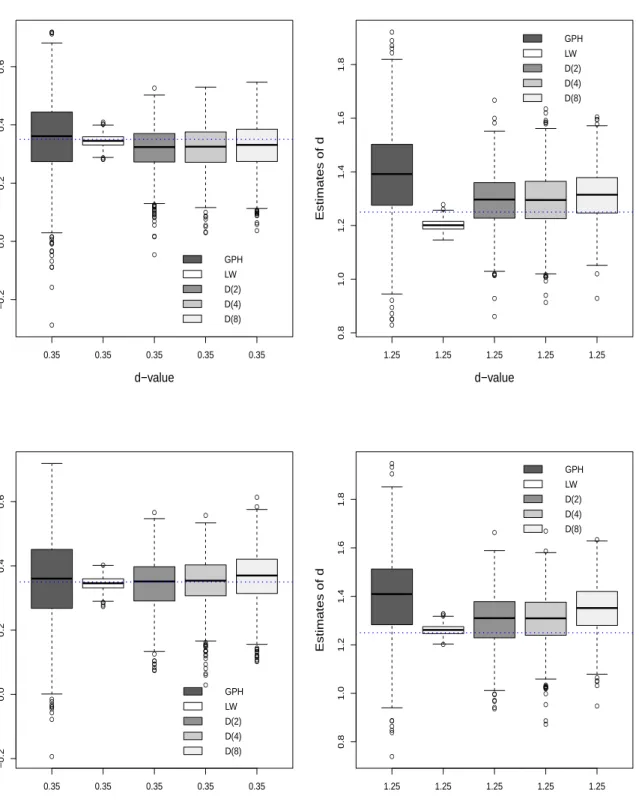
The boxplots for the ARFIMA(0,d,0) and ARFIMA(1,d,1) models withd=0.35 (stationary case)
andd=1.25 (non stationary case) are given in figures 6.3.
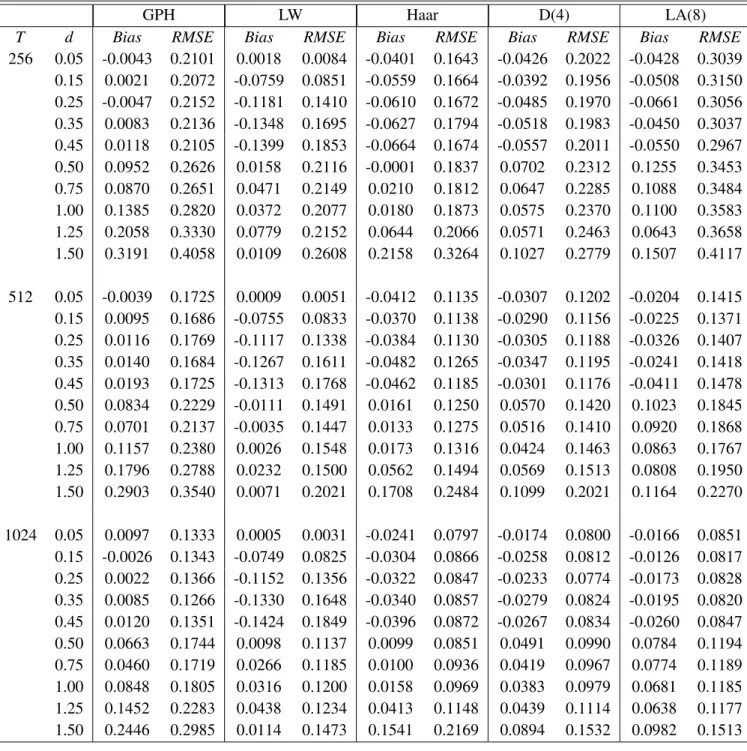
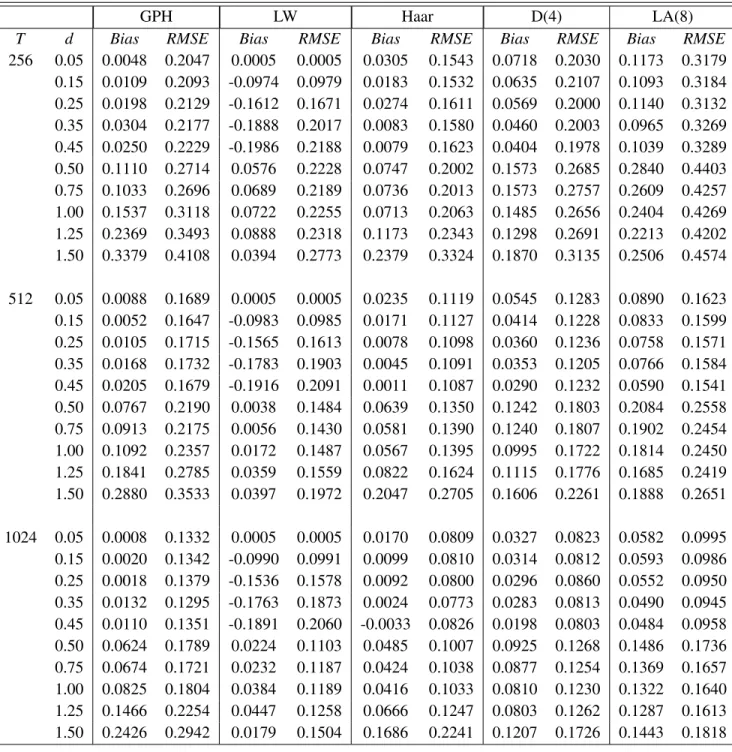
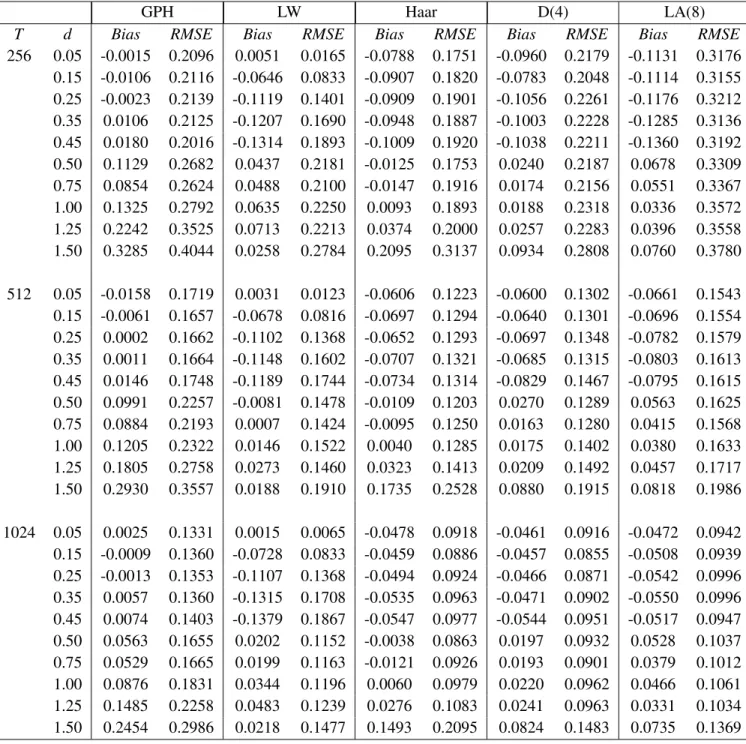
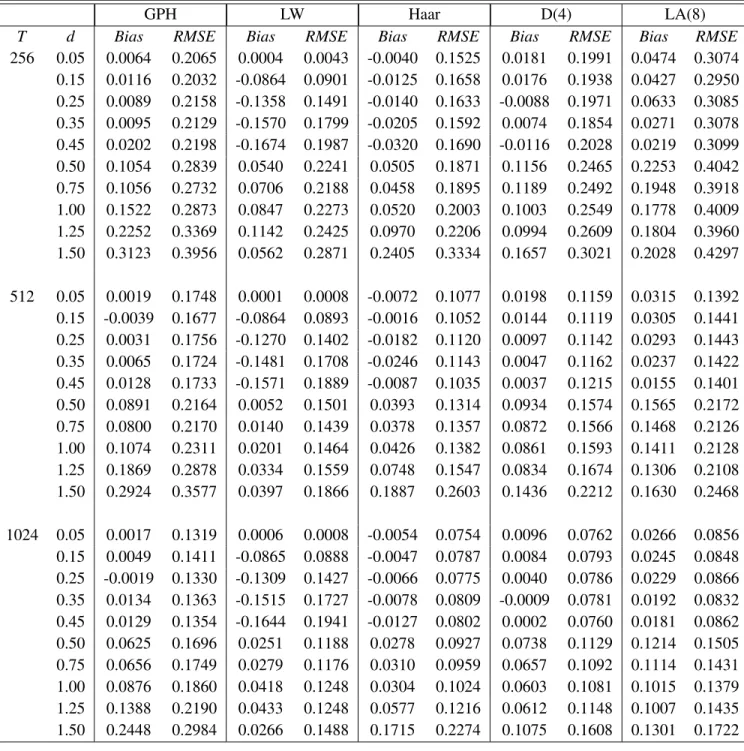
TheRMSEandBiasfor the GPH, LW and wavelet OLS estimates over 1000 simulated realizations
are provided in table 6.1, 6.2, 6.3 and 6.4. Some general comments are as follows :
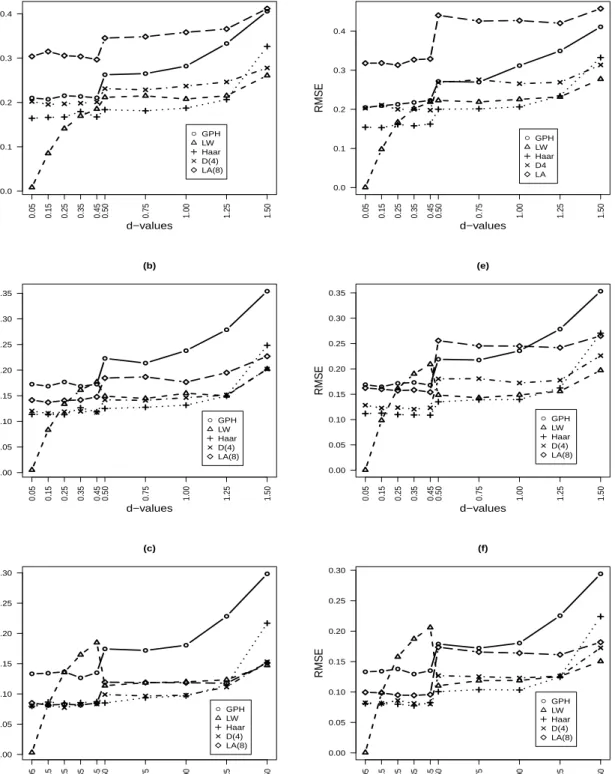
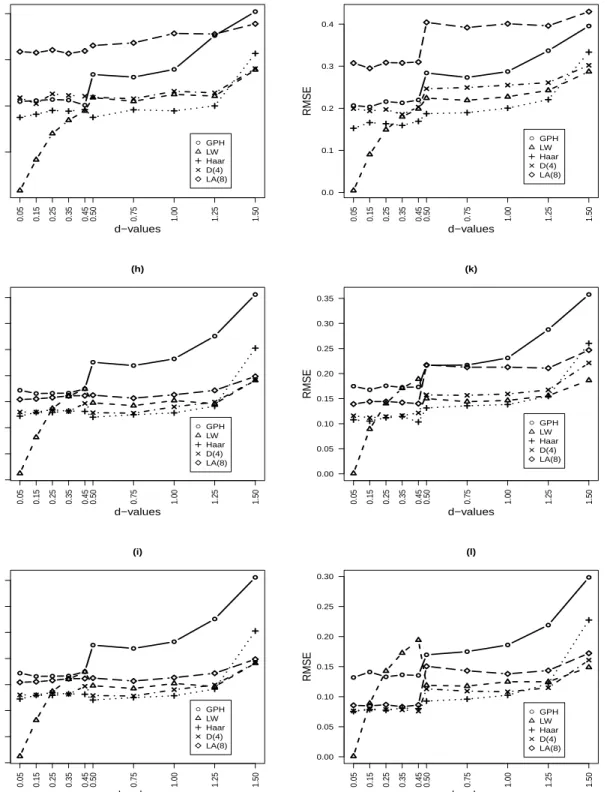
•In stationary case, for the four models the LW estimate performs the GPH estimate (smallRMSE).
Such results were pointed out in Boutahar et al. (2007). In non stationary case, we have found the same results.
•Generally, for the four models used in our simulation and ford≤0.2, the LW estimate is better
than the wavelet OLS one.
• Increasing the number of vanishing moments, we showed that the LW estimate is better. For
instance, for the LA(8) estimate (the number of vanishing moments is 4) the RMSEis larger than
those of all estimates.
18The Haar filter corresponds to the Daubechies filter with one vanishing moments.
Figure 6.1. RMSEas a function ofdfor ARFIMA(0,d,0) and ARFIMA(1,d,0) models. ● ● ● ● ● ● ● ● ● ● (a) ● GPH LW Haar D(4) LA(8) 0.05 0.15 0.25 0.35 0.45 0.50 0.75 1.00 1.25 1.50 0.0 0.1 0.2 0.3 0.4 d−values RMSE ● ● ● ● ● ● ● ● ● ● (d) ● GPH LW Haar D4 LA 0.05 0.15 0.25 0.35 0.45 0.50 0.75 1.00 1.25 1.50 0.0 0.1 0.2 0.3 0.4 d−values RMSE ● ● ● ● ● ● ● ● ● ● (b) ● GPH LW Haar D(4) LA(8) 0.05 0.15 0.25 0.35 0.45 0.50 0.75 1.00 1.25 1.50 0.00 0.05 0.10 0.15 0.20 0.25 0.30 0.35 d−values RMSE ● ● ● ● ● ● ● ● ● ● (e) ● GPH LW Haar D(4) LA(8) 0.05 0.15 0.25 0.35 0.45 0.50 0.75 1.00 1.25 1.50 0.00 0.05 0.10 0.15 0.20 0.25 0.30 0.35 d−values RMSE ● ● ● ● ● ● ● ● ● ● (c) ● GPH LW Haar D(4) LA(8) 0.05 0.15 0.25 0.35 0.45 0.50 0.75 1.00 1.25 1.50 0.00 0.05 0.10 0.15 0.20 0.25 0.30 d−values RMSE ● ● ● ● ● ● ● ● ● ● (f) ● GPH LW Haar D(4) LA(8) 0.05 0.15 0.25 0.35 0.45 0.50 0.75 1.00 1.25 1.50 0.00 0.05 0.10 0.15 0.20 0.25 0.30 d−values RMSE
Notes: RMSEas a function of long memory parameter using GPH, LW and wavelet OLS (Haar,
D(4) and LA(8)) estimation methods. (a), (b), (c) for an ARFIMA(0,d,0); (d), (e) and (f) for an
ARFIMA(1,d,0) models, withT =256,T =512 andT =1024.
Figure 6.2. RMSEas a function ofdfor ARFIMA(0,d,1) and ARFIMA(1,d,1) models. ● ● ● ● ● ● ● ● ● ● (g) ● GPH LW Haar D(4) LA(8) 0.05 0.15 0.25 0.35 0.45 0.50 0.75 1.00 1.25 1.50 0.1 0.2 0.3 0.4 d−values RMSE ● ● ● ● ● ● ● ● ● ● (j) ● GPH LW Haar D(4) LA(8) 0.05 0.15 0.25 0.35 0.45 0.50 0.75 1.00 1.25 1.50 0.0 0.1 0.2 0.3 0.4 d−values RMSE ● ● ● ● ● ● ● ● ● ● (h) ● GPH LW Haar D(4) LA(8) 0.05 0.15 0.25 0.35 0.45 0.50 0.75 1.00 1.25 1.50 0.00 0.05 0.10 0.15 0.20 0.25 0.30 0.35 d−values RMSE ● ● ● ● ● ● ● ● ● ● (k) ● GPH LW Haar D(4) LA(8) 0.05 0.15 0.25 0.35 0.45 0.50 0.75 1.00 1.25 1.50 0.00 0.05 0.10 0.15 0.20 0.25 0.30 0.35 d−values RMSE ● ● ● ● ● ● ● ● ● ● (i) ● GPH LW Haar D(4) LA(8) 0.05 0.15 0.25 0.35 0.45 0.50 0.75 1.00 1.25 1.50 0.00 0.05 0.10 0.15 0.20 0.25 0.30 0.35 d−values RMSE ● ● ● ● ● ● ● ● ● ● (l) ● GPH LW Haar D(4) LA(8) 0.05 0.15 0.25 0.35 0.45 0.50 0.75 1.00 1.25 1.50 0.00 0.05 0.10 0.15 0.20 0.25 0.30 d−values RMSE
Notes: RMSEas a function of long memory parameter using GPH, LW and wavelet OLS (Haar,
D(4) and LA(8)) estimation methods. (g), (h), (i) for an ARFIMA(0,d,1); (j), (k) and (l) for an
ARFIMA(1,d,1) models, withT =256,T =512 andT =1024.
Figure 6.3. Box-plots of GPH, LW and wavelet OLS estimators. ● ● ● ● ● ● ● ● ● ● ● ● ● ● ● ● ● ● ● ● ● ● ● ● ● ● ● ● ● ● ● ● ● ● ● ● ● ● ● ● ● ● ● ● ● ● ● ● ● ● ● ● ● ● ● ● ● ● ● ● ● ● ● 0.35 0.35 0.35 0.35 0.35 −0.2 0.0 0.2 0.4 0.6 d−value Estimates of d GPH LW D(2) D(4) D(8) ● ● ● ● ● ● ● ● ● ● ● ● ● ● ● ● ● ● ● ● ● ● ● ● ● ● ● ● ● ● ● ● ● ● ● ● ● ● ● ● ● ● 1.25 1.25 1.25 1.25 1.25 0.8 1.0 1.2 1.4 1.6 1.8 d−value Estimates of d GPH LW D(2) D(4) D(8) ● ● ● ● ● ● ● ● ● ● ● ● ● ● ● ● ● ● ● ● ● ● ● ● ● ● ● ● ● ● ● ● ● ● ● ● ● ● ● ● ● ● ● ● ● ● ● ● ● ● ● ● ● ● ● ● 0.35 0.35 0.35 0.35 0.35 −0.2 0.0 0.2 0.4 0.6 d−value Estimates of d GPH LW D(2) D(4) D(8) ● ● ● ● ● ● ● ● ● ● ● ● ● ● ● ● ● ● ● ● ● ● ● ● ● ● ● ● ● ● ● ● ● ● ● ● ● ● ● ● 1.25 1.25 1.25 1.25 1.25 0.8 1.0 1.2 1.4 1.6 1.8 d−value Estimates of d GPH LW D(2) D(4) D(8)
Notes: The results are based on 1000 realizations with sample sizeT=1024 for an ARFIMA(0,d,0)
and ARFIMA(1,d,1) model. The dotted blue lines indicate 0.35 and 1.25 ordinates, respectively. The
first row of the picture corresponds to the ARFIMA(0,d,0) model and the second row corresponds to the ARFIMA(1,d,1) model.
Table 6.1. Bias and RMSE of the GPH, LW and wavelet OLS estimator of the long memory parameter for an ARFIMA(0,d,0).
GPH LW Haar D(4) LA(8)
T d Bias RMSE Bias RMSE Bias RMSE Bias RMSE Bias RMSE
256 0.05 -0.0043 0.2101 0.0018 0.0084 -0.0401 0.1643 -0.0426 0.2022 -0.0428 0.3039 0.15 0.0021 0.2072 -0.0759 0.0851 -0.0559 0.1664 -0.0392 0.1956 -0.0508 0.3150 0.25 -0.0047 0.2152 -0.1181 0.1410 -0.0610 0.1672 -0.0485 0.1970 -0.0661 0.3056 0.35 0.0083 0.2136 -0.1348 0.1695 -0.0627 0.1794 -0.0518 0.1983 -0.0450 0.3037 0.45 0.0118 0.2105 -0.1399 0.1853 -0.0664 0.1674 -0.0557 0.2011 -0.0550 0.2967 0.50 0.0952 0.2626 0.0158 0.2116 -0.0001 0.1837 0.0702 0.2312 0.1255 0.3453 0.75 0.0870 0.2651 0.0471 0.2149 0.0210 0.1812 0.0647 0.2285 0.1088 0.3484 1.00 0.1385 0.2820 0.0372 0.2077 0.0180 0.1873 0.0575 0.2370 0.1100 0.3583 1.25 0.2058 0.3330 0.0779 0.2152 0.0644 0.2066 0.0571 0.2463 0.0643 0.3658 1.50 0.3191 0.4058 0.0109 0.2608 0.2158 0.3264 0.1027 0.2779 0.1507 0.4117 512 0.05 -0.0039 0.1725 0.0009 0.0051 -0.0412 0.1135 -0.0307 0.1202 -0.0204 0.1415 0.15 0.0095 0.1686 -0.0755 0.0833 -0.0370 0.1138 -0.0290 0.1156 -0.0225 0.1371 0.25 0.0116 0.1769 -0.1117 0.1338 -0.0384 0.1130 -0.0305 0.1188 -0.0326 0.1407 0.35 0.0140 0.1684 -0.1267 0.1611 -0.0482 0.1265 -0.0347 0.1195 -0.0241 0.1418 0.45 0.0193 0.1725 -0.1313 0.1768 -0.0462 0.1185 -0.0301 0.1176 -0.0411 0.1478 0.50 0.0834 0.2229 -0.0111 0.1491 0.0161 0.1250 0.0570 0.1420 0.1023 0.1845 0.75 0.0701 0.2137 -0.0035 0.1447 0.0133 0.1275 0.0516 0.1410 0.0920 0.1868 1.00 0.1157 0.2380 0.0026 0.1548 0.0173 0.1316 0.0424 0.1463 0.0863 0.1767 1.25 0.1796 0.2788 0.0232 0.1500 0.0562 0.1494 0.0569 0.1513 0.0808 0.1950 1.50 0.2903 0.3540 0.0071 0.2021 0.1708 0.2484 0.1099 0.2021 0.1164 0.2270 1024 0.05 0.0097 0.1333 0.0005 0.0031 -0.0241 0.0797 -0.0174 0.0800 -0.0166 0.0851 0.15 -0.0026 0.1343 -0.0749 0.0825 -0.0304 0.0866 -0.0258 0.0812 -0.0126 0.0817 0.25 0.0022 0.1366 -0.1152 0.1356 -0.0322 0.0847 -0.0233 0.0774 -0.0173 0.0828 0.35 0.0085 0.1266 -0.1330 0.1648 -0.0340 0.0857 -0.0279 0.0824 -0.0195 0.0820 0.45 0.0120 0.1351 -0.1424 0.1849 -0.0396 0.0872 -0.0267 0.0834 -0.0260 0.0847 0.50 0.0663 0.1744 0.0098 0.1137 0.0099 0.0851 0.0491 0.0990 0.0784 0.1194 0.75 0.0460 0.1719 0.0266 0.1185 0.0100 0.0936 0.0419 0.0967 0.0774 0.1189 1.00 0.0848 0.1805 0.0316 0.1200 0.0158 0.0969 0.0383 0.0979 0.0681 0.1185 1.25 0.1452 0.2283 0.0438 0.1234 0.0413 0.1148 0.0439 0.1114 0.0638 0.1177 1.50 0.2446 0.2985 0.0114 0.1473 0.1541 0.2169 0.0894 0.1532 0.0982 0.1513
•For 0.5≤d<1.5, we have used the Bartlett taper of order p=2. We found that the Haar filter
performs better results than the GPH, LW, D(4) and LA(8) estimates. But, for d ≥1.5 we have
used the Zhurbenko Kolmogorov taper of order p=3. Using the Zhurbenko Kolmogorov taper the
D(4) is better than the GPH, Haar and LA(8) estimates. Hence, we have smallRMSE.
•In non stationary case, ford≥1.5 the LW estimate is better than all other estimates.
We concluded that theRMSEof the LW estimate are smaller than those of GPH and wavelet OLS
Table 6.2. Bias and RMSE of the GPH, LW and wavelet OLS estimator of the long memory parameter for an ARFIMA(1,d,0).
GPH LW Haar D(4) LA(8)
T d Bias RMSE Bias RMSE Bias RMSE Bias RMSE Bias RMSE
256 0.05 0.0048 0.2047 0.0005 0.0005 0.0305 0.1543 0.0718 0.2030 0.1173 0.3179 0.15 0.0109 0.2093 -0.0974 0.0979 0.0183 0.1532 0.0635 0.2107 0.1093 0.3184 0.25 0.0198 0.2129 -0.1612 0.1671 0.0274 0.1611 0.0569 0.2000 0.1140 0.3132 0.35 0.0304 0.2177 -0.1888 0.2017 0.0083 0.1580 0.0460 0.2003 0.0965 0.3269 0.45 0.0250 0.2229 -0.1986 0.2188 0.0079 0.1623 0.0404 0.1978 0.1039 0.3289 0.50 0.1110 0.2714 0.0576 0.2228 0.0747 0.2002 0.1573 0.2685 0.2840 0.4403 0.75 0.1033 0.2696 0.0689 0.2189 0.0736 0.2013 0.1573 0.2757 0.2609 0.4257 1.00 0.1537 0.3118 0.0722 0.2255 0.0713 0.2063 0.1485 0.2656 0.2404 0.4269 1.25 0.2369 0.3493 0.0888 0.2318 0.1173 0.2343 0.1298 0.2691 0.2213 0.4202 1.50 0.3379 0.4108 0.0394 0.2773 0.2379 0.3324 0.1870 0.3135 0.2506 0.4574 512 0.05 0.0088 0.1689 0.0005 0.0005 0.0235 0.1119 0.0545 0.1283 0.0890 0.1623 0.15 0.0052 0.1647 -0.0983 0.0985 0.0171 0.1127 0.0414 0.1228 0.0833 0.1599 0.25 0.0105 0.1715 -0.1565 0.1613 0.0078 0.1098 0.0360 0.1236 0.0758 0.1571 0.35 0.0168 0.1732 -0.1783 0.1903 0.0045 0.1091 0.0353 0.1205 0.0766 0.1584 0.45 0.0205 0.1679 -0.1916 0.2091 0.0011 0.1087 0.0290 0.1232 0.0590 0.1541 0.50 0.0767 0.2190 0.0038 0.1484 0.0639 0.1350 0.1242 0.1803 0.2084 0.2558 0.75 0.0913 0.2175 0.0056 0.1430 0.0581 0.1390 0.1240 0.1807 0.1902 0.2454 1.00 0.1092 0.2357 0.0172 0.1487 0.0567 0.1395 0.0995 0.1722 0.1814 0.2450 1.25 0.1841 0.2785 0.0359 0.1559 0.0822 0.1624 0.1115 0.1776 0.1685 0.2419 1.50 0.2880 0.3533 0.0397 0.1972 0.2047 0.2705 0.1606 0.2261 0.1888 0.2651 1024 0.05 0.0008 0.1332 0.0005 0.0005 0.0170 0.0809 0.0327 0.0823 0.0582 0.0995 0.15 0.0020 0.1342 -0.0990 0.0991 0.0099 0.0810 0.0314 0.0812 0.0593 0.0986 0.25 0.0018 0.1379 -0.1536 0.1578 0.0092 0.0800 0.0296 0.0860 0.0552 0.0950 0.35 0.0132 0.1295 -0.1763 0.1873 0.0024 0.0773 0.0283 0.0813 0.0490 0.0945 0.45 0.0110 0.1351 -0.1891 0.2060 -0.0033 0.0826 0.0198 0.0803 0.0484 0.0958 0.50 0.0624 0.1789 0.0224 0.1103 0.0485 0.1007 0.0925 0.1268 0.1486 0.1736 0.75 0.0674 0.1721 0.0232 0.1187 0.0424 0.1038 0.0877 0.1254 0.1369 0.1657 1.00 0.0825 0.1804 0.0384 0.1189 0.0416 0.1033 0.0810 0.1230 0.1322 0.1640 1.25 0.1466 0.2254 0.0447 0.1258 0.0666 0.1247 0.0803 0.1262 0.1287 0.1613 1.50 0.2426 0.2942 0.0179 0.1504 0.1686 0.2241 0.1207 0.1726 0.1443 0.1818
estimates for d ≤ 0.2 and d ≥1.5. Thus, the LW estimation method has a good performance.
Moreover, the performance of the Haar estimate is better for 0.3≤d<1.5.
Table 6.3. Bias and RMSE of the GPH, LW and wavelet OLS estimator of the long memory parameter for an ARFIMA(0,d,1).
GPH LW Haar D(4) LA(8)
T d Bias RMSE Bias RMSE Bias RMSE Bias RMSE Bias RMSE
256 0.05 -0.0015 0.2096 0.0051 0.0165 -0.0788 0.1751 -0.0960 0.2179 -0.1131 0.3176 0.15 -0.0106 0.2116 -0.0646 0.0833 -0.0907 0.1820 -0.0783 0.2048 -0.1114 0.3155 0.25 -0.0023 0.2139 -0.1119 0.1401 -0.0909 0.1901 -0.1056 0.2261 -0.1176 0.3212 0.35 0.0106 0.2125 -0.1207 0.1690 -0.0948 0.1887 -0.1003 0.2228 -0.1285 0.3136 0.45 0.0180 0.2016 -0.1314 0.1893 -0.1009 0.1920 -0.1038 0.2211 -0.1360 0.3192 0.50 0.1129 0.2682 0.0437 0.2181 -0.0125 0.1753 0.0240 0.2187 0.0678 0.3309 0.75 0.0854 0.2624 0.0488 0.2100 -0.0147 0.1916 0.0174 0.2156 0.0551 0.3367 1.00 0.1325 0.2792 0.0635 0.2250 0.0093 0.1893 0.0188 0.2318 0.0336 0.3572 1.25 0.2242 0.3525 0.0713 0.2213 0.0374 0.2000 0.0257 0.2283 0.0396 0.3558 1.50 0.3285 0.4044 0.0258 0.2784 0.2095 0.3137 0.0934 0.2808 0.0760 0.3780 512 0.05 -0.0158 0.1719 0.0031 0.0123 -0.0606 0.1223 -0.0600 0.1302 -0.0661 0.1543 0.15 -0.0061 0.1657 -0.0678 0.0816 -0.0697 0.1294 -0.0640 0.1301 -0.0696 0.1554 0.25 0.0002 0.1662 -0.1102 0.1368 -0.0652 0.1293 -0.0697 0.1348 -0.0782 0.1579 0.35 0.0011 0.1664 -0.1148 0.1602 -0.0707 0.1321 -0.0685 0.1315 -0.0803 0.1613 0.45 0.0146 0.1748 -0.1189 0.1744 -0.0734 0.1314 -0.0829 0.1467 -0.0795 0.1615 0.50 0.0991 0.2257 -0.0081 0.1478 -0.0109 0.1203 0.0270 0.1289 0.0563 0.1625 0.75 0.0884 0.2193 0.0007 0.1424 -0.0095 0.1250 0.0163 0.1280 0.0415 0.1568 1.00 0.1205 0.2322 0.0146 0.1522 0.0040 0.1285 0.0175 0.1402 0.0380 0.1633 1.25 0.1805 0.2758 0.0273 0.1460 0.0323 0.1413 0.0209 0.1492 0.0457 0.1717 1.50 0.2930 0.3557 0.0188 0.1910 0.1735 0.2528 0.0880 0.1915 0.0818 0.1986 1024 0.05 0.0025 0.1331 0.0015 0.0065 -0.0478 0.0918 -0.0461 0.0916 -0.0472 0.0942 0.15 -0.0009 0.1360 -0.0728 0.0833 -0.0459 0.0886 -0.0457 0.0855 -0.0508 0.0939 0.25 -0.0013 0.1353 -0.1107 0.1368 -0.0494 0.0924 -0.0466 0.0871 -0.0542 0.0996 0.35 0.0057 0.1360 -0.1315 0.1708 -0.0535 0.0963 -0.0471 0.0902 -0.0550 0.0996 0.45 0.0074 0.1403 -0.1379 0.1867 -0.0547 0.0977 -0.0544 0.0951 -0.0517 0.0947 0.50 0.0563 0.1655 0.0202 0.1152 -0.0038 0.0863 0.0197 0.0932 0.0528 0.1037 0.75 0.0529 0.1665 0.0199 0.1163 -0.0121 0.0926 0.0193 0.0901 0.0379 0.1012 1.00 0.0876 0.1831 0.0344 0.1196 0.0060 0.0979 0.0220 0.0962 0.0466 0.1061 1.25 0.1485 0.2258 0.0483 0.1239 0.0276 0.1083 0.0241 0.0963 0.0331 0.1034 1.50 0.2454 0.2986 0.0218 0.1477 0.1493 0.2095 0.0824 0.1483 0.0735 0.1369 7. Empirical application 7.1. Data
In this section, the proposed methodology is applied to a real example for illustration. The data consist of weekly crude oil spot prices (in US dollars per barrel) during the period from Jun 15,
Table 6.4. Bias and RMSE of the GPH, LW and wavelet OLS estimator of the long memory
parameter for an ARFIMA(1,d,1),φ =0.2,θ =0.1
GPH LW Haar D(4) LA(8)
T d Bias RMSE Bias RMSE Bias RMSE Bias RMSE Bias RMSE
256 0.05 0.0064 0.2065 0.0004 0.0043 -0.0040 0.1525 0.0181 0.1991 0.0474 0.3074 0.15 0.0116 0.2032 -0.0864 0.0901 -0.0125 0.1658 0.0176 0.1938 0.0427 0.2950 0.25 0.0089 0.2158 -0.1358 0.1491 -0.0140 0.1633 -0.0088 0.1971 0.0633 0.3085 0.35 0.0095 0.2129 -0.1570 0.1799 -0.0205 0.1592 0.0074 0.1854 0.0271 0.3078 0.45 0.0202 0.2198 -0.1674 0.1987 -0.0320 0.1690 -0.0116 0.2028 0.0219 0.3099 0.50 0.1054 0.2839 0.0540 0.2241 0.0505 0.1871 0.1156 0.2465 0.2253 0.4042 0.75 0.1056 0.2732 0.0706 0.2188 0.0458 0.1895 0.1189 0.2492 0.1948 0.3918 1.00 0.1522 0.2873 0.0847 0.2273 0.0520 0.2003 0.1003 0.2549 0.1778 0.4009 1.25 0.2252 0.3369 0.1142 0.2425 0.0970 0.2206 0.0994 0.2609 0.1804 0.3960 1.50 0.3123 0.3956 0.0562 0.2871 0.2405 0.3334 0.1657 0.3021 0.2028 0.4297 512 0.05 0.0019 0.1748 0.0001 0.0008 -0.0072 0.1077 0.0198 0.1159 0.0315 0.1392 0.15 -0.0039 0.1677 -0.0864 0.0893 -0.0016 0.1052 0.0144 0.1119 0.0305 0.1441 0.25 0.0031 0.1756 -0.1270 0.1402 -0.0182 0.1120 0.0097 0.1142 0.0293 0.1443 0.35 0.0065 0.1724 -0.1481 0.1708 -0.0246 0.1143 0.0047 0.1162 0.0237 0.1422 0.45 0.0128 0.1733 -0.1571 0.1889 -0.0087 0.1035 0.0037 0.1215 0.0155 0.1401 0.50 0.0891 0.2164 0.0052 0.1501 0.0393 0.1314 0.0934 0.1574 0.1565 0.2172 0.75 0.0800 0.2170 0.0140 0.1439 0.0378 0.1357 0.0872 0.1566 0.1468 0.2126 1.00 0.1074 0.2311 0.0201 0.1464 0.0426 0.1382 0.0861 0.1593 0.1411 0.2128 1.25 0.1869 0.2878 0.0334 0.1559 0.0748 0.1547 0.0834 0.1674 0.1306 0.2108 1.50 0.2924 0.3577 0.0397 0.1866 0.1887 0.2603 0.1436 0.2212 0.1630 0.2468 1024 0.05 0.0017 0.1319 0.0006 0.0008 -0.0054 0.0754 0.0096 0.0762 0.0266 0.0856 0.15 0.0049 0.1411 -0.0865 0.0888 -0.0047 0.0787 0.0084 0.0793 0.0245 0.0848 0.25 -0.0019 0.1330 -0.1309 0.1427 -0.0066 0.0775 0.0040 0.0786 0.0229 0.0866 0.35 0.0134 0.1363 -0.1515 0.1727 -0.0078 0.0809 -0.0009 0.0781 0.0192 0.0832 0.45 0.0129 0.1354 -0.1644 0.1941 -0.0127 0.0802 0.0002 0.0760 0.0181 0.0862 0.50 0.0625 0.1696 0.0251 0.1188 0.0278 0.0927 0.0738 0.1129 0.1214 0.1505 0.75 0.0656 0.1749 0.0279 0.1176 0.0310 0.0959 0.0657 0.1092 0.1114 0.1431 1.00 0.0876 0.1860 0.0418 0.1248 0.0304 0.1024 0.0603 0.1081 0.1015 0.1379 1.25 0.1388 0.2190 0.0433 0.1248 0.0577 0.1216 0.0612 0.1148 0.1007 0.1435 1.50 0.2448 0.2984 0.0266 0.1488 0.1715 0.2274 0.1075 0.1608 0.1301 0.1722
1990 to January 29, 2010. The data are from the U.S. Energy Information Administration.19 We
consider a weekly nominal percentage return for crude oil series, i.e., rt =ln(Pt/Pt−1)∗100 for
t=1,2, . . . ,T, wherertis the return for crude oils at timet,Pt is the weekly current price andPt−1
19http://tonto.eia.doe.gov/dnav/pet/pet_pri_spt_s1_w.htm
is the previous week’s price.
In the literature, the oil price has been analyzed by many authors, see for example Chang and Wong (2003) for oil price fluctuations in Singapore economy, Sadorsky (2006) for forecasting and modeling petroleum volatility, Lardic and Mignon (2006), Lardic and Mignon (2008) for oil prices and economic activities, Chen and Chen (2007) for financial assets, Narayan and Narayan (2007) for modeling and forecasting crude oil market volatility and Kang et al. (2009) for forecasting volatility of daily crude oil markets.
Figure (7.1) shows the dynamics of crude oil spot prices and return oil price of the two sample WTI
20 and Europe Brent21 and figure (7.2) depicts a plot of volatility (i.e. of the absolute returns|r
t|)
for the two crude oils and corresponding correlogram and spectrum function. We observe a slow decay of correlogram indicating the long memory behavior of the volatility of the weekly energy price.
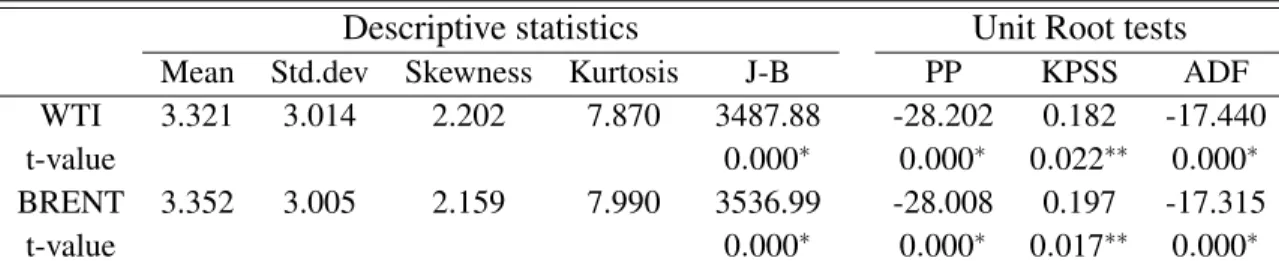
Table 7.1. Summary statistics and Unit Root tests of energy price volatility.
Descriptive statistics Unit Root tests
Mean Std.dev Skewness Kurtosis J-B PP KPSS ADF WTI 3.321 3.014 2.202 7.870 3487.88 -28.202 0.182 -17.440 t-value 0.000∗ 0.000∗ 0.022∗∗ 0.000∗ BRENT 3.352 3.005 2.159 7.990 3536.99 -28.008 0.197 -17.315
t-value 0.000∗ 0.000∗ 0.017∗∗ 0.000∗
Notes: Sample period, weekly data: Juin 15, 1990 to January 29, 2010. J-B is the Jarque-Bera statistic for null hypothesis of normality in sample volatility distribution. PP and ADF are the Phillips-Perron and
Augmented-Dickey-Fuller adjustedt-statistics of lagged dependent variable in a regression with intercept
and trend (H0: Data are I(1)). KPSS is the Kiwatkoski et al. (1992) test statistic based on residuals from
regression with intercept and trend (H0: Data are I(0)). The critical values for PP, KPSS and ADF are
−3.43, 0.216 and−3.96, respectively, at 1% significance level. * and ** indicate significance at 1% and
5% level, respectively.
Table(7.1) displays descriptive statistics and unit root tests of weekly volatility for both WTI and Brent crude oil spot prices. The sample mean and variance of volatility are around 3 and skewness and kurtosis statistics indicate that the volatility distribution is not normally distributed.
We apply three standard unit root tests on each individual transformed series, PP (Phillips-Perron), KPSS (Kwiatkoski, Phillips, Schmidt and Shin) and Augmented-Dickey-Fuller in order to show the stationarity behavior for weekly crude oil data. Results are given in table (7.1). For the PP and ADF tests, large negative values for the statistics support the rejection of the null hypothesis of unit root at the 1% significance level. For KPSS test, the statistics are significant at 5% level implying
20West Texas Intermidiate or Texas light Sweet is a type of crude oil used in the pricing of US domestic crudes, as
well as oil imports into the US.
21Brent crude or Brent petroleum is used as a reference for pricing a number of other crude streams. It is produced
in North sea region.
Figure 7.1. Oil price time series. 0 200 400 600 800 1000 20 40 60 80 100 120 140 Pr ice ($/Barrel) WTI 0 200 400 600 800 1000 −20 −10 0 10 20 Retur ns (%) 0 200 400 600 800 1000 20 40 60 80 100 120 140 Pr ice ($/Barrel) BRENT 0 200 400 600 800 1000 −20 −10 0 10 20 Retur ns (%)
Notes: Level and return oil price in the period between Jun 15, 1990 and January 29, 2010.
that the two series are stationary models. Hence, the volatility crude oil price series are stationary. Thus, we can examine evidence for any possible long-range dependence phenomenon.
To implement the tapering on non stationarity crude oil data, we have concentrated on the Bartlett
and Zhurbenko Kolmogorov tapers. We plotted these data tapers for p=2 and p=3 for sample
size T =1024 on the first row of Fig. 7.3. The tapered crude oil series htpt are plotted in the
second and fourth rows. In the third and fifth rows of the pictures we plotted the log-periodogram of tapered crude oil series.
7.2. Long memory of crude oil spot price volatility
Baillie et al. (1996), introduced the Fractionally Integrated GARCH (FIGARCH) model as gen-eralization of the GARCH and Integrated GARCH (IGARCH) specifications, see Beine et al. (2002), Giraitis et al. (2004), Lardic and Mignon (2004), Lee (2005) and Baillie et al. (2007) for a few recent applications. They suggested the FIGARCH model because is able to distinguish between short and long memory in conditional variance behavior. Let the conditional variance
ht=Var(εt|Ωt−1)whereΩt−1is the information set in periodt−1. The GARCH model is written
Figure 7.2. Energy price analysis. 0 200 400 600 800 1000 0 5 10 15 20 25 WTI V olatility 0 200 400 600 800 1000 0 5 10 15 20 BRENT V olatility 5 10 15 20 −0.05 0.00 0.05 0.10 0.15 0.20 0.25 Lag A CF WTI 5 10 15 20 −0.05 0.00 0.05 0.10 0.15 0.20 Lag A CF BRENT 0.0 0.1 0.2 0.3 0.4 0.5 2 5 10 20 frequency spectr um WTI bandwidth = 0.00189 0.0 0.1 0.2 0.3 0.4 0.5 2 5 10 20 50 frequency spectr um BRENT bandwidth = 0.00189
Notes: weekly volatility WTI (top left) and Brent (top right) crude oil spot price in the period Jun 15, 1990 to January 29, 2010 and corresponding ACF and spectrum function.
as
(1−β(L))ht=ω+α(L)εt2. (7.1)
where β(L) and α(L) are polynomials of order p and q, respectively. Let νt =εt2−ht. The
FIGARCH model is defined as follows:
φ(L) (1−L)dεt2=ω+ (1−β(L))νt. (7.2)
whereφ(L) = [1−β(L)−α(L)] (1−L)−d. Note that the FIGARCH model reduces to a GARCH
model whend=0 and to an IGARCH model whend=1. The conditional variance of FIGARCH
model may be written as
ht= ω 1−β(L)+λ(L)ε 2 t. (7.3) Whereλ(L) =1− φ(L)(1−L)d/[1−β(L)].
In our analysis, we first estimate the fractional integration parameter d by the three methods
de-scribed previously in section 5. The estimates results are provided in table (7.2). These estimates indicate evidence of long memory in WTI and Brent crude oil volatility.
We also assess the null hypothesis of a White noise model for WTI and Brent returns using
Box-Pierce test statisticsQ(24). The corresponding t-statistics are 70.722 and 69.397 for WTI and Brent
returns, with p−value=0, respectively. Thus, we find significant evidence of serial dependence
in the volatility series. Therefore, this finding implies non-normality and serial correlation in the crude oil volatilities. We used a filter to remove the serial dependence in the return series and the resulting residuals series are re-tested for GARCH and FIGARCH models to detect the long memory phenomenon in the volatility of crude oils spot prices. We used an autoregressive moving average ARMA(p,q) model to take out all the linearity in the return series. The identification of the
autoregressive and moving average orders pand qare based on the lowest AIC. The Box-Pierce
Q-statistics (not presented here) showed that the residuals of an ARMA(3,3) and ARMA(3,1) are White noise for the WTI and Brent return, respectively.
Second, we reported the estimation results of the GARCH and FIGARCH models in table (7.4). We showed that the FIGARCH (1,d,1) describe volatility persistence for the two crude oil prices.
The estimates of long memory parameterd are 0.72 and 0.94 for the WTI and Brent, respectively,
rejecting the null hypothesis of the GARCH model (d=0). This result indicates persistence in the
conditional variance of the volatility crude oils. Therefore, the FIGARCH model is able to capture persistence in the volatility of crude oils.
Table 7.2. GPH, LW and wavelet OLS estimates. WTI Brent p=1 p=2 p=3 p=1 p=2 p=3 Panel A: GPH (1983) Spot price (pt) 0.904 (0.000) 1(0..142000) 1(0..187000) 0(0..864000) 1(0..117000) 1(0..122000) return (rt) −0.144 (0.282) 0.019 (0.984) 0(0..082934) −0.181 (0.177) −0.001 (0.998) 0.075 (0.940) Absolute return (|rt|) 0.379 (0.004) 0(0..542000) 0(0..515000) 0(0..395003) 0(0..623000) 0(0..626000)
Panel B: Local Whittle
Spot price (pt) 1.008 (0.000) 0(0..925000) 0(0..857000) 1(0..008000) 0(0..971000) 0(0..832000) return (rt) 0.027 (0.079) 0(0..021172) 0(0..027079) 0(0..006658) 0(0..004757) −0.002 (0.876) Absolute return (|rt|) 0.623 (0.000) 0 .374 (0.000) 0 .347 (0.000) 0 .518 (0.000) 0 .299 (0.000) 0 .223 (0.000)
Panel C: Haar filter
Spot price (pt) 0.854 (0.001) 1(0..558000) 1(0..541000) 0(0..826001) 1(0..510000) 1(0..497000) return (rt) −0.055 (0.000) 0.033 (0.000) 0(0..046000) −(00..000030) 0.023 (0.000) 0(0..032000) Absolute return (|rt|) 0.137 (0.000) 0(0..207001) 0(0..227002) 0(0..114000) 0(0..208000) 0(0..229000) Panel D: D(4) filter Spot price (pt) 0.608 (0.001) 1(0..318000) 1(0..359000) 0 .636 (0.002) 1(0..318000) 1(0..344000) return (rt) −0.117 (0.000) −0.019 (0.000) −0.003 (0.001) −0.126 (0.008) −0.040 (0.006) −0.026 (0.005) Absolute return (|rt|) 0.159 (0.004) 0(0..195004) 0(0..190004) 0(0..087003) 0(0..171004) 0(0..180005)
Panel E: LA(8) filter
Spot price (pt) 0.529 (0.012) 1(0..324005) 1(0..400001) 0(0..571016) 1(0..328007) 1(0..398005) return (rt) −0.070 (0.004) 0.031 (0.007) 0(0..047008) −0.006 (0.036) 0.076 (0.043) 0(0..089040) Absolute return (|rt|) 0.069 (0.025) 0(0..139027) 0(0..144031) −0.018 (0.001) 0.092 (0.011) 0(0..196014)
Notes:(pt),(rt)and|rt|are, respectively, crude oil spot price, return and absolute return. The value
between parentheses are p-values. p=1,2 and 3 are the orders of the taper. p=1 means no tapering, p=2 is the Bartlett taper and p=3 is the Zhurbenko Kolmogorov taper.
Table 7.3. ARMA model estimation for the oil price returns. ˆ φ0 φˆ1 φˆ2 φˆ3 θˆ1 θˆ2 θˆ3 WTI 0.1420 (0.1563) 0(0..27670312) −0.5153 (0.0278) −0.2293 (0.0318) −0.1677 (0.3456) 0.4134 (0.00) 0(0.4273.1488) BRENT 0.1527 (0.1819) −0.3251 (0.0312) 0.0893 (0.0484) 0(0..09880323) 0(0.5041.2603)
Notes: The value between parentheses are standard deviation. he mean µ was clearly
non-signicant for the tow processes.
Figure 7.3. Data tapers, tapered oil series and log-periodogram of tapered series. 0 200 400 600 800 1000 0.0 0.2 0.4 0.6 0.8 1.0 p=2 time h(t) 0 200 400 600 800 1000 0.0 0.2 0.4 0.6 0.8 1.0 p=3 time h(t) 0 200 400 600 800 1000 0 5 10 15 20 25 30 35 WTI time p(t).h(t) 0 200 400 600 800 1000 0 5 10 15 20 25 30 35 WTI time p(t).h(t) 0.0 0.1 0.2 0.3 0.4 0.5 −30 −20 −10 0 10 20 30 40 WTI bandwidth = 0.000282, 95% C.I. is (−6.26,16.36)dB frequency log−P er iodogr am 0.0 0.1 0.2 0.3 0.4 0.5 −40 −20 0 20 40 WTI bandwidth = 0.000282, 95% C.I. is (−6.26,16.36)dB frequency log−P er iodogr am 0 200 400 600 800 1000 0 5 10 15 20 25 30 35 Brent time p(t).h(t) 0 200 400 600 800 1000 0 10 20 30 Brent time p(t).h(t) 0.0 0.1 0.2 0.3 0.4 0.5 −30 −20 −10 0 10 20 30 40 Brent bandwidth = 0.000282, 95% C.I. is (−6.26,16.36)dB frequency log−P er iodogr am 0.0 0.1 0.2 0.3 0.4 0.5 −40 −20 0 20 40 Brent bandwidth = 0.000282, 95% C.I. is (−6.26,16.36)dB frequency log−P er iodogr am
Notes: The columns correspond to data tapers of orders p=2,3, respectively.
In the first row, the plots correspond to the weightsht. In second and fourth
rows we plot the tapered series htpt. In the third and fifth rows appear the
log-periodogram of the above series plotted against frequency.
Table 7.4. Estimation results for Crude oil price
WTI BRENT
GARCH FIGARCH GARCH FIGARCH
ω 0.6866 (0.004) 0(.03758.022) 0(.04427.020) 0(.02549.017) α 0.0.091 (0.000) 0(.00945.000) β 0.871 (0.000) 0(.07941.000) 0(.08843.000) 0(.08732.000) Qs(24) 25.621 (0.372) 26(0..331434) 26(0..324575) 26(0.3098.884) d-FIGARCH 0.7262 (0.000) 0(.09477.000) φ 0.1888 (0.000) 0(.00286.850) Notes: p-values are in parentheses below corresponding parameter
esti-mates.Qs(24)is the Box-Pierce test statistic for lag 24.
8. Conclusion
In this paper we considered a simulation study to evaluate the procedure for estimating the long memory parameter in stationary and non stationary time series. We have compared three
semipara-metric methods for the estimation of the fractional parameter d in four models: ARFIMA(0,d,0),
ARFIMA(1,d,0), ARFIMA(0,d,1) and ARFIMA(1,d,1). These estimates are the Geweke and Porter-Haduk (1983), the Local Whittle (Robinson, 1995b) and the wavelet Ordinary Least-Square (Jensen,
1999). We have used the Bartlett and Zhurbenko Kolmogorov tapers with orders p=2 and p=3,
respectively, in non stationary models. According to the simulation results we have showed that the
order pof taper has a strong impact on the performance of estimates. Ford≤0.25 and ford≥1.5
the Local Whittle estimate possesses a small mean squared error than the GPH and wavelet OLS estimates for small and large sample sizes and for different values of long memory parameter. But,
ford ∈[0.25,1.5)the performance of Haar estimate (Jensen, 1999) usually is better than the two
other estimates.
The estimation results showed that the volatility of crude oil prices exhibit strong evidence of long memory which can be captured by FIGARCH model.
References
Abry, P., Veitch, D. (1996). Wavelet analysis of long-range-dependence traffic. IEEE Transactions
on Information Theory. 44, 2–15.
Baillie, R.T., Bollerslev, T. and Mikkelsen, H.O. (1996). Fractionally integrated generalized
au-toregressive conditional heteroskedasticity. Journal of Econometrics. 74, 3–30.
Baillie, R.T., Han Y.W., Myers, R.J. and Song, J. (2007). Long memory and FIGARCH models for
daily and high frequency commodity prices. Journal of Futures Markets. 27, 643-668.
Beine, M., Laurent, S. and Lecourt C. (2002). Accounting for conditional leptokurtosis and closing
days effects in FIGARCH models of daily exchange rates. Applied Financial Economics. 12,
589-600.
Beran, J. (1994). Statistics for long memory processes. New York: (Chapman & Hall).
Bollerslev, T. and Mikkelsen, H. O. (1996). Modeling and pricing long memory in stock market
volatility. Journal of Econometrics. 73, 151-184.
Boutahar, M., Marimoutou, V. and Nouira, L. (2007). Estimation Methods of the Long Memory
Parameter: Monte Carlo Analysis and Application. Journal of Applied Statistics. 34, 261-301.
Brillinger, D. R. (1981). Time Series: Data analysis and Theory. Expanded Edition, 540 pp.,
Holden-Day. San Francisco, CA.
Chang, Y., Wong, J.F. (2003). Oil price fluctuations and Singapore economy. Energy Policy. 31,
1151-1165.
Chen, W. W. (2001). Tapering and nonstationarity/non invertibility in time series. Presented at Symposium on New Directions in Time Series Analysis, CIRM, Luminy, France.
Chen, G., Abraham, B. and Peiris, S. (1994). Lag window estimation of the degree of differencing
in fractionally integrated time series models. Journal of Time Series Analysis. 15, 473–487.
Chen, S.S. and Chen, H.C. (2007). Oil prices and real exchange rates. Energy Economics. 29,
390-404.
Crato, N. and de Lima, P. J. F. (1994). Long range dependence in the conditional variance of stock
returns. Economics Letters. 45, 281-285.
Dahlhaus, R. (1989). Efficient parameter estimation for self-similar processes. The Annals of
Statistics. 17, 1749-1766.
Daubechies, I. (1992). Ten Lectures on Wavelets. CBMS-NSF Series in Applied Mathematics. 61.
SIAM, Philadelphia.
Davidson, R., Labys, W.C. and Lessourd, J.B. (1998). Wavelet Analysis of Commodity Price
Behavior. Computational Economics. 11, 103-128.
Dickey, D. and Fuller, W. (1979). Distribution of the estimators for autoregressive time series with
unit root. Journal of the American Statistical Association. 74, 427-431.
Diebold, F. X. and Rudebush. G. (1989). Long memory and persistence in aggregate output.
Journal of Monetary Economics.24, 189-209.
Faÿ, G., Moulines, E., Roueff, F. and Taqqu, M.S. (2009). Estimators of long-memory: Fourier
versus wavelets. Journal of Econometrics. 151, 159-177.