FLOW THEORY AND ENGAGEMENT:
OBSERVING ENGAGEMENT THROUGH THE LENS OF FLOW IN A MIDDLE SCHOOL INTEGRATED MAKER SPACE
by Jeffrey Zollars
B.S., Indiana University of Pennsylvania, 1989 M.S., California University of Pennsylvania, 2005
Submitted to the Graduate Faculty of the School of Education in partial fulfillment
of the requirements for the degree of Doctor of Education
by
Jeffrey T. Zollars
B.S. in Spanish Education, Indiana University of Pennsylvania, 1989 M.A. in School Administration and Curriculum, California University of PA, 2005
Submitted to the Graduate Faculty of the School of Education in partial fulfillment
of the requirements for the degree of Educational Doctorate
UNIVERSITY OF PITTSBURGH SCHOOL OF EDUCATION
This dissertation was presented
by
Jeffrey T. Zollars
It was defended on October 25, 2017
and approved by
Dr. Carl Fertman, Associate Professor, Health and Physical Activity
Dr. R. Gerard Longo, Clinical Associate Professor, Administrative and Policy Studies Dr. Najeeb Shafiq, Department Chairperson, Administrative and Policy Studies Dr. Keith Trahan, Assistant Director School Affiliations, Administrative and Policy Studies
Dissertation Advisor: Dr. Cynthia Tananis, Associate Professor, Administrative and Policy Studies
Copyright © by Jeffrey T. Zollars 2017
The purpose of this study was to explore engagement as it occurred in the sample of middle school aged students situated in a learning environment of a Western Pennsylvania public school with an integrated Maker Space. This study was embedded within a larger two-year NSF study Making Success: Researching a School District’s Integration of the Maker Movement into its Middle and High School conducted by the University of Pittsburgh’s Collaborative for Evaluation and Assessment Capacity (CEAC). Flow theory, also called optimal experience theory first introduced in 1975 by Mikhail Csikszentmihalyi, played a critical role in this study. The importance of this study can be framed in the context of increasing the understanding of how students are engaged in learning within a Maker Space that is situated within a traditionally structured educational setting. This research explored student engagement from the student perspective as observed through the lens of flow theory. Flow Theory also informed the development of the research questions Evidence included data gathered to observe for presence of the nine components of flow (balance of challenges and skills, merging of action and awareness, clear goals, clear feedback, intense focus, paradox of control, loss of self-consciousness, autotelic experience, and loss of time).
FLOW THEORY AND ENGAGEMENT: OBSERVING ENGAGEMENT THROUGH THE LENS OF FLOW IN A MIDDLE SCHOOL INTEGRATED MAKER SPACE
Jeffrey Zollars, Ed.D. University of Pittsburgh, 2017
TABLE OF CONTENTS
1.0 INTRODUCTION TO THE STUDY ... 1
1.1 DEFINITION OF TERMS ... 2
1.2 STATEMENT OF THE PROBLEM ... 3
1.3 PURPOSE ... 4
1.4 RESEARCH QUESTIONS ... 5
1.5 METHODOLOGY ... 6
1.6 SIGNIFICANCE OF THE STUDY ... 9
1.7 BACKGROUND OF THE PROBLEM ... 11
1.8 SUMMARY ... 14
2.0 PLAY: A FOUNDATION FOR FLOW AND ENGAGEMENT ... 16
2.1 FIVE CHARACTERISTICS OF PLAY ... 17
2.2 THE PLAY PROCESS... 18
2.3 PLAY AND NON-PLAY ... 21
2.4 DEFINING FLOW ... 22
2.5 EXAMPLES OF FLOW IN WORK, PLAY, AND DAILY ACTIVITIES .. 23
2.6 COMPONENTS OF FLOW ... 24
2.6.1 A Balance of Challenges and Skills ... 25
2.6.4 Feedback ... 26
2.6.5 Focus ... 27
2.6.6 The Paradox of Control ... 27
2.6.7 Loss of Self-Consciousness ... 28
2.6.8 Distortion of the Perception of Time ... 28
2.6.9 Autotelic Experience ... 29
2.7 MODELS OF FLOW ... 30
2.8 FLOW AND ENGAGEMENT ... 34
2.9 PLAY, FLOW, AND ENGAGEMENT IN A MAKER SPACE ... 35
3.0 PROCEDURES ... 38
3.1 NSF CEAC RESEARCH INITIATIVE OVERVIEW ... 39
3.2 DESCRIPTION OF THIS STUDY ... 40
3.2.1 Maker Culture ... 41
3.2.2 Maker Spaces ... 43
3.2.3 Student Engagement... 44
3.2.4 Flow ... 44
3.2.5 Flow and Middle School Maker Spaces ... 46
3.3 STATEMENT OF THE PROBLEM ... 47
3.4 RESEARCH QUESTIONS ... 48
3.5 RESEARCH METHODS AND DESIGN ... 50
3.5.1 Evidence ... 50
3.5.2 Research Design ... 52
3.6 RESEARCH SETTING AND THE PARTICIPANTS ... 53
3.7 DATA COLLECTION AND INSTRUMENTS ... 54
3.7.1 Observations... 54
3.7.2 Documentation ... 55
3.7.3 Artifacts ... 55
3.7.4 Focus Groups ... 56
3.7.5 Semi-structured Teacher Interview ... 60
3.8 DATA ANALYSIS AND INTERPRETATION ... 60
3.9 RESEARCH PERSPECTIVE AND PROFESSIONAL KNOWLEDGE .... 65
3.10 METHODOLOGICAL ASSUMPTIONS AND LIMITATIONS ... 66
4.0 EVIDENCE, ANALYSIS, AND INSIGHTS: FOUR VIGNETTES ... 68
4.1 VIGNETTE 1: MALIA (INTEREST, FOCUS, AND CONTROL) ... 72
4.2 VIGNETTE 2: NATE (INTEREST, CONTROL, AND THE LOSS OF SELF-CONSCIOUSNESS) ... 75
4.3 VIGNETTE 3: MICHAEL (FOCUS, LOSS OF SELF-CONSCIOUSNESS, AND THE DISTORTION OF TIME) ... 80
4.4 VIGNETTE 4: HAYLEE, BETH, AND SHANA (DISENGAGEMENT WITH WEAK CONTROL AND LOW INTEREST) ... 83
4.5 CONCLUSION ... 87
5.0 ANALYSIS AND INSIGHTS ... 89
5.1 BEHAVIOR THAT ALIGNS TO FLOW COMPONENTS ... 90
5.1.1 Balance of Challenge and Skills ... 91
5.1.3 Focus (Concentration) ... 93 5.1.4 Goals (Interest) ... 94 5.1.5 Autotelic (Enjoyment) ... 95 5.1.6 Distortion of Time ... 95 5.1.7 Feedback ... 96 5.1.8 Loss of Self-Consciousness ... 97
5.1.9 Merging of Action and Awareness ... 98
5.2 OBSERVATIONS, FOCUS GROUPS, AND TEACHER INTERVIEW .... 99
5.2.1 Observations... 99
5.2.2 Focus Groups ... 100
5.2.3 Teacher Interview ... 100
5.3 STUDENT DESCRIBED EXPERIENCES IN THE DREAM FACTORY ... ... 101
5.3.1 Opportunities for Collaboration ... 102
5.3.2 Control and Flexibility ... 102
5.3.3 The Ability to Use Skills From Other Classes ... 104
5.3.4 Fun ... 105
5.4 STUDENT DESCRIBED EXPERIENCES IN OTHER CLASSES ... 105
5.5 STUDENT DESCRIBED EXPERIENCES OUTSIDE OF SCHOOL ... 107
5.6 SUMMARY: COMPONENT, METHOD, AND PARTICIPANTS ... 108
6.0 CONCLUSIONS, IMPLICATIONS AND LIMITATIONS ... 110
6.1 CONCLUSIONS ... 110
6.3 IMPLICATIONS FOR MAKER PRACTICE ... 118 6.4 LIMITATIONS ... 120 6.5 QUANTITATIVE INSTRUMENTATION ... 123 6.6 FURTHER STUDY ... 124 6.6.1 Replication ... 125 6.6.2 Methodology ... 125 6.6.3 Perspective ... 126 6.7 CONCLUSION ... 127
7.0 IMPLICATIONS FOR RESEARCHER PRACTICE AND FUTURE STUDY ... ... 128 APPENDIX A ... 132 APPENDIX B ... 134 APPENDIX C ... 136 APPENDIX D ... 139 BIBLIOGRAPHY ... 142
LIST OF TABLES
Table 1. Case study site visit order of investigation per site ... 53 Table 2. Research and Data Collection Table Research Question 1... 63 Table 3. Research and Data Collection Table Research Question 2... 64
LIST OF FIGURES
Figure 1. Play Elements. Reprinted from Eberle, S. (2014). “The Elements of Play: Toward a Philosophy and a Definition of Play,” by S. Eberle, 2014, American Journal of Play, 6(2), p.221. Copyright 2014 by The Strong. Reprinted with permission. ... 19 Figure 2: Four sequences of positive emotions. Reprinted from “Play as Experience,” by T.S.Henricks, 2015, American Journal Of Play, 8(1), p.44. Copyright 2014 by The Strong. Reprinted with permission. ... 20 Figure 3. Play and Nonplay. Reprinted from “The Elements of Play: Toward a Philosophy and a Definition of Play,” by S. Eberle, 2014, American Journal of Play, 6(2), p.230. Copyright 2014 by The Strong. Reprinted with permission. ... 22 Figure 4. Skills-Challenge Balance to determine flow. Reprinted from On the Measurement and Conceptualization of Flow (p.26) by G.B. Moneta in Historical Lines and an Overview of Current Research on Flow, S.Engeser and A. Shipe-Tiska (Ed.), 2012, New York, NY: Springer. Copyright 2012 by Springer. Reprinted with permission. ... 31 Figure 5: Absolute Difference Regression Model. Reprinted from On the Measurement and Conceptualization of Flow (p.38) by G.B. Moneta in Historical Lines and an Overview of Current Research on Flow, S.Engeser and A. Shipe-Tiska (Ed.), 2012, New York, NY: Springer. Copyright 2012 by Springer. Reprinted with permission. ... 32 Figure 6: Hybrid Componential Model. Adapted from On the Measurement and Conceptualization of Flow (p.44) by G.B. Moneta in Historical Lines and an Overview of Current Research on Flow,
S.Engeser and A. Shipe-Tiska (Ed.), 2012, New York, NY: Springer. Copyright 2012 by Springer.
Reprinted with permission. ... 34
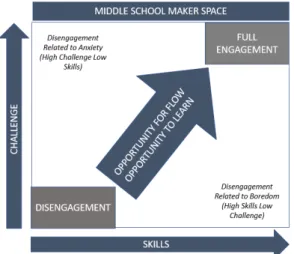
Figure 7: Flow theory illustration in terms of engagement in a learning environment ... 47
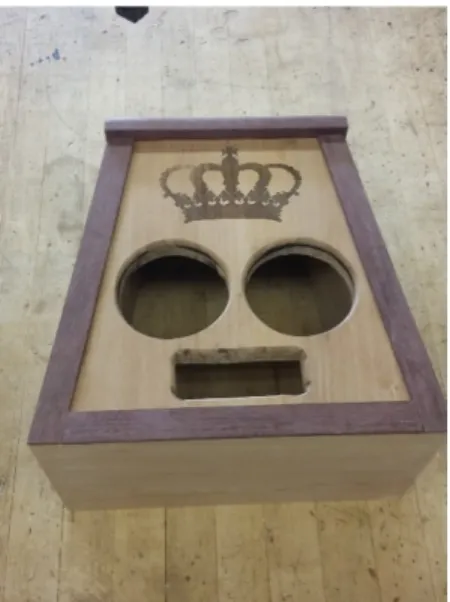
Figure 8. The Mission-Style Speaker Box created by Malia’s Group near completion. ... 72
Figure 9. The “Superhero Speaker Box” created by Nate’s Group near completion ... 76
Figure 10. The “Hexagonal Speaker-Box” created by Michael’s Group near completion ... 80
Figure 11. The “Simple Design Speaker-Box” created by Haylee’s Group near completion ... 83
1.0 INTRODUCTION TO THE STUDY
Dewey (1913) lamented that somewhere over the last century learning went from being an enjoyable, playful part of life to becoming drudgery. The industrialization of education mimicked the industrialization of the world during the late nineteenth and early twentieth century. At minimum, industrialization created parallels to the emerging education system in America and contributed to its social structure. Learning became work. Considering that learning has not always been synonymous with ‘work,’ it is worth investigating the essential components that contribute to learning.
This study looked at three aspects of the phenomenon of engagement as it supports learning: engagement as a function of play, as a function of flow, and engagement in the context of flow as described by middle school students in a Maker Space in a Southwestern Pennsylvania public school. The literature review that follows demonstrates that play, flow, and engagement share many common characteristics. Understanding how each of these concepts can contribute to learning in a way that enhances the overall experience of a student in the classroom could help educators and learners to understand what it means to experience joyful, meaningful learning through purposefully designed engagement.
1.1 DEFINITION OF TERMS
DREAM Factory- The Dream Factory is a maker lab located at Elizabeth Forward Middle School that encourages students to dream, create and make by providing the materials, tools and teachers to make dreams into reality. At the Dream Factory, students can learn robotics, engineering, design and programming with state of the art tools that they would not otherwise have access to, including laser cutters, 3D printers, microcontrollers and a functioning TV studio with green screen (Remake Learning, 2017).
Engagement- (or school engagement) is defined in three ways: behavioral engagement (consistency of effort), emotional engagement (students’ affect and emotions in schools, such as interest, boredom, anxiety), and cognitive engagement (involving investment in learning, depth of processing, and/or the use of self-regulated metacognitive strategies) (Shernoff, et.al., 2016).
Flow- Csikszentmihalyi and LeFevre (1989) refer to flow as the “optimal
experience”(Csikszentmihalyi & Lefevre, 1989). Moneta and Csikszentmihalyi (1996) define flow as a “psychological state in which the person feels simultaneously cognitively efficient, motivated, and happy.” ( p. 277)
Making- a class of activities focused on designing, building, modifying, and/or repurposing material objects for playful or useful ends, oriented toward making a “product” of some sort that can be used, interacted with, or demonstrated (Martin, 2015).
Maker Space-A space created for people to engage in complex, personally meaningful projects. Some examples of maker spaces include fablabs (fabrication labs) which house professional-grade hardware (Martinez and Stager, 2014).
Meaningful Engagement- “The engagement that appears to engender both dimensions of academic intensity (i.e. work-like engagement) and a positive emotional response (i.e., play like engagement).” (Shernoff, 2013, p.92)
Play- Play can be defined as a distinct sphere, an action, or a spirit or attitude. Play exists as unpredictable processes that occur within a relatively predictable form. Play is associated with freedom of creative expression and a respite from normal affairs of life (Henricks, 2008).
1.2 STATEMENT OF THE PROBLEM
A perpetual issue in schools is that some students in middle and high schools are disengaged and are dropping out. Archambault (2009) found in a recent study that one third of adolescents experienced disengagement during high school. She further emphasized this point in relating that “independently of behavioral disengagement, the risk that students withdraw before completing high school increases when they report disconnectedness on multiple facets of their school experience” (p.413). Shernoff (2016) spoke to the implications of dropout. “Dropping out of school diminishes their quality of life over a lifetime including but not limited to participation in drugs, alcohol, sex, crime, and delinquency (Steinberg et al., 1996; Shernoff, 2016).” Shernoff (2016) stated that “we constantly tell children to ‘do their best’ but for at least half of them their best is not clearly good enough…Thus, unhappiness and disengagement are actively created by the system” (p. 10). He further asserts that “youth appear to be more concerned with the actual
experience of classrooms as lacking in (a) meaningful challenges, (b) leading to competence building, (c) in relevant areas of life, (d) and in the context of supportive relationships (p. 10).” Therefore, engagement in learning becomes a challenge to the educator to counter student
disengagement and dropout. Educators need to understand the nature of engagement in learning to better understand how to motivate students to learn. Furthermore, the perspective that an individual takes on what it means to learn and to be engaged plays an important role in how engagement is interpreted. Each individual is unique and brings to the learning environment a unique set of skills and individual responses to challenges in the environment. This study allowed for a means to explore a non-traditional learning environment and attempts to understand from the perspective of the learner what it is that inspires them to engage in learning. Connecting the components of flow theory to first person experiences in engagement could provide a new perspective for how educators perceive the learning growth that occurs in each student.
1.3 PURPOSE
This study served three purposes. First, this study was designed to understand how students describe their engagement in learning within a Maker Space that is situated within a traditionally structured educational setting. Next, this study explored how students describe how they are engaged in similar experiences outside of a Maker Space learning environment including other classes in school and experiences outside of school. Finally, this study explored student engagement in the above contexts from the student perspective as observed through the lens of flow theory.
Shernoff (2016) equated student engagement to flow in that to achieve an ideal state of engagement it needs to be intrinsically meaningful and would include both characteristics associated with work and with play. This aspect of engagement serves to prevent disengagement and its negative consequences on learning. Three components of concentration, interest, and
enjoyment had greater influence in his most recent study. Flow researchers identified nine components of flow. This research included as evidence the presence of these nine components of flow (balance of challenges and skills, merging of action and awareness, clear goals, clear feedback, intense focus, paradox of control, loss of self-consciousness, autotelic experience, and loss of time) with an emphasis on balance of challenges and skills, clear goals, concentration on task, a sense of loss of time, interest, and enjoyment as principle indicators of the potential for flow to occur.
1.4 RESEARCH QUESTIONS
The research questions for the study were:
1. How do middle school students describe their experiences in the DREAM Factory?
a. How do the students describe this experience as being similar to or different than their experience in other classes?
b. How do students describe experience in the DREAM Factory compared to their experience in other similar activities in which s/he participates during her/his time away from school?
2. Do students’ self-reported experiences in the DREAM Factory, in other classes, or during an outside-of-school activity evidence engagement that aligns with elements of flow theory?
1.5 METHODOLOGY
The following exploratory study was an inquiry about how students describe engagement in a variety of activities using observations, a semi-structured teacher interview, and small focus group interviews. This study was embedded within a larger research initiative conducted by the University of Pittsburgh’s Collaborative for Evaluation and Assessment Capacity (CEAC). CEAC, in conjunction with the National Science Foundation (2017). The larger initiative is conducting an evaluative case study titled Making Success: Researching a School District’s Integration of the Maker Movement into its Middle and High School.
The site chosen for this exploratory study is significant. The ability to observe flow components in traditional classrooms is a challenge. Previous studies using various methods such as Experience Method Sampling (ESM), post-flow surveys, and interviews did not yield strong evidence of flow occurring for many students in a traditional classroom setting (Shernoff, 2013). Therefore, either all of the employed methodologies are flawed or the traditional school setting is one that does not often produce flow in the participants. Assuming the latter, it is worth investigating a non-traditional learning environment for behaviors that relate to flow components that may lead to a flow experience in the participants. As such, choosing a non-traditional learning environment that is exceptional in performance and well established could potentially yield more opportunities to observe behaviors that support the components of flow. The ability to find evidence of behaviors that support flow in an environment that approaches the ideal will provide insight into how to approach the future observation of similar behaviors in less than ideal learning environments.
Elizabeth-Forward school district with the help of the Grable Foundation and many other foundations developed a Maker Space program beginning in 2013. The program at
Elizabeth-Forward expanded to include both middle and high school levels. The DREAM Factory, at the middle school level, provides curriculum and maker environments for students to learn robotics, engineering, design, and programming with state of the art tools. All middle school students are enrolled in DREAM Factory. The only exceptions to enrollment are students who have schedule challenges due to some music courses. The success of the program at Elizabeth-Forward made it a regional hub for consultation to schools from surrounding counties (Remake Learning, 2017). This program receives national and international visits from educators who want to learn more about Remake Learning and how a functioning and established Maker Space works. If student behaviors that parallel flow components leading to meaningful engagement can be observed in a learning environment, then Elizabeth-Forward’s DREAM Factory may serve as the most viable exemplar available and accessible at this time. Furthermore, if disengaging behaviors present themselves, then these behaviors could be more easily identifiable as a contrast in this environment.
This exploratory study included four data source recommendations (Yin, 2009): interviews (focus groups), direct observations, documentation, and physical artifacts. Several observations of approximately one class period in length were conducted of a middle school classroom of approximately fourteen students in the DREAM Factory, an integrated maker space in the Elizabeth Forward Middle School. Two focus groups of six to eight students each, approximately thirty minutes in duration, were convened. Each focus group interview included questions to elicit responses that reflected the students’ experiences in the DREAM Factory and in other active engagement environments experienced by the participants. The researcher conducted teacher interviews with the teacher and student teacher who instructed the student participants in DREAM
Factory. The interview protocol intended to elicit responses that focus on student engagement and disengagement in terms of the nine flow components as observed and reported by the teacher.
The researcher coded data from observations and focus groups using a general inductive approach. “The purposes for using an inductive approach are to (1) condense extensive and varied raw text data into a brief summary format; (2) to establish clear links between the research objectives and the summary insights derived from the raw data and (3) to develop a model or theory about the underlying structure of experiences or processes which are evident in the raw data (Thomas, 2003).” The classroom observer coded data for nine flow components as outlined by Csikszentmihalyi (1990) including the balance of challenge to skill, merging of action and awareness, focus, control, feedback, goals, loss of self-consciousness, loss of time, and autotelic experience. Through coding, analysis identifies emerging themes. Classroom observations yielded evidence of student engagement and disengagement as recorded in the context of flow components for future use while conducting the focus groups.
This research chose to use focus groups instead of individual interviews of middle school students due to a distinct advantage focus group interviews provide. According to Breen (2007), focus groups are “far more appropriate for the generation of new ideas formed within a social context” (p. 466). Questioning techniques utilized during each focus group as outlined in Krueger’s categories as they appear in Breen (p. 471) helped to guide the process of gathering data of observed flow components during each focus group interview. Krueger (2002) also influenced the guidelines used for focus group design.
The focus group interviews allowed for further gathering of evidence of engagement and disengagement. These focus group interviews provided evidence as to how the student experience within the DREAM Factory environment compared to the student experience in other classrooms
and outside of school. The interview with the teacher (and student teacher) provided further insight to the engagement and disengagement behaviors of the students. The evidence gathered helped to better develop an understanding of patterns of behavior within the context of the DREAM Factory environment. Triangulation of coded data from the observations, the focus groups, and the teacher interview contributed to the development of insight as to the function of flow, engagement, and disengagement in the DREAM Factory. The researcher revised and refined the original category system by way of a general inductive approach to reduce overlap and redundancy towards the end of creating a new model (Thomas, 2003). Triangulation of the emerging data provided insight as to how students’ experiences within the DREAM Factory learning environment compare with their experiences in other classrooms and outside of the school setting.
1.6 SIGNIFICANCE OF THE STUDY
Dewey (1910) expanded on the understanding of engagement of children in the context of play. He stated that when children play they are creating “a world of meanings, a story of concepts (so fundamental to all intellectual achievement), is defined and built up” (p. 161). Play indicates the domination of activity by meanings or ideas. According to Dewey, playfulness is to be considered even greater than play as play is an attitude of mind, but playfulness is the outward manifestation of this attitude. Therefore, exploring engagement in learning as a function of play as outlined by Dewey merited investigation. One way to accomplish this goal was through the investigation of flow.
“Engagement is an important outcome of schooling in its own right. Mounting evidence suggest that engagement is a vital protective factor and leads to a host of positive educational and social outcomes and decreases in negative emotions and behaviors (Shernoff, 2013, p.10).” Drawing conclusions from previous research conducted by Steinberg et al. (1996) Shernoff concluded that disengagement in “students who are withdrawn from school are far more likely to have psychological problems ranging from depression and aggression to participation in drugs, alcohol, sex, crime, and delinquency” (p.11). Student engagement is necessary for learning in that it is a psychological investment in, and an effort directed toward, learning. Play, flow, and engagement have distinct overlaps in components and function. Flow acts as a nexus between the concept of play and the structure of engagement as it supports learning. The literature review that follows further explored this connection. Considering the overlap in components and functions among play, flow, and engagement this research recognized that flow is an aspect of play. Csikszentmihalyi (1975) explained that “games are obvious flow activities, and play is the flow experience par excellence” (p.37). He further states that “by studying play one might learn how work can be made enjoyable, as in certain cases it clearly is” (p.5). Play can be understood as a foundation for understanding flow, and therefore, the lens through which the understanding of engagement in terms of flow is generated. There is value in viewing classroom interactions through the lens of play as a means to understanding the importance enjoyment plays in the learning process. Even negative and non-productive interactions can be explained as a function of ‘play going wrong’ with characteristics of non-productive engagement or disengagement (Eberle 2014). The literature review that follows explains how flow, as a function of play, can also explain interactions that lead to anxiety, boredom, or complacency and a move away from positive engagement.
Student interactions (with each other and with the learning environment) can seem like play to them. However, this type of engagement where learning is enjoyable is rarely the case in U.S. public school classrooms (Shinn and Yoshikawa, 2008). Shernoff (2013) found from a 2010 study that “on average, high school students were less engaged while in pubic classrooms than they were elsewhere” (p.83). He further suggested that “enjoyment is the key element missing form life in classrooms that makes flow and engagement so rare” (p.83). His conclusions also suggest that even where concentration and interest may be high in a given classroom, the one component that measured below average was enjoyment.
This study explored the interactions of students in a learning environment observing if these interactions reflected play, engagement that supports learning that may lead to flow experiences (an optimal experience), or somewhere in the range between these two extremes.
1.7 BACKGROUND OF THE PROBLEM
The following study illustrated that play, flow, and engagement are all individualistic in nature. This study extracted from the most recent research on the concepts of play, flow theory, and engagement to develop an understanding where the interplay of these three concepts create a cohesive insight into the world of learning and engagement. Nonetheless, all three share commonalities that are universal in experience. Even with recognizing the components, characteristics, and processes associated with play, flow, and engagement, recognition itself does not complete the understanding of the nature of either play or flow, nor how each relates to engagement. Identifying what play and flow are not is equally important to understanding both
concepts in order to find connections to engagement that supports learning. The next chapter also sets parameters to illustrate what constitutes play and flow and what does not.
Research on flow indicates that there are many specific challenges to recognizing the degree to which flow manifests itself in an individual. Learning aspects such as the balance between skills and challenges (Shernoff, Csikszentmihalyi, & Schneider, 2003), the perception of difficulty (Baumann & Scheffer, 2010), mood, level of interest (Schiefele, 1991), increased engagement, motivation (Schaik, Martin, & Vallance, 2012), locus of control (Keller & Blomann, 2008), the correlation between motivation and achievement (Nystrand & Gamoran,1992), and if the person is ‘action-oriented’ or not determine the viability of a flow experience (Keller & Bless, 2007). Research also suggests that while the psychological features of optimal experience (flow) and the other extreme, apathy, appear to be universal across cultures, emotional experiences such as what is regarded as ‘happy’, fluctuates in intensity among cultures (Delle Fave & Massimini, 2005).
It is also important to understand the perspective on engagement as it relates to learning in the context of the approach to education in schools for this research. This research countered the industrial approach to education where learning environments and subsequent engagement within these learning environments are founded in the concept of producing student output as a result of variations of contributors of input of information. Traditional schools measure learning growth through testing content knowledge using a variety of assessments such as in-class teacher or textbook created pencil and paper assessments or standardized assessments from which multiple year results statistically calculate learning growth. Dewey (1937;1946) explained that the means to which traditional schools address skill acquisition and knowledge presents a danger of depriving students of purpose, meaning, and vibrancy when learning does not occur within a useful context.
The following study explored engagement in a learning environment where learning is constructed. Natural curiosity leads someone to want to grow, and subsequently to engage. Engagement in the context of flow theory occurs when the participant is challenged at a level that is relatively balanced with the skills s/he perceives to possesses at that time (Moneta & Csikszentmihalyi, 1996). As a result, growth may occur in the context of the skill on which the learner is challenged. Many other factors are involved in providing an environment that is conducive for growth to occur. The aspect of observing engagement in a non-traditional learning environment takes on greater importance with the increase in learning environments such as maker spaces in public middle and high schools. There exists a lack of clear understanding how engagement is measurable in these learning environments and if this engagement is meaningful engagement. The next chapter illuminates the connections between play and flow as well as how flow as an aspect of play can function as a means to observe engagement that leads to learning in a maker space learning environment.
Flow is a complex and multi-faceted phenomenon. It appears to be a facet of play that unlike play is able to be quantified enough to evaluate its presence or absence and degree of intensity. A flow experience can occur in many environments and contexts, but is subject to the individual experiencing flow. Flow occurs in learning environments and is closely associated with engagement and subsequently has strong potential to enhance learning. Observing the presence of flow in a traditional classroom is challenging in that findings from previous studies suggest that enjoyment is the key element absent in this type of environment that makes finding flow and engagement a rare occurrence (Shernoff, 2013). Nevertheless, if flow can be observed in a learning setting, there is greater likelihood that it would be found in a learning environment that provides the conditions for flow such as Elizabeth-Forward’s DREAM Factory.
1.8 SUMMARY
Engagement in a learning environment is complex and is comprised of many factors. Deconstructing engagement in a learning environment in terms of contributing components and processes can vary depending on the underlying perspective adopted by the observer. Education in the United States over the last several decades manifested itself as a mirror to industry in purpose and design. Learning in schools became work diverging from a previous conception of learning that included a sense of play or enjoyment. A resurgence of constructivism in learning and education during the last decade inspired the development of unconventional learning spaces such as maker spaces through the maker movement.
Flow theory proposes that when nine components are in place when a participant is actively engaged where there exists a balance between the participant’s perceived skills and the challenges being presented, the participant can potentially experience flow, or an optimal experience— “optimal experience” implies that the participant is functioning at the highest point of performance capable for him/her at that skill (Moneta, 2012). Growth occurs as a result of the prior skill set meeting and successfully completing the challenge.
Flow is an aspect of play. Play theory, like flow theory, is composed of essential components, processes, and characteristics. Play fractal theory contends that patterns of play repeat over time and increase in complexity. Flow experiences parallel this pattern of behavior where higher states of flow increase the likelihood of future flow experiences. In this sense, both play and flow share commonalities with engagement.
In conclusion, researchers study flow, play, and engagement to better understand the nature of each concept. Flow is an aspect of play reinforces the idea of the existence of commonalities between the two concepts. Engagement that leads to learning has traditionally been studied through
the lens of a traditional, industry-influenced educational system. Engagement that leads to learning as observed in a non-traditional learning environment requires a new approach. Flow provides the observer with the ability to perceive growth through engagement where skills are in balance with challenges. Other factors such as a sense of control over the process (autonomy), a loss of sense of time, immediate feedback from the environment, interest, and enjoyment serve to further support growth. Ideally, a learning environment where the learner constructs learning would provide opportunities to observe for the presence of flow as engagement that leads to learning. Therefore, observing for flow components in a learning environment such as a maker space becomes the first step to developing an understanding of what potential instruments can be used to better understand engagement as it supports learning in most learning environments.
2.0 PLAY: A FOUNDATION FOR FLOW AND ENGAGEMENT
Flow, as described by Mihaly Csikszentmihalyi (1990), is “optimal experience”. Csikszentmihalyi provides many broad examples as to when flow can occur that are related to play experiences such as playing chess, rock climbing, and sculpting. He also provides many examples of flow that are not traditionally considered play experiences such as experiences that would occur in a work situation or while learning a new skill. Flow is universal, and yet, is individual. Anyone can experience flow in innumerable experiences and contexts but each individual’s flow experience is unique in its composition. Flow becomes an aspect of all constructs of social life and serves as a model for successful culture. If flow occurs in nearly every social context, further explanation is required to ascertain how flow is considered to be an aspect play.
Csikszentmihalyi (1990) said it best when he stated, “When culture succeeds in evolving a set of goals and rules so compelling and so well matched to the skills of the population that its members are able to experience flow with unusual frequency and intensity, the analogy between games and cultures is even closer. In such a case we can say that the culture as a whole becomes a ‘great game’” (p. 81).
Schrank (2010), a game designer and theorist, explained the concept of flow as play by connecting Csikszentmihalyi’s concept of life as a ‘great game’. This belief can be imagined where reality is essentially a simulation. The universe, in this sense, becomes a giant computer with
multiple networks designed to play the great game of life. All of our interactions in this great game become a means to train us to playfully function in reality. In essence, we are all part of a simulation game and everything we do becomes play. This study proposes the idea that consideration be given to view all interactions as a form of play. Assuming this point of view provides a unique perspective on engagement as observed through flow theory.
The sections that follow will systematically deconstruct play and flow in order to provide a clear understanding of how play and flow are related and the role each plays in engagement. The understanding of the components, characteristics, and processes related to play and flow is essential for the development of a model that encapsulates the complexity of the roles flow and play have in engagement when applied to the context of a learning environment.
2.1 FIVE CHARACTERISTICS OF PLAY
The most recent deconstruction of play consolidates the many approaches to define the characteristics of play into five basic qualities. The intent was to more easily identify the attributes of play for the purpose of using them as criteria that can be applied as standards for play. The qualities are as follows: (1) play is purposeless (2) voluntary (3) outside of the ordinary (4) fun, and (5) focused by rules (Eberle, 2014, p. 215). A cross-comparison of the qualities of play with characteristics and elements of play proposed by various theorists yields the elimination of duplications within the other theorists’ lists and provides a more succinct and global definition for some characteristics. The qualities of play also strip the definitions of identifiers that would be specific to a particular field of study. This is not to say that the qualities of play definitions
supersede other definitions. Rather, clarification and context can be discerned with greater specificity through referencing other theorists’ definitions of play (Eberle, 2014).
2.2 THE PLAY PROCESS
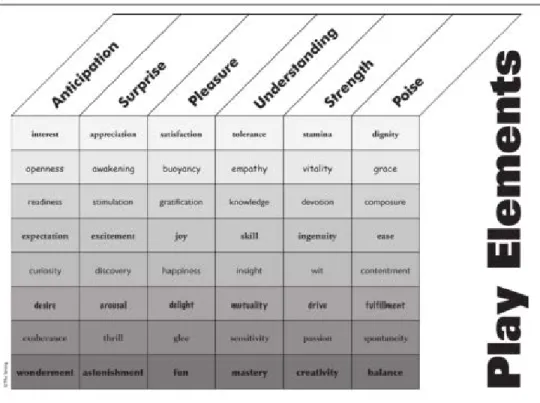
One voiced concern is that in most research on play there exists an absence of the accounting for the movement, change and process of play (Eberle, 2010). The disposition of the player and how s/he connects to the environment around him/her impacts the play experience in process. The person experiences aspects of play from the point where play is initiated (anticipation) to the conclusion of an episode of play (poise). In anticipation of play interest narrows and the mind focuses. Anticipation gives way to surprise as something incongruous or novel happens. In this way, anticipation functioning as curiosity leads to the pleasure of discovery. Pleasure acts as incentive to continue play and leads to understanding. Understanding in this sense can mean increased appreciation of others, increased knowledge, greater sensitivity, and other insights that give way to making play more enjoyable. Understanding builds strength in the player by increasing mental, physical, or social capabilities. When a player reaches this point of play he is rewarded with a sense that he is prepared for anything. He senses balance and a perception of the suspension of the passage of time. This last element is defined as poise (see Figure 1):
Figure 1. Play Elements. Reprinted from Eberle, S. (2014). “The Elements of Play: Toward a Philosophy and a Definition of Play,” by S. Eberle, 2014, American Journal of Play, 6(2), p.221. Copyright 2014 by The Strong. Reprinted with permission.
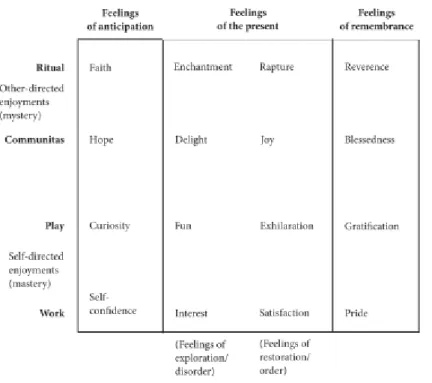
Play can be defined as one of four fundamental forms of human activity. The other three basic human activities are ritual, work, and communitas. The function of ritual can be understood in this sense as a means to rely on guiding forms, learning from obligations to otherness. Work is exemplified as the effective and efficient practice of goal-centered employment. Communitas is the concept of the realization of the possibilities of mutual support through connections to the world. Separating play from the other three basic human activities, and considering the previously mentioned elements of the process of play (Eberle, 2014) a pattern emerges. The process of play exposes an underlying deconstruction of meaning, a reordering, and a later reconstitution of
to all four fundamental activities (ritual, work, communitas, and play). In this light as it relates to play, a transformation occurs where players form, de-form, and re-form circumstances through identification, confrontation, and manipulation of the elements of their world at their own choosing. In this manner, play as a self-directed enjoyment begins with anticipatory curiosity, moves to fun as the unknown deconstructs meaning. Fun progresses to exhilaration when meaning is reconstructed and order restored while in play. Finally, play culminates in the feeling of gratification on reflection of play (see Figure 2) (Henricks, 2008, p. 176; Henricks, 2015b, p. 274):
Figure 2: Four sequences of positive emotions. Reprinted from “Play as Experience,” by T.S.Henricks, 2015,
2.3 PLAY AND NON-PLAY
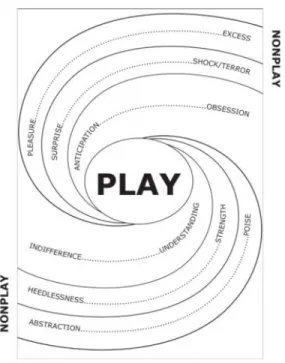
To understand play it is important to note what play is not. Physiological indicators of what is and is not play can be discerned among players through facial expressions and gestures (Goffman, 1974). Physiological indicators are not the only means to discern play from non-play. Taking into consideration the five qualities of play (Eberle, 2014), play would need to adhere to all of the following parameters (1) play is purposeless (2) voluntary (3) outside of the ordinary (4) fun, and (5) focused by rules. Deconstructing play in another way provides insight by employing the previously outlined elements of the play process of anticipation through poise (p. 220). Play turns into something different when one of the five qualities of play is missing or one of the elements of play is taken to the extreme. Eberle summarizes succinctly with the words “too much of a good thing becomes a bad thing” (p. 227). For example, a bully may be having fun (the fourth quality of play), but it is fun taken to the extreme of cruelty and therefore is not play. Furthermore, the person who during a normal play experience would take pleasure in a pleasant surprise (the second element of the play process) would experience shock at being bullied. What a person experiences at the extreme of the range of each element as play as spins out of control and morphs into something completely foreign to play.
Eberle (2014) defines six qualities of play that occur when the fundamental elements of play are all present: anticipation, surprise, pleasure, understanding, strength, and poise. Each of these qualities exist and progress through the play process unless, as mentioned previously, something is introduced into the play process that morphs each of these qualities into the antithesis of play. A player can have anticipation of play, but can also become obsessed. A surprise if not received in good fun can become a shock or even terror if taken to an extreme. Pleasure at play
Likewise, understanding becomes indifference possibly due to desensitization from overexposure. Strength becomes heedlessness when empathy diminishes or the love of power becomes consuming. And, finally, poise becomes abstraction distorting the essence of play (see Figure 3).
Figure 3. Play and Nonplay. Reprinted from “The Elements of Play: Toward a Philosophy and a Definition of Play,” by S. Eberle, 2014, American Journal of Play, 6(2), p.230. Copyright 2014 by The Strong. Reprinted with permission.
2.4 DEFINING FLOW
Mihalyi Csikszentmihalyi, the Hungarian born psychologist, is considered to be the leading researcher and primary architect of Flow Theory. He first introduces the structure of Flow Theory in his work Beyond Anxiety and Boredom (1975). Research conducted since that time maintains the essential meaning behind his theory with minor variations on the same theme. What is Flow?
Csikszentmihalyi and LeFevre (1989) refer to flow as the “optimal experience”(Csikszentmihalyi & Lefevre, 1989). Moneta and Csikszentmihalyi (1996) define flow as a “psychological state in which the person feels simultaneously cognitively efficient, motivated, and happy” (Moneta & Csikszentmihalyi, 1996, p. 277). Csikszentmihalyi (2014) began his research during the 1970’s by interviewing approximately 100 people who participated in activities such as dance, music, and art. He chose these people because it intrigued him as to why they would expend so much energy and time on activities that would not likely yield rewards such as money and status. He discovered through those interviews what he called the flow experience, an experience that you enjoy so much that you want to do it for its own sake (p. 132). Since his original research in the 1970’s, flow experiences have been observed in nearly every imaginable daily experience and to have been experienced by every demographic. The flow experience is nearly identical in description regardless if the person experiencing flow is an artist, scientist, athlete, affluent, destitute, male, female, young, old, or from any country or culture in the world (Csikszentmihalyi, 1996, pp. 111-112).
2.5 EXAMPLES OF FLOW IN WORK, PLAY, AND DAILY ACTIVITIES
The universal experience of flow does not intend to imply that everyone who experiences flow does so in the same way and under the same conditions. Flow is a subjective experience in that there are many underlying factors that contribute to the flow experience that vary from individual to individual. Moneta and Csikszentmihalyi (1996) point out that flow theory proposes a “space” for optimal experience to occur. Yet, the experience is constructed on the participant’s perception of his own skills and his own perception of his ability to meet the immediate challenges of the
activity (p. 282). Considering that flow experiences are subjective and vary in context from sports, to the arts, to daily activities, to work, to any other activity, one might assume that the flow experience is more often associated with activities grounded in leisure. To the contrary, when average adults were studied flow experiences predominantly manifested from work conditions rather than leisure (64% and 47% of the time for managers and workers, respectively) (Csikszentmihalyi, 2014, p. 164). Csikszentmihalyi (2014) describes this essential focus of the flow experience as the opposite of psychic entropy. Psychic entropy is “a state of disorder in the self-system that results in decreased efficiency of that system” (p. 157). Allocation of attention in too many directions at once or pointing attention inward creates disharmony and conflict. In flow, a person experiences the opposite effect of psychic negentropy. Psychic negentropy is “a condition in which the information processed in consciousness does not conflict with other information available to the self. The self-system is in harmony, and no attention needs to be allocated to its internal functioning” (p. 157). Finally, in addressing an understanding of flow, in general, LeFevre and Csikszentmihalyi (1989) state three predictions that come out of the flow model: “(a) flow can be experienced in a variety of situations, including work; (b) people differ greatly in terms of where and how often they experience flow; and (c) those who experience flow more often, regardless of context, are more involved and more satisfied with their lives” (p. 820).
2.6 COMPONENTS OF FLOW
Moneta (2012) qualifies the nine components of flow as “correlated dimensions of the flow construct that can trade off in determining the intensity or level of flow” (p. 41). He further explains that the variations in intensity among the nine components of flow where some components are
stronger than others will produce a flow state that “will be overall less intense, complex, and ordered than the ideal flow state” (p. 41).
Synopses of each of the nine components of the flow experience are expanded below. It is worth noting that Czikszentmihalyi (1990) originally defined them as “elements of enjoyment” (adapted from Czikszentmihalyi, 1990, pp. 49-72):
2.6.1 A Balance of Challenges and Skills
A person needs to have the fundamental skills associated with the activity to be able to enjoy an activity. This holds true whether the skill is physical skill or mental skill. When a person’s skills are challenged as in a competition (mental or physical), a person finds enjoyment approximating an optimal experience from the honing of his own skills. Czikszentmihalyi (1990) indicates that enjoyment decreases when the participant focus shifts to beating the challenger as opposed to honing his own skills. He further states that “enjoyment appears at the boundary between boredom and anxiety, when challenges are just balanced with the person’s capacity to act” (p. 52). The design of many subsequent studies to better understand the flow (a.k.a. optimal experience) base their research on the balance of skills and challenges.
2.6.2 The Merging of Action and Awareness
When in a situation with multiple people talking, a person is biologically incapable of processing all of the stimuli simultaneously impacting his brain. This limitation forces the individual to screen out stimuli to focus on what is important to them at that moment. As a result, he is incapable of understanding more than two people at a time. As this relates to the flow experience: When a
person is engaged in the process of creating something new such as approaching an optimal experience, he has no attention left over to focus on the needs of self. Therefore, he becomes part of what is happening around him, and action and awareness merge (Csikszentmihalyi, 2004, p. 44). The participant is not aware he is separate from the actions around him and actions become spontaneous (Csikszentmihalyi, 1990, p. 53).
2.6.3 Goals
To experience flow, the participant needs to have an understanding for himself what his goals are in participating in the activity in order to determine what his next move will be and to develop a strategy for reaching his goal. This goal can be apparent or not and sometimes can be negotiated in the moment as occurs with players in a game (p. 56).
2.6.4 Feedback
It is impossible to experience flow unless the participant has an internal understanding of what works and what does not work in the context of the activity. The kind of feedback is not necessarily important. Rather, the importance lies in the message it contains in order to make the participant feel success in achieving his goal. Feedback in this sense can come from a wide range of information during the flow experience such as hitting a tennis ball between the white lines or immobilizing the enemy king on a chessboard. What is of value is that the feedback be “logically related to a goal in which one has invested psychic energy” (p. 57).
2.6.5 Focus
One of the reasons that flow contributes to the quality of an activity is concentration. “Clearly structured demands of the activity impose order, and exclude the interference of disorder in consciousness” (p. 58). Once a participant enters into a mental state of concentration, all of the cares of the world begin to disappear due to the limited capability of the mind to focus on too many concerns at once. The activity then becomes a world unto itself and begins to appear to the participant as though it is his total world (p.59).
2.6.6 The Paradox of Control
The paradox of control implied by Csikszentmihalyi (1990) means that while a person may feel a lack of control over daily experiences in ordinary life, the relative perception of control during an activity approaching a flow state becomes the antithesis of this state of mind. Rather than worrying about mistakes and failure, the participant develops a sense of control, or the “lacking [of] the sense of worry about losing control that is typical in many situations of normal life” (p. 59). Csikszentmihalyi clarifies that this sense of control is the participant’s perception of calmness and of the possibility of being in control, not what necessarily happens in actuality. Anyone participating in a risk-taking activity (whether it be a chess championship or hang gliding) is in essence taking the risk of actual loss of control through defeat, mistake, or injury (p. 60).
2.6.7 Loss of Self-Consciousness
It is not uncommon for a person to have normally occurring preoccupations based in personal vulnerability many times during the course of the day. Self-scrutiny occurs as a self-protection mechanism to protect the psyche against threats no matter how trivial the threats may be. These preoccupations consume a lot of psychic energy. During a flow experience, the absence of the self occurs as a loss of self-consciousness. This absence of self intensifies the experience as the participant becomes hyper-focused on the experience itself. Csikszentmihalyi (1990) indicates that a paradox occurs relative to the loss of self-consciousness in that on completion of the activity and self-consciousness returns, the participant on reflection has become transcended by the experience with an improved self-concept (p. 65-66).
2.6.8 Distortion of the Perception of Time
The perceived passage of time during a flow experience does not correlate to conventional time. Sequences of events, a hyper-focus on elements of time (such as the time allotted for a chess move or the counting of passing minutes and seconds for a long-distance runner), or the necessary focus on multiple aspects of a task at once are examples that would distort the perception of the conventional passage of time for someone experiencing flow. Csikszentmihalyi (1990) posits that while in the state of flow, the loss of the sense of passage of time is liberating and contributes to the elation experienced during flow (p. 67).
2.6.9 Autotelic Experience
The autotelic (Greek: “self-goal”) experience is described as an experience that is an end in itself. Csikszentmihalyi (1990) describes experiences in general as being primarily a combination of autotelic and exotelic experiences. Exotelic experiences are ones that are essentially done for external reasons such as receiving a monetary reward. Autotelic experiences are based in intrinsic motivation. An autotelic experience is one where life is lifted to a different level from what is experienced day to day. It is accompanied by involvement, enjoyment, control, and a reinforced sense of self. It is an experience that is not held to future reward. It generally consists of exploring new opportunities utilizing the skills available to the participant (p. 68).
The nine components of the flow experience: balance, merging, focus, control, feedback, goals, loss of self-consciousness, loss of time, and autotelic have appeared in most of the studies reviewed to date from their first appearance in 1990. Taken as individual components, each of the above conditions could explain many kinds of experiences not related to flow. This assumption can also be made for any combination of individual components related to flow. As an example, someone could be very goal-oriented and highly focused in an emergency situation yet feel incredible anxiety and out of control which would not be indicative of a flow experience. Engeser and Scheipe-Tiska (2012) conclude that “flow cannot be reduced to a single component, and all attempts to take one component of flow as the definitional aspect of flow will consequently disregard essential parts” (p. 4).
2.7 MODELS OF FLOW
The study of flow theory during the last forty years inspired at least five models of the flow experience. Moneta (2012) consolidated previous research that employed each of the following models and explained through the use of graphical representations the development of flow theory from its inspiration to the present. A summary of three of these models will provide an understanding of the nature of flow theory and how it has been studied and presented in the literature. The models will include: a) Csikszentmihalyi’s first model, b) the absolute difference regression model, and c) the hypothetical hybrid componential model. The quadrant and octagonal models are worth mentioning as they were designed on the premise of the observation of multiple flow experiences, but will not be the focus in this study. Both of these models represent flow as a function of a balance between skills and challenges and divide z-score results of multiple flow observations into four and eight quadrants respectively representing flow, anxiety, boredom, and apathy (or the addition of worry, arousal, control, and relaxation in the octagonal model).
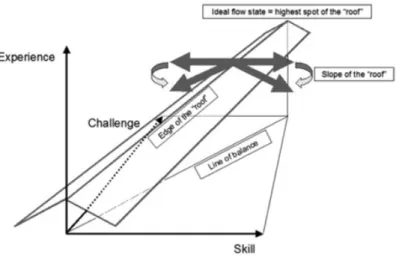
The First Model: Csikszentmihalyi (1975/2000) observed that experiencing flow is dependent upon the balance between two variables: the skills the participant brings into the action and the degree of challenge the participant meets while in the moment of action. Skill is represented on the x-axis of a Cartesian map while Challenge is represented by the y-axis. Flow occurs when there is adequate skill to meet the challenge. The impact of having an imbalance between skill and challenge is as follows: If the challenge of the activity is beyond skill level, then the participant experiences worry (increased self-consciousness) followed by anxiety. The result is the participant begins to lose the experience of one or more of the components of flow such as a sense of control and falls out of flow. When skills exceed challenges, the participant becomes bored, loses one or more of the component experiences of flow such as becoming acutely aware
of the passage of time (the opposite of “loss of time”), and falls out of flow (Nakamura and Csikszentmihalyi, 2001, p.90). He might then experience anxiety and try to seek out challenges to regain the flow experience. Maintaining the flow experience as represented by the Cartesian map appears as a diagonal channel that moves from bottom-left of low challenge and low skill to the upper right of high challenge and high skill. In terms of the previously mentioned dichotomy of entropy and negentropy, a stronger degree of flow with greater complexity and order would be movement toward negentropy. Whereas, a lower, less complex degree of flow would be movement toward disorder, or entropy (see Figure 4) (Moneta 2012; Csikszentmihalyi 1975/2000):
Figure 4. Skills-Challenge Balance to determine flow. Reprinted from On the Measurement and Conceptualization of Flow (p.26) by G.B. Moneta in Historical Lines and an Overview of Current Research on Flow, S.Engeser and A. Shipe-Tiska (Ed.), 2012, New York, NY: Springer. Copyright 2012 by Springer. Reprinted with permission.
Moneta and Csikszentmihalyi (1999) explored an idea based on Csikszentmihalyi’s previous conclusions regarding the connection between the skills/challenge balance and flow. Csikszentmihalyi (1975) concluded that flow experiences can occur whether the balance of skills to the challenge reflects high skills and high challenge or if the balance reflects medium skills and
medium challenges. This observance generated the question as to if there exists a range of intensity of the flow experience as it would correlate to the intensity of the skills/challenge balance. In other words, does a balance of high skills/high challenge equate to a more intense experience of flow (Moneta and Csikszentmihalyi, 1999, p. 631)? As a result, the following model was developed with a visual representation (Moneta 2012):
Figure 5: Absolute Difference Regression Model. Reprinted from On the Measurement and Conceptualization of Flow (p.38) by G.B. Moneta in Historical Lines and an Overview of Current Research on Flow, S.Engeser and A. Shipe-Tiska (Ed.), 2012, New York, NY: Springer. Copyright 2012 by Springer. Reprinted with permission.
The Absolute Difference Regression Model shown above utilizes the skills/challenge balance as a foundational starting point for determining the existence of flow as did the previous models. The increase of skills is represented along the x-axis and the increase of challenge is represented along the y-axis. The difference this model represents compared to previous models is that it changes the perception of the nature of the flow experience from a static representation to a dynamic process. This change is manifested through the introduction of the dimension of subjective experience as represented along the z-axis. Subjective experience has many facets and can be defined in many ways. Massimini and Csikszentmihalyi (1987) employed examples of
subjective experiences as part of the development of the previous model. Examples of the subjective experiences identified for the 1987 study included concentration, control, alert, happy, cheerful, strong, friendly, active, sociable, involved, free, excited, open, clear, etc. (p. 547). Moneta and Csikszentmihalyi (1999) focused primarily on subjective experience through the lens of concentration, interest in the activity, enjoyment of the activity, or happiness to develop the above absolute difference regression model (Moneta, 2012, p. 39).
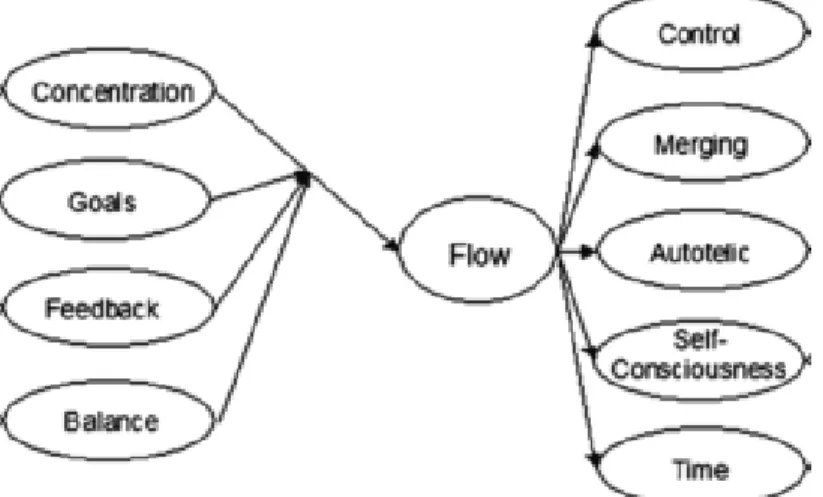
The componential model utilizes the nine components of flow as a basis to increase the understanding of the nature of flow. This model, a more psychometrically sound model employed by Marsh and Jackson (1996) and Jackson and Csikszentmihalyi (1999), resulted in the creation of two sets of questionnaires in order to provide insight into flow as a state and flow as a trait. Flow as a state is indicative of observing all of the components of flow as they are occurring approximating their highest state. Flow as a trait is indicative tendency of flow that occurs frequently and intensely over a range of situations. Moneta (2012) explains the componential model to measure each state or trait as an individual component contributing to behavior as a multi-faceted construct and as a single factor construct designed by Jackson and Eklund (2002, 2004) (Moneta, 2012, p. 42). Moneta (2012) suggests a hybrid componential model (shown below) that identifies from the nine flow components antecedents to flow and separates them from facets of flow. He posits that a path exists from concentration to flow that is moderated by goals, feedback and balance. Once in the state of flow, facets of flow emerge to various degrees including control, merging of action, autotelic experience, loss of self-consciousness, and the loss of time (p.44).
Figure 6: Hybrid Componential Model. Adapted from On the Measurement and Conceptualization of Flow (p.44) by G.B. Moneta in Historical Lines and an Overview of Current Research on Flow, S.Engeser and A. Shipe-Tiska (Ed.), 2012, New York, NY: Springer. Copyright 2012 by Springer. Reprinted with permission.
Moneta (2012) supports the conclusion that this model is the most psychometrically sound with the fact that this method has good construct and content validity and has generated measurement methods for the intensity of flow. All of the models of flow are designed to provide insight to the abstract concept of flow, and each serve to increase the understanding of flow through different lenses (p. 48).
2.8 FLOW AND ENGAGEMENT
There are many proposed models of student engagement. A recent model (Fredricks in Zimmer, 2012) outlines four components to contribute to student engagement: academic, social, cognitive, and affective. Zimmer found that not only is there an importance of engagement/disengagement to learning, research shows that without intervention behavioral and academic risk progress
simultaneously as students progress to higher grade levels. Furthermore, engagement can protect students from harm that may accrue (p. 107). Disengagement is attributed to students who do not actively participate, who are not cognitively involved, who have little sense of belonging, and who practice counterproductive behavior. Ocumpaugh et.al. (2016) characterize disengaged student behaviors as boredom, confusion, frustration, carelessness (careless errors; student possesses knowledge but answers incorrectly), gaming the system (intent to succeed without learning), and off-task behaviors. Disengaged students, due to various contributing factors, risk a cascade of a process of disengagement that leads to dropping out of school (p. 99). Exploring novel and effective means for educators to identify and monitor engagement of students in classrooms as it supports learning is critical.
The perception of engagement and disengagement in a learning environment as an all or nothing proposition would be short-sighted. As proposed earlier with play theory, engagement possesses both characteristics and at the same time can be perceived as a process unfolding and fluctuating in intensity over a period of observation. The challenge becomes the ability to observe both the characteristics and the process of engagement in a given environment. A further complication to this challenge is finding a means to adequately represent engagement in a measurable way as it would lead to learning. Flow theory provides the necessary building blocks to design a study that will satisfy these challenges.
2.9 PLAY, FLOW, AND ENGAGEMENT IN A MAKER SPACE
A review of the literature revealed insight to play, flow, and engagement contributing to a comprehensive and thorough understanding of the components and mechanisms of each.
Csikszentmihalyi (1990) described flow, an aspect of play, as a means for culture to play out a ‘great game’ of life manifesting flow experiences with frequency. Schrank (2010) connected Csikszentmihalyi’s ‘great game’ to proceduralism describing the concept as though everything we do in a culture essentially equates to a virtual reality game. Employing this concept of reality in the context of a learning environment, one can draw many parallels. Schooling in many ways intends for the participants to ‘practice’ in preparation for ‘real world’ experiences. Students are preparing for future academic and social challenges and interactions as they learn concepts and develop skills, practicing them in a simulated environment, that will help them to become fully functioning adults and positive contributors to society. Schools, and learning environments within and outside of school, become the virtual reality for the game of life where students play out their roles in hope of mastering new levels of academic and social success.
This literature review outlined previous models of play and flow that delineated individual components and characteristics of each that lead to play and flow. This review also identified through previous research the processes of play and flow in action. The challenge to previous research is to conceptualize models of play and flow that reflect both components and processes.
Previous research that utilizes flow models as a means to discover occurrences of flow in a classroom setting have had mixed results. Traditional classroom settings based in a didactic approach modeled after industry do not provide learning environments that yield strong results. Education researchers over the last decade began a resurgence of constructivism in education. The maker movement is an example of constructivism in action. Maker spaces are becoming the norm for many communities and base their approach to learning in the problem-solving and critical thinking skill development often associated with constructivism. The next section of this study proposes a qualitative exploratory study that uses a maker space that is embedded in a public
middle school program as the primary study site to look for reported evidence of engagement that leads to learning as observed in the context of flow.