year longitudinal study
Stefanie Habermann
Thesis submitted for a PhD qualification
Supervisors: Prof. Chris Donlan Prof. Charles Hulme Dr Alexandra Perovic
UCL, UK
Department of Psychology and Language Sciences
2
Author’s Declaration
I, Stefanie Habermann confirm that the work presented in this thesis is my own. Where information has been derived from other sources, I confirm that this has been indicated in the thesis. This research was supported by an Economic and Social Research Council (ESRC) studentship awarded to the candidate.
Selected aspects of the research have been presented elsewhere:
Habermann, S., Donlan, C., Göbel, S. and Hulme, C. Pre-school predictors of early arithmetic skills: a two year longitudinal study. In preparation.
Habermann, S., Donlan, C., Göbel, S. and Hulme, C. (2017, February). Pre-school Predictors of 6 Year Olds’ Arithmetic Skills: The Importance of Knowing Your Numbers. Poster presented at the Royal Society scientific meeting ‘The origins of numerical abilities’, London, UK.
Habermann, S., Donlan, C., Göbel, S. and Hulme, C. The Importance of Pre-school Transcoding Skills in the Development of Arithmetic. Oral presentation at Experimental Psychology Society Annual Meeting, London, UK, 5th January, 2017.
Habermann, S., Donlan, C., Göbel, S. and Hulme, C. (2016, September). Pre-school Predictors of 6 Year Olds’ Arithmetic Skills: The Importance of Knowing Your Numbers. Poster presented at the ‘Domain-General and Domain-Specific Foundation of Numerical and Arithmetic Processing’ workshop, Tübingen, Germany.
Some of the research presented here was conducted in collaboration with others: The research in Chapter 4 and 5 was aided by Kate Murray who collected the data at Time 4 as part of her BSc Psychology and Language Sciences dissertation project.
The magnitude comparison tasks used in this thesis were initially developed by Sarah Watson in her PhD project led by Silke Göbel.
3
Abstract
The purpose of this thesis was to examine longitudinal predictors of children’s early arithmetic abilities with a particular focus on the relation to the approximate number system (ANS), language and numeracy skills as well as
background measures of cognitive abilities. This longitudinal study assessed children five times over a 25-month period beginning in nursery classes and continuing to the end of Year One (the first complete year of formal schooling). The thesis
investigated the concurrent and longitudinal predictive importance of ANS, numeracy, language and cognitive abilities in children’s arithmetic development using structural equation modelling. Path models found different concurrent predictors of arithmetic at each time point and only transcoding, the ability to
translate between the verbal number code and the Arabic numeral, was a consistently recurring predictor. Furthermore, children’s nonverbal intelligence and their
understanding of language specific to mathematics related significantly to early arithmetic (pre-school) whereas children’s magnitude comparison skills were
significantly associated with arithmetic scores in Year One. The longitudinal analysis showed that transcoding was the only unique predictor of arithmetic and neither ANS nor language and cognitive skills were significant independent contributors to the prediction of children’s arithmetic abilities 25 months later.
4 Table of contents Title Page ... 1 Author’s Declaration ... 2 Abstract ... 3 Table of Contents ... 4 List of Tables ... 9 List of Figures ... 11 List of Appendices ... 15 Acknowledgements ... 17 Chapter 1: Background ... 18
1.1Models of numerical processing ... 18
1.1.1 General models of numerical processing ... 18
1.1.1.1 McCloskey’s Modular Model and MATHNET ... 19
1.1.1.2 Dehaene’s Triple Code Model ... 20
1.1.1.3 Network interference model ... 22
1.1.2 Developmental models of arithmetic ... 24
1.1.2.1 Adaptive Strategy Choice Model ... 24
1.1.2.2 Four-Step Developmental Model of Numerical Cognition .... 25
1.1.2.3 Pathways to Mathematics ... 26
1.1.3 The Integrated Theory of Numerical Development ... 27
1.2 Mathematics and Language ... 31
1.3 Mathematics and the Approximate Number System ... 33
1.4 Mathematics and Cognitive Factors ... 36
1.5 Early arithmetic and number knowledge ... 39
1.6 Purpose of this Thesis ... 40
Chapter 2. Methods ... 42
2.1 Participants ... 42
2.2 Procedures ... 43
2.2.1 Measures taken at Time 1 ... 43
2.2.2 Measures taken at Time 2 ... 44
2.2.3 Measures taken at Time 3 ... 44
2.2.4 Measures taken at Time 4 ... 45
2.2.5 Measures taken at Time 5 ... 44
5
2.4 Data Analysis ... 46
2.4.1 Structural Equation Modelling (SEM) ... 46
Chapter 3. Development of Magnitude Comparison: Moving from a two-factorial model towards a unitary model ... 49
3.1 Methods ... 50 3.1.1 Participants ... 50 3.1.2 Materials ... 50 3.1.2.1 Times 1 and 2 ... 50 3.1.2.2 Times 3, 4 and 5 ... 51 3.1.3 Procedure... 52 3.2 Results ... 52 3.2.1 Descriptive Statistics ... 53 3.2.2 Distance Effects ... 53
3.2.2.1 Symbolic Distance Effect ... 54
3.2.2.2 Nonsymbolic Distance Effect ... 57
3.2.3 Ratio Effects ... 58
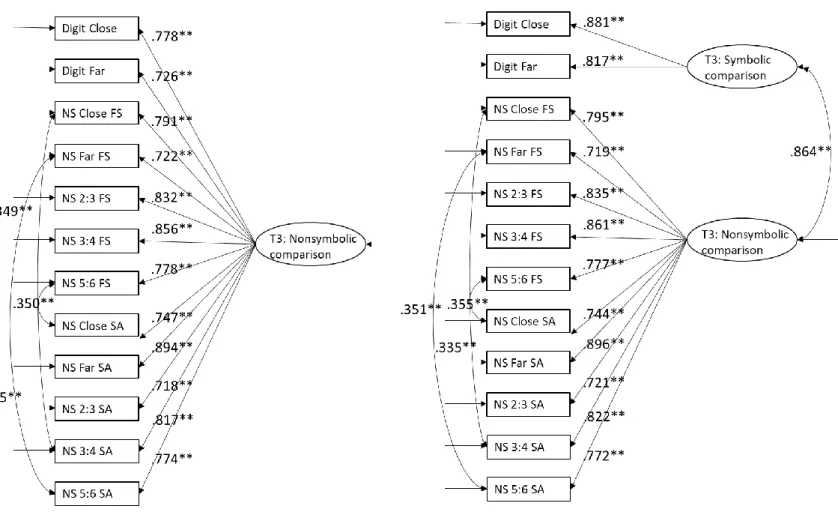
3.2.4 Confirmatory Factor Analyses (CFAs) on comparison measures... 60
3.2.4.1 Time 1 ... 60
3.2.4.2 Time 2 ... 62
3.2.4.3 Time 3 ... 64
3.2.4.4. Time 4 ... 67
3.2.4.5 Time 5 ... 67
3.2.5.4 CFAs on comparison measures: investigating high achievers in number recognition ... 70
3.3 Conclusion ... 71
Chapter 4. Concurrent Prediction of Early Arithmetic across Time ... 76
4.1 Methods ... 77
4.1.1 Participants ... 77
4.1.2 Materials ... 77
4.1.2.1 Measures taken at Time 1 ... 77
4.1.2.2 Measures taken at Time 2 ... 80
4.1.2.3 Measures taken at Time 3 ... 81
4.1.2.4 Measures taken at Time 4 ... 82
6
4.1.3 Procedure ... 85
4.2 Results ... 85
4.2.1 Descriptive Statistics ... 86
4.2.2 Structural Equation Modelling ... 91
4.2.2.1 Concurrent prediction at Time 1 ... 91
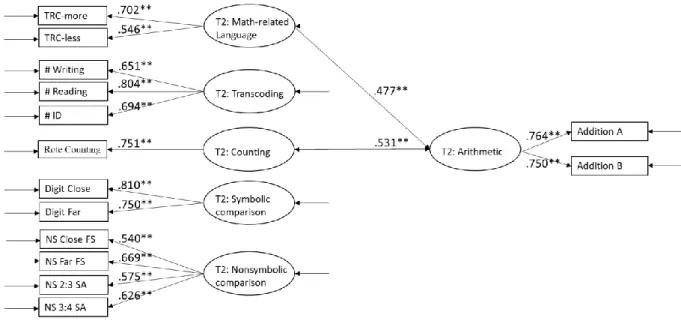
4.2.2.2 Concurrent prediction at Time 2 ... 95
4.2.2.3 Concurrent prediction at Time 3 ... 97
4.2.2.4 Concurrent prediction at Time 4 ... 99
4.2.2.5 Concurrent prediction at Time 5 ... 100
4.3 Conclusion ... 102
Chapter 5. Longitudinal Prediction of Early Arithmetic ... 107
5.1 Methods ... 107
5.1.2 Materials ... 107
5.1.2.1 Baseline Prediction Model assessed at Time 1 ... 107
5.1.2.2 Arithmetic Skills ... 108 5.1.3 Procedure ... 108 5.2 Results ... 110 5.2.1 Descriptive Statistics ... 110 5.2.2 Predicting Time 2 ... 114 5.2.3 Predicting Time 3 ... 116 5.2.4 Predicting Time 4 ... 118 5.2.5 Predicting Time 5 ... 119 5.3 Conclusion ... 122
Chapter 6. Relations between Inhibitory Control, ANS and Early Arithmetic 130 6.1 Congruent versus Incongruent ANS Trials ... 131
6.1.1 Methods ... 131
6.1.1.1 Participants ... 131
6.1.1.2 Materials ... 132
6.1.1.2.1 Measures taken at Times 1 and 2 ... 132
6.1.1.2.2. Measures taken at Times 3, 4 and 5 ... 133
6.1.1.3 Procedure ... 134
6.1.2 Results ... 137
6.1.2.1 Time 1 ... 137
7
6.1.2.3 Time 3 ... 140
6.1.2.4 Time 4 ... 141
6.1.2.5 Time 5 ... 142
6.1.3 Conclusion ... 143
6.2. Inhibitory Control, ANS and Arithmetic ... 144
6.2.1 Methods ... 144
6.2.1.1 Participants ... 144
6.1.1.2 Materials ... 144
6.2.1.3 Procedure... 145
6.2.2 Results ... 146
6.2.2.1 Hierarchical regression models ... 147
6.2.2.1.1 Relations between inhibition, ANS and arithmetic at Time 3 ... 147
6.2.2.1.2 Relations between inhibition, ANS and arithmetic at Time 4 ... 149
6.2.2.2 Hierarchical regressions using structural equation modelling ... 150
6.2.2.2.1 Relations between inhibition, ANS and arithmetic at Time 3 ... 150
6.2.2.2.2 Relations between inhibition, ANS and arithmetic at Time 4 ... 152
6.2.3 Conclusion ... 154
Chapter 7. Approximate Arithmetic Performance ... 155
7.1 Methods ... 156
7.1.1 Participants ... 156
7.1.2 Materials ... 156
7.1.2.1 Baseline Prediction Model assessed at Time 1 ... 156
7.1.2.2 Measures taken at Time 3 ... 156
7.1.2.3 Measures taken at Time 4 ... 158
7.1.2.4 Measures taken at Time 5 ... 158
7.1.3 Procedure... 159
7.2 Results ... 159
7.2.1 Descriptive Statistics ... 163
8
7.2.3 Exploration of the structure of approximate arithmetic ... 165
7.2.3.1 Time 3 ... 166
7.2.3.2 Time 4 ... 167
7.2.3.3 Time 5 ... 167
7.2.4 Predicting approximate arithmetic using Time 1 baseline model ... 168
7.3 Conclusion ... 173
Chapter 8. The Importance of Children’s Number Estimation on Arithmetic 177 8.1 Methods ... 178
8.1.1 Participants ... 178
8.1.2 Materials ... 178
8.1.2.1 Baseline model taken at Time 1 ... 178
8.1.2.2 Numerical Estimation ... 178
8.1.2.3 Arithmetic measures taken at Time 5 ... 179
8.1.3 Procedure ... 180
8.2 Results ... 180
8.2.1 Descriptive Statistics ... 181
8.2.2 The associations between children’s number line estimation and early arithmetic ... 186
8.2.3 The quality of children’s number line estimation as a predictor of early arithmetic ... 187
8.2.4 Longitudinal prediction of arithmetic ... 194
8.3 Conclusion ... 198
Chapter 9. General Discussion ... 200
9.1 Concurrent and longitudinal relations between arithmetic and transcoding, ANS, counting, number estimation, language, nonverbal intelligence and inhibition ... 200
9.2 Development of magnitude comparison ... 204
9.3 Performance and structure of early approximate arithmetic skills ... 205
9.4 Number estimation and early arithmetic skills ... 207
9.5 Implications for models of mathematical development ... 207
9.6 Method Constraints ... 212
9.7 Future Directions ... 213
9.8 Conclusion ... 214
Appendices ... 217
9 List of Tables
Table 2.1: Mean age and standard deviations of children ... 43 Table 3.1: Mean and standard deviations of predictor and criterion measures from all
testing sessions ... 55 Table 3.2: Numerical Distance Effects across Time ... 56 Table 4.1: Mean and standard deviations of predictor and criterion measures from all
testing sessions ... 88 Table 4.2: Correlations between the predictor and the criterion measures at Time 1 (n
= 100) ... 94 Table 4.3: Correlations between the predictor and the criterion measures at Time 2 (n
= 117) ... 97 Table 4.4: Correlations between the predictor and the criterion measures at Time 3 (n
= 116) ... 98 Table 4.5: Correlations between the predictor and the criterion measures at Time 4 (n
= 115) ... 100 Table 4.6: Correlations between the predictor and the criterion measures at Time 5 (n
= 119) ... 102 Table 5.1: Mean and standard deviations of predictor and criterion measures from all
testing sessions ... 112 Table 5.2: Correlations between Time 1 model and arithmetic at Time 2 (n = 142)123 Table 5.3: Correlations between Time 1 baseline model with Time 2 autoregressor
and arithmetic at Time 3 (n = 143) ... 124 Table 5.4: Correlations between Time 1 baseline model with Time 2 autoregressor and arithmetic at Time 4 (n = 143) ... 125 Table 5.5: Correlations between Time 1 baseline model with Time 2 autoregressor and arithmetic at Time 5 (n = 148) ... 126 Table 6.1: Mean and standard deviations of predictor and criterion measures from all
10
Table 6.2: Correlations between ANS, inhibition and arithmetic at Time 3 ... 147 Table 6.3: Hierarchical Regressions for ANS, Inhibition and arithmetic at Time 3 (n
= 76) and Time 4 (n = 108) ... 148 Table 6.4: Hierarchical Regressions for Inhibition, ANS and arithmetic at Times 3
and 4 ... 149 Table 6.5: Correlations between ANS, inhibition and arithmetic at Time 4 (n = 108)
... 150 Table 7.1: Mean and standard deviations of predictor and criterion measures from all
testing sessions ... 161 Table 7.2: Children’s Performance on Symbolic and Nonsymbolic Approximate
Arithmetic compared to chance level at Times 3, 4 and 5 ... 164 Table 7.3: Correlation matrix between Symbolic and Nonsymbolic Approximate
Arithmetic and Exact Arithmetic at Times 3, 4 and 5 ... 165 Table 8.1: Mean and standard deviations of predictor and criterion measures from all
testing sessions ... 183 Table 8.2: Estimation error, R2lin and R2log for 0-10 and 0-20 scale of number
estimation task at all three time points ... 187 Table 8.3: Correlations between the linear and logarithmic function fits and
arithmetic at Times 1, 3 and 5 ... 188 Table 8.4: Correlations between the linear and logarithmic function fits, counting and
transcoding at Time 1 ... 189 Table 8.5: Hierarchical Regressions for Counting, Transcoding and linear and
logarithmic function fits and arithmetic at Time 1 ... 190 Table 8.6: Correlations between the linear and logarithmic function fits, counting and
transcoding at Time 3 ... 192 Table 8.7: Hierarchical Regressions for Counting, Transcoding and linear and
logarithmic function fits and arithmetic at Time 3 ... 193 Table 8.8: Correlations between Time 1 baseline model, number estimation 0-10
11 List of Figures
Figure 1.1: Modular Model proposed by McCloskey, Caramazza, and Basili (1985) ... 20 Figure 1. 2: MATHNET model proposed by McCloskey, and Lindemann (1992)21 Figure 1.3: Dehaene’s Triple Code Model (Dehaene, 1992, p. 31) ... 22 Figure 1.4: Schematics shows some of the nodes and connections described in the
Network Interference Model (Campbell, 1995) ... 23 Figure 1.5: Overview of Adaptive Strategy Choice Model proposed by Siegler and Shipley (1995) ... 25 Figure 1.6: Four-step-developmental model of numerical cognition ... 26 Figure 1.7: The Pathways to Mathematics model proposed by LeFevre et al.
(2010) ... 27 Figure 1.8: Mental number line model proposed by Siegler and Braithwaite, 2017 29 Figure 3.1: One factor (left side) and two factor (right side) CFA of magnitude
comparison tasks (Time 1) ... 61 Figure 3.2: One factor (left side) and two factor (right side) CFA of magnitude
comparison tasks (Time 2) ... 63 Figure 3.3: One factor (left side) and two factor (right side) CFA of magnitude
comparison tasks (Time 3) ... 65 Figure 3.4: One factor (left side) and two factor (right side) CFA of magnitude
comparison tasks using all subtasks (Time 3) ... 66 Figure 3.5: One factor (left side) and two factor (right side) CFA of magnitude
comparison tasks (Time 4) ... 68 Figure 3.6: One factor (left side) and two factor (right side) CFA of magnitude
comparison tasks (Time 5) ... 69 Figure 4.1 Example TRC item “The boy has more carrots than the girl” in the a) easy
condition and b) the hard condition ... 78 Figure 4.2 Example Number Identification task “Can you point to number 206.” 79
12
Figure 4.3: Concurrent associations of arithmetic assessed at Time 1 ... 92
Figure 4.4: Number wizards’ concurrent associations of arithmetic assessed at Time 1 ... 93
Figure 4.5: Concurrent associations of arithmetic assessed at Time 2 ... 96
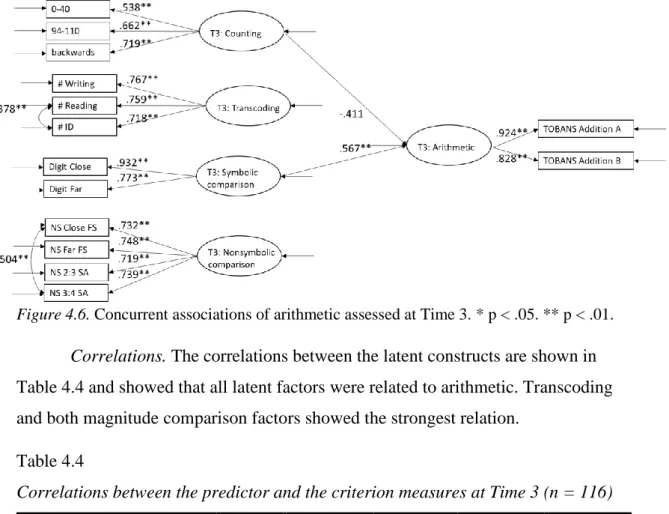
Figure 4.6: Concurrent associations of arithmetic assessed at Time 3 ... 98
Figure 4.7: Concurrent associations of arithmetic assessed at Time 4 ... 100
Figure 4.8: Concurrent associations of arithmetic assessed at Time 5 ... 101
Figure 5.1: Prediction of arithmetic at Time 2 by Time 1 base model without autoregressor ... 115
Figure 5.2: Prediction of arithmetic at Time 2 by Time 1 base model with autoregressor ... 115
Figure 5.3: Prediction of arithmetic at Time 3 by Time 1 base model without autoregressor ... 117
Figure 5.4: Prediction of arithmetic at Time 3 by Time 1 base model with autoregressor ... 117
Figure 5.5: Prediction of arithmetic at Time 4 by Time 1 base model without autoregressor ... 118
Figure 5.6: Prediction of arithmetic at Time 4 by Time 1 base model with autoregressor ... 119
Figure 5.7: Prediction of arithmetic at Time 5 by Time 1 base model without autoregressor ... 120
Figure 5.8: Prediction of arithmetic at Time 5 by Time 1 base model with autoregressor ... 120
Figure 5.9: Prediction of children’s arithmetic performance at Time 5 by Time 1 base model with autoregressor. The model is run using only the data from high achievers on number reading task at Time 1 ... 121
Figure 6.1: Scatter dot plot of congruent trial performance and arithmetic skills (r2 = .145, left side compared to incongruent trial performance and arithmetic skills at Time 1 (r2 = .098, right side) ... 138
13
Figure 6.2: Prediction of arithmetic scores by congruent and incongruent latent factors at Time 1... 138 Figure 6.3: Scatter dot plot of congruent trial performance and arithmetic skills (r2 =
.189, left side compared to incongruent trial performance and arithmetic skills at Time 2 (r2 = .131, right side) ... 139 Figure 6.4: Prediction of arithmetic scores by congruent and incongruent latent
factors at Time 2... 140 Figure 6.5: Scatter dot plot of congruent trial performance and arithmetic skills (r2 =
.378, left side compared to incongruent trial performance and arithmetic skills at Time 3 (r2 = .360, right side) ... 141 Figure 6.6: Scatter dot plot of congruent trial performance and arithmetic skills (r2 =
.332, left side compared to incongruent trial performance and arithmetic skills at Time 4 (r2 = .309, right side) ... 141 Figure 6.7: Scatter dot plot of congruent trial performance and arithmetic skills (r2 =
.244, left side compared to incongruent trial performance and arithmetic skills at Time 5 (r2 = .230, right side) ... 142 Figure 6.8: Hierarchical SEM regression model of arithmetic at Time 3. Step 1:
Magnitude Comparison. Step 2: Magnitude Comparison and Inhibition 151 Figure 6.9: Hierarchical SEM regression model of arithmetic at Time 3. Step 1:
Inhibition. Step 2: Inhibition and Magnitude Comparison ... 152 Figure 6.10: Hierarchical SEM regression model of arithmetic at Time 4. Step 1:
Magnitude Comparison. Step 2: Magnitude Comparison and Inhibition 153 Figure 6.11: Hierarchical SEM regression model of arithmetic at Time 4. Step 1:
Inhibition. Step 2: Inhibition and Magnitude Comparison ... 153 Figure 7.1: Example item of the Symbolic Approximate Arithmetic Problems. “Sarah
has 21 candies. She gets 30 more candies. John has 34 candies. Who has more candies?” ... 158 Figure 7.2: One factor (left side) and two factor (right side) CFA of congruent and
14
Figure 7.3: One factor (left side) and two factor (right side) CFA of congruent and incongruent magnitude comparison tasks (Time 4) ... 167 Figure 7.4: One factor (left side) and two factor (right side) CFA of congruent and
incongruent magnitude comparison tasks (Time 5) ... 168 Figure 7.5: Prediction of symbolic approximate arithmetic at Time 3 by Time 1 base
model ... 169 Figure 7.6: Prediction of nonsymbolic approximate arithmetic at Time 3 by Time 1 base model ... 169 Figure 7.7: Prediction of symbolic approximate arithmetic at Time 4 by Time 1 base
model with Time 3 autoregressor ... 171 Figure 7.8: Prediction of nonsymbolic approximate arithmetic at Time 4 by Time 1
base model with Time 3 autoregressor ... 171 Figure 7.9: Prediction of symbolic approximate arithmetic at Time 5 by Time 1 base
model with Time 3 autoregressor ... 172 Figure 7.10: Prediction of nonsymbolic approximate arithmetic at Time 5 by Time 1
base model with Time 3 autoregressor ... 173 Figure 8.1: Prediction of arithmetic at Time 5 by Time 1 latent factors Transcoding,
Counting, Symbolic and Nonsymbolic comparison tasks, number line 0-10 small and number line 0-10 large as well as Time 1 arithmetic
15
List of Appendices
Appendix 1: Symbolic and Nonsymbolic Magnitude Comparison Tasks ... 217
Appendix 2: Test of Relation Concepts (TRC) at Time 1 ... 218
Appendix 3: Test of Relation Concepts (TRC) more and less (Times 2, 3 and 5)219 Appendix 4: Number Identification Task Time 1 ... 220
Appendix 5: Number Identification Task Time 2 ... 221
Appendix 6: Number Identification Task Time 3 ... 222
Appendix 7: Number Identification Task Time 4 ... 223
Appendix 8: Number Identification Task Time 5 ... 225
Appendix 9: Arithmetic at Time 1 ... 226
Appendix 10: Arithmetic at Time 2 ... 227
Appendix 11: TOBANS Simple Addition (Times 3, 4 and 5) ... 228
Appendix 12: TOBANS Addition with carry (Times 3, 4 and 5) ... 229
Appendix 13: TOBANS Simple Subtraction (Times 3, 4 and 5) ... 230
Appendix 14: Symbolic Approximate Arithmetic ... 231
Appendix 15: Nonsymbolic Approximate Arithmetic ... 232
Appendix 16: Head-Toes-Shoulders-Knees Task ... 234
Appendix 17: Visual Search Task ... 235
Appendix 18: Calculation of d’ (d prime) ... 236
Appendix 19: Booklet Order of Magnitude Comparison at Time 3, 4 and 5... 237
Appendix 20: Standardized coefficients of Structural Equation Modelling of Concurrent Associations of arithmetic at Times 1, 2, 3, 4 and 5 ... 238
Appendix 21: Standardized coefficients of SEM of Longitudinal Prediction of arithmetic at Times 2, 3, 4 and 5 ... 239
16
Appendix 22: Standardized coefficients of SEM of Number Wizards’ Concurrent Associations at Time 1 and Longitudinal Prediction of arithmetic at Time 5 by Time 1 base model ... 240 Appendix 23: Standardized coefficients SEM of Symbolic Approximate Arithmetic
at Times 3, 4 and 5 by Time 1 base model ... 241 Appendix 24: Standardized coefficients SEM of Nonsymbolic Approximate
Arithmetic at Times 3, 4 and 5 by Time 1 base model ... 242 Appendix 25: Standardized coefficients SEM of Longitudinal Prediction of
17
Acknowledgements
I would like to specially thank my supervisors, Chris Donlan for his support, guidance and encouragement throughout my PhD and Charles Hulme for his time and patience teaching me to use MPlus and his guidance with the data analysis. I would also like to acknowledge Alexandra Perovic for the insightful discussions on all matters linguistics.
I would like to extend a very special thank you to the Tudor Court Primary school in Chafford Hundred for inviting me to work with them. A big thanks to all the children (and parents) who participated in this research and the teachers for their advice and warm welcome. I am grateful to the ESRC for funding this research. I would also like to say thank you to all the undergraduate students for helping me carrying out the data collection.
Most importantly, I would like to say thank you to my family and friends for their continued support. I am indebted to my husband Michael who believed in me and helped me keep things in perspective and I deeply appreciate all your love and support throughout this PhD. I owe a big thank you to a very special person, my daughter Lucy, for the patience she showed during my thesis writing. You are the best thing that happened to me!
18
Chapter 1. Background
Competence in numeracy is of great and increasing importance for success in modern society. The development and understanding of mathematics is a complex combination of factual knowledge (memorised number facts), procedural knowledge (understanding of how to proceed in order to get an answer) and conceptual
knowledge (understanding why a strategy works and is more effective than another) (Dowker, 2005). Proficiency in arithmetic is one of the most crucial achievements in primary education. Thereby children have to master the basic principles of counting and arithmetic concepts (Desoete and Grégoire, 2006; Nunes and Bryant, 1996; Gelman and Gallistel, 1978).
Despite a growing literature mapping the development of mathematical skills, little is known about longitudinal predictors of early, arithmetic skills. The search for cognitive-developmental precursors of basic arithmetic has focussed on working memory (e.g. Bull, Epsy, and Wiebe, 2008), counting (e.g. Donlan, Cowan, Newton, and Lloyd, 2007), language (Kleemans, Segers, and Verhoeven, 2011; 2012),
number knowledge (Jordan, Kaplan, Ramineni and Locuniak, 2009) and magnitude processing (Mazzocco, Feigenson and Halberda, 2011; Durand, Hulme, Larking, and Snowling, 2005). The interaction of these predictors has received little attention. Language is the core medium of instruction in school and therefore crucial for the acquisition of knowledge and skills across the curriculum. On the other hand, there is strong intuitive appeal in a modular developmental model in which infants’ ability to identify numerical differences between nonsymbolic stimulus sets (e.g. arrays of dots) provides the basis on which symbolic number processing is constructed, in turn providing the semantic framework needed for the development of arithmetic skills. A central aim of this thesis is to establish whether magnitude comparison tasks are reliable longitudinal predictors of early arithmetic performance, once number knowledge, language and cognitive skills are taken into account.
1.1 Models of numerical processing.
1.1.1 General models of numerical processing.
Several models have been proposed to explain adults’ ability to solve
19
1992), McCloskey’s Modular Model (McCloskey, Sokol and Goodman, 1986), MATHNET (McCloskey and Lindemann, 1992) and the Network Interference Model (Campbell, 1995).
1.1.1.1 McCloskey’s Modular Model and MATHNET.
McCloskey and colleagues proposed the modular model (Figure 1.1) after studying adults with acquired dyscalculia (McCloskey and Lindemann, 1992; McCloskey et al., 1985; 1986). The model incorporates distinct subsystems for particular arithmetic abilities. In particular, the model distinguishes between calculation and number processing which in itself is divided into number comprehension and production. Verbal and Arabic numerals are dealt with separately. The calculation system involves three mechanisms: one for operation processing, one for procedures and one for fact storage and access. The first is used when processing symbols and words related to symbols (e.g. plus) whereas the second mechanism involves rules for the processing of operations such as addition, subtraction, multiplication and division. Storage and retrieval of facts rely on the facts mechanism. The semantic processing of numbers is a key component of the Modular Model. It converts input into abstract semantic representations, similar to the magnitude representations posited by Dehaene (1992), which then are processed in the calculation system and/or output through the numeral production system. For example, the semantic form of the number ‘123’ is {1} 102, {2} 101 and {3} 100 whereas {1}, {2} and {3} represent quantities and 10n is the power of ten.
According to the model, a problem needs to be converted into a semantic representation before it can activate stored facts in memory. The semantic
representation of the answer can then be accessed and converted into the appropriate format for the response. Therefore, an impairment in the semantic representation system impedes the performance on all arithmetic problems.
20
Figure 1.1. Modular Model proposed by McCloskey, Caramazza, and Basili (1985). From Edelman, Abdi, and Valentin (1996, p.48).
McCloskey and Lindemann, (1992) proposed the MATHNET model (Figure 1.2) with three layers. The first layer consists of 26 input units which are connected to the 40 hidden units, layer two, which are connected to the 24 answer units. A particular feature of this model is that the answer units are also interconnected. All connections are symmetric and bidirectional and the hidden and answer units tend towards either a positive or negative activation. However, the problem arises that the only solution method for an arithmetic problem is retrieval from memory neglecting to explain non-retrieval solutions such as transformation or counting-based strategies (Geary and Wiley, 1991; LeFevre, Sadesky and Bisanz, 1996).
1.1.1.2 Dehaene’s Triple Code Model.
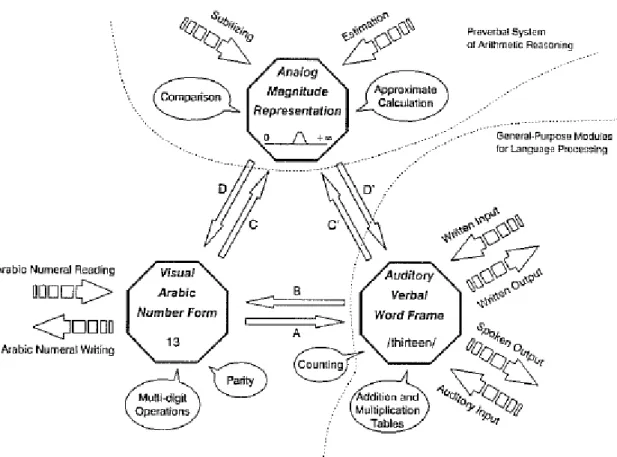
The most influential model of adult numerical processing is Dehaene’s Triple Code Model (Dehaene, 1992, Figure 1.3). The model proposes that numbers are represented mentally in three different codes: the auditory verbal code or auditory
21
Figure 1.2. MATHNET model proposed by McCloskey, and Lindemann (1992).
verbal word frame, the visual Arabic number form, and the analogue
magnitude code. The codes are interlinked via pathways that translate from one code to another and the task being performed determines which form of mental number representation is used. The auditory verbal code draws on general language
processing systems and deals with tasks such as verbal counting and multiplication tables. The visual Arabic number code is created and manipulated using Arabic numerals and is used in multi-digit calculations. These two codes are considered to be unique to humans.
The analogue magnitude code in which quantity or magnitude is represented in an approximate way is believed to be shared by animals and humans, even
preverbal infants alike (Dehaene, 1992; Whalen, Gallistel and Gelman, 1999; Wynn, 1998; Rugani, Vallortigara, Priftis and Regolin, 2015) and often referred to as the number sense (Dehaene, 1997). The analogue magnitude code is hypothesised to take
22
the form of a compressed number line following Weber’s Law. Magnitude
representations are supposed to be compressively spaced with larger numbers being less discriminable than smaller numbers.
Figure 1.3. Dehaene’s Triple Code Model (Dehaene, 1992, p. 31). Three representations are
depicted as octagons. Large arrows indicate input-output processes, whereas thin arrows depict internal translation processes.
Dehaene also proposed two separate pathways for solving arithmetic problems, the direct asemantic route for over learned calculations and the indirect semantic route for exact arithmetic. The former relies on activation of the auditory verbal code because facts are stored as a “learned lexicon of verbal associations” (Dehaene, 1992, p.34) in memory. The latter involves the analogue magnitude code and is proposed to be used in subtractions and more complex addition problems.
1.1.1.3 Network interference model.
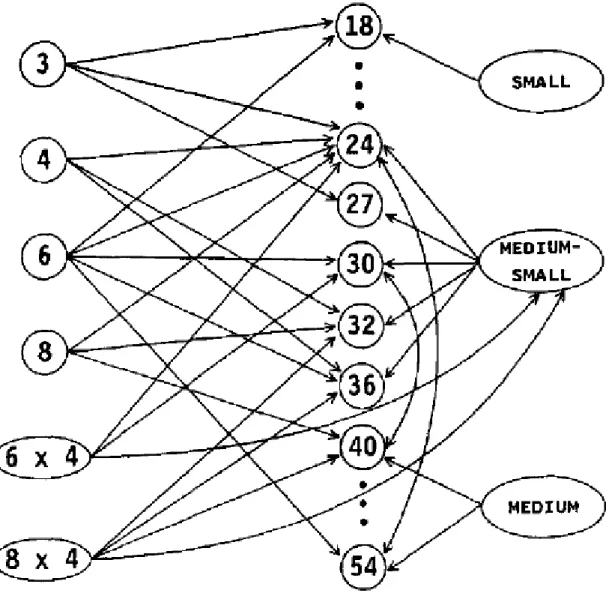
The Network interference model (Campbell, 1995, Figure 1.4) proposes multiple internal codes. Similar to Dehaene (1992), codes include the magnitude, verbal and visual code for numbers. Encoding and calculation processes are assumed
23
to be interactive which explains why large mathematical problems in word format take longer to solve. It further hypothesises that larger magnitudes are less
discriminable than smaller quantities as proposed in the Triple Code model (Dehaene, 1992). This encoding complex model posits that numbers evoke “an integrated network of format-specific number codes and processes that collectively mediate number comprehension, calculation, and production, without the assumption of central representation” (Campbell and Clark, 1988, p. 204). According to the model, additions and comparisons depend on qualitatively different processes (Takahashi and Green, 1983). The model, however, does not account for non-retrieval solution methods.
Figure 1.4. Schematic shows some of the nodes and connections described in the Network Interference Model (Campbell, 1995).
24
1.1.2 Developmental models of arithmetic.
Most developmental models of arithmetic are models of children’s problem solution and were inspired by the adult models. Models discussed in this thesis are the Adaptive Strategy Choice Model (ASCM, Siegler and Shipley, 1995), the Four-Step Developmental Model of Numerical Cognition (von Aster and Shaley, 2007), the Pathways to Mathematics Model (LeFevre, Fast, Skwarchuk, Smith-Chant, Bisanz, Kamawar and Penner-Wilger, 2010) and the The Integrated Theory of Numerical Development (Siegler and Braithwaite, 2017).
1.1.2.1 Adaptive Strategy Choice Model.
Siegler and Shipley’s (1995) Adaptive Strategy Choice model (ASCM, Figure 1.5) is a “computer simulation of how strategy choices are made and how they change with age and experience” (p.72). It aims to explain how and why people choose a specific strategy among alternative strategies to perform fast and accurately. ASCM’s three assumptions are: First, a database maintains information on
performance and outcome of a particular strategy which plays an important role in choosing strategies in the future. This database is dynamic and updates the
information after the strategy was used and it also stores information on global data (average speed and accuracy for a particular strategy), feature data (speed and accuracy for each strategy on problems with a particular structural feature) and local data (speed and accuracy of the strategy on particular problems). Second, choosing a strategy is determined by past performance of the strategy and the predicted
performance of the strategy if that strategy would be used. Third, strategy choice depends on the each strategy’s strength (speed and accuracy) in comparison with alternative strategies. New strategies are developed by boosting the speed and accuracy information of novel strategies.
The model posits two distinct strategy-choice pathways for procedures and retrieval. If the former is activated, the procedure will be performed and the answer is produced. Contrarily, a successful retrieval depends on the strength of each strategy. Procedure is often chosen for problems were the association between a problem and an answer is weak, whereas the retrieval pathway is more likely to be chosen for problems with strong answer associations. A retrieval answer will only produce an answer if the confidence in the correctness of the answer exceeds a set
25
criterion otherwise the models attempts another retrieval. The procedure pathway will then only be chosen after numerous failed retrieval attempts.
Figure 1.5. Overview of Adaptive Strategy Choice Model proposed by Siegler and Shipley (1995). From Siegler and Lemaire (1997), p. 73.
1.1.2.2 Four-Step Developmental Model of Numerical Cognition
The Four-Step Developmental Model of Numerical Cognition (von Aster and Shalev, 2007) describes four stages of numerical cognition in which children move through the stages as they progress in arithmetic competency through exposure and formal schooling and an increase in working memory capacity (Figure 1.6). The first stage consists of an inherited core-system of magnitude representation, similar to Dehaene’s number sense, which entails subitizing and approximation abilities. This basic meaning of number is a prerequisite for the acquisition of more complex mathematical skills. Pre-school children move on to the linguistic stage of numeracy (step 2) where children acquire the verbal number codes. In step 3, children learn the Arabic number system and the symbolic representations of magnitudes in school. Typical mathematical skills developing at this stage are written calculations and odd-even decisions. The final stage, the mental number line, develops during school years as children acquire the concept of ordinality, a second core principal of number.
Von Aster and Shalev (2007) further propose that failure to establish a stage appropriately may lead to developmental delays in acquiring the follow-on stages or dyscalculia. For example, a child that has an inappropriate concept of magnitude
26
(step 1) because of genetic vulnerability may still learn the verbal codes (stage 2) by rote memory, but the codes are void of the meaning putting the child at risk of pure developmental dyscalculia.
Figure 1.6. Four-step-developmental model of numerical cognition. From Von Aster and Shalev (2007), p. 870. Shaded area below line represents increasing working memory.
1.1.2.3 Pathways to Mathematics
LeFevre and colleagues postulate the Pathways to Mathematics model
(Figure 1.7) focusing on the relationships between children's mathematical skills and cognitive precursors, early numeracy skills and mathematical outcomes. (LeFevre et al., 2010). This model posits three separate pathways: quantitative, linguistic and spatial attentional. Each of these pathways contributes individually to the acquisition of early numeracy abilities. Furthermore, the models proposes that the linguistic, quantitative and spatial attention pathways vary in their contribution to mathematical performance depending on the demands of the arithmetic problem. According to the model, linguistic skills are linked to children’s symbolic number system knowledge. The second skill pathway comprises quantitative abilities and processing numerical magnitudes. Spatial attention forms a third pathway with connections across a variety of numerical and mathematical skills.
27
Figure 1.7. The Pathways to Mathematics model proposed by LeFevre et al. (2010), p. 1755.
Sowinski, LeFevre, Skwarchuk, Kamawar, Bisanz and Smith-Chant (2014) further expanded the quantitative pathway to include not only magnitude comparison but also counting and subitizing (ability to quickly and exactly enumerate small quantities; Clements, 1999). They also introduced a working memory pathway (the original model only focused on visuo-spatial attention). These new pathways were examined in relation to backward counting, arithmetic fluency, calculation, number system knowledge and reading. As expected, all three pathways contributed to backward counting and arithmetic fluency, but only the linguistic and quantitative pathway were uniquely predicting calculation and number system knowledge. Word reading was solely predicted by the linguistic pathway.
1.1.3 The Integrated Theory of Numerical Development
Siegler and Braithwaite (2017) proposed the integrated theory of numerical development assuming that the core of numerical development is an increase in understanding of numerical magnitudes. The theory posits five assumptions:
1. Magnitudes of numbers are represented on a mental number line in humans and animals. This number line is a dynamic structure that represents small numbers first and “then is progressively extended
28
rightward to include larger whole numbers, leftward to include negative numbers, and interstitially to include fractions and decimals” (Siegler and Braithwaite, 2017, p. 3). Figure 1.8 shows the approximate age range of the changes in the mental number line.
2. The representation of whole numbers shifts from a compressive,
approximately logarithmic distribution towards a linear distribution. This shift occurs first for small whole numbers than larger whole numbers based on children’s experience with the number range.
3. All real numbers can be presented as magnitudes on a mental number line and are thus ordered on the number line.
4. Whole and rational number knowledge is related and predictive of arithmetic attainment and more advanced aspects of mathematics. 5. Interventions to enhance numerical magnitudes knowledge positively
affect arithmetic attainment.
The integrated theory presumes that numerical magnitudes are represented on a horizontally oriented mental number line, at least for many Western and Eastern cultures. Smaller numbers are presented on the left and larger number on the right of the number line. Rugani et al. (2015) found that newborn chicks spontaneously associate small numbers (e.g. “2”) with the left and larger numbers (e.g. “8”) with the right side when trained on the number “4”. There is evidence for the mental number line representation of numbers provided by distance effects and the SNARC effect (spatial-numerical association of response codes). The former comes from the finding that the identification of the larger of two numbers is faster for numerically farther apart pairs of numbers (Moyer and Landauer, 1967). The SNARC effect explains the finding that responses for smaller numbers are faster when pressing a button on the left hand side and responses for larger numbers are faster when pressing a button on the right hand side (Dehaene, Dupoux and Mehler 1990).
Siegler and Braithwaite (2017) posit that numerical magnitude knowledge is related to and predictive of arithmetic development. Numerical magnitude
knowledge is conventionally measured using the number-to-position task. Children are asked to indicate the position of a target number on a blank number line.
Research has shown that older children perform better on number lines (as indicated by the difference between actual position and children’s estimated position) than
29
younger children, that performance on the number line is significantly associated with arithmetic skills (Siegler and Booth, 2004; Booth and Siegler, 2006, 2008) and that there is a shift from a logarithmic to a linear distribution of numerical
magnitudes between five and eight years (Booth and Siegler, 2008; Siegler, Thompson and Opfer, 2009). However, these findings come mostly from cross-sectional studies.
Figure 1.8. Mental number line model proposed by Siegler and Braithwaite (2017), p. 190, shows the approximate age ranges of major changes to the size and types of symbolic numbers whose magnitudes individuals can represent.
Some studies identify the involvement of language and counting alongside magnitude estimation as developmental associates of early arithmetic (Praet, Titeca, Ceulemans and Desoete, 2013). Indeed, Praet and colleagues (2013) explored the relationship between arithmetic and children’s estimation using number words, dots and Arabic numerals, adding language as a covariate (from kindergarten through to grade two). The results revealed that Arabic numerals were more linearly distributed than number words and that language explained kindergartener’s arithmetic
30
performance, but not the growth of arithmetic. Children’s untimed math performance was predicted by number line estimation.
Muldoon, Towse, Simms, Perra and Menzies (2013) assessed 5-year-olds over a 12 month period, with repeated measurement of number line estimation skills, counting ability and math achievement. They showed that counting was the largest contributor to children’s math performance and only linear fit of number estimation on the 0-20 scale at 5 years and linear fit of number estimation on the 0-100 scale at six years made a significant contribution. Some studies propose that, rather than being a precursor of mathematical achievement, number line acuity and math
performance both influence each other during development from pre-school through early school years (Friso-van den Bos, Kroesbergen, Van Luit, Xenidou-Dervou, Jonkman, Van der Schoot and Van Lieshout, 2014; LeFevre, Lira, Sowinski, Cankaya, Kamawar and Skwarchuk, 2013).
Evidence form cross-cultural research by the same team revealed that
children’s number estimations were related to some but not all mathematical skills in English and Chinese children. Although Chinese children are typically precocious when it comes to mathematical development, their estimations on the mental number line were not more linearly distributed or accurate than an older Western sample with equivalent math scores suggesting that linearity may not be a driver for math
attainment. It also emerged that young children display numbers as accurately in the vertical as the horizontal orientation (Simms, Muldoon and Towse, 2013).
Ramini, Siegler and Hitti (2012) found that playing a linear number board game improved low-SES children’s number line estimation, magnitude comparison, numeral identification and counting skills. Further evidence comes from an
intervention study examining extremely preterm-born (EP) children (Simms, Gilmore, Cragg, Marlow, Wolke and Johnson, 2012). The authors compared EP children’s performance on cognitive tests and number line estimation tasks to term-born control children. They reported that EP children performed worse than the controls in all tests, but different relationships between mathematical attainment and number estimation were found in the two groups. The relationship between number estimation and mathematical achievement was stronger in EP children and remained significant after controlling for cognitive abilities only in the EP children. The
31
authors conclude that math attainment in EP children was associated with accuracy of numerical representations and not their general cognitive abilities.
1.2. Mathematics and Language.
Despite a growing literature mapping the development of mathematical skills, the interaction of language and arithmetic concept formation has received little attention. However, language is the core medium of instruction in school and therefore crucial for the acquisition of knowledge and skills across the curriculum. For this reason alone, it is essential to look at the role of language in children’s early arithmetic skills.
Motivation for exploring the relationship between language and numeracy derives from findings suggesting that the development of numeracy is critically dependent on linguistic representations. Early support for this view came from scholarly examination of the cross-linguistic underpinnings of number systems (Hurford, 1987). More recently, an important perspective has been offered by studies assessing the mathematical skills of children with specific language impairment (SLI) in order to determine the impact of an impaired linguistic system on numeracy development. Children with SLI have impaired linguistic abilities which are not caused by hearing loss, physical disabilities or environmental influences. However, their nonverbal intelligence seems to be within normal range (APA, 1994).
Studies indicate that SLI may affect a wide range of numeracy skills differently (Donlan, Bishop and Hitch, 1998; Donlan, and Gourlay, 1999; Fazio, 1994, 1996). Children with SLI performed lower in rote counting than typically developing children of the same age (Donlan et al., 2007). Furthermore, Cowan, Donlan, Newton and Lloyd (2005) and Donlan et al. (2007) found that difficulties in producing the spoken number sequence, as well as poor comprehension of language, are significantly associated with calculation. Kleemans et al. (2011, 2012) found a relationship between grammatical ability and early numeracy skills. Similarly, neurocognitive studies of adults suggest that linguistic processes such as
phonological awareness and grammatical ability are related to both, addition and subtraction (Baldo and Dronkers, 2007; Dehaene et al., 2003). However, the relationship between these skills is complex, and runs counter to other findings
32
which indicate independence between verbal and nonverbal calculation skills (Nunes and Bryant, 1996; Jordan, Huttenlocher and Levine, 1994).
A few recent studies have started to address issues around the association between mathematical language use and the development of mathematical concepts. Saxe, Guberman, Gearhart, Gelman, Massey and Rogoff (1987) reported that mothers from middle socio-economic background engaged their children in more complex math activities and language than low-SES mothers. Therefore, the four year old children from middle-SES outperformed their low-SES peers on complex mathematical tasks. Klibanoff, Levine, Huttenlocher, Hedges, and Vasilyeva (2006) explored the relation between pre-school teachers’ amount of math talk and
children’s growth of mathematical knowledge. They found that the amount of math talk had an effect on the growth of conventional mathematical knowledge. However, Boonen, Kolkman and Kroesbergen (2011) reported not only positive associations with children’s number concepts, but also negative associations, possibly indicating confusion where the level of teachers’ talk exceeded children’s understanding. There is a need for further research concerning the effects of both quantity and quality of math talk on mathematical learning in the early years.
Some studies indicate that the same underlying mechanisms that are crucial for reading attainment may also play an important role in mathematics, particularly phonological awareness (Jordan, Kaplan and Hanich, 2002; Simmons and Singleton, 2008). A recent study by Vukovic and Lesaux (2013) explored the difference
between the relationship of children’s general verbal abilities and arithmetic compared to phonological skills. The results suggest that eight-year-olds
performance on verbal analogies was indirectly related to arithmetic skills through symbolic number skills whereas phonological skills such as phonological decoding were directly related to arithmetic knowledge. The authors concluded that children’s general verbal activities may affect children’s understanding and reasoning with numbers and children’s phonological skills may play a part in executing conventional arithmetic.
In particular, relational terms (e.g. more, less) play a crucial role in mature mathematical communication. Although little is known about their acquisition and development, previous studies have shown that young children do not perfectly
33
comprehend relational concepts (Donaldson and Balfour, 1968). Younger children tend to treat less as if it is a synonym of more conceivably due to the children’s bias to choose the greater of two arrays in comparison judgement tasks (Clark, 1973). The implications of these findings for mathematical development have yet to be fully explored. LeFevre and colleagues (2010) assessed four- to seven-year olds
vocabulary, phonological awareness, subitizing skills and a spatial span task. They showed that the linguistic, spatial and quantitative pathways contribute
independently to the development of early numeracy as well as children's formal mathematical knowledge. However, only vocabulary and phonological awareness were tested to assess linguistic skills, leaving open the possibility that more complex language skills may make further contributions.
1.3 Mathematics and the Approximate Number System.
Numerous studies propose that an innate approximate number sense (ANS; Dehaene, 1992) is fundamental for children’s understanding of abstract, symbolic number concepts thus contributing to the development of arithmetic. The ANS is typically assessed using magnitude comparison tasks (comparing numerosities of groups of objects (Barth, Kanwisher, and Spelke, 2003; Piazza, Facetti, Trussardi, Berteletti, Conte, Lucangeli, Dehaene, and Zorzi, 2010)). Performance on these discrimination tasks varies according to the difference between the numerosities, and response time is shorter than is possible by counting. Support for the innate ANS comes from studying infants’ discrimination abilities. Xu and Spelke (2000) reported that six-month old infants can successfully discriminate arrays of 8 vs. 16 dots, a ratio of 1:2; by adulthood the discriminability ratio has reduced to 9:10 (Halberda, Mazzocco, Feigenson, 2008).
Evidence in support of the importance of the ANS comes from correlational studies showing that individual differences in ANS and general mathematical achievement were strongly correlated (Halberda et al., 2008; Gilmore, McCarthy, and Spelke, 2010; Libertus, Feigenson and Halberda, 2013), most notably by Mazzocco et al. (2011), who found a significant correlation between ANS precision at pre-school and mathematical skill measured 30 months later. Halberda et al. (2008) found that individual differences in nonsymbolic dot comparison scores in 14-year-old children were correlated with children’s past performance on standardised
34
math achievement tasks. Although this study included numerous covariates, the study had an unusual retrospective design. Given that ANS and other cognitive processes develop throughout childhood, the retrospective design makes it
problematic to draw a conclusion. Gilmore, McCarthy and Spelke (2007) proposed an alternative approach to the ANS as the developmental precursor of arithmetic. They examined six-year-olds’ symbolic approximate arithmetic skills showing that children with no formal instruction on arithmetic can accurately solve approximate arithmetic problems. The authors claim that children’s performance on symbolic approximate arithmetic tasks depends on nonsymbolic representations, and provides the basis for exact arithmetic.
In contrast, some studies have failed to report a significant relation between nonsymbolic ANS measures and arithmetic (Holloway and Ansari, 2009; Iuculano, Tang, Hall and Butterworth, 2008; Sasanguie, Göbel, Moll, Smets and Reynvoet, 2012; Kolkman, Kroesberger and Leseman, 2012; Vanbinst, Ghesquière and De Smedt, 2012). Fuhs and McNeil (2013) posited the hypothesis that the link between arithmetic and ANS measures was mediated by children’s inhibition skills because performance on nonsymbolic magnitude comparison may rely on children’s ability to supress other salient features of the dot arrays such as density or dot size. They assessed pre-school dot comparison skills, mathematics achievement and inhibition abilities in children from low-income background and found that nonsymbolic ANS was a borderline predictor of math achievement. This link was no longer significant once children’s inhibition scores were accounted for. The same evidence was found in school children, where children’s dot comparison performance did not explain mathematical achievement after performance on inhibition task had been taken into account. However, inhibition was significantly contributing to variance in math scores over and above children’s performance on dot comparison (Gilmore, Attridge, Clayton, Cragg, Johnson, Marlow, Simms and Inglis, 2013).
Further evidence from a study by Holloway and Ansari (2009) called the specificity of the correlation between ANS and arithmetic into question. In their study they assessed six- to eight-year-olds performance on a symbolic number comparison task (identifying the greater of two single digit numbers) as well as a nonsymbolic number discrimination task and examined the specific correlations with
35
mathematical achievement. While symbolic and nonsymbolic comparison were highly related, only the symbolic task proved to be predictive of mathematical skills. Subsequent extensive reviews (de Smedt, Noël, Gilmore, and Ansari, 2013; Siegler 2016) have shown that the relationship between the nonsymbolic ANS and children’s arithmetic skills is not consistent, while the association between symbolic
comparison and mathematic skills is relatively strong. Studies investigating the concurrent correlations between ANS and arithmetic neglect crucial longitudinal aspects of this relationship.
However, recent longitudinal studies produced mixed results (Desoete, Ceulemans, De Weerdt, and Pieters, 2012; Lyons, Price, Vaessen, Blomert, and Ansari, 2014; Kolkman et al., 2012). A longitudinal study by Lyons and colleagues (2014) explored the prediction of arithmetic across grades 1-6 and found no evidence that children’s performance on nonsymbolic comparison was a unique predictor of arithmetic scores at any grade. Kolkman et al. (2012) examined the relationship between arithmetic and nonsymbolic, symbolic and mapping skills at age four, five and six. The findings suggest that nonsymbolic, symbolic and mapping skills were separate skills at a younger age integrating over time to form one general numeracy skills concept. Only children’s mapping skills were uniquely predictive of math performance at six years.
A recent study by Göbel, Watson, Lervåg and Hulme (2014) addressed the relation between nonsymbolic and symbolic judgement tasks and their role as longitudinal predictors of arithmetic development in six-year-olds. The authors reported that symbolic and nonsymbolic magnitude comparisons define a unitary factor, which was a strong longitudinal correlate of arithmetic skills. The study also included a number identification task in which spoken numerals were presented to be matched to the corresponding Arabic numeral, with a range of targets including single, double and three digit numbers. This measure was not associated with the magnitude comparison factor, and was entered in a longitudinal path model as a separate latent variable, alongside magnitude comparison and other potential
predictors of later arithmetic skills, including vocabulary size and nonverbal ability. The path model revealed that number identification was the only significant
36
The authors interpret their number identification task as tapping individual differences in both Arabic digit knowledge and place value understanding,
suggesting that the former may represent a critical foundational skill underlying early arithmetic, analogous to the role of letter knowledge in reading, and the latter may be crucial for further arithmetic development.
By focussing precisely on properties of the symbol system, these findings offer clarification of previous literature as follows: On the one hand, consistent findings of high correlation between single digit comparison and nonsymbolic comparison (Holloway and Ansari 2009; Göbel et al., 2014; Matejko, and Ansari 2016) reflect general properties of magnitude comparison (as reported by Moyer, and Landauer 1967), relevant but not central to arithmetic development. On the other hand, the specific relation between symbolic comparison and early arithmetic skills (Holloway, and Ansari 2009; Lyons et al. 2014) reflects the contribution of symbolic item identification as a foundational arithmetic skill, but is limited by the nature of the task and the range of single digits. Therefore, when a comprehensive number identification task is included in a longitudinal model of early arithmetic
development, simple magnitude comparison fails to predict outcome. 1.4 Mathematics and Cognitive Factors.
Working memory is suggested to play an important role in the development of numeracy skills (Berg, 2008; Geary, Hoard, Byrd-Craven, Nugent, and Numtee, 2007; Jarvis and Gathercole, 2003). Working memory is described as the ability to mentally maintain and manipulate information for a short period of time, storing and accessing information in long-term memory. The dominant model of working
memory comprises a phonological loop, visuo-spatial sketchpad, episodic buffer and central executive (Baddeley, 2000).
The majority of research exploring working memory and mathematics achievement has studied primary school children and focused on formal aspects of mathematics. Children with mathematics difficulties tend to perform lower on working memory tasks than their peers (Geary, Hoard, Nugent, and Bailey, 2012; Passolunghi and Siegel, 2004), and there is evidence that working memory is a significant predictor of later mathematics success through middle school (Nunes, Bryant, Barros, and Sylva, 2012).
37
There is also some evidence that working memory and informal mathematics skills are related in pre-school and kindergarten (Bull et al., 2008; Chiappe, Hasher, and Siegel, 2000). Östergren and Träff (2013) assessed the relation of working memory to informal and formal mathematics skills. Their latent variable model found that verbal working memory was a predictor of both informal and formal skills, and more advanced mathematical concepts. Purpura and Ganley (2014) found that pre-school children’s (four- to six-year olds) performance on language tasks was a strong predictor of a range of different mathematical and numeracy competencies, but verbal working memory was only related to cardinality (counting a subset), set comparison and number order.
Some studies reported that the three components of working memory are differentially related to mathematics (Simmons, Willis, and Adams, 2012; Wilson and Swanson, 2001). According to Berg (2008), both phonological loop and visuo-spatial sketchpad function related to arithmetic in children at eight years of age. Third to sixth graders’ processing speed, short-term memory, verbal working memory and visual–spatial working memory abilities were assessed. Furthermore, various studies document important relationships between working memory and language and mathematical attainment in school children (Gathercole, Pickering, Knight and Stegmann, 2004; Jarvis and Gathercole, 2003). Gathercole et al. (2004) investigated the relationship between working memory skills including executive functioning (measured by backwards digit span and listening recall) and
phonological loop (measured by digit recall and word list matching) and outcome on national curriculum assessments in English, mathematics and science in 7 and 14 year old children. The results noted were that children’s performance in English and mathematics was significantly related to working memory skills, and complex span tasks in particular, at 7 years of age. The strong associations between children’s performance on complex span tasks and mathematics and science persisted at 14 years, but the link between working memory and English was not significant suggesting that cognitive processes required in the curriculum areas of mathematics and science may be influenced by general capacities of working memory.
Additionally, central executive functioning may relate to children's emergent mathematical achievement (Bull, Espy, Wiebe, Sheffield and Nelson, 2011). Bull et
38
al. (2011) assessed pre-school children’s (four years) performance on a
comprehensive battery of executive functioning tasks, as well as age and vocabulary skills. Using SEM models, the authors report that age, sex and social factors affect mathematical achievement. Age differences contribute indirectly to emergent mathematical skills via central executive functioning. The pattern that emerged was that older children show a better developed central executive functioning than their younger peers and this age-central executive relation is significantly higher in girls than boys, which may point to sex differences in the development of the frontal lobe. However, the study did not assess other possible precursors of arithmetic.
Executive functioning can be divided into three types: monitoring and manipulating information (working memory), supressing unwanted and distracting information (inhibition) and flexible thinking (shifting) (Gilmore, Keeble,
Richardson and Clagg, 2014). A growing body of research has turned its focus on the link between inhibition and mathematical attainment. Most studies examined school aged children (Gilmore et al., 2014; Visu-Petra, Cheie, Benga and Miclea, 2011; St Clair-Thompson and Gathercole, 2006). It has been reported that children’s
performance on inhibition tasks is related to their school outcome in mathematics (Brock, Rimm-Kaufman, Nathanson and Grimm, 2009; Visu-Petra et al., 2011) and children’s performance on standardised mathematical tests (St Clair-Thompson and Gathercole, 2006). Wang, Tasi and Yang (2012) reported that children’s performance on inhibition tasks was poorer for children with mathematical learning difficulties compared to their normally developing peers. Gilmore et al. (2014) were exploring performance on inhibition tasks and mathematical achievement, and factual, procedural and conceptual arithmetic knowledge in particular, in older children. They found that inhibition scores were strongly associated with arithmetic and that inhibition influenced conceptual knowledge in older children and procedural skills in younger children.
In contrast, many studies have failed to find a link between children’s inhibition performance and arithmetic skills. Waber, Gerber, Turcios, Wagner and Forbes (2006) showed a weak link between inhibition skills and mathematical
performance. A few studies reported that inhibition skills were not a unique predictor of mathematical performance (Miller, Müller, Giesbrecht, Carpendale and Kerns,
39
2013; Monette, Bigras and Guay, 2011). Similar, there is evidence that the link between inhibition skills and mathematical performance may no longer be significant once children’s shifting abilities are accounted for (Bull and Scerif, 2001; Van der Ven, Kroesbergen, Boom and Leseman, 2012).
There is mixed evidence concerning the link between inhibition and
arithmetic. Interestingly, Bull et al. (2011) analysed pre-school children’s arithmetic skills using SEM models and found a significant prediction of arithmetic by
executive functioning. However, the study did not control for other covariates of arithmetic. Little is known of the importance of cognitive components in very early numeracy skills. Further research is therefore needed to expand the existing evidence and add to the knowledge of the fundamental underlying skills that contribute to early arithmetic and how the contribution of precursors change over time.
1.5 Early arithmetic and number knowledge.
While there is evidence of the developmental importance of ANS for arithmetic (and the possibility that ANS drives exact arithmetic via approximate arithmetic skills), and also for the role of general cognitive abilities (executive functioning in particular) as drivers of emergent arithmetic skills, the possibility remains that number knowledge itself is the major precursor. Jordan et al. (2009) investigated the relation between early number competence and mathematics achievement from beginning of kindergarten to the middle of grade 1. They showed that kindergarten number competence predicted rate of growth in mathematics achievement. However, their number competency factor comprised of a wide range of numerical skills including counting and number recognition, number comparisons, nonverbal calculation, story problems, and number combinations.
Göbel et al. (2014) noted that number identification, in which spoken
numerals were presented to be matched to the corresponding Arabic numeral (targets included single, double and three digit numbers), was the most powerful longitudinal predictor of arithmetic skills a year later, apart from the auto-correlate. Magnitude comparison, though highly correlated with later arithmetic, was not a significant predictor once number identification was taken into account. These results are more suggestive of the particular importance of children’s associations between spoken
40
and written symbols. The findings show the importance of early number knowledge for driving children’s mathematical learning in school.
1.6 Purpose of this Thesis.
Recent research (Lyons et al. 2014) highlights the time-sensitive nature of influences on mathematical development. Might it be the case, then, that the findings of Göbel at al. (2014) represent a transient state in which symbolic knowledge has particular importance? Most importantly, if similar measurements were taken during preschool would they support the proposal that knowledge of the symbol system drives later arithmetic development, or would they support the findings of Mazzocco et al. (2011) indicating that early precision in nonsymbolic magnitude comparison, measured before the onset of formal schooling, provides the basis for later arithmetic skills, or would they attribute greater importance to language or general cognitive abilities?
The purpose of this thesis was to examine a broad range of possible longitudinal precursors of early arithmetic skills over a 25-month period using structural equation modelling. The comprehensive test battery explored children’s early arithmetic performance and included assessment of numeracy, language and cognitive abilities. Based on the premise that mathematical concepts are
fundamentally underpinned by linguistic representations, the thesis aims to clarify the association between arithmetic skills and language comprehension, and to
explore the possible importance of specific mathematical language. Furthermore, the study investigated to what extent ANS on the one hand and specific number
knowledge place critical constraints on the development on early arithmetic.
Children at age four attending preschool (morning or afternoon sessions only) were assessed on their general and specifically mathematical language skills, and on a range of symbolic and nonsymbolic magnitude comparison tasks, adjusted to capture earlier developmental levels. An expanded set of tasks to capture number knowledge, including reading and writing numbers as well as number identification, were administered: following Mix, Prather, Smith and Stockton (2014) a wide range of multi-digit numbers were included. Rote counting ability, vocabulary and
grammatical comprehension and general cognitive ability (nonverbal intelligence) were controlled for.
41
The thesis asks the following questions. What is the extent of preschool children’s knowledge of the Arabic number system? Is Arabic number knowledge closely associated with counting ability? Do symbolic and nonsymbolic magnitude comparison tasks form a unitary factor (as in Göbel at al., 2014)? What is the importance of specific mathematically related language? Which of the latent variables formed by our predictor variables account for arithmetic skills at age six (after a year of formal schooling)?
Furthermore, the study aimed to establish a detailed model of the typical development of numeracy, thereby facilitating subsequent research into the
development of a screening tool to identify children at risk of numeracy difficulties. The main goals of this thesis are therefore:
To explore the relationship between symbolic and nonsymbolic magnitude comparison tasks and whether they are distinct or rely on the same underlying construct.
To assess the performance and structure of the magnitude comparison tasks over a 25-months period, within the same sample of children, in order to capture developmental change.
To assess the importance of specific mathematical language.
To assess the importance of number knowledge.
To investigate the concurrent predictors of early arithmetic in a large represeentative sample.
To assess longitudinal relations between ANS, numerical knowledge, language and general cognitive abilities and arithmetic in a large
representative sample at a critical period of math development (transition from pre-school to formal schooling) over a 25-months time period.
To assess whether the link between ANS and math achievement was mediated by children’s inhibition skill.
To explore the nature and development and relationship of symbolic and nonsymbolic approximate arithmetic.
To investigate pre-schoolers‘ performance on number line estimation tasks and its contribution towards early arithmetic.