ICTs for Education
P.O. Box 11586 2502 AN The Hague The Netherlands visitors address: Raamweg 5 2596 HL The Hague The Netherlands T. +31 (0)70 - 311 73 11 F. +31 (0)70 - 311 73 22 E. [email protected] www.iicd.orgPeople - ICT - Development
Impact and lessons learned from IICD-supported activities
This impact study is part of a series of publications on the use of Information andCommunication Technology (ICT) in various sectors in developing countries. It describes the experiences, achievements and lessons learned of the International Institute for Communication and Development (IICD) and its partners in using Information and Communication Technology (ICT) to enhance education through thirty-two projects and ICT policy processes over eight years in Jamaica, Bolivia, Zambia, Burkina Faso, Mali, Ghana, Tanzania and Uganda.
ICTs for Education
Foreword
This impact study is part of a series of publications on the use of Information and Communication Technology (ICT) in various sectors in developing countries. It describes the experiences, achievements and lessons learned of the International Institute for Communication and Development (IICD) and its partners in using ICT to enhance education through thirty-two projects and ICT policy processes over eight years in Jamaica, Bolivia, Zambia, Burkina Faso, Mali, Ghana, Tanzania and Uganda.
The education sector is crucial for developing the human capital of countries to innovate and find solutions for sustained and equitable growth. ICT can be used to improve the quality of education by enhancing educational content development, supporting administrative processes in schools and other educational establishments, and increasing access to education for both teachers and pupils via distance learning. It offers opportunities for students and young people, particularly those living in rural communities, to broaden their horizons and improve their employment prospects. To achieve this, IICD has supported its partners in the South in their efforts to integrate appropriate ICTs through a wide variety of education projects that cover areas such as teacher training, the development of teaching materials, and educative administration at primary, secondary and tertiary levels in Bolivia, Burkina Faso, Ghana, Jamaica, Uganda, Tanzania and Zambia. In addition to this, IICD and its partners have also assisted the national government in a number of countries with the development of ICT policies and strategies.
This impact study highlights the projects’ achievements and describes the lessons learned by IICD and its local partners during this process. By sharing these experiences, IICD hopes to contribute to a better understanding within the development community of the opportunities and challenges of using ICT in the education sector.
IICD’s partners play a vital role in implementing, integrating and upscaling the projects. We would therefore like to thank all our partner organisations in the South who have worked with us to formulate and implement the projects and share the results. In addition, we would also like to thank our partners in the North who helped by funding the programme and sharing their knowledge, namely the Dutch Directorate-General for International Cooperation (DGIS), the United Kingdom Department for International
Table of contents
Foreword 3
Executive Summary 6
1. Introduction 13
2. ICT for development and education 16
3. IICD project experiences with ICT in education 24
4. Impact of IICD-supported projects in the education sector 42
5. Practical lessons learned 48
6. References 55
Annexes
Annex 1. About IICD 57
Annex 2. Millennium Development Goals and targets 59
Annex 3. Overview of projects and policy processes in the education sector 61
Annex 4. Partners and partnerships 75
Annex 5. List of acronyms 80
Feria schoolchildren demonstrate the use of ICTs, and in particular computers, during Development (DFID), the Swiss Agency for Development Cooperation (SDC), the
Catholic Organisation for Relief and Development (CORDAID), the Humanistic Institute for Development Cooperation (HIVOS), Cap Gemini, InterAccess, Atos Origin, KPN, Altran, Ordina, PSO, Global E-Schools Initiative and Warchild.
We hope you find the impact study useful for your work. Jac Stienen,
Managing Director, IICD November 2007
ICTs for education ICTs for education
Executive Summary
The study is intended to provide guidance to organisations working in the education sector and is directed towards policymakers, ICT practitioners and donor agencies, in particular. ‘Everyone has the right to education’.
Art. 26 of the Universal Declaration of Human Rights. Education in developing countries
Developing countries are generally characterised by a rapidly growing, young population. Literacy levels are also low combined with high drop-out rates in schools. The cost of education is often too high for children to continue with their studies after a certain point. Yet, governments give low priority to education which has resulted in limited educational facilities and a shortage of qualified teachers in most developing countries. However, in order to participate in the global economy and ensure sustainable national development, developing countries need to develop a vibrant education system.
In 2000, the international development community adopted the Millennium Development Goals (MDGs) that aim to eliminate global poverty, hunger and inequality by 2015. Education receives special attention in MDG2, which focuses on enhancing primary education in terms of quality and access; in MDG3, which focuses on women’s access to education; and in MDG8, which seeks to promote collaboration and develop a skilled workforce. In addition, the Education For All (EFA) principles developed by UNESCO provide a more specific set of objectives for the education sector.
Information and Communication Technologies (ICTs) can be used to achieve the MDGs and the EFA principles described above as they can enhance the quality of education across the board at primary, secondary and tertiary level and also to support teacher training. Finally, ICTs contribute to a more conducive environment through the application of ICT in management and administration.
IICD activities in the education sector
It is within this context that IICD has been involved in integrating ICTs into the educational sectors of eight countries through 32 projects over the past eight years. IICD operates through partnerships. Partnerships with international organisations, government agencies, ministries, schools, teachers, civil society organisations and the private sector. IICD has worked closely with these partners to develop and implement a broad range of educational projects that use ICTs to achieve the following:
• Enhance the quality of teachers and instructors;
• Improve the learning process by provision of more interactive educational materials; • Improve management and administration;
• Improve young people’s learning skills;
• Develop a critical mass of knowledge workers; • Provide access to ICT in schools.
As a result of the locally-owned projects that IICD has helped to develop and support, educational content has been created and enriched, schools have been provided with an ICT infrastructure, and students have become computer-literate and have received sufficient training to be able to train others to select, install, maintain and repair hardware and software.
IICD also works with national governments in Bolivia, Burkina Faso, Tanzania and Zambia, providing them with guidance and advice on formulating sector-wide ICT policies and implementation strategies. In Bolivia, for example, IICD is supporting the government with the implementation of a national programme for ICT in education. In these four countries, the projects provide empirical and practical experience of how ICTs are being applied in an educational context for the governments and are used to gain a better understanding of the value of ICT in helping to achieve educational objectives. Increasingly, IICD’s project partners are being invited by the Ministry of Education in their respective countries to participate in and contribute to the policy formulation and implementation process because of their experience with developing and implementing ICT projects in the education sector.
Numerous attempts to introduce ICT into the education sector have been carried out, sometimes with good results but also some less successful outcomes. Therefore, during this process many lessons learned have been collected and documented to help minimise the risk of failure and maximize the chances of success for future activities in the education sector.
The lessons described here are a selection of the lessons presented in chapter 5 and apply equally to the different education areas described in this study: primary, secondary and tertiary education, teacher training, and technical training focusing on young people and workers.
Lessons about the projects’ impact on the MDGs
and the EFA initiative
ICT supports universal access to education - MDG2 and EFA
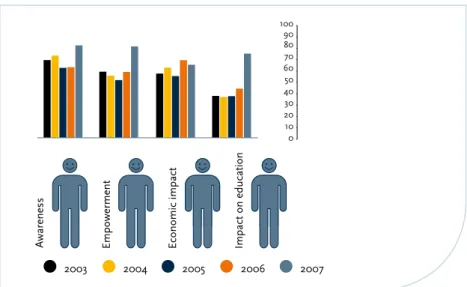
There are clear indications that the ICT projects described in this study have made a positive contribution towards achieving universal access to education. This is the result of the tangible impact of ICT on the quality and efficiency of teaching and learning processes at primary, secondary, tertiary and teacher training levels. Evidence gathered during the study shows that up to 80% of participants are more aware and feel empowered, while 60% indicated that they have experienced a direct improvement in the teaching and learning processes.
ICT generates opportunities for adolescents and young people in the workplace - MDG8
ICT as applied in the study contributes to generating skills that prepare adolescents, including young entrepreneurs and workers, for employment opportunities in the 21st century. This was found in the vocational training projects that train people for specific technical jobs. Equally, the training institutions described in the study directly contribute to MDG8 by producing knowledge workers with specific ICT skills. In 2007, 75% of the participants indicated that they had experienced an improvement in their employment opportunities.
Equal gender opportunities - MDG3
The study indicates that there is a healthy balance - 45% - of men and women participating in the projects, which also contributes to a reduction in gender inequality. Yet despite the equal participation of women, they still experience a lower impact compared to their male counterparts.
Lessons associated with the teaching
and learning processes
Focus on materials developed by teachers and instructors
One of the key lessons found in this study is that it is necessary to focus on training teachers and instructors to use ICT to develop their own teaching support materials. This approach assures ownership by teachers and instructors and enhances the usability of products. Many projects still focus on using materials for teachers and students that have been developed externally, however, such materials often fall short of providing appropriate or relevant content for the local situation.
Train teachers and instructors in basic ICT and pedagogical skills
Teachers and instructors need to be trained in basic ICT skills and ICT-based teaching methods to feel comfortable about using the materials. It is equally important to train them to integrate ICT in their teaching methods.
Support networking among teachers
Teachers need to be supported to set up platforms that enable them to share their opinions, experiences and teaching materials with other teachers. Face-to-face and virtual exchanges are both equally important to motivate teachers and improve the quality of local materials. Networking between projects at the country level is also very valuable. For this, the national ICT for development networks supported by IICD represent one possible approach. Cross-country exchanges are also important as a way to motivate and promote the exchange of experiences in ICT for education projects and programmes. For more sustained learning, online communities of practice for practitioners can be an additional option.
Use administrative applications as complementary services
The prospect of managing information more effectively and streamlining internal administrative procedures will act as an important incentive for headmasters and administrative staff to institutionalise the use of ICT at all levels. While most beneficiaries view ICTs for teaching and learning purposes as a priority, the use of ICT to support management and administrative procedures is very important.
Lessons on technology
Increase access to computers
Any initiative, be it government, NGO or private sector based, should make lobbying for more investments in computers a priority. Most teachers, instructors and students cited insufficient access to computers as the main obstacle in ICT for education programmes. This is particularly relevant for educational institutions located in the rural areas where the school or training institution is often the only access point for computers. Although this will require massive investments in the infrastructure, it is nevertheless essential in order to guarantee equal access and overcome the digital divide.
Introduce combined off-line and online based applications
Access to the Internet is viewed by most as an important tool for education as it allows for easier access to online teaching and learning resources. It also facilitates networking between teachers and between students. Finally, it is an important tool to exchange administrative and management information in the sector. Internet access is recommended where services are provided at a low cost and are of acceptable quality. Yet, in many areas Internet access is either unavailable or very costly. In such cases, alternative exchange modes such as CD ROMS need to be integrated right at the start of a project.
Search for low-cost solutions
Even where computer and Internet access is available and affordable, do not develop or introduce expensive online education platforms that require high-bandwidth Internet access. The widespread availability of free and open access platforms strongly increases the feasibility of a dynamic virtual exchange of experiences, opinions and materials. Many discussions have taken place in recent years on the use of Open Source Software versus proprietary software, but clear-cut answers remain elusive. It is therefore important to consider the philosophy as well as the level of convenience and related costs.
Second-hand computers are offered free-of-charge or at very low cost by various private sector and not-for-profit initiatives. However, second-hand computers usually come with additional costs for repairs, import taxes and costs to replace missing parts. Alternatives are found in the low-cost PCs such as the 100$ computer and similar initiatives by the private sector.
10 ICTs for education 11 ICTs for education
Lessons on sustainability
Set up an appropriate organisational structure
Strategically involving headmasters and parents is necessary for the institutionalisation and longer-term sustainability management of ICT facilities. Setting up administrative committees to manage ICT facilities has proven to be very effective in ensuring the sustainability of ICT initiatives. Beyond the institution, it is important to seek political support from the local authorities and the district or national education authorities to prepare for longer-term opportunities of funding and to have ICT recognised as part of the curriculum.
Think through a viable financial model before starting
Make sure that partners identify a locally feasible financial plan. Private training institutions may be able to generate sufficient income from trainees to afford more advanced ICTs. Larger public teacher-training and training institutions need to define how much of the institutional budget can be reserved for the re-current costs of ICT and take this as a starting point for an ICT plan. Smaller rural schools or vocational training centres will not be able to sustain costly ICT applications and should avoid high recurrent costs right from the start. Empirical evidence, however, does show that small institutions can also sustain smaller computer labs. Through contributions to the school, the Parent-Teacher Associations can be very supportive towards the ICT projects.
Secure technical capacities at the institutional level
ICT managers in the participating institutions need to be sufficiently trained to ensure that they can maintain and upgrade the ICT facilities on their own without any outside help. As it is very difficult to retain ICT-trained managers, institutions need to train a select number of enthusiastic teachers and students to ensure that temporary replacements will be on hand if needed.
Sector policy development for education
Generate awareness on the basis of experiences
It is important that practitioners with experience in ICT and education promote and raise awareness and engage in lobbying activities. Despite the enormous progress made in the last decade, there is still a lack of general awareness among policymakers, particularly with regard to the development aspects of ICT in the education sector. Support from external supporting institutions is found to be important as a complementary instrument in awareness and lobbying. The evidence base of IICD-supported projects in education and the national ICT4D knowledge sharing networks can contribute to this process.
Participate in ICT policy and strategy development in education
A long-term vision on the integration of ICT in education is a clear necessity in order to provide guidance and motivation to enthusiastic early adopters and other stakeholders. A vision is also crucial to actively plan for the deployment of ICT in the sector. In the longer term, the active participation of the government is essential to ensure the sector-wide introduction of ICT in education. Government involvement is critical to source additional investments in the ICT infrastructure; to integrate ICT in the curriculum; and to facilitate the widespread diffusion of materials.
1. Introduction
This impact study explores the potential contribution of ICT in the educational sector in developing countries. The experiences and lessons learned documented here are placed in the context of their contribution to the United Nations Millennium Development Goals (MDGs) and UNESCO’s Education for All (EFA) initiative, both of which are widely used by international donors and governments in developing countries as a framework for setting priorities.
Information and Communication Technology is a relatively recent instrument in the fight to eliminate hunger and poverty. In its 2002 Strategy Paper on ICT1, the World Bank states that: ‘information and communication technologies are a key input for economic development and growth. They offer opportunities for global integration while retaining the identity of traditional societies. ICT can increase the economic and social well-being of poor people, and empower individuals and communities. Finally, ICT can enhance the effectiveness, efficiency, and transparency of the public sector including the delivery of social services.’
The MDGs and EFA targets are formidable but achievable if a concerted and collective effort is made. The MDGs in particular aim to ensure that, by 2015, all children, particularly girls, underprivileged children, and children from ethnic minorities, will have access to and the opportunity to complete, free and compulsory, high quality primary education. The EFA framework recognises that to achieve these goals greater cooperation amongst the development community and more resources alone will not be enough. New initiatives will also need to be employed. One such initiative is to harness the potential of Information and Communication Technologies (ICTs). It recognises that, ‘these technologies have great potential for knowledge dissemination, effective learning and the development of more efficient education services’2 , and identifies a need to tap the potential of ICTs to:
• Support the professional development of teachers;
• Improve access to education by remote and disadvantaged communities; • Provide opportunities to communicate across classrooms and cultures; and,
• Strengthen management and administration procedures from the central ministries through sub-national levels to the schools.
While this indicates the importance of ICT for education, other institutions such as the World Bank’s InfoDev programme state, ‘There is widespread belief that ICT can and will empower teachers and learners (…) However, there are currently very limited, unequivocally compelling data to support this belief.’ When examining the integration of ICT in support of achieving educational objectives, it can be said that, after almost one decade of using ICT to 1 Information and Communication Technologies: A World Bank Group Strategy. Washington DC: World Bank Group, 2002. 2 UNESCO, 2000, Dakar Framework For Action, p. 21: unesdoc.unesco.org/images/0012/001211/121147e.pdf
1 ICTs for education 1 ICTs for education
TanEdu students during a hands-on computer course, Tanzania stimulate development, it is still not fully integrated in development activities. Greater
awareness-raising is therefore required. Scope of this study
The programmes provide lessons learned from on-the-ground experiences of partners, IICD staff and project end-users. An office-based study of project and policy documents was also used for the study. This report reflects how ICT has been deployed within the educational field and describes the achievements and lessons learned during this process. It also addresses the effectiveness of applying ICT to achieve goals set by the international development agenda.
This study provides evidence of the impact of ICT in the education sector through an evaluation of IICD-facilitated projects including 32 on-the-ground projects and policy formulation processes. Partners in the education field include private and public schools in rural and semi-urban areas, teacher training colleges and Ministries of Education. The overall impact is measured in terms of who is reached by the programme, the extent to which the projects have affected their level of awareness, empowerment, and economic position. The end-users and beneficiaries of the projects described in the study include school administrative staff, teachers and pupils.
The study highlights the nature and impact of IICD-supported activities on the education sector and provides lessons learned that are particularly relevant for policymakers, donor agencies, and organisations involved in development cooperation and the education sector.
this situation further, the education provided in most schools has not been adjusted to and does not correspond with the needs of the national labour market.
Teacher training, too, is often below par, with few possibilities for teachers to update their skills and few incentives for young people to choose teaching as a career in the first place. Those who do enter the teaching profession often leave because of poor wages and difficult working conditions.
Only a very small percentage of students enrol at secondary school level and even fewer go on to follow tertiary education. Finally, the devastating impact of HIV/AIDS on the education sector in developing countries cannot be overstated, from the shortage of teachers to the large numbers of children who are forced to leave school prematurely either to stay at home with sick relatives or to take up work to sustain their families. The international community is trying to redress the situation via international strategic frameworks and goals such as the UNESCO’s Education for All declaration and the MDGs mentioned earlier.
MDGs in education and the EFA initiative
In September 2000, the United Nation’s member states unanimously adopted the Millennium Declaration. The Millennium Development Goals (MDGs) were subsequently introduced as the framework to structure the development efforts of donors and government institutions. A monitoring mechanism measures goals, targets and indicators in the pre-defined time-frame of 2000-2015. The goals have been commonly accepted as a framework for coordinating and measuring development progress.
The education sector is crucial for enhancing human and social capital. It is widely recognised that education catalyses economic development by improving the skills of the labour force. It also stimulates social development by raising awareness and motivating people to strive for improvements in the health sector, the environment and governance.
Objectives two and three of the MDGs are derived from UNESCO’s Education For All initiative. The initiative has led to the Dakar Framework for Action, which is today considered to be the most comprehensive international educational agreement. It commits governments to provide quality basic education for all by 2015. The initiative specifies the following targets:
• Expand and improve care and education in early childhood, especially for young children who are disadvantaged and at risk.
• Introduce compulsory free primary schooling for all children, boys and girls, by 2015. • Meet the needs of young people by ensuring access to education and the acquisition of
basic ‘life skills’.
2. ICT for development and education
‘Many pupils learn in crowded, poorly furnished and unfinished classrooms, and often have to share scarce textbooks. Many teachers are poorly qualified and poorly deployed, but in any case are often trying to do a good job with a minimum of basic resources. The curriculum is often seen as too diverse and in some ways irrelevant for many of the pupils and their life needs. Many teachers, head teachers and other education support staff are also poorly prepared for the management and quality assurance tasks demanded of their roles, but are also often trying to work to the best of their ability in isolated and under-resourced contexts.’
Tanzanian Primary Education Development Plan 2007.
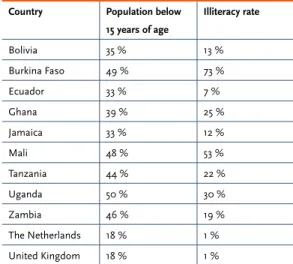
This chapter illustrates the role that ICTs play in supporting the leading development objectives identified by the international development community and national governments. While access to education is considered a basic human right, many countries are still struggling with poor quality education, insufficient teachers, high levels of illiteracy, large numbers of children dropping out of school, and the high cost of education. The illiteracy rate in IICD’s focal countries is outlined in Table 1 below.
Country Population below 15 years of age Illiteracy rate Bolivia 35 % 13 % Burkina Faso 49 % 73 % Ecuador 33 % 7 % Ghana 39 % 25 % Jamaica 33 % 12 % Mali 48 % 53 % Tanzania 44 % 22 % Uganda 50 % 30 % Zambia 46 % 19 % The Netherlands 18 % 1 % United Kingdom 18 % 1 %
Table 1. Illiteracy rate in IICD focal countries, as compared to the United Kingdom and The Netherlands (Source: CIA The World Fact Book 2006)
Access to education can be hampered by a number of different factors. The gender balance is generally tilted with fewer girls receiving education than boys. People in rural areas have less access to the educational system than their peers in urban areas. In addition, the educational sector has until recently received rather low levels of political support. This has led to chronic under-funding of the education sector as a result of which educational establishments across the board are usually ill-equipped and understaffed. To compound
1 ICTs for education 1 ICTs for education
International development frameworks and ICT task force that acknowledge the potential contribution of ICT have been put in place. However, the anecdotal evidence of projects needs to be transformed into a more systematic assessment of the impact of ICT. Documenting and sharing lessons learned is necessary to derive best practices that can, in turn, be used to maximise the impact and effectiveness of future efforts. This study aims to provide more comprehensive and empirical evidence of the impact of ICT on education.
Role of ICT in national development strategies
Within these international development frameworks, individual countries have prepared their own Poverty Reduction Strategy Papers (PRSPs), which report on progress in achieving specific development objectives. The PRSPs typically include strategies and objectives for the educational sector and are closely linked to the EFA goals described earlier.
The introduction of the PRSPs in 2000 have led to a strong focus on primary education in recent Sector Wide Approaches (SWAps) of the education sector. Yet, more recently, many governments have begun to recognise the need to expand their focus to include secondary education and teacher training. SWAps have received an increased level of donor support. A SWAp is a process in which sector funding from governments and donors supports a single policy and expenditure programme in a given sector under government leadership. SWAps in education outline clear goals for the education sector but tend to be less focused on the use of ICT. As ICT for education lies at the crossroads of these two policies, ample attention is needed to bring them together. A conducive policy environment is required in which individual projects can be initiated, results upscaled, and eventually incorporated into the mainstream activities of governments and organisations active in the education sector.
Remarkably, the need for ICT training and skills development is often more explicitly addressed in national ICT for development strategies than in education sector strategies. The ICT strategies are typically more focused on educational needs, than education strategies on ICT needs. National ICT policies provide a general framework for the use and development of ICT in a country. However, they generally focus on the telecom infrastructure and usually fail to address the development dimension, for example: the need for capacity building in ICT, or to invest in rural areas, or the sector-specific use of ICT. Moreover, they are not sector-specific.
In light of the above, governments are increasingly seeking to integrate the use of ICT in the PRSP and SWAps in education. Examples of this can be found in a growing number of countries including Bolivia, Egypt and Namibia, where ICT is now applied on a national level as part of the drive for enhanced quality and access to education for all. The • Reduce the illiteracy rate among adults by half, with an appropriate level of basic education
for adults.
• Eliminate all gender differences in the education system by 2015. • Improve the quality of education.
The Dakar Framework for Action stipulates that in order to achieve these goals the development community will need to allocate more resources to the education sector as well as start new initiatives in a coherent manner. It addresses the need for primary education, but also recognises the role of higher education, particularly in the field of teacher training, combined with reforms and good governance in educational systems. Role of ICT to achieve international education goals
Introducing ICT as a tool to support the education sector has initiated substantial discussions since the late 1990s. A decade ago the emphasis was on Technical and Vocational Education and Training and training teachers. During the last few years an increasing number of international development agencies3 have embraced the potential of ICT to support the education sector.
UNESCO has played a major role in spearheading the Education for All initiative to harness the potential of ICT. The widely subscribed Dakar Framework for Action recognises that, ‘these technologies (ICTs) have great potential for knowledge dissemination, effective learning and the development of more efficient education services’.
Furthermore, the United Nations ICT Task Force under Secretary General Kofi Annan recognised the potential of ICT for achieving the key Millennium Development Goals. It believes that one of the best ways to expand the use of ICT in the developing world is through schools and local communities. In 2003, McKinsey & Company were commissioned to investigate this further. Based on these results, the Task Force determined that: ‘…education, especially education enhanced by ICTs, not only sparks economic development by improving learners’ skills, but it also enhances social development across the community by raising peoples awareness of and their ability to improve their health, their environment, and even the way they are governed.’
When looking at the integration of ICT to support the achievement of educational objectives, it can be found that after almost a decade of using ICT to stimulate development, it is not yet fully integrated in development activities and awareness raising is still required. Yet, there has been considerable improvement over the past decade. Initial disbelief about the potential contribution of ICT for development embodied in comments such as ‘Why does a farmer need a computer’?’ and ‘Shouldn’t we focus on clean water first?’ have gradually faded away.
3 Donors and international agencies known for their supportive viewpoint in relation to ICTs include : SIDA, CIDA, DANIDA, DGIS, DFID, NORAD, InfoDev, the World Bank, UNESCO and UNDP.
governments of these countries have realised the contribution that ICT can make towards achieving broader development goals such as improved access to, and enhancing the quality of, education. To this end, they have developed an ICT for Education strategy. The experiences of Bolivia, Burkina Faso, Jamaica, Tanzania, Uganda and Zambia, where IICD assists governments in the development of sector-wide ICT strategies in education, will be highlighted in the following chapters.
ICTs for education
Over the last twenty years, industrialised countries and emerging economies have introduced ICT to their educational sector. This has changed the sector substantially and has had an enormous impact on the national economic development of the countries in question. Dramatic changes in the administrative processes and organisational aspects of the sector, including those within the curricula and the methodology of teaching, are inconceivable without the use of ICT.
In IICD’s vision, ICT is a cross-cutting tool that can improve development objectives in key development sectors, particularly in education. Often a distinction is made between modern ICTs (computer and Internet-based technology) and traditional ICTs (radio, printed matter, videos, telephones, and television). However, since traditional media can now be digitised, the distinction between the different media is gradually fading. All information and communication technologies that support the creation, collection, exchange and dissemination of information are equally valid and can play a vital role in catalysing the development process.
In practice, IICD strives to integrate a mixture of both traditional ICTs (radio, television) and modern ICTs (email, Internet) in its education programmes including elements of radio-based lessons, computer-based training, Internet-based training, or more interactive eLearning applications. Choices for combinations of applications are made on the basis of the local context considering the cultural, social and economic realities and competencies of partner organisations and their beneficiaries. The selected applications are chosen in direct consultation with the partners. This means that the ICT solutions chosen do not depend on what is technically possible, but rather on what is feasible and appropriate in each local context.
ICT-supported interventions in the education sector
The contribution that ICT can make to education has been described in detail in a study by the United Kingdom Department for International Development (DFID) which carried out an in-depth examination of the specific role that ICT can play in achieving the various MDGs. It provides details for assessing the contribution that ICT can have across the various sectors. The table below lists ICT-supported interventions that are most relevant for the education sector and lists the Millennium Development Goals they are helping to realise.
In Teemu Leinonen’s article ‘A critical history
of ICT in education’ four phases were outlined
as critical:
• Late 1970s - early 1980s: Programming: This was the era in which the pedagogical reason to use the computer focused primarily on programming, assisting in the development of students’ logic, and mathematics skills.
• Late 1980s - early 1990s: Computer Based Learning: When multimedia computers with graphics and sound applications became available, the computer began being used to support learning processes in basic subjects such as mathematics, reading and writing.
• Early 1990s: Web-based Learning: The third wave of using ICT in the education sector came with the advent of the World Wide Web. The use of the Web is partially a product of the challenges in updating content on CD-ROMs. Web-based information allows for educational content to be updated frequently.
• Late 1990s: E-Learning: E-learning combines computer-based and web-based learning applications for the student. It also provides facilities for interaction between the teacher and the student, and between students themselves.
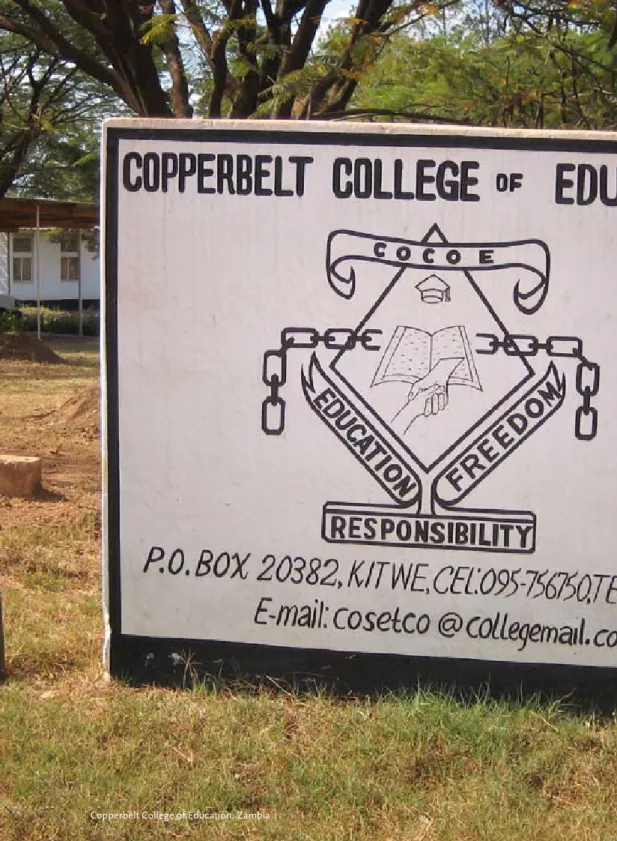
22 ICTs for education 2 ICTs for education Copperbelt College of Education, Zambia
MDGs ICT-supported interventions relevant for the education sector
MDG2: Achieve universal primary education
Teacher training: Increase the supply of trained pre-service teachers through ICT-enhanced training and by creating teacher networks.
Teaching and learning in the classroom: Capacity development of teachers to empower them to use ICT in the classroom and the development of curricula and support materials/resources through ICT.
Management and administration: Improve the efficiency and effectiveness of Ministries of Education and related bodies through the use of ICT for management and educational information.
Policy and strategy: Establish an enabling environment. Improve the overall strategic development of education by integrating ICT policies and strategies into the SWAps.
MDG8: Develop global partnerships for development and make new technologies, especially ICT, available
Young people’s learning skills: Use ICT to increase the employability of young people and empower them to meet the challenges of the knowledge-based global economy of the 21st century.
Knowledge workers: Develop a critical mass of knowledge workers with the technical skills to build and maintain the national ICT infrastructure.
Table 2. ICT-supported interventions in the education sector and the Millennium Development Goals they are helping to realise.
3. IICD project experiences
with ICT in education
‘Failure to absorb the growing number of primary school leavers will undermine Universal Primary Education and broader national goals like the elimination of poverty.’
Yusuf K. Nsubuga, Commissioner for Secondary Education in Uganda.
This chapter introduces IICD’s approach towards facilitating ICT-enabled development in the education sector and illustrates the various ICT for education (ICT4E) projects and policy processes supported by IICD and undertaken by local partners in eight developing countries.
IICD’s approach towards facilitating ICT for development
IICD’s involvement in ICT for development activities, both on a global and local level, is based on a complementary set of six guiding principles: demand-responsiveness, multi-stakeholder involvement, local ownership, capacity development, partnerships and learning by doing.
To achieve an appropriate level of integration of ICT in education, IICD applies a systematic, step-by-step participatory approach towards project and policy development. The whole process starts with a Roundtable workshop for 10 to 20 key stakeholders from the education sector in a developing country. The workshop participants are asked to contemplate the future of the education sector and the long-term challenges and opportunities ahead. This provides a realistic context in which they can proceed to identify different ways in which ICT applications could be used to improve the sector.4 The next step is for the stakeholders to develop their own individual idea further and transform it into a concrete project. Out of all the project ideas generated during a Roundtable workshop, around 6-10 reach the project formulation stage.
Once a project has been formulated and officially approved it is then ready for implementation. IICD provides support and guidance throughout the project implementation phase. The project is further strengthened with on-the-job capacity development programmes for administrative staff, teachers and students as well as training and advice about technical and organisational matters for the local project partners. ICT for development networks in each of the countries bring together project partners and governments to share experiences in formulating and implementing ICT-based activities and to lobby for the appropriate use of ICT by both private and government institutions in the education sector. The implementation of projects and policies is combined with a participatory and innovative monitoring and evaluation approach to foster learning and assess progress on an annual basis (see Chapter 4).
Projects that have a pilot function are developed in a participatory and systematic manner. The multi-stakeholder Roundtable process enables local partners to generate ideas for, and formulate their own, projects. This process is further strengthened by awareness-raising and capacity development activities. When a project goes into implementation, end-users give their opinions about their own personal satisfaction with the projects and the projects’ impact. These opinions are analysed and discussed with the end-users in question at Focus Group Discussions. The purpose of the Focus Group Discussions is to facilitate learning between project partners and to provide useful lessons learned that can be used to improve the project implementation process.
IICD’s work in the education sector is developed in collaboration with other international organisations. For example, ItrainOnline (www.itrainonline.org); a web-based resource developed by a partnership of eight development organisations working in ICT and Media for Development (IICD, APC, Bellanet FAO, INASP, OneWorld Network, UNESCO and Telecentre.org). ItrainOnline offers online training material to improve capacity in the use of ICT and was shortlisted in April 2007 by the Online Educational Database (OEDb) as one of the top 80 online resources for building or participating in a collaborative educational activity. Another important source for partners is the collection of CD ROM-based eLearning modules on ICT which are available to IICD training partners and project partners so that they can train themselves and use the information in training activities. Overview of IICD-supported projects in the education sector
IICD and its partners have built up a substantial portfolio of 32 ICT projects in education in eight countries. The projects are formulated and implemented by government agencies, ministries, schools, teachers, civil society organisations and the private sector.
The projects use ICT to enhance the teaching skills of teachers, increase computer literacy, produce digital educational materials, and support management and administrative procedures in the education sector. Other projects improve young people’s ability to acquire new skills and, in so doing, contribute towards developing a critical mass of knowledge workers. For this, partners provide ICT connectivity and equipment, software applications and continuous capacity development.
IICD and its partners also focus on embedding lessons learned from pilot projects within national education policies and programmes. In this respect, IICD and its partners work closely with national governments, providing guidance and support to them during their work to formulate ICT policies and strategies to integrate ICT in SWAps. For this, IICD and the Global e-Schools and Communities Initiative (www.gesci.org) entered into a partnership to share experiences in supporting governments in the formulation and implementation of national ICT for education programmes.
2 ICTs for education 2 ICTs for education
While many development programmes focus exclusively on primary level education, IICD’s partners have consistently argued for more attention to be given to other educational levels: secondary, tertiary, and teacher training colleges. This first became evident during the Roundtable workshops facilitated by IICD which enable stakeholders from the education sector to set their own ICT priorities and determine which areas would benefit most from ICT. As ICT is relatively costly to install, maintain and run, it has to be applied selectively to the education system. Inevitably, choices have to be made.
IICD’s education projects are classified overleaf according to their contribution to MDG2: Achieve Universal Primary Education and MDG8: Develop a Global Partnership for Development. The chapter goes on to provide examples of some of the education projects supported by IICD and uses them to illustrate the many different ways in which ICT applications can be introduced successfully in the education sector. A complete overview of all IICD-supported projects in the education sector, with brief descriptions of their main activities, can be found in the annexes at the back of this publication.
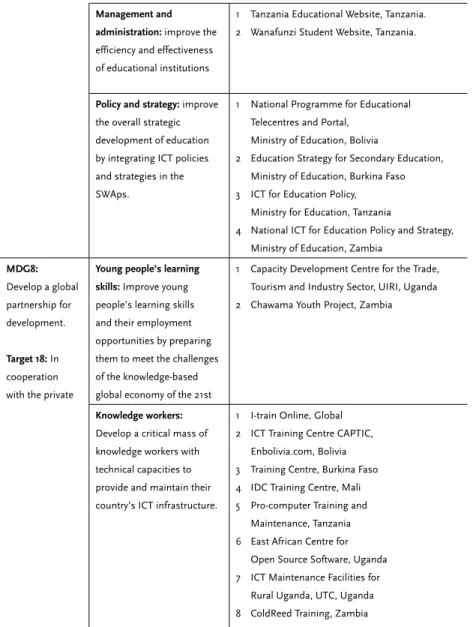
MDGs ICT-supported interventions relevant for the education sector
IICD-supported projects and policy processes
MDG2: Achieve universal primary education
Teacher training: increase supply of trained teachers through ICT-enhanced training and by facilitating networking between the teacher training colleges.
1 Jamaica Collaborative for Universal Technology Education, IECF, Jamaica
2 ICT Connect-TED, Tanzania
3 Teacher Professional Development, Tanzania 4 Basic ICT Training, ITEK, Uganda 5 Copperbelt College of Education, Zambia Teaching and learning in
the classroom: capacity development for teachers to train them to use ICT in the classroom and to develop curricula and support materials/resources through ICT.
1 Global Teenager Project; active in 30 countries 2 Integration of ICT in primary and secondary
schools (Fundación Ayni), Bolivia. 3 ICT for education in secondary schools
(CEPAC), Bolivia.
4 Multimedia systems for ethnographic material (APCOB), Bolivia.
5 ICT for Education, Burkina Faso.
6 Global Teenager Ghana, Rescue Mission, Ghana. 7 Distance Learning and Education Services,
Tanzania
8 Production of ICT-based Education Content, Kyambogo University, Uganda.
9 Education Network, OneWorld Africa, Zambia. 10 Enhancing the Visual Presentation of
Educational Content, Zambia.
Management and administration: improve the efficiency and effectiveness of educational institutions
1 Tanzania Educational Website, Tanzania. 2 Wanafunzi Student Website, Tanzania.
Policy and strategy: improve the overall strategic development of education by integrating ICT policies and strategies in the SWAps.
1 National Programme for Educational Telecentres and Portal,
Ministry of Education, Bolivia
2 Education Strategy for Secondary Education, Ministry of Education, Burkina Faso 3 ICT for Education Policy,
Ministry for Education, Tanzania
4 National ICT for Education Policy and Strategy, Ministry of Education, Zambia
MDG8: Develop a global partnership for development. Target 18: In cooperation with the private
Young people’s learning skills: Improve young people’s learning skills and their employment opportunities by preparing them to meet the challenges of the knowledge-based global economy of the 21st
1 Capacity Development Centre for the Trade, Tourism and Industry Sector, UIRI, Uganda 2 Chawama Youth Project, Zambia
Knowledge workers: Develop a critical mass of knowledge workers with technical capacities to provide and maintain their country’s ICT infrastructure.
1 I-train Online, Global 2 ICT Training Centre CAPTIC,
Enbolivia.com, Bolivia 3 Training Centre, Burkina Faso 4 IDC Training Centre, Mali 5 Pro-computer Training and
Maintenance, Tanzania 6 East African Centre for
Open Source Software, Uganda 7 ICT Maintenance Facilities for
Rural Uganda, UTC, Uganda 8 ColdReed Training, Zambia
Table 3. Overview of IICD-supported projects and their contribution to the MDGs.
Teacher training
‘ICTs can help in the achievement of MDG2 by increasing the supply of teachers through ICT-based distance education and enabling greater access to education for all, which will strengthen the knowledge equity on technology.’
IICD has supported a number of projects that focus on improving teacher training. The focus on teacher training evolved from the need to secure sufficient human capacity to enable an appropriate use of ICT in the education sector. For this, ICT is to be introduced as a new subject in the standard curriculum of Teacher Training Colleges so that future teachers can leave school with basic ICT skills and knowledge. However, it is even more important to secure the integration of ICT in the overall teaching and learning process of Teacher Training Colleges. This requires training modules focusing on the development of pedagogical competences related to the integration of ICT in the teaching and learning processes of future teachers.
Projects in this category include:
• Jamaica Collaborative for Universal Technology Education, IECF, Jamaica • ICT Connect-TED, Tanzania
• Teacher’s Professional Development, Tanzania • Basic ICT Training, ITEK, Uganda
• Copperbelt College of Education, Zambia
Case: The Jamaica Collaborative for Universal
Technology Education initiative
Launched in February 2006, this high-profile, public-private initiative aims to ‘provide a solution to the increasing number of the island’s secondary school students graduating without the requisite work-related technology skills by building partnerships between the public and private sector to fund ICT programmes in schools’. For this, Teacher Colleges will be equipped with ICT facilities and will use elearning modules to upgrade their skills in integrating ICT in education. So far, 39 organisations from both the public and private sector have pledged their support for this initiative in terms of funding, advice and practical input. The initiative is led by the International Education Collaboration Foundation (IECF) and the ICT4D Jamaica network, which was set up with support from IICD. More information about the initiative can be found on the ICT4D Jamaica website (www.ict4djamaica.org/jcute) as well as the JCUTE website (www.jcute.org.jm).
Teaching and learning in the classroom
‘In addition to having learned how to use these technologies together with my students, I now use the computer as an effective additional teaching tool.’
(Maria Lourdes, Teacher, AYNI project in Oruro, Bolivia)
Most primary and secondary schools in Africa and Latin America lack adequately trained teachers and have poor quality, or limited access to, learning materials. ICT can assist in addressing these challenges.
First and foremost, this requires ICT facilities to be set up in the schools. As this requires an investment in facilities, it is important to ensure that a proper organisational structure has been put in place beforehand; one in which headmasters, teachers and parents can participate. A proper organisational structure is key to the sustainable use of ICTs in schools in the longer term. Encouraging the active involvement of parents will open up ways to raise money for small financial contributions that are required for maintenance, contracting a manager for the ICT facilities, and replacing equipment. To generate political and financial support, representatives from the local authorities should also be invited. However, if this organisational model is applied, the capacity of the parents to handle issues relating to financial and organisational management must be secured, if necessary by providing them with limited training.
It is also necessary to give the manager of the ICT facilities advanced training to ensure that the schools will be able to maintain and upgrade their facilities without having to call upon – often expensive – external support. Furthermore, basic ICT training for teachers is required to overcome their possible fear of new technologies and to give them a headstart over the students. In most cases, direct ICT training for students is not required as ICT can be integrated directly into relevant subjects.
ICT can provide teachers with more up-to-date support materials. In the projects’ supported by IICD it was found that teachers are best trained in the development of their own, localized materials thus ensuring ownership by the teachers and the production of materials that are directly relevant to the secondary school students. As the development of local content is time-consuming, externally developed materials can be complementary. However, they cannot completely replace local content.
A wide range of educational content has been produced by teachers and supporting institutions within the scope of the IICD-supported projects. This includes educational support materials for mathematics, languages, indigenous knowledge and cultures. One interesting example of a project that produces educational content based on indigenous knowledge is the Multimedia Systems for Ethnographic Material project in Bolivia (see case study). Another project provides teachers with swift access to useful training materials. This is the DILES project in Tanzania which focuses on making text books and model exams accessible online. Projects that contribute towards strengthening the curriculum include the Global Teenager Project (see case study overleaf) through which schools all over the world link up with each other online to discuss important issues, such as HIV/AIDS, human rights and the environment.
0 ICTs for education 1 ICTs for education
The teachers can also use ICT and digitised materials in the classroom to introduce new and more productive ways of teaching and learning. Yet, ICT-based educational material is a lot more complex than simply digitising text books and making them available online. It requires teachers to be trained not only in basic ICT skills but also in pedagogical skills to use online tools and teaching materials in the classroom.
Case: Bolivia’s largest ICT for education initiative
– the AYNI Project
Launched in 2000, Fundación Ayni began a 5-year project that focussed on integrating ICTs in primary and secondary education. By 2005, this project had reached twenty schools and, from there, expanded to include the departments of La Paz and Tarija, making it the largest ICT for education initiative in Bolivia. Most significantly, the programme had reached seven schools located in very isolated rural areas, all of which lacked access to basic services.
In total, approximately 40,000 teachers, students and parents have benefited from the project either by directly participating in the content programmes or through indirect access, such as access to the computer facilities. Furthermore, 46 schools have had computer labs installed. These labs are managed by administrative committees in which headmasters and parents participate. The facilities are sustained through monthly contributions by parents. During the evening hours, parents can follow training too.
Trained staff are now assisting in the maintenance and further technological development of the labs. Teachers have also started to develop educational modules that incorporate very basic ICTs in lessons and, in turn, the curriculum. The teachers have hitherto produced 16 interactive educational games for primary pupils to enhance their mathematics and language abilities. Evaluation has shown that as a result of using the games the learning processes of pupils are more effective and, above all, are much faster than standard methods. Last but not least, 350 students have participated in the Global Teenager Project (GTP) as a result of the project and have been sharing their experiences with fellow students in other countries.
Case: Teaching the next generation
about indigenous cultures
Indigenous organisations and non-governmental organisations (NGOs) in Bolivia have developed a large collection of ethnographic materials, consisting of important indigenous knowledge about culture and economic practices in Bolivia. The material is available as text and on audio and is catalogued on image and video. If unpreserved, valuable information and educational material about cultural traditions and cultural values could be lost forever.
This award-winning project began in 2000: the NGO Apoyo Para el Campesino Indígena del Oriente Boliviano (APCOB) developed a collection of multi-media based modules for basic, secondary and teacher training. The first module produced in the series was about the indigenous Ayoreos people. All modules were tested and introduced in four secondary schools in Santa Cruz, along with a training programme for teachers and students. Since then, steps have been made to mainstream the project and to secure future financial support by means of a Memorandum of Understanding with the regional education authorities, integration of the materials in the national curricula by means of active lobbying at national level, and presentation of a long-term proposal to the Ministry of Education for funding as part of the ICT policy for the education sector.
Case: The Global Teenager Project
The Global Teenager Project (www.globalteenager.org) aims to improve the quality of secondary school education by introducing secondary school teachers and pupils all over the world to new applications of ICT. The project was set up and funded by IICD and is based on an idea by both IICD and I-EARN in 1998.
The first GTP Learning Circle took place in 1999 between a handful of pupils from secondary schools in South Africa and the Netherlands. The project has grown exponentially since then: today, over 6,000 teachers and pupils from 30 different countries regularly take part in the project. To facilitate the smooth running of the project, each of the countries taking part has its own GTP Coordinator. Each year, coordinators exchange experiences at an international gathering supported by IICD and KPN of the Netherlands.The project also strives to promote intercultural awareness and sensitivity by enabling pupils to meet up with other pupils in online ‘Learning Circles’ to discuss topical issues such as the environment, human rights, and HIV/AIDS. The Learning Circles
facilitate a structured exchange of research questions between and among students from different countries to enable them to learn about each others local and cultural realities. Currently, English, Spanish and French circles are in operation. As a spin-off, other organisations have started a circle in Arabic.
Case: ICT in secondary schools in Burkina Faso
The TICE project in Burkina Faso targets twelve secondary schools and empowers them to a level at which they will be able to integrate ICTs more successfully in their education cycle. This is achieved through awareness-raising, by providing capacity development and technical assistance, and through content development. Both teachers and students benefit from their newly acquired IT-skills. Teachers involved in the project developed the website themselves to create a pool of teaching materials that is available online. The project also generates experiences that can be fed into the development of the Education policy of Burkina Faso. The TICE website (www.tice-burkina.bf) won second prize in the national competition for the best website which took place during the National Internet 2007 week in Burkina Faso.
Projects in this category include:
1 Global Teenager Project, Global
2 Integration of ICT in primary and secondary schools, Fundación Ayni, Bolivia 3 ICT for education in secondary schools, CEPAC, Bolivia
4 ICT for education, TICE, Burkina Faso
5 Multimedia systems for ethnographic material, APCOB, Bolivia 6 Global Teenager Ghana, Rescue Mission, Ghana
7 Distance Learning and Education Services, DILES, Tanzania 8 ICT-based Education Content, Kyambogo University, Uganda 9 Education Support Network, One World Africa, Zambia
10 Enhancing the Visual Presentation of Educational Content, Zambia. Management and administration
Institutional capacity in the education sector needs to be strengthened in order to manage and plan activities more effectively. Information is mostly in hardcopy format and is not easily accessible. Data about teachers, salaries, student grades, the number of pupils per class, and statistical information in general are scattered and are not readily available. The scant amount of information that is available tends to be unstructured and dispersed, which makes analysis for management purposes difficult.
The need for educational management systems to provide structured and up-to-date information about the educational system is clearly evident. The introduction of ICT to support institutional processes is complex and requires organisational changes which, in turn, will pose other challenges once they have been implemented.
IICD has supported two projects that focus on institutional strengthening. The Wanafunzi project in Tanzania focuses on information and exchanges that are directly relevant to Tanzania’s students. Meanwhile, the Tanzania Educational Website project focuses on disseminating information about the educational system to students and parents in Tanzania (see case).
Projects in this category:
1 Tanzania Educational Website – TANEDU, Tanzania 2 Wanafunzi Student Website, Tanzania
Case: Examination results on the Internet
in Tanzania
The Tanzania Educational Website project has developed a website and newsletter with reliable, accurate and up-to-date information about education services around the country. Together with high-profile events, the initial goal was for this to become a hub for knowledge sharing in the education sector. Information about schools, examination results, school administration, and the latest news is disseminated in the education sector. The website (www.tanedu.org) has become integral to this, enabling users to navigate their way to relevant sources of information as well as exchange ideas. Activities include gathering and linking reliable and significant information from local and national sources; distributing relevant content to users; facilitating dialogue among relevant parties in the education sector around the country; and sharing knowledge and communicating information through discussion boards and a blog. Very popular parts of the site are the examination results section and the school database system: Over 500,000 students and parents visit the website following the publication of new examination results. Since June 2004, a monthly newsletter has been produced and the off-line version has been circulated up-country via a co-operative agreement with Peace Corps volunteers, among others. The news bulletin contains articles that are mainly targeted at students, teachers and parents.
ICTs for education ICTs for education
Policy and strategy
It is important to include an ICT dimension in sector policies and implementation strategies in the education sector. Engaging in policy dialogues with governments and helping them to develop appropriate ICT strategies and implementation frameworks is therefore high on IICD’s agenda. The focus is not merely on integrating the more traditional ICT aspects of equipment and connectivity, but focuses on integrating ICT in teacher training, formal primary, secondary and tertiary education and vocational training as well. In addition, ICT to support management and administrative procedures within the education sector is also a standard focus area to develop as part of the strategy. IICD realises that the policy formulation process is just as important as the final policy document itself. It therefore promotes processes that reflect national and international policy frameworks and which are based on a participatory multi-stakeholder approach, local ownership, and practical experiences. The process in each country has been different due to the varying political dimensions. The key success factor in this respect is the political support from high-ranking decision-makers in the education sector. Without their support the chance that a policy document will be approved is highly remote, let alone that it will implemented.
One important variable is the difference in the range of stakeholders involved in delivering education services, including public and private actors at the local and national level. Another element to consider is the level of awareness and knowledge amongst key staff at the Ministry of Education. Where needed, awareness-raising or training workshops are provided to generate interest and ownership at different levels within the ministries. Another important element is the presence of a dedicated ICT team or committee within the ministry that will lead the strategy formulation or implementation process.
During these processes, governments too often start from scratch when developing ICT strategies or base their assumptions on experiences in other countries. Yet, local experiences can provide more close-to-home and appropriate approaches to ICT in education. Therefore, individual ICT for education projects, including those of IICD partners, serve as a starting point by showcasing the potential of ICT to policymakers and decision-makers and demonstrating the benefits that ICTs can bring.
A good example of this can be found in Burkina Faso: a high-profile Roundtable Workshop on ‘How to use and integrate ICT in secondary education’ in July 2006 prompted the Ministry of Secondary Education to set up a Task Force to make ICT policy recommendations and come up with ideas for ICT projects in 2007. In addition, the project leader of the ICT for Education Technologies project, an IICD-supported project, recently became a resource person for the Ministry of Secondary Education and is currently helping the ministry to formulate policy recommendations.
IICD is currently supporting the Ministries of Education in their policy and strategy formulation and implementation processes in Tanzania, Bolivia, Burkina Faso and Zambia.
Projects in this category:
1 National Programme for Educational Telecentres and Portal, Ministry of Education, Bolivia 2 Education Strategy for Secondary Education, Ministry of Education, Burkina Faso 3 ICT for Education Policy, Ministry of Education, Tanzania
4 National ICT for Education Policy and Strategy, Ministry of Education, Zambia
Case: Developing a national ICT for education
policy in Tanzania
In Tanzania, a series of multi-stakeholder workshops were held to help develop an ICT policy and implementation strategy for primary and secondary education and teacher training. Following the workshops, a smaller group generated the key elements of this strategy. In Tanzania, project partners of IICD across the education sector have been the catalyst for policy discussions. New initiatives, such as the SIDA-sponsored eSchool programme, were integrated into this policy study.
The approach taken was quite novel. The starting point was to focus on the interests of the main stakeholders in the sector. These interests and the mechanisms to realise them were mapped out in a participatory manner. This helped to better define the usefulness of ICT, the areas of policymaking required, and provided a much better mutual understanding between all those involved.
Using the latest software, the Innovation Suite of Inpaqt, the maps were computerised and areas with the highest impact for ICT were identified. For each of the areas, ideas were generated and discussed. Ten areas were then prioritised for ICT policy and implementation.
The workshop activities proved to be resoundingly productive for all participants and have since resulted in a national ICT for education policy which was officially launched by the Ministry of Education and Vocational Training in July 2007.