How to offer an international
experience to every student? Realization
and implications of an integrated
internationalization policy at
Katholieke Hogeschool Leuven
1
Jose Tummers Lieve Mulier
Katholieke Hogeschool Leuven, Belgium
AbstractWe will discuss the internationalization policy of Katholieke Hogeschool Leuven, department of Business and Management Studies to offer (at least) one international experience to every undergraduate student. After having presented the general political and social background of this policy, we will review the different internationalization initiatives and the possibilities for students and staff members to participate. Finally, we will discuss the implications of this policy for the organization arguing for a broad and structural integration of internationalization initiatives at all levels of departmental organization.
Key-words
Internationalization policy, International week, Bachelor degree program, Double degree program
Introduction
In the present paper, we will discuss the policy to offer an international experience to every undergraduate student at Katholieke Hogeschool Leuven (Leuven University College), department of Business and Management Studies, hence abbreviated as ECHO. We will give an overview of the internationalization initiatives and discuss their embedding in the study program. Finally, we will show how this broad and structural embedding has given rise to the creation of a novel initiative challenging the actual organization.
ECHO is one of the four departments of Katholieke Hogeschool Leuven, a university college organizing professional bachelor degree programs. Compared to academic
bachelor programs, where graduates are – most of the time – prepared for a master program, professional bachelor programs prepare students for a specific job, such as accountant or office manager. The program is characterized by a practical and case-driven approach, as opposed to the theoretical and general(izing) point of view adopted in academic programs.
ECHO hosts about 1,300 students in the following bachelor degree programs: Bachelor in Business Management, where students can choose between the following •
options: Marketing, Legal Practices, Accountancy & Tax, and Finance & Insurance. Bachelor in Office Management, where students can choose between the following •
options: Management Assistant and Business Translator.
Postgraduate bachelor in Advanced Business Management2, with the following •
options: Marketing & Communication, Logistics, Human Resources Management, and International Tax.
The remainder of this paper is structured as follows. First, we will briefly sketch the social and political background that has led to the decision to focus on internationalization (section 1). Next, we will give an overview of how internationalization is realized at the department (section 2). Finally, we will discuss some practical implications for the organization (section 3).
1 Social and political background
Before describing the internationalization activities at ECHO, we will briefly review the social and political background motivating the departmental policy to focus on internationalization as a component of the curriculum of bachelor degree programs in Business Management and Office Management.
1.1 Politics
During the last decade, politicians have been progressively creating a framework to enhance international collaboration in higher education. Collaboration amongst EU partners is considered a necessary condition to maintain their international competitiveness in a changing and globalizing market.
At the European level, the Bologna Declaration3 in 1999 was an important milestone aiming at the creation of a European higher education area with comparable and interchangeable degrees and quality insurance standards.4 The resulting Bologna Process has progressively enlarged the opportunities not only to exchange students and staff members but also to jointly organize degree programs. At the Leuven and Louvain-la-Neuve summit in 2009, the Ministers Responsible for Higher Education of the countries
of the Bologna Process have set “International openness” as well as “Mobility” as priorities for the next decade.5 The goal that has been set states that 20% of the students in higher education should spend a study period abroad by 2020.
In Flanders6, these goals have been adopted in the Flanders in Action-plan7, translating the Flemish ambition to figure amongst the best performing European regions. Internationalization is considered a prerequisite to maintain and enhance the competitiveness of the Flemish economy and industry. As a consequence, the current Flemish government (2009-2014) considers internationalization as a strategic goal in its policy in the domains of economy8, research and innovation9 and education10.
1.2 Business and industry
Entrepreneurs stress the importance of internationally sensitive employees. In 2005, an inquiry amongst entrepreneurs organized by Flanders’ Chamber of Commerce and Industry has identified internationally sensitive employees as one of the most important needs of the Flemish economy.11 Flanders District of Creativity, a governmental organization promoting entrepreneurial creativity, also stresses the importance of internationalization as a key to entrepreneurial success.
In short, in Europe as well as in Flanders, one can witness a growing movement stressing the international dimension of business and entrepreneurship and hence the importance to integrate it in (higher) education. However, due to historical and cultural reasons,12 Flemish educational law sets far-reaching language restrictions to the organization of international programs at bachelor-level, mainly because this level is considered essential for the development of a Dutch professional and technical terminology.13
2 Realization of an integrated internationalization policy in higher education In this section, we will first present how internationalization is integrated in departmental policy plans and next we will show how these plans are put into practice, for students as well as for staff members.
2.1 Departmental policy plan
Internationalization is one of the four focuses defined by the department. This choice is strongly motivated by taking into account the political and social context outlined in section 1.
policy plan for 2008-2013. The main advantage is that separate critical success factors and operational goals have been formulated for internationalization:
Every undergraduate student must take part in at least one international experience in •
his/her bachelor program.
The international mobility of staff members has to be stimulated and improved. •
The progression toward these goals is monitored at the end of every academic year.
2.2 Realization of the departmental policy plan 2.2.1 … for students
From the students’ point of view, the default internationalization program and the optional internationalization opportunities have to be distinguished.
The default program is mandatory and consists of a series of international weeks.13 These international weeks are conceived as short internationalization at home programs offering an international experience to students at their home campus. The mandatory character requires that those initiatives are organized at home in order to be financially accessible to all students and that a separate international week is organized for every option in the bachelor programs.15 During one week students collaborate in international teams to solve a case in their domain of expertise at the ECHO campus. The international experience is twofold: first of all, working and living with students from various nationalities brings the students in touch with – often subtle – cultural differences and sensitivities; next, the international dimension of the case to be solved confronts the students with different national systems next to the European system (e.g. tax, law, accountancy).
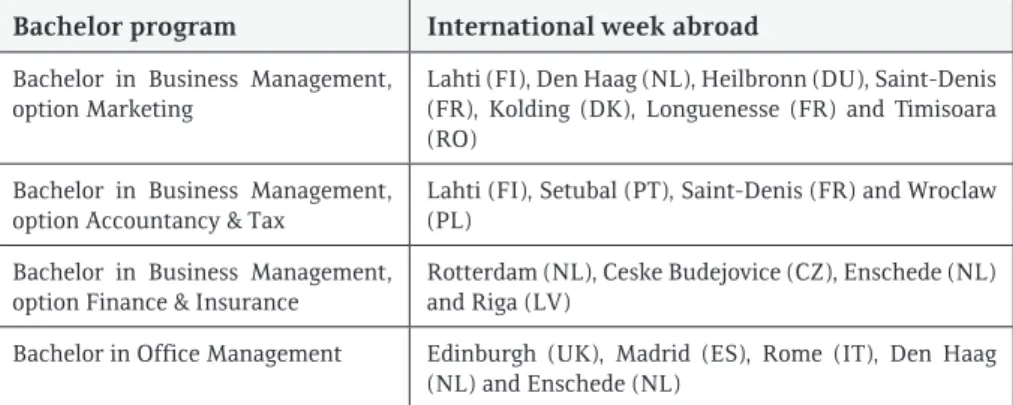
Moreover, instead of participating in the international weeks at ECHO, students have the opportunity to participate in an international week abroad organized by one of our partner institutions. There is a tendency to organize the international weeks in the same week to reduce the practical problems for the students and staff members attending an international week abroad. Table 1 lists the international weeks students can attend abroad during the academic year 2009-2010.
Bachelor program International week abroad Bachelor in Business Management,
option Marketing
Lahti (FI), Den Haag (NL), Heilbronn (DU), Saint-Denis (FR), Kolding (DK), Longuenesse (FR) and Timisoara (RO)
Bachelor in Business Management, option Accountancy & Tax
Lahti (FI), Setubal (PT), Saint-Denis (FR) and Wroclaw (PL)
Bachelor in Business Management, option Finance & Insurance
Rotterdam (NL), Ceske Budejovice (CZ), Enschede (NL) and Riga (LV)
Bachelor in Office Management Edinburgh (UK), Madrid (ES), Rome (IT), Den Haag (NL) and Enschede (NL)
Table 1: International weeks abroad ECHO students can attend in 2009-2010
The organization of these international weeks requires an extended network of trustworthy partners sending each year students and staff members and organizing each year an international week.
Next to the international weeks, students can engage in one of the following initiatives. These initiatives, except the business games, generally represent the study load of one semester, viz. 30 ECTS.
The Erasmus exchange program offers students the possibility to study during one semester at an institution in another EU member state, offering an intensive linguistic and cultural immersion. Moreover, ECHO organizes an international (and English-taught) program in Business Management for incoming Erasmus students during the second semester of the academic year. Since academic year 2008-2009, Erasmus students can also follow an international program during the first semester: these students join the EBM students (see below for more information). To organize these Erasmus exchanges, bilateral agreements are signed between both partner institutions.
During the sixth semester (viz. semester 2 of year 3 in the bachelor program), students conclude their training with a 13-week internship where they put into practice the knowledge and skills acquired. Students have the opportunity to do this internship abroad by means of an Erasmus exchange. To bridge the geographical gap hampering the follow-up of these students, a software platform has been developed where the student’s activities are monitored by the company mentor as well as the school mentor.
From the academic year 2008-2009 onwards, a limited number of internships is offered in Africa (Malawi) and Latin-America (Peru) in the context of North-South collaboration. After an intensive introduction in Belgium, including a specialized module about North-South collaboration, to prepare for activities of the internship, students train local partners to start a new business or to extend and optimize the activities of an
existing business.
Erabel (Erasmus Belgium) is an exchange program similar to Erasmus but takes place within Belgium. Flemish, viz. Dutch-speaking, students are offered the opportunity to study for one semester in the French-speaking community and vice-versa. This immersion in the language and culture of the other main community in Belgium is of a particular interest for students in Business Management, since the French-speaking community is Flanders’ most important business partner.
ECHO participates in two international business games, namely the case competition organized by the Network of International Business Schools (NIBS) and the Hagen Business Game. Students of the postgraduate bachelor in Advanced Business Management can apply to represent the ECHO teams in these international competitions.
Finally, ECHO has initiated two international projects, the first leading to a double bachelor degree16 and the second leading to a UK master degree. We will first discuss the double bachelor degree in Business Management (EBM) that has started in September 2007. Students following the bachelor in Business Management – option Marketing can choose between the regular Dutch-taught program and an English-taught variant of this program, the European Bachelor in Business Management – Marketing (EBM). This is a three year bachelor degree program organized by the International Business Academy Kolding (DK), Coventry University Business School (UK) and ECHO (BE). Students take the first year at the International Business Academy Kolding (60 ECTS), the second year at ECHO (60 ECTS) and conclude the program at Coventry University Business School (60 ECTS). The goal of this program is to turn out internationally sensitive graduates who can flexibly collaborate in an international setting and adapt to different cultural environments. Next to the UK degree issued by Coventry University Business School, students taking the EBM program have the opportunity to obtain the Flemish degree when they meet the criteria stipulated in the ECHO Education and Examination Regulations. To this end, they have to pass modules of Business French or Business German for 15 ECTS. In order to issue the English-taught bachelor degree, the EBM program had to be approved as equivalent to the regular Dutch-taught program by the Flemish administration checking whether this program meets the criteria stipulated in Flemish legislation17 for programs taught in a foreign language.18
Let us now consider the international master program. Students following the postgraduate bachelor in Advanced Business Management have the possibility to get a master degree in Marketing, Logistics or Human Resources Management at Coventry University Business School by following a shortened program in Coventry from the academic year 2007-2008 onward. To this end, Coventry University Business School recognizes part of the 60 ECTS of this postgraduate bachelor program as APEL/APCL so
that students only have to take 2/3 of the master program, 1/3 consisting of modules and 1/3 consisting of a research project. However, graduates who want to work in Flemish administration still need to have their master degree recognized on an individual basis by the Flemish administration because ECHO, as a university college organizing only bachelor programs, is not authorized to (co-)organize nor recognize a foreign master program.
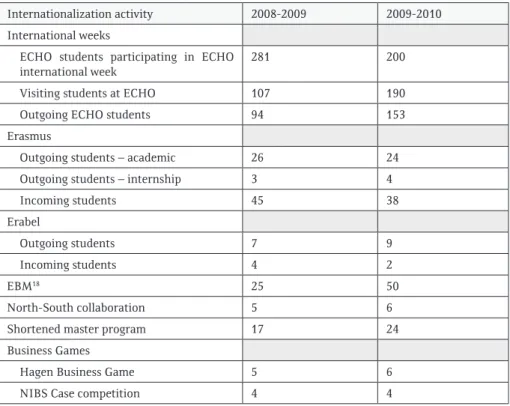
After having presented the initiatives, we will now turn to their impact. In other words, to what extent does ECHO meet the objective to offer one international experience to every student and to what extent do students seize the opportunities to internationally upgrade their resume? The first question can be answered by looking at the curricula: in all bachelor programs, the project work in year 2 includes an international week for 2 ECTS. As a consequence, every student has at least one international experience in his/ her curriculum. To answer the second question, we will have a look at the data in table 2. In this table, student participation in internationalization activities is summarized for the academic years 2008-2009 and 2009-2010.
Internationalization activity 2008-2009 2009-2010 International weeks
ECHO students participating in ECHO international week
281 200
Visiting students at ECHO 107 190
Outgoing ECHO students 94 153
Erasmus
Outgoing students – academic 26 24
Outgoing students – internship 3 4
Incoming students 45 38 Erabel Outgoing students 7 9 Incoming students 4 2 EBM18 25 50 North-South collaboration 5 6
Shortened master program 17 24
Business Games
Hagen Business Game 5 6
NIBS Case competition 4 4
These data clearly show that there is considerable student interest to participate in internationalization activities, in particular short activities as can be deduced from the figures for outgoing ECHO students for the international weeks. Although we notice a broad student participation in the long activities, it is evident that the numbers are lower since those activities require a greater personal and financial engagement. Moreover, the number of students that can apply for some of those activities is limited due to the character of the activity (e.g. business games, North-South internships).
We can conclude that ECHO succeeds in offering every student at least one international experience by organizing at its campus an international week for every bachelor program. Students looking for a more challenging experience can choose from a wide range of activities.
2.2.2 … for staff members
Staff members can engage in several internationalization activities related to education and research. As far as education is concerned, staff members can engage in different mobility activities.
They can coach students during an international week at ECHO or abroad. Whereas •
coaching students at ECHO focuses on the contents of the case study to be solved, coaching students during an international week abroad encompasses the contents of the case as well as the practical organization of the journey and the stay.
They can coach as school mentor students doing an internship abroad. •
They can teach international students taking the Erasmus program or the second year •
of the EBM program at ECHO.
They can give training sessions to students and colleagues at partner institutions. This •
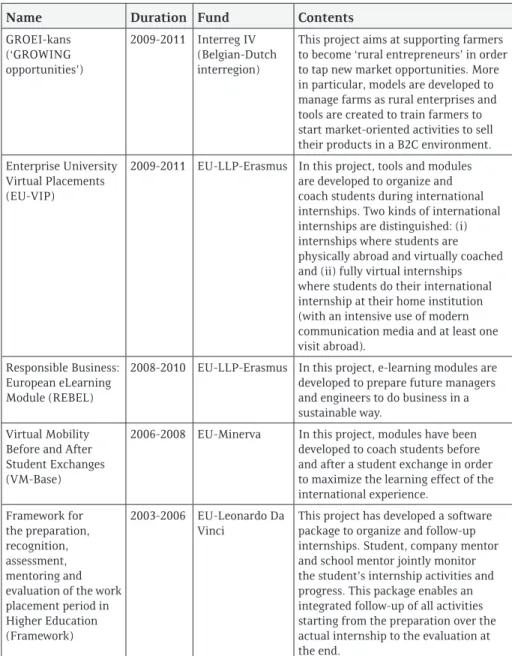
As for research, ECHO has participated as partner in the following international projects since 2005:
Name Duration Fund Contents
GROEI-kans (‘GROWING opportunities’) 2009-2011 Interreg IV (Belgian-Dutch interregion)
This project aims at supporting farmers to become ‘rural entrepreneurs’ in order to tap new market opportunities. More in particular, models are developed to manage farms as rural enterprises and tools are created to train farmers to start market-oriented activities to sell their products in a B2C environment. Enterprise University
Virtual Placements (EU-VIP)
2009-2011 EU-LLP-Erasmus In this project, tools and modules are developed to organize and coach students during international internships. Two kinds of international internships are distinguished: (i) internships where students are physically abroad and virtually coached and (ii) fully virtual internships where students do their international internship at their home institution (with an intensive use of modern communication media and at least one visit abroad).
Responsible Business: European eLearning Module (REBEL)
2008-2010 EU-LLP-Erasmus In this project, e-learning modules are developed to prepare future managers and engineers to do business in a sustainable way.
Virtual Mobility Before and After Student Exchanges (VM-Base)
2006-2008 EU-Minerva In this project, modules have been developed to coach students before and after a student exchange in order to maximize the learning effect of the international experience. Framework for the preparation, recognition, assessment, mentoring and evaluation of the work placement period in Higher Education (Framework)
2003-2006 EU-Leonardo Da Vinci
This project has developed a software package to organize and follow-up internships. Student, company mentor and school mentor jointly monitor the student’s internship activities and progress. This package enables an integrated follow-up of all activities starting from the preparation over the actual internship to the evaluation at the end.
The projects listed in table 3 can be divided in two categories: projects (creating tools and modules) to support and optimize the internationalization activities and projects where the know-how of staff members is used for knowledge creation and dissemination.
In conclusion, staff members have various opportunities to engage in internationalization activities. In the academic year 2008-2009, staff members participated in 77 internationalization actions. We consider as internationalization action any activity abroad that is primarily related to internationalization. This can be coaching a student group during an international week abroad, visiting a student on an internship abroad or participating in an EBM board meeting.
3 Implications for the departmental organization
The large scale of internationalization activities outlined in the previous section requires administrative support for both students and staff members. Moreover, in order to guarantee the sustainability of those activities, they have to be structurally embedded in the organization, for the students as well as for the staff members.
We will start by discussing the administrative support which covers a wide range of services.
The overall support and management issue has been tackled by the creation of an •
internationalization office staffed with the coordinators of the different initiatives mentioned in section 2.1 and managed by the internationalization coordinator. This office meets on a regular basis to outline the management of activities and to discuss matters at hand. The internationalization office also manages the international partner network which is essential for a sustainable internationalization project.
The presence of international students on the campus requires (i) English ICT facilities, •
(ii) English course materials, (iii) communication with the students in English and (iv) official documents in English (such as the Education and Examination Regulation, the transcripts, the year programs, the study contract). Whereas items (i) and (ii) are rather easy to implement due to the language settings in computers and the lecturer’s individual responsibility of the course materials, the implications of implementing items (iii) and (iv) are far-reaching because affecting various aspects of the daily organization (e.g. instructions on the copy machine) and departments (such as, communication by mailings, communication on the intranet; student desk, student administration, etc.) that have originally been created to confer monolingual services in Dutch. Although the recruitment of a certified translator has solved the problem of the availability of English (official) documents, this does not solve the problem of monolingual Dutch structures. We will illustrate the practical consequences by looking at an example, namely the portal site. The portal site is an intranet that is used for all internal communication with students and staff members. It is conceived
as a monolingual Dutch platform where only the top layer (viz. the message board) is translated in English, which rules out the use of the database underlying the portal site including, amongst others, the library catalogue, the students’ personal portfolio, the students’ year program and the academic calendar. In order to transform it into a bilingual or multilingual platform, the underlying architecture has to be completely redesigned. The actual situation generates ad hoc manual work for the internationalization office and administrative services increasing the risk of committing mistakes and creating inconsistent documents. Moreover, the international students feel set back because of the overwhelming presence of information exclusively available in Dutch.
Staff members have to teach in English to a culturally heterogeneous group instead of •
using Dutch to a (mainly) homogeneous group of Flemish students (viz. students living in Flanders who have generally obtained a Flemish secondary education degree). This has repercussions for all aspects of teaching: the use of English course materials with international cases and examples, the longer preparation time due to the use of English, teaching to students with different backgrounds and expectations, etc. Although language support is offered, there is no support or training to cope with the specificities of teaching to intercultural groups.
Outgoing as well as incoming students have to be prepared for their international •
experience: they will live and study abroad in a foreign language as member of an intercultural group for a limited period. Moreover, some exchanges, such as international internships, require a permanent follow-up from the home institution. At this point, major progress has been achieved in several of the projects mentioned in table 3.
Next, let us turn to the structural embedding of internationalization activities in the departmental organization. From the students’ point of view, most activities – mandatory as well as optional – are integrated in the curriculum. This implies that students obtain credits when they successfully participate in an activity. The business games constitute the only exception since students are not rewarded with credits for participation. The internationalization activities are integrated in the curriculum in the following way:
The mandatory international weeks are part of the curriculum representing 2 ECTS •
credits. To be more precise, the international weeks are integrated in the project work closing the first semester (for the Accountancy & Tax, Finance & Insurance and Legal Practices students) or the second semester (for the Marketing and the Office Management students) of year 2.
The programs for outgoing Erasmus and Erabel exchange students represent the full •
30 ECTS of respectively the first semester of year 3 and the second semester of year 2. For the administrative processing of the credits acquired during an exchange, ‘dummy’ modules have been created in the curriculum. Those modules are linked to the modules taken as part of the exchange program so that the credits acquired abroad can easily be inserted in the student’s program and transcript.
Students who take up an international internship or a North-South internship do it •
in the second semester of year 3, parallel with the other students who conclude their formation with an internship.
The EBM program constitutes an extra option within the bachelor in Business •
Management. Those students (can) obtain an ECHO degree in Business Management, option Marketing as part of the double degree at the end of the program.
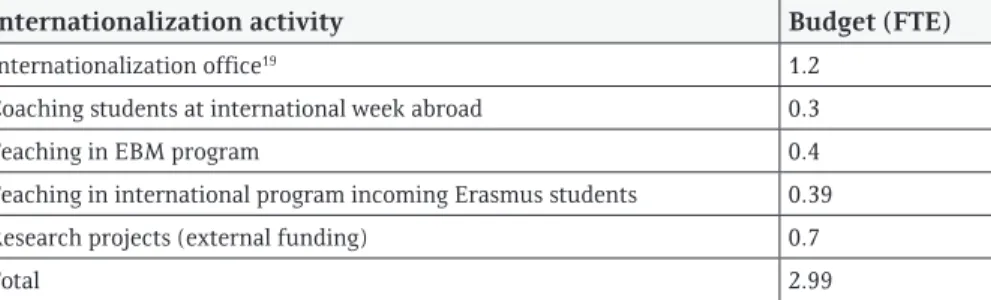
As for the empowerment of staff, internationalization activities are mentioned in the job description, including the estimated work load expressed as a percentage of FTE, of the lecturers concerned. As a result, on a total number of 55.68 FTE of employees, 2.99 FTE are reserved for internationalization. Table 4 shows how this internationalization budget is used:
Internationalization activity Budget (FTE)
Internationalization office19 1.2
Coaching students at international week abroad 0.3
Teaching in EBM program 0.4
Teaching in international program incoming Erasmus students 0.39
Research projects (external funding) 0.7
Total 2.99
Table 4: Internationalization budget academic year 2009-2010
However, if ECHO wants to become a real international business school21, the institution will need to run a parallel Dutch and English administration for the services outlined above.22 This has become apparent by organizing the EBM program: while most internationalization activities have a minor impact on administration since they are confined to 1 module or 1 semester (for which special ‘dummy’ modules have been created) at most, EBM is a complete English-taught and English-run international program issuing a Flemish degree and hence affecting all sections of administration.
4 Conclusion
In the present paper, we have outlined the internationalization policy of the Business and Management dept. of Katholieke Hogeschool Leuven. Given the growing political and social interest for internationalization as necessary condition to maintain and improve the competitiveness of the EU in general and Flanders in particular, departmental policy aims at offering at least one international experience to every undergraduate student and to stimulate staff members to participate in international activities.
This ambitious goal not only influences the offer of internationalization activities but also their status and the way these activities are managed. The offer comprises a large range of internationalization activities. The organization of international weeks on campus is the solution to offer at least one international experience to every student. An internationalization office has been set up to coordinate the various activities that are integrated as much as possible in the curriculum of the different bachelor degree programs and the job description of staff members. This firm organization makes it possible to develop and optimize the activities, as is shown by the creation of the double degree bachelor program and the North-South internships.
However, there is one final step to be taken to become a full-fledged international business school, namely the creation of a true parallel administrative organization. This step is necessary, not only to make the international students feel at home but also to computerize administrative tasks (e.g. generating English year programs and report cards) and to minimize the risk of administrative mistakes due to manual data treatment.
Notes
1) We thank Barbara Gos for helping us to gather the figures used in this article.
2) In a postgraduate bachelor program, students specialize in one particular domain of Business Management. This is a 60 ECTS program (one academic year) where students take modules for 30 ECTS (viz. semester 1) and where they do a business project in a company for the remaining 30 ECTS (semester 2). In Flanders, a postgraduate bachelor is the only possibility to organize postgraduate programs for an institution with only professional bachelors since master programs are the privilege of the universities and a limited number of university colleges organizing (due to historical reasons) academic bachelor programs.
3) Joint declaration of the Ministers responsible for higher education convened in Bologna on the 19th of June 1999.
4) These standards have been stipulated in the European Qualification Framework in 2008 (Recommendation of the European Parliament and of the Council of 23 April 2008 on the establishment of the European Qualifications Framework for lifelong learning (2008/C 111/01)). 5) The Bologna Process 2020. The European Higher Education Area in the new decade. Communiqué of the Conference of European Ministers Responsible for Higher Education. Leuven and Louvain-la-Neuve, 28-29 April 2009. §16-20.
6) Notice that we jump from the supra-regional European level to the regional Flemish level, apparently discarding the federal Belgian level. Irrespective of any political statement, this choice is motivated by the assignment of responsibilities in Belgium where education is organized by the communities, viz. the Dutch-speaking, the French-speaking and the German-speaking Communities. As a consequence, ECHO issues Flemish degrees.
7) Flemish Government. 2009. Flanders In Action. Future Plan 2020. Url: http://www. flandersinaction.be/nlapps/data/docattachments/Brochure%20ViA%20(en).pdf and Karel van Miert. 2008. Vlaanderen In Actie. Positioneringspaper Internationalisering. Url: http://via. vlaanderen.be/nlapps/data/docattachments/Positioneringspaper_Internationalisering.pdf. 8) Peeters, Kris. 2009. Economie. De Open Ondernemer. Beleidsnota 2009-2014. Url: http://www. vlaanderen.be/servlet/Satellite?c=Solution_C&cid=1171947608450&pagename=Infolijn%2FView
9) Lieten, Ingrid. 2009. Wetenschappelijk onderzoek en innovatie. Beleidsnota 2009-2014. Url: http:// www.vlaanderen.be/servlet/Satellite?c=Solution_C&cid=1171947608450&pagename=Infolijn%2F View
10) Smet, Pascal. 2009. Onderwijs. Samen grenzen verleggen voor elk talent. Beleidsnota 2009-2014. Url: http://www.vlaanderen.be/servlet/Satellite?c=Solution_C&cid=1171947608450&pagename=I nfolijn%2FView
11) VOKA. 2005. Internationaler ondernemen. Kansen voor Vlaanderen (Voka-studie 01). Url: http:// www.voka.be/startpagina/media/publicaties/Documents/Voka-studie01.pdf
12) In Belgium, Dutch has progressively been recognized as an official language in the 20th century. Up till then, Belgium was a monolingual French-speaking country.
13) When we have a look at higher education legislation (Decreet betreffende de herstructurering van het hoger onderwijs in Vlaanderen van 4 april 2003, §92), we find the following major language restrictions on professional bachelor programs: only 10% of the ECTS in a bachelor program can be taught in a foreign language and when a module is organized in a foreign language, students must be offered the possibility to take the same module in Dutch.
14) The international weeks were originally funded by European IPP grants.
15) The only exception to this principle is the Office Management Week that is organized for both options, viz. Management Assistant and Business Translator.
16) One of the realizations of the Bologna Process is the possibility to organize joint and multiple degree programs: in case of the former, the students are granted one joint degree by the different institutions co-organizing the program; in case of the latter, students are granted separate degrees from the different institutions collaborating in the program. Whereas a joint degree requires the creation of a new and integrated program, a multiple degree program can be created combining existing programs in the different partner institutions.
17) Decreet betreffende de herstructurering van het hoger onderwijs in Vlaanderen van 4 april 2003, §94.
18) The EBM program has been recognized by the Flemish administration as equivalent to the regular Dutch-taught bachelor program in Business Management, option Marketing on 27 April 2007. For more information about the equivalence of both programs, see Godelieve Mulier & Jose Tummers. 2009. “The international joint bachelor’s degree in Business Studies: Design, implementation, issues”. Presentation at 20th Annual EAIE Conference, Leuven. (url: http://associatie.kuleuven.be/ eng/eaie/IAEA(282910).pdf).
19) Since this program started in September 2007, the data for the academic year 2008-2009 only comprise the students in the first and the second bachelor year.
20) The budget to coach students during the international weeks at ECHO is not included in these figures since it is part of the budget for project work.
21) On 14 May 2008, at the end of an audit conducted by NIBS, ECHO was granted the title of International Business School.
22) For some of these matters, such as communication and student administration, ECHO depends on the 3 other departments of the university college, where internationalization has not the same importance.
Correspondence Jose Tummers
Katholieke Hogeschool Leuven, Department of Business and Management Studies Hertogstraat 178
B-3001 Leuven, Belgium