M E T H O D O L O G Y
Open Access
Sample size re-estimation in crossover
trials: application to the AIM HY-INFORM
study
Julie Wych
1*, Michael J. Grayling
1,2and Adrian P. Mander
1,3Abstract
Background:Crossover designs are commonly utilised in randomised controlled trials investigating treatments for long-term chronic illnesses. One problem with this design is its inherent repeated measures necessitate the availability of an estimate of the within-person standard deviation (SD) to perform a sample size calculation, which may be rarely available at the design stage of a trial. Interim sample size re-estimation designs can be used to help alleviate this issue by adapting the sample size mid-way through the trial, using accrued information in a
statistically robust way.
Methods:The AIM HY-INFORM study is part of the Informative Markers in Hypertension (AIM HY) Programme and comprises two crossover trials, each with a planned recruitment of 600 participants. The objective of the study is to test whether blood pressure response to first line antihypertensive treatment depends on ethnicity. An interim analysis is planned to reassess the assumptions of the planned sample size for the study. The aims of this paper are: (1) to provide a formula for sample size re-estimation in both crossover trials; and (2) to present a simulation study of the planned interim analysis to investigate alternative within-person SDs to that assumed.
Results:The AIM HY-INFORM protocol sample size calculation fixes the within-person SD to be 8 mmHg, giving > 90% power for a primary treatment effect of 4 mmHg. Using the method developed here and simulating the interim sample size reassessment, if we were to see a larger within-person SD of 9 mmHg at interim, 640 participants for 90% power 90% of the time in the three-period three-treatment design would be required. Similarly, in the four-period four-treatment crossover design, 602 participants would be required.
Conclusions:The formulas presented here provide a method for re-estimating the sample size in crossover trials. In the context of the AIM HY-INFORM study, simulating the interim analysis allows us to explore the results of a possible increase in the within-person SD from that assumed. Simulations show that without increasing the planned sample size of 600 participants, we can reasonably still expect to achieve 80% power with a small increase in the within-person SD from that assumed.
Trial registration:ClinicalTrials.gov,NCT02847338. Registered on 28 July 2016.
Keywords:Crossover trial, Sample size calculation, Simulation study, AIM HY-INFORM study, Hypertension
© The Author(s). 2019Open AccessThis article is distributed under the terms of the Creative Commons Attribution 4.0 International License (http://creativecommons.org/licenses/by/4.0/), which permits unrestricted use, distribution, and reproduction in any medium, provided you give appropriate credit to the original author(s) and the source, provide a link to the Creative Commons license, and indicate if changes were made. The Creative Commons Public Domain Dedication waiver (http://creativecommons.org/publicdomain/zero/1.0/) applies to the data made available in this article, unless otherwise stated.
* Correspondence:[email protected]
1Medical Research Council Biostatistics Unit, University of Cambridge, School
Background
Randomised crossover trials are a well-established design for long-term chronic illnesses such as hypertension [1]. The UK hypertension NICE guidance (CG127) stratifies hypertension treatment by age and self-defined ethnicity (SDE), with guidelines adopting a ‘black versus white’ approach [2]. The problems with this stratification in-clude a lack of data from UK populations supporting the current SDE stratification and no reference to South Asians – the largest ethnic minority group in the UK [2]. Consequently, the primary objective of the AIM HY-INFORM study is to determine if the response to exist-ing first-line antihypertensive drugs differs by ethnic group, white British, black African/African Caribbean or South Asian, for participants who are newly diagnosed or established hypertensives.
The AIM HY-INFORM study comprises two open-label, randomised crossover trials: one three-period three-treatment (monotherapy) trial for participants newly diagnosed with hypertension and one four-period four-treatment (dual therapy) trial for participants with existing hypertension. The primary outcome is systolic blood pressure (SBP) mmHg; linear mixed models are the preferred method of analysis for a crossover design with a continuous outcome variable [1]. Repeated mea-surements of SBP taken from the same participant are correlated and this correlation needs to be accounted for in sample size calculations. That is, sample size estima-tion for any repeated measures design requires an esti-mate of the within-person standard deviation (SD). Taking estimates of the within-person SD from other studies can be unreliable due to differences in the study population and participant attributes, instruments and measurement techniques, or other background condi-tions, which can result in trials that are either under or over-powered [3, 4]. With the absence of reliable prior estimates of the within-person SD available for the AIM-HY INFORM study, in particular for South Asian eth-nicities, the calculation of the required sample size to ensure the desired power to detect a single treatment-by-ethnic interaction is challenging.
To address this issue in many repeated measures texts, sample size re-estimation designs have been con-sidered [3, 5–7]. However, there is little, directly applicable work on sample size re-estimation at interim for crossover designs. Zucker and Denne describe a strategy to deal with the unknown within-person SD in a two-stage, repeated measures design that examines the accrued data at an interim point, obtaining an estimate of the within-person SD. They then use this estimate to update the covariance parameter in the linear mixed model and modify the sample size required to ensure the trial has sufficient power [3]. Moreover, a collection of papers have addressed sample size re-estimation in
bioequivalence trials using a two-period two-treatment crossover design [8–11]. While more recently, method-ology for blinded and unblinded sample size re-estimation in multi-treatment crossover trials balanced for period was described [12]. None of these papers, however, directly allows for re-estimation in the context of the AIM HY-INFORM study, for reasons that will be described shortly.
Here, we present the framework for sample size re-estimation in both our 3 × 3 (monotherapy) and 4 × 4 (dual therapy) settings. Precisely, the study design and models used are described, along with the methods de-veloped for re-estimation of the required sample size. The planned interim analysis in the AIM HY-INFORM study states in the protocol that after 50 individuals have completed their treatment sequence, the sample size cal-culation for both the mono and dual-therapy treatment rotations will be recalculated using a mid-trial estimate of the within-person SD. Therefore, following our initial descriptions, results from a simulation study carried out ahead of trial recruitment, with the aim of simulating the interim analysis to explore the effect of a larger within-person SD from that assumed in the protocol are presented.
Methods
Study design
AIM HY-INFORM is a multicentre, prospective study comprising two randomised, open-label crossover trials (three-period three-treatment monotherapy and four-period four-treatment dual therapy) in a multi-ethnic cohort of hypertensive participants, where each study re-quires separate randomisation to treatment sequences [2].
Participants on both trials self-identify into one of the following three ethnic groups (SDE):
White (white British, white Irish or any other white background);
Black or black British (black Caribbean, black African or any other black background); Asian or Asian British (Asian Indian, Asian
Pakistani, Asian Bangladeshi or any other South Asian background).
mg followed by 6 –7 weeks of Amlodipine 10 mg, treat-ment B is 1–2 weeks of Lisinopril 10 mg followed by 6– 7 weeks of Lisinopril 20 mg and treatment C is approxi-mately eight weeks of 25 mg Chlortalidone (Fig.1).
The dual-therapy study is a 32-week period four-treatment crossover trial of established hypertensives with ABPM > 135/85 and < 200/110. After initial screen-ing and baseline measurement collection, participants are randomised with equal allocation to one of four se-quences of treatments from a four-treatment four-period Williams square design: ABDC; BCAD; CDBA; and DACB. There are 24 possible Latin squares for a four-treatment crossover design; the design used here is one of six special cases of the Latin square design which are balanced for first-order carry-over and are known as Williams Squares [13,14].
For participants on dual therapy, treatment A is eight weeks of Amlodipine 5 mg and Lisinopril 20 mg, treat-ment B is eight weeks of Amlodipine 5 mg and Chlortali-done 25 mg, treatment C is eight weeks of Lisinopril 20 mg and Chlortalidone 25 mg and treatment D is eight weeks of Amiloride 10 mg and Chlortalidone 25 mg (Fig.2).
The two randomised crossover trials (monotherapy and dual therapy) are open-label and require separate randomisation to treatment sequence. To control for balance permuted blocks within strata are implemented with an allocation ratio: 1:1:1:1:1:1 for the monotherapy trial and 1:1:1:1 for the dual-therapy trial.
The monotherapy and dual-therapy trials are distinct and analysed using separate linear mixed models. The primary outcome of both trials is seated automated of-fice SBP mmHg as measured eight weeks (± 4 days) after receiving each treatment. The primary objective of the trials is to test for a significant treatment-by-ethnic group interaction.
With the absence of an available estimate of the within-participant SD for the trial participants, the protocol estimates a sample size of 600 participants as-suming a fixed within-person SD of 8 mmHg, based on previous clinical trial data in people representative of the general population with either high normal blood pres-sure or mild hypertension [2]. More precisely, for a within-person SD of 8 mmHg and a single treatment-by-ethnic interaction of 3 mmHg, with all other interactions being 0 mmHg, the protocol outlines that a sample size of 600 participants produces 81.3% power to detect treatment-by-ethnic interactions using a global test of interaction at a 5% significance level. For the same fixed within-person SD of 8 mmHg and a larger single
Fig. 1Participants receive each treatment A, B and C; they are randomised to a treatment sequence according to two three-period three-treatment Latin square designs: ABC, ACB, BAC, BCA, CAB and CBA, balanced by ethnic group
[image:3.595.305.539.86.350.2] [image:3.595.56.290.376.687.2]treatment-by-ethnic interaction of 4 mmHg, a sample size of 600 participants would give 98% power to detect a single treatment-by-ethnic interaction. A 10% over-recruitment allows for loss to follow-up, resulting in 220 planned enrolments from each ethnic group, for each trial [3].
In order to check the assumptions that the within-person SD is 8 mmHg, there is a planned interim ana-lysis after approximately 50 participants have completed their treatment sequence. The aim of the interim ana-lysis is twofold: (1) to obtain an estimate of the within participant SD from trial participants; and (2) to use this estimate to calculate the sample size required for either 80 or 90% power to detect a treatment-by-ethnic inter-action using a global test of interinter-action at a 5% signifi-cance level. The aim here is to describe the method for the sample size re-estimation and present results from a simulation study carried out ahead of the interim analysis.
Sample size calculations for the protocol along with simulations, sample size and power calculations for the interim analysis were carried out using Stata Statistical Software: Release 14 (StataCorp LP, College Station, TX, USA).
Models and sample size calculations
Sample size re-estimation in the period three-treatment monotherapy crossover
The linear mixed effects model for the three-period three-treatment crossover study has fixed effects for treatment, period, ethnic group and treatment-by-ethnic group interactions. Additionally, subject is included as a random effect. This is our unrestricted model. We com-pare this unrestricted model with a nested restricted model that does not contain the treatment-by-ethnic group interaction terms.
Restricted model, assuming n participants are re-cruited in total:
yijkl¼μþτdð Þj;k þπjþelþuiklþϵijkl:
Unrestricted model:
yijkl¼μþτdð Þj;k þπjþelþθdð Þlj;k þuiklþϵijkl:
Here
i= 1,…,n/18 indicates a particular individual,j= 1, 2, 3 indicates the time period,k= 1,…, 6 indicates the sequence a particular individual was allocated andl= 1, 2, 3 indicates which of the three ethnicities a particular individual self-defined as. That is,i,kandltogether completely prescribe a particular individual in the trial (there arenunique combinations of these three indices);
μis an intercept term (the mean of the valuesyi1k1); τd(j,k)is the direct effect of the treatment
administered to a participant on sequencekin periodj. That is, d(j,k)∈{A,B,C}. For identifiability purposes, we setτA= 0;
πjis a fixed effect for period, withπ1= 0 for
identifiability;
elis a fixed effect for ethnic group, withe1= 0 for
identifiability;
θd(j,k)lis a fixed interaction effect for treatment d(j,
k) by ethnic groupl. For identifiability, we set
θA1=θA2=θA3=θB1=θC1= 0.
uikl N1ð0;σ2bÞis a random participant effect; ϵijkl N1ð0;σ2eÞis the residual error.
We perform a global Wald test to see if the unstricted model gives a significantly better fit than the re-stricted, in order to test the primary hypothesis of whether there is an interaction between treatment and ethnic group. To perform sample size re-estimation, we require the sampling distribution of a suitable test statis-tic under the null and alternative hypotheses.
Precisely, setting θ= (θB2,θB3,θC2,θC3)⊤, we test the following null hypothesis of no treatment-by-ethnic interactions
H0:θ¼0;
against the following alternative
H1:θ≠0:
Denoting by ^θ¼ ð^θB2;^θB3;^θC2;θ^C3Þ ⊤
our estimates of the interaction terms computed using conventional max-imum likelihood estimation, we can test H0 using the following test statistic
t¼θ^⊤Covd ^θ −1θ:^
Moreover, we power our trial for an alternative in which there is a single non-zero treatment-by-ethnic interaction (θB2=δ, i.e.θ=δ= (δ, 0, 0, 0)⊤).
Accordingly, Grayling et al. [12] specified the denom-inator degrees of freedom as that of a corresponding multi-level single-stage ANOVA design. For our unre-stricted model this would designate the denominator de-grees of freedom,ν, for sample sizen, as
ν¼3n−n−10¼2n−10:
Here, the 3nterm arises as the total number of mea-surements accrued, while 1 degree of freedom is sub-tracted for each participant, and for each fixed effect in the model. Thus, at the interim we suppose that we would reject H0 at the end of the trial when t>F−1(1
−α, 0, 4, 2n−10), where F−1(q, 0,m,n) is the 100q th quantile of anF(0,a,b)-distribution (a centralF -distribu-tion on a and b degrees of freedom). Combining this with a suitable non-central F-distribution under the chosen alternative at which the trial is to be powered, in-terim re-estimation can then be performed.
Such an approach, however, was found by Grayling et al. [12] to, in many circumstances, lead to a notable inflation of the type-I error rate, and frequently provide power slightly below the desired level under the speci-fied alternative. Therefore, they discussed the utility of a potential α-adjustment procedure, of using the above methodology for interim re-estimation but performing the final hypothesis test using the method of Kenward and Roger [15], and they explored the advantages of a sample size inflation factor. A problem with these ad-justments as individual amendments to the basic re-estimation procedure described above, however, is that predicting their impact on both the type-I error rate and the power can be difficult.
Consequently, here, desiring to accurately control the type-I error rate while maintaining a high level of power, we make a heuristic conservative adjustment to the above degrees of freedom based on Hotelling’sT2 distri-bution [16].
Precisely, for x1, …, xn~Np(ϕ,Ω), the test statistic t2 ¼ ðx−ϕÞ⊤CovðxÞd −1ðx−ϕÞ T2ðp;n−1Þ , Hotelling’s T2 distribution onpand n−1 degrees of freedom. We can work with this distribution using standard statistical software via the following relationship
T2ðp;n−1Þ ¼p nð −1Þ
n−p F pð ;n−pÞ:
In our case, we therefore suppose H0 will be rejected when
2n−13 4 2ð n−10Þ
t> F−1ð1−α;4;2n−13Þ:
Moreover, to attain power 1−βwe can search for the minimal integernsuch that
ℙ 2n−13
4 2ð n−10Þ
T > F−1ð1−α;4;2n−13Þ
≥1−β;
for
T Fδ⊤Covd θ^ −1δ;4;2n−13:
Such a search is easy to perform using interval bisec-tion over the discrete n. The final problem therefore is to specify Covðd θÞ^ −1. In theAppendix, we justify the use of
d
Cov ^θ ¼12^σ2e
n
1 0:5 0:5 0:25 0:5 1 0:25 0:5 0:5 0:25 1 0:5 0:25 0:5 0:5 1
0 B B @
1 C C A;
where σ^2e is the interim estimated within person SD, computed using REML (for the reasons outlined below).
With this, our methodology for re-estimating the required sample size in the 3 × 3 trial is complete. However, we must still specify how the final analysis will be performed.
Here, we use REML estimation as it takes into account the uncertainty in the fixed parameters in the model into account when estimating the random parameters, in the-ory leading to better estimates of the variance components with reduced bias when the number of groups is small [17]. Additionally, we use the Kenward–Roger approxima-tion [15] to compute the denominator degrees of freedom in the finalF-test. These choices are again made in order to limit the possibility of observing inflation to the type-I error rate. As AIM HY-INFORM is a confirmatory trial of treatment differences between different ethnic groups, in-flation of the type-I errors should be avoided.
Sample size re-estimation in the four-period four-treatment dual-therapy crossover
The dual-therapy trial is a four-period four-treatment crossover. It will compare the same restricted and unre-stricted models as for the three-period three-treatment monotherapy trial. However, we now have
i= 1,…,n/12,j= 1,…, 4,k= 1,…, 4, andl= 1, 2, 3; d(j,k)∈{A,B,C,D};
For identifiability, we set
θA1=θA2=θA3=θB1=θC1=θD1= 0.
Here, setting θ= (θB2,θB3,θC2,θC3,θD2,θD3)⊤, we again test the following hypotheses
H0:θ¼0;H1:θ≠0:
For ^θ¼ ð^θB2;^θB3;^θC2;θ^C3;^θD2;^θD3Þ ⊤
T¼^θ⊤Covd θ^ −1^θ:
Applying the Hotelling’s T2 based adjustment de-scribed above, in this case at interim we supposeH0will be rejected when
3n−19 6 3nð −14Þ
t> F−1ð1−α;6;3n−14Þ;
and choose the required sample size by determining the minimalnsuch that
ℙ 3n−19
6 3ð n−14Þ
T >F−1ð1−α;6;3n−14Þ
≥1−β;
for
T Fδ⊤Covd θ^ −1δ;6;3n−14;
with δ= (δ, 0, 0, 0, 0, 0)⊤, and where in theAppendix we now justify the use of
d
Cov θ^ ¼12σ^2e
n
1 0:5 0:5 0:5 0:25 0:25 0:5 1 0:5 0:25 0:5 0:25 0:5 0:5 1 0:25 0:25 0:5 0:5 0:25 0:25 1 0:5 0:5 0:25 0:5 0:25 0:5 1 0:5 0:25 0:25 0:5 0:5 0:5 1 0
B B B B B B @
1 C C C C C C A :
Finally, as for the 3 × 3 trial, the final analysis is per-formed using REML estimation and the Kenward–Roger correction.
At the interim, 50 participants have completed either three treatment periods if they are on the monotherapy trial, or four treatment periods if they are on the dual-therapy trial. Inherently, we have more data from the four-treatment crossover and may anticipate better per-formance in this setting. It is important to note that at this stage we are not concerned with estimating treat-ment effects, we simply want the estimate, ^σ2e, of the within-person variance required for the sample size cal-culations outlined above.
Simulation design
To consider the variation in the estimate of the within-person SD, a simulation study was carried out to investi-gate the effect on the requisite final sample size for dif-ferent treatment effects and within-person SD scenarios, based on the sample size re-estimation calculations de-scribed above. In the protocol, the sample size calcula-tion fixes the SD to be 8 mmHg giving power equal to 98% for a single 4 mmHg interaction effect with 600 par-ticipants, and 81.3% power with 600 participants and a single 3 mmHg interaction effect.
Two separate simulation studies have been carried out assuming participants are on either the monotherapy or
dual-therapy treatment regimes, in all cases assuming that each participant has received three (monotherapy) or four (dual-therapy) treatments and that there are no missing values. Participants are randomly generated with approximately equal numbers of participants on each of the six treatment sequences—ABC, ACB, BAC, BCA, CAB and CBA—for monotherapy and four treatment
se-quences—ABDC, BCAD, CDBA and DACB—for dual
therapy. We consider scenarios in which 80% and 90% power to detect treatment-by-ethnic interactions are de-sired, using our outlined global test of interaction at a 5% significance level are assumed.
What is important to realise is that in sample size cal-culations the within-person SD is typically fixed. In our simulation study, we set the desired power, the strength of a single treatment-by-ethnic interaction and a within-person SD, and solve for sample size across numerous replicates. Accordingly, of principle interest is the distri-bution of the interim estimated values of the within-participant SD and the distribution of the final required sample sizes.
The factors varied and held constant in these simulations are outlined in Table1, resulting in 2 × 2 = 4 scenarios to as-sess for each of the two trials, with 1000 simulations carried out for each scenario-trial combination. We assume that there is no carryover effect and no treatment-by-period interaction. The between-person SD is held constant at 10 mmHg, we do not need to consider varying this as the pro-cedures should be invariant toσbwith a sample size of 50.
Our methodology for estimating the sample size re-quires a minimum acceptable sample size. In the protocol, a sample size of 600 is estimated for each monotherapy and dual-therapy trial, based on a within-person SD of 8 mmHg. As there is no plan to reduce the sample size at interim, we therefore set a minimum sample size of 600 for all simulations and scenarios investigated. Matlab and Stata code for sample size calculations can be found in Additional files1,2,3and4.
Results
Simulation of the interim analysis and re-estimation of the sample size: monotherapy
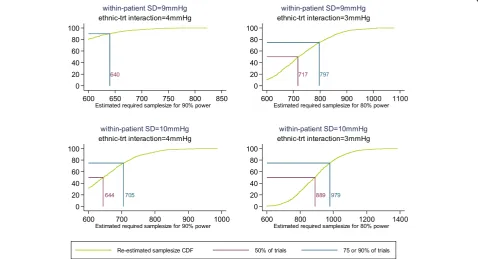
Assuming a smaller single treatment-by-ethnic inter-action of 3 mmHg, and a 1 mmHg increase in the as-sumed within-person SD, 75% of the time with a sample size of 797 participants would give us 80% power to de-tect the primary hypothesis. A 2 mmHg increase in within-person SD from that assumed in the protocol means that 75% of the time with a sample size of 979 participants would give us 80% power detect a treatment effect of 3 mmHg (Fig.3). As would be expected, smaller values ofδ, and larger values ofσe, imply larger required sample sizes. Figure3 shows for the scenario with σe=
9 mmHg and δ = 4 mmHg more than the planned 600
particpiants are required because of the nature of sample size re-estimation and the methodology used here. The
conservative approach adopted here to try and control the type-I error rate means we have to push the sample size up a little to keep the type-II error rate down. That is, the use of Kenward–Roger and the Hotelling adjust-ments pushes the power down compared to the method-ology used for the initial 600 estimate, so it is inevitable that the simulations here produce > 600 for the sample size re-estimation designs.
Simulation of the interim analysis and re-estimation of the sample size: dual therapy
[image:7.595.57.540.98.239.2]For the dual-therapy trial, sample sizes required for the different simulation scenarios are similar to those esti-mated for the monotherapy trial. For 90% power to Table 1Fixed and constant parameter values for the interim analysis simulations
Description Constant factors Factors varied
Interim sample size n= 50
Minimum required sample size n= 600
Number of simulations 1000
Between-person SD σb= 10 mmHg
Within person SD σe= 9, 10 mmHg
Overall mean SBP (mmHg) μ= 140 mmHg
Single treatment-by-ethnic interaction (mmHg) δ= 3, 4 mmHg
Period effect (mmHg) πj= 0 mmHg,∀j
Power to detect a single ethnic by treatment interaction at 5% significance level (%) 1−β= 0.1,0.2
[image:7.595.59.538.444.703.2]detect a treatment effect of 4 mmHg, 90% of the time 602 participants would usually be fine when the within-person SD is 9 mmHg. A larger within-person SD of 10 mmHg would mean that 75% of the time 692 participants would usually be fine to give us 90% power to detect the same treatment effect (Fig. 4). In both scenarios, the dual-therapy trial requires slightly fewer participants.
Assuming a smaller single treatment-by-ethnic inter-action of 3 mmHg, a 1 mmHg increase in the assumed within-person SD 75% of the time a sample size of 782 participants would give us 80% power to detect the pri-mary hypothesis. A 2 mmHg increase in within-person SD from that assumed in the protocol means that 75% of trials with a sample size of 966 participants would give us 80% power detect a planned treatment effect of 3 mmHg; again, in both scenarios, fewer participants are required than in the monotherapy trial, as a result of having more measurements overall in the dual-therapy trial.
In summary, for the same simulated treatment-by-ethnic interaction an increase in within-person SD re-quires a large sample size. For the same simulated within-person SD, a smaller planned treatment effect also requires a larger sample size, which is what would be expected from sample size calculation theory. The fact that the dual-therapy trial when compared with the monotherapy trial requires slightly fewer participants when comparing like-for-like is a result of the increased number of denominator degrees of freedom in the
sample size calculation for the period
four-treatment compared with the three-period
three-treatment crossover: 3n–14 = 136 compared with 2n – 10 = 90 when n= 50. The increased number in the de-nominator degrees of freedom in the period
four-treatment compared with the three-period
three-treatment crossover is in turn due to the increased num-ber of observations per participant in the four-by-four crossover trial.
Discussion
A novel method for sample size re-estimation has been described for three-period three-treatment and four-period four-treatment crossover trials. Here we have dealt with a more complicated covariance matrix in a 3 × 3 and 4 × 4 randomised crossover setting that incor-porates both a global test and allows for interaction terms in the linear mixed model.
The simulation study allowed us to explore the out-come for a possible increase in the within-person SD from that assumed and used for the sample size calcula-tions in the protocol ahead of trial recruitment and the interim analysis. As would be expected, an increase in the within-person SD or a smaller primary treatment ef-fect would require a larger sample size. The fact that the dual-therapy trial requires slightly fewer participants than the monotherapy trial when all variables are like for like is a consequence of the increased degrees of
[image:8.595.58.537.445.702.2]freedom in the denominator of theF-test which is used in the sample size calculation. The simulation of the in-terim sample size indicates that we can only realistically aim for 80% in these scenarios without increasing the sample size above 600 participants.
Conclusions
The formulas presented here provide a means for re-estimating the sample size in both period three-treatment and four-period four-three-treatment crossover tri-als. In the context of the AIM HY-INFORM study, simulating the planned interim analysis allows us to ex-plore the outcome for a possible increase in the within-person SD from that assumed in the protocol. Simula-tions show that without increasing the planned sample size of 600 participants, on each crossover trial, we can reasonably still expect to achieve 80% power with a small increased in the within person SD from that assumed.
Appendix
Here, we justify our specified values for Covðd θÞ^ , used in the sample size re-estimation procedures. To begin, con-sider the 3 × 3 trial and cast our unrestricted linear mixed model in the form
Y¼XβþZbþϵ;
where β= (μ,π2,π3,τB,τC,e2,e3,θB2,θB3,θC2,θC3)⊤. Then, the maximum likelihood estimator of the fixed ef-fectsβat the end of trial is
^
β¼^μ;π2;^ π3;^ ^τB;^τC;^e2;^e3;θB2;^ ^θB3;^θC2;^θC3T ¼XTΣ−1X −1XTΣ−1Y;
withΣ=ZCov(u)ZT+Cov(ϵ). We then have
Cov ^β ¼XTΣ−1X −1:
See, for example, Fitzmaurice et al. [18] for further details.
In our case, CovðuÞ¼σ2
bIn and CovðϵÞ¼σ2eI3n: This implies thatΣis block diagonal, withnblocks of the 3 × 3 matrixΣ3, say, where
Σ3¼ σ 2
eþσ2b σ2b σ2b σ2
b σ2eþσ2b σ2b σ2
b σ2b σ2eþσ2b 0
@
1 A:
It can then be shown by verifyingΣ3Σ−31¼I3that
Σ−1 3 ¼
1
σ2
e σ2eþ3σ2b
σ
2
eþ2σ2b −σ2b −σ2b
−σ2
b σ2eþ2σ2b −σ2b
−σ2
b −σ2b σ2eþ2σ2b 0
@
1 A:
Now
Cov ^β ¼XTΣ−1X −1;
¼ n 9 X6 k¼1 X3 l¼1 XT klΣ−13 Xkl
!−1 ;
where Xkl is the design matrix for a single individual on treatmentk, of ethnicityl.
Thus CovðβÞ^ can be found by evaluating the above expression, which can be readily achieved computation-ally using a symbolic algebra package. Performing these
calculations in Matlab, and extracting the
sub-component corresponding toθ^, we identified that
Cov ^θ ¼12σ2e
n
1 0:5 0:5 0:25 0:5 1 0:25 0:5 0:5 0:25 1 0:5 0:25 0:5 0:5 1
0 B B @ 1 C C A:
It is for this reason that we utilise
d
Cov ^θ ¼12^σ2e
n
1 0:5 0:5 0:25 0:5 1 0:25 0:5 0:5 0:25 1 0:5 0:25 0:5 0:5 1
0 B B @ 1 C C A;
in our re-estimation procedure.
Equivalent calculations for the 4 × 4 trial also demon-strate that
Cov ^θ ¼12σ2e n
1 0:5 0:5 0:5 0:25 0:25 0:5 1 0:5 0:25 0:5 0:25 0:5 0:5 1 0:25 0:25 0:5 0:5 0:25 0:25 1 0:5 0:5 0:25 0:5 0:25 0:5 1 0:5 0:25 0:25 0:5 0:5 0:5 1 0 B B B B B B @ 1 C C C C C C A : Supplementary information
Supplementary informationaccompanies this paper athttps://doi.org/10. 1186/s13063-019-3724-6.
Additional file 1.Matlab code.
Additional file 2.Stata do file.
Additional file 3.Three-period three-treatment sample size calculation code (Stata ado file).
Additional file 4.Four-period four-treatment sample size calculation code (Stata ado file).
Abbreviations
ABPM:Ambulatory blood pressure monitoring (mmHg); AIM HY-INFORM: ComparIsoN oF Optimal HypeRtension RegiMens (Part of the Informative Markers in Hypertension (AIM HY) Programme–AIM HY-INFORM); SBP: Systolic blood pressure (mmHg)
Acknowledgements
methods advice. JW is supported by the Medical Research Council grant reference MR/M016560/1, M.J.G. and A.P.M are supported by Medical Research Council grant reference MC_UU_00002/3. We are grateful to Caroline Fairhurst and Helen Mossop for taking the time to review our work and for their constructive comments that have improved this manuscript.
Authors’contributions
MJG developed the method for sample size re-assessment. JW produced all simulation results and analysis of the data. JW drafted the manuscript. MJG and APM critically revised the manuscript for important intellectual content. All authors approved the final version.
Funding
The AIM HY program is co-funded by the Medical Research Council and Brit-ish Heart Foundation (Medical Research Council Reference: MR/M016560/1; EUDRACT number 2016–000165-23).
Availability of data and materials
The datasets generated and analysed during the current study are available from the corresponding author on reasonable request.
Ethics approval and consent to participate Not applicable.
Consent for publication
Consent for publication was not required as no individual person data are reported.
Competing interests
The authors declare that they have no competing interests.
Author details
1
Medical Research Council Biostatistics Unit, University of Cambridge, School of Clinical Medicine, Forvie Site, Robinson Way, Cambridge CB2 0SR, UK. 2
Institute of Health & Society, Newcastle University, Baddiley-Clark Building, Richardson Road, Newcastle upon Tyne NE2 4AX, UK.3Centre for Trials Research, College of Biomedical & Life Sciences, Cardiff University, 7th Floor, Neuadd Meirionnydd, Heath Park, Cardiff CF14 4YS, UK.
Received: 3 April 2019 Accepted: 13 September 2019
References
1. Jones B, Kenward MG. Design and analysis of crossover trials. 3rd ed. Boca Raton: Chapman and Hall/ CRC Press; 2014.
2. Mukhtar O, Cheriyan J, Cockcroft JR, Collier D, Coulson JM, Dasgupta I, et al. A randomized controlled crossover trial evaluating differential responses to antihypertensive drugs (used as mono- or dual therapy) on the basis of ethnicity: The comparIsoN oF Optimal Hypertension RegiMens; part of the Ancestry Informative Markers in HYpertension program—AIM-HY INFORM trial. Am Heart J. 2018;204:102–8.
3. Zucker DM, Denne J. Sample-size redetermination for repeated measures studies. Biometrics. 2002;58:548–59.
4. Lenth RV. Some practical guidelines for effective sample size determination. Am Stat. 2001;55(3):187–93.
5. Guo Y, Logan HL, Glueck DH, Muller KE. Selecting a sample size for studies with repeated measures. BMC Med Res Methodol. 2013;13:100.https://doi. org/10.1186/1471-2288-13-100.
6. Lui GF. Sample size calculations for studies with correlated observations. Biometrics. 1997;53(30):937–47.
7. Shih WJ, Gould AL. Re-evaluation design specifications of longitudinal clinical trials without unblinding when the key response is rate of change. Stat Med. 1995;14:2239–48.
8. Potvin D, DiLiberti CE, Hauck WW, Parr AF, Schuirmann DJ, Smith RA. Sequential design approaches for bioequivalence studies with crossover designs. Pharm Stat. 2008;7:245–62.
9. Montague TH, Potvin D, Diliberti CE, Hauck WW, Parr AF, Schuirmann DJ. Additional results for‘Sequential design approaches for bioequivalence studies with crossover designs’. Pharm Stat. 2012;11:8–13.
10. Golkowski D, Friede T, Kieser M. Blinded sample size re-estimation in crossover bioequivalence trials. Pharm Stat. 2014;13:157–62.
11. Xu J, Audet C, DiLiberti CE, Hauck WW, Montague TH, Parr AF, et al. Optimal adaptive sequential designs for crossover bioequivalence studies. Pharm Stat. 2016;15:15–27.
12. Grayling MJ, Mander AP, Wason JMS. Blinded and unblinded sample size reestimation in crossover trials balanced for period. Biom J. 2018;60:917–33. 13. Senn S. Crossover trials in clinical research. 2nd ed. Chichester: Wiley; 2002. 14. Williams EJ. Experimental designs balanced for the estimation of residual
effects. Aust J Sci Res. 1949;2:149–68.
15. Kenward MG, Roger JH. Small sample inference for fixed effects from restricted maximum likelihood. Biometrics. 1997;53:983–97.
16. Hotelling H. The generalization of Student’s ratio. Ann Math Statist. 1931; 2(3):360–78.
17. Maas CJM, Hox JJ. Sufficient sample sizes for multilevel modelling. Methodology. 2005;1(3):86–92.
18. Fitzmaurice GM, Laird NM, and Ware JH. Applied Longitudinal Analysis, NJ: Wiley. Second edition; 2011.
Publisher’s Note