WRL
Research Report 91/2
A Simulation-Based
Study of
TLB Performance
research relevant to the design and application of high performance scientific computers. We test our ideas by designing, building, and using real systems. The systems we build are research prototypes; they are not intended to become products.
There is a second research laboratory located in Palo Alto, the Systems Research Cen-ter (SRC). Other Digital research groups are located in Paris (PRL) and in Cambridge, Massachusetts (CRL).
Our research is directed towards mainstream high-performance computer systems. Our prototypes are intended to foreshadow the future computing environments used by many Digital customers. The long-term goal of WRL is to aid and accelerate the development of high-performance uni- and multi-processors. The research projects within WRL will address various aspects of high-performance computing.
We believe that significant advances in computer systems do not come from any single technological advance. Technologies, both hardware and software, do not all advance at the same pace. System design is the art of composing systems which use each level of technology in an appropriate balance. A major advance in overall system performance will require reexamination of all aspects of the system.
We do work in the design, fabrication and packaging of hardware; language processing and scaling issues in system software design; and the exploration of new applications areas that are opening up with the advent of higher performance systems. Researchers at WRL cooperate closely and move freely among the various levels of system design. This allows us to explore a wide range of tradeoffs to meet system goals.
We publish the results of our work in a variety of journals, conferences, research reports, and technical notes. This document is a research report. Research reports are normally accounts of completed research and may include material from earlier technical notes. We use technical notes for rapid distribution of technical material; usually this represents research in progress.
Research reports and technical notes may be ordered from us. You may mail your order to:
Technical Report Distribution
DEC Western Research Laboratory, WRL-2 250 University Avenue
Palo Alto, California 94301 USA
Reports and notes may also be ordered by electronic mail. Use one of the following addresses:
Digital E-net: DECWRL::WRL-TECHREPORTS
Internet: [email protected]
UUCP: decwrl!wrl-techreports
To obtain more details on ordering by electronic mail, send a message to one of these
addresses with the word ‘‘help’’ in the Subject line; you will receive detailed
J. Bradley Chen, Anita Borg, and Norman P. Jouppi
May, 1992
This paper presents the results of a simulation-based study of various translation lookaside buffer (TLB) architectures, in the context of a modern VLSI RISC processor. The simulators used address traces, generated by instrumented versions of the SPECmarks and several other programs running on a DECstation 5000. The performance of two-level TLBs and fully-associative TLBs were investigated. The amount of memory mapped was found to be the dominant factor in TLB performance. Small first-level FIFO instruction TLBs can be effective in two level TLB configurations. For some applications, the cycles-per-instruction (CPI) loss due to TLB misses can be reduced from as much as 5 CPI to negligible levels with typical TLB parameters through the use of variable-sized pages.
This research report is a preprint of a paper to appear in the
Proceedings of the 19th International Symposium on Computer Architecture.
1. Introduction
In computer systems with virtual memory, a TLB is typically used to provide fast translation of virtual addresses generated by instruction execution to physical addresses needed for cache tag comparisons. Both physically and virtually addressed caches require address translation. With physically addressed caches, the TLB lookup is in the critical path of cache access, so low latency and miss rates are crucial for memory system performance. The TLB is a cache, speed-ing up access to entries in the page table, where complete information on virtual to physical memory mappings is maintained. Most modern machines use split instruction and data caches, and this configuration is assumed (unless stated otherwise) in the remainder of this paper. Given this context, we consider several possibilities for the TLB implementation:
•A single TLB shared between instruction and data caches. To reduce conten-tion, the TLB can be dual-ported. This introduces complex circuitry, doubling the size of the TLB without increasing its capacity.
•Independent TLBs for instruction and data caches. The instruction TLB should be made smaller than the data TLB, as instruction reference streams exhibit greater locality than those for data. The appropriate size tradeoff is difficult to determine and once made is fixed. If the instruction TLB is too small, performance will suffer. If it is too large, the space available for the data TLB is compromised and again performance suffers.
•Two-level TLB architectures. A small instruction TLB (i.e., micro-TLB), can be refilled from a larger single-ported shared TLB, primarily used for data references. This option is described in more detail below.
A micro-TLB is a fully associative TLB with a very small number of entries (probably less than eight) which is reloaded in hardware from a larger shared TLB. A number of recent machines use micro-TLBs, including the MIPS R4000 [7], though they are invisible at the ar-chitecture level. A micro-TLB is accessed in parallel with the instruction cache. On a miss, the micro-TLB is reloaded from the shared TLB. As the larger TLB is single ported, the CPU may stall for a few cycles, with data references suspended while the TLB is busy, but this penalty is much less expensive than that of a full TLB miss. We assume 3 cycles as the micro-TLB miss penalty in this paper. Because of the high locality in instruction reference streams, and the rela-tively small miss penalty, acceptable miss rates can be achieved with a small micro-TLB. The balance of instruction and data entries in the shared TLB is determined dynamically, unlike in the second option above. In addition the shared TLB need not be dual-ported, so the extra space can be used to increase its capacity. No previous research known to the authors characterizes the design space for the micro-TLB.
Because the TLB can be in the critical path of memory access, good TLB performance is essential to good overall performance of a machine. TLB design has been complicated in several recent architectures with split instruction and data TLBs. To date, such designs have received negligible attention in the research literature. Experimental results are presented herein to characterize the behavior of split as well as shared TLBs.
4K bytes to a gigabyte [5, 7]. Although there are several obvious applications of variable size pages, such as mapping operating system text and graphics frame buffers, it is not yet understood to what degree they can be used to improve the execution rate of application code. Performance of applications which concentrate references on a contiguous segment could improve if that seg-ment were accessed as a single page with a single TLB entry. Applications which scatter references across a sparse address space have little hope of benefiting from large pages without significantly increased memory usage. Address traces and reference counting tools can be used to record dynamic patterns of memory access, to aid in understanding the applicability of these structures.
The many recent studies on memory system behavior and performance have concentrated al-most exclusively on cache design [10, 9]. Little attention has been given to TLB performance. Early studies have shown that TLB miss penalties consume 6% of all machine cycles [4] and 4% of execution time [3], and hence can have a significant impact on machine performance. However, these results were for VAX computers with 512 byte page sizes, an order of magnitude smaller than is typical today, and main memory sizes two orders of magnitude smaller than those considered in this study.
Wood [12, 11] proposed in-cache address translation as an alternative to a TLB. His work has shown that such methods are effective for programs such as Lisp applications and operating sys-tems, where the working set is spread over a large address space. They are less useful for be-havior such as is seen with typical C programs, where memory activity is concentrated in the bottom of several segments. His methods also become less applicable when memory access times become large with respect to processor speed.
Finally, previous TLB studies [3, 11] have considered set-associative or direct-mapped or-ganizations. These were common when TLBs were made from discrete MSI and LSI RAMs. Recently, however, VLSI RISC microprocessors (e.g., [5, 7]) typically make use of fully-associative TLBs, since these require about the same area as set-fully-associative TLBs when im-plemented within a VLSI chip. Thus the TLB implementations studied in this paper are all fully-associative designs.
This paper is concerned with TLB performance. Understanding the relation between TLB performance and overall machine performance is a different question, involving the balance of compulsory to capacity misses and the relative ability of caches and TLBs to map multiple localities. The first access to a page results in a Compulsory TLB miss. In this situation, cache misses also occur, the cost of which might overshadow the TLB penalties. Other TLB misses are capacity misses, when a program returns to a locality that has been replaced out of the TLB, though it might still be present in the cache. This phenomena becomes more common as cache sizes increase. In this paper, CPI effects of TLB performance are discussed assuming perfect memory system performance. This can be deceptive, as it trivializes the question of cache per-formance. More exact results require simulation of a more complete memory system.
2. Methodology
The tracing and simulations were done on a DECstation 5000, using an updated version of the WRL address tracing tools [2]. Application programs are instrumented by inserting code at the start of each basic block and before each load or store instruction to make entries in a per-process trace buffer. The contents of the per-process buffer are appended to a system trace buffer each time the kernel is invoked, and whenever the per-process buffer becomes full. The kernel makes additional entries in the system buffer to record context switches, system calls, and other such events. When the system buffer becomes full, traced processes are suspended and an analysis program, in this case a TLB simulator, is started. The analysis program runs until the contents of the kernel buffer have been consumed, at which time tracing may continue. The system permits multi-process traces and on-the-fly analysis of trace data with minimum distortion to the traces. System references are not included in the traces.
In simulating the various TLB configurations, a variety of workloads were used, including each of the SPECmarks, plus a number of other workloads meant to anticipate more realistic future workloads. Tree is a recursive, data intensive benchmark written in C-Scheme [1]. Magic [8] is a VLSI layout tool. In this run it was extracting the MultiTitan CPU chip [6]. A multi-tasking mix was also used, running the following programs:
•gcc
•magic extracting the MultiTitan CPU chip
•ld loading magic
•tree with a 10 megabyte heap
•a loop running the shell programs cp, cat, sed, ls, ps, and rm.
Short running programs were put in loops, so that their execution would continue throughout the entire run. This mix is meant to be comparable to the mix used in previous trace-based studies by Borg et.al. [2].
3. Instruction TLB results
Instruction reference streams place lesser demands on TLB resources than data reference streams. Instruction references generally exhibit higher locality, both spatial and temporal. Also there is generally less memory involved. The largest text segment of the SPECmarks, when compiled for the DECstation, is the Gnu C compiler gcc with 688K bytes. The average text segment size is around 200K bytes. Data segments are frequently much larger. Data references for nasa7, a benchmark for numeric computation, range over a space of over three megabytes.
Because of the different performance characteristics of TLBs and micro-TLBs, they are dis-cussed separately.
3.1. Micro-TLBs
Micro-TLBs were simulated with sizes varying from one to eight entries and Least Recently
Used (LRU) or Least Recently Replaced (FIFO) replacement algorithms. Page sizes of 4K and
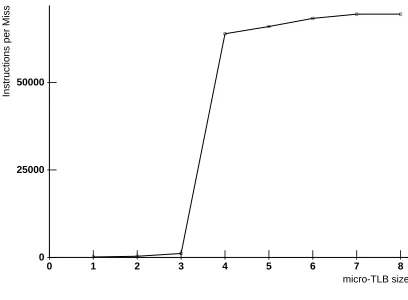
Figure 1 is a plot of the simulation results for the eqntott benchmark, illustrative of micro-TLB behavior. The number of entries in the micro-TLB varies along the x axis. The y axis is scaled in instructions per miss, the reciprocal of the miss rate. Plots of instructions per miss are used because they illustrate interesting behavior more clearly than plots of miss rate, with data points corresponding to good performance towards the top of the graph, poor performance toward the bottom, and points spaced in a meaningful way, rather than disappearing along the X axis.
|
0
|
1
|
2
|
3
|
4
|
5
|
6
|
7
|
8
|
0
|
25000
|
50000
micro-TLB size
Instructions per Miss
[image:8.612.91.499.179.479.2]
Figure 1: Eqntott micro-TLB behavior FIFO replacement, 4K byte pages
There are three general regimes of behavior to be observed. Notice the flatness of the curve to the left side of the graph. In this region, thrashing is occurring. The number of micro-TLB entries is well under the number of instruction pages in the working set of the program, and consequently micro-TLB performance is relatively poor: 442 instructions per miss with two micro-TLB lines, 1490 instructions per miss with three.
After the flat part of the curve comes a region where performance improves rapidly. For
eqntott this occurs between three and four micro-TLB entries. Lastly comes another relatively
flat region, where the micro-TLB has enough entries to map the entire working set of the program. In this region, additional micro-TLB entries do little to improve performance.
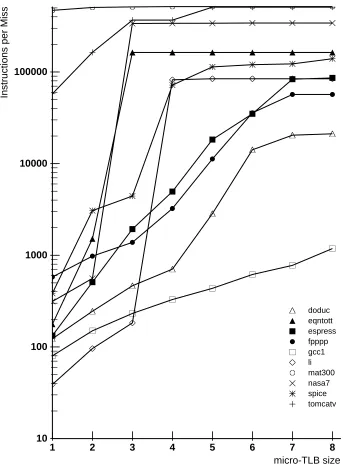
SPEC-marks on the same graph. If a micro-TLB miss penalty of 3 cycles is assumed and the average number of instructions per miss is 333 or less, then about one machine cycle per one hundred instructions (i.e. 0.01 cycles per instruction - CPI) is lost to TLB misses. With one TLB entry, more than half the SPECmarks have this much of a penalty. With a two entry micro-TLB, 40% are at this penalty level.
doduc eqntott espress fpppp gcc1 li mat300 nasa7 spice tomcatv | 1 | 2 | 3 | 4 | 5 | 6 | 7 | 8 | 10 | | | | | | | | | 100 | | | | | | | | | 1000 | | | | | | | | | 10000 | | | | | | | | | 100000 | micro-TLB size
Instructions per Miss
[image:9.612.122.470.165.630.2]
Figure 2: SPECmark micro-TLB Behavior FIFO replacement, 4K byte pages
cache performance, predictive of the observed micro-TLB behavior. The miss rate for fpppp for a simulated 4K byte instruction cache with 16 byte lines is 23%, due to its particularly long basic blocks (an average of 130 instructions per branch for the entire run). Computation in doduc is spread over a large number of procedures, and has a simulated 4K byte I-cache miss rate of 11%.
Two language processing programs, gcc, the Gnu C compiler, and li, a lisp interpreter, have the worst micro-TLB performance. The I-cache miss rates for gcc and li are 10% and 2%, respectively. Their micro-TLB behavior is explained in considering the structure of the programs. Gcc for example, has a large amount of code and it tends to make many nested proce-dure calls. We believe that the observed behavior results from there being eight or more procedures involved in most of gcc’s localities, and that these procedures tend to be spread over more than eight pages.
The SPECmarks were also simulated for micro-TLBs using an instruction page of size 16K bytes. The results are shown in Figure 3. At this page size, with 7 micro-TLB entries, the working set of virtually all the programs appears to have been reached, with the exception of
gcc. The amount of memory fragmentation induced by the change to 16K byte pages can be
inferred from the change in TLB resource demands of the programs. For example, eqntott uses 4 × 4K = 16K bytes of instruction memory with 4K pages, and 48K bytes with 16K byte pages. Spice grows from 28K to 64K bytes. Fragmentation for 16K byte pages could be reduced with compilers and loaders that used heuristics or feedback information to locate the most active code adjacent in memory.
One issue which turned out to be uninteresting is the effect of context switches on the micro-TLB. One alternative in simulations is to be pessimistic about preserving the contents of the micro-TLB, and flush it after every context switch. An optimistic alternative is to preserve the contents of the micro-TLB between context switches. It was found in the optimistic simulations that behavior improved in regions of already good behavior, but that there was little change where behavior was poor. In regions of good behavior, all micro-TLB misses are compulsory. In the optimistic simulations, only one compulsory miss is taken for each referenced page. In the pessimistic simulations, the micro-TLB is flushed, and so a compulsory miss occurs for every context switch. Preserving the micro-TLB reduces the number of compulsory misses, hence im-proving good behavior. During poor micro-TLB behavior, the vast majority of misses are not compulsory but capacity misses, and so changing the number of compulsory misses has a negli-gible effect on the overall results. The simulations used to generate data for this paper use the pessimistic model.
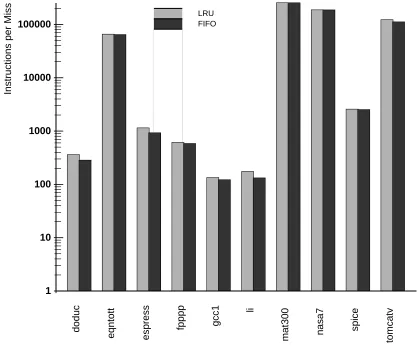
Another micro-TLB design parameter that was considered is replacement policy. For two entries, LRU is easily implemented in hardware. For more than two entries, hardware LRU becomes more difficult. An interesting alternative for micro-TLBs is least recently replaced. This has the advantage of a relatively straightforward hardware implementation as a in first-out queue. FIFO is used in this exposition to refer to this replacement policy.
doduc eqntott espress fpppp gcc1 li mat300 nasa7 spice tomcatv | 1 | 2 | 3 | 4 | 5 | 6 | 7 | 8 | 10 | | | | | | | | | 100 | | | | | | | | | 1000 | | | | | | | | | 10000 | | | | | | | | | 100000 | | | | micro-TLB size
Instructions per Miss
[image:11.612.124.467.87.553.2]
Figure 3: SPECmark micro-TLB Behavior FIFO replacement, 16K byte pages
sidered, establishing it as an interesting replacement policy for micro-TLBs of size greater than two.
LRU FIFO || 1 | | | | | || | | 10 | | | | | || | | 100 | | | | | || | | 1000 | | | | | || | | 10000 | | | | | || | | 100000 |
Instructions per Miss
doduc
eqntott espress
fpppp gcc1
li
mat300 nasa7
spice
[image:12.612.70.488.69.423.2]tomcatv
Figure 4: LRU vs. FIFO Replacement 4 entry micro-TLB, 4K byte pages
Table 1 shows miss rates for the ten SPECmarks, plus tree and magic. Under the assumption of a 3 cycle miss penalty, figures in bold-face indicate where the micro-TLB penalty is greater than 0.01 CPI. Again, with 4K byte pages, it is observed that most of the SPECmarks achieve reasonable performance with a two entry micro-TLB, although improvement is observed with larger sizes. Figure 5 shows how data from Table 1 can be used to estimate CPI contribution for a given SPECmark, micro-TLB configuration, and miss penalty.
Note that the micro-TLB performance for tree is particularly poor. With 4K byte pages, a two entry micro-TLB absorbs about 0.10 CPI. Micro-TLB performance for tree begins to improve rapidly beyond four micro-TLB entries. There are two effects that could conceivably be con-tributing to the degraded performance: the working set size of the computation, and conflicts between the garbage collector and the rest of the computation. The garbage collector and the program behave as independent co-routines or threads in the single address space. In the case of
tree, most of the observed miss rate is due to locality properties of the compiled Scheme code, as
1×4KB page 2×4KB page 4×4KB page 8×4KB page 1×16KB page 2×16KB page 4×16KB page 8×16KB page
doduc 0.015415 0.006433 0.003552 0.000953
0.008111 0.004078 0.001416 0.000047
eqntott 0.007415 0.002951 0.000016 0.000014
0.005647 0.000661 0.000006 0.000006
espress 0.009610 0.003687 0.001089 0.000099
0.007500 0.001966 0.000202 0.000012
fpppp 0.002936 0.002085 0.001727 0.000988
0.001723 0.001022 0.000309 0.000018
gcc1 0.021989 0.013269 0.008288 0.005010
0.012539 0.006648 0.003042 0.000844
li 0.031792 0.015781 0.007661 0.001097
0.025473 0.010456 0.000012 0.000012
mat300 0.000005 0.000004 0.000004 0.000004
0.000002 0.000002 0.000002 0.000002
nasa7 0.003544 0.002037 0.000005 0.000005
0.003180 0.001788 0.000003 0.000003
spice 0.003199 0.001407 0.000399 0.000026
0.002598 0.000326 0.000014 0.000007
tomcatv 0.000025 0.000013 0.000009 0.000005
0.000017 0.000006 0.000002 0.000002
ccom 0.030306 0.016114 0.007844 0.004098
0.017705 0.008653 0.001761 0.000174
sed 0.033778 0.008355 0.000070 0.000064
0.009710 0.000031 0.000031 0.000031
tree 0.074999 0.034553 0.017515 0.001264
0.062228 0.021160 0.002427 0.000215
magic 0.014811 0.007654 0.002853 0.000606
0.013080 0.006197 0.001599 0.000287
Table 1: SPECmark FIFO micro-TLB Miss Rates
2 entry FIFO micro-TLB with 4K byte page 3 cycle miss penalty
CPI Contribution = 3 * 0.0133 = 0.0399 CPI
Figure 5: Estimating micro-TLB CPI Contribution for gcc
1
infrequent to account for the observed miss rates.
Although multi-thread effects were not important with tree, it is worth noting that, in as much as threads tend to execute in independent code localities, tightly coupled threads executing in a single address space will lead to degraded micro-TLB performance. This effect will be ex-aggerated with very small micro-TLBs.
1The tree execution takes about 147 seconds, of which 2 seconds are spent collecting garbage. Garbage
3.2. Instruction TLBs
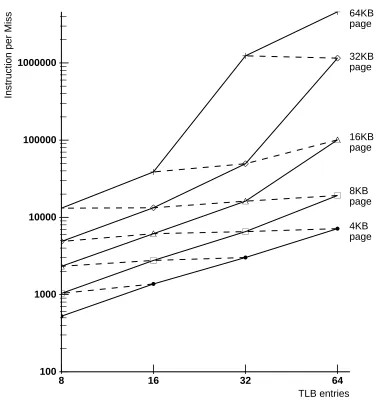
We simulated instruction TLBs with sizes in powers of two from 8 to 64 entries, and page sizes in powers two from 4K to 64K bytes. In examples used to illustrate TLB performance, an approximation of 100 cycles is used for the TLB miss penalty. It is assumed that a TLB miss will cause two memory references, corresponding to a page table lookup, and that the latency of these memory references will dominate the miss penalty. The penalty of 100 cycles corresponds to a futuristic microprocessor with a cycle time of under five nanoseconds, and is meant to be somewhat less than the time for two references to main memory and somewhat more than the time for two references to an off chip cache. Under these assumptions, with TLB performance of 10000 instructions per miss, 0.01 CPI is lost to the TLB. This is used as a somewhat arbitrary lower bound on reasonable TLB performance.
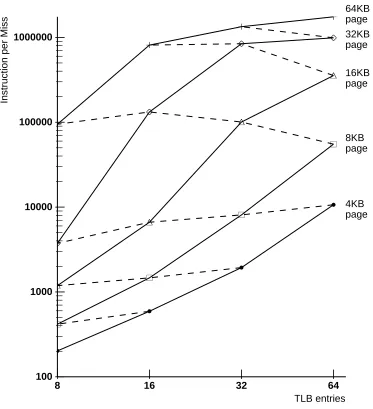
The behavior of single-benchmark workloads in instruction-only TLBs is mostly uninterest-ing, as gcc is the only SPECmark that presents a significant demand on resources. Figure 6 illustrates the behavior for gcc. Again log scales are used. Solid lines connect TLB configura-tions with the same page size. Dashed lines connect TLBs that map the same amount of memory. The amount of memory mapped by a TLB will be referred to as its mapping size, to discriminate between that measure of size and others, such as the number of lines in a TLB.
As with the micro-TLB, there are three regimes of behavior to be observed. The placement of data points is more compact in the lower portion of the graph, with relatively little improvement for larger TLB configurations. This represents thrashing, trying to operate with TLB resources well below the working set size of the program. In the next region, performance improves quickly as working set size is approached. This figure shows that gcc approaches the TLB resources to map its working set with an instruction TLB mapping size of 512K bytes. Once the working set size of the program has been reached, increasing the mapping size has a reduced effect on performance, and the points again become more closely spaced. Such behavior is ob-served at the top of the graph. These three regimes of behavior become more pronounced for shared and data TLBs, as in Figure 8.
Note that in the lower part of the graph, the dashed lines that connect TLBs with the same mapping size tend to slope upward slightly, while at the top of the graph they slope down. An application that uses sparse, non-contiguous data tends to have better TLB performance with more smaller pages of memory than with a few larger pages. Such behavior is observed in the lower part of the graph. In the upper part of the graph, the dashed lines tend to slope down, hence better performance with fewer larger pages. As a TLB becomes large enough to map all of a program’s working set, smaller pages mean that TLB misses occur for each of several small pages, rather than once for a single large page. Similar behavior is observed when a program accesses contiguous data, as in Figure 8.
| 8 | 16 | 32 | 64 | 100 | | | | | | | | | 1000 | | | | | | | | | 10000 | | | | | | | | | 100000 | | | | | | | | | 1000000 TLB entries
Instruction per Miss
[image:15.612.119.492.84.493.2]4KB 8KB 16KB 32KB 64KB page page page page page
Figure 6: Gcc Instruction TLB Behavior Random Replacement, Fully Associative
Table 2 gives miss rates for selected benchmarks for a number of instruction-only TLB con-figurations. The benchmarks not included have very low miss rates.
| 8 | 16 | 32 | 64 | 100 | | | | | | | | | 1000 | | | | | | | | | 10000 | | | | | | | | | 100000 | | | | | | | | | 1000000 | | | TLB entries
Instruction per Miss
[image:16.612.79.457.89.500.2]4KB 8KB 16KB 32KB 64KB page page page page page
Figure 7: Multi-task instruction TLB behavior Random Replacement, Fully Associative
16x4KB 32x4KB 64x4KB 16x16KB 32x16KB
gcc1 0.001688 0.000516 0.000094 0.000151 0.000010
magic 0.000275 0.000059 0.000000 0.000041 0.000000
tree 0.000309 0.000000 0.000000 0.000000 0.000000
ccom 0.001969 0.000032 0.000003 0.000001 0.000001
mixA 0.000728 0.000331 0.000140 0.000163 0.000062
4. Data and Shared TLB Results
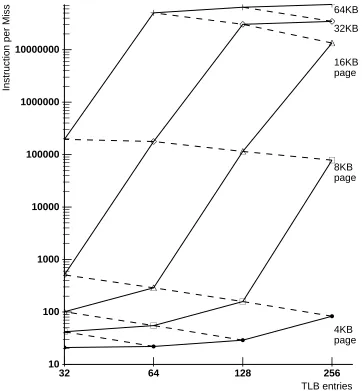
Data-only TLBs and shared TLBs behave similarly. Most programs have well behaved in-struction reference patterns, so in the shared case behavior is dominated by data references. Al-though the following discussion is in terms of shared TLBs, the analysis can be applied to the data-only case as well. Shared TLBs were simulated with sizes in powers of two from 32 to 256 entries, page sizes in powers of two from 4K to 64K bytes, and with LRU and Random replace-ment policies. All TLBs simulated were fully associative.
| 32 | 64 | 128 | 256 | 10 | | | | | || | | 100 | | | | | || | | 1000 | | | | | || | | 10000 | | | | | || | | 100000 | | | | | || | | 1000000 | | | | | || | | 10000000 | | | | | | TLB entries
Instruction per Miss
[image:17.612.112.474.211.602.2]4KB 8KB 16KB 32KB 64KB page page page
Figure 8: Mat300 Shared TLB Behavior
approximately 2.5 megabytes. The contents of these three matrices are accessed in regular pat-terns, sometimes sequentially and sometimes stepping by columns. This explains the poor be-havior when the TLB maps less than 2.5 megabytes, and rapid improvement as that barrier is reached and surpassed. Observe that lines connecting TLBs with the same mapping size always slope down, consistent with the observation that mat300 accesses its data contiguously.
| 32 | 64 | 128 | 256 | 100 | | | | | | | | | 1000 | | | | | | | | | 10000 | | | | | | | | | 100000 | | | | | | | | | 1000000 | | | | | | TLB entries
Instruction per Miss
[image:18.612.76.437.172.570.2]4KB 8KB 16KB 32KB 64KB page page page page page
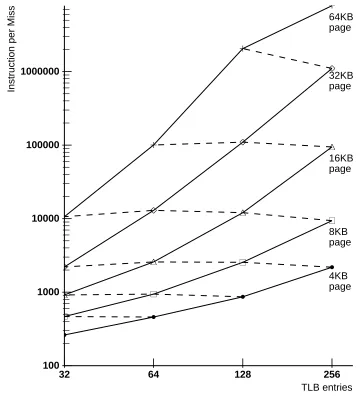
Figure 9: Tree Shared TLB Behavior Random Replacement Fully Associative
horizontal. This indicates that TLB performance for this benchmark depends exclusively on the mapping size. Other TLB parameters are unimportant.
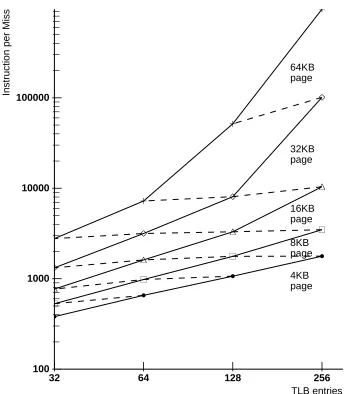
As a last illustration of shared TLB behavior, Figure 10 shows a plot for the multi-task mix. Several conclusions are immediate. First, as for tree, the mapping size of the TLBs is the dominant factor in performance. Only after a mapping size of eight megabytes do the dashed lines stop looking horizontal. Also, most of the plot is fairly compact. Data points become less compact beyond a mapping size of eight megabytes, as the working set size is approached. Lastly, for all TLBs with a mapping size of one megabyte or less, assuming a 100 cycle miss penalty, at least 0.05 CPI is lost to the TLB, a significant performance penalty. This suggests that if a machine with a TLB is to execute such a workload efficiently, the TLB must have a significantly larger mapping size.
| 32 | 64 | 128 | 256 | 100 | | | | | | | | | 1000 | | | | | | | | | 10000 | | | | | | | | | 100000 | | | | | | | | TLB entries
Instruction per Miss
[image:19.612.122.470.262.656.2]4KB 8KB 16KB 32KB 64KB page page page page page
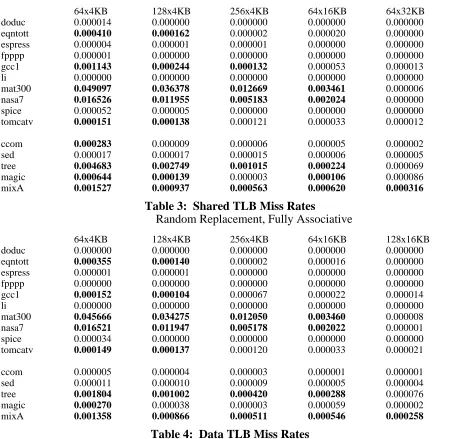
Table 3 shows TLB miss rates for the ten SPECmarks, plus several other workloads of inter-est. This table is highlighted to indicate where the TLB penalty is more than 0.01 CPI. With the exceptions of nasa7 and mat300, both of which are oriented towards scientific/vector machines, the SPECmarks perform better than this with a 64x16k TLB, suggesting that such a configura-tion provides adequate TLB performance. The smaller configuraconfigura-tions don’t perform as well. This suggests that sometime in the near future, TLBs with larger mapping sizes will be needed, especially for machines running numeric programs.
Table 4 gives miss rates for a number of data-only TLB configurations.
64x4KB 128x4KB 256x4KB 64x16KB 64x32KB
doduc 0.000014 0.000000 0.000000 0.000000 0.000000
eqntott 0.000410 0.000162 0.000002 0.000020 0.000000
espress 0.000004 0.000001 0.000001 0.000000 0.000000
fpppp 0.000001 0.000000 0.000000 0.000000 0.000000
gcc1 0.001143 0.000244 0.000132 0.000053 0.000013
li 0.000000 0.000000 0.000000 0.000000 0.000000
mat300 0.049097 0.036378 0.012669 0.003461 0.000006
nasa7 0.016526 0.011955 0.005183 0.002024 0.000000
spice 0.000052 0.000005 0.000000 0.000000 0.000000
tomcatv 0.000151 0.000138 0.000121 0.000033 0.000012
ccom 0.000283 0.000009 0.000006 0.000005 0.000002
sed 0.000017 0.000017 0.000015 0.000006 0.000005
tree 0.004683 0.002749 0.001015 0.000224 0.000069
magic 0.000644 0.000139 0.000003 0.000106 0.000086
[image:20.612.58.514.193.632.2]mixA 0.001527 0.000937 0.000563 0.000620 0.000316
Table 3: Shared TLB Miss Rates
Random Replacement, Fully Associative
64x4KB 128x4KB 256x4KB 64x16KB 128x16KB
doduc 0.000000 0.000000 0.000000 0.000000 0.000000
eqntott 0.000355 0.000140 0.000002 0.000016 0.000000
espress 0.000001 0.000001 0.000000 0.000000 0.000000
fpppp 0.000000 0.000000 0.000000 0.000000 0.000000
gcc1 0.000152 0.000104 0.000067 0.000022 0.000014
li 0.000000 0.000000 0.000000 0.000000 0.000000
mat300 0.045666 0.034275 0.012050 0.003460 0.000008
nasa7 0.016521 0.011947 0.005178 0.002022 0.000001
spice 0.000034 0.000000 0.000000 0.000000 0.000000
tomcatv 0.000149 0.000137 0.000120 0.000033 0.000021
ccom 0.000005 0.000004 0.000003 0.000001 0.000001
sed 0.000011 0.000010 0.000009 0.000005 0.000004
tree 0.001804 0.001002 0.000420 0.000288 0.000076
magic 0.000270 0.000038 0.000003 0.000059 0.000002
mixA 0.001358 0.000866 0.000511 0.000546 0.000258
Table 4: Data TLB Miss Rates
Random Replacement, Fully Associative
and data references. This comparison is not meant to suggest two specific implementation alter-natives, as the split TLBs illustrated use twice the resources of the shared TLB.
DATA+INSTRUCTION DATA only INST only || | | | | | || || | | | | | || || | | | | | || || | | | | | || || | | | | | || || | | | | | || || | | | | | || || | Miss rate 0.1 0.01 0.001 0.0001 0.00001 0.000001 0.0000001 0.00000001 doduc
eqntott espress fpppp
gcc1
li
mat300 nasa7
spice
tomcatv
tree
[image:21.612.109.523.137.474.2]magic mixA
Figure 11: Shared vs. Split TLBs 64 entries, 4KB pages Random Replacement, Fully Associative
5. Variable Size TLB Entries
An interesting question for future work is how to make use of the variable size TLB entries that have appeared in recent architectures [5, 7]. Maps of the dynamic patterns of memory ac-cess are useful to understand this problem. Figure 12 shows the pattern of data memory acac-cesses for mat300. Page address varies in the x dimension, from 0x10000000 on the left to 0x1021e000 on the right, a range of about 2.2 megabytes. Instruction count (i.e. time) varies along the y dimension, ranging from 0 at the top to 2.63 billion at the bottom. The darkness of each square corresponds to the number of accesses per 16K byte page during a 1000000 instruction interval.
mat300-data
instruction range: 0-2770000000 page range:10000-1021e
[image:22.612.99.407.84.489.2]block = 10000000 instructions x 0x2000 bytes
Figure 12: mat300 Data Memory Access Patterns
pages could virtually eliminate TLB misses, provided that adequate memory resources were available.
Tree, the lisp benchmark, also shows interesting data reference patterns, illustrated in Figure
tree-data
instruction range: 0-2410000000 page range:10000-10a5c
[image:23.612.134.466.77.441.2]block = 10000000 instructions x 0x10000 bytes
Figure 13: tree Data Memory Access Patterns
Interesting patterns of reference are the exception rather than the rule in memory access pat-terns. Most of the benchmarks concentrate on a small number of unclustered pages, resulting in a few dark vertical bars from the top to the bottom of the map, with occasional horizontal excur-sions.
Figure 14 shows a map of instruction references for gcc. Each point represents one or more references to a 4K byte page during an interval of 100000 instructions. The address space spanned in this figure is 684K bytes, the largest text segment of any of the SPECmarks. The number of different pages touched during a single 100000 instruction interval illustrates clearly why gcc places high demands on the TLB. If variable size memory pages were to be used to improve gcc performance, the only solution would be load the entire program text into a con-tiguous segment.
gcc-inst
instruction range: 0-22700000 page range:400-4a7
[image:24.612.62.398.76.411.2]block = 100000 instructions x 0x1000 bytes
Figure 14: gcc Data Memory Access Patterns
allocated structures are allocated dynamically, and so their location is not under the control of the compiler. With the relocatable nature of lisp data, it might be possible to tune garbage col-lectors to improve the locality of reference. For uncollected memory allocation schemes, a tool using feedback information could make suggestions of how to order heap data allocation to im-prove contiguity of data.
6. Conclusions
This study has investigated the performance of one and two-level instruction TLBs, data TLBs, and shared TLBs, as well as analyzing the potential performance implications of variable-sized pages. In contrast to previous studies, this work concentrated on fully-associative TLB organizations and split instruction and data reference streams.
reason-ably well. For example, with a 3 cycle micro-TLB miss penalty (i.e., assuming that the reference hits in the 2nd-level TLB) all SPECmarks except gcc and li incur a CPI of less than 0.03 due to microTLB misses. gcc and li can achieve this level of performance with 4-entry micro-TLBs, but incur a CPI penalty of about 0.06 with a 2-entry micro-TLB. A FIFO replacement policy performs almost as well as LRU for micro-TLBs.
In single-level instruction, data, and shared TLBs, TLB performance is usually dominated by how much memory is mapped. Single-level fully-associative instruction TLBs (or the second level of a two-level organization) with more that 32 entries, 4K byte pages, and a 100 cycle miss penalties incur CPIs of under 0.1 even for gcc. Performance on other benchmarks and with larger TLBs is better. With the larger capacities and miss penalties of full size instruction TLBs, multi-tasking and system effects also become important.
A data or shared TLB mapping 256K bytes in 4K byte pages (i.e., 64 entries) with 100 cycle miss penalty incurs 0.1 CPI or less for all of the SPECmarks except nasa7 and mat300. Both of these are scientific/vector oriented programs with large data sets. Furthermore, column access (i.e., non-unit stride) can result in successive data references to successive pages, disastrous for TLB performance unless the entire data set is mapped at the same time. nasa7 and mat300 incur a CPI of 1.7 and 4.9, respectively, for the TLB parameters given above. This is not reduced to under 0.1 CPI for mat300 until the TLB can map 2 megabytes (e.g., 256 entry TLB with 8K byte pages). Work with more demanding workloads suggests that future TLBs must map sig-nificantly more memory.
One way to increase the amount of memory mapped without requiring an unreasonably large number of TLB entries is the use of variable-sized pages. Memory access plots suggest that the use of very large pages (e.g., 256K byte or greater) for the data space of mat300 and tree, and the instruction space of gcc could vastly reduce the size of the TLB required for good performance while decreasing its miss rate.
One significant shortcoming of this TLB analysis is the inability to consider operating system effects. We are currently involved in completing a new tracing system which includes system traces, with the intention of performing a thorough exploration of operating system memory be-havior on modern RISC processors.
7. Acknowledgements
8. References
[1] J. F. Bartlett.
SCHEME->C: A Portable Scheme-to-C Compiler.
WRL Research Report 89/1, Digital Equipment Western Research Laboratory, 1989.
[2] Anita Borg, R.E. Kessler, Georgia Lazana, and David Wall.
Long Address Traces from RISC Machines: Generation and Analysis.
WRL Research Report 89/14, Digital Equipment Western Research Laboratory, 1989.
[3] Douglas W. Clark and Joel S. Emer.
Performance of the VAX 11/780 Translation Buffer: Simulation and Measurement.
ACM Transactions on Computer Systems 3(1), February, 1985.
[4] Douglas W. Clark, Peter J. Bannon, and James B. Keller.
Measuring VAX 8800 Performance with a Histogram Hardware Monitor.
In Proceedings of the 15th Annual International Symposium on Computer Architecture, pages 176-185. June, 1988.
[5] Daniel Dobberpuhl, et. al.
A 200Mhz 64b Dual-Issue CMOS Microprocessor.
In The 39th International Solid-State Circuits Conference, pages 106-107. IEEE Com-puter Society Press, February, 1992.
See also slide supplement.
[6] Norman P. Jouppi.
Architectural and Organizational Tradeoffs in the Design of the MultiTitan CPU. In Proceedings of the 16th Annual International Symposium on Computer Architecture,
pages 281-289. May, 1989.
[7] Sunil Mirapuri, Michael Woodacre, and Nader Vasseghi. The MIPS R4000 Processor.
IEEE Micro 12(4):10-22, April, 1992.
[8] J. Ousterhout, G. Hamachi, R. Mayo, W. Scott, and G.S. Taylor. The Magic VLSI Layout System.
IEEE Design and Test of Computers 2(1):19-30, February, 1985.
[9] Steven A. Przybylski.
Cache Design: A Performance-Directed Approach.
Morgan-Kaufmann, San Mateo, CA, 1990.
[10] Alan Jay Smith. Cache Memories.
ACM Computer Surveys 14(3):473-530, September, 1982.
[11] David A. Wood, et. al.
An In-Cache Address Translation Mechanism.
[12] David A. Wood.
The Design and Evaluation of In-Cache Address Translation.
Table of Contents
1. Introduction 1
2. Methodology 3
3. Instruction TLB results 3
3.1. Micro-TLBs 3
3.2. Instruction TLBs 10
4. Data and Shared TLB Results 13
5. Variable Size TLB Entries 17
6. Conclusions 20
7. Acknowledgements 21
List of Figures
Figure 1: Eqntott micro-TLB behavior FIFO replacement, 4K byte pages 4 Figure 2: SPECmark micro-TLB Behavior FIFO replacement, 4K byte pages 5 Figure 3: SPECmark micro-TLB Behavior FIFO replacement, 16K byte pages 7 Figure 4: LRU vs. FIFO Replacement 4 entry micro-TLB, 4K byte pages 8
Figure 5: Estimating micro-TLB CPI Contribution for gcc 9
Figure 6: Gcc Instruction TLB Behavior Random Replacement, Fully Associa- 11 tive
Figure 7: Multi-task instruction TLB behavior Random Replacement, Fully As- 12 sociative
Figure 8: Mat300 Shared TLB Behavior 13
Figure 9: Tree Shared TLB Behavior Random Replacement Fully Associative 14 Figure 10: Multiprocess Mix TLB Behavior Random Replacement, Fully As- 15
sociative
Figure 11: Shared vs. Split TLBs 64 entries, 4KB pages Random Replacement, 17 Fully Associative
Figure 12: mat300 Data Memory Access Patterns 18
Figure 13: tree Data Memory Access Patterns 19
List of Tables
Table 1: SPECmark FIFO micro-TLB Miss Rates 9