ENERGY-EFFICIENT CLUSTERING BASED ON HYBRID
EVOLUTIONARY ALGORITHM IN WIRELESS SENSOR
NETWORK
1KHALILBENNANI, 2DRISS ELGHANAMI, 3ABDELILAH MAACH
1
PhD candidate, Department of computer science, Mohamed 5 University, Rabat, Morocco
2
Assoc. Prof., Department of computer science, Mohamed 5 University, Rabat, Morocco
3Assoc. Prof., Department of computer science, Mohamed 5 University, Rabat, Morocco
E-mail: [email protected], [email protected], [email protected]
ABSTRACT
Energy-aware algorithms are important factors for extending the lifetime of the wireless sensor network. In energy concerned fields, network clustering has proved to be an efficient technique that renders structures of low consumption. Yet, clustering protocols face a major issue that is of grouping sensor nodes in an optimal way. This is an NP-Hard problem which necessitates evolutionary algorithms in order to solve. In this paper, we explore a new hybrid optimization algorithm to decrease the energy consumption, in which modified particle swarm optimization and simulated annealing are combined to find the optimal clusters based on transmission distance. Simulated annealing is used as a local search around the best solutions of the modified particle swarm optimization. The simulation results show that our proposed protocol can improve the lifetime of systems compared with existing clustering protocols.
Keywords: Wireless Sensor Network, Clustering, Evolutionary Optimization Algorithm, particle swarm optimization, Energy Efficiency.
1. INTRODUCTION
A wireless sensor network (WSN) consists of a dense network of low cost and energy constrained devices that are capable of extracting information in hostile environments. The use of wireless sensor networks in several applications such as surveillance, national security, environmental monitoring and many other applications has recently received more attention.
An important challenge in the design of these networks is the energy. These constraints require innovative energy-aware algorithms for extending the lifetime of sensors. One of the efficient techniques for minimizing node energy consumption is to reduce the number of transmissions by clustering the nodes. Clustering algorithms is dividing the network into groups of nodes, each cluster have a particular node called cluster-head which is responsible for coordination between the different members of his group, aggregate their data collected and sent to the base station (BS).
Selecting an optimal group of sensor nodes is an NP-Hard problem and solving it involves an efficient optimization method. In this paper, we propose a clustering protocol based on a hybrid evolutionary algorithm which combines both
Simulated Annealing and modified particle swarm optimization. The simulation results show that our proposed protocol can improve system lifetime compared with LEACH-C protocol.
This paper is organized as follows. In the next section, we outline original related work. In the section 3, we present LEACH protocol. The hybrid evolutionary algorithm is briefly described in section 4. In section 5 we explain our proposed protocol. Simulation results are presented in section 6. The final section presents the conclusion.
2. RELATED WORKS
Various energy efficient routing protocols in many contexts have been proposed to minimize the energy consumption of the wireless sensor networks. Power-aware routing protocols fall under this category [1][2][3][4]. It selects the least-power cost routes as optimal routes.
clustering protocol that includes distributed cluster formation, and randomized rotation of cluster-heads. Together, these features allow LEACH to achieve the desired properties. In [6], HEED extends LEACH by considering range limits of the wireless communication. The probability to become a cluster head depends on its residual energy. Accordingly, the final cluster heads are selected on the basis of the intra-cluster communication cost. PEGASIS [7] is another improvement of LEACH that uses a communication chain based on Traveling Sales Person heuristic. By means of this protocol, the nodes communicate with the closest neighbors along the chain of communication. A single designated node performs data aggregation and transmits the fused data to the BS. Besides, there is a centralized algorithm under the label LEACH-C [8] that makes cluster formation by minimizing the distances between all the non-cluster head nodes and the closest non-cluster head. Again there is PSO-C [9], a centralized energy-aware clustering based on particle swarm optimization algorithm, which minimizes the intra-cluster distance and the energy consumption of the network. In [10] [11] a recursive bisection algorithm based on PSO is used in order to equalize the number of nodes and candidate cluster heads in each cluster.
3. LEACH PROTOCOL
Low Energy Adaptive Clustering Hierarchy (LEACH) is one of the most popular clustering algorithms for WSNs [5]. It forms clusters based on the received signal strength and uses the CH nodes as routers to the BS. LEACH forms clusters by using a distributed algorithm, where nodes make autonomous decisions. Initially a node decides to be a CH with a probability p and broadcasts its decision. Each non-CH node determines its cluster by choosing the CH that can be reached using the least communication energy.
The role of being a CH is rotated periodically among the nodes of the cluster in order to balance the load. The rotation is performed by getting each node to choose a random number ‘‘T’’ between 0 and 1. A node becomes a CH for the current rotation round if the number is less than the following threshold:
If n∈G
T
(n)
=
P1-P*(r mod1P) (1)
Otherwise
T(n) = 0
Where p is the desired percentage of CH nodes in the sensor population, r is the current round number, and G is the set of nodes that have not been CHs in the last 1/p rounds. Since the decision
to change the CH is probabilistic, there is a good chance that a node with very low energy gets selected as a CH. When this node dies, the whole cell becomes dysfunctional. Also, the CH is assumed to have a long communication range so that the data can reach the BS from the CH directly.
In [8] authors propose LEACH-C to form the optimal clusters. It is a central control algorithm whose purpose is to reduce the amount of energy used by the non-cluster head nodes to transmit their data to the cluster head. Under this algorithm, the central control resides in the BS. It utilizes the data concerning positions and energy level of nodes to decide the cluster heads and form the clusters that consume the least energy in communication. It attempts to do so by means of minimizing the intra-cluster distances.
4. EVOLUTIONARY ALGORITHM
4.1 Simulated Annealing
Simulated Annealing (SA) was published in 1953 [12] and adopted as a general metaheuristic by Kirkpatrick, Gelatt and Vecchi [13]. They demonstrated the algorithm on various problems of computer design and the traveling salesman problem. This algorithm is a probabilistic method for finding the global minimum of a cost function that may possess several local minima. It is inspired from the physical process whereby heating and controlled cooling of a material increase the size of the matter’s crystals and reduce their defects. In the SA algorithm, we started with randomly chosen non-optimal solutions S, then selected another solution S’ in the neighborhood to improve the configuration. The new one is accepted with certain probability P. This probability principle may help the optimization procedure to escape from the local minima
P < exp( ∆E )
(2)∆E is the variation of the energy (the variation of the fitness in optimization method). ∆ E = F(S’) - F(S). T is the temperature (the control parameter). The algorithm begins with a high temperature which decreases to a lower value.
4.2 MPSO Algorithm
promising algorithm to solve NP-hard problem. It is then considered as a great competitor to traditional evolutionary algorithms, such as genetic algorithms (GAs.)
Assuming that there is m random particles (solutions) in the D-dimension searching space, xi is the position of the i particle, Pi is the personal best value of the particle, and Vi is the velocity of the particle. Pg is the best value obtained by any particle in the population.
x
i = (x
i1,x
i2,
...,x
id ): The position of the particle.v
i = (v
i1,v
i2,
...,v
id ): The velocity of the particle.P
i = (p
i1,p
i2,
...,p
id ) : The best personnel position.P
gd = (p
i1,p
g2,
...,p
gd): The best global position.v
id=wv
id+c
1r
1(P
id-x
id) + c
2r
2(P
gd-x
id)
(3)x
id=x
id+v
id(4)
Where, w is the inertia weight and used to control the trade-off between the global and the local exploration ability of the swarm. c1 and c2 are the scaling constants, Random numbers r1 and r2 are uniformly distributed in (0,1)
In [15], the authors have modified the velocity function by introducing a new term PN in the equation (3), and then the equation becomes:
v
id=wv
id+c
1r
1(P
id-x
id)+ c
2r
2(P
gd-x
id)
+ c
3r
3(P
Nd-x
id)
(5)
Where,
P
Nd = (p
N1,p
N2,
...,p
Nd)is the best position of the neighborhood.In the first stage, the algorithm is started by the initialization of the swarm and velocities in a random fashion. In this regard, the best positions are set equal to initial swarm that the position of each particle is a potential solution. Afterward, each particle updates its velocity and position according to the equations (5) and (4). Thus the knowledge of the best positions is used to drive the movement of swarm toward the best solutions.
The MPSO search procedure is based on the concept of the social cooperation and knowledge of the information concerning the position of the best particle among the entire swarm. Thus, the movement of each particle is related to the information regarding the best position of the
neighbors. Particles belonging to different partitions and having different behaviors can interact by sharing information through their neighborhoods. In other words, all particles in a neighborhood share the same value of PN and each neighbor has a different value of PN.
4.3 MPSO-SA Algorithm
MPSO-SA [16] is a new hybrid evolutionary algorithm which combines both SA algorithm and MPSO. To increase the diversity of the population and improve the convergence, this algorithm modifies PSO under the concept of neighborhood then fuses it with the SA. The SA is used as a local search around both the best particle in the neighborhood PN and the best position in the swarm Pg.
MPSO is one of the most reliable algorithms for finding the global optima but it has disadvantages concerning local optima search. In order to remedy the later, SA, which has a strong ability for finding the local optimal result, is introduced. It starts off with an initial population and a high temperature. The particles then generate a new population according to evolutionary equations of MPSO algorithm, which is compared and improved by SA algorithm. Then if the new results obtained have better fitness, the particle is accepted as a member of the next generation. This process is repeated until the terminal criterion is fulfilled.
To increase the performance this hybrid algorithm, the parameters of the simulated annealing (the number of iteration in SA, temperature parameter T) are adopted. In each iteration, a new value of the temperature and information about the best positions are given to SA, which then start his search around them.
The process begins with a high temperature which decreases throughout its course and by directing the search toward positions that have shown a relative advantage over others. It, thus, orients the swarm to further increase and covers the search space.
5. PROPOSED METHOD
5.1 Network model
We assume a WSNs model similar to those used in [5], with the following properties:
• All sensor nodes uniformly deployed over the sensing field.
• All nodes are stationary and energy constrained. • The nodes have power control capabilities to vary their transmitted power.
• The nodes can be either cluster heads or ordinary nodes.
• Data aggregation is used to reduce the total data message sent.
• A fixed BS is located inside or outside of the sensor network fields. For the simulations
5.2 Radio energy model
Our energy model for the sensors is based on the first order radio model as used in [17]. In this model, the transmitter has power control abilities to dissipate minimal energy to send data to the receiver. In order to achieve an acceptable signal- to-noise-ratio (SNR), the energy consumption of the transmitter is given by:
ETx ( k , d ) = Eelec k + Efs kd2 ; d < d0
ETx ( k , d )= Eelec k + Emp kd4; d≥ d0
(6)
k is the number bit of the message and d is the
transmission distance. Eelec (nJ/bit)
:
the energy consumption per bit in the transmitter and receiver circuitry; Efs (pJ/(bit ⋅ m −2 )): free space model’s amplifier energy consumption; Emp (pJ/(bit ⋅ m−2)):
multiple attenuation model’s amplifier energy consumption; d0 is a constant which relies on the application environment.If the distance is less than a threshold d0, the free space (FS) model is used; otherwise, the multipath (MP) model is used.
The energy consumption of the receiver is given by:
ERx ( k , d ) = Eelec k (7)
5.3 MPSO-SA based clustering
In this paper, we propose a centralized clustering protocol that based on hybrid evolutionary algorithm. The process of our protocol is divided into rounds. Each round consists of two phases; setup-phase and steady phase. The first phase is concerned with the organization of clusters. Then, the second phase is when periodical data gathering and transferring are performed by the sensors.
5.3.1 Set-up phase
This iterative phase is where clusters get formed under the conduct of the base station according to status of the nodes. The base station utilizes information about the location and energy level of the nodes so as to establish clustering. Initially, all the nodes are deployed with equal energy levels. Then, at the beginning of each set-up phase, each node conveys an identification message (energy, location) to the BS which, in turn, selects optimal cluster heads. To ensure that the energy load is evenly distributed among all the nodes, only the nodes that have energy above the average are eligible to be cluster head for the current round. Among the candidate nodes, the BS finds clusters using the MPSO-SA algorithm.
The centralized algorithm LEACH-C functionality targets communications between the non-cluster head nodes and the cluster head. During the transmission of their data to the cluster heads, the nodes experience the problem of energy dissipation which this protocol attempts to solve by minimizing distance between them. However, it does not take into consideration the energy dissipation due to distance between the BS and the cluster heads. To overcome the high energy loss Initialization
Randomly initialize particles and velocity (Xi,Vi)
Best positions are set equal to initial swarm (Pi,Pg,PN)
Initialization of T (temperature)
While (termination criterion is not meet) {
For (i = 0; i < N; i + + ) if F (t) < F( Pi )(t) Pi ← Xi
end
if F (t) < F( Pg )(t) Pg← Xi
end Start SA
For (i = 0; i < M; i + + ) (M number of neighbors in the swarm)
PN→ SA algorithm
PN← modify the best positions of the neighbor
end for End SA
Update velocity Vid (t + 1) in equation (5) Update position Xid (t + 1) in equation (4) end
Update the temperature value end
over BS and cluster heads communication, it is required to minimize the distance from cluster heads to the BS, too. This is NP-hard problem and solving it involves the utilization of an evolutionary algorithm which is efficient and more advanced, such as the hybrid algorithm MPSO-SA. The problem requires a mathematical description. Therefore, we propose a novel fitness function F which represents both distances:
F(P J)=αf1(P J)+β f2(P J) (8)
f1(P J)=� � d �ni ,CHpJ, k � ∀ni∈CpJ , k
K
k=1
(9)
f2(P J)=�d �BS ,CHpJ, k � K
k=0
(10)
d �ni ,CHpJ, k �= min
∀k=1,2,…,K�d �ni ,CHpJ, k �� (11)
C p, k: Number of nodes that belong to cluster Ck of particle p j.
f1(P J) calculates the sum of squared distance between non-cluster head nodes and the closest cluster heads.f2(P J) calculates the sum of total squared distance between the cluster heads and the BS.
In (8), the coefficients α and β aim at regulating the distance between the cluster-heads and the BS and thus the rate of energy consumption by the cluster-heads.
After collecting information about position and amount energy of each node, the BS finds K optimal cluster among N nodes by means of the algorithm shown below.
Once clusters are formed the BS inform the nodes by their new status by broadcasting a informative message.
5.3.2 Steady-phase
After the formation of the clusters, each sensor node transmits the sensed information to its cluster head at the time slot assigned by its cluster head. In order to save its energy, the node goes to sleep until it is time to transmit data. Once the data from all nodes have been received, the cluster head performs data aggregation and thus reduces the amount of raw data that needs to be sent to the BS. After the data gathering and the data aggregation are completed, the cluster head sends the aggregated data to the BS.
6. SIMULATION
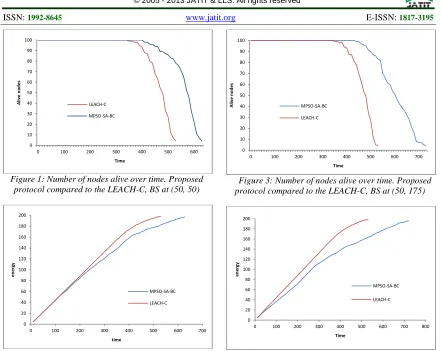
In order to evaluate the performance of the proposed protocol, we use NS-2 to simulate it and LEACH-C [8]. We ran the simulations for 100 randomly deployed nodes in a 100m×100m network area. We consider two scenarios for the simulations; (1) BS is located inside the field, at position (50, 50) and (2) outside the field, at (50,175). The number of clusters is set to be K=5 while the number of particles is Q=20 in the MPSO. The initial energy of nodes is 2J. We evaluate the energy efficiency by the network lifetime and the amount of energy consumed in the network. The Figure.1 shows the alive nodes, over time in a network using MPSO-SA-based clustering and LEACH-C [8], the BS is located at position (50,50). In this case, the simulation conducted under LEACH-C shows that the first node’s battery dissipates at the point 340 and all the rest experience the same thing one by one until the last which dies at point 540, while under MPSO-SA-BC, the first node dies at point 400 and the last at point 640.
Figure.2 and figure.4 represents a comparison between LEACH-C and our proposed method in terms of energy consumption. The ratio of energy dissipation under LEACH-C is quick. A look at the shapes of indicators reveals that the network consumes power quicker and over a shorter time under the respective protocol. On the other hand, our proposed protocol that is based on hybrid evolutionary algorithm relatively slows down the loss of energy.
1. Initialize each particle pj, {j=1,2,…, Q}, by K randomly chosen cluster heads among N nodes. 2. For each particle p j (Evaluate the fitness function).
2.1 For each node ni, {i = 1, 2... N} chooses the closer cluster-head by calculating (11) between ni and all cluster heads CHpj ,k. 2.2 Calculate the fitness function using (8). 3. Find the best position (Pi,Pg,PN).
4. Start SA as local search around both the best particle in the neighborhood PN and the best position in the swarm Pg.
5. Update the particle’s velocity and position using (5) and (4).
Figure 1: Number of nodes alive over time. Proposed protocol compared to the LEACH-C, BS at (50, 50)
Figure 2: The amount of energy over time. Proposed protocol compared to the LEACH-C, BS at (50, 50)
When the BS is located out the field (figure.3) the first node die at the point 340 for the LEACH-C and at 440 for the MPSO-SA-BC, The results demonstrate that our protocol improves the network lifetime compared to LEACH-C. Finally, it is realized that if the distance from the cluster heads to the BS and the intra-cluster distance are made closer, considerably good performance of nodes battery would be achieved.
For the simulations described in this paper, we adopt the same assumption as [17]. The communication energy parameters are set as: Eelec=50nJ/bit, Efs=10pJ/(bit ⋅m −2), Emp=0.0013pJ
/(bit ⋅m −4).
Figure 3: Number of nodes alive over time. Proposed protocol compared to the LEACH-C, BS at (50, 175)
Figure 4: The amount of energy over time. Proposed protocol compared to the LEACH-C, BS at (50, 175)
7. CONCLUSION
In this paper, we presented a clustering protocol based on hybrid evolutionary algorithm, which combines Simulated Annealing and modified particle swarm optimization. The principle was to reduce the energy dissipation in heads during data transfer between the cluster heads and the BS by minimizing the distance. Similarly, the energy in non-cluster heads is economized by minimizing the intra-cluster distance.
As compared with existing clustering protocols, our proposed protocol has considerably prolonged the lifetime of nodes. Thus, we have managed to increase the network’s lifespan.
REFRENCES:
[1] M. Ettus, “System capacity, latency, and power consumption in multihop-routed SS-CDMA wireless networks,” in Proc. Radio and
Wireless Conf. (RAWCON), Colorado Springs,
CO, Aug. 1998, pp. 55–58.
0 10 20 30 40 50 60 70 80 90 100
0 100 200 300 400 500 600
Al
iv
e n
od
es
Time
LEACH-C
MPSO-SA-BC
0 20 40 60 80 100 120 140 160 180 200
0 100 200 300 400 500 600 700
en
er
gy
time
MPSO-SA-BC
LEACH-C
0 10 20 30 40 50 60 70 80 90 100
0 100 200 300 400 500 600 700
Al
iv
e n
od
es
Time
MPSO-SA-BC
LEACH-C
0 20 40 60 80 100 120 140 160 180 200
0 100 200 300 400 500 600 700 800
en
er
gy
Time
MPSO-SA-BC
[image:6.612.95.315.72.407.2][2] T. Shepard, “A channel access scheme for large dense packet radio networks,” in Proc. ACM
SIGCOMM, Stanford, CA, Aug. 1996, pp. 219–
230.
[3] Jeong-Uk Kim,Lei Shu,Yu Niu, Sungyoung Lee, Jin Wang, A Distance-Based Energy Aware Routing Algorithm for Wireless Sensor Networks, Sensors 2010, 10(10), 9493-9511 Published: 21 October 2010
[4] Suresh Singh,Mike Woo ,C. S. Raghavendra, power-aware routing in wireless Ad-hoc networks,MobiCom '98 Proceedings of the 4th annual ACM/IEEE international conference on
Mobile computing and networking New York,
NY, USA ©1998
[5] W.R. Heinzelman, A. Chandrakasan, H. Balakrishnan, Energyefficient communication protocol for wireless microsensor networks,in: Hawaii International Conferenceon System
Sciences (HICSS), 2000.
[6] O. Younis, S. Fahmy, Heed: A hybrid, energy-efficient, distributed clustering approach for ad hoc sensor networks, IEEE Transactions on
Mobile Computing 3 (4) (2004) 366–379.
[7] Lindsey, S.; Raghavendra, C.S. PEGASIS: Power Efficient gathering in sensor informationsystems. In Proceedings of IEEE
Aerospace Conference, Big Sky, MT, USA, 9–
16 March 2002;pp. 924-935.
[8] W. Heinzelman, Application-specific protocol architectures for wireless networks, Ph.D. thesis, Massachusetts Institute of Technology.
[9] Latiff N M A, Tsimenidis C C, Sharif B S. Energy-aware clustering for wireless sensor networks using particle swarm optimization. Proceedings of the 18th International Symposium on Personal, Indoor and Mobile
Radio Communications (PIMRC’07), Sep 3−7,
2007, Athens, Greece. Piscatawaw,
[10] Jason C. Tillett ; Raghuveer M. Rao ; Ferat Sahin ; T. M. Rao, Particle swarm optimization for the clustering of wireless sensors, Proc. SPIE 5100, Digital Wireless Communications
V, 73 (July 25, 2003)
[11] J Tillett, R Rao, F Sahin, Cluster-head identification in ad hoc sensor networks using particle swarm optimization, Personal Wireless Communications, IEEE International
Conference on,2002, 201-205
[12] Nicholas Metropolis, Arianna W. Rosenbluth, Marshall N. Rosenbluth, Augusta H. Teller, and Edward Teller, Equation of State Calculations
by Fast Computing Machines J. Chem. Phys.
21, 1087 (1953).
[13] S. Kirkpatrick; C. D. Gelatt; M. P. Vecchi Optimization by Simulated Annealing, Science, Vol. 220, No. 4598. (May 13, 1983), pp. 671-680.
[14] R.C. Eberhart, J. Kennedy, A new optimizer using particle swarm theory, Proceedings Sixth Symposium on Micro Machine and Human
Science, IEEE Service Center, Piscataway, NJ,
39-43, (1995).
[15]B. Bochenek, P. Fory, Structural optimization for post-buckling behavior using particle swarms, Structural and Multidisciplinary
Optimization, 521-531, (2006).
[16] N. El Hami, R. Ellaia, M. Itmi, Hybrid evolutionary optimization algorithm
MPSO-SA, Int. J. Simul. Multidisci. Des. Optim.
Volume 4, Number 1, January 2010
[17] Heinzelman W B, Chandrakasan A P, Balakrishnan H. Application specific protocol architecture for wireless microsensor networks. IEEE Transactions on Wireless