OPTIMAL DESIGN STUDY OF PLATFORM STRUCTURE
BASED ON BP NEURAL NETWORK AND GENETIC
ALGORITHM
1LI WENXING, 1,2TAN JUN
1
Department of mechanical and electrical engineering, Xin Xiang University, Xin Xiang, China 453003 2
School of Mechanical and Power Engineering, Henan Polytechnic University No. 21000 Century Avenue, High-tech Zone, Jiaozuo, China 454000
ABSTRACT
The paper uses finite element method, orthogonal experiment method, BP neural network and genetic algorithm to optimize platform structure system of large, heavy duty NC rotary table. First of all, the harmonic response kinetics analysis can be processed on the platform structure system and can find out the mode frequency which has the strongest effect on the system dynamic behavior. Meanwhile, the design variables are confirmed as the BP neural network input variables. Then an orthogonal experiment was used in choosing the training sample data and the sample data were calculated through the finite element model. The BP neural network model which reflected the Platform structure features was established. At last, the BP neural network model will be optimized through the genetic algorithm. Simulation results show that the first inherent frequency increases by 15.5 percent with 9.8 percent weight lost.
Keywords: BP Neural Network; Genetic Algorithm; Finite Element; Orthogonal Experiment; Structural
Optimization;
1. INTRODUCTION
Genetic algorithm (Genetic Algorithm, referred to as GA) is the imitation of natural biological evolution mechanism developed random global search and optimization method, which uses a coding technology, applied to known as chromosome number string, simulated by these groups of the evolutionary process. Genetic algorithm through organized, random information exchange to reconfigure the good adaptability of string, generates a new string groups [1].Simply using the genetic algorithm to the disk structure shape optimization design, need to be constantly on the structure with finite element analysis, it takes a lot of time to the structure optimization design which will bring very great difficulty. According to using BP neural network nonlinear mapping ability to obtain genetic algorithm fitness function value, instead of the complicated finite element analysis method. Finally, the genetic algorithm to optimize the results of finite element analysis, found the optimal results can meet the requirements of the project.
2. PLATFORM STRUCTURE DYNAMIC CHARACTERISTICS ANALYSIS
2.1 The Platform Structure Dynamic Characteristics Analysis Of The Platform Main Performance Parameters.
The faceplate is large CNC rotary table bearing countertops. The platform structure dynamic characteristics analysis of the platform main performance parameters: MaterialHT300; Mass
density7000Kg m3; Elastic modulus1.3E11MPa;
Poisson ratio 0.27; Quality10398Kg.
[image:1.612.322.514.554.714.2]2.2 The Static Analysis Of Platform
.
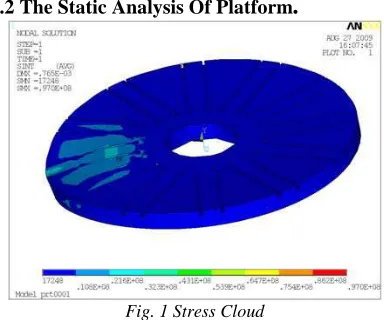
Platform constraint situation: The inner hole and the inner hole surface are constrained; the faceplate force situation: Uniform loads, at the platform surrounding, is 10 tons, concentrated loads, at the platform edge is 5 tons.
The figure 1 shows that the faceplate structure of maximum stress is 97MPa. While the HT300 allowable stress [σ] = 220MPa meet the mechanics of materials performance requirements, and the safety factor. Therefore, it is necessary to optimize the design of its structural system to maximize the
mechanical properties of the material and to reduce the structure’s own weight.
2.3 Faceplate Dynamic Stiffness Analysis
.
[image:2.612.96.519.247.462.2]Table 1 shows the first six natural frequency of the system under the theoretical conditions. On faceplate harmonic response analysis shows that the first order frequency easily cause the faceplate system of resonance for the maximum peak displacement response at the natural frequency of the first order under dynamic loading in the excitation frequency.
Table 1 Faceplate Structure First Six Order Natural Frequency
Order number 1 2 3 4 5 6
Natural frequency
f
1(Hz)116.52 124.01 124.07 154.02 155.13 183.24
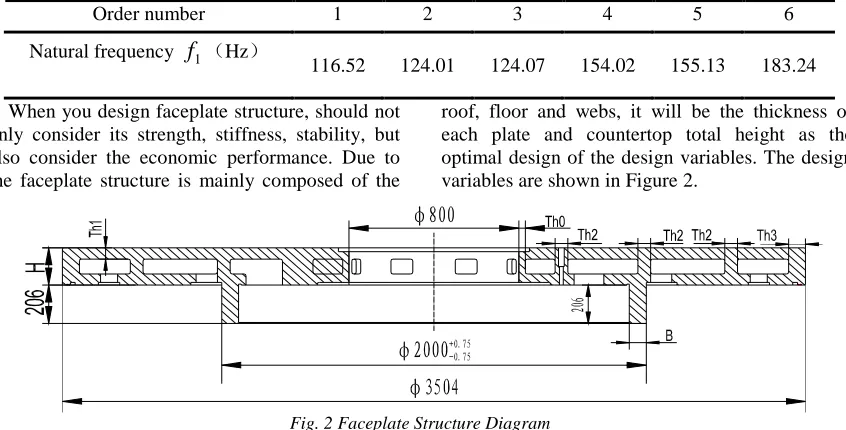
When you design faceplate structure, should not only consider its strength, stiffness, stability, but also consider the economic performance. Due to the faceplate structure is mainly composed of the
roof, floor and webs, it will be the thickness of each plate and countertop total height as the optimal design of the design variables. The design variables are shown in Figure 2.
Fig. 2 Faceplate Structure Diagram
3. BP NEURAL NETWORK MODEL
BP neural network (Back-Propagation Network referred to as the BP network) is one of the most important model of neural network. It has the advantages of simple structure, strong operability, can simulate arbitrary nonlinear input output relationship. BP network theory has been proven, typically containing the input layer, single hidden layer and output layer of three layer BP neural network can approximate any nonlinear relationship, which can realize arbitrary n-dimensional to m dimension mapping[2][3] . The training of a mature three layer BP network has strong nonlinear mapping ability. According to consider the research object and the characteristics of the BP network structure, we can find that using BP network modeling will get better mapping results.
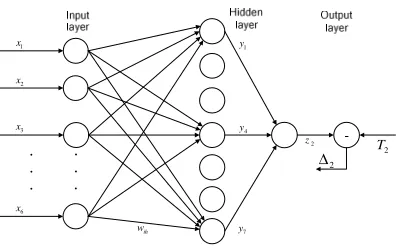
3.1 The Network Structure Of The BP Network. This paper adopts BP network containing the input layer, single hidden layer and output layer three layer network structure, in which the BP network input layer 6 neurons (disk structure system 6 design variables), single hidden layer design for 7 neurons, output layer 1 neuron is used to describe the disk of the first order natural
frequency. The
6
×
7
×
1
three-layer BP network topology is shown in Figure 3.3.2 The BP Neural Network Sample
.
[image:2.612.104.507.350.455.2]principle of or thogonality to test these representative points have " uniformly dispersed , neat comparable characteristics , the main tool of the orthogonal experiment method is orthogonal table[4][5].
1
x
2
x
1
y
2
z
2
∆ T2
ih
w
6
x
3
x y4
7
[image:3.612.94.292.175.299.2]y
Fig.3 BP Neural Network Topology
Faceplate structure model of neural network
training samples using orthogonal table
L
25(5
6), namely the samples of a total of 25, this design factors (i.e., input variables) number is 6, each factor is 5 levels, samples of factors and levels as [image:3.612.103.523.462.642.2]shown in table 2. Orthogonal table
L
25 (5
6 ) omitted. The 25 samples are used as the neural network model output variables by using the finite element model to calculate the corresponding to the first order natural frequency.Table 2 Factors And Levels Of Orthogonal
test
Num ber
1 2 3 4 5 6
Facto r
0
Th
(mm) 1
Th
(mm) 2
Th
(mm) 3
Th
(mm)
B
(mm)
H
(mm) Leve
l 1
20 70 50 50 70 175
Leve l 2
25 75 60 55 80 200
Leve l 3
30 80 70 60 90 225
Leve l 4
35 85 80 65 100 250
Leve l 5
40 90 90 70 110 275
3.3 BP Network Training.
The MATLAB7.1 neural network toolbox is used as neural network training tools for neural network design and training. First the orthogonal test the results of the 25 groups is divided into two parts, of which 20 were used for training, the other 5 groups for the trained network evaluation
The parameter P represents the input vector, and the parameter T represents the output vector, and then a BP network program code is created as follows:
net=newff(minmax(P), [7,1], {'tansig','purelin'},'trainlm')% new network
net.trainParam.show=10% Cycling 10 times to display results
net.trainParam.lr=0.05% the speed of learning is 0.5
net.trainParam.mc=0.9% Setting the momentum coefficient is 0.9
net.trainParam.epochs=100% Maximum number of cycles is 100
net.trainParam.goal=1e-2% Setting performance goals
[net,tr]=train(net,P,T)% Training neural network
Network iteration 52 times to achieve the training requirements (Fig. 4). The test result of simulation function sim showed that the maximum error of the network output values of the five test samples with the finite element results does not exceed 5% of these networks. That applied to performance prediction the BP network through effective training with higher prediction accuracy and good generalization ability.
Fig. 4 Error Convergence Schematic Diagram
4 GENETIC ALGORITHM COMBINED WITH BP NETWORK
[image:3.612.94.387.471.645.2]adaptive behavior of natural systems and to design a software system with adaptive function. It is a global optimization method[8], because it is characterized by the parameter encoding operation, do not need any prior knowledge of the system , a parallel search along a variety of routes , will not fall into the trap of local ,the best global optimum can be found in many local. However, when using genetic algorithms to solve the optimization problem, we need to know the explicit expression of the objective function, which calculates the fitness value and iterative calculation.
For the complex structure of the faceplate system, between the design variables and optimization objectives (dynamic parameters) is difficult to express explicitly. The artificial neural network model can just provide a nonlinear function mapping relationship. Therefore, the use of neural network modeling, genetic algorithm optimization is an effective method for solving dynamic optimization problem.
4.1 The Mathematical Model Of Faceplate Optimization.
Faceplate structure optimization is to determine
the parameter valueTh0,Th ,1 Th ,2 Th3, B , and H ,
when the first order natural frequency f was 1
highest
under20≤Th0 ≤40,70≤Th1≤90,70≤Th2 ≤90,
70
50≤Th3 ≤ , 70≤B≤110 and
275
175≤H≤ conditions. Optimized
mathematical model is described as:
Objective function
max f
1T
S
⋅
40
20
≤
Th
0≤
70
≤
Th
1≤
90
90
70
≤
Th
2≤
50
≤
Th
3≤
70
110
70
≤
B
≤
175
≤
H
≤
275
4.2 The Faceplate Structure Optimization Flow Chart.
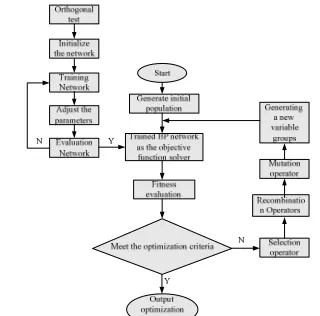
The figure 5 describes the faceplate structure optimization flow. Genetic algorithm for optimization of neural network model with
MATLAB 7.1 software as a platform uses the genetic algorithm toolbox GATBX that the British developed at the University of Sheffield, Objective function is ObjV = sim net (, (bs2rv (Chrom, FieldD) ') ', including sim () for neural network simulation function, net for the trained neural network model, bs2rv for binary string to decimal conversion function. Because GATBX genetic algorithm toolbox for objective function minimum, not negative, but to optimal faceplate structure the first order natural frequency for maximum. Some of its genetic algorithm the HTML code is as follows [1]:
FitnV=ranking (-ObjV); Fitness function
SelCh=select('sus',chrom,FitnV,GGAP); Select function
SelCh=recombine('xovsp',SwlCh,0.7); Reorganization of function
SelCh=mut(SelCh); Variation function
variable=bs2rv (SelCh, FieldD); the offspring individuals decimal conversion
Fig.5 Faceplate Structure Optimization Flow Chart
[image:4.612.337.497.371.529.2]Table 3 Comparison Of The Original Design And The Optimal Design
Parameter 0
Th
(mm)
1 Th
(mm)
2 Th
(mm)
3 Th
(mm)
B
(mm)
H
(mm)
Weight
(Kg)
The first order natural
frequency f (Hz) 1
Original design 30 80 60 60 80 200 10398 116.525
optimal design 25 90 50 70 70 275 9378 134.523
5 CONCLUSIONS
Taking faceplate structure system as the research object, this paper puts forward the orthogonal test method, the finite element method, neural network and genetic algorithm the integrated use of the method of optimization design. Using finite element analysis software of the harmonic response analysis function, and find out the biggest influence on faceplate dynamic performance of natural frequency. Orthogonal test method and neural network combined with a small amount of sample to obtain a homogeneous dispersion , neat comparable sample points ; genetic algorithm optimization neural network model get the optimal solution in the global sense in a relatively short period of time ; examples show this optimization method can make up for the lack of algorithms and enhance each other's ability to adapt , broaden the application range of each other , and have the versatility to optimize complex structure.
REFERENCES
[1] Lei Ying-jie, Zhang Shan-wen, Li Xu-wu, Zhou Chuang-Ming etc. MATLAB genetic algorithm toolbox and application [M]. Xian: Xian University of electronic science and technology press, 2005
[2] Yi Shao-hua, Liu Shu-tang. BP genetic algorithm in structure shape optimization design [J]. Journal of Guangzhou University (NATURAL SCIENCE EDITION), 2007 [3] Wen Xin, Zhou Lu, Wang Dan, Xiong
Xiao-ying and MATLAB neural network application design [M]. Beijing: Science Press, 2000 [4] Yu Lan-Feng. Tower crane structure rigidity
and dynamic optimization research [D]. Chengdu: southwest jiao tong university, 2006 [5] Fu Li-jun, Bao zhong-xu, Chen Ze-zhong, et al.
The orthogonal test method, neural network and genetic algorithm combined with [J]. Journal of Nanchang University (Engineering Science Edition), 2003, 25 (1): 79 - 82
[6] Dong Chang-hong MATLAB neural network and application [M]. Beijing: National Defense Industry Press.2005.