Distributed Applications
Maomao Wu
M.Sc. (Liverpool, UK, 2000)
B.E. (Shanghai, P.R.China. 1999)
Computing Department Lancaster University
United Kingdom
SUBMITTED IN PARTIAL FULFILLMENT OF THE REQUIREMENTS FOR THE DEGREE OF
DOCTOR OF PHILOSOPHY
Adaptive Privacy Management for Distributed Applications
Maomao Wu
Computing Department Lancaster University
Submitted for the degree of Doctor of Philosophy. June 2007.
In networked computing environments, it becomes increasingly difficult for normal people to manage privacy, i.e., “to determine for themselves when, how, and to what extent information about them is communicated with others”. The thesis argues that achieving better privacy is not about hiding as much personal information as possible but enabling personal information disclosure at a level of openness that is as close as to a user’s desired level to assist him/her in accomplishing useful tasks. Following Palen and Dourish’s observation that privacy management is a dialectic and dynamic bound-ary regulation process [Palen03], the thesis argues that no set of pre-specified static privacy policies can meet users’ changing requirements for privacy in networked com-puting environments, and therefore a new approach (i.e., adaptive privacy management) is proposed as the process that a user and/or a system to continuously adjust the system behaviour of disclosing personal information according to the user’s changing desire for openness.
networked computing environments. The middleware facilitates the creation of adaptive privacy aware applications that allows users or the system on behalf of the user to adjust the balance between openness and closedness; leading to an evolution of the users’ privacy preferences as a result of on-going interactions.
This thesis has been written by myself, and the work reported herein is my own. Many of the ideas in this thesis were the product of dis-cussions with my supervisor Dr. Adrian Friday. The work reported in this thesis has not been previously submitted for a degree in this, or any other form.
Firstly, I would like express my most sincere thanks to my supervisor Dr. Adrian Friday. He not only encouraged and inspired my Ph.D. research, but also provided dedicated support throughout the work, from insightful comments and constructive criticism to technical and linguistic guidance. This thesis would never have been completed without his patient supervision and most importantly tremendous support that he dedicated to the writing of the thesis. Moreover, I owe him thanks for offering me the opportunities to work with him on various research projects, and I feel extremely lucky to have worked under his guidance.
I would like to thank Prof. Nigel Davies for his insightful recommendation on eval-uating the work in the thesis and for his supervision during Adrian’s absence. I would also like to thanks Dr. Joe Finney for reading the whole thesis and provided useful com-ments. Moreover, I would like to express my thanks to Prof. Alan Dix and Dr. Corina Sas for providing expert advice on conducting the user study. Many thanks to all the participants of the user study, as this work would not have been finished without your generous help. Thanks to all the colleagues and friends in the departments. Special thanks to Dr. Christos Efstratiou for creating the elegant Lancasterian thesis template and providing assistance in preparing the LaTex version of the thesis. Additional thanks to other guys in D23: Oliver Storz, Mark Lowton, Andre Hesse, and Rob Hooper.
Abstract i
Declaration iii
Acknowledgements iv
Contents v
List of Tables xi
List of Figures xii
1 Introduction 1
1.1 The Right to Privacy . . . 2
1.2 Motivation . . . 3
1.3 What is Private Information? . . . 5
1.4 Technological Impact on Information Privacy . . . 6
1.4.1 Information Collection . . . 6
1.4.2 Information Storage . . . 8
1.4.3 Information Dissemination . . . 9
1.4.4 Information Use . . . 10
1.5 Understanding Threats to Information Privacy . . . 12
1.6 Scope of the Thesis . . . 13
1.7 Research Aims and Objectives . . . 15
1.8 Structure of the Thesis . . . 18
2.2.1 Modern Privacy . . . 22
2.2.2 Summary . . . 23
2.3 Social Perspective of Information Privacy . . . 24
2.3.1 People’s Perception of Privacy . . . 24
2.3.2 Economics of Information Privacy . . . 27
2.3.3 Summary . . . 29
2.4 Legal Prespective of Information Privacy . . . 29
2.4.1 Fair Information Practice Principles . . . 30
2.4.2 Europe Union’s Directive 95/46/EC . . . 32
2.4.3 Impact of Legal Framework . . . 33
2.4.4 Summary . . . 33
2.5 Technical Mechanisms for Privacy . . . 34
2.5.1 Access Control and Encryption . . . 34
2.5.2 Anonymity and Pseudonymity . . . 41
2.5.3 Transparency and Awareness . . . 45
2.5.4 Privacy Enforcement . . . 48
2.5.5 System Support for Privacy . . . 53
2.6 The Need for Adaptive Privacy Management . . . 65
2.7 Summary . . . 70
3 Analysis 71 3.1 Overview . . . 72
3.2 Design Strategies for Achieving Privacy . . . 72
3.2.1 Control at Information Collection . . . 72
3.2.2 Anonymity and Pseudonymity . . . 74
3.2.3 Awareness and Accountability . . . 75
3.2.4 Control at Information Use . . . 76
3.2.5 Discussion . . . 77
3.3 Requirements for Adaptive Privacy Management . . . 79
3.3.4 R4. Balance between Privacy and User Involvement . . . 81
3.3.5 R5. Accountability for Privacy-related Behaviour . . . 82
3.4 Summary . . . 83
4 Design 84 4.1 Overview . . . 85
4.2 Design Decisions for Adaptive Privacy Management . . . 85
4.2.1 Critical Factors for Privacy Decisions . . . 85
4.2.2 Notifying Users of Critical Events Concerning Privacy . . . 87
4.2.3 Providing Multi-modal and Multi-device Interaction . . . 88
4.2.4 Automating Privacy Decisions using Privacy Rules . . . 89
4.2.5 Facilitating Management of Privacy Rules . . . 90
4.2.6 Maintaining Status for Privacy-related Interactions . . . 91
4.2.7 Providing Support for Plausible Deniability . . . 92
4.2.8 Summary . . . 93
4.3 Incorporating Privacy into Distributed Applications . . . 94
4.3.1 Distributed System Architectures . . . 94
4.3.2 Synchronous Middleware . . . 96
4.3.3 Asynchronous Middleware . . . 99
4.3.4 Discussion . . . 102
4.4 Support for Adaptive Privacy Management . . . 104
4.4.1 The Need for Privacy Middleware . . . 105
4.4.2 The Flexibility of the Middleware . . . 106
4.4.3 Summary . . . 108
4.5 Architectural Design . . . 108
4.6 Summary . . . 112
5 Implementation 114 5.1 Overview . . . 115
5.2 Adding Privacy to Distributed Applications . . . 115
5.3.3 Enabling Multi-modal and Multi-device Interaction . . . 126
5.3.4 Automating Privacy Decisions using Privacy Rules . . . 127
5.3.5 Balancing User Intrusiveness and Privacy Rule Management . . 129
5.3.6 Realising Persistence for Privacy Interactions . . . 132
5.3.7 Discussion: Flexibility and Extensibility of the Prototype System134 5.4 Case Study: A Privacy-Aware Location Sharing Application . . . 136
5.4.1 Motivation for Location Sharing and Privacy . . . 136
5.4.2 Intended End User Experience . . . 138
5.4.3 Location Sensing and Map Services . . . 140
5.4.4 Integrating with the Adaptive Privacy Manager . . . 141
5.4.5 Improving Usability . . . 144
5.5 Summary . . . 146
6 Evaluation 147 6.1 Overview . . . 148
6.2 Experimental Methodology . . . 148
6.2.1 Phase 1: Preparation Tasks and Opening Questionnaire . . . 148
6.2.2 Phase 2: Deployment of the System . . . 151
6.2.3 Phase 3: Surveys and Interviews at the End of the Trial . . . 153
6.3 Quantitative Analysis of Usage . . . 154
6.3.1 Location Information Requests . . . 154
6.3.2 Sharing of Context . . . 159
6.3.3 Privacy Rules and User Groups . . . 161
6.3.4 Response to the Stranger . . . 164
6.4 Reflecting on User Experience . . . 166
6.4.1 Accuracy of the Location Information . . . 166
6.4.2 Usefulness of the System . . . 167
6.4.3 Cost for the Location Information . . . 170
6.5 Evaluation against Requirements . . . 171
6.5.4 R4. Balance between Privacy and User Involvement . . . 181
6.5.5 R5. Accountability for Privacy-related Behaviour . . . 185
6.6 Discussion . . . 187
6.6.1 Key Findings . . . 187
6.6.2 Limitations . . . 189
6.6.3 Reflecting on Developer’s Experience . . . 190
6.6.4 Suggestions for Improvement . . . 192
6.7 Summary . . . 193
7 Conclusions 194 7.1 Overview . . . 195
7.2 Major Results . . . 197
7.2.1 Identification of Adaptive Privacy Management . . . 197
7.2.2 Requirements for Adaptive Privacy Management . . . 198
7.2.3 Feasibility of Adaptive Privacy Solution . . . 199
7.2.4 End User Study and Evaluation . . . 199
7.3 Other Significant Results . . . 200
7.3.1 Investigation of the Problem of Privacy . . . 200
7.3.2 An Architecture for Adaptive Privacy Management . . . 201
7.3.3 An Instance of Middleware Platform . . . 202
7.4 Future Work . . . 203
7.4.1 Improving the Location Sharing Application . . . 203
7.4.2 Using the Platform as a Testbed for Privacy Solutions . . . 204
7.4.3 Extending Adaptive Privacy Management . . . 205
7.5 Concluding Remarks . . . 206
References 207
Appendix A Research Protocol Form 231
Appendix B Opening Questionnaire 236
2.1 The Privacy Awareness System (pawS) [Langheinrich02b] . . . 56
2.2 The Houdini Framework [Hull03] . . . 60
2.3 InfoSpace Model for Confab Toolkit [Hong04a] . . . 64
2.4 Degree of Privacy defined by Reiter and Rubin [Reiter98] . . . 69
3.1 Spectrum of adaptation in computer systems [Oppermann97] . . . 82
4.1 Client-Server Architecture Adapted from [Coulouris01] . . . 95
4.2 Functional Steps in a Remote Procedure Call Adapted from [Stevens90] 97 4.3 Asynchronous Remote Procedure Call from [Tanenbaum06] . . . 100
4.4 Event Notification in ECA: (a) direct and (b) mediated [Bacon00] . . . 102
4.5 Architecture for Supporting Adaptive Privacy Management . . . 109
5.1 Synchronous operation for information sharing . . . 116
5.2 Transforming synchronous operation into four interactions . . . 117
5.3 System Component Overview . . . 118
5.4 Data Structures Required for Notification Service . . . 121
5.5 API method and plug-in interface for notification . . . 121
5.6 MSN messenger style privacy alerts . . . 123
5.7 Representation of a private information request (PrivInfoReq class) . . . 124
5.8 Internal sequence of operations for processing a private information re-quest . . . 125
5.9 API methods for accepting and rejecting privacy request(s) . . . 125
5.10 Plug-in interfaces for customising the privacy decision automation service128 5.11 Representation of a privacy rule (PrivPref class) . . . 128
5.12 API methods for managing privacy rules . . . 130
5.13 API methods for managing user groups and membership information . . 130
5.14 Internal operation for AddPrivPrefForReq method . . . 131
5.19 Integrated privacy-aware location sharing application . . . 142
5.20 Location information shown on Google Maps . . . 143
5.21 Received information requests monitoring page . . . 144
6.1 Age distribution of participants . . . 150
6.2 Response to privacy diary . . . 152
6.3 Number of location requests by day during the user trial . . . 155
6.4 Number of location requests on days in a week and during hours in a day 156 6.5 Number of location requests sent and received by participants . . . 157
6.6 Breakdown of location requests in different final status . . . 158
6.7 Number of location requests containing contextual information in re-quest and reply . . . 160
6.8 Privacy rules created by participants . . . 161
6.9 Number of location requests processed by each privacy rule . . . 162
6.10 Number of individuals in the user groups for group rules . . . 163
Introduction
Contents
1.1 The Right to Privacy . . . 2
1.2 Motivation . . . 3
1.3 What is Private Information? . . . 5
1.4 Technological Impact on Information Privacy . . . 6
1.4.1 Information Collection . . . 6
1.4.2 Information Storage . . . 8
1.4.3 Information Dissemination . . . 9
1.4.4 Information Use . . . 10
1.5 Understanding Threats to Information Privacy . . . 12
1.6 Scope of the Thesis . . . 13
1.7 Research Aims and Objectives . . . 15
1.1 The Right to Privacy
Novel technologies and their adoption have significant impact on ethical, economic, legal and social issues. Failing to address these issues in the development stage may foster misuse of technology and incur an adverse response to it. When Samuel Warren and Louis Brandeis first introduced the notion ofprivacyin their influential articleThe Right to Privacy [Warren90] in 1890, they were fiercely reacting to the unethical use of portable photography and modern printing technologies to publicly disseminate in-formation relating to individuals’ private lives. Since then, privacy has become a multi-disciplinary topic that attracts attentions from psychological, economic, legal, social and technological researchers.
With the advance in computer networks and the popularity of Internet applications, the flow of personal information can easily get out of control: private emails can be intercepted by unscrupulous third-parties; credit card details and mailing addresses can be transmitted by simply filling in a web form and the click of a button; people’s online activities are increasingly logged, archived, and searched; the details of online transac-tions might be maintained and exploited for marketing purposes by companies that you are not even aware of. In contrast with the original definition of privacy by Brandeis, as
“the right to be left alone”, we believe that privacy is more about controlling the flow of the personal information in the modern information age. As we define based on the writings of Alan Westin in Privacy and Freedom[Westin67]:
Definition 1: Privacy is the claim of individuals, groups, or institutions to determine for themselves when, how, and to what extent information about them is communicated to others.
1.2 Motivation
The last decade has witnessed important technological changes that have had a signifi-cant impact on people’s personal lives. Wide deployment of the wireless communication infrastructure, most notably in the form of the Global System for Mobile Communica-tions (GSM) and Wireless Local Area Networks (WLAN), has dramatically increased the availability of network connectivity allowing people to be seamlessly connected to each other from anywhere anytime. Coincidentally, decreased cost of terminal devices has enabled an increasing number of people to possess and utilise a variety of electronic appliances in their everyday life. The mobile phone handset has become ubiquitous in many parts of the world, and people have already regarded it as commodity or necessity of their daily life [Davies02]. The high availability of connected devices such as these fosters the development, deployment, and adoption of new applications that empower people to seamlessly communicate with each other from a variety of Information and Communication Technology (ICT) devices. For example, Instant Messenger (IM) is readily found running on PCs, laptops, PDAs and mobile phones, facilitating communi-cation between people via text messaging, voice conversation, and video conferencing; but also increasingly distributing presence and contextual information.
However, these technological changes have negative impact on the privacy of peo-ple’s personal information. To be left alone becomes much more difficult to achieve because of the “always-available” network connections and “always-on” terminal de-vices. In the near future, we believe IMs will transmit not only people’s presence in-formation but also other contextual inin-formation such as location or activity, to facilitate people to find and communicate with one another [Hong04a]. With the increase in per-sonal information that can be disclosed, simple “on or off” control will not be sufficient for enabling users to “determine for themselves when, how, and to what extent infor-mation about them is communicated to others”. For example, people might disclose their location information to their colleagues when they are at work, but they might also disclose location information to family members after working hours. Moreover, with large amount of personal information being recorded, distributed, accumulated, and stored, it becomes increasingly possible that the information will be correlated and analysed over time to reveal other types of personal information, such as working pat-terns [Beresford03].
into commodity hardware. GPS devices in vehicles can provide convenient location and route information for drivers while they are on the road, but this apparently private in-formation has already been exploitedby companies against their customers: car-rental companies have charged their customers for crossing state boundaries in US [Lemos01] and even for speeding [CBS News04]. Radio Frequency Identification (RFID) technol-ogy was envisioned to replace barcodes, and its huge code space makes it possible to tag every single product on earth. For example, the 96 bit code and partition scheme in Auto-ID standard not only offers space for 256 million manufacturers and 16 million products per manufacturer, but also leaves 64 billion serial numbers for each individual product model [Stajano05]. Unlike barcodes that can only be read by aligning them with the reader, RFID tags use radio frequency and can be read within range of the RFID reader without any explicit action. With RFID, machines effectively possess an X-ray vision [Stajano05], which enables them to silently scan us at any point to find out detailed information of the items on our body or among or posessions. Machines can not only know what brand and size the items are, but when and where we bought them.
Coupled with these rapid advances in wireless communication and sensor-based computing, recent evolution of microprocessors has enabled computing capabilities to be increasingly embedded into ‘smart artefacts’; daily objects that can communicate seamlessly with one another and are increasingly aware of their surroundings or modes of use. In 1991, Mark Weiser envisioned this technological trend and described it in his seminal Scientific American article [Weiser91]; coining the term Ubiquitous Comput-ing (or Ubicomp). For the last decade, UbiComp has become one of the hottest research topics in computer science, and a number of research prototypes [Microsoft Corp.01, HP Corp.01, MIT04, AT&T Labs01] have emerged to explore the potential for building so-called “intelligent” or “smart environments” that are designed to utilise sensing to intelligently serve the needs of the occupants in an unobtrusive manner. In order to pro-vide services that conform to the user’s needs and desires without explicit interaction, UbiComp systems will become not only knowledgeable about users’ locations or move-ments, but also their longer-term behaviours and habits. Keeping and exploring such detailed user knowledge is crucial for building UbiComp systems, yet paradoxically such systems clearly have a great potential for invading personal information privacy [Satyanarayanan03]. As Weiser himself acknowledged, privacy will become one of the major challenges in achieving the UbiComp vision:
hard to know what is controlling what, what is connected to what, where information is flowing, how it is being used, what is broken (vs what is working correctly, but not helpful), and what the consequences of any given action (including simply walking into a room).”
The emergence of early Ubiquitous Computing prototypes using today’s networked environments forms the context for our work. In this thesis, we concern ourselves with the privacy of personal information in networked computing environments, from tradi-tional local area networks, intranets, and the Internet, to emerging mobile computing and ubiquitous computing systems. We describe the scope and aims of our work as follows: in section 1.3 we provide our definition of personal and private information. Section 1.4 examines the impact of modern information technology on personal infor-mation privacy and identifies key challenges that make privacy difficult to achieve over the whole lifetime of the information. Section 1.5 investigates the range of privacy vul-nerabilities in exiting networked environments. We then define the scope of the thesis in section 1.6. Section 1.7 enumerates the research aims and objectives of the thesis. We conclude with an outline of the overall structure of the thesis in section 1.8.
1.3 What is Private Information?
Our framework protects unwanted sharing of private information. We define private information in terms of personal information, thus:
Definition 2: Personal Information (or personal data) is any information (or data) that is pertinent to an identified or identifiable person.
Privacy is an extrinsic, not an intrinsic, property of a piece of information about an individual [Jones03]. Whether a piece of personal information is considered private is not an internal property of the information itself, but rather an external view of whether people regard it as private. Based on the above observation, we define private informa-tion as:
Definition 3: Private Information is any personal information that the user deems private.
The subtle perception of the human parties involved necessarily means that pri-vacy is not a purely technical problem but rather a complex socio-technical system [Anderson04].
1.4 Technological Impact on Information Privacy
We first taxonomise the threats to information privacy introduced by increased uptake of information technology. We categorise the lifecycle of such information into four stages: collection, storage, dissemination, and use. We examine the impact of technol-ogy on personal information privacy in each of these stages.
To facilitate our discussion, we use the following terms to refer to the common entities involved in the process of personal information disclosure and exploitation:
• Data Subjectis an individual to whom personal data relates;
• Data Collectoris an individual, a system, or an institution that collects informa-tion about the data subject; and
• Data User is an individual, a system, or an institution that uses information col-lected by the data collector. The data collector and data user can sometimes be the same entity.
1.4.1 Information Collection
already experienced the dramatic changes in many parts of our everyday lives and no-ticed that an increasing number of our daily activities have been recorded by comput-erised systems, e.g., paying bills using credit card, borrowing books from library, vis-iting GPs or dentists, booking flights or hotels online, etc. More recently, multimedia technologies have changed the magnitude of the personal data that can be collected, because people’s activities in the physical world can be captured in various formats of digital images, audios, and videos, with higher quality. For instance, high-definition colour surveillance cameras, which used to be low-definition black and white systems, can focus to resolve minute details and record larger number of high resolution picture frames per second. Moreover, multimedia data contains much richer information than textual data [Adams01b], e.g., audio can reveal a subject’s tone of voice, accent, or dialect, and videos can reveal a subject’s appearance, mannerism, or body language.
Computers collect not only primary personal data, but also secondary or associ-ated data [Jones03]. For example, all digital files have timestamps for creation and last modification; electronically-edited documents (e.g., a Microsoft WORD document) may contain a record of changes made during the process of preparing the final ver-sion; and web servers often log accesses to visited pages together with the IP address of the requesting client. People are often not aware of the existence of this kind of sec-ondary data, and even if they were, they would not necessarily be able to interpret them [Jones03]. Such data can be very informative for others, and we should not overlook the potential that they may be exploited to reveal sensitive personal information. The prac-tice of gathering metadata will continue with the advances of context-aware computing and Ubicomp, where systems increasingly collect contextual information (e.g., time, location, or activity) in addition to supporting primary interactions [Satyanarayanan03].
concluded that:
“reliable, inconspicuous sensing of personal information is problematic be-cause users do not always understand the extent or methods of data collec-tion and thus cannot adequately evaluate privacy issues”[Beckwith03].
People must make rational choices about their actions for managing their privacy, but they cannot make such choices without knowing or understanding what the system does to what piece of their information [Smith04].
1.4.2 Information Storage
Information storage is about preserving collected information on digital storage devices, e.g., RAMs, hard disks, DVDs, etc. The advances in hardware technology not only in-crease the amount of data that can be maintained, but also the ease with which it can be stored and retrieved. Unlike the human memory, digital storage media never for-gets, and therefore anything that is recorded immediately achievespotential immortality
[Grudin01]. Preserving transient events or states in digital formats for such a prolonged period significantly increases the potential of reuse and exploitation. In public places, people’s movements and activities can be recorded by surveillance cameras and poten-tially accessed in the future for purposes such as crime detection. In intelligent envi-ronments, occupants’ daily conversations and activities can be recorded and exploited to derive their long-term behaviours and habits [Lester05].
Databases management systems (DBMS) facilitate maintaining and organising large amounts of data, and accelerate retrieving useful information from data sources. The World Wide Web (WWW) and search engines offer ordinary people a friendly user interface to access data sources conveniently, efficiently, and ubiquitously. Online ac-tivities have surged with the popularity of Internet applications, and the combination of the above technologies facilitates logging, archiving, and searching people’s on-line activities. The WayBack Machine[Internet Archive07] allows users to search the archives of the WWW back to 1996. Google bought Dejanews and created Google Groups[Google Inc.07b] offering archival search of the Usenet newsgroups dating back to 1981.
expense in executing the search itself, but also incur less burden and intrusion on the person being searched. The latter reduces the legal justification for interfering with the searches, since the legal grounds for restricting searches have been based on the burdens imposed on the person being searched [Lessig98]. In late 2005, the US government sub-poenaed records from all major search engines, in order to protect children from harmful materials from the Internet [Rasch]. Almost all of the requested companies, including AOL, Yahoo and Microsoft, complied with the subpoenas except Google [BBC06].
Unlike traditional paper documents, the information on the digital storage media is normally only accessible indirectly through a combination of hardware and software. This indirection makes it difficult to completely dispose of information, as stored in-formation leaves traces (metadata) throughout the system. For example, when a user deletes a file, for efficiency reasons operating systems typically only mark the disk space free and leave the file content untouched on the disk. Deleted files can be recovered by using special tools that use file system APIs directly. Unsecure virtual memory man-agement systems do not encrypt the page file on the hard disk while shutdown, which makes it possible to inspect fragments of memory snapshots if one has physical access to the disk [Stajano02]. Recovering this type of information is essential to the field of ‘Computer Forensics’, but these same techniques also clearly present a threat to the privacy of the individuals whose information is recovered. The complexity of these soft-ware architectures can result in a lack of appreciation over the consequences of one’s information disposal actions, often involuntarily leaving information exposed.
1.4.3 Information Dissemination
indus-try [NY Lawyer07]. While duplication is only possible to a limited degree of accuracy with traditional analogue forms of information, digital information technology has made perfect duplication (with 100% accuracy) not only possible but also the norm.
With the increased practices of information dissemination, people are losing track of their previous activities regarding the duplication and distribution of information, e.g., how many copies of the file they’ve made, when they transferred the copy of the file, to whom, and by what means. The pure existence of duplicated information itself has a significant impact on privacy, because the data subject can not easily detect when information is duplicated and when this is accessed. Moreover, the data subject cannot usually prevent the data receiver from disseminating his personal information to a third-party. From the experience of online P2P file-sharing systems, researchers found that it is a non-trivial technical problem to prevent people from disseminating information that they already have access to [Goldberg02].
1.4.4 Information Use
Integrated sensors and embedded computing devices facilitate the collection of personal information, and advanced communication and networking technologies amplify their capabilities by enabling distribution of collected information to powerful remote servers that can automatically process the information. In 2003, London’s Congestion Charg-ing (LCC) system [Anonymous03] deployed 700 surveillance cameras around 203 en-trances and exits to the 21 square kilometre central zone of London, and connected those surveillance cameras to an number plate recognition system that automatically identifies a vehicle’s number plate from the video streams. The recognition system can increasingly connect to a variety of data sources and link pieces of information together to derive more sensitive personal information. For instance, LCC now connects to the Driver and Vehicle Licensing Agency (DVLA) database, allowing identification of the vehicle’s registered owner that has not paid, and issues a fine letter to the mailing address of the owner.
travelling has significantly different privacy implication from publishing the whole col-lection with timestamps, which is equivalent to disclosing the personal travel itinerary. For the same reason, allowing a friend to view your instant messenger status is a widely accepted practice, but it has dramatically different privacy implication if your friend records this status information over time to find out your long-term usage behaviour. Data Mining not only aggregates a large number of data instances for the same type, but also combines data from different sources that reveal more information. The same thread may arise in intelligent environments that record a combination of occupants’ locations, activities and time, to derive long-term behaviour. Personalisation, the pro-cess of customising applications according to user’s preferences, is not new in computer science, and UbiComp has made it an explicit goal to exploit as much user information as possible in order to anticipate the users’ needs and desires without explicit interac-tion. The existence of the detailed knowledge about a user has the potential risk of being stolen and misused, and the consequences would be much more serious than theidentity theftwe might have already experienced.
Privacy enforcement is often achieved by attaching metadata to information describ-ing how it should be processed. The fluid nature of digital media makes it easy to remove such a “privacy tag” from the information, increasing the potential that it is used for completely different purposes and under different conditions from those orig-inally specified. The LCC system was origorig-inally designed to immediately discard the information about vehicle registration number, location, and timestamp if the vehicle has already shown aspaid in the database. This policy has since been revised so that these sightings are kept, so that the police and other authorities may be granted access to it in the future [Stajano03]. This is not a new problem — early HCI researchers [Mackay91a] noticed numerous potential ethical problems in using videos for different audiences and purposes other than those originally intended. The fact that records of people’s activities may be manipulated and used out of their original context in the fu-ture clearly poses challenging questions for developers of networked environments, and especially for UbiComp [Bellotti93].
a medium to disseminateunsolicited commercial email (spam)messages orworm pro-grams and viruses [Pfleeger02]. Scanning and filtering technologies used in anti-virus software employed by Google’s GMail [BBC04], scans the contents of users’ email messages not only to filter spam and detect viruses, but also to provide users with per-sonalised advertisements — a substantially different and more controversial purpose. Information technology serves the purposes to which it is put; information privacy is thus not a purely technical problem but rather a complex socio-technical one that inter-plays between technology, people, and society as a whole.
1.5 Understanding Threats to Information Privacy
Having explored technological impact on privacy generally, in this section we refine the focus of the thesis by investigating the range of privacy vulnerabilities specifically in existing networked computing systems. Based on Bellotti’s dichotomy of privacy problems [Bellotti97], we classify privacy attacks into two categories: malicious or covert attacks on information privacy, and accidental or negligent releases of private information.
[Schneier00], andphishing is a typical example of semantic attacks. Phishing attacks deceive users into disclosing personal information by mimicking a legitimate entity in an electronic communication [James05]. Phishing has been a growing concern for per-sonal information privacy, and 135 legitimate brands have been hijacked according to a report by the Anti-Phishing Working Group in February 2007 [Group]. Addressing these security threats is an active area of research in its own right [Dhamija06, Wu06], and it is out of scope of this thesis. For the purposes of the thesis, we assume that the developers wish to behave ethically and respect user’s privacy to encourage trust.
Accidental or negligent release of private information occurs if a user’s understand-ing of a system is inadequate. For example, mis-configuration of file access permis-sions may lead to unintentional sharing of personal information in multi-user comput-ing systems; mis-configuration of security settcomput-ings of messengers or blogs may incur undesirable exposure of private information. Inadvertent privacy intrusion occurs when consequences of user actions are hidden by system abstraction. When an administrator sets up a web interface for a shared file folder, the users who originally have access to that folder are unaware that the folder is now publicly exposed. People may acciden-tally publish private information as an unexpected side-effect of legitimate actions, e.g., sensitive credentials may be embedded in URIs to printer queues that are exposed when shared on the network and personal files may even be cached on printers and reprinted remotely. Personal information sharing applications have been designed to make it easy to publish information, but few provide tools for reminding users to stop sharing. Cog-nitive science taught us that humans are forgetful, and the asymmetry of information disclosure and control leads to human mistakes of accidental information leakage. In the context of this thesis, we focused on exploring privacy management solutions for ac-cidental or negligent privacy intrusion in distributed systems.We provide more detailed description for defining the scope of the thesis in the next section.
1.6 Scope of the Thesis
are vulnerable to human weakness [Jones03]. We believe that personal information privacy cannot be achieved using technology alone, as a prominent cyber-law scholar, Stanford Law Professor Lawrence Lessig concluded: privacy has to be achieved through a combination of technologies, legislations, social norms, and market forces [Lessig98, Lessig99].
The area of privacy management is extremely broad and complex, and we have chosen to focus on provide privacy management support for applications that enable intentional sharing of personal information in networked computing environments.
Surveys [Mabley00] showed that a large percentage of users were typically willing to share some personal information with service providers and other users for receiving better services. However, numerous user studies [Harper96, Kaasinen03, Barkuus03] demonstrated that many people want to remain in control of their privacy. Existing information sharing applications provide very few options for people to control their private information [Hull03]. For example, Instant Messengers clients (e.g., MSN, Jab-ber, AOL Messenger, etc) only allow users to make all-or-nothing privacy decisions, i.e., controlling presence information based on buddy-lists. With increased personal information being sharing among people, simple all-or-nothing control will not be suf-ficient for enabling users to“determine for themselves when, how, and to what extent information about them is communicated to others”[Westin67].
In this thesis, we concentrate on designing information privacy management mech-anisms in the scope of individual-to-individual interactions mediated by networked ap-plications (as opposed to interactions between individuals and organisations). Based on a fundamental premise of the cognitive sciences that people are mostly rational [Simon96], we assume that developers and users involved in distributed information sharing applications will protect their own privacy and respect the privacy of others [Boyle05]. End users involved in those applications share their private information voluntarily, and there is no unbalanced power relationship between them. Moreover, users involved in those applications have already established social relationships be-tween each other (as opposed to adversaries or attackers in traditional computer secu-rity), and therefore we focus on privacy management forinadvertent privacy infractions
to avoid undesired social obligations or potentially embarrassing situations [Hong05].
1.7 Research Aims and Objectives
of information, the time of disclosure, the precision of the information, etc. We provide the following definition for better privacy in the context of the thesis:
Definition 4: Better privacy is when personal information disclosure is at a level of openness that is as close to a user’s desired level as possible.
The reciprocity of traditional face-to-face social interactions enables people to sense sufficient cues from the environment and from their expectations of social behaviour according to social norms [Boyle05]. However, recent development of technology for networked environments has changed this situation: people are increasingly unaware of personal information disclosure; and even if they are, they can hardly be expected to understand the intended or unintended consequences of the disclosure [Smith04]. Grudin argued that technology resulteddesituatedanddecontextualisedactions:
“We are losing control and knowledge of the consequences of our actions, because if what we do is represented digitally, it can appear anywhere and at any time in the future. We no longer control access to anything we dis-close.” [Grudin01]
Without sufficient cues, people often fail to adjust their behaviour and appearance according to social norms and expectations, a common regulatory process in traditional social interactions known as self-appropriation [Bellotti97]. The strategies for self-appropriation in traditional social interactions are both fine-grained and lightweight, but very few fine-grained yet lightweight strategies exist in computer-mediated inter-actions [Bellotti97]. It is hard to design computing systems that provides fine-grained and lightweight control, because they are sometimes contradictory goals and require trade-off at the design stage [Boyle05].
knowledge together with their subjective views through an adaptive approach, which optimises selective disclosure of personal information in response to changing circum-stances through a mixture of system-initiation and user-initiation. More concretely, we provide the following three definitions:
Definition 5: A privacy aware application is an application that employs a privacy framework to ensure that the users’ wish for privacy is respected.
Definition 6: Adaptive privacy management is the process that a user and/or a system continuously adjusts the system behaviour of disclosing personal information according to his/her changing desire for openness un-der different circumstances.
Definition 7:An adaptive privacy aware application is an application that attempts to achieve better privacy using a privacy framework that supports adaptive privacy management.
This thesis aims to investigate the issues of incorporating adaptive privacy man-agement into personal information sharing applications in networked environments that work within the existing social contexts. In particular, we explore principles that we believe are essential to constitute an adaptive privacy aware application with end users:
• Adaptive Privacy Balance and Evolution of Privacy Preferences: to enable users or/and the system to adjust the balance between openness and closedness depend-ing on situations in dynamic networked environments; and to allow evolution of users’ privacy preferences specified in the system over time as a result of on-going interactions between the user and the system.
• Awareness of System Behaviour Concerning Privacy: to promote users’ aware-ness of system’s behaviours concerning privacy, e.g., what the system can poten-tially or/and actually do with users’ personal information.
• Balance between Privacy and User Involvement: to balance end users’ need for information privacy with the level of intrusiveness incurred by privacy-related interactions.
• Accountability for Privacy-related Behaviour: to maintain audit trails for privacy-related behaviours (e.g., information disclosed either explicitly by the user or au-tomatically by the system) to increase accountability and traceability of the sys-tem.
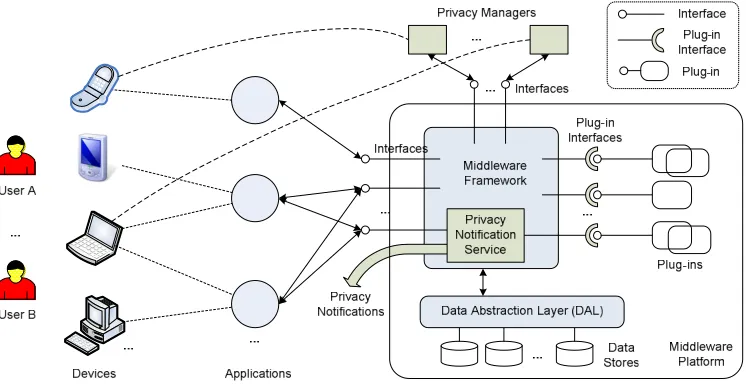
In order to investigate the aforementioned principles, the thesis presents the design of a middleware platform that provides support for developing adaptive privacy aware applications. A prototype implementation of the platform is presented as well as an adaptive privacy aware application that enables sharing of GSM-based location infor-mation. To meet the aforementioned requirements, adaptive privacy aware applications built upon the platform promote privacy awareness through timely notification to end users of critical privacy events; enable multi-modal and multi-device interactions to pro-vide users convenient and timely access to privacy controls; propro-vide support for users to make privacy decisions ‘in context’ to enable users or/and the system to adaptively balance personal information disclosure; automate privacy decisions using privacy rules to strike a balance between privacy and user involvement; and realise persistence for privacy interactions to increase accountability and traceability of the system. We eval-uate the principles of adaptive privacy management through an end user study of the adaptive privacy aware location sharing application.
1.8 Structure of the Thesis
The remainder of the thesis is structured as follows.
Chapter 2 presents an investigation into the nature of privacy itself and existing technical approaches for preserving information privacy. The chapter surveys privacy from historical, social, legal, and technological perspectives and provides important context for the thesis. In this chapter we motivate a new approach, i.e., adaptive privacy management, that enables people to adaptively adjust their level of openness in dynamic networked computing environments.
of these approaches. Based on this analysis, the chapter explains rationales for selecting specific technical mechanisms for adaptive privacy management, to empower people to manage their privacy more efficiently and effectively in dynamic networked computing environments. The chapter concludes with a set of requirements that need to be satisfied in order to develop adaptive privacy aware applications.
Chapter 4 presents the design decisions for private information sharing applications to meet the requirements set in the previous chapter. To facilitate incorporating adaptive privacy management into distributed applications, a middleware platform was designed to support the development of adaptive privacy aware applications. The flexibility of the platform enables developers to customise it to meet requirements in different domain, and facilitates modification, extension and maintenance of applications.
Chapter 5 presents the implementation of a prototype platform that supports the development of adaptive privacy aware applications. The components of the support platform are examined in detail, particularly in terms of the application programming interfaces offered to distributed application developers and plug-in interfaces designed to facilitate the customisation of the platform and privacy request handling algorithms. Lastly, the chapter describes the implementation of a prototype application built using the platform that allows people to sharing GSM-based location information while pre-serving their privacy.
Chapter 6 presents an evaluation of adaptive privacy management approach from end user perspective. A three-phased user study was conducted during April to May in 2007 with 30 participants over a period of 71/2weeks using our privacy aware location
sharing application. The chapter describes the experimental methodology of the user study, provides analysis of the gathered usage data, and presents an evaluation of the principles constituting adaptive privacy management.
Background
Contents
2.1 Overview . . . 21
2.2 Historical View of Privacy . . . 21
2.2.1 Modern Privacy . . . 22
2.2.2 Summary . . . 23
2.3 Social Perspective of Information Privacy . . . 24
2.3.1 People’s Perception of Privacy . . . 24
2.3.2 Economics of Information Privacy . . . 27
2.3.3 Summary . . . 29
2.4 Legal Prespective of Information Privacy . . . 29
2.4.1 Fair Information Practice Principles . . . 30
2.4.2 Europe Union’s Directive 95/46/EC . . . 32
2.4.3 Impact of Legal Framework . . . 33
2.4.4 Summary . . . 33
2.5 Technical Mechanisms for Privacy . . . 34
2.5.1 Access Control and Encryption . . . 34
2.5.2 Anonymity and Pseudonymity . . . 41
2.5.3 Transparency and Awareness . . . 45
2.5.4 Privacy Enforcement . . . 48
2.5.5 System Support for Privacy . . . 53
2.6 The Need for Adaptive Privacy Management . . . 65
2.1 Overview
The objective of this chapter is to provide an overview of the privacy from historical, so-cial, legal, and technological perspectives. It aims to provide important context for our work and to identify contributions and limitations of the existing technical approaches. The first section of the chapter provides the historical view of privacy, introducing dif-ferent aspects of privacy and the implications for privacy as new technologies have been introduced. Next we examine the privacy issue from the social and legal perspectives, in order to better understand the social and legal context under which the technical mech-anisms were applied. Armed with the background knowledge of privacy, we investigate the technical mechanisms for achieving information privacy in detail. This consists of the early research in access control and encryption, anonymity and pseudonymity, recent development in privacy transparency and awareness, privacy enforcement, and work in system support for building privacy aware applications. Last section of this chapter critically analyses the limitations of existing technical approaches (e.g., static-policy approach) and motivates the need for adaptive privacy management in dynamic networked environments.
2.2 Historical View of Privacy
The recognition of individual’s right to privacy is deeply rooted in history. According to a report published by Privacy International [Laurant03], the earliest reference to privacy can be traced back to the Qur’an and in the sayings of Mohammed, and the Bible has numerous references to privacy. In 1361, the first legal protection of privacy, the Justices of the Peace Act, emerged in England, which provided for the arrest of peeping toms and eavesdroppers [Laurant03].
workplace or public space [Laurant03]. With the advent of modern technology, violation of territorial privacy refers not only to the physical intrusions and searches of the places, but also to video or electronic surveillance and other remote access methods to physical properties.
Another important aspect of privacy is concerned with people’s physical selves, called bodily privacy, which originally refers to the protection against invasive pro-cedures such as strip and body searches. The implication of bodily privacy evolved with the technological developments, to encompass protective measures against medical tests such as genetic tests or drug testing [Laurant03].
2.2.1 Modern Privacy
Later in 19th century, the concept of privacy was extended to people’s personal appear-ance, sayings, acts, beliefs, thoughts, emotions, sensations, etc. The formulation of the contemporary legal concept of privacy can be traced back to the seminal article The Right to Privacy[Warren90] by Samuel Warren and Louis Brandeis in the Harvard Law Review in 1890. They emphasized“the right to be let alone”, reacting fiercely to the unethical use of portable cameras and modern printing presses to facilitate the collection and public dissemination of information relating to individual’s private life. It might be the first time that people realised that the advent of new technologies has significant impact on personal private life.
Communication Privacy
Information Privacy
Alan Westin’s definition of privacy quoted in the previous chapter is often regarded as the most appropriate forinformation privacy, but his definition 1.1 is mainly from the perspective of the individual data subject. From the perspectives of data collector and data user, information privacy involves the establishment of rules governing the collection and handling of personal data [Laurant03]. In 1960s and 1970s, information privacy, sometimes known as data protection, became a hot topic when government departments introduced automated data processing systems, as the potential misuse of powerful computer systems prompted demands for those rules.
With wide adoption of modern information technology, computing systems have been extensively utilised to record increasing amount of personal information in every part of our daily life, e.g., credit card transactions, tax bills, medical records, library borrowing history, etc. Moreover, the development of multimedia technology makes it easy to record, maintain, and disseminate personal information in non-textual formats such as images, audios, and videos. Information privacy has become the most important aspect of privacy due to the pervasiveness of personal information in the Information Age. Moreover, information privacy is the one of the most challenging research topics that requires efforts from multiple disciplines such as psychology, sociology, economics, law, computer science.
We have discussed the impact of technology on the implication of information pri-vacy by explaining the potential threats to information pripri-vacy at every stage of the information lifecycle in section 1.4. In the context of this thesis, we concentrate on studies ofinformation privacy, and we use privacy and personal information privacy
alternatively in the rest of the thesis to refer toinformation privacy.
2.2.2 Summary
net-worked environments. In this thesis, we concentrate on how to assist users in managing their information privacy in the networked environments. Since information privacy is a complex multi-disciplinary topic, we will discuss it from social and legal perspectives in the next two sections, in order to better understand the context of applying technical mechanisms.
2.3 Social Perspective of Information Privacy
Previous experiences of developing privacy-sensitive information systems have taught computer security scientists that the success of information privacy is not just down to the technical measures. As security engineering expert Ross Anderson acknowledged that personal information privacy is a complex social-technical system, which requires both correctincentives and policyand rightmechanism and assurance[Anderson04].
People’s perception of privacy greatly influences their decisions to disclose personal information, and therefore understanding individual’s perception of privacy helps to identify potential privacy risks for designing privacy-sensitive technical systems. Em-pirical user studies have been conducted to develop our understanding of the impact of technologies such as multimedia communications and UbiComp systems on people’s perception of privacy. Like the research on perception of privacy, economics of infor-mation privacy studies the individuals’ privacy decisions at micro-level, and regards individuals as economic agents that make rational decisions to maximise utilities or profit by selectively disclosing personal information. Moreover, economics of informa-tion privacy studies the individuals’ privacy decisions at macro-level — the aggregate behaviour of the participating entities including data subjects, data collectors, and data users. We will review perception of privacy and economics of information privacy re-spectively in the following two subsections.
2.3.1 People’s Perception of Privacy
per-ceive themselves to be private [Adams01b]. Research on people’s perception of pri-vacy bridges between computer science and social psychology, and recent work in this area has been concentrated on empirical user studies from the field of Human Com-puter Interactions (HCI) [Bellotti93, Adams01b, Beckwith03, Lederer03a, Consolvo05, Olson05, Chatfield05].
In early nineties, research efforts were focused on the investigation of people’s per-ception of privacy within computer meditated communication environments, especially multimedia communication environments. With the experience in deploying an au-dio and video communication infrastructure into the working environment, Bellotti and Sellen [Bellotti93] identified that lack of control and feedback on information captured by the system tends to break the technologically mediated social interactions, which may“foster unethical use of the technology”[Bellotti93] and be“much more conducive to inadvertent intrusion on privacy”[Heath91].
In late nineties, Anne Adams [Adams01a] carried out systematic research on peo-ple’s privacy perception in multimedia communications, and generated a users’ privacy perception model using the well-known Grounded Theory Methodology [Open Sources07d] from the domain of social psychology. Her privacy perception model identified that three factors — information sensitivity, information receiver, and information usage — which interplay to form the users’ overall perception of privacy, and privacy invasions often occur when users realise that there is a mismatch between their perception and reality of privacy [Adams01b].
In seeking Weiser’s vision of UbiComp, HCI researchers have conducted many em-pirical user studies in UbiComp environments, especially the so-called intelligent envi-ronments, in order to explore how people understand the UbiComp technology and its implication on the privacy of their personal information.
Lederer et al. [Lederer03a] conducted a questionnaire-based user study to inves-tigate the relative importance of two factors, the identity of the information inquirer and the user’s situation at the time of inquiry, in determining the accuracy that the user preferred while releasing his personal information through a UbiComp system. The finding shows that people consider identity as a stronger determinant than situation for determining their privacy preferences [Lederer03a].
Consolvo et al. [Consolvo05] conducted a three-phased formative user study on people’s willingness to disclose their location information to social relations. The results show that the identity of the information requester (i.e., who), the proposed purpose of the request (i.e., why), and the quality of information (i.e., what levels of detail) that is most useful for the requester are the most important factors for people to decide whether to disclose their location. Consistent with the previous work by Lederer et al. [Lederer03a], this user study confirmed that current activity and mood are relatively less important factors than requester identity and purpose for people to make location information disclosure.
Olson et al. [Olson05] studied people’s behaviour in sharing different types of per-sonal information (e.g., age, email address, credit card details, current location, etc) with different social relations. In a survey, participants were asked to rate their willing-ness to share 40 types of information to 19 types of people. The results of the study showed that most people cluster the persons to whom they want to share their personal information with into a similar set of categories, i.e., public, coworkers, manager and a trusted coworker, family, and spouse. The findings suggested that privacy preference for information sharing can be set based on clusters of requesters to reduce the overhead of privacy management.
2.3.2 Economics of Information Privacy
Economics of information privacy regards personal information as a property and uses the language of economics to explain that many privacy failures are due to perverse economic incentives rather than the lack of technical mechanisms [Anderson04].
Computer security experts have spent over two decades developing sophisticated Privacy Enhancing Technologies (PETs) to achieve information privacy for Internet users. Most of the PETs are technically sound and mature, but end user adoption and commercial uptake have been very disappointing [Goldberg02]. Although issues of poor integration and usability do exist in some PET products [Whitten99], the most compelling explanations for the failure use economic arguments to dissect this privacy dilemma [Danezis05]. By gathering detailed user information, companies are able to determine consumers’ willingness to pay, and therefore charge different prices to var-ious consumer groups for the sales of identical goods or services. It is the growing incentive to price discriminate and the increasing ability to do so due to the modern technology, that prevented PETs from being widely adopted and deployed by commer-cial organisations [Odlyzko03].
An analytic framework [Acquisti03] was proposed to reason about the economics of anonymity infrastructures, and it provides some guidelines on how to balance the incentives of the different parties involved so that they all benefit from more anonymity. In fact, hardly any technology, including PETs, will reach widespread adoption un-less correct economic incentives have been aligned for the different parties involved [Acquisti04].
At micro-level, economic analysis has been extended to understand the people’s privacy preferences by regarding people as rational economic agents, who tend to max-imise the utility or profit by making choices based on available information. But recent theoretical studies and user surveys showed that people often take privacy-sensitive de-cisions under incomplete information and with significant uncertainties about the con-sequences of their actions [Acquisti05a]. Even if people had equipped with complete information, they are unable to make optimal privacy decisions on large amounts of complex data because of human’s bounded rationality, which limits their ability to ac-quire, memorise, and process all relevant information [Acquisti05a]. Even if individuals could compute the optimal strategies for their privacy decisions with unbounded ratio-nality and complete information, they often fail to behave according to optimal strate-gies because of various forms of systematic psychological deviations from rationality that have been extensively documented in economic and psychological literature, e.g., hyperbolic discounting, underinsurance, optimism bias, self-control problems, immedi-ate gratification, etc [Acquisti05a].
More recently, empirical research has been conducted in the form of extensive user surveys, to measure the quantitative value of certain piece of private information for individuals. By conducting reverse second-price auctions on personal information such as weight and age over 127 participants, Huberman et al [Huberman05] concluded that people value a piece of personal information more if the revealed trait is more unde-sirable to them with respect to the group, whether perceived or actual. For example, individuals whose weights are over average request higher monetary values to reveal their wrights. This work demonstrated the contextual nature of the privacy-related deci-sions. Conducted over a group of undergraduate students in Cambridge, recent survey on location privacy preferences revealed that the value of the students’ precise location information largely depends on their travel patterns and the persons they communicate with [Danezis05].
2.3.3 Summary
People’s perception of privacy has great impact on their actual behaviours on disclosing personal information, since privacy decisions are mostly personal choices that largely rely on whether people perceive themselves to be private. The networked computing systems are becoming increasingly unobtrusive and the complexity of those systems have reached to the point of incomprehension [Smith04]. Therefore, we argue that we need to empower the users to preserve their information privacy by promoting their awareness of privacy and assisting them in understanding the consequences of their activities in the networked environments.
Economics of information privacy helps to explain that many privacy failures are due to perverse incentives rather than the lack of technical mechanisms [Anderson04]. To make privacy technologies succeed beyond research prototypes, we need to correctly align the incentives of the participating parties. The micro-level economic analysis has more direct influence on our work. In particular, we aim to empower the user by increas-ing their awareness of privacy and assistincreas-ing them in understandincreas-ing the consequences of their actions, to counteract the effects of incomplete information while people make privacy-sensitive decisions. Moreover, user studies on quantitative values of personal information highlighted the contextual nature of privacy decisions, and it prompts us to propose dynamic and flexible approaches for privacy management in the networked environments.
2.4 Legal Prespective of Information Privacy
The first data protection (or information privacy) law in the world was enacted in the Land of Hesse in Germany in 1970 [Laurant03]. It was in the same decade that national laws on information privacy were passed in Sweden (1973), the United States (1974), Germany (1977), and France (1978) [Laurant03].
private information, e.g., video rental record, financial report, medical data, etc. In the sectional law approach, new legislations are often required with the introduction of new technologies, and therefore legal protections always lag behind technology. In US, there is still no legal protection for personal information on the Internet. Many countries have sectional laws as a complement for the comprehensive law by providing more detailed protections for certain categories of personal information [Laurant03].
Evolved from the legislations around the world, an important consensus on infor-mation privacy was reached at the international level —the Organization for Economic Cooperation and Development’s (OECD) Guidelines Governing the Protection of Pri-vacy and Transborder Data Flows of Personal Data [OECD80]. OECD’s guidelines formulated a set ofFair Information Practices (FIP)principles, which described rules on collecting, maintaining, using and disseminating personal information. The most comprehensive information privacy legislation,Europe Union’s Directive 95/46/ECwas greatly influenced by the FIP principles. In this section, we first introduce the FIP prin-ciples and the Europe Union’s Directive 95/46/EC, and then discuss the impact of legal frameworks on designing technical solutions for information privacy.
2.4.1 Fair Information Practice Principles
The notion of Fair Information Practice principles was first articulated in a report enti-tledRecords, Computers and the Rights of Citizens [US Dept. of Health73] by the US Department of Health, Education and Welfare (renamed to Department of Health and Human Services) in 1973. The report formulated a list of requirements for maintaining and processing personal data, which became the major ingredients of the US Privacy Act of 1974 as well as the privacy legislations worldwide. Later in 1980, the Orga-nization for Economic Co-operation and Development (OECD)further developed the original requirements and proposed eight FIP principles in the OECD Guidelines on the Protection of Privacy and Transborder Flows of Personal Data[OECD80]. These are the widely accepted FIP principles we refer to today, and they have been working as the foundation for national privacy laws in the United States, Canada, Europe and other parts of the world. We quote here the eight FIP principles verbatim from OECD’s Guidelines [OECD80]:
per-sonal data and any such data should be obtained by lawful and fair means and, where appropriate, with the knowledge or consent of the data subject.
2. Data Quality Principle Personal data should be relevant to the purposes for which they are to be used, and, to the extent necessary for those purposes, should be accurate, complete and kept up-to-date.
3. Purpose Specification Principle The purposes for which personal data are col-lected should be specified not later than at the time of data collection and the subsequent use limited to the fulfilment of those purposes or such others as are not incompatible with those purposes and as are specified on each occasion of change of purpose.
4. Use Limitation Principle Personal data should not be disclosed, made available or otherwise used for purposes other than those specified in accordance with the Purpose Specification Principle except:
a) with the consent of the data subject; or
b) by the authority of law.
5. Security Safeguards Principle Personal data should be protected by reasonable security safeguards against such risks as loss or unauthorised access, destruction, use, modification or disclosure of data.
6. Openness Principle There should be a general policy of openness about devel-opments, practices and policies with respect to personal data. Means should be readily available of establishing the existence and nature of personal data, and the main purposes of their use, as well as the identity and usual residence of the data controller.
7. Individual Participation Principle An individual should have the right:
a) to obtain from a data controller, or otherwise, confirmation of whether or not the data controller has data relating to him;
b) to have communicated to him, data relating to him
i) within a reasonable time;
iv) in a form that is readily intelligible to him;
c) to be given reasons if a request made under subparagraphs (a) and (b) is denied, and to be able to challenge such denial; and
d) to challenge data relating to him and, if the challenge is successful to have the data erased, rectified, completed or amended.
8. Accountability Principle A data controller should be accountable for complying with measures which give effect to the principles stated above.
2.4.2 Europe Union’s Directive 95/46/EC
Most European countries have their own legislation on information privacy, and the diversity of these legislations impeded the free flow of personal data within the Euro-pean Union. Therefore, the EuroEuro-pean Union proposed the Directive 95/46/EC of the European Parliament and of the Council of 24 October 1995 on the protection of in-dividuals with regard to the processing of personal data and on the free movement of such data[CDT95] to harmonise data protection regulation within EU member states [Open Sources07c]. The Directive regulates the processing of personal data, where processing encompasses “any operation or set of operations which is performed upon personal data, whether or not by automatic means, such as collection, recording, or-ganization, storage, adaptation or alteration, retrieval, consultation, use, disclosure by transmission, dissemination or otherwise making available, alignment or combination, blocking, erasure or destruction” [CDT95].
![Figure 2.4: Degree of Privacy defined by Reiter and Rubin [Reiter98]](https://thumb-us.123doks.com/thumbv2/123dok_us/7983270.757294/83.595.147.488.69.110/figure-degree-privacy-dened-reiter-rubin-reiter.webp)
![Figure 3.1: Spectrum of adaptation in computer systems [Oppermann97]](https://thumb-us.123doks.com/thumbv2/123dok_us/7983270.757294/96.595.144.493.71.139/figure-spectrum-adaptation-computer-systems-oppermann.webp)
![Figure 4.1: Client-Server Architecture Adapted from [Coulouris01]Process:tification to or from which information is transmitted in the network” [Winett71], i.e.on different machines is to exchange messages using the BSD socket application pro-gramming inter](https://thumb-us.123doks.com/thumbv2/123dok_us/7983270.757294/109.595.131.501.291.420/architecture-coulouris-process-tication-information-transmitted-different-application.webp)
![Figure 4.2: Functional Steps in a Remote Procedure Call Adapted from [Stevens90]3definitions of the RPC interface using an Interface Definition Language (IDL), and aseparate compiler generates the stub procedures from these definitions](https://thumb-us.123doks.com/thumbv2/123dok_us/7983270.757294/111.595.129.504.235.367/functional-procedure-denitions-interface-denition-aseparate-procedures-denitions.webp)
![Figure 4.3: Asynchronous Remote Procedure Call from [Tanenbaum06]](https://thumb-us.123doks.com/thumbv2/123dok_us/7983270.757294/114.595.123.505.163.426/figure-asynchronous-remote-procedure-call-from-tanenbaum.webp)