Burr Type XII Software Reliability Growth Model
R. Satya Prasad,
Ph.D Associate Professor Department of CSE Acharya NagarjunaUniversity Guntur, India
K.V. Murali Mohan
Associate Professor Department of ECE H.M. Institute of Tech. and
Science Hyderabad, India
G. Sridevi
Associate Professor Department of CSE Nimra Women’s College of
Engg Vijayawada, India
ABSTRACT
Software Reliability Growth model (SRGM) is a mathematical model of how the software reliability improves as faults are detected and repaired. The development of many SRGMs over the last several decades have resulted in the improvement of software facilitating many engineers and managers in tracking and measuring the growth of reliability. This paper proposes Burr type XII based Software Reliability growth model with time domain data. The unknown parameters of the model are estimated using the maximum likelihood (ML) estimation method. Reliability of a software system using Burr type XII distribution, which is based on Non-Homogenous Poisson process (NHPP), is presented through estimation procedures. The performance of the SRGM is judged by its ability to fit the software failure data. How good does a mathematical model fit to the data is also being calculated. To access the performance of the considered SRGM, we have carried out the parameter estimation on the real software failure datasets.
General Terms
Software failure data, Mean value function.
Keywords
Software Reliability, Burr type XII distribution, NHPP, ML Estimation
1.
INTRODUCTION
Software reliability is defined as the probability of failure free software operation for a specified period of time in a specified environment (Lyu, 1996) (Musa et al.. 1987).SRGM is a mathematical model of how the software reliability improves as faults are detected and required (Quadri and Ahmad, 2010). Among all SRGMs developed so far a large family of stochastic reliability models based on a Non-Homogeneous Poisson Process known as NHPP reliability model has been widely used. Software Reliability is the most dynamic quality characteristic which can measure and predict the operational quality of the software system during its intended life cycle. To identify and eliminate human errors in software development process and also to improve software reliability, the Statistical Process Control concepts and methods are the best choice. If the selected model does not fit the collected software testing data relatively well. We would expect a low prediction ability of this model and the decision makings based on the analysis of this model would be far from what is considered to be optimal decision (xie et al., 2001). This paper presents a method for model validation.
2. RELATED RESEARCH
This section presents the theory that underlies the proposed distributions and maximum likelihood estimation for complete data. If „t‟ is a continuous random variable
with pdf:
f t
( ; ,
1 2,...,
k)
. Where
1,
2,...,
k are k unknown constant parameters which need to be estimated, and cdf:F t
( )
. Where, the mathematical relationship between the pdf and cdf is given by:( ( ))
( )
d F t
f t
dt
. Let „a‟ denote the expected numberof faults that would be detected given infinite testing time in case of finite failure NHPP models. Then, the mean value function of the finite failure NHPP models can be written as:
m t
( )
aF t
( )
. Where,F t
( )
is a cumulative distributive function. The failure intensity function
( )
t
in case of the finite failure NHPP models is given by:'
( )
t
aF t
( )
[8].2.1 NHPP Model
There are numerous software reliability growth models available for use according to probabilistic assumptions. The Non Homogenous Poisson Process (NHPP) based software reliability growth models are proved to be quite successful in practical software reliability engineering [4]. Model parameters can be estimated by using maximum Likelihood Estimate (MLE). NHPP model formulation is described in the following lines.
A software system is subjected to failures at random times caused by errors present in the system. Let
N t t
( ),
0
be a counting process representing the cumulative number of failures by time „t‟, where t is the failure intensity function, which is proportional to the residual fault content.Let
m t
( )
represent the expected number of software failures by time „s‟. The mean value functionm t
( )
is finite valued, non-decreasing, non-negative and bounded with the boundary conditions.0,
0
( )
,
t
m t
a t
Suppose
N t
( )
is known to have a Poisson probability mass function with parametersm t
( )
i.e.,𝑃 𝑁 𝑡 = 𝑛 =
𝑚 𝑡
𝑛. 𝑒
−𝑚 𝑡𝑛!
, 𝑛 = 0,1,2 …
∞
Then
N t
( )
is called an NHPP. Thus the stochastic behaviour of software failure phenomena can be described through theN t
( )
process. Various time domain models have appeared in the literature that describes the stochastic failure process by an NHPP which differ in the mean value functionm t
( )
.2.2. Proposed Model Description
In this paper, we propose to monitor software quality using SPC based on Burr Type XII distribution model. The Burr distribution has a flexible shape and controllable scale and location which makes it appealing to fit to data. It is frequently used to model insurance claim sizes [5]. The mean value function and intensity function of Burr Type XII NHPP model are as follows.
The Cumulative distributive function (CDF) is given by
1
0
( )
( )
1
1
c bm t
t dt
a
t
(2.2.1)
a F t
( )
The Probability Density Function (PDF) of Burr XII distribution are given, respectively by
1
1
( )
( )
1
c
b c
cbt
t
a
a f t
t
Where t>0, a>0, b>0 and c>0 denote the expected number of faults that would be detached given infinite testing time in case of finite failure NHPP models. In order to have an assessment of the software reliability, a, b and c are unknown parameters and estimated by using Newton Raphson method. Expressions are now delivered for estimating „a‟, „b‟ and „c‟ for the Burr type XII model.
( )
( )
( )!
n m t
m t
e
p N t
n
n
lim
( )
.
!
a n
n
e
a
p N t
n
n
This is also a Poisson model with mean „a‟.
Let N (t) be the number of errors remaining in the system at time„t‟.
𝑁 𝑡 = 𝑁 ∞ − 𝑁 𝑡
𝐸 𝑁 𝑡 = 𝐸 𝑁 ∞ − 𝐸 𝑁 𝑡
a
m t
( )
a a
1 (1
t
c)
b
a
(1
t
c)
bLet 𝑆𝑘 be the time between (𝑘 − 1)𝑡ℎ and 𝑘𝑡ℎ failure of
the software product. Let 𝑋𝑘 be the time up to the 𝑘𝑡ℎ
failure. Let us find out the probability that time between
(𝑘 − 1)𝑡ℎ and 𝑘𝑡ℎ failures, i.e., 𝑆
𝑘 exceeds a real number
„s‟ given that the total time up to the (𝑘 − 1)𝑡ℎ failure is
equal to 𝑥. i.e., 𝑃 𝑆𝑘>𝑋𝑠
𝑘−1= 𝑥
𝑅 𝑆𝑘/𝑋𝑘−1 𝑠/𝑥 = 𝑒− 𝑚 𝑥+𝑠 −𝑚(𝑠) (2.2.2)
This Expression is called Software Reliability.
3. ILLUSTRATING THE MLE
3.1. Parameter Estimation based on Time
Domain Data
In this section we develop expressions to estimate the parameters of the Burr type XII model based on time domain data. Parameter estimation is of primary importance in software reliability prediction.
A set of failure data is usually collected in one of two common ways, time domain data and time domain data. In this paper parameters are estimated from the time domain data.
The mean value function of Burr type XII model is given by
( )
1
1
c b,
0
m t
a
t
t
(3.1.1)We conduct an experiment and obtain N independent
observations
t t
1, ,...,
2t
n. The likelihood function for time domain data [4] is given by1
1 (1 ) 1
1
(1
)
.
c b b
N
a t
c c
i i
i
L
abct
t
e
1
(1
)
(
1) log
(
1) log(1
)
n
c b c
i i
i
LogL
a
a
t
Log a
Log b
Log c
c
t
b
t
(3.1.2)i.e.,
Log L
0
a
(1
)
(1
)
1
c b c b
n
t
a
t
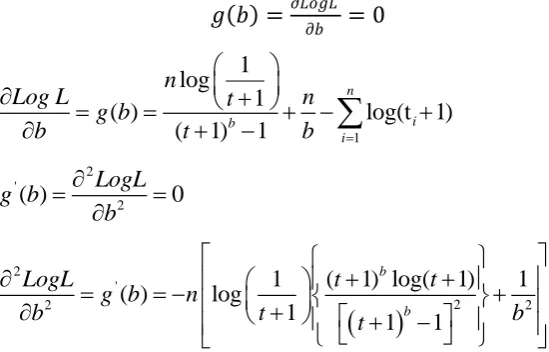
(3.1.3)The parameter „b‟ is estimated by iterative Newton Raphson Method using
𝑏𝑛+1= 𝑏𝑛−𝑔𝑔(𝑏)′(𝑏) , Where 𝑔 𝑏 𝑎𝑛𝑑 𝑔′(𝑏) are expressed as follows.
𝑔 𝑏 =
𝜕𝐿𝑜𝑔𝐿𝜕𝑏= 0
1
1
log
1
( )
log(t
1)
(
1)
1
n i b
i
n
Log L
t
n
g b
b
t
b
(3.1.4)2 '
2
( )
LogL
0
g b
b
2
'
2
2 2
1
(
1) log(
1)
1
( )
log
1
1
1
b
b
LogL
t
t
g b
n
b
t
t
b
(3.1.5)
The parameter „c‟ is estimated by iterative Newton Raphson Method using
𝑐𝑛+1= 𝑐𝑛 −𝑔′ 𝑐𝑔 𝑐𝑛
𝑛
Where 𝑔 𝑐 𝑎𝑛𝑑 𝑔′ 𝑐 are expressed as follows.
𝑔 𝑐 =𝜕𝐿𝑜𝑔𝐿𝜕𝑐 = 0
1 1
( )
log( )
2 log( )
log
(1
)
(1
)
c
n n
i
i
c c
i i i
t
LogL
n
n
g c
t
t
t
c
t
c
t
(3.1.6)𝑔′ 𝑐 =𝜕2𝜕𝑐𝐿𝑜𝑔𝐿2 = 0
2
'
2 2 2 2
1
log
1
( )
log
2 log .
log
(1
)
(1
)
c n
c
i i
c c
i i
Log L
nt
t
n
g c
t
t
t
t
c
t
c
t
(3.1.7)4. DATA ANALYSIS
[image:3.595.80.355.193.369.2]The set of software errors analyzed here is borrowed from software development project as published in Pham (2006) [8].
Table 1: Naval Tactical Data System Software Dataset
Failure Number
(n)
Time Between Failures (xk) days
Cumulative Time
(Sn)
1 9 9
2 12 21
3 11 32
4 4 36
5 7 43
6 2 45
7 5 50
8 8 58
9 5 63
10 7 70
11 1 71
12 6 77
13 1 78
14 9 87
15 4 91
16 1 92
18 3 98
19 6 104
20 1 105
21 11 116
22 33 149
23 7 156
24 91 247
25 2 249
26 1 250
Test Phase
27 87 337
28 47 384
29 12 396
30 9 405
31 135 540
User Phase
32 258 798
Test Phase
33 16 814
34 35 849
Solving equations by Newton Raphson Method for the NTDS test data, the iterative solutions for MLEs of a, b and c are
[image:4.595.74.297.69.418.2]𝑎 = 26.105273 𝑏 = 0.998899 𝑐 = 0.998903
Table 2 : Parameters Estimated through MLE
Dataset
Number of samples
Estimated Parameters
a b c
NTDS 26 26.105273 0.998899 0.998903
Xie 30 30.040800 0.999825 0.999619
AT & T 22 22.032465 0.999859 0.999611
IBM 15 15.051045 0.999530 0.999196
SONATA 30 30.016391 0.999958 0.999920
Hence, we may accept these three values as MLSs of The estimator of the reliability function from the equation (2.2.2) at any time x beyond 250 hours is given by
𝑅 𝑆
𝑘/𝑋
𝑘−1𝑠/𝑥 = 𝑒
− 𝑚 𝑥+𝑠 −𝑚(𝑠)[ (50 250) (250)] 7
/
6(250 / 50)
m m
R s
x
e
[ (300) (250)]
0.98269972
m m
e
5. METHOD OF PERFORMANCE
ANALYSIS
[image:4.595.72.302.513.709.2]The performance of SRGM is judged by its ability to fit the software failure data. The term goodness of fit denotes the question of “How good does a mathematical model fit to the data?”. In order to validate the model under study and to assess its performance, experiments on a set of actual software failure data have been performed. The considered model fits more to the dataset whose Log Likelihood is most negative. The application of the considered distribution function and its Log Likelihood on different datasets collected from real world failure data is given below.
Table 3 : Log Likelihood on different datasets
Data Set Log L (MLE) Reliability
(tn+x)
NTDS - 38.477204 0.98269972
Xie - 44.402007 0.99616300
AT & T - 18.949300 0.99573348
IBM - 27.365034 0.98841341
SONATA - 46.991596 0.99700207
6.
CONCLUSION
To validate the proposed approach, the parameter estimation is carried out on the data sets collected from (Xie et al., 2002; Pham, 2006; Ashoka, 2010).Out of the data sets that were collected, the model under consideration best fits the data of SONATA using MLE approach. Since, it is having the highest negative value for the log likelihood. The reliability of all the data sets are given in Table 3.The reliability of the model over SONATA data is high among the data sets which were considered.
7.
REFERENCES
[1] Kimura, M., Yamada, S., Osaki, S., 1995. ”Statistical Software reliability prediction and its applicability based on mean time between failures”. Mathematical and Computer Modelling Volume 22, Issues 10-12, Pages 149-155.
[2] Ashoka, M., (2010), “Sonata Software Limited” data set, Bangalore.
[3] Lyu, M.R., (1996), “Handbook of Software Reliability Engineering”, MCGraw-Hill, New York.
[4] Musa, J.D., Iannino, A., Okumoto, k., 1987. “Software Reliability: Measurement Prediction Application”. McGraw -Hill, New York.
[6] Pham. H., 2003. “Handbook of Reliability Engineering”, Springer.
[7] Pham. H., 2006. “System software reliability”, Springer.
[8] Swapna S. Gokhale and Kishore S.Trivedi, 1998. “Log-Logistic Software Reliability Growth Model”. The 3rd IEEE International Symposium on High-Assurance Systems Engineering. IEEE Computer
Society.
[9] Xie, M., Goh. T.N., Ranjan.P., (2002) “Some effective control chart procedures for reliability monitoring” – Reliability engineering and System Safety 77 143 -150 ̧ 2002.
[10]Satya Prasad, R., “Half logistic distribution for software reliability growth model”, Ph.D thesis, 2007.
[11]Goel, A.L., Okumoto, K., 1979. Time-dependent error detection rate model for software reliability and
other performance measures. IEEE Trans. Reliab. R-28, 206-211.
[12]Satya Prasad, R., Shaheen., Krishna Mohan, G., “Two step Approach for Software reliability: HLSRGM”, IJCTT-Volume 4 Issue 10-Oct 2013.
[13]Wood, A., (1996), “Software Reliability Growth models”, Tandem Computers, Technical report 96.1.
[14]Quadri, S.M.K and Ahmad, N., (2010), “Software Reliability Growth Modelling with new modified Weibull testing-effort and optimal release policy”, International Journal of Computer Applications, Vol.6, No.12.