Published Online February 2014 (http://www.scirp.org/journal/ojpc) http://dx.doi.org/10.4236/ojpc.2014.41001
Refractometric Studies on Molecular Interactions in
Six Binary Liquid Mixtures
Nizamul Haque Ansari
1, Anand Trivedi
2, Dhirendra Kumar Sharma
3, Prakash Chandra
3*1
Department of Chemistry, Rajdhani College, University of Delhi, New Delhi, India
2
Department of Chemistry, SRIT College, Datia, India
3
Department of Chemistry, Bundelkhand University, Jhansi, India Email: *[email protected]
Received October 23, 2013; revised November 20, 2013; accepted November 28, 2013
Copyright © 2014 Nizamul Haque Ansari et al. This is an open access article distributed under the Creative Commons Attribution License, which permits unrestricted use, distribution, and reproduction in any medium, provided the original work is properly cited. In accordance of the Creative Commons Attribution License all Copyrights © 2014 are reserved for SCIRP and the owner of the intellectual property Nizamul Haque Ansari et al. All Copyright © 2014 are guarded by law and by SCIRP as a guardian.
ABSTRACT
Refractive indices of the six binary mixtures between N-Butyl bromide with Aniline, Benzene, Xylene, Carbon tetrachloride, n-Heptane and Toluene for the entire concentration range have been measured at 303.15 K. Fur-thermore, deviation in refractive indices from ideal mixture, molar refraction, deviation in molar refraction from ideal values for these mixtures has also been evaluated. The results are discussed in term of molecular in-teractions between the components of the binary mixtures.
KEYWORDS
Refractive Indices; Density; Molecular Interactions; Molar Refraction; Lorentz-Lorenz Relation
1. Introduction
The studies of refractive indices are being increasingly used as tools [1-5] for investigation of the physical prop-erties of pure components and the nature of intermolecu-lar interaction between the liquid mixture constituents. Refractive index measurements of binary liquid mixtures are essential for determination of composition of binary mixtures usually for non-ideal mixtures where experi-mental measurements are performed directly over the entire range of composition. The review of literature [6] on acoustical studies of solution reveals that refractive indices measurements are also used to estimate the dif-ferent elastic properties of the molecule from which the type of molecular interactions can be very well under-stood. Pandey et al. [7] have made refractive indices measurements in liquid mixtures and have suggested that such studies are very much helpful for understanding of the molecular interactions in the components of the mix- ture. In addition to binary liquid mixtures, a few ternary, [8,9] mixtures have also been studied employing refrac- tive index measurements. However, literature survey shows that study of molecular interactions between N-
Butyl bromide and hydrocarbon molecules either by re- fractive index measurements or other methods is rare. Taking these into considerations, in the present study we have reported refractive index data for binary mixture of N-Butyl bromide with Aniline, Benzene, Xylene, Carbon tetrachloride, n-Heptane and Toluene for the entire con- centration range.
2. Experimental
Materials and Methods
were injected by means of syringe in to the glass vials of sealed with rubber stopper in order to check evaporation losses during sample preparation. Refractive indices of pure liquids and liquid mixtures were measured using white light by an Abbe refract meter (Model R-8 M/S Mittal Enterprised, New Delhi) Refract meter was cali- brated with kept constant at 303.15 K ± 0.03 K by circu- lating water of the thermostat with the help of pump through both the prism boxes of the refract meter. Re- fractive indices of liquid were measured after attainment of constant temperature. An average of five measure- ments was made for each sample. Density of pure liquids and liquid mixtures at experimental temperature were de- termined using double steam capillary type pyknometer. Pyknometer was also calibrated with liquids of known density values. The weight of the sample was measured using electrical single pan analytical balance (K-Roy).
3. Results and Discussion
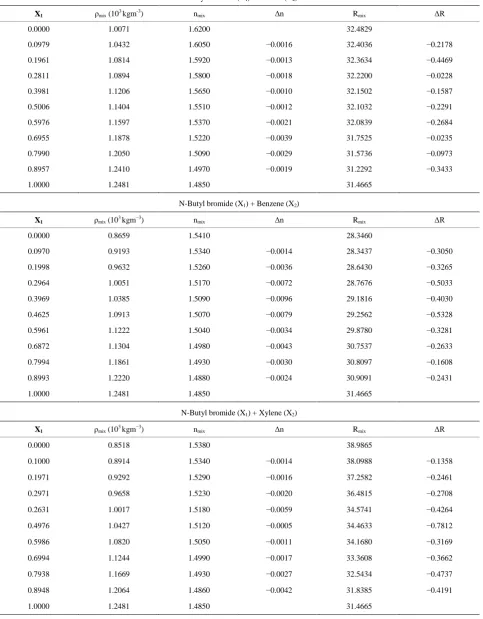
The experimental values of refractive indices (nmix ) and density (ρmix ) at 303.15 K with mole fraction of second components for all binary mixtures of N-Butyl bromide and second components are reported in Table 1. Values of deviation in refractive indices (Δn) for all the systems studied are evaluated using experimental values of re-fractive indices for pure liquids and liquid mixtures em-ploying following equation [11] (Equation (1))
mix ideal
n n n
∆ = − (1)
where nmix and n ideal are refractive indices of actual bi-nary mixture and ideal bibi-nary mixtures.
The refractive index deviation, Δn, has been calculated on a molefraction basis and nideal has been evaluated by Equation (2).
ideal 1 1 2 2
n =X n +X n
(2)
where X1, X2 and n1, n2 are the mole fraction and refrac-tive indices of the components 1 and 2 respecrefrac-tively. Val-ues of deviation in refractive indices, Δn, with composi-tions of the binary mixtures studied at experimental tem-perature are also recorded inTable 1.
The experimental values of refractive indices and den-sities of the mixtures have been used to evaluated molar refraction, R, employing Lorentz-Lorenz equation,
(
2) (
2)
mix mix 1 mix 2
R V= n − n +
(3)
where Vmix=
(
X M1 1+X M2 2)
ρ
mix is the molar volume of the mixtures. Deviation in molar refraction, ΔRis evaluated by Equation (4),
mix ideal
R R R
∆ = − (4) where
ideal 1 1 2 2
R =X R +X R (5)
The value of molar refraction and ΔR are recorded in
Table 1. Perusal of Table 1 shows that experimental re-fractive indices decrease with mole fraction of N-Butyl bromide increases, for the binary mixtures of all the N-Butyl bromide with Aniline, Benzene, Xylene, Carbon tetrachloride, n-Heptane and Toluene, except that refrac-tive indices increases with mole fraction of N-Butyl bro-mide increases in type system N-Butyl brobro-mide + n-hep- tane. Values of Δn for the entire composition range of N-Butyl bromide in binary mixture of the Aniline, Ben-zene, Xylene, Carbon tetrachloride, n-Heptane and Tolu-ene, are negative.
On the basis of the above, it seems that molecular in-teractions play an important role in governing the devia-tion in refractive indices for the binary systems studied in the present investigation. It may also be concluded that there is a gradual change in molecular interactions be-tween the components of binary mixtures. Values of mo-lar refraction, R, evaluated by Equation (3) and deviations in molar refractions, ΔR at experimental temperature for all binary mixtures are reported in Table 1. perusal of
Table 1 shows that for binary mixtures of different hy-drocarbon and CCl4 with a common N-Butyl bromide, R, values have the following trend in the entire composition range, Benzene < carbon tetrachloride < Aniline < Tolu-ene < XylTolu-ene < n-Heptane.
The above order shows the graded interactions between components of the mixtures. Since R can be interpreted as a hard-core volume of one mole of molecules, its values have been associated with atoms, groups of atoms and even types of chemical bonds [12]. Fermeglia and Torri-ano [13] define deviation in molar refraction on mole fraction basis while it is defined on the basis of volume fraction [14] by others. Herein, we have reported ΔR val-ues on the mole fraction basis. Table 1 shows that ΔR
values for all the systems studied are negative [15,16]. It may be concluded that the interactions resulting in the interstitial accommodation of benzene in to Toluene are the predominant factor over dipole-dipole and dipole in-duced-dipole interaction.
4. Conclusions
Table 1. Mole fraction (x1), densities (ρmix), refractive indices (nmix), deviation in refractive indices (Δn), molar refraction (Rmix)
and deviation in molar refraction (ΔR) for different binary mixtures at 303.15 K. N-Butyl bromide (X1) + Aniline (X2)
X1 ρmix (103 kgm-3) nmix Δn Rmix ΔR
0.0000 1.0071 1.6200 32.4829
0.0979 1.0432 1.6050 −0.0016 32.4036 −0.2178
0.1961 1.0814 1.5920 −0.0013 32.3634 −0.4469
0.2811 1.0894 1.5800 −0.0018 32.2200 −0.0228
0.3981 1.1206 1.5650 −0.0010 32.1502 −0.1587
0.5006 1.1404 1.5510 −0.0012 32.1032 −0.2291
0.5976 1.1597 1.5370 −0.0021 32.0839 −0.2684
0.6955 1.1878 1.5220 −0.0039 31.7525 −0.0235
0.7990 1.2050 1.5090 −0.0029 31.5736 −0.0973
0.8957 1.2410 1.4970 −0.0019 31.2292 −0.3433
1.0000 1.2481 1.4850 31.4665
N-Butyl bromide (X1) + Benzene (X2)
X1 ρmix (103 kgm−3) nmix Δn Rmix ΔR
0.0000 0.8659 1.5410 28.3460
0.0970 0.9193 1.5340 −0.0014 28.3437 −0.3050
0.1998 0.9632 1.5260 −0.0036 28.6430 −0.3265
0.2964 1.0051 1.5170 −0.0072 28.7676 −0.5033
0.3969 1.0385 1.5090 −0.0096 29.1816 −0.4030
0.4625 1.0913 1.5070 −0.0079 29.2562 −0.5328
0.5961 1.1222 1.5040 −0.0034 29.8780 −0.3281
0.6872 1.1304 1.4980 −0.0043 30.7537 −0.2633
0.7994 1.1861 1.4930 −0.0030 30.8097 −0.1608
0.8993 1.2220 1.4880 −0.0024 30.9091 −0.2431
1.0000 1.2481 1.4850 31.4665
N-Butyl bromide (X1) + Xylene (X2)
X1 ρmix (103 kgm−3) nmix Δn Rmix ΔR
0.0000 0.8518 1.5380 38.9865
0.1000 0.8914 1.5340 −0.0014 38.0988 −0.1358
0.1971 0.9292 1.5290 −0.0016 37.2582 −0.2461
0.2971 0.9658 1.5230 −0.0020 36.4815 −0.2708
0.2631 1.0017 1.5180 −0.0059 34.5741 −0.4264
0.4976 1.0427 1.5120 −0.0005 34.4633 −0.7812
0.5986 1.0820 1.5050 −0.0011 34.1680 −0.3169
0.6994 1.1244 1.4990 −0.0017 33.3608 −0.3662
0.7938 1.1669 1.4930 −0.0027 32.5434 −0.4737
0.8948 1.2064 1.4860 −0.0042 31.8385 −0.4191
Continued
N-Butyl bromide (X1) + Carbon tetrachloride (X2)
X1 ρmix (103 kgm−3) nmix Δn Rmix ΔR
0.0000 1.5662 1.5010 28.9349
0.0980 1.5464 1.4980 −0.0012 28.9647 −0.3384
0.1992 1.5050 1.4960 −0.0018 29.2075 −0.2317
0.2970 1.4715 1.4950 −0.0010 29.4959 −0.1909
0.3861 1.4464 1.4930 −0.0016 29.6044 −0.3079
0.4954 1.4079 1.4910 −0.0019 29.9310 −0.2581
0.5970 1.3694 1.4900 −0.0012 30.3592 −0.0871
0.6949 1.3390 1.4880 −0.0017 30.5875 −0.1069
0.7993 1.3076 1.4870 −0.0010 30.8809 −0.0775
0.8922 1.2832 1.4860 −0.0015 31.0643 −0.1293
1.0000 1.2481 1.4850 31.4665
N-Butyl bromide (X1) + n-Heptane (X2)
X1 ρmix (103 kgm−3) nmix Δn Rmix ΔR
0.0000 0.6713 1.4380 39.1128
00.0957 0.7145 1.4360 −0.0018 3708975 −0.4835
0.2005 0.7654 1.4310 −0.0022 36.3348 −1.2449
0.3003 0.8131 1.4406 −0.0024 36.0219 −0.7947
0.3976 0.8705 1.4510 −0.0025 35.4889 −0.5838
0.5015 0.9216 1.4540 −0.0049 34.8438 −0.4343
0.5968 0.9818 1.4590 −0.0048 33.9999 −0.5496
0.7012 1.0443 1.4630 −0.0060 33.2238 −0.5274
0.7981 1.1096 1.4680 −0.0063 32.4576 −0.5527
0.8993 1.1770 1.4720 −0.0070 31.7141 −0.5224
1.0000 1.2481 1.4850 31.4665
N-Butyl bromide (X1) + Toluene (X2)
X1 ρmix (103 kgm−3) nmix Δn Rmix ΔR
0.0000 0.8528 1.5380 33.7949
0.0984 0.8986 1.5310 −0.0016 33.2449 −0.3209
0.1980 0.9330 1.5260 −0.0013 33.2371 −0.0968
0.2961 0.9757 1.5200 −0.0021 32.8505 −0.2549
0.3936 1.0170 1.5150 −0.0019 32.5595 −0.3189
0.4982 1.0539 1.5100 −0.0014 32.4947 −0.1402
0.5968 1.0954 1.5050 −0.0012 32.2033 −0.2020
0.6933 1.1354 1.5000 −0.0011 31.9302 −0.2504
0.7945 1.1725 1.4930 −0.0027 31.6787 −0.2663
0.8962 1.2156 1.4890 −0.0013 31.4283 −0.2799
1.0000 1.2481 1.4850 31.4665
Acknowledgements
This work has been carried out with financial assistance from UGC, New Delhi, (Grant No.33-493/2007(SR), da- ted 28.02.2008.
REFERENCES
[1] T. M. Aminabhavi, K. Banerjee and R. H. Balundgi, “Thermodynamic Interactions in Binary Mixtures of 1-
Chloronaphthalene and Monocyclic Aromatics,” Indian Journal of Chemistry, Vol. 38A, 1999, p. 768.
[2] A. Pal and A. Kumar, “Excess Molar Volumes, Viscosi- ties, and Refractive Indices of Diethylene Glycol Di- methyl Ether with Dimethyl Carbonate, Diethyl Carbon- ate, and Propylene Carbonate at (298.15, 308.15, and 318.15) K,” Journal of Chemical & Engineering Data, Vol. 43, No. 2, 1998, pp. 143-147.
http://dx.doi.org/10.1021/je9701902
“Re-fractive Indices, Densities, and Excess Properties of 4-(2- Hydroxyethyl)morpholine + Water at (298.15, 308.15, and 318.15) K,” Journal of Chemical & Engineering Da- ta, Vol. 45, No. 5, 2000, pp. 647-649.
http://dx.doi.org/10.1021/je0000322
[4] A. K. Nain, P. Chandra, J. D. Pandey and S. Gopal, “Den- sities, Refractive Indices, and Excess Properties of Binary Mixtures of 1,4-Dioxane with Benzene, Toluene, o-Xy- lene, m-Xylene, p-Xylene, and Mesitylene at Tempera- tures from (288.15 to 318.15) K,” Journal of Chemical & Engineering Data, Vol. 53, No. 11,2008, pp. 2654-2665. http://dx.doi.org/10.1021/je800579j
[5] A. K. Nain, “Molecular Interactions in Binary Mixtures of Formamide with 1-Butanol, 2-Butanol, 1,3-Butanediol and 1,4-Butanediol at Different Temperatures: An Ultra- sonic and Viscometric Study,” Fluid Phase Equilibria, Vol. 265, No. 46, 2008, p. 56.
[6] M. I. Aralaguppi, Jadar and T. M. Aminabhavi, “Density, Refractive Index, Viscosity, and Speed of Sound in Bi- nary Mixtures of Cyclohexanone with Benzene, Methyl- benzene, 1,4-Dimethylbenzene, 1,3,5-Trimethylbenzene, and Methoxybenzene in the Temperature Interval (298.15 to 308.15) K,” Journal of Chemical & Engineering Data, Vol. 44, No. 3, 1999, pp. 446-450.
http://dx.doi.org/10.1021/je980219h
[7] J. D. Pandey, V. Vyas, G. P. Dubey, N. Tripathi and R. Dey, “Speed of Sound, Viscosity and Refractive Index of Multicomponent Systems: Theoretical Predictions from the Properties of Pure Components,” Journal of Molecu- lar Liquids, Vol. 81, 1999, pp. 123-133.
http://dx.doi.org/10.1016/S0167-7322(99)00061-6
[8] J. A. Acosta, E. Rodil and A. Soto, “Density, Refractive Index, Viscosity, and Speed of Sound in Binary Mixtures of Cyclohexanone with Benzene, Methylbenzene, 1,4-Di- methylbenzene, 1,3,5-Trimethylbenzene, and Methoxy-benzene in the Temperature Interval (298.15 to 308.15) K,” Journal of Chemical & Engineering Data, Vol. 46, No. 5, 2001, pp. 1176-1180.
http://dx.doi.org/10.1021/je0100490
[9] C. C. Wang, H. W. Chen and C. H. Tu, Densities, “Vis-
cosities, and Refractive Indices for Binary and Ternary Mixtures of Ethanol, 2-Methylpropan-2-ol, and 2,2,4- Trimethylpentane,” Journal of Chemical & Engineering Data, Vol. 50, No. 5, 2005, pp. 1687-1693.
http://dx.doi.org/10.1021/je0501639
[10] S. Kamila, V. Chakravarthy and S. Jena, “Studies on Acoustic Behavior, Viscosity, and Density of Some Com- mercial Extractants and Their Molecular Interaction with Diluent, Modifier, and Extractant,” Journal of Solution Chemistry, Vol. 33, No. 4, 2004, pp. 365-380.
http://dx.doi.org/10.1023/B:JOSL.0000036307.76436.a0
[11] S. S. Yadav, N. Kushwaha and N. Yadav, “Refractromet- ric Studies on Molecular Interactions between Some Bro- moalkanes and Nonpolar Hydrocarbons,” Indian Journal of Chemistry, Vol. 48A, 2009, pp. 650-657.
[12] S. Glasstone, “Taxt book of Physical Chemistry,” Mac Millan India Limited, Delhi, 1997, Chapter 8.
[13] M. Fermeglia and G. Torriano, “Density, Viscosity, and Refractive Index for Binary Systems of n-C16 and Four Nonlinear Alkanes at 298.15 K,” Journal of Chemical & Engineering Data, Vol. 44, No. 5, 1999, p. 965-969. http://dx.doi.org/10.1021/je9900171
[14] M. I. Aralaguppi, T. M. Aminabhavi, R. H. Balundgi and S. S. Joshi, “Thermodynamic Interactions in Mixtures of Bromoform with Hydrocarbons,” The Journal of Physical Chemistry, Vol. 95, No. 13, 1991, pp. 5299-5308. http://dx.doi.org/10.1021/j100166a070
[15] M. R. Riazi and Y. Roomi, “Use of the Refractive Index in the Estimation of Thermophysical Properties of Hy- drocarbons and Petroleum Mixtures,” Industrial & Engi-neering Chemistry Research, Vol. 40, No. 8, 2001, p. 1975.