To Design a English Language Recognizer by using
Nondeterministic Pushdown Automata (ELR-NPDA)
Madiha Khurram Pasha
Department of Computer Science (UBIT) University of Karachi
M. Sadiq Ali Khan,
Ph.D.Department of Computer Science (UBIT) University of Karachi
ABSTRACT
Natural language recognization is a popular topic of research as it covers many areas such as computer science, artificial intelligence, theory of computation, and machine leaning etc. Many of the techniques are used for natural language recognization by the researchers, parsing is one of them.
The aim to propose this paper is to implement nondeterministic pushdown automata (NPDA) for the English Language (ELR-NPDA) that can modernize Context Free Grammar (CFG) for English language and then refurbish into Nondeterministic Pushdown Automata (NPDA). This converting procedure can uncomplicatedly parse legitimate English language sentences. Parsing can be organized by Nondeterministic Pushdown Automata (NPDA) that used push down stack and input tape for recognizing English language sentences. To formulate this NPDA convertor we have to exchange Context Free Grammar into Chomsky Normal Form (CNF). The move toward this is more appropriate because it uses nondeterministic approach of PDA that can improve language recognizing capabilities as compare to other parsing approach.
General Terms
Natural Language Recognizer, Computer Science, Artificial Intelligence, Theory of Computation, Machine Learning, Pushdown Automata (PDA), Nondeterministic pushdown automata (NPDA), Context Free Grammar (CFG), Chomsky Normal Form (CNF).
Keywords
English Language Recognizer - Nondeterministic Pushdown Automata (ELR-NPDA)
1.
INTRODUCTION
The main purpose of parsing is to find the syntax error in any natural language or in computer language. Every language has some set of rules whether it is a Computer language or a natural language. The arrangement of words in a sentence and punctuation are called syntax. Our focus here is to parse the English Language.
CFG is a collection of four things: a starting non terminal, a finite set of non terminal, a finite set of terminal and a finite set of production. For parsing we need a left factored Context free Grammar [8] [1]. To achieve goal this CFG must be converted into CNF. Before this conversion there are two more phases. First one is to remove all null productions (Non-terminal→ €) and get a new GFG. Now, second is to remove all unit productions (Non terminal → one non-terminal). The resulting CFG is now capable to make Chomsky normal form (CNF). In CNF the whole CFG only has these two types of productions:
1. Non terminal → exactly two non terminals
2. Non terminals → one terminals
The resultant CFG is required Chomsky Normal Form (CNF) that can be converted into Nondeterministic Push Down Automata (NPDA) .The Nondeterministic Push down automata consist of following elements: the set of input letter, an input tape, a stack, and set of states (START, ACCEPT, REJECT, PUSH, POP, READ).
2.
LITRATURE REVIEW
Parsing is a technique that checks the syntactical structure of any given input, if the given input is matched with the syntactical structure of parser then, it can be passed from it otherwise it will reject. Parsing having two types: [22], [23] Top-down and Bottom-up parsing. Top-down parsing technique first finds the highest level of the parse tree that parses from top to bottom, whereas, the bottom-up parsing does the opposite. Top-down parsing has few types, Recursive descent parser and LL parser.
The context free grammar that defines the syntax of English language sentences was proposed in [1]. Basically it is “English grammar predictive parser” that portrays a left factored context-free grammar for English language and used top down predictive parsing for syntax checking. Same approach of top down parsing is used is [2] that projected the Bangla grammar parser that also based on predictive parsing approach for parsing the Bangla language.
A “natural language analyzer” has been proposed in [3] that takes a general class of context-free grammars as drivers and also used the conception of non-deterministic pushdown transducer to compute the computational efficiency. Also in [4] an algorithm has been planned that offer conversion from “acceptor model” to “generator model”. In this pushdown automata used as an acceptor model and context-free grammar used as a generator model.
Another technique that based on this conversion was developed in [5] is a context-free grammar that used as a meta-language. This language is then joint with Genetic programming to develop Deterministic Push-Down Automata (D-PDAs). Also Formalization of context-free grammars and pushdown automata using HOL4 was projected in [6].
Through formalization is to create a CFG from a PDA and vice versa. See also the [9]. Another paper [23] verifies the theorem that every Context Free Grammar (CFG) is accepted by a Pushdown Automata (PDA).
JFLAP [7] is a potent tool for execution of theory of computation. It supports approximately all topics of machine computation such as finite state machine, nondeterministic finite automata, nondeterministic pushdown automata, multi-tape Turing machines, several types of grammars, and parsing etc. By using this software CFG to NPDA translation is pretty trouble-free.
3.
METHODOLOGY
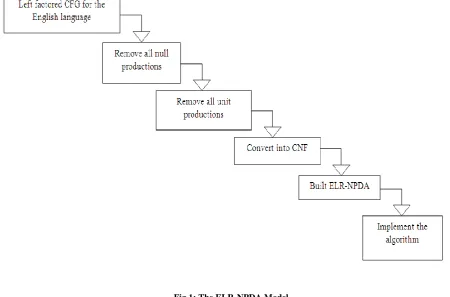
The block diagram shows the steps to convert English language Context Free Grammar (CFG) into Nondeterministic Pushdown Automata (NPDA). (See Figure 1)
[image:2.595.66.517.329.626.2]The first step for this conversion is to make left factored CFG for the English language [1]. Second is to remove all null, third to kill all unit productions from the CFG and in the forth step convert this CFG into CNF, in the second last step this CNF is capable for the NPDA. Finally, this ELR-NPDA can be tested through parsing of different English sentences.
3.1
Left Factored CFG for English
Language
[image:3.595.49.279.130.405.2]The left factored context free grammar extract from [1]. (See Table 1)
Table 1. Left factored grammar [1]
S NP.VP
[image:3.595.308.545.235.742.2]NP a NP1.VP4 |pronoun.NP4|the.NP6|an.NP7 | propernoun.NP3 | I| noun
NP1 noun|adjective.NP2 NP2 noun
NP3 conjuction.NP5|€ NP4 conjuction.NP5|noun|€ NP5 noun |pronoun | propernoun NP6propernoun.NP4|adjective NP2 NP7 adjective1.NP2
VP verb1.vp‟|verb2.vp‟ |aux31.VP3 |aux32.VP6 | aux21.VP4| aux22.VP9|aux11.VP5 VPaux12.VP7|adverb.VP6 VP‟ NP1.VP2|adverb.VP2|PP.NP|€|pronoun VP1 adjective.NP2 VP2PP.NP|€ VP3 verb4.VP‟|adverb.VP6|pronoun.VP1 VP4verb1.VP‟|be.VP6|aux.11.VP7|have.VP8 VP5verb3.VP‟|BEEN.VP6 VP6verb4.VP‟ VP7 verb3.VP‟ VP8 been.VP6 VP9 be.VP6 PP preposition
3.2
Remove All Null Productions
After removing the €-productions the CFG become: (see Table 2). Only four non-terminals are having the null productions i.e. NP3, NP4, VP‟ and VP2.
Table 2. Remove all null productions
S NP .VP
NP a NP 1.VP4 |pronoun |the.NP6|an.NP7 |propernoun |I| noun| pronoun.NP4|proper noun.NP3
NP1 noun|adjective.NP2 NP2 noun
NP3 conjuction.NP5 NP4 conjuction.NP5|noun NP5 noun |pronoun | propernoun
NP6proper noun.NP4|propernoun.| adjective.NP2 NP7 adjective1.NP2
VP verb1.vp‟| verb1.|verb2.vp‟ |verb2. |aux31.VP3 | aux32.VP6|aux21.VP4|aux22.VP9|aux11.VP5 VPaux12.VP7 |adverb2.VP6 VP‟NP1.VP2|NP1.|adverb.VP2|adverb.|PP.NP|pronoun VP1 adjective.NP2 VP2PP.NP VP3 verb4.VP‟|verb4.|adverb.VP6|pronoun.VP1 VP4verb1.VP‟|verb1.|be.VP6|aux.11.VP7|have.VP8
3.3
Remove All Unit Productions
There is only a single unit production VP‟NP1 So, it can be replace by
VP‟ noun
VP‟ adjective.NP2
3.4
Convert into Chomsky Normal Form
(CNF)
As mention above there are two possibilities for CNF: 1. Non terminal → exactly two non terminals 2. Non terminals → one terminals
3.4.1
Possibility 1 for CNF
The result is shown in Table 3.
Table 3. Possibility 1 for CNF
SNP.VP
NPA‟NP1.VP4|pronoun|C‟.NP6|B‟.NP7|propernoun|I| noun| F‟.NP4|G‟.NP3
NP1noun|H‟.NP2 NP2noun NP3L‟NP5 NP4L‟.NP5|noun
NP5noun| propernoun| pronoun NP6G‟.NP4| propernoun| H‟.NP2 NP7I‟.NP2
VPM‟.VP‟| verb1| N‟.VP‟| verb2 | U‟.VP3| V‟.VP6 | S‟.VP4| T‟.VP9| Q‟.VP5 |R‟.VP7| J‟.VP6 VP‟NP1.VP2| noun| H‟.NP2| J‟.VP2| adverb| PP.NP | pronoun
VP1H‟.NP2 VP2PP.NP
VP3P‟.VP | verb4 | J‟.VP6 | F‟.VP1
VP4M‟.VP‟ | verb1|Y‟.VP6| Q‟.VP7| W‟.VP8 VP5O‟.VP‟ | verb3 | X‟.VP6
3.4.2
Possibility 2 for CNF
[image:4.595.302.541.222.544.2]The result of second possibility of CNF is shown in Table 4.
Table 4. Possibility 2 for CNF
1. SNP.VP 2. NPA‟R1 3. R1NP1.VP4
4. NPpronoun | C‟.NP6 | B‟.NP7 | propernoun | I| noun| F‟.NP4| G‟.NP3
5. NP1noun|H‟.NP2 6. NP2noun 7. NP3L‟NP5 8. NP4L‟.NP5|noun
9. NP5noun| propernoun| pronoun 10.NP6G‟.NP4| propernoun| H‟.NP2 11. NP7I‟.NP2
12. VPM‟.VP‟| verb1| N‟.VP‟| verb2 | U‟.VP3| V‟.VP6 |S‟.VP4| T‟.VP9| Q‟.VP5 |R‟.VP7| J‟.VP6 13. VP‟NP1.VP2| noun| H‟.NP2| J‟.VP2| adverb| PP.NP | pronoun
14. VP1H‟.NP2 15. VP2PP.NP
16. VP3P‟.VP | verb4 | J‟.VP6 | F‟.VP1
17. VP4M‟.VP‟ | verb1|Y‟.VP6| Q‟.VP7| W‟.VP8 18. VP5O‟.VP‟ | verb3 | X‟.VP6
19. VP6P‟.VP‟| verb4 20. VP7O‟.VP‟| verb3 21. VP8X‟.VP6 22. VP9Y‟.VP6 23. PPpreposition 24. A‟ a
25. B‟an 26. C‟ the 27. D‟noun 28. F‟pronoun 29. G‟proper noun 30. H‟ adjective 31. I‟ adjective1 32. J‟ adverb 33. K‟preposition 34. L‟Conjunction 35. M‟verb1 36. N‟verb2 37. O‟verb3 38. P‟verb4 39. Q‟aux11 40. R‟aux12 41. S‟aux21 42. T‟aux22 43. U‟aux31 44. V‟aux32 45. W‟have 46. X‟been 47. Y‟be
3.5
Construct English Language Pushdown
Automata (ELR-NPDA)
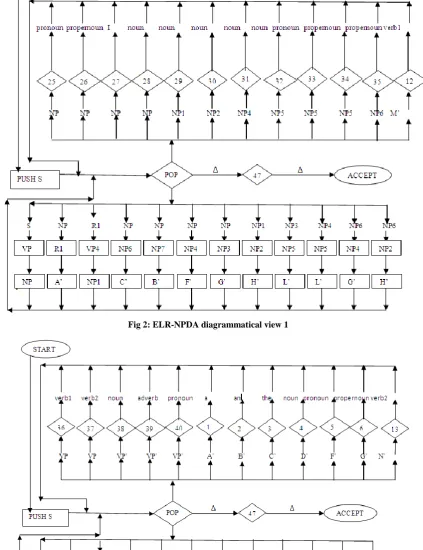
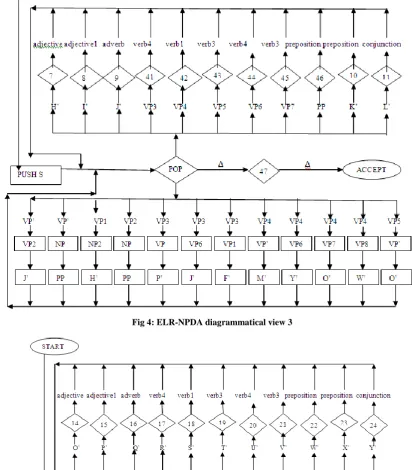
The diagrammatical view of ELR-NPDA is exposed in figures 2, 3, 4 and 5. Essentially these figures (2, 3, 4, and 5) showing the single nondeterministic pushdown automata for the English language. It means that all figures (2, 3, 4, and 5) are connected with each other. It has been separated into parts for appropriate view and better understanding. The all diamond shapes symbol in ELR-NPDA symbolize the READ states and all rectangular shapes shows the PUSH states of stack.
3.6
Algorithm for ELR-NPDA
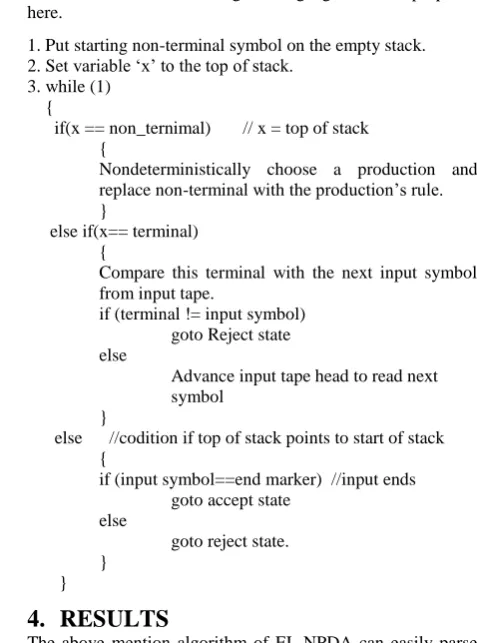
The algorithm of ELR-NPDA that can recognize syntactically correct sentences of the English language is to be proposed here.
1. Put starting non-terminal symbol on the empty stack. 2. Set variable „x‟ to the top of stack.
3. while (1) {
if(x == non_ternimal) // x = top of stack {
Nondeterministically choose a production and replace non-terminal with the production‟s rule. }
else if(x== terminal) {
Compare this terminal with the next input symbol from input tape.
if (terminal != input symbol) goto Reject state else
Advance input tape head to read next symbol
}
else //codition if top of stack points to start of stack {
if (input symbol==end marker) //input ends goto accept state
else
goto reject state. }
}
4.
RESULTS
Fig 4: ELR-NPDA diagrammatical view 3
Table 5: example 1 “John was going to school”
STATE
STACK
TAPE
START ∆ John was going to school PUSH S S John was going to school
POP ∆ John was going to school
[image:7.595.47.288.88.382.2]PUSH VP VP John was going to school PUSH NP NP.VP John was going to school POP VP John was going to school READ 23 VP John was going to school POP VP John was going to school PUSH VP6 VP6 John was going to school PUSH v‟ V‟.VP6 John was going to school READ 21 VP6 John was going to school POP VP6 John was going to school PUSH VP‟ VP‟ John was going to school PUSH P‟ P‟.VP‟ John was going to school Pop P‟ .VP‟ John was going to school READ 15 VP‟ John was going to school POP VP‟ John was going to school PUSH NP NP John was going to school PUSH PP PP.NP John was going to school POP PP.NP John was going to school READ 46 NP John was going to school POP NP John was going to school READ 28 ∆ John was going to school ACCEPT ∆ John was going to school
Table 6: example 2 “The young man is laughing”
STATE STACK TAPE
START ∆ The young man is laughing PUSH S S The young man is laughing
POP ∆ The young man is laughing
PUSH VP VP The young man is laughing PUSH NP NP.VP The young man is laughing PUSH NP6 VP The young man is laughing PUSH C‟ C‟.NP6.VP The young man is laughing POP NP6.VP The young man is laughing READ 3 NP6.VP The young man is laughing
POP VP The young man is laughing
PUSH NP2 NP2.VP The young man is laughing PUSH H‟ H‟.NP2.VP The young man is laughing POP NP2.VP The young man is laughing READ 7 NP2.VP The young man is laughing
POP VP The young man is laughing
READ 30 VP The young man is laughing READ 30 VP The young man is laughing
POP ∆ The young man is laughing
PUSH VP6 VP6 The young man is laughing PUSH V‟ V‟.VP6 The young man is laughing
POP VP6 The young man is laughing
READ 21 VP6 The young man is laughing
POP ∆ The young man is laughing
PUSH VP‟ VP‟ The young man is laughing
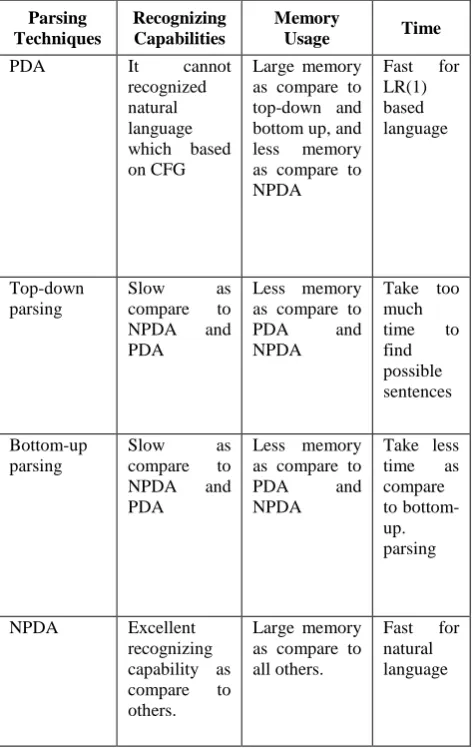
[image:7.595.311.548.173.548.2]the language recognizing capabilities are increased considerably as compare to other parsing approaches. The PDA can hold unlimited amount of information. The only drawback is that it uses more memory because of stack data structure. The comparative results of NPDA with the other are shown in table 7.
Table 7: Parsing Techniques Comparisons
Parsing Techniques
Recognizing Capabilities
Memory
Usage Time
PDA It cannot
recognized natural language which based on CFG
Large memory as compare to top-down and bottom up, and less memory as compare to NPDA
Fast for LR(1) based language
Top-down parsing
Slow as
compare to NPDA and PDA
Less memory as compare to
PDA and
NPDA
Take too much time to find possible sentences
Bottom-up parsing
Slow as
compare to NPDA and PDA
Less memory as compare to
PDA and
NPDA
Take less time as compare to bottom-up. parsing
NPDA Excellent recognizing capability as compare to others.
Large memory as compare to all others.
Fast for natural language
In the future, we will design and implement the NL-PDA for many other Natural languages. The ELR-PDA has some restrictions that it cannot parse idioms and poetry text, but in future we will cope up with this limitation too.
6.
REFERENCES
[1] Ratnagiri, Ichalkanji, Recognizing English grammar using predictive parser, IJERA, Vol. 3, Issuen4, Jul-Aug 2013, pp.306-312
[5] Afra Zomorodian, Context-Free Language Induction by Evolution of Deterministic Push-Down Automata Using Genetic Programming.
[6] Aditi Barthwal1, Michael Norrish, Mechanisation of PDA and Grammar Equivalence for Context-Free Languages.
[7] www.jflap.org
[8] Robert C. Moore, Removing Left Recursion Form context Free Grammar.
[9] http://hol.sourceforge.net.
[10] Ahmed Al-Taani, Mohammed Msallan and Sana Wedian, A top-Down chart Parser for Analyzing Arabic Sentences.
[11]Dick G. and Ceriel H., Paring Techniques, a Practical Guide, Technical Report, England, 1990.
[12]Richard A. Frost and Rahmatullah Hafiz, A New Top-Down Parsing Algorithm to Accommodate Ambiguity and left Recursion in Polynomial Time.
[13]Richard A. Frost, Rahmatullah Hafiz and Paul C-Callaghan, Modular and Efficient Top-down Parsing for Ambiguous Left-Recursive Grammars, Proceedings of the 10th Conference on Parsing Technologies, pages 109–120,
[14]Laurence Tratt, Direct Left-Recursive Parsing Expression Grammars.
[15]Pankaj Sharma, Naveen Malik, Naeem Akhter, Rahul, Hardep Rohilla, Parsing Techniques: A Review.
[16]Arianna D Ulizia, Fernando Ferri, and Patrizia Grifoni, A Survey of Grammatical inference Methods for Natural Language Learning.
[17]Georgios Petaris, Vangelis Karkaletsis, Georgios Paliouras and Contantine D. Spyropoulos, Learning Context-Free Grammars to Extract Relations Form text”.
[18]Robert Moore and John Dowding, Efficient Bottom-up Parsing.
[19]Nazir Ahmad Zafar, LR(K) Parser Constraction Using Bottom Up Formal Analysis.
[20]David Carter, Efficient Disjunctive Unification for Bottom-Up Parsing.
[21]J.C.M. Beaten, P.J.L. Cuipers and P.J.A Van Tilburg, A Context-Free Process as a Pushdown Automata.
[22]Alfred V. Aho, Ravi Sethi, and Jeffrey D. Ullman. compilers: principles, techniques, and tools: (Addison-Wesley Publishing Company, 1988).
![Table 1. Left factored grammar [1]](https://thumb-us.123doks.com/thumbv2/123dok_us/8029717.768367/3.595.49.279.130.405/table-left-factored-grammar.webp)