Double Combinatorial Auction based Resource
Allocation in Cloud Computing by Combinational using
of ICA and Genetic Algorithms
Rezvan Alipoor Sabzevari
Department of Computer, Khouzestan Science and Research Branch, Islamic Azad University,Ahvaz, Iran Department of Computer, Ahvaz Branch, Islamic Azad
University, Ahvaz, Iran
Ebrahim Behrouzian Nejad
Department of Computer, Shoushtar Branch, Islamic Azad University, Shoushtar, Iran
ABSTRACT
Computational resources have become cheaper, more powerful and accessible than ever with the development of processing and strong technology and internet success. This technology has realized a new computing model called cloud computing in which resources are provided as a service to users and users can rent them or rent of them based on their demands. One of the problems with cloud computing is related to optimizing the allocated resources. Resource allocation is done with the aim of minimizing costs, times and due to the uniqueness of model. In this paper, one double combinatorial auction based resource allocation approach has been proposed. The purpose of this study is to allocate economic resources in a way that lead to increase social welfare. Resource allocation in double combinatorial auction includes two phases. These two phases are winner determination and resource allocation. The proposed approach implement ICA for winner determination and genetic algorithm for resource allocation and payment Schemes .we name this algorithm as IG. The experimental results showed that our proposed algorithm improves the profits of providers and users and works well than other algorithms in the term of increasing providers’ profit.
General Terms
Cloud computing, resource allocation
Keywords
Cloud computing, resource allocation, double auction, genetic algorithm, ICA
1.
INTRODUCTION
In fact, Cloud computing has features that are attractive to companies and organizations: No advance payment, reduce operating costs, high Scalability, accessibility, reduce the risk of business and maintenance costs [1]. Resource allocation is one of the integral issues of cloud computing and data centers management [2]. These days cloud providers use fixed-price mechanisms to allocate resources to their users. But these mechanisms don’t provide efficient allocation and don’t maximize the revenue of providers. Economic model of cloud-based resource allocations are more suitable to adjust supply and demand of resources. A better alternative for resource allocation is to use auction-based Mechanisms. The most appropriate mechanism in cloud computing for resource allocation and pricing is combinatorial auction [3]. Prices should only depend on the demand and supply condition, in order to fair exchange between providers (sellers) and users. Therefore, using double combinatorial auction to resource allocation in cloud computing is a proper model. Double combinatorial auction includes two steps. At first, winner
determination from auction offers by solving an optimization model that its aim is to maximize social welfare (by distinguishing between buyers pay and total income of sellers); Second, the allocation and pricing of resources among a winners set, But this trend of auction has some problems. The winner determination is a NP-hard problem when the number of volunteers and resources is in a particular scale and the winner cannot be found in a polynomial time [4]. Therefore, the heuristic algorithms solve problem from a scientific perspective very well. The article includes: cloud computing, resource allocation, double combinatorial auction, related works and proposed method.
2.
CLOUD COMPUTING
The main idea of cloud computing is not new. John McCarty in 1960, predicted that computing, provide some tools to help public. It is obvious that, the lack of defined standard in cloud computing have led to confusing. For this reason, the standardization of cloud computing definitions has been worked recently. A large number of researchers have tried to define cloud computing in functional aspects, but they didn’t success and there is not a comprehensive definition for it. Among different definition , the definition of NIST is as follow : (( cloud computing is a model that has been designed to easy access to the configurable computing resources such as networks , servers and Services, ... that is created with lowest management Endeavour and by providers’ participation )) .[5]
3.
RESOURCE ALLOCATION
resource allocation process that optimize previous allocations. The first problem can be considered as a pack bin problem with different bin size. Common algorithms for pack bin problems include: worst fit, best fit, first fit, Next fit [6].
3.1 Double Combinatorial Auction
Double combinatorial auction is not of the most common combinatorial auction approaches that can model as an optimization problem to maximize social welfare (buyers’- total pay and sellers’ total income). It is possible that several buyers and several sellers volunteer for goods bid bundles. Participants in auction, send a request about buying or selling a goods bid bundles. Any bundle is a buying request that all of its goods will be bought or a selling offer that all of its goods will be sold. In this auction the request is seal bid. It means that the participants in the market don’t know each other and only the auctioneer access to information [7].
4. RELATED WORKS
Fuji Ware et al in [4] used double combinatorial action to resource allocation and provided current/future booking in the spot markets and front markets. They have used a combinatorial liner programming to determine winner of auction that led to the auction winner to be determined on a large scale and in a longer time. Schnizler et al in [8] used combinatorial auction in grid computing to allocate resources. In this paper, they offered combinatorial auction-based resource allocation protocol in which, a user can offer a price for any mix of needed resource to perform his/her duties. This protocol involves an approximation algorithm to solve the combinatorial auction. The proposed approach includes four steps: request information from local market auction, generating proposals, determining resource allocation and assigning tasks to winner resources. They have used an approximation algorithm to solve combinatorial auction problem that find a near to optimization allocation and includes two steps. In first step, an approximation is determined by combinatorial auction liner programming and in the last step named hill climbing step, the quality algorithm improve the solution by performing the sequence of greedy allocation procedures obtained in the first step. The results showed that, their proposed model has an economical effect on performance of system. Ghorbanzadeh et al in [9] have used genetic combinatorial algorithm to determine auction winner in gird. They have used two type of genetic combinatorial algorithm in order to improve the efficiency of genetic algorithm. The experimental results showed that the combinatorial algorithm of genetic, hill climbing and Simulated-annealing let to better results than genetic algorithm.
5.
PROPOSED ALGORITHM
Proposed algorithm to allocate double combinatorial auction based resources in cloud computing is the combinatorial algorithm of ICA and genetic algorithms. The ICA algorithm identifies the auction winners. In fact, the output of this algorithm determines which of bid bundles of users and providers is won in auction. The answer of this algorithm only determines which of users and providers are won. the winners matrix is created by answers obtained from winner determination algorithm and bid bundles matrix in mapping stage. We identify a matrix for winner user bids and a matrix for winner provider bids. the chromosome of genetic algorithm is created by means of matrixes obtained from ICA algorithm and mapping. In next stage it should be identified that which resource allocate to which user and with what price? The genetic algorithm was used in this stage and
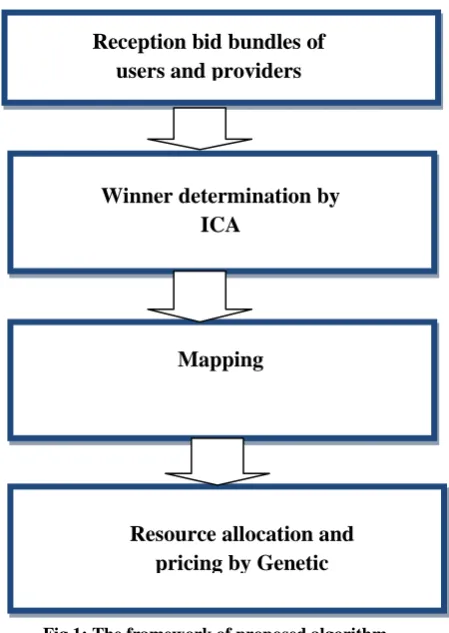
employed K-Pricing model. The framework of proposed algorithm has shown in figure (1).
5.1
Bid Bundles
B = {B1… Bj… Bn} is a collection of bid bundles that
includes n bundles (n is the total numbers of users and providers. The Bj bid can include four tipple ( Ej , Rj , Sj , Pj )
, where : Ej= (E1j… Eij… Enj): if Eij>0 then it is the unit of
requested ECU.If Eij <0, then, it is the unit of supplied ECU.
Rj= (R1j,….,Rij,……,Rnj) where: If Rij>0 then, it is the unit of
requested memory. If Rij<0, it is the unit of supplied memory.
Sj= (S1j,….,Sij,……,Snj) where: If Sj >0 then, it is the unit of
requested storage. If Sj <0, it is the unit of supplied storage.
Pij∈R is the amount that the bidder eager to pay it. It is
considered as a buying bid if pij>0 or it is considered as a
selling bid if pij<0.
It should be noted that bundle will be won and all of its resources be allocated or never won. Moreover, every bid bundle of provider can cover several requests of users. It means that several requests can be provided by a single provider, but the resources of a provider only can allocated to a single user.
5.2
ICA
ICA is one of the approaches of evolutionary computing that try to find optimal answers of different optimization problems, this approach provides an algorithm for solving mathematical problems of optimization by mathematical modeling of social-political evolution process [10]. At this algorithm the numbers of dimension of a country is equal to the number of bid bundle of users and providers.
Country = [P1, P2… P Nvar]
That Pi ∈ {0, 1} and 1 indicates that the bid bundle has been won and 0 indicates that the bid bundle have not been won. In fact, any country is an array includes 0 and 1.
The purpose of this study was to allocate economical resources so that in this allocation the profits of users and also providers are considered. In fact , in double combinatorial auction, the provider that offer with lowest price will be won and also the user with the highest proposed price will be won, therefore a country is better that the sum of Its winner bid bundle be more than others.
Therefore the cost function of this algorithm calculated as follow:
Pj Xj
n
j=1 ,Xj
∈ {0,1}
𝑎𝑗 𝑥𝑗 ≤ 0 , a
j∈ {𝐸j, 𝑅j, 𝑆j}
Xj
∈ 0,1 , ∀ 𝑗 ∈ {0,1, … , 𝑛}
The first equation means that a combination of winners that their offered price are higher than other considered as an answer. Of course the combination should fulfill users’ request. This control has done by equation (2) and it means that the answer with negative winner bundles is proper i.e. the prospered resources be more than requested resources. Pj is
Fig 1: The framework of proposed algorithm
5.3
Mapping
In mapping stage the identification of winner users were put in REQWIN matrix according to optimized answer of ICA algorithm of winner determination. The matrix consists of user’s offers identification and includes four columns for offers’ characteristics and the number of its row is equal to the number of users.
In addition, the characteristics of winner of providers’ offers were put in SUPWIN matrix. The data of these two matrixes were used to create the chromosomes of genetic algorithm in order to resource allocation.
It should be identified that which request is provided by which provider, after the auction winners were determined. In the other word , it should be identified that which task should be done by which virtual machine , because the providers have offered virtual machines in the form of auction bid bundle. For this purpose, the result of ICA algorithm was used. This answer identifies that which and how many numbers of users and providers’ bid bundles were won in this auction.
5.4
Resource Allocation
Now with the results of ICA we know that what resources and how much we have and what resources and how much is needed. Now should identify that which virtual machine (provider’s bid bundle) allocated to which task (user’s request bundle). genetic algorithm is used for this purpose that its components are as fallow.
Genetic algorithm is a search technique in computer science to finding approximate solutions to optimization and search problems. Genetic algorithm is a special type of evolutionary algorithms that employs biological evolutionary techniques such as inheritance and mutation. This algorithm was first introduced by John Holland [11].
To resource allocation with genetic algorithm, the integers are used to display chromosomes, so that the length of each chromosome is equal with the number of winner users and the amount of each chromosome is equal with the random amount of winner providers in auction minus 1.
The obtained price/paid by provider/user was calculated by pricing scheme. The pricing scheme should balance the budget and should be reasonable in order to retain market and motivate providers and users. Budget balancing means that the amount obtained from providers should be equal with the amount that is paid by users. Reasonable means that the amount of obtained/paid by providers/users shouldn’t be less/more than their offered value. The K-Pricing scheme provides the above condition.
The main idea is that welfare created by allocation algorithm distribute between providers and users based on k∈ [0, 1] [12].
Formally, the price of task j is given by:
And the payment to the node n is equal to:
(
j(
1
).(
j n))
N n t T
j jnt
n
X
c
v
k
v
v
p
In this algorithm to calculate the fitness function, firstly the amount of benefit (user bid/provider bid) was identified by K-Pricing scheme. According to the aim of this algorithm that is to increase the benefit, each chromosome that its total users’ profit be higher than other chromosome is better. In the other words, the fitness function is equal to
Max 𝑛𝑗 =0
𝑤𝑗
Wj= vj-vm
Where, Wj is the difference of j-th bid user (gen) from n-th
bidder that located in to that gen. in fact, Vj is the price
offered by j-th user and Vn is the price offered by provider
that its virtual machine was allocated to j-th user. In addition, K is a variable that is used in K-Pricing.
The price paid by user is equal to the amount of provider value in K-Pricing scheme.
K equal to 0.6 is considered. According to above equations, how much the profit is higher (the profit that user and provider enjoy from it), the amount of user payment will be lower and vice versa.
This fitness showed that, the chromosome with the highest amount of profit is better than other. Any gen indicates the number of a winner user’s bid bundle. In fact the welfare in K-pricing, decreases from user’s price and add to provider in genetic algorithm. Race choosing, one-point crossover and randomized mutation were used to resource allocation.
6.
SIMULATION
cloudsim simulator is used to implement proposed algorithm were compared with GG, GI and Fixed-Price algorithms. The GG algorithm uses genetic algorithm to winner determination and also allocation phase. The GI algorithm uses genetic algorithm to winner determination and ICA for resource allocation. As it has been said before, our proposed algorithm named IG.
(
j.(
j n))
N n t T
j jnt
j
X
c
v
k
v
v
p
Reception bid bundles of
users and providers
Winner determination by
ICA
Mapping
The approach followed in the cloud computing service providers. Include paying a certain amount of price for requested resource and providing the source for a period agreed time. Today, known cloud server like Amazon EC2 uses this approach in the form of calculating per hour of CPU using. The Fixed-Price algorithm has used Round-Robin to resource allocation and Fixed-Price method to resource pricing. In fact proposed algorithm is compared with other algorithm that is used in well known cloud service providers. This comparison was based on number of winner users and providers, the average of users pay, the average profit of users and providers and also the convergence of desired algorithms criteria.
The below parameters were used as a default in this simulation:
The number of data centre: 4, The number of hosts on each data centre: 13, The number of cloudlets: 600, The number of virtual machines: 400
That the information of hosts is as follow:
RAM: 400000 MB, Storage: 1700000 MB, BW: 270000 As it has been said before, the ICA was used in winner determination phase. The parameters of this algorithm are as follow:
The number of problem dimensions: the number of user’s bid bundles + the number of provider’s bid bundles.
The number of countries: 100, the number of Empires: 10, The number of decades: 100, Revolution rates: 0.1
In addition, the genetic algorithm was used in resource allocation phase that its parameters are as follow:
The length of chromosomes: the number of winner users in winner determination phase.
Gen displaying: the integer in the range of 0 and winner providers minus 1
The population size: 100, the number of generations: 100, Mutation rate: 0.005
The K-Pricing was used for payment plan and its parameters are as follow: K: 0.6
[image:4.595.310.549.72.117.2]In fact, the providers bid the characteristics of their virtual machines in their bid bundles that Amazon EC2 Standard is used for this purpose. The virtual machine m3 include different size of medium, large, x large and 2x larges that x- large and 2x larges is used. Users and providers bid the amount and prices of three resources in their bid bundles. Moreover it supposed that each bid bundle includes request or offer resources for a time unit (hour) that desired virtual machines had this amounts. The data of these machines have been shown in below table [1].
Table 1. The characteristics of virtual machines [13]
Windo ws Usage Storage
(GB) Memory
(GB) EC
U
Instan ce Vm
type
$0.532 per Hour 2 x 40
SSD 15
13 m3.xl
arge
$1.064 per Hour 2 x 80
SSD 30
26 m3.2
xlarg e
ECU is a technical term for processor. Many of providers have various ways to allocate andsharing processor, therefore it is difficult to comprise processor performance in deferent clouds. Therefore different providers have use different technical terms to define the processors of servers, such as ECU, VPC, CORES and …… that ECU have been used in this kind of virtual machines.
7.
EVALUATION
The comparison diagram of desired algorithm in convergence point of view is shown in figure 2. Proposed algorithm (IG) works better than other algorithms.
Figure 2: The convergence diagram of algorithms.
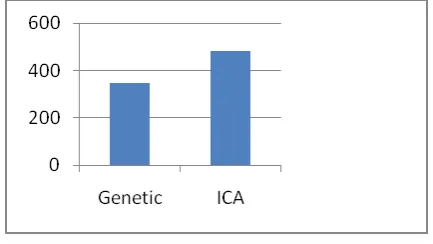
Figure 3 shows that how many users from 600 users in each algorithm won the auction. Proposed algorithm suggested the ICA for winner/determination. The following diagram compares ICA and genetic algorithm to solve winner determination problem. This diagram shows that the number of winner algorithm in proposed algorithm is more than genetic algorithm. This algorithm worked 22.5 percent better than genetic algorithm.
Figure3: The diagram of number of winner users of algorithms.
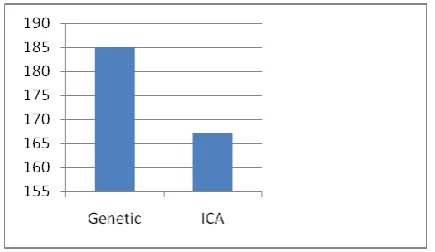
[image:4.595.316.533.507.629.2]Figure 4: The diagram of number of winner providers of algorithms.
The average value of providers is art amount of payment that received by each provider in auction that determined by K-Pricing scheme. The comparison of desired algorithm in the average amount received by providers’ point of view has shown in figure 5. The results showed that proposed algorithm had a highest level of providers’ receiving and worked 45.1 percent better than Fixed-Price algorithm.
Figure 5: The comparison diagram of average receiving of providers
[image:5.595.318.533.265.403.2]In addition, the total profit of providers has shown in figure 6. The following diagram shows that totally, how many dollars the providers have earned. This diagram indicate that our proposed algorithm provided the highest amount of profit to providers compared with other algorithms and works %56.02,% 42.47 better than GI, GG, respectively.
Figure 6: The diagram of total profit of providers
Figure 7 shows the average of users’ payment. The average of user payment is calculated by following equation:
The average payment that paid by users = the total payment paid by winner users according to K-Pricing plan/the number of winner.
The following diagram shows that GI algorithm had a lowest level of paying for users and worked 22.5 percent better than our proposed algorithm. In addition our proposed algorithm
has improved 15.71 more than Field-Price algorithm.
Figure7: The diagram of the average paying of users.
[image:5.595.55.272.311.428.2]Figure 8 shows users’ total profit.
Figure 8: The diagram of total profit of users
8.
CONCLUSION
This article has discussed about proposed algorithm for resource allocating in cloud computing. This algorithm has used double combinatorial auction to allocate resources in cloud computing. This algorithm led to resource allocation changed according to the condition of supply and demand. The total price of bid is suggested in each bid bundle. The winner determination stage has been performed by ICA, after receiving bid bundles. At this stage, the winner users and providers were identified with the consideration of auction aim that was increasing users and providers’ profit.
The resource allocation was performed after mapping stage. At this stage it was identified that which task should be done by which virtual machine (provider). This stage the K-Pricing scheme was used to determine the price of bid.
The result of simulation was comprised with other four algorithms. The comparison criteria were the average amount of user paying, the average profit of users, the average amount of provider earning, the profit of provider, the number of winner users and the number of winner providers. Generally, according to the algorithm convergence diagrams it can be said that algorithms with Genetic winner determination has less winner user than ICA.
[image:5.595.58.271.532.648.2]Moreover, the results show that auction-based algorithm work better than Fixed-Price algorithm about users paying and providers’ earning the reason for this matter is that the supply and demand condition doesn’t considered in Fixed-Price method.
Moreover, there is not any priority between requests in Fixed-Price method, while in proposed algorithm the request with higher price has higher priority.
Some advantages of IG algorithm include: increasing social welfare, it is Scalable and its priority. But this method has also some disadvantages that include: It performs higher than other algorithms about users’ and provider’s paying and earning but about providers and users’ profit doesn’t perform maximally. It can be suggested that playing theories used to reach proper stability of this problem.
9.
ACKNOWLEDGMENTS
This paper has been extracted from M.Sc thesis of Rezvan Alipoor sabzevari as a student at Department of Computer, Khouzestan Science and Research Branch, Islamic Azad University, Ahvaz, Iran
10.
REFERENCES
[1] Zhang Q, Cheng L, Boutaba R. “Cloud computing: state-of-the-art and research challenges”, 2010, Journal of Internet Services and Applications, 1:7-18.
[2] Rai A, Bhagwan R, Guha S. “Generalized Resource Allocation for the Cloud”, 2012, Proceedings of the Third ACM Symposium on Cloud Computing, New York, October 14 – 17, N 15.
[3] Zaman S, Grosu D. “Combinatorial Auction-Based Mechanisms for VM Provisioning and Allocation in Clouds”, 2012, 12th IEEE/ACM International Symposium on Cluster, Cloud and Grid Computing, Ottawa, 13-16 May, 729-734.
[4] Fujiwara I, Aida K, Ono I. “Applying Double-sided Combinational Auctions to Resource Allocation in Cloud Computing” , 2010, 10th Annual International Symposium on Applications and the Internet, Seoul,
19-23 July,7-14.
[5] TENG F. “Evidence and management scheduling of tasks on architectures distributed”, 2011, phd thises, appliqu'ees MATHEMATICS and computer.
[6] Tam S,Tam H,Kuan, Tam L, Zhang T. “A New Optimization Method,the Algorithm of Changes, for Bin Packing Problem” , 2010, Fifth International Conference on Bio-Inspired Computing: Theories and Applications, Changsha, 23-26 Sept, 994 – 999.
[7] Xia M, Stallaert J, Whinston A. “Solving the combinatorial double auction problem”, 2005, European Journal of Operational Research, 164:239-251.
[8] Schnizler B, Neumann D, Veit D, Weinhardt C. “Trading grid services a multi-attribute combinatorial approach” , 2008, European Journal of Operational Research , 187:943-961.
[9] Gorbanzadeh F, Pourhaji Kazem A. “Hybrid Genetic Algorithms for Solving Winner Determination Problem in Combinatorial Double Auction in Grid”, 2012, Institute of Advanced Engineering and Science, I International Journal of Artificial Intelligence, 2:54-62. [10] Atashpaz-Gargari E, Lucas C. “Imperialist Competitive
Algorithm: An algorithm for optimization inspired by imperialistic competition”, 2007, IEEE Congress on Evolutionary Computation, Singapore, 25-28 Sept, 4661-4667.
[11] Eiben A, Smith J. “Introduction to Evolutionary Computing”, 2003, Springer, Natural Computing Series 1st edition, Corr. 2nd printing, 300p.
[12] Xing-wei W, Xue-yi W, Min H. “A resource allocation method based on the limited English combinatorial auction under cloud computing environment”, 2012, 9th International Conference on Fuzzy Systems and Knowledge Discovery, Sichuan, 29-31 May,905-909.
[13] Amazon Web Service site,