HEC-RAS Model for Mannnig’s Roughness: A Case Study
Prabeer Kumar Parhi
Center for Water Engineering and Management, Central University of Jharkhand, Ranchi, India. Email: [email protected]
Received June 18th, 2012; revised July 20th, 2012; accepted July 28th, 2012
Copyright © 2013 Prabeer Kumar Parhi. This is an open access article distributed under the Creative Commons Attribution License, which permits unrestricted use, distribution, and reproduction in any medium, provided the original work is properly cited.
ABSTRACT
Channel roughness is considered as the most sensitive parameter in development of hydraulic models for flood fore-casting and flood inundation mapping. Hence, it is essential to calibrate the channel roughness coefficient (Mannnig’s
“n” value) for various river reaches through simulation of floods. In the present study it is attempted to calibrate and
validate Mannnig’s “n” value using HEC-RAS for Mahanadi River in Odisha (India). For calibration of Mannnig’s “n”
value, the floods for the years 2001 and 2003 have been considered. The calibrated model, in terms of channel rough-ness, has been used to simulate the flood for year 2006 in the same river reach. The performance of the calibrated and validated HEC-RAS based model has been tested using Nash and Sutcliffe efficiency. It is concluded from the
simula-tion study that optimum Mannnig’s “n” value that can be used effectively for Khairmal to Barmul reach of Mahanadi
River is 0.029. It is also verified that the peak flood discharge and time to reach peak value computed using Mannnig’s
“n” of 0.029 showed only an error of 5.42% as compared with the observed flood data of year 2006.
Keywords: Hydrodynamic Model; Flood Simulation; Flood Forecasting; HEC-RAS; River Mahanadi
1. Introduction
For flood forecasting, flood plane mapping and flood volume estimation, various hydrodynamic models, based on hydraulic routing, have been developed and applied to different rivers in the past using computer technology and numerical techniques. For flood warning, the dis-charge and river stage were chosen as the variables, which along with other hydraulic properties are interre-lated to each other [1]. Among various hydraulic pa-rameters, the channel roughness plays very important role in the study of open channel flow particularly in hydraulic modeling. Channel roughness is highly vari-able which depends upon number of factors like surface roughness, vegetation cover, channel irregularities, chan- nel alignment etc. [2]. It also depends on such factors as: bed material, vegetation, channel irregularity and align-ment, scour and deposition, obstructions, channel size and shape, stage and discharge, seasonal changes, sus-pended material and bed load [3].
Earlier, good numbers of researchers including Patro
et al. [4], Usul and Turan [5], Vijay et al. [6], Parhi et al.
[7] and Wasantha Lal [8] have calibrated channel rough-ness for different rivers for the development of hydraulic model for flood forecasting and flood plane mapping.
Ramesh et al. [2] estimated single channel roughness
value for open channel flow using optimization method, taking the boundary condition as constraints. Timbadiya
et al. [9] calibrated channel roughness for Lower Tapi River, India using HEC-RAS model. Ross Doherty [10] calibrated the channel roughness for large number of semiarid rivers of Western Australia having variable channel characteristics for development of rating curves.
In the above context, there is a need to calibrate the
channel roughness coefficient (Mannnig’s “n” value) for
the River Mahanadi, Odisha through simulation of floods, using HEC-RAS. It will be pertinent to mention that the river Mahanadi experiences severe floods frequently causing huge loss to life and property. Hence the present study attempts to accurately estimate the channel rough-ness of the upstream reach of river Mahanadi beyond Hirakud reservoir from Khairmal to Barmul gauging sta-tions.
2. Model Description
net-work of natural and constructed channels [3].
0
A Q
t x
(1)
2
0 f 0
Q A
Q H
gA gA S S
t x x
(2)
where A = cross-sectional area normal to the flow; Q =
discharge; g = acceleration due to gravity; H = elevation
of the water surface above a specified datum, also called
stage; S0 = bed slope; Sf = energy slope; t = temporal
co-ordinate and x = longitudinal coordinate. Equations (1)
and (2) are solved using the well known four-point im-plicit box finite difference scheme [11].
3. Study Reach
In the context of flood scenario, the Mahanadi system can be broadly divided into two distinct reaches: 1) Up-per Mahanadi (area upstream of Mundili barrage, inter-cepting a catchment of 132,100 sq·km), which does not have any significant flood problem 2) Lower Mahanadi (area downstream of Mundili barrage, intercepting a catchment of 9304 sq·km). The key area downstream of Hirakud up to Munduli intercepting a catchment of 48,700 sq·km is mainly responsible for flood havoc in
the deltaic area of Mahanadi [12]. Figure 1 shows the
details of catchments of Mahanadi Basin inside and out-side of Odisha. In the present study, river reach in the Mahanadi system extending over a length of 106 km from Khairmal to Barmul is considered for analysis.
4. Geometric and Hydrologic Data
The channel geometry, upstream and downstream bound-
ary conditions and channel resistance are required for conducting flow simulation through HEC-RAS. The cross- section data at 8 to 10 Kilometer intervals from Khairmal to Barmul extending over a length of 106 km were col- lected from the Department of Water Resources Odisha. The cross section data of the down stream catchment of Hirakud reservoir used for the present analysis was col- lected from the Department of Water Resources, Odisha, which was surveyed during 1997-1998 by Department of Water Resources, Odisha, for dam break analysis of Hirakud Dam and preparation of emergency action plan The flood hydrograph at Khairmal and the friction slope of the reach have been considered as up-stream and downstream boundary conditions respectively. The flood hydrograph at Barmul has been used for validation of the model.
5. Calibration of HEC-RAS Model for
Manning’s Roughness Coefficient “
n
”
The data pertaining to the floods for years 2001 and 2003 have been used for calibration of Manning’s roughness
coefficient “n”. In the present study, effort has been made
to calibrate Manning’s roughness coefficient for single value using aforesaid data and subsequently, different
values of “n” (from 0.04 to 0.025) have been used to
jus-tify their adequacy for simulation of flood in the study reach along the channel. Nash and Sutcliffe efficiency test [13] has been used for comparison of simulated flow hydrograph (computed using different Manning’s rough-
ness coefficient “n”) with the observed flow hydrograph
at Barmul gauging station where gauge discharge data is
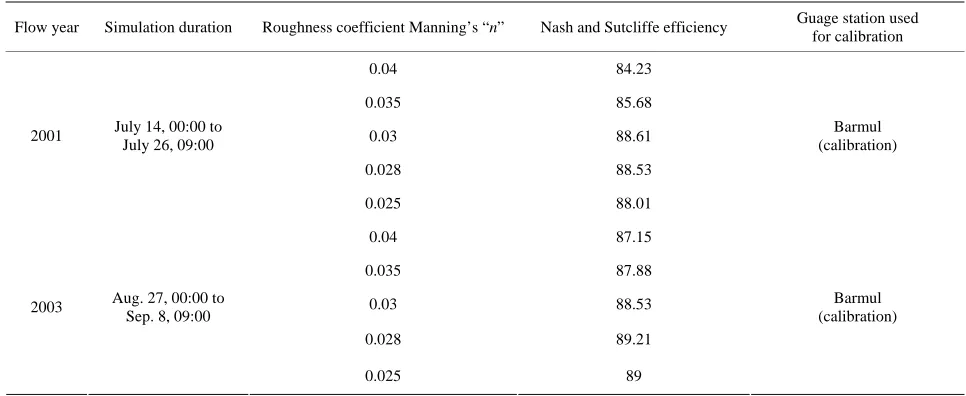
available. Table 1 shows the flood year, flow duration,
name of gauging station and various single values of “n”
24% of total C.A 70% of D/S
Area 33760
Tel Sub-basin
34% of total C.A 58% of the U/S of the
Dam 48700
D/S of Hirakud upto Mundali
59% of total C.A 83400
U/S of Hirakud
Catchment Area (1,41,600 Sqkm.)
Khairmal
Barmul
[image:2.595.80.515.505.720.2]Mundali
(from 0.04 to 0.025) used for model calibration. The comparison of observed and simulated flow hydrograph (calibration) at Barmul gauging station for Manning’s
“n” value of 0.028 is also shown in Figure 2. From
Ta-ble 1 it is clearly visible that for the flood of the year
2001 Manning’s “n” value of 0.03 yields maximum
ciency of 88.61 and that of 0.028 yields maximum effi-ciency of 89.21 for the flood year 2003.
6. Performance of Calibrated Model in
Simulation of Flood for Year 2006
Taking the mean of the optimum Manning’s “n” values
estimated for the flood years of 2001 and 2003, as 0.029 for the focus reach, HEC-RAS based model has been used to simulate the flood for year 2006. It is found from
the simulation that Manning’s “n” value of 0.029 yields
[image:3.595.133.465.338.486.2]the maximum Nash and Sutcliffe efficiency of 92.39. Table 2 shows the simulated flood hydrograph at Barmul
gauging station for various Manning’s “n” values. The
comparison of observed and simulated flow hydrograph
at Barmul gauging station for Manning’s “n” value of
0.029 is also shown in Figure 3.
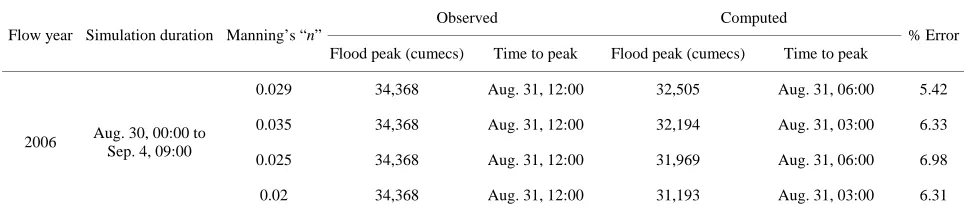
Further, considering Manning’s “n” value as 0.029, the
flood peak and time to peak for the flood year 2006 is computed and it is observed that there is a close
agree-ment between the observed and computed values. Table
3 shows the comparison between the observed and
com-puted values of the flood peak and time to peak for the
flood year 2006 for different values of Manning’s “n”. It
is clearly visible from Table 3 that the flood peak and
time to peak estimated using Manning’s “n” value as
0.029 shows minimum percentage error.
In the above context, it shall be pertinent to mention
that the Manning’s “n” value as detailed by Chow [14]
lies between 0.025 to 0.035 for flood planes having short grasses and also for straight clean having no deep pools, which shows close resemblance with the channel charac-teristics of focus reach (Khairmal to Barmul) of Ma- hanadi River.
0 5000 10000 15000 20000 25000 30000 35000 40000 45000
26A
ug20
03
27A
ug20
03
28A
ug20
03
28A
ug20
03
29A
ug20
03
30A
ug20
03
30A
ug20
03
31A
ug20
03
31A
ug20
03
01S
ep
2003
02S
ep
2003
02S
ep
2003
03S
ep
2003
04S
ep
2003
04S
ep
2003
05S
ep
2003
05S
ep
2003
06S
ep
2003
07S
ep
2003
07S
ep
2003
Flow duration hours
Fl
ow
i
n C
um
e
c
s
computed flood at barmul" Observed flood at barmul
[image:3.595.55.538.539.737.2]Figure 2. Observed and simulated flow hydrograph at Barmul (calibration) for flood year 2003 using Manning’s “n” value of 0.028.
Table 1. Flow year, simulation duration, Manning’s “n” and gauge station used for calibration.
Flow year Simulation duration Roughness coefficient Manning’s “n” Nash and Sutcliffe efficiency Guage station used for calibration
0.04 84.23
0.035 85.68
0.03 88.61
0.028 88.53 2001 July 14, 00:00 to
July 26, 09:00
0.025 88.01 Barmul (calibration)
0.04 87.15
0.035 87.88
0.03 88.53
0.028 89.21 2003 Aug. 27, 00:00 to
Sep. 8, 09:00
0 5000 10000 15000 20000 25000 30000 35000 40000
29A
ug2006 240
0
30A
ug2006 090
0
30A
ug2006 180
0
31A
ug2006 030
0
31A
ug2006 120
0
31A
ug2006 210
0
01
S
ep2006 0600
01
S
ep2006 1500
01
S
ep2006 2400
02
S
ep2006 0900
02
S
ep2006 1800
03
S
ep2006 0300
03
S
ep2006 1200
03
S
ep2006 2100
04
S
ep2006 0600
04
S
ep2006 1500
04
S
ep2006 2400
05
S
ep2006 0900
05
S
ep2006 1800
06
S
ep2006 0300
06
S
ep2006 1200
06
S
ep2006 2100
07
S
ep2006 0600
07
S
ep2006 1500
07
S
ep2006 2400
Time (hours)
F
low
(
C
um
ec
s)
[image:4.595.62.534.84.253.2]computed flow hydrograph at abarmul Observed flow hydrograph at barmul
[image:4.595.54.538.306.395.2]Figure 3. Observed and simulated flow hydrograph at Barmul (validation) for flood year 2006 for Manning’s “n” value of 0.029.
Table 2. Simulation period, Manning’s “n” and gauge station used for validation at Barmul.
Flow year Simulation period Roughness coefficient Manning’s “n” Nash and sutcliffe efficiency
0.029 92.39
0.035 92.02
0.025 92.32 2006 Aug. 30, 00:00 to
Sep. 4, 09:00
0.02 92.12
Table 3. Observed and computed values of flood peak and time to peak for different values of Manning’s “n”.
Observed Computed Flow year Simulation duration Manning’s “n”
Flood peak (cumecs) Time to peak Flood peak (cumecs) Time to peak
% Error
0.029 34,368 Aug. 31, 12:00 32,505 Aug. 31, 06:00 5.42
0.035 34,368 Aug. 31, 12:00 32,194 Aug. 31, 03:00 6.33
0.025 34,368 Aug. 31, 12:00 31,969 Aug. 31, 06:00 6.98
2006 Aug. 30, 00:00 to Sep. 4, 09:00
0.02 34,368 Aug. 31, 12:00 31,193 Aug. 31, 03:00 6.31
7. Conclusions
Based on the simulation study carried out for the down stream catchment of Hirakud Reservoir of Mahanadi River (Khairmal to Barmul reach) following conclusions can be summarized:
1) The most effective single Manning’s roughness
coef-ficient calibrated (on flood data of the years 2001 and 2003) and validated (on flood data of the year 2006) for the Khairmal to Barmul reach of the Mahanadi River comes out to be 0.029.
2) The performance of calibrated and validated model
has been verified using Nash and Sutcliffe (1970). A close agreement (92.39% efficiency) is seen between the simulated and observed flows at Barmul gauging station.
3) Furthermore, the calibrated Manning’s roughness co-
efficient of 0.029 also works best for the estimation of flood discharge peak and time to peak at Barmul reach of the Mahanadi River, as these values can be computed only with an error of 5.42% (compared with the observed flood data of the year 2006).
4) The calibrated Manning’s roughness coefficient value
of 0.029 for the focus reach between Khairmal to Barmul of Mahanadi River having short grasses, straight and no deep pools can be further supported
by the “n” value detailed by Chow [14] for flood
planes having similar channel characteristics as above.
REFERENCES
[1] W.-M. Bao, X.-Q. Zhang and S.-M. Qu, “Dynamic Cor- rection of Roughness in the Hydrodynamic Model,” Jour-
[image:4.595.56.538.422.528.2]doi:10.1016/S1001-6058(08)60143-2
[2] R. Ramesh, B. Datta, S. Bhallamudi and A. Narayana, “Optimal Estimation of Roughness in Open-Channel Flows,” Journal of Hydraulic Engineering, Vol. 126, No. 4, 1997, pp. 299-303.
doi:10.1061/(ASCE)0733-9429(2000)126:4(299)
[3] HEC-RAS, “User Manual,” US Army Corps of Engineers, Hydrologic Engineering Center, Davis Version 4.0, 2008.
[4] S. Patro, C. Chatterjee, S. Mohanty, R. Singh and N. S. Raghuwanshi, “Flood Inundation Modeling Using Mike Flood and Remote Sensing Data,” Journal of the Indian
Society of Remote Sensing, Vol. 37, No. 1, 2009, pp. 107-
118. doi:10.1007/s12524-009-0002-1
[5] N. Usul and T. Burak, “Flood Forecasting and Analysis within the Ulus Basin, Turkey, Using Geographic Infor- mation Systems,” Natural Hazards, Vol. 39, No. 2, 2006, pp. 213-229. doi:10.1007/s11069-006-0024-8
[6] R. Vijay, A. Sargoankar and A. Gupta, “Hydrodynamic Simulation of River Yamuna for Riverbed Assessment: A Case Study of Delhi Region,” Environmental Monitoring
Assessment, Vol. 130, No. 1-3, 2007, pp. 381-387.
doi:10.1007/s10661-006-9405-4
[7] P. K. Parhi, R. N. Sankhua and G. P. Roy, “Calibration of Channel Roughness of Mahanadi River (India) Using HEC-RAS Model,” Journal of Water Resources and Pro-
tection, Vol. 4, No. 10, 2012, pp. 847-850.
doi:10.4236/jwarp.2012.410098
[8] A. M. Wasantha Lal, “Calibration of Riverbed Rough- ness,” Journal of Hydraulic Engineering, Vol. 121, No. 9, 1995, pp. 664-671.
doi:10.1061/(ASCE)0733-9429(1995)121:9(664)
[9] P. V. Timbadiya, P. L. Patel and P. D. Porey, “Calibration of HEC-RAS Model on Prediction of Flood for Lower Tapi River, India,” Journal of Water Resources and Pro-
tection, Vol. 3, No. 11, 2011, pp. 805-811.
doi:10.4236/jwarp.2011.311090
[10] R. Doherty, “Calibration of HEC-RAS Models for Rating Curve Development in Semi Arid Regions of Western Australia,” AHA 2010 Conference, Perth, 2010.
[11] HEC-RAS, “Hydraulic Reference Manual,” US Army Corps of Engineers, Hydrologic Engineering Center, Davis Version 4.0, 2008.
[12] P. K. Mishra and S. Behera, “Flood Management Plan- ning in the Mahanadi River Basin Odisha,” 7th Interna-
tional R&D Conference, Bhubaneswar, 4-6 February 2009,
pp. 149-150.
[13] J. E. Nash and J. V. Sutcliffe, “River Flow Forecasting through Conceptual Models, Part I—A Discussion of Prin- ciples,” Journal of Hydrology, Vol. 10, No. 3, 1970, pp. 282-290. doi:10.1016/0022-1694(70)90255-6