A Google Map Based Social Network (GMBSN) for
Exploring Information about a Specific Territory
Wasim Ahmad*, Ashraf Zia, Usman Khalid
Department of Computer Sciences, Abdul Wali Khan University Mardan, Shankar Campus, Khyber, Pakistan. Email: *[email protected], [email protected], [email protected]
Received April 30th, 2013; revised June 1st, 2013; accepted June 10th, 2013
Copyright © 2013 Wasim Ahmad et al. This is an open access article distributed under the Creative Commons Attribution License, which permits unrestricted use, distribution, and reproduction in any medium, provided the original work is properly cited.
ABSTRACT
Social Networking is a harbinger to a more recent era in the area of computing where allocated and central resources are used in an exclusive manner. Millions of people around the globe with access to the internet are part of one or more social networks. They have permanent online accounts on Facebook and Twitter etc. where they create profiles, share photos, videos, useful links, their thoughts and spend hours catching up with what their friends are doing in their lives. The problem arise when somebody needs specific information about any city inside a country e.g. Where he/she can live? What he/she can eat? Where is the best place for outing? What are the special events relevant to that region? And may be any other help? In this paper we suggest a social network called Google map based social network (GMBSN), where users can choose their desired city of interest from the list. The selected city will be highlighted on Google map. After choosing any city from the map, the user will be able to select any category from the list and start finding and sharing information about the desired city of any country.
Keywords: Google Map; Social Network; GMBSN; LBSN’s; LARE; LDA
1. Introduction
The social networking sites like Facebook and Twitter have rapidly gained popularity in the recent decade. Mil- lions of people have their online Facebook and Twitter accounts and connect to the worldwide web. Users are connected with each other by sharing their thoughts, pic- tures and videos etc. [1-3].
1.1. Google Map
The Google map is a mapping application provided by Google. One can embed it to one’s site by highlighting their areas of business, office, restaurant, hospital etc. for easy access. Google map is a global map where users can find any area on the globe, Whereas Google map location can be created by user according to their need [4]. Goo- gle map is simple to customize, one can include zooming, dragging and other options as well easily. Google map only requires user’s registration to register secret key of Google map API [5].
1.2. Google Map API
Google map has a large scale of APIs which enable the
clients to embed their applications easily [6]. It can be used in desktop applications, web applications and mo-bile applications. In the midst of APIs congestion Google Maps JavaScript API v 3.9 is used that let one to pene- trate one’s dynamic page into web page and make utili- ties available to their customized map [7]. We can access Google map API as shown in Figure 1.
1.3. Features
Any user can login to the GMBSN system by provid- ing their Facebook account information for easy ac- cess.
Since GMBSN supports not only PC but also mobile phones, users can access it from anywhere on the globe. Users can search/access any required information
regarding any city of the target country from every- where across the world 24/7.
By merging these features we have managed to de- velop such a system that gives the opportunity for every user to access and use it as a social network.
2. User Authentication
User authentication is required for rating a post, sharing new posts, photos, videos, links and allowing users to access GMBSN system. User will be required to login the network through Facebook account. Facebook API is used for the authentication due to its enormous data and users across the globe.
Facebook API (Application Programming Interface) is provided by Facebook for developers in order to access and submit information by programming [9]. Facebook API can be accessed by using the following Figure 2.
3. Literature Review
Some map based SNS (Social Networking Sites) have already been developed. We can take example of shaka- banga which provides Google map with list of the certain major countries. By clicking on any desirous country, users are then provided with some interesting images of the target country. Foursquare is another example, where users select their locations and can find some appropriate information related to that region.
Jia-Ching et al. [11] worked on user association analy- sis of locales on location based social networks. It has a solid abstract with the proposal of four locale based met- rics. These metrics include locale clustering coefficient, Inward locale transitivity, locale assertively coefficient,
Figure2. Accessing Facebook API [10].
and locale assort ability coefficient. It has also the ob- servation ability, when people who share more trajecto- ries would get more attention and users who connect to other users who are already been popular. As for the fu- ture work, it has a plan to further investigate other locale based metrics to enhance the analysis on LBSNs. In FCF observation, social friends share more common locations than non-friends. According to the patio social analysis of foursquare observations nearby friends can share more common visited locations. It contains the comparison graphs of different approaches proposed in this paper. It has some ambiguous algorithms in some sections e.g. Inward locale transitivity and locale assertively coeffi- cient. It also contains some ambiguous titles of the pro- posed metrics and does not contain any future enhance- ments for the proposed approaches.
Bao et al. [12] worked on location-based and prefer-
ence-aware recommender system. This system provide the users with location recommendations around the specified geo-Position based on the user’s personal pref- erences Learnt from their location history and social opinions piled up by the local experts who could share analogous interests. It also recommends a system which facilitates people to not travel only near their residential areas but also to a city that is new to them. It also pro-poses a novel location recommended system for people who travel to new cities. The main part of the proposed system is online recommendation and offline modeling. This paper also provides well understandable diagrams. There is conclusion in its algorithms and it also contains some ambiguous titles which need to be clarified. It does not have any progress of future enhancements.
Yamamoto et al. [13] worked on social networking service based on the location of students. It proposed a system that has the cited below functions.
1) Can obtain information regarding when and where the students are located by using both the attendance re- cords of classes, and the login records of educational computers. These records are automatically recorded by a student card serving on a noncontact-type IC.
2) While system supports also web access form cell phone therefore users can also access it from outdoors. These functions enable users to search out anything anywhere in the vicinity without special terminals. One can expect the communication through this system not only on the web, but can too expect in real life. It has some well understandable diagrams that can be easily understand. This paper has absolutely fair functions, so that there remains no negative point in this paper.
scale quantitative analysis of a real-world commercial LSN service. This paper also states that that one user traveled 95,155 miles in 62 days, which means that the user traveled 1500 miles per day on average. It has a poor abstract which is difficult to understand. There are lots of complexities and has no future progress.
Scellato et al. [15] worked on Measuring User Activity on an Online Location-based Social Network. This paper presents measurement study of user activity on a popular online location-based social network with hundreds of thousands of users. It also describes that how the number of friends appears distributed according to a Double- Pareto law, both the number of check-ins and the number of places per user are better described by normal distri- butions. Moreover it reports how user activity spans de- cay faster than exponentially and how, over time, users add friends more quickly than they accumulate check-ins and places. It also suggest that the difference in the dis- tribution of friends and check-ins/places may be moti- vated by physical constraints that do not allow users to steadily visit very large numbers of new places, while online friends can be added at virtually no cost. This pa-per contains some diagrams which is non-understandable. It does not have any impressive future plan as well.
Long et al. [16] worked on Exploring Trajectory- Driven Local Geographic Topics in Foursquare. It fo-cuses on exploring the local geographic topics through check-ins In Pittsburgh area in Foursquare. It uses the Latent Dirichlet Allocation (LDA) model to discover the local geographic topics from the check-ins. It also com- pares the local geographic topics on weekdays with those at weekends. It contains well-understandable and relative diagrams which is helpful in understanding the motives of the paper. The weak point of the paper is that it has no well- suited future plan, and do not show any progress of
the future development.
Chow et al.[17] worked on Towards Location based social Networking services. This paper has strong ab- stract that present an aggregate system called Geo Social DB. It provides three location-based social networking services namely; location-based news feed, location- based news ranking, and location-based recommendation. The purpose of Geo Social DB is to implement the afore- mentioned services as query operators inside a database engine to optimize the query processing performance. Within the Geo Social DB framework, it also discusses research challenges, and directions toward the realization of scalable and practical query processing for location- based social networking services. Some of the titles names are not well-suited. Some of its diagrams are lucid. There is no future enhancement progress.
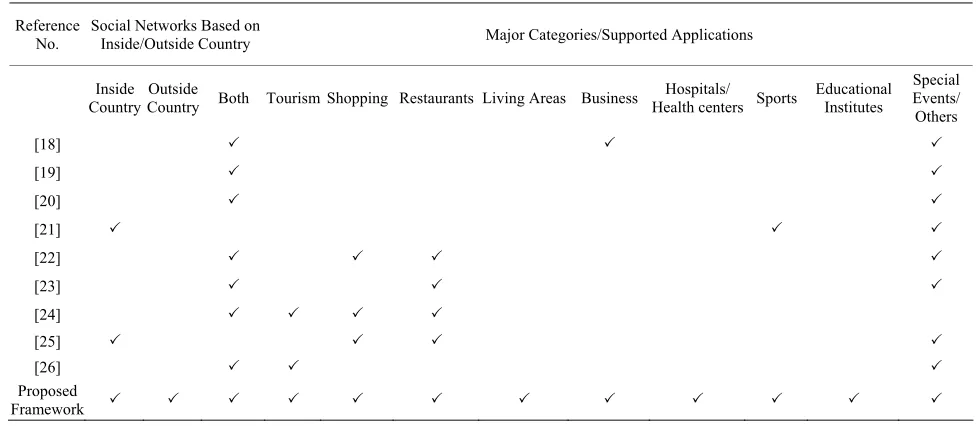
On the basis of the above discussion the following Ta- ble 1 is drawn which shows the existing social net work frameworks, their comparison, major categories and sup- ported applications. At the end of the table a proposed framework is suggested that supports all the major cate- gories and applications.
4. Preliminary
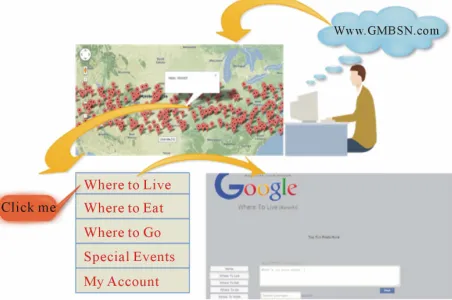
[image:3.595.52.541.526.739.2]This Section of the paper presents the key structure of GMBSN system that elaborates how users from the worldwide web can access the system from any location on the globe. In order to access the GMBSN system the user will first has to visit GMBSN. After that they will be followed by a page presenting highlighted cities on the map. The user will then select any city highlighted on the map. After selecting the city, users have to select the category of their desired interest/need. In the category page user will be able to share and get useful information
Table 1. Comparison of the proposed framework with the existing frameworks.
Reference No.
Social Networks Based on
Inside/Outside Country Major Categories/Supported Applications
Inside Country
Outside
Country Both Tourism Shopping Restaurants Living Areas Business
Hospitals/ Health centers Sports
Educational Institutes
Special Events/
Others
[18]
[19]
[20]
[21]
[22]
[23]
[24]
[25]
[26]
Proposed
about the specified city in the form of posts. The phe- nomena are described in the following Figure 3.
5. GMBSN Architecture
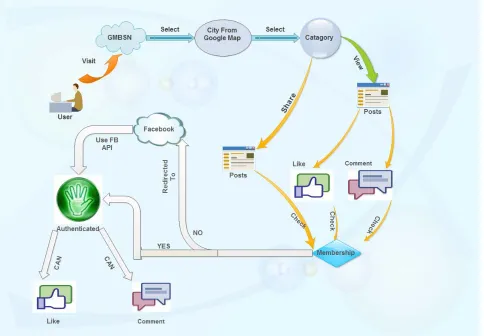
GMBSN, functions for the provision of multifarious es- sential information for the ease of worldwide clients on the globe. The users of social network should visit in tyro/novice to GMBSN which cited in Figure 4. Shortly after, going through the required process, GMBSN cli- ents shall choose a particular city from the map. The map can be accessed through Google map API as described earlier. Soon after selecting a city, users will be redi- rected to the city page, where they can have another op- tion for selecting category from the categories index, de- pending on their interest as directed in Figures 3 and 4. When the category selection process gets over, client will be re-enacted to Category page: there will be innumer-able information about the likened city of a country re-lated to category. Users will then be enabled to watch out all the posts; but they are ought to authenticate the claim before rating, commenting or sharing the visual posts, the process for authentication is shown in Figure 4. Insofar as, if the clients attempt to make any particular action they shall seek to login their Facebook account, method have shown in Figure 4. The purpose of authentication is to provide an access to the users for the performance of certain actions inside GMBSN. For query, users will be directed to “Facebook login’s page” where they shall be required to login their Facebook accounts, if a user al-ready is a member of GMBSN then he/she shall make haste to redirect it, otherwise it will show a pop up to the user for granting permission to access GMBSN, already shown in Figure 4. After the authentication process user can eagerly evaluate/devaluate the post.
6. System Functions
[image:4.595.58.284.570.720.2]GMBSN provide some basic functions for their users which includes the following basic functions.
Figure 3. GMBSN user interface.
6.1. Google Map
GMBSN system utilizes Google map which discussed in the aforementioned sections. It is friendlier/fun-loving activity for users and easy to interact with, hence it will be handy enough for clients to watch the map and ex- plore any region being highlighted on the map and will be redirected to that region on the globe.
6.2. Categories
GMBSN provide different categories in overall system which includes home, where to live, where to eat, where to go and my account etc··· These parts can be explained and divided into three sub-categories on the basis of their functions e.g.
1) Home: This is the category when user click on this category he/she will be redirected to the main page and it is the crucial one, since if the user might be anywhere, and on any page, they can directly switch-over to the main page by clicking this category.
2) Middle Categories: These includes categories e.g. where to live, to eat and to go etc··· These categories provide easy access for users to go to any category of their interest or according to their need of information about the concern region. Users can choose any category from the index and can be easily entered to the related category.
User can switch-over from one category to another simultaneously.
3) My Account: This category includes the overall in- formation about the user who is using this network. The information includes the users Facebook profile name, picture and any other information, and the most impor- tant information such as user’s posts, comments, and likes etc··· This category also contains the friend list of those users who are added with the current user. It also consists of find new friends which suggest friends to current user to add them. These users are suggested on the basis of best ratings or comments on the current user’s post. Users can add these suggested users by just clicking on add as friend button and can easily remove these friends by just clicking on remove button.
7. Conclusion
Figure 4. GMBSN architecture.
the globe and have currently expanded its vendors in order to provide best protection over one billion users who use this network [27]. Currently we have imple- mented this system for Pakistan and in future we are looking to spread and implement this system in all over the world.
REFERENCES
[1] N. Li and G. Chen, “Analysis of a Location-Based Social Network,” International Conference on Computational Sci- ence and Engineering, Vancouver, 29-31 August 2009, pp. 263-270. doi:10.1109/CSE.2009.98
[2] M. Ye, P. Yin and W.-C. Lee, “Location Recommenda- tion for Location-Based Social Networks,” Proceedings of the 18th SIGSPATIAL International Conference on Ad- vances in Geographic Information Systems, (c), (2010, pp. 458. doi:10.1145/1869790.1869861
[3] I. Workshop, “We Will Set One Best Paper award Ac- cording to the Review Organizers General Chair: Pro- gram Chair: Program Committee,” The 4th International Workshop on Location-Based Social Networks (LBSN
2012), Pittsburgh, 8 September 2012.
[4] C. Fu, Y. Wang, Y. Xu and Q. Li, “The Logistics Network System Based on the Google Maps API,” 2010 Interna-
tional Conference on Logistics Systems and Intelligent Management (ICLSIM), Harbin, 9-10 January 2010, pp. 1486-1489. doi:10.1109/ICLSIM.2010.5461215
[5] H. Li and L. Zhijian, “The Study and Implementation of Mobile GPS Navigation System Based on Google Maps,” 2010 International Conference on Computer and Infor- mation Application, Tianjin, 3-5 December 2010, pp. 87- 90. doi:10.1109/ICCIA.2010.6141544
[6] S. Saha, N. Agarwal, P. Dhanuka and S. Nandi, “Google Map Based User Interface for Network Resource Plan- ning in Post Disaster Management,” Proceedings of the
3rd ACM Symposium on Computing for Development, Bangalore, 11-12 January 2013, Article No. 22.
doi:10.1145/2442882.2442910
[7] http://www.sdbay.sdsu.edu/maps/images/DisMap_archite cture.gif
[8] http://developers.facebook.com/docs/reference/php/faceb ook-api/
[9] http://uswaretech.com/blog/wp-content/uploads/2009/02/f acebook.jpg
69-76. doi:10.1145/2063212.2063214
[11] J. Bao, Y. Zheng and M. F. Mokbel, “Location-Based and Preference-Aware Recommendation Using Sparse Geo- Social Networking Data,” Proceedings of the 20th Inter- national Conference on Advances in Geographic Infor- mation Systems SIGSPATIAL, Redondo Beach, 6-9 No- vember 2012, pp. 199-208.
doi:10.1145/2424321.2424348
[12] D. Yamamoto, I. Takumi and H. Matsuo, “Location-Bas- ed Social Network Services Employing Student Cards for University,” Proceedings of the 2009 International Work- shop on Location Based Social Networks, Seattle, 3 No- vember 2009, pp. 21-24. doi:10.1145/1629890.1629895 [13] S. C. Tan, “Location Aware Applications for Smart Cities
with Google Maps and GIS Tools,” 2006.
[14] S. Scellato and C. Mascolo, “Measuring User Activity on an Online Location-Based Social Network,” 2011 IEEE Conference on Computer Communications Workshops
(INFOCOM WKSHPS), Shanghai, 10-15 April 2011, pp. 918-923. doi:10.1109/INFCOMW.2011.5928943
[15] X. Long, L. Jin and J. Joshi, “Exploring Trajectory-
Driven Local Geographic Topics in Foursquare,” Proceed- ings of the 2012 ACM Conference on Ubiquitous Com- puting, Pittsburgh, 5-8 September 2012, pp. 927-934. doi:10.1145/2370216.2370423
[16] http://www.facebook.com
[17] C. Chow, “Towards Location-Based Social Networking Services Categories and Subject Descriptors,” 2010. [18] http://georillas.com/
[19] http://eu1.badoo.com/ [20] http://www.shakabanga.com/
[21] http://www.dehood.com/http://www.foursquare.com [22] http://www.citysourced.com/about
[23] http://www.foodspotting.com [24] http://www.foursquare.com [25] http://en.friendticker.com/ [26] http://www.locr.commap