»
EUROPEAN ATOMIC ENERGY COMMUNITY - EURATOM
PROGRAMS FOR DATA PROCESSING
AT THE ACCELERATORS OF THE
HUM
HHtiHEiMJBf
CENTRAL BUREAU FOR NUCLEAR MEASUREMENTS
iíAfiíj
i
mm mmm
íÍAáStisa»¿w.,*ff 4ri
HULÜÍW ä J I f Ρ *!*- E fili* ;4jf<c J™ i*äiMftt l i ^ . T H * * WMOHP
• „,,''Lie: ï'ï; ■WÅiSaA
ΦΑΪ
iLEGAL NOTICE
This document was prepared under the sponsorship of the Commission of the European Communities.
Neither the Commission of the European Communities, its contractors
' w i r
nor any person acting on their behalf :
make any warranty or representation, express or implied, with respect to the accuracy, completeness or usefulness of the information con tained in this document, or that the use of any information, apparatus, method or process disclosed in this document may not infringe privately owned rights; or
H
assume any üability with respect to the use of, or for damages resulting from the use of any information, apparatus, method or process disclosed in this document.
report is on sale at the addresses listed on cover page
at the price of F F 34.45 FB 310, DM 22.70 Lit. 3 870 Fl. 22.30
fl3*! in«
M
When ordering, please quote the EUR number and the title,
which are indicated on the cover of each report. j |
Printed by Guyot, s.a. Brussels, December 1969
^ • • l ^ f i P ' N t ø ^
H^Krfa
tf
¿Jas*
itffølBSiJ!'
** IBM BELGIUM
European Atomic Energy Community - EURATOM
Joint Nuclear Research Center - Geel Establishment (Belgium) Central Bureau for Nuclear Measurements
Luxembourg, December 19C9 - 244 Pages - FB 310
A set of IBM 1800 programs for data handling and reduction at the Van de Graaff and the electron linear accelerator of the Central Bureau for Nuclear Measurements is described. Most of the data to be processed arc neutron cross section data collected in time-of-flight multi-channel analysers. These data arc either buffered on magnetic tape (off-line operation) or directly transferred to the computer and stored on disk (on-line operation).
EUR 4404 e
PART 1
IBM 1800 PROGRAMS FOR DATA PROCESSING AT THE ACCELERATORS OF THE CENTRAL BUREAU FOR NUCLEAR MEASUREMENTS, by H. SCHMID *, H. HORSTMANN * and H. CLAESSENS **
* EURATOM ** IBM BELGIUM
European Atomic Energy Community - EURATOM
Joint Nuclear Research Center - Geel Establishment (Belgium) Central Bureau for Nuclear Measurements
Luxembourg, December 1969 - 244 Pages - FB 310
A set of IBM 1800 programs for data handling and reduction at the Van de Graaff and the electron linear accelerator of the Central Bureau for Nuclear Measurements is described. Most of the data to be processed are neutron cross section data collected in time-of-flight multi-channel analysers. These data are either buffered on magnetic tape (off-line operation) or directly transferred to the computer and stored on disk (on-line operation).
EUR 4404 e
PART 1
IBM 1800 PROGRAMS FOR DATA PROCESSING AT THE ACCELERATORS OF THE CENTRAL BUREAU FOR NUCLEAR MEASUREMENTS, by H. SCHMID *, H. HORSTMANN * and H. CLAESSENS **
* EURATOM ** IBM BELGIUM
European Atomic Energy Community - EURATOM
Joint Nuclear Research Center - Geel Establishment (Belgium) Central Bureau for Nuclear Measurements
Luxembourg, December 1969 - 244 Pages - FB 310
The program package described contains programs for checking the analyser data on magnetic tape, conversion of analyser spectra (tape to card, printer, and plotter; card to tape and disk; disk to card, printer and plotter), and summing of analyser spectra, especially for data reduction of transmission measurements.
Almost all programs are written in ASSEMBLER language for the Time-Sharing Executive System (TSX).
_ _ 1
The program package described contains programs for checking the analyser data on magnetic tape, conversion of analyser spectra (tape to card, printer, and plotter; card to tape and disk; disk to card, printer and plotter), and summing of analyser spectra, especially for data reduction of transmission measurements.
EUROPEAN ATOMIC ENERGY COMMUNITY - EURATOM
IBM 1800 PROGRAMS FOR DATA PROCESSING
AT THE ACCELERATORS OF THE
CENTRAL BUREAU FOR NUCLEAR MEASUREMENTS
PART 1 : OFF-LINE PROGRAMS FOR DATA HANDLING
AND REDUCTION
by
H. SCHMID *, H. HORSTMANN * and H. CLAESSENS **
* EURATOM ** IBM BELGIUM
1969
Joint Nuclear Research Center Geel Establishment - Belgium
the computer and stored on disk (on-line operation).
The program package described contains programs for checking the analyser data on magnetic tape, conversion of analyser spectra (tape to card, printer, and plotter; card to tape and disk; disk to card, printer and plotter), and summing of analyser spectra, especially for data reduction of transmission measurements.
Almost all programs are written in ASSEMBLER language for the Time-Sharing Executive System (TSX).
KEYWORDS
IBM
COMPUTERS PROGRAMMING DATA PROCESSING
VAN DE GRAAFF ACCELERATORS LINEAR ACCELERATORS
NEUTRONS
CROSS SECTIONS
TIME OF FLIGHT SPECTROMETERS MAGNETIC TAPES
1. I N T R O D U C T I O N 5
2. DATA F O R M A T S 7
3. S U B R O U T I N E SET 12
4. D E S C R I P T I O N O F T H E P R O G R A M S F O R
DATA HANDLING AND R E D U C T I O N 43
5. R E F E R E N C E S 61
1. Introduction
This r e p o r t d e s c r i b e s p r o g r a m s for data handling and reduction at
the Van de Graaff and the e l e c t r o n l i n e a r a c c e l e r a t o r of the C e n t r a l
B u r e a u for N u c l e a r M e a s u r e m e n t s (CBNM). The data p r o c e s s i n g
s y s t e m i s b a s e d on an IBM 1800 c o m p u t e r (32 K, 2 /usee c / c l e time)
with the following p e r i p h e r a l u n i t s : 3 disk d r i v e s , 4 m a g n e t i c tape
units (one for 7 t r a c k s , t h r e e for 9 t r a c k s ) , p r i n t e r (144 c h a r a c t e r s /
line), c a r d r e a d p u n c h , and a Calcomp p l o t t e r .
Most of the data to be p r o c e s s e d a r e collected in n e u t r o n t i m e o f f l i g h t
e x p e r i m e n t s at data a c q u i s i t i o n stations equipped with m u l t i c h a n n e l
a n a l y s e r s ( l ) . T h e s e m u l t i c h a n n e l a n a l y s e r s a r e connected to the
IBM 1800 c o m p u t e r by' i n t e r f a c e units (2, 3), initiating i n t e r r u p t s
a c c o r d i n g to v a r i o u s e x p e r i m e n t a l conditions and d i r e c t i n g the data
t r a n s f e r s from the data a c q u i s i t i o n stations to the c o m p u t e r (online
o p e r a t i o n ) . C o r r e c t l y t r a n s f e r r e d data a r e s t o r e d on disk. In c a s e of
a c o m p u t e r defect or l a c k of disk s t o r a g e the m u l t i c h a n n e l a n a l y s e r s
can be switched to a m a g n e t i c tape unit (7 t r a c k s ) as a b a c k u p device
for data s t o r a g e (offline o p e r a t i o n ) .
This r e p o r t d e s c r i b e s in detail the p r o g r a m
for analysing the m a g n e
t i c t a p e s of the b a c k u p unit and all p r o g r a m s used for data handling
and r e d u c t i o n r e g a r d l e s s if the data a c q u i s i t i o n is done online or off
l i n e . F o r the i n t e r r u p t p r o g r a m s for o n l i n e data acquisition and r e
duction the r e a d e r is r e f e r r e d to (4).
In offline o p e r a t i o n data collected in the m u l t i c h a n n e l a n a l y s e r s a r e
r e a d out on a s e v e n t r a c k tape in BCD f o r m a t with a density of 2 00 cha
r a c t e r s / i n c h . T h e s e t a p e s a r e checked by the IBM 1800 c o m p u t e r for
tape e r r o r s and a l i s t of identification n u m b e r s of the data together
with e r r o r m e s s a g e s i s p r i n t e d ( p r o g r a m TMAPG, cf. 4. 01). In many
c a s e s the data a r e t r a n s f o r m e d to b i n a r y f o r m a t and a new tape (9
t r a c k s ) is w r i t t e n to be u s e d for f u r t h e r data reduction.
To f a c i l i t a t e the p r o g r a m m i n g a g e n e r a l f o r m a t of an a n a l y s e r s p e c t r u m
in the c o m p u t e r m e m o r y r e f e r r e d to a s " m e m o r y f o r m a t " h a s been
defined. Section 2 d e s c r i b e s the data f o r m a t s on 7 and 9 t r a c k tape,
on disk, in c o r e m e m o r y , and in b i n a r y c a r d s which a r e used for p e r
m a n e n t data s t o r a g e .
In section 3 all the s u b r o u t i n e s a r e d e s c r i b e d which a r e not included
in the IBM 1800 l i b r a r y or not yet published in the r e p o r t s about the
IBM 1800 utility p r o g r a m s (5) or about the Calcomp p r o g r a m package
(6): m a i n l y s u b r o u t i n e s for v a r i o u s data c o n v e r s i o n s and for the t r a n s
fer of a s p e c t r u m from m e m o r y to tape, to disk, to c a r d s , and vice
v e r s a . All a n a l y s e r data a r e s t o r e d a s i n t e g e r b i n a r y v a l u e s in double
p r e c i s i o n f o r m a t . In o r d e r to have a c c e s s with FORTRAN p r o g r a m s
to the data s t o r e d on disk or tape two s u b r o u t i n e s FLDSK and F L T P E
have been w r i t t e n . T h e s e s u b r o u t i n e s s e a r c h the s p e c t r a on disk or
tape and t r a n s f o r m t h e m to FORTRAN a r r a y s of floating point v a l u e s
Section 4 d e s c r i b e s the m a i n p r o g r a m s . M o s t of t h e m a r e c o n v e r s i o n p r o g r a m s for m u l t i - c h a n n e l a n a l y s e r s p e c t r a :
T a p e to c a r d >. „ „ . _ , _ . ) . . . p r o g r a m S E A R T p r i n t e r
T a p e to C a l c o m p p r o g r a m A N A L T C a r d to t a p e p r o g r a m C A T A P C a r d to d i s k p r o g r a m CADSK
Disk to c a r d \ ο τ^ .π τ Λ
) p r o g r a m S E A R D
p r i n t e r ^ s
Disk to C a l c o m p p r o g r a m A N A L D
P r o g r a m s S E A R T and S E A R D c a n a l s o be u s e d for s u m m i n g up single s p e c t r a .
F u r t h e r m o r e , a n a l y s e r s p e c t r a can be p r o c e s s e d w h i c h h a v e b e e n p u n c h e d into c a r d s ( b i n a r y and BCD f o r m a t ) by an IBM 1401 c o m p u t e r ( p r e c o u r s e r of the p r e s e n t c o m p u t e r ) . P r o g r a m s O C T A P and O C T A 1 p e r f o r m the t r a n s f o r m a t i o n of t h e 1401 d a t a f o r m a t s , to the p r e s e n t t a p e f o r m a t .
P r o g r a m S U M O F is u s e d for s p e c i f i c s u m m i n g p r o c e d u r e s n e c e s s a r y for the d a t a r e d u c t i o n of t r a n s m i s s i o n m e a s u r e m e n t s (cf. 4. 10).
P r o g r a m T B P R T p r i n t s a l i s t of the i d e n t i f i c a t i o n n u m b e r s of all s p e c t r a s t o r e d on d i s k .
2. Data F o r m a t s
2. 01 7 - T r a c k Tape F o r m a t (Original Analyser Tapes)
The analyser m e m o r y of 4096 channels (analyser words) is r e a d out
in 16 separately a d d r e s s e d blocks of 256 channels each. Each analy
ser word consists of 6 decimal digits. The data a r e stored on m a g n e
tic tape (7 t r a c k s , 200 c h a r a c t e r s / i n c h , even parity) in the following
format: Each block forms a r e c o r d including a 2-digit block number
(from 1 to 16) and a 4-digit identification number. The 4-digit identi
fication number consists (left to right) of a 1-digit 1
s texperiment n u m
ber, a 1-digit 2
n c iexperiment number and a 2-digit s e r i a l number. The
length of the r e c o r d is therefore 1542 (=6.256+6) c h a r a c t e r s .
2. 02 F o r m a t of Spectra in Core Storage ("Memory F o r m a t " )
Spectra a r e stored in m e m o r y in groups of 4096 channels in the follo
wing ascending o r d e r :
Words 1-16: 16 identification words (see below)
Words 17-64: 48 words for 24 s c a l e r s (double precision integers)
Words 65-8256: 8192 words for 4096 channels (double p r e c i s i o n integers).
The spectrum has to s t a r t at an even m e m o r y a d d r e s s and the two words
preceding this a d d r e s s a r e r e s e r v e d for the i / O operations (word count,
sector a d d r e s s ) . Spectra with l e s s than 4096 channels (number of blocks
< 16) a r e stored as a complete s p e c t r u m of 4 K where the blocks not
used contain z e r o e s .
Identification words
Each spectrum on tape, disk, or in m e m o r y is preceded by the follo
wing 16 identification words:
1. word: Group number of experiment (= PISW bit number in the on-line
case,
= ist experiment number in the
off-line case)
2. word: I
sexperiment No. (1 word equals 2
nc* word in the off-line
case)
3. word: 2
η" experiment No. of s p e c t r u m
4. word: Serial No. of s p e c t r u m
5. word: Group No. of 4096 channels
0: s p e c t r u m < 4 Κ (not possible on tape)
1: 1
s tgroup of 4096 channels
2: 2
nd group of 4096 channels etc.
6. word: Number of blocks in the spectrum
7. word: Number of first block in the spectrum
8. word: Only used for disk storage (cf. 2. 04)
Occupation indicator:
1: s p e c t r u m occupies 13 s e c t o r s
0: s p e c t r u m occupies 26 s e c t o r s
9. word: Only used for disk storage (cf. 2. 04)
Overflow indicator:
11. word: Automatic type (cf. p r o g r a m SUMOF in 4. 10)
0: 4 K standard s p e c t r u m (binary format, 1 channel =
2 words)
1: 4 K partial s p e c t r u m of t r a n s m i s s i o n m e a s u r e m e n t
(binary format, 1 channel = 2 words)
2: 8 K p a r t i a l s p e c t r u m of t r a n s m i s s i o n m e a s u r e m e n t
(binary format, 1 channel = 1 word)
3: 12 K p a r t i a l spectrum of t r a n s m i s s i o n m e a s u r e m e n t
(BCD format)
4: 20 K p a r t i a l s p e c t r u m of t r a n s m i s s i o n m e a s u r e m e n t
(BCD format)
5: 24 K partial s p e c t r u m of t r a n s m i s s i o n m e a s u r e m e n t
(BCD format)
12. word: Number of groups of 4096 channels in the s p e c t r u m (0 for
s p e c t r a < 4 K)
13. word: Sample changer sequence indicator (cf. 4. 10 p r o g r a m SUMOF)
14. word: \
15. word: \ Not used for off-line operation
16. word:
2. 03 F o r m a t of Spectra on 9 - T r a c k Magnetic Tape
All spectra a r e stored in groups of 4096 channels (cf. 2. 02), each group
in 17 r e c o r d s : 1 identification r e c o r d + 16 data r e c o r d s . The
identifica-tion r e c o r d has a length of 64 computer words (16 words identificaidentifica-tion +
48 words for scaler data), the data r e c o r d s have a length of 512 computer
words each.
2. 04 F o r m a t of Spectra on Disk
Three data files of variable length for the storage of s p e c t r a of 16 blocks,
spectra s m a l l e r than 16 blocks, and for overflow data, and t h r e e
identi-fication tables corresponding to the t h r e e data files (each 1 sector in
length) a r e provided. Channels with counts g r e a t e r than 6553 5 (=2 - l)
a r e so-called overflow channels.
Data File for Spectra of 16 Blocks
Name: SPZNE
Length: About 143 0 s e c t o r s (= 110 spectra)
This file is composed of 13-sector places which a r e used in the following
way:
1 place of 13 s e c t o r s : 1 s p e c t r u m of 16 blocks with l e s s than 1921 overflow
channels
16 words for identification
48 words for s c a l e r data
4096 words for 4096 channels of analyser data
4160 words = 13 s e c t o r s
2 consecutive places of 13 s e c t o r s each: 1 s p e c t r u m of 16 blocks with
m o r e than 1920 overflow channels (1 channel =
2 words on disk).
16 words for identification
48 words for s c a l e r data
Data File for Spectra S m a l l e r than 16 Blocks
Name: SPZN1
Length: About 40 s e c t o r s
The blocks of s p e c t r a < 16 blocks a r e stored in consecutive s e c t o r s in
the following way:
1 channel = 1 word, if no overflow channels in the s p e c t r u m
1 channel = 2 w o r d s , if overflow channels in the s p e c t r u m .
Each s p e c t r u m s t a r t s with a new sector.
Data File for Overflow Data
Name: OVZNE
Length: About 100 s e c t o r s
Overflow data a r e stored s e c t o r w i s e . Each sector contains 160 overflow
channels (ascending channel n u m b e r s ) . F o r each overflow channel two
words a r e used, the first one for the channel n u m b e r , and the second one
for the overflow count (bits 0-15 of a double word). The overflow s e c t o r s
belonging to one s p e c t r u m m a y be at different positions in the file. In
this case the s e c t o r s a r e stored in the o r d e r of ascending channel n u m b e r s .
Identification Table for Spectra of 16 Blocks
Name: SPTBL
Length: 1 sector
The places of 13 s e c t o r s for the storage of 16block s p e c t r a a r e c o n s i
-dered as being n u m b e r e d from 1 to 110. There is an identification number
of 2 words (= 32 bits) for each place of 13 s e c t o r s . These identification
n u m b e r s a r e stored in the identification table in an onetoone c o r r e s p o n
-dance with the 13-sector p l a c e s .
2-word identification n u m b e r :
Bits 0 - 3: Group number of e x p e r i m e n t
4 - 7: I
s* experiment number
8 - 1 1 : 2
nd experiment number
12 - 19: Serial number of s p e c t r u m
20 - 23: Group number of 4096 channels
24 - 27: Occupation indicator
1: Spectrum occupies 13 s e c t o r s
0: Spectrum occupies 26 s e c t o r s consecutively. In this case
the identification n u m b e r s for the two p l a c e s a r e identical.
28 - 31: Overflov/ indicator
1: Spectrum with overflow s e c t o r s
0: Spectrum without overflov/ s e c t o r s .
Identification Table for Spectra with L e s s than 16 Blocks
Name: SPTB1
Length: 1 sector
F o r s p e c t r a with l e s s than 16 blocks about 40 s e c t o r s a r e r e s e r v e d in the
corresponding data file. F o r each sector a 2-word identification number
is stored in the identification t a b l e . The 2-word identification number is
the s a m e as that one for the s p e c t r a of 16 blocks except that bit positions
20-23, 24-27, and 28-31 have different meaning:
Bits 20 - 23: Number of I
s*- block in the s p e c t r u m
24 - 27: Occupation indicator
Identification Table_f_or Overflow Data
Name: OVFTB
Length: 1 sector
For each sector of the overflow data file the identification table
con-tains a 2-word identification number specifying the s p e c t r u m to which
the sector of overflow data belongs. This 2-word identification n u m b e r
is the same as that one explained in the description of the identification
table for spectra of 16 blocks.
2. 05 F o r m a t of Spectra on Binary Cards
Card 1: Title card (IBM card code)
Card 2: Header card for first block
Col. 1-16:
Col. 17-64:
Col. 73-74:
Col. 75-78:
Col. 79-80:
Card 3: Data Card
Col. 1- 2:
2-72:
7 3 - 8 0 :
Low o r d e r 12 bits of the binary equivalent of the
identification words (col. 8, 9, 14-16 a r e blank).
Maximum value is 4095.
Low o r d e r 24 bits of the binary equivalent of the
scaler words (each s c a l e r
-
2 columns). Negative
values a r e not p e r m i t t e d . Maximum value is
2
2 4- 1 « 16. 10
6.
6-digit identification number (2-digit group number
of experiment, 1-digit 1
s texperiment No. , 1-digit
2 experiment number, 2-digit s e r i a l n u m b e r ) .
Each digit is binary coded by 4 bits, 3 digits a r e
punched in one column.
Block number in IBM card code.
Serial card number for each block (IBM card code)
beginning with 00.
Blank
3 5 channels, each channel 2 columns with a range
of - 2
2 3to 2
2 3- 1.
See header card.
. etc.
Card 10:
Col.
1- 2
3-24
73-80
Blank
Last 11 channels for this block
See header c a r d
Card 11: Header card for following block, etc.
2. 06 IBM 1401 F o r m a t of 4 K Spectra in Cards (BCD and Binary)
BCD F o r m a t
Each card contains the following data:
Col. 1- 2
3- 6
8-13
15-20
Block number
4-digit identification number
)
)
) 6-digit data words (8 channels per card)
)
57-63
Binary F o r m a t
The channels a r e punched consecutively in binary form into c a r d s ,
each of them in l l / 2 columns. Therefore, 48 channels can be
pun-ched in one card (col. 1-72).
Columns 73-76 contain the 4-digit identification number, columns
77-80 a s e r i a l card number (IBM card code).
2. 07 IBM 1401 F o r m a t of 8 K Spectra (BCD F o r m a t Only)
Each card contains the following data:
Col.
1- 2
3- 6
8-10
11-13
15-17
18-20
Block number
4-digit identification number
F i r s t channel of second group of 4 K
F i r s t channel of first group of 4 K
Second channel of second group of 4 K
Second channel of first group of 4 K
'.
etc.
3. Subroutine Set
This section contains the description of the subroutines used in the
p r o g r a m s of this report. All subroutines save the three index r e g i s
t e r s , but do not save accumulator, Q - r e g i s t e r and status indicators.
In all c a s e s (except for F L T P E , FLDSK, F L M E T , TBBL, and EXPAN)
the calling sequences differ from the standard method of IBM 1800 FOR
TRAN. Therefore these subroutines a r e only to be used by ASSEMBLER
written calling p r o g r a m s . The subroutines F L T P E , FLDSK, and F L M E T
have been written for handling multi-channel analyser data with FORTRAN
p r o g r a m s .
Some of the subroutines used in this r e p o r t a r e already published:
USER, CDTST, BLANK, MOVE/MOVEI, CHIF (5)
FINIM/FINTR, DESNF, SYMBL, NUMBR, EIFIX (6)
The following subroutines a r e described:
Utility subroutines:
BNDC/BNDCX
CDBIN
MFLT
MINT
Subroutines for data handling
and reduction:
MTAPE
TAPEM
BCDBI
SUMT
NT ES Τ
PACK
CDBIM
MCDBI
INTEG
MPRNT/MPRN1
OCRDM
OCRD1
SPSRC
DISKM
MDISK
F L T P E
FLDSK
F L M E T
PROC
T A P E I
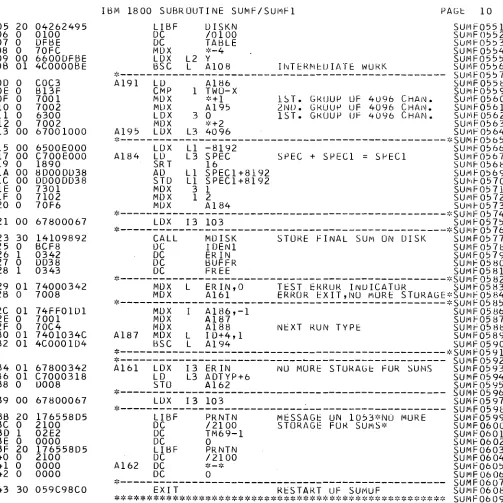
SUMF/SUMFl
TBBL
2. Ol Utility Subroutines
BNDC
Entry points with calling sequences:
CALL BNDC
DC DEST
DC DEST
CALL BNDCX
Subroutines called by BNDC:
BLANK cf. (5)
Core locations used:
160 (AO hexadec. )
Description:
BNDC The double p r e c i s i o n integer number in the accumulator
and Q - r e g i s t e r is converted to p r i n t e r code and moved
to DEST through DEST+4. The positive sign and leading
z e r o e s a r e s u p p r e s s e d .
CDBIN
Entry point with calling sequence:
CALL CDBIN
DC AREA
Subroutines called by CDBIN: MOVE cf. (5)
Core locations used: 184 (B8 hexadec. )
Description:
MFLT
Entry point with calling sequence:
CALL
DC DC
M F L T
AREA
N
Subroutines called by M F L T : none
Core locations used: 78 (4E hexadec. )
Description
MINT
Entry point with calling sequence:
CALL
DC DC
MINT
AREA
N
Subroutines called by MINT: EIFIX cf. (6)
Core locations used: 46 (2E hexadec. )
Description:
MINT The subroutine substitutes the N floating point values
(standard precision) in the field starting at AREA by
their corresponding double p r e c i s i o n integer values.
The floating point values a r e rounded before
conver-sion.
2. 02 Subroutines for Data Handling and Reduction
MTAPE
Entry point with calling sequence:
CALL MTAPE
DC SPADR
DC n' (tape number)
DC ERRSW
Subroutines called by MTAPE:
MAGT
IBM 1800 l i b r a r y
Core locations used:
84 (54 hexadec. )
Description:
TAPEM
Entry point
CALL
DC DC DC DC
with calling sequence
TAPEM
SPADR
ID
n (tape nun
ERRSW
Subroutines called by TAPEM:
MAGT
)PRNTN J IBM 1800 l i b r a r y
PAUSE
'
USER cf. (5)
Core locations used:
158 (9E hexadec. )
Description:
BCDBI
E n t r y point with calling sequence:
CALL BCDBI
DC AREAI
DC AREA2
DC TYPE
Subroutines called by BCDBI: none
Core locations used: 138 (8A hexadec. )
Description:
BCDBI AREAI indicates the s t a r t a d d r e s s of an a r e a of 768 words
length containing BCD digits packed two per word in bit 4-7
and 12-15. The data in AREAI a r e r e g a r d e d as
256 6-digit decimal n u m b e r s when ITYPE = 0 or 1 and as
512 3-digit decimal n u m b e r s when ITYPE = 2.
These data a r e t r a n s f o r m e d to their binary equivalent of
double p r e c i s i o n if ITYPE = 0 or 1 or of single p r e c i s i o n
if ITYPE = 2 and stored in AREA2 through AREA2+511.
The input data should be t e s t e d previously by NTEST for
valid BCD digits and for changing the BCD r e p r e s e n t a t i o n
of z e r o as a binary z e r o (cf. NTEST).
SUMT
Entry point with calling sequence:
CALL
DC
DC
DC
SUMT
SUM
AREA
TYPE
Subroutines called by SUMT: none
Core locations used: 122 (7A hexadec. )
Description:
SUMT The subroutine calculates the sum over all channels of
the data stored in AREA through AREA+8191 and moves
it to SUM and SUM+1 as a double p r e c i s i o n value.
TYPE d e t e r m i n e s the type of s p e c t r u m stored in AREA
through AREA+8191:
TYPE = 0 or 1 . . . . 4 K s p e c t r u m
= 2 8 K
= 3 12 K
= 4 20 K
= 5 24 K
NTEST
Entry point with calling sequence:
CALL
DC
D C
NTEST
AREA
ERRSW
Subroutine called by NTEST: none
Core locations used: 72 (46 hexadec. )
Description:
NTEST Subroutine NTEST t e s t s the a r e a at AREA through
AREA+770 for valid BCD digits. It sets ERRSW = 0
if all digits a r e valid, otherwise ERRSW is set
unequal z e r o . In this case unvalid c h a r a c t e r s a r e r e
-placed by a r b i t r a r y valid BCD digits. F u r t h e r m o r e ,
the BCD value of z e r o which is a hexadecimal A is
replaced by a binary 0.
PACK
Entry point with calling sequence:
CALL
DC
DC
PACK
AREAI
AREA2
S u b r o u t i n e s c a l l e d b y P A C K : n o n e
C o r e l o c a t i o n s u s e d : 60 (3C h e x a d e c . )
D e s c r i p t i o n :
P A C K T h e input a r e a s t a r t i n g at l o c a t i o n A R E A I w i t h a l e n g t h of 768 c o m p u t e r w o r d s i s s u p p o s e d t o c o n t a i n 1536 B C D d i g i t s p a c k e d t w o p e r w o r d . T h e s e d i g i t s a r e t r a n s f o r m e d t o a n e w f o r m a t s t a r t i n g at l o c a t i o n A R E A 2 w i t h a l e n g t h of 512 c o m p u t e r w o r d s , w h e r e t h r e e d i g i t s a r e s t o r e d in one w o r d :
input f o r m a t output f o r m a t
0 1 2 3 4 5 6 7 8 9 0 1 2 3 4 5 0 1 2 3 4 5 6 7 8 9 0 1 2 3 4 5 OOOOxxxxOOOOxxxx OOxxxxOxxxxOxxxx
CDBIM
E n t r y point with calling sequence:
CALL
DC
DC
DC
CDBIM
SPADR
TITLE
END
Subroutines called by CDBIM:
CARDN χ
PRNTNJ IBM 1800 l i b r a r y
PAUSE
'
BLANK
MOVE ) cf. (5)
BNDC
Core locations used:
522 (2AO hexadec. )
Description:
CDBIM Subroutine CDBIM r e a d s a s p e c t r u m from binary c a r d s ,
(for format cf. 2. 05) controls.the sequence of c a r d s and
the completeness of the spectrum,and s t o r e s the title card
in card code in the field TITLE through TITLE+79 and the
s p e c t r u m in the a r e a starting at SPADR. Indicator END is
set unequal z e r o if instead of a s p e c t r u m the card ±END in
column 1-4 has been read. Otherwise END is set to z e r o .
If an e r r o r of the input deck is detected a m e s s a g e is
printed and the p r o g r a m w a i t s . Execution is to be r e
MCDBI
E n t r y point with c a l l i n g s e q u e n c e :
CALL
DC DC DC DC
MCDBI
SPADR
B l B2
TITLE
S u b r o u t i n e s c a l l e d by M C D B I : BINDC
CARDN ) IBM 1800 l i b r a r y
MOVE
CDTST ) cf. (5)
C o r e l o c a t i o n s u s e d : 434 (1B2 h e x a d e c . )
D e s c r i p t i o n :
MCDBI S u b r o u t i n e MCDBI p u n c h e s the s p e c t r u m in S P A D R f r o m b l o c k B l to B2 into c a r d s (for f o r m a t cf. 2. 05). T I T L E i s the s t a r t a d d r e s s of a field of 80 c h a r a c t e r s c o n t a i n i n g an a r b i t r a r y t i t l e of the s p e c t r u m in c a r d c o d e . A b l o c k is a g r o u p of 256 c h a n n e l s .
INTEG
Entry point with calling sequence:
CALL
D C
D C
D C
D C
INTEG
SPADR
Bl
B2
OVFLW
Subroutines called by INTEG:
PRNTN
IBM 1800 l i b r a r y
Core locations used:
176 (BO hexadec. )
Description:
INTEG Subroutine INTEG calculates the integral spectrum between
block Bl and B2 and r e p l a c e s the original spectrum by the
integrated one:
c. =Σ
1j=l
where c. = channel count of channel i
in the original spectrum
c.
ι
channel count of channel' i
in the integrated spectrum
MPRNT
Entry points with calling sequences:
CALL
DC DC DC DC
MPRNT
SPADR
B l B2
TITLE
CALL
DC
DC
DC
DC
MPRN1
SPADR
Bl
B2
TITLE
Subroutines called by MPRNT:
PRNTN
HOLPR
) IBM 1800 l i b r a r y
BLANKx cf. (5)
CHIF
BNDC/BNDCX
Core locations used:
828 (33C hexadec. )
Description:
The subroutine prints a spectrum starting at a d d r e s s
SPADR from block Bl to block B2.
F o r spectra s m a l l e r than 4 K an e r r o r m e s s a g e is
printed if the block n u m b e r s Bl a n d / o r B2 a r e outside
the range of the existing blocks in this s p e c t r u m . Only
the existing blocks of the s p e c t r u m a r e printed.
MPRNT The output format is 16 channels per line with a field length
of 8 positions per channel.
MPRN1 The output format is 8 channels per line with a field length
of 11 positions per channel. This format is used for printing
an integral s p e c t r u m .
OCRDM
Entry point with calling sequence:
CALL
DC
DC
DC
OCRDM
SPADR
TITLE
END
Subroutines called by OCRDM:
CARDN
)PRNTN { IBM 1800 l i b r a r y
PAUSE
'
MOVE cf. (5)
CDBIN
BNDC
Core locations used:
710 (2C6 hexadec. )
Description:
OCRDM The subroutine r e a d s a spectrum from c a r d s (binary or
BCD) which have been punched by an IBM 1401 computer,
the p r e c o u r s e r of the p r e s e n t computer. If instead of a
s p e c t r u m the ±END in column 1-4 has been read, indicator
END is set unequal z e r o , otherwise it is set to z e r o .
The subroutine r e q u i r e s the following input c a r d s :
1. c a r d col. 1-80 Title, will be stored in TITLE through
. TITLE+79 (IBM card code)
2. card col. 1-3 Blank
4-5 Number of blocks, m a y b e g r e a t e r than
16
6 Blank for a s p e c t r u m punched in binary
format, not blank for a s p e c t r u m punched
in BCD format.
3. Data c a r d s in BCD or binary format (cf. 2. 06). In the last
case the c a r d s m u s t be r e a d with 12 edge
face down to prevent a / / b l a n k condition.
The input c a r d s a r e checked for card o r d e r e r r o r s and m i s s i n g
block number card. Each s p e c t r u m is supposed to s t a r t with
block number 1. F o r spectra g r e a t e r than 4 K subroutine
OCRDM has to be called several t i m e s to read the total s p e c t r u m .
With each single call only 4096 channels a r e read and t r a n s
-f e r r e d . In this case title card and block number card m u s t not
be repeated in the input deck.
OCRDl
Entry point with calling sequence:
CALL
DC
DC
DC
DC
OCRDl
SPAD1
SPAD2
TITLE
END
Subroutines called by OCRDl:
CARDN s
PRNTN
τ τ, , ,
l o n n...
PAUSE
I B M1800 l i b r a r y
DCBIN
'
MOVE cf. (5)
BNDC
Core locations used:
586 (24A hexadec.
Description:
OCRDl Subroutine OCRDl r e a d s data from BCD c a r d s containing the
spectra (cf. 2. 07). The spectrum defined by the 3 r i g h t - m o s t
digits of the 6-digit input word is stored in SPAD1, the s p e c
t r u m defined by the 3 left-most digits is SPAD2. SPAD1 gets
the identification words given in the BCD c a r d s (serial number
should be < 98), SPAD2 gets the same identification words
except that the serial number is incremented by 1.
SPSRC
try point
CALL
DC DC DC DC DC DC
: with calling
SPSRC
ID
BUF
TABNR
NRENT
ERRSW
SWITC
sequence
with
IDBUF
TABNR
NRENT
ERRSW
SWITC
BSS BSS DC BSS DC DC DC
E 16 324
1, 2 or 3
12 - 1
±-±
0 or 1
Subroutines called by SPSRC:
Data files used:
DISKN IBM 1800 l i b r a r y
MOVEI cf. (5)
SPTBL ν
OVFTB ( cf. 2. 04
SPTB1
Core locations used:
182 (B6 hexadec. )
Description:
SPSRC Subroutine SPSRC s e a r c h e s identification n u m b e r s in the
disk tables SPTBL, OVFTB or SPTB1 depending on TABNR.
F o r TABNR = 1 a s e a r c h is performed in table SPTBL,
= 2 " OVTBL,
= 3 " S P T B l .
The identification number to be searched is found in the first
5 positions of a field of 16 words starting at ID. The fifth word
contains the group number of 4 K for a 4 K s p e c t r u m or the
number of the first block for a s p e c t r u m s m a l l e r than 4 K
(TABNR = 2).
If no entry for this identification number is found ERRSW
is set to 6.
If one or m o r e e n t r i e s a r e found ERRSW is set to z e r o and
the entry n u m b e r s a r e stored in the a r e a starting at NRENT.
The m a x i m u m number of e n t r i e s is 12 for one identification
number, which is only possible for a s p e c t r u m s m a l l e r than
4 K stored in double precision.
An entry in one of the disk tables SPTBL, OVTBL, or SPTB1
has the following format, a double word being used for each
entry (cf. 2. 04):
P Q R S S N O V where each c h a r a c t e r m e a n s a hexade
cimal digit:
Ρ . . . group number of experiment
Q . . . I
s* experiment number
R . . . 2 experiment number
SS . . s e r i a l number of the s p e c t r u m
Ν . . . group number of 4 Κ for SPTBL
and OVTBL or number of first
block for SPTB1
DISKM
E n t r y point with calling s e q u e n c e :
with
CALL
D C DC DC D C DC
DISKM
SPADR
ERRSW
BUF
ID
SWITC
SPADR
BUF
ID
SWITC
ERRSW
BSS BSS BSS BSS DC DC
E E E
2
82 56
324
5 ■
0 or 1
i - *
Subroutines called by DISKM:
Data files u s e d :
DISKN
IBM 1800 l i b r a r y
MOVE/MOVEI
cf. (5)
SPSRC
E R F I L
SPZNE
OVZNE i cf. ?.. 04
SPZN1 '
)
Core l o c a t i o n s used:
374 (176 h e x a d e c . )
D e s c r i p t i o n :
DISKM
Subroutine DISKM s e r a c h e s the s p e c t r u m identified by the
5 identification n u m b e r s at ID through ID+4 on disk and
s t o r e s it in the a r e a s t a r t i n g at SPADR. ERRSW is an i n
d i c a t o r which i s set to z e r o if the s p e c t r u m h a s been found,
o t h e r w i s e it is set to 6. SWITC i s an input p a r a m e t e r which
c a u s e s the s p e c t r u m to be deleted on disk if it i s 1. F o r
SWITC = 0 the s p e c t r u m is not deleted by the execution of
DISKM. BUF i s the s t a r t a d d r e s s of a field of 324 w o r d s
u s e d a s input buffer. SPADR1 and SPADR2 will be
d e s t r o y e d by DISKM. BUF and SPADR m u s t be even a d d r e s s e s .
B e c a u s e DISKM is u s e d by i n t e r r u p t s and n o n p r o c e s s p r o g r a m s ,
it m a s k s all o u t o f c o r e i n t e r r u p t to m a k e s u r e that the data
files on disk a r e not modified during the execution of DISKM.
E R F I L i s a data file of 1 s e c t o r which contains information
. about the status of execution of DISKM, This information m a y
MDISK
E n t r y point with c a l l i n g s e q u e n c e : with
CALL
DC
DC
DC
DC
MDISK
SPADR
ERRSW
BUF
ADR
S P A D R B U F ADR ERRSW
BSS E 2 BSS E 82 56 BSS E 646 BSS 3
DC ±-±
S u b r o u t i n e s c a l l e d by MDISK:
D a t a files u s e d :
DISKN IBM 1800 l i b r a r y
M O V E / M O V E 1 cf. (5)
E R F I L S P T B L O V F T B O V Z N E S P Z N E S P Z N 1 S P T B 1
cf. DISKM
cf. 2. 04
Core l o c a t i o n s u s e d : 816 (330 h e x a d e c . )
D e s c r i p t i o n :
MDISK S u b r o u t i n e MDISK s t o r e s on d i s k a s p e c t r u m s t a r t i n g at the e v e n a d d r e s s S P A D R . S P A D R m u s t be p r e c e d e d by two w o r d s n e e d e d for the e x e c u t i o n of MDISK. B U F i s the e v e n a d d r e s s of a field of 646 w o r d s u s e d a s buffer for r e a d i n g the d i f f e r e n t t a b l e s . ERRSW i s s e t by t h e s u b r o u t i n e MDISK i n d i c a t i n g the d i f f e r e n t e r r o r c o n d i t i o n s :
ERRSW = 0 S p e c t r u m h a s b e e n s t o r e d .
= 1 No p l a c e for a 4 K s p e c t r u m to be s t o r e d in s i n g l e p r e c i s i o n (table S P T B L ) .
= 2 No p l a c e for a 4 K s p e c t r u m t o be s t o r e d in double p r e c i s i o n (table S P T B L ) .
= 3 No p l a c e for a s p e c t r u m s m a l l e r t h a n 4 K (table S P T B 1 ) .
= 4 No p l a c e for o v e r f l o w c h a n n e l s (table O V F T B ) . = 5 The s a m e i d e n t i f i c a t i o n n u m b e r h a s a l r e a d y b e e n
s t o r e d on d i s k .
The s a m e i d e n t i f i c a t i o n n u m b e r c a n n e v e r be s t o r e d t w i c e .
ADR contains the remaining free e n t r i e s in SPTBL
ADR+1 " ~ i n S P T B l
ADR+2 " in OVFTB
Note: For spectra s m a l l e r than 4 K overflow s e c t o r s a r e
not used. If t h e r e is at l e a s t one overflow channel the t o
-tal spectrum is stored in double p r e c i s i o n .
F L T P E
Entry point with calling sequence:
xONE WORD INTEGERS
DIMENSION ID(5), SPECT(4129), SCAL(24), IDSPC(16)
EQUIVALENCE (SPECT(4097), SCAL(l)), (SPECT(4121), IDSPC(2))
(equivalence card is optional)
CALL F L T P E (ID, SPECT, SCAL, IDSPC, NR;
Subroutines called by F L T P E :
PAUSE
PRNTN
)· IBM 1800 l i b r a r y
MOVE cf. (5)
MFLT
TAPEM
Core locations used:
238 (CE hexadec. )
Description:
st
F L T P E The subroutine s e a r c h e s a spectrum identified by
ID(l) . . . . Group No. of the spectrum
ID(2)
ID(3)
ID(4)
ID(5)
1 experiment No.
2
n(l experiment No.
Serial number of spectrum
Group No. of 4 K
on the magnetic tape with unit number NR and puts the data
in FORTRAN o r d e r and floating point format in S P E C T ( l )
to SPECT(4096), the scaler data in SCAL(l) to SCAL(24)
and the identification n u m b e r s in IDSPC(l) to IDSPC(l6).
If the spectrum cannot be found a m e s s a g e is given and
the p r o g r a m waits. The operator then has the possibility
to change the magnetic tape. By p r e s s i n g START a new
search is t r i e d with the same ID-number.
SPECT and SCAL a r e floating point a r r a y s in STANDARD
PRECISION.
FLDSK
Entry point with calling sequence:
¿ONE WORD INTEGERS
DIMENSION ID(5), SPECT(4129), SCAL(24), IDSPC(l6)
EQUIVALENCE (SPECT(4097), SCAL(l)), (SPECT(4121), IDSPC(2))
(equivalence card is optional)
CALL FLDSK (ID, SPECT, SCAL, IDSPC)
Subroutines called by FLDSK:
PRNTN
EXIT
MOVE
) IBM 1800 l i b r a r y
cf. (5)
MFLT
DISKM
Core locations used:
526 (20E hexadec. )
Description:
FLDSK The subroutine s e a r c h e s the s p e c t r u m identified by ID(l)
to ID(5) (see subroutine F L T P E ) on disk and puts the data
in FORTRAN o r d e r and floating point format in S P E C T ( l )
to SPECT(4096), the scaler data in SCAL(l) to SCAL(24)
and the identification n u m b e r s in IDSPC(l) to IDSPC(l6).
If the spectrum cannot be found a m e s s a g e is printed and
the job is finished.
SPECT and SCAL a r e floating point a r r a y s in STANDARD
PRECISION.
FLMET
Entry point with calling sequence:
*ONE WORD INTEGERS
DIMENSION SPECT(4129), SCAL(24), IDSPC(16)
EQUIVALENCE (SPECT(4097), SCAL(l)), (SPECT(4121), IDSPC(2))
(equivalence card is optional)
CALL F L M E T (SPECT, SCAL, IDSPC, NR.) .
Subroutines called by F L M E T :
PRNTN
PAUSE
MOVE
) IBM 1800 l i b r a r y
cf. (5;
MINT
MTAPE
Core locations used:
152 (98 hexadec. )
Description:
PROC
Entry point with calling sequence:
CALL PROCT CALL PROCI
DC PERC
Subroutine called by PROC: . none
Core locations used: 28 (1C hexadec. )
Description:
PROC Subroutine PROC is called by p r o g r a m SUMOF (cf. 4. 10)
and contains the e r r o r limit for the check of the in-out
ratio (floating point value in standard precision, < 1. ).
n H
PROCI Entry point PROCI is used for transformation of the 2
TAPEI
Entry point with calling sequence:
tape number
CALL
DC
DC
DC
DC
DC
DC
TAPEI
SPADR
GRNR
n
EOF
RNBAD
RNEW
Subroutines called by T A P E l :
PRNTN
MAGT
) IBM 1800 l i b r a r y
CHIF
USER
) cf. (5)
BNDC
PROCI
Core locations used:
232 (E8 hexadec. )
Description:
T A P E l Subroutine T A P E l r e a d s the next following s p e c t r u m with
group number of experiment GRNR from magnetic tape
(unit number n) into the a r e a starting at SPADR. Spectra
with other group n u m b e r s than GRNR a r e automatically
skipped.
RNBAD is the s t a r t a d d r e s s of a table containing in the
first word the number of sequences to be suppressed and
in the following words the s e r i a l n u m b e r s of these sequences.
This is a possibility to s u p p r e s s spectra which for one r e a s o n
or another should not be summed up.
All s p e c t r a t r a n s f e r r e d to the calling p r o g r a m (SUMOF)
a r e given the same s e r i a l number (RNEW).
F u r t h e r m o r e the 2
n dexperiment n u m b e r s a r e changed
according to subroutine PROCI.
SUMF
Entry point with calling sequences:
CALL
DC
SUMF
PERC
CALL
DC
SUMF1
ID
Subroutines called by SUMF:
DISKN
PRNTN
F L D / F S T O
FDIV
FADD/FSUB
FMPY
BIND C
HOLPR
EXIT
IBM 1800 l i b r a r v
MDISK
SUMT
M F L T
DISKM
Data files used:
INSU1
SAVS1
CONS1
Core locations used:
Description:
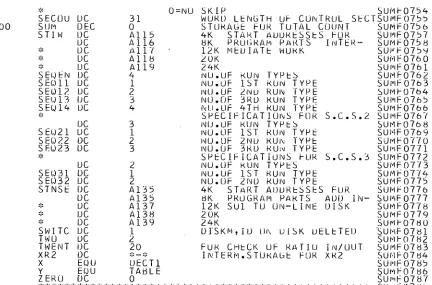
SUMF This subroutine is especially used for data reduction of
t r a n s m i s s i o n e x p e r i m e n t s . Spectra of 4 K or 8 K
chan-nels and for 3 different sample changer sequences can be
p r o c e s s e d (cf. 2. 02, word 13 of identification number):
Sample changer sequence indicator 1:
4 run types ,
sample-in (2 experiment number = 1)
sample-out ( 2
n dexperiment number = 2)
two background runs (2
n(^ experiment number =
3 and 4)
Sample changer sequence indicator 2:
3 run types (sample-in, sample-out, background)
Sample changer sequence indicator 3:
2 run types (sample-in, sample-out)
The s p e c t r a for the d i f f e r e n t r u n t y p e s of the s e l e c t e d s a m p l e c h a n g e r s e q u e n c e i n d i c a t o r a r e s u m m e d up s e p a r a t e l y . In t h i s s u m m a t i o n p r o c e d u r e it is c h e c k e d if the r u n t y p e s follow e a c h o t h e r in a c o r r e c t s e q u e n c e or not. In c a s e of s e q u e n c e e r r o r s the c o r r e s p o n d i n g r u n t;, p e s a r e s u p p r e s s e d . In the s u m m a t i o n p r o c e d u r e it is a l s o c h e c k e d if the r a t i o of t h e t o t a l count of a s a m p l e i n r u n to the t o t a l count of the c o r r e s p o n d i n g s a m p l e -out r u n a g r e e s within a p r e s e t e r r o r l i m i t (ef. P R O C ) with a r e f e r e n c e v a l u e or not. In c a s e of d i s a g r e e m e n t the c o r r e s -ponding r u n t y p e s a r e s u p p r e s s e d . The r e f e r e n c e v a l u e for t h i s c h e c k is c a l c u l a t e d f r o m the f i r s t 20 s e q u e n c e s (which of c o u r s e a r e s u m m e d up without t h i s c h e c k ) .
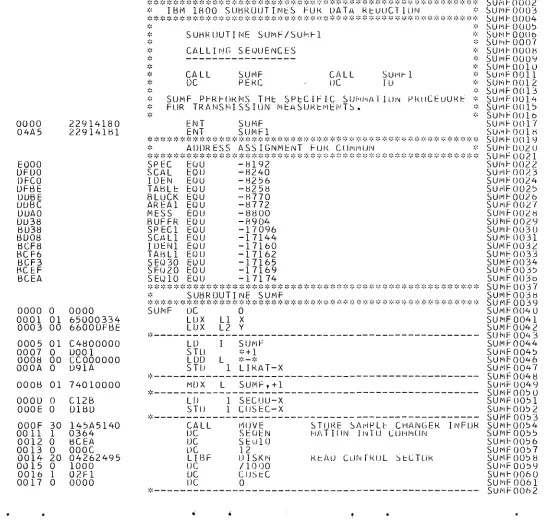
S u b r o u t i n e S U M F a s s u m e s a s p e c t r u m of t r a n s m i s s i o n m e a s u -r e m e n t s in c o -r e l o c a t i o n s 24512 to 32767. P E R C a d d -r e s s e s a floating point n u m b e r in s t a n d a r d p r e c i s i o n specifying the e r -r o -r l i m i t fo-r the c h e c k of the i n - o u t - -r a t i o (0 < -r < l ) . The d a t a file INSU1 h a s a l e n g t h of 104 s e c t o r s ( s t o r a g e for four 4 K s p e c t r a in double p r e c i s i o n o r four 8 K s p e c t r a in s i n g l e p r e c i s i o n ) . INSU1 is u s e d for s t o r a g e of s p e c t r a for one c o m -p l e t e s a m -p l e c h a n g e r s e q u e n c e . Data file SAVS1 is u s e d for i n t e r m e d i a t e s t o r a g e of one s p e c t r u m in double p r e c i s i o n (26 s e c t o r s ) .
Data file CONS 1 (l s e c t o r ) c o n t a i n s c o n t r o l i n f o r m a t i o n w h i c h allow the u s e r to p e r f o r m the s u m m a t i o n in s e v e r a l j o b s . The r e s u l t s p e c t r a of the s u m m i n g p r o c e d u r e a r e s t o r e d by s u b r o u t i n e MDISK i s i n g the d a t a f i l e s d e s c r i b e d in 2. 04.
E X P A N
E n t r y point w i t h c a l l i n g s e q u e n c e :
C A L L E X P A N with DC A
DC Β Β
DC I D I DC ID2 BSS 7
S u b r o u t i n e s c a l l e d by E X P A N : none
C o r e l o c a t i o n s u s e d : 46 (2E h e x a d e c . )
D e s c r i p t i o n :
E X P A N S u b r o u t i n e E X P A N e x p a n d s t h e p a c k e d i d e n t i f i c a t i o n n u m b e r (2. 04) in IDI and ID2 into 7 c o m p u t e r w o r d s
T B B L
E n t r y point with c a l l i n g s e q u e n c e :
CALL
DC DC
TBBL
I N
S u b r o u t i n e s c a l l e d by T B B L : none
C o r e l o c a t i o n s u s e d : 40 (28 h e x a d e c . )
De sc r i p t i o n :
T B B L S u b r o u t i n e T B B L d e t e r m i n e s the n u m b e r of e n t r i e s in t a b l e S P T B L if I = 1
4. Description of the P r o g r a m s for Data Handling and Reduction
4. 01 T a p e - M a p - P r o g r a m for Multi-Channel Analyser Data (TMAPG)
Control
1. card
2. card
3. card
4. card
5. card
I/O Devi
Card F o r m a t :
col.
col.
col.
col.
col.
c e s
1- 2
3
11-15
17-21
71-80
1- 2
3
11-15
1
2
5
7
1-80
1-80
Jbfc
Input tape unit number (0, 1,2, or 3)
Label of 1
s tinput tape
Label of 2
n dinput tape
etc. (max. 10 r e e l s )
Blank
Hxk
Output tape unit number (0, 1,2, or 3)
Label of output tape
±
F i r s t experiment number of s p e c t r a to be
t r e a t e d by p r o g r a m SUMOF (cf. 4. J 0), or
blank otherwise.
Automatic type of these s p e c t r a (cf. 2. 02)
or blank if col. 2 is blank.
Sample changer sequence indicator for these
s p e c t r a or blank if col. 2 is blank.
Title for first input tape, will be headed on
the listing.
Title for second input tape, etc.
1. Two magnetic tape units (one at l e a s t 'with 7 t r a c k s )
2. 1443 p r i n t e r
3. 1442 card read-punch
Subroutines called by TMAPG:
PRNTN
CARDN
PAUSE
HOLPR
M A G T
EXIT
PAGE/BLANK χ
CHIF j
USER {
MOVE
'
NTEST
SUMT
M T A P E j cf. (3)
BNDC
PACK
BCDBI
IBM 1800 library
Halts and E r r o r M e s s a g e s :
1. END OF F I L E . . MOUNT TAPE XXXX. START
2. ERROR CONTROL CARD. START AGAIN.
C o r r e c t the card and start again reading all c a r d s .
3. TAPE ERROR IN BLOCK XX.
4. BLOCK XX TOO SHORT.
5. BLOCK XX TOO LONG.
6. OUTPUT TAPE NOT READY.
7. ERROR IN BLOCK NUMBERS.
8. INVALID NUMBERS IN BLOCK XX.
9. END OF FILE.
Description of TMAPG:
P r o g r a m TMAPG checks the tapes with multi-channel analyser data
which have been collected in off-line operation. The p r o g r a m s t a r t s
by reading the input c a r d s defining the tape unit n u m b e r s for input
and output tapes (0, 1, 2, or 3) and specifying the n e c e s s a r y p a r a
-m e t e r s for s p e c t r a which a r e to be t r e a t e d with p r o g r a -m SUMOF.
Then it r e a d s the input tape (for format cf. 2. Ol) and checks for
tape e r r o r s (parity check), for c o r r e c t r e c o r d length, c o r r e c t
block numbering and for valid BCD digits. If e r r o r s a r e detected
a m e s s a g e is printed and an automatic c o r r e c t i o n i s performed.
All data which a r e not to be t r e a t e d by p r o g r a m SUMOF a r e t r a n s
formed to binary double p r e c i s i o n v a l u e s . Data which a r e to be t r e a
-ted by p r o g r a m SUMOF a r e t r a n s f o r m e d to binary or packed BCD
format depending on the specification for the automatic type. These
spectra receive new s e r i a l n u m b e r s starting with 1 in o r d e r to
avoid equal identification n u m b e r s on the output tape.
Data collected in on-line operation of the multi-channel a n a l y s e r s
contain some additional information such as the group number of
the experiment and the s c a l e r data. F o r compatibility with these
on-line collected data the group n u m b e r of the experiment i s
simulated by repeating the 1 experiment number. Scaler data
are also simulated (zeroes) except for the second s c a l e r which
contains the calculated total count of the spectrum, if the o r i
-ginal s p e c t r u m has no e r r o r s , otherwise the second s c a l e r is
set to - 1 .
The spectra a r e stored in core storage in " m e m o r y format" and then
written on a 9-track magnetic tape. A listing of all identification
num-b e r s and e r r o r m e s s a g e s is printed.
The n u m b e r of input tapes is determined by the number of labels on
control card 1 (max. 10). A blank label is not p e r m i t t e d . Each r e e l
may contain only one file of data (one end-of-file m a r k ) .
4. 02 Tape S e a r c h P r o g r a m (SEART)
Control Card F o r m a t
1. c a r d
2. c a r d
col.
c o l .
12
3
12
3
xx·
c a r d ( s p e c t r u m card)
col. 1
3
Input tape unit n u m b e r (0, 1, 2 or 3)
x*
Output tape unit n u m b e r (0, 1, 2, or
or blank if no output tape is u s e d .
3)
10
12
11·
13
1415
1617
1922
2324
26-29±
L
L i s t of data to be p r i n t e d .
blank No l i s t of data to be p r i n t e d .
C
B i n a r y c a r d s to be punched (blank
c a r d s m u s t follow t h i s c a r d ) .
blank No b i n a r y c a r d s to be punched.
Τ
The s p e c t r u m i s w r i t t e n on the output
t a p e .
blank No tape copy is p e r f o r m e d .
I
The i n t e g e g r a l s p e c t r u m is p r i n t e d .
blank No i n t e g r a t i o n is p e r f o r m e d .
blank The s p e c t r u m is t r e a t e d a s a single
s p e c t r u m .
+ or T h e s p e c t r u m i s added or s u b t r a c t e d
from a sum s p e c t r u m which i s z e r o
at the beginning of SÈART.
±
No s p e c t r u m . i s s e a r c h e d on tape but
the sum a r e a r e c e i v e s the identifica
tion n u m b e r given in col. 1117 and
i s handled a s specified in col. 3 9 .
After execution the sum a r e a i s set
to z e r o .
Group n u m b e r of s p e c t r u m
. (period)
1
s te x p e r i m e n t n u m b e r
2
n" e x p e r i m e n t n u m b e r
S e r i a l n u m b e r
F i r s t block of the s p e c t r u m
N u m b e r of blocks
■ New identification n u m b e r to be w r i t t e n
on the tape copy or punched into the b i n a r y
c a r d s . 4 positions a r e p r o v i d e d b e c a u s e
only the 1
and 2
n ae x p e r i m e n t n u m b e r s
and the s e r i a l n u m b e r m a y be changed* If
blank the identification n u m b e r will not be
changed.
3172
R e m a r k s , will be headed on the output
l i s t i n g and punched a s title into the b i n a r y
c a r d s .
F o r each s p e c t r u m a c a r d No. 3 i s n e c e s s a r y .
l / O Devices:
1. One or two magnetic tape units
2. 1443 p r i n t e r
3. 1442 card read-punch
Subroutines called_by SEART: PRNTN
C A R D NPAUSE
HOLPR
MAGT
EXIT
HOLEB
BLANK
MOVE
CDTST
)IBM 1800 l i b r a r y
cf. (5)
INTEG
TAPEM
M P R N T / M P R N I
MCDBI
MTAPE
cf. 3.
Halts and E r r o r M e s s a g e s :
1. ERROR INPUT CARD. CORRECT AND START WITH THIS CARD.
If t h e r e is an e r r o r in the tape c a r d s (card 1 and 2) these c a r d s
m u s t be r e a d again; if t h e r e is an e r r o r in a spectrum card the
p r o g r a m has to be r e s t a r t e d with this card.
2. SPECTRUM NOT FOUND ON INPUT TAPE. Then m e s s a g e 1 is
printed.
3. OUTPUT TAPE NOT READY. CORRECT AND PRESS START.
4. INTEGRAL SPECTRUM and
INTEGRAL SPECTRUM - OVERFLOW IS ON.
5. INPUT TAPE ERROR.
This m e s s a g e o c c u r s when the input tape does not correspond
to the 9 - t r a c k tape format described in 2. 03.
6. LAST BLOCK NUMBER SMALLER THAN FIRST ONE FOR
SPECTRUM XX. XXXX. Then m e s s a g e 1 is printed.
7. ID-NUMBER XX. XXXX HAS BEEN CHANGED TO XX. XXXX.
8. FIRST AND LAST BLOCK NUMBER DO NOT BELONG TO THE
SAME GROUP OF 4 K. This m e s s a g e o c c u r s only if the + - ±
option is used.
9. BLANK CARDS NEEDED.
10. LOWER BLOCK NUMBER HAS BEEN CORRECTED.
11. U P P E R BLOCK NUMBER HAS BEEN CORRECTED.
12. END PROGRAM SEART.
Description of SEART:
P r o g r a m SEART s e r v e s as an output p r o g r a m for data stored on
magnetic tape. Tape copy, listing, integral listing, binary c a r d s
of single spectra or of sums or differences of two or m o r e spectra
can be performed. The p r o g r a m r e a d s and checks the first two
control c a r d s containing the tape specifications. Then it r e a d s a s p e c
functions defined in col. 3-10. If the sum or difference of single
spectra a r e to be calculated only groups of 4 K can be handled.
If the integral s p e c t r u m is to be calculated and the spectrum is
g r e a t e r than 4 K each group of 4 K is t r e a t e d separately in o r d e r
to avoid an overflow condition.
03 C a l c o m p P l o t t i n g of M u l t i - C h a n n e l A n a l y s e r D a t a S t o r e d on T a p e (ANALT)
C o n t r o l C a r d F o r m a t : 1.
2.
3. c a r d
c a r d
c a r d
c o l . 1-2 3 c o l . 1-2
3
( s p e c t r u m c a r d ) c o l . 11-12
13 14 15 16-17 19-22 2 3 - 2 4 3 1 - 4 0
4 1 - 5 0
5 1 - 6 0
F o r e a c h s p e c t r u m a c a r d 4. L a s t c a r d
col. 1
±±
Input t a p e unit n u m b e r (0, 1, 2, o r 3) xx·
Output t a p e u n i t n u m b e r for C a l o m p (0, 1, 2, o r 3). C a r d 2 i s not u s e d for d i r e c t o n - l i n e o p e r a t i o n of the C a l c o m p (cf. (6)).
G r o u p n u m b e r of e x p e r i m e n t . ( p e r i o d )
Is*· e x p e r i m e n t n u m b e r
2nc* e x p e r i m e n t n u m b e r
S e r i a l n u m b e r
N u m b e r of f i r s t b l o c k N u m b e r of b l o c k s
L e n g t h of x - a x i s (floating point v a l u e ) in c m , if blank t h e p r o g r a m a s s u m e s 100 c m . L e n g t h of y - a x i s (floating point v a l u e ) i n c m , if blank t h e p r o g r a m a s s u m e s 2 5 c m . M a x i m u m count (floating point v a l u e ) . All c o u n t s g r e a t e r t h a n the m a x i m u m count a r e r e p l a c e d by t h i s l i m i t . If b l a n k the p r o g r a m
a s s u m e s 1 0¿ .
3 i s n e c e s s a r y .
1
I / O D e v i c e s :
1. Two m a g n e t i c t a p e u n i t s (one for a n a l y s e r d a t a , one for C a l c o m p d a t a )
2. C a l c o m p p l o t t e r 3. 1443 p r i n t e r
4. 1442 c a r d r e a d - p u n c h
S u b r o u t i n e s c a l l e d by A N A L T : S u b r o u t i n e s of the I B M 1800 l i b r a r y
F I N I M /F I N T R
D E S N F ) cf. (6)
S Y M B L
NUMBR )