Munich Personal RePEc Archive
Financial repression redux
Reinhart, Carmen and Kirkegaard, Jacob and Sbrancia,
Belen
Peterson Institute for International Economics
June 2011
Online at
https://mpra.ub.uni-muenchen.de/31641/
First draft: April 26, 2011 This draft: May 25, 2011 Revised version in:
Finance and Development, Vol. 48 No.2, June 2011
Financial Repression Redux1
Carmen M. Reinhart
Peterson Institute for International Economics, CEPR, and NBER
Jacob Kirkegaard
Peterson Institute for International Economics
M. Belen Sbrancia
University of Maryland
Periods of high indebtedness have historically been associated with a rising
incidence of default or restructuring of public and private debts. Sometimes the debt
restructuring is subtle and takes the form of “financial repression.” In the heavily
regulated financial markets of the Bretton Woods system, a variety of restrictions
facilitated a sharp and rapid reduction in public debt/GDP ratios from the late 1940s to
the 1970s. We document the resurgence of financial repression in the wake of the
2007-2009 financial crises and the accompanying surge in public debts in advanced
economies.
1
In light of the record or near-record levels of public and private debt, deficit/debt
reduction strategies are likely to remain at the forefront of policy discussions in most of
the advanced economies for the foreseeable future. 2 Throughout history, debt/GDP ratios
have been reduced by (i) economic growth; (ii) a substantive fiscal adjustment/austerity
plans; (iii) explicit default or restructuring of private and/or public debt; (iv) a sudden
surprise burst in inflation; and (v) a steady dosage of financial repression that is
accompanied by an equally steady dosage of inflation. (Financial repression is defined in
Box 1) It is critical to clarify that options (iv) and (v) are only viable for
domestic-currency debts (the euro area is a special hybrid case). Since these debt-reduction
channels are not necessarily mutually exclusive, historical episodes of debt reduction
have owed to a combination of more than one of these channels.
Financial repression is most successful in liquidating debts when accompanied by
a steady dose of inflation. Low nominal interest rates help reduce debt servicing costs
while a high incidence of negative real interest rates liquidates or erodes the real value of
government debt. Inflation need not take market participants entirely by surprise and, in
effect, it need not be very high (by historic standards).
2
Box 1. Financial repression defined
Financial repression includes directed lending to the government by
captive domestic audiences (such as pension funds or domestic banks), explicit
or implicit caps on interest rates, regulation of cross-border capital movements,
and (generally) a tighter connection between government and banks, either
explicitly through public ownership of some of the banks or through heavy
“moral suasion”. Financial repression is also sometimes associated with
relatively high reserve requirements (or liquidity requirements), securities
transaction taxes, prohibition of gold purchases (as in the US from 1933 to
1974), or the placement of significant amounts of government debt that is
nonmarketable.
In the current policy discussion, financial repression issues come under
We suggest that the combination of high public and private debts in the advanced
economies (and the attendant pressures towards creating captive audiences for
government debt) and the perceived dangers of currency misalignments and
overvaluation in emerging markets facing surges in capital inflows (and, thus, the
pressures towards currency intervention and capital controls) interact to produce a “home
bias” in finance and a resurgence of financial repression. It is not called financial
repression but unfolds in the context of “macroprudential regulation.”
Succinctly, while emerging markets may increasingly look to financial regulatory
measures to keep international capital “out” (especially as the expansive monetary policy
stance of the US and others persists), advanced economies have incentives to keep capital
“in” and create a domestic captive audience to facilitate the financing for the high
existing levels of public debt. Concerned about potential overheating, rising inflationary
pressures and the related competitiveness issues, emerging market economies are altering
the regulatory frameworks that deter cross-border financial flows in their eternal quest for
higher yields. This offers advanced and emerging market economies the common ground
of agreeing to increased regulation and/or restrictions on international financial flows
and, more broadly, the return to more tightly regulated domestic financial environment—
often referred to as “financial repression.”
II. Negative real interest rates during 1945-1980 and again post-2008
One of the main goals of financial repression is to keep nominal interest rates
lower than would otherwise prevail. This effect, other things equal, reduces the
reduction. However, when financial repression produces negative real interest rates and
reduces or liquidates existing debts, it is a transfer from creditors (savers) to borrowers
(in the historical episode documented in Reinhart and Sbrancia, 2011 and summarized
here--the government).
The financial repression tax has some interesting political-economy properties.
Unlike income, consumption, or sales taxes, the “repression” tax rate (or rates) are
determined by financial regulations and inflation performance that are opaque to the
highly politicized realm of fiscal measures. Given that deficit reduction usually involves
highly unpopular expenditure reductions and (or) tax increases of one form or another,
the relatively “stealthier” financial repression tax may be a more politically palatable
alternative to authorities faced with the need to reduce outstanding debts.
Liberal capital-market regulations and international capital mobility reached their
heyday prior to World War I under the gold standard. However, the Great Depression,
followed by World War II, put the final nails in the coffin of laissez-faire banking. It was
in this environment that the Bretton Woods arrangement of fixed exchange rates and
tightly controlled domestic and international capital markets was conceived. The result
was a combination of very low nominal interest rates and inflationary spurts of varying
degrees across the advanced economies. 3 The obvious results were real interest
rates--whether on treasury bills (Figure 1), central bank discount rates, deposits or loans—that
were markedly negative during 1945-1946.
3
The advanced economy aggregate is comprised of: Australia, Belgium, Canada, Finland, France,
For the next 35 years or so, real interest rates in both advanced and emerging
economies would remain consistently lower than the eras of freer capital mobility before
and after the financial repression era. In effect, real interest rates were, on average
negative. Binding interest rate ceilings on deposits (which kept real ex-post deposit rates
even more negative than real ex-post rates on treasury bills) “induced” domestic savers to
hold government bonds. What delayed the emergence of leakages in the search for
higher yields (apart from prevailing capital controls) was that the incidence of negative
returns on government bonds and on deposits was (more or less) a universal phenomenon
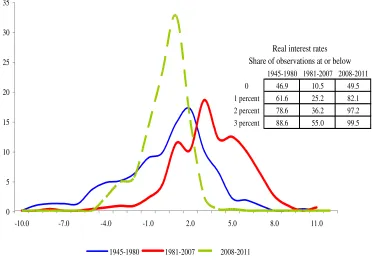
at this time. The frequency distributions of real rates for the period of financial
repression (1945-1980) and the years following financial liberalization shown in Figure
1, highlights the universality of lower real interest rates prior to the 1980s and the high
incidence of negative real interest rates.
A striking feature of Figure 1, however, is that real ex-post interest rates (shown
for treasury bills) for the advanced economies have, once again, turned increasingly
negative since the outbreak of the crisis. Real rates have been negative for about one half
of the observations and below one percent for about 82 percent of the observations. This
turn to lower real interest rates has materialized despite the fact that several sovereigns
have bee teetering on the verge of default or restructuring (with the attendant higher risk
premia). Real ex-post central bank discount rates and bank deposit rates (not shown
here) have also become markedly lower since 2007.
No doubt, a critical factor explaining the high incidence of negative real interest
(and more broadly, official central bank intervention) in many advanced and emerging
economies during this period. This raises the broad question of to what extent current
interest rates reflect market conditions versus the stance of official large players in
financial markets. A large role for non-market forces in interest rate determination is a
[image:8.612.111.486.273.547.2]key feature of financial repression.
Figure 1: Real Interest Rates Frequency Distributions: Advanced Economies, 1945-2011
Treasury bill rates
1945-1980 1981-2007 2008-2011 0 46.9 10.5 49.5 1 percent 61.6 25.2 82.1 2 percent 78.6 36.2 97.2 3 percent 88.6 55.0 99.5
Real interest rates Share of observations at or below
0 5 10 15 20 25 30 35
-10.0 -7.0 -4.0 -1.0 2.0 5.0 8.0 11.0
1945-1980 1981-2007 2008-2011
Sources: Reinhart and Sbrancia (2011), International Financial Statistics, International Monetary Fund, various sources listed in the Data Appendix, and authors’ calculations.
In the US treasury market, the rising role of official players (or conversely the
shrinking role of “outside market players”) is made plain in Figure 2, which shows the
evolution of the s Share of “Outside” Marketable U.S. Treasury Securities plus
Government Sponsored Enterprises (GSEs) securities from 1945 through 2010.4 The
combination of QE, QE2 and, more importantly, record purchases of US Treasuries (and
near Treasuries-the GSEs) by foreign central banks (notably China, but also emerging
Asia and other BRICs) has left the share of outside marketable treasury securities at
nearly 50 percent and when GSE are included below 65 percent. There are the lowest
shares since the expansive monetary policy stance of the US regularly associated with
break down of the Bretton Woods in the early 1970s. This was also a period (like the
present) of rising oil, gold, and commodity prices, negative real interest rates, currency
turmoil, and eventually higher inflation.
Figure 3, which shows the share of UK General Government gross debt held by
the Bank of England (and domestic banks) from 1998 until end-2010, presents the
complementary image to Figure 2 for the US market. The Bank of England’s
quantitative easing policies since the crisis, coupled the requirement (since October 2009)
that bank hold a higher share of gilts in their portfolios to satisfy tougher liquidity
standards have reduced the share of “outside” gilts to about 70 percent. If foreign official
holdings (by central banks) were included in this calculus the share of outside gilts would
be considerably lower and closer to that of the US treasury market.
4
Figure 2. Share of “Outside” Marketable U.S. Treasury Securities plus Government Sponsored Enterprises (GSEs) Securities: End-of-period, 1945-2010
45 55 65 75 85 95
1945 1950 1955 1960 1965 1970 1975 1980 1985 1990 1995 2000 2005 2010 Share of "Outside"
Treasury Securities
Share of "Outside" Treasury Securities plus GSEs
Sources: Flow of Funds, Board of Governors of the Federal Reserve and authors’ calculations.
Figure 3. Share of UK General Government Gross Debt Held by the Bank of England and Domestic Banks: End-of-period, 1998-2010
0 5 10 15 20 25 30
1998 1999 2000 2001 2002 2003 2004 2005 2006 2007 2008 2009 2010 Bank of
England Bank of England plus
domestic banks
Sources: Bankof England, Kirkegaard and Reinhart (2011) for individual country sources, International Monetary Fund, World Economic Outlook.
Holdings of both general government loans and securities. Totals do not include government debt holdings by pension funds.
The European Central Bank (ECB) bond purchases of the three troubled
sovereigns totaled about €76 billion over May 2010-March 2011 and account for about
12 percent of the combined general government debts of Greece, Ireland, and Portugal.
To summarize, central banks on both sides of the Atlantic (and the Pacific, for
that matter) have become even bigger players in purchases of government debt, possibly
for the indefinite future. For the United States, fear of currency appreciation continues to
drive central banks in many emerging markets to purchase U.S. government bonds on a
large scale. In other words, markets for government bonds are increasingly populated by
relatively to their underlying risk profile—a common feature of financially repressed
systems.
III. The liquidation of government debt: The historical precedent, 1945-1980
In this section, we summarize Reinhart and Sbrancia, 2011 (RS, henceforth) , who
document how financial repression liquidated mountains of public debts in the advanced
economies following World War II by quantifying the “liquidation effect” a key
component of the broader financial repression tax on savings. We then move on to
document the forms financial repression is taking on in the modern context and speculate
about future developments.
Calculating the financial repression tax: concepts and results
A summary measure of the reduction in government debt (relative to income)
wrought by financial repression dubbed the “liquidation effect” is developed. No doubt,
the devil lies in the details, as the structure of government debt varies enormously across
countries and within countries over time. Differences in coupon rates, maturity and the
distribution of marketable and nonmarketable debt, securitized debt versus loans from
financial institutions, importantly shape the overall cost of debt financing for the
government. The starting point to come up with a measure that reflects the true cost of
debt financing is a reconstruction of the government’s debt profile over time.
The debt portfolio. The first step is to construct a “synthetic portfolio” for the
actual shares of debts across the different spectrum of maturities as well as the shares of
marketable versus nonmarketable debt.
Interest rate on the portfolio. The “aggregate” nominal interest rate for a
particular year is the coupon rate on a particular type of debt instrument weighted by that
instrument’s share in the total stock of debt. RS then aggregate across all debt
instruments. The real rate of interest,
t t t t
i r
π π
+ − = −
1
1
(where i and are the nominal interest and inflation rates, respectively) is calculated on
an ex-post basis using CPI inflation for the corresponding one-year period. It is a
before-tax real rate of return (excluding capital gains or losses).
A definition of debt “liquidation years.” Benchmark calculations define a
liquidation year, as one in which the real rate of interest (as defined above) is negative
(below zero). This is a conservative definition of liquidation year; a more comprehensive
definition would include periods where the real interest rate on government debt was
below a “market” real rate.
Savings to the government during liquidation years. This concept captures the
savings to the government from having a negative real interest rate on government debt.
(As noted it is a lower bound on saving of interest costs, if the benchmark used assumed,
for example a positive real rate of, say, two or three percent.) These savings can be
thought of as having “a revenue-equivalent” for the government, which like regular
budgetary revenues can be expressed as a share of GDP or as a share of recorded tax
revenues to provide standard measures of the “liquidation effect” across countries and
real (negative) interest rate times the “tax base,” which is the stock of domestic
government debt outstanding.
Results
Reinhart and Sbrancia (2011) document the high incidence of “liquidation years”
(which even by conservative estimates amount to at least ¼ of the years for the United
States and considerably more for other countries). We now present estimates of the
magnitude of the savings to the government (financial repression tax or liquidation
effect). These estimates take “the tax rate” (the negative real interest rate) and multiplies
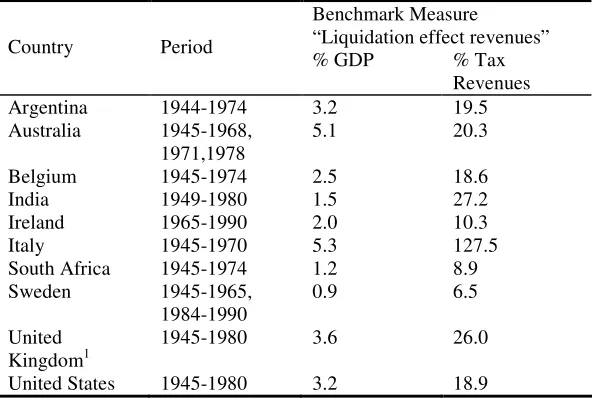
it by the “tax base” or the stock of debt. Table 1 reports these estimates for each
country. The magnitudes are in all cases non-trivial.
For the United States and the United Kingdom, the annual liquidation of debt via
negative real interest rates amounted on average from 3 to 4 percent of GDP a year.
Annual deficit reduction of 3 to 4 percent of GDP quickly accumulates (even without any
compounding) in the course of a decade. For Australia and Italy, which recorded higher
inflation rates, the liquidation effect was larger (around 5 percent per annum). These
estimates (which are arrived at under a conservative algorithm) highlight the significant
Table 1: Government Revenues from the “Liquidation Effect” per year
Benchmark Measure “Liquidation effect revenues” Country Period
% GDP % Tax Revenues Argentina 1944-1974 3.2 19.5 Australia 1945-1968,
1971,1978
5.1 20.3
Belgium 1945-1974 2.5 18.6 India 1949-1980 1.5 27.2 Ireland 1965-1990 2.0 10.3 Italy 1945-1970 5.3 127.5 South Africa 1945-1974 1.2 8.9 Sweden 1945-1965,
1984-1990
0.9 6.5
United Kingdom1
1945-1980 3.6 26.0
United States 1945-1980 3.2 18.9 Source: Reinhart and Sbrancia (2011)
IV. “Modern” Financial Repression: 2008-2011
One thing advanced economies do not lack at present is an abundance of
government debt, which is accompanied with the attendant common policy challenge of
finding prospective buyers for such debt. The role of massive purchases of government
debt by central banks around the world in keeping nominal and real interest rates low was
already noted in Section II. In addition, Basle III provides for the preferential treatment
of government debt in bank balance sheets via substantial differentiation (in favor of
government debt) in capital requirements.
Other approaches to creating or expanding demand for government debt may be
more direct. For example, at the height of the financial crisis UK banks were required to
hold a larger share of gilts in their portfolio (see Table 2). Figure 4 documents how
Greek, Irish, and Portuguese banks have already liquidated a substantial fraction of their
foreign assets and swapped into domestic public debt. 5 Thus, the process where debts are
5
being “placed” at below market interest rates in pension funds and other more captive
domestic financial institutions is already under way in several countries in Europe. Spain
[image:16.612.143.549.208.447.2]has recently reintroduced a de facto form of interest rate ceilings on bank deposits. 6,7
Figure 4. Domestic Bank Holdings of General Government Debt: Greece, Ireland, Portugal, and UK, 2008-2010, end-of-period (as a percent of gross general government debt) 4 6 8 10 12 14 16 18 20 22 24 26 28 30
2008 2009 2010
Greece Ireland
Portugal
UK
Sources: See Kirkegaard and Reinhart (2011) for individual country sources, International Monetary Fund,
World Economic Outlook.
Notes: Holdings of both general government loans and securities. Totals do not include European Central Bank (ECB) bond purchases of the three troubled sovereigns. These purchases totaling about €76 billion over May 2010-March 2011, account for about 12 percent of the combined general government debts of Greece, Ireland, and Portugal. Does not include government debt holdings by pension funds.
Supra-national pressure from the ECB on peripheral banks to scale back this practice (and thus limit domestic financial repression) was instrumental in pushing the governments of both Ireland and Portugal to request international bail-outs. See also the discussion in the IMF’s April 2011 Global Financial Stability Report.
6
See Table 2.
7
The use of capital controls for emerging markets concerned about destabilizing
“hot money” inflows, potential overheating, rising inflationary pressures, and the related
competitiveness issues have found far greater acceptance in the international community
than at any time since the breakdown of the Bretton Woods system of fixed exchange
rates. Many emerging markets have already embarked on various policies with that aim
(Table 2).
V. Implications and Conjecture
As noted, financial repression contributed to rapid debt reduction following
World War II. At present, the levels of public debt in many advanced economies are at
their highest levels since that time; some of these governments face the prospect of debt
restructuring. Furthermore, public and private external debts (which are a relatively
volatile source of funding) are at historic highs. It seems probable that policymakers for
some time to come will be preoccupied with debt reduction, debt management, and, in
general, efforts to keep debt servicing costs manageable. In this setting, financial
repression (with its dual aims of keeping interest rates low and creating or maintaining
captive domestic audiences) will probably find renewed favor and the measures and
developments we have described and discussed in this note are likely to be only the tip
of a very large iceberg.
References
Kirkegaard, Jacob F. and Carmen M Reinhart (2011) “The Return of Financial Repression in the Aftermath of the Great Recession”. Forthcoming Peterson Institute Working Paper.
Reinhart, Carmen M. and M. Belen Sbrancia, “The Liquidation of Government Debt,” NBER Working Paper 16893, March 2011.
Reinhart, Carmen M. and Kenneth S. Rogoff, “From Financial Crash to Debt Crisis,” (with Kenneth S. Rogoff), NBER Working Paper 15795, March 2010. Forthcoming in
Table 2. The Re-emergence of Financial Repression, 2008-2011
The Advanced Economies (mostly directing domestic credit to the government)
France, December 2010: Liquidation of Fonds de Reserve Pour Les Retraites (FFR) The French government changed the law to shift the €37bn FFR from providing long-term financial support to the French PAYG pension system after 2020 to instead pay an annual €2.1bn to the Caisse d’Amortissement de la Dette Sociale (CADES) from 2011 to 2024 and at that point transfer all remaining assets to the CADES in one lump-sum payment. This shift in FFR’s investment horizon has meant a radical shift in asset allocation from longer-term diversified riskier assets to a short-term LDI-strategy dominated by liability matching short-term French government bonds. For the duration of its lifespan the FRR has consequently been transformed into a large captive buyer of French government bonds.
Ireland, 2010: Use of the National Pension Reserve Fund to Recapitalize Banks As a result of the banking crisis, Ireland National Pension Reserve Fund (NPRF) may have to contribute up to €17.5bn to recapitalize Ireland’s banks. The NPRF was originally set up in 2001 to help finance the long-term costs of Ireland's social welfare and public service pensions from 2025 onwards. However, a 2010 law directed the NPRF to invest in Irish government securities and provides the legal authority for the Irish government to fund capital expenditure from the NPRF from 2011-2013.
April 2011: Levy on pension funds. The Irish government has further recently suggested to fund job creation schemes through a special 0.5% levy on private pension funds.
Japan, March 2010: Reversal of Post Privatization and Raising of Deposit Ceiling The new DPJ government reversed the 2007 plan to privatize Japan Post, the world’s largest financial conglomerate with more than ¥300tr in assets. Crucially, the DPJ government with the new law also doubled the deposit cap at Japan Post Bank to ¥20mn and raised the life insurance coverage limit at Japan Post Insurance Co. from ¥13mn to ¥25mn. Given Japan Post’s traditional roughly 75 percent asset allocation to JGBs, and under the assumption that consumers will transfer deposits to a company certain to enjoy a government guarantee, the reversal of the Japan Post privatization provides additional incentives to a captive customer of Japanese government debt.
Portugal, 2010: The transfer of the previously privatized Portugal Telecom pension scheme back to the Portuguese government, which in the process immediately booked €2.8bn (1.6% of GDP) in extra revenues. This enabled the Portuguese government to improve its budget deficit in 2010 sufficiently to cosmetically appear to be in line with annual EU deficit reduction targets.
Spain, April 2010: Interest rate ceilings on deposits. The Ministry of Finance (MoF) requires that institutions offering deposit interest rates that are considered to be above market rates (determined by MoF) double their contributions to the Fondo de Garantía de Depósitos.
UK, October 2009, UK Financial Services Authority (FSA) puts a global regulatory liquidity marker.
The proposal by the FSA requires UK banks, investment banks, and subsidiaries or branches of foreign banks operating in the London market to hold more high quality government securities—at least around
110 billion more (at that time), and cut their reliance on short-term funding by 20 percent in the first year alone.
2011?Royal Mail privatization, which will see an expected £23.5bn in assets transferred to the UK treasury ahead of privatization (as well as an expected £29.5bn in liabilities).
Table 2. The Re-emergence of Financial Repression, 2008-2011 (continued)
The Emerging Markets (mostly controls on capital inflows)
Brazil, March, 2008: IOF tax (Tobin-type tax on entry) of 1.5% on fixed income investments by foreigners.
October, 2008: IOF tax on fixed income investments by foreigners reduced from 1.5% back to zero.
October, 2009: 2% IOF on stock and bond market purchases.
November, 2009: Tax on the issuance of depositary receipts in international markets.
October, 2010: IOF increased to 4% for fixed income investments and equity funds (IOF on individual equities left at 2%). IOF increased to 6% for fixed income investments, and from 0.38% to 6% on margin deposits for derivative transactions. Loopholes for IOF on margin requirements closed.
Czech Republic, 2008: 40% non-interest reserve requirement for portfolio flows (IPOs excluded).
Hungary, 2011 the government gave the population “an offer few could refuse” by demanding that pensioners in order to receive any state pension had to return fully to the state pension system, taking their existing private second pillar assets with them. Forcefully coerced the vast majority of Hungarians obliged, providing the Hungarian government with a likely €10bn (about 9.5% of GDP) in extra revenues in 2011.
Indonesia, June, 2010: Required holding period on foreign capital inflows and central bank notes were increased to 1 month, and central bank’s instruments with longer maturity (6 month and 9 month) were introduced.
Peru, 2009: Foreign purchases of central bank bills were banned, reserve requirements all deposits were increased (local currency deposits held by foreigners raised to 120%)., and reserve requirement on other foreign liabilities with maturity less than 2 years were increased to 75%.
2010: Fee on foreign purchases of central bank liquidity draining instruments was increased to 400 basis points. 30% for transactions through a Peruvian broker and 5% for transactions through a foreign broker Capital gains tax for non-residents’ investments in the domestic stock market were imposed. Imposed a 30% tax on foreign investor gains from PEN-denominated futures maturing within 60 days.
January, 2010: 30% income tax introduced for settlement of derivative contract with offshore banks (imposed on local financial institutions).
February, 2010: Banking regulator changed limits on net FX positions: a) Long net FX positions reduced to 75% of net equity from 100%, b) short net FX positions raised to 15% of net equity from 10%.
June, 2010: Private pension funds’ limit on trading FX imposed at 0.85% of AUM (for daily transactions) and 1.95% of UAUM (over 5-day period).
Philippines,October, 2010: Caps on over-the-counter FX purchases for non-trade purposes by residents without documentation were raised from USD30,000 to USD60,000. Cap tourists’ purchases upon departure without documentation was increased from USD200 to USD5000. Caps on residents’ FX purchases for advance payments of import transactions without documentation increased from
USD100,000 to USD1million. No approval required to prepay central bank-registered foreign currency debt of the private sector. For foreign investors’ outward remittances, banks are now allowed to convert peso funds. The annual limit on the amount each resident may buy from banks for outward investments and purchases of Philippine offshore debt has been raised from USD30million to USD60million
Table 2. The Re-emergence of Financial Repression, 2008-2011 (concluded)
The Emerging Markets (mostly controls on capital inflows)
Poland, 2011: has legislated a more drastic contributions’ divergence of five percent of gross wages from private second pillar pension funds and into the public Social Insurance Institutions (ZUS).
Russia, September, 2010: In 2011, interest payments on FX borrowing exceeding 0.8 times the refinance rate of the central bank will be subject to corporate profit tax.
South Africa, February, 2010: to encourage outflows, banks were allowed to invest up to 25% of non-equity liabilities in external portfolios.
South Korea,2009: To dampen real estate prices, ceilings on LTV rations lowered in Seoul.
November, 2009: Required domestic banks to fully match long-term asset holdings with mid-to-long term funding. Limits on currency forward transactions were lowered from 125% to 100% of real transactions being hedged. Domestic banks are required to manage FX liquidity ratio on a daily basis.
Februar,y 2010: Withholding tax of 0-15% on interest, capital gains tax (10% of total selling amount or 20% of net margin), and transaction tax (0.3% of selling price) were removed.
June, 2010: Local banks' FX forward positions were limited to 50% of their equity capital. Forward positions for local branches of foreign banks were limited to 250% of capital (with 3 months to meet new ceiling and 2 years to cover existing positions).
November, 2010: Tax on profit on government bonds for foreigners: 14%.
Thailand,June, 2010: Limits on foreign asset accumulation by Thai residents (including outward FDI) were raised.
September, 2010: Limits on direct overseas investment were removed, restrictions on lending by Thai firms to foreign borrowers were relaxed, and the cap on offshore property purchase was increased.
October, 2010: For new Thai bonds issued by government and government sponsored entities, a 15% withholding tax on foreigners' interest and capital gains was reinstated. Central bank asked brokerages to start submitting daily reports of non-resident clients' outstanding cash assets.
Turkey, 2010: Withholding tax was cut to 0% for institutional investors and to 10% for retail investors irrespective of residency.