ScholarWorks @ Georgia State University
ScholarWorks @ Georgia State University
Economics Dissertations
Fall 12-16-2011
The Effects of Outside Income on Household Behavior: The Case
The Effects of Outside Income on Household Behavior: The Case
of Remittances in Jamaica
of Remittances in Jamaica
Andrew V. Stephenson Georgia State University
Follow this and additional works at: https://scholarworks.gsu.edu/econ_diss
Part of the Economics Commons
Recommended Citation Recommended Citation
Stephenson, Andrew V., "The Effects of Outside Income on Household Behavior: The Case of Remittances in Jamaica." Dissertation, Georgia State University, 2011.
https://scholarworks.gsu.edu/econ_diss/79
PERMISSION TO BORROW
In presenting this dissertation as a partial fulfillment of the requirements for an advanced
degree from Georgia State University, I agree that the Library of the University shall make it
available for inspection and circulation in accordance with its regulations governing
materials of this type. I agree that permission to quote from, to copy from, or to publish this
dissertation may be granted by the author or, in his or her absence, the professor under whose
direction it was written or, in his or her absence, by the Dean of the Andrew Young School of
Policy Studies. Such quoting, copying, or publishing must be solely for scholarly purposes
and must not involve potential financial gain. It is understood that any copying from or
publication of this dissertation which involves potential gain will not be allowed without
written permission of the author.
____________________________________
All dissertations deposited in the Georgia State University Library must be used only in
accordance with the stipulations prescribed by the author in the preceding statement.
The author of this dissertation is:
Andrew Valroy Stephenson 6659 Setter Drive
Riverdale, GA 30296
The director of this dissertation is:
Sally Wallace
Department of Economics
Andrew Young School of Policy Studies Georgia State University
14 Marietta Street, NW, Atlanta, GA 30303
Users of this dissertation not regularly enrolled as students at Georgia State University are
required to attest acceptance of the preceding stipulations by signing below. Libraries
borrowing this dissertation for the use of their patrons are required to see that each user
records here the information requested.
Name of User Address Date Type of Use
THE EFFECTS
OF
OUTSIDE INCOME
ON
HOUSEHOLD BEHAVIOR:
THE CASE
OF
REMITTANCES
IN
JAMAICA
BY
ANDREW VALROY STEPHENSON
A Dissertation Submitted in Partial Fulfillment of the Requirements for the Degree
of
Doctor of Philosophy in the
Andrew Young School of Policy Studies Of
Georgia State University
GEORGIA STATE UNIVERSITY
Copyright by
Andrew Valroy Stephenson
ACCEPTANCE
This dissertation was prepared under the direction of the candidate’s Dissertation
Committee. It has been approved and accepted by all members of that committee, and it
has been accepted in partial fulfillment of the requirements for the degree of Doctor of
Philosophy in Economics in the Andrew Young School of Policy Studies of Georgia
State University.
Dissertation Chair: Sally Wallace
Committee: Shiferaw Gurmu
Andrew Feltenstein
Dillon Alleyne
Electronic Version Approved: Mary Beth Walker, Dean
Andrew Young School of Policy Studies Georgia State University
vi
ACKNOWLEDGEMENTS
First, I must thank my chair, Professor Sally Wallace, who has displayed extreme
patience with me as I muddled through this dissertation. Knowing that she wants me to finish
and succeed has been a driving force behind my recent progress. I would also like to thank other
committee members, Shif Gurmu, Andrew Feltenstien, and Dillon Alleyne for their feedback
over the years. Additional faculty at the Andrew Young School and participants at the Southern
Economics Association Conference also provided important insight into this topic.
I would also like to thank my family, especially my wife. She was there every step of the
way to encourage me and even acted as a sounding board when no one else would listen.
Without her, I do not know that this dissertation would have been possible.
vii
TABLE OF CONTENTS
List of Tables ... ix
List of Figures ... xi
Dissertation Introduction ... 1
Chapter One: Labor Market Effects Of Foreign Remittances ... 6
Background ... 8
Welfare Programs in Jamaica ... 11
Motivation ... 12
Main Contributions ... 16
Review of the Literature ... 17
The Determinants and uses of Remittances ... 17
The Microeconomic Effect of Remittances on Labor Supply ... 18
Remittance as a form of Income Transfer ... 22
Theoretical Model of Labor Supply. ... 23
Level of Decision Making ... 23
Empirical Issues ... 26
Self-selection ... 27
Endogeneity of Key Variables ... 27
The Methodology ... 28
Labor Force Participation ... 28
Hours of Work ... 29
Instruments ... 30
The Data ... 31
Data Cleaning ... 32
Outliers ... 34
Summary Statistics ... 35
Testing the Reliability of Reported Remittances ... 39
Hypotheses ... 43
Results ... 44
viii
Hours Worked ... 50
Robustness checks ... 54
Nonlinear Effect of Remittances ... 64
Conclusion ... 66
Chapter Two: Consumption Effects Of Foreign Remittances ... 69
Background on Jamaica ... 71
Expenditures in Jamaica ... 73
Consumption Studies ... 75
Fungibility of Income ... 76
Individuals versus Families–Sharing Rules ... 80
Theoretical Model ... 81
Behavioral Life-cycle Model ... 81
Budget Shares ... 87
Theoretical Relationships between Budget Shares and Remittances ... 88
The Methodology ... 91
Fractional Response Modeling (FRM) ... 92
Two-part Fractional Response Model ... 93
Accounting for Endogeneity of Remittances ... 95
The Data ... 97
Outliers ... 100
Discussion of Variables ... 100
Results ... 108
OLS Regression on all Household Heads ... 108
Two-part Model Assuming Exogeneity of RHS ... 113
Two-part Model with Endogenous Remittances ... 123
Discussion and Conclusion ... 135
Appendix ... 141
ix
LIST OF TABLES
Table
1 Distribution of Welfare and Remittance Receipts by Expenditure Quintiles ... 23
2 Remittance Questions from the SLC by Year ... 34
3 Variable Definitions ... 36
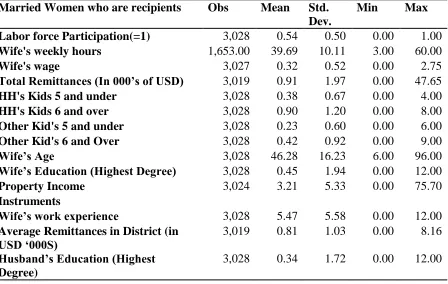
4 Summary Statistics for Women in a Relationship ... 37
5 Summary Statistics for Married Women who are Remittance Recipients ... 38
6 Married Women who are not Recipients of Remittances ... 38
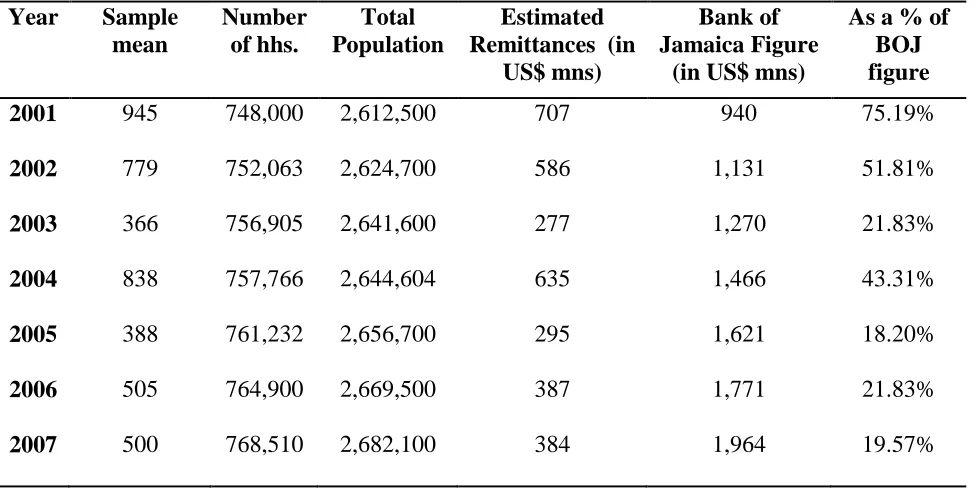
7 Remittances from Survey and the Bank of Jamaica... 41
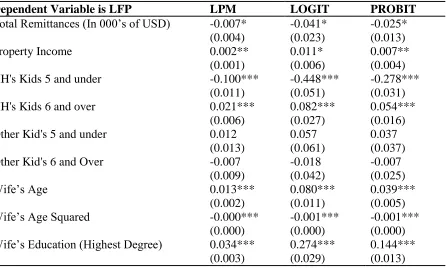
8 Labor Force Participation (Parish and Year Control Variables Included) ... 46
9 Participation in the Labor Market-Instrumental Approaches... 48
10 Check of the Instrumental Variables: IVREG2 Postestimation in Stata ... 49
11 Reduced-form Regressions of the Endogenous Variables on All Exogenous Variables ... 50
12 Basic Tobit Model... 52
13 Instrumental Variable Estimation of the Tobit Model ... 53
14 First Stage Reduced-Form Estimates of the Endogenous Variables ... 54
15 Predicting Remittances ... 56
16 Summary Statistics of Actual (from Survey) and Updated Remittances ... 56
17 Imputing Remittances ... 57
18 Single Women ... 59
19 Married Men ... 61
20 Single Males ... 63
21 Nonlinear Effects of Remittances ... 65
22 Expected Signed of Key Parameters on Budget Shares ... 90
23 Descriptive Statistics (Explanatory Variables) ... 99
24 Households' Reported Main Means of Support ... 102
25 Self-reported Financial Health of the Household ... 103
26 Descriptive Statistics (Expenditure Variables)-All Household Heads ... 105
27 Descriptive Statistics (Expenditure variables–By Recipient Status ... 106
28 OLS Regression of Budget Shares–Basic Engle Curve ... 111
29 Logit Regression-Likelihood of Spending (0 to 1) – First Part ... 114
30 Fractional Response Model–Second Part ... 116
31 Partial Effects-Probability of Participation Assuming Exogeneity ... 120
32 Partial Effects-Conditional Mean given Participation Assuming Exogeneity ... 121
33 Total Partial Effect Assuming Exogeneity... 122
34 First State regression of Remittance Share on the Exogenous Variables ... 125
35 IV Probit–First Part of theTwo-part Model ... 127
36 Fractional Response Model–With Endogenous Remittances ... 129
37 Partial Effects: Probability of Participation with Endogenous Remittances ... 131
x
39 Total Partial Effect with Endogenous Remittances ... 133
40 Significant Effects Across Models ... 138
41 Married Males First Stage Results ... 141
42 Single Women First Stage ... 142
43 Single Males- First Stage Results ... 143
44 Contents of STATIN's Consumption Aggregate Dataset (Slightly Modified) ... 144
45 Items in Consumption Categories for the Second Essay ... 145
46 Checking the Performance of the Instrument ... 148
xi
LIST OF FIGURES
Figure
xii
ABSTRACT
THE EFFECTS OF OUTSIDE INCOME ON HOUSEHOLD BEHAVIOR: THE CASE OF REMITTANCES IN JAMAICA
By
ANDREW VALROY STEPHENSON
DATE: NOVEMBER 11, 2011
Committee Chair: Dr. Sally Wallace Major Department: Economics
Remittances from individuals not residing in the home significantly affect recipient
households’ behavior. Using data from the Jamaican Survey of Living Conditions and the
Jamaican Labor Force Survey for years 2001-2007, this dissertation aims to explore some of the
most significant effects of remittances, namely effects on labor market participation and
household expenditures. Jamaica’s proximity to the United States and Canada coupled with
Jamaica’s diaspora of educated individuals shapes an economy largely dependent on remittances.
The country, therefore, provides an interesting and exciting case study for examining the effects
xiii
In the first essay, we investigate whether remittances alter the labor market behavior of
married women (or those in long-term relationships) in remittance-receiving households located
in Jamaica. As is often the case in labor supply studies, it is important to identify key variables
that are likely endogenous in the model. For purposes of this research, endogenous variables
include remittances, the wife’s education, and wages. We instrument both when predicting labor
market participation and hours worked. Unlike other studies which find the income effect of
remittances on household behavior results in increased leisure, we find that after instrumenting
for remittances, the outside income has no significant effect on the supply of labor, either in
terms of hours worked or participation.
The second paper assesses the extent that remittances alter the consumption pattern of
recipient households in Jamaica. Classical theory predicts that total income and not income
sources affects household consumption decisions, but developments in behavioral economics
suggest the contrary. The disaggregation of both income streams and consumption expenditures
as reported in the Jamaica Survey of Living Conditions provide us with unique insight into
household behavior and in particular, spending on items such as food, schooling, and vices.
Using Engel curve estimation and the two-part fractional response models, we find that the
source of the income significantly affects the shares of income spent in specific consumption
categories. Recipients, for example, generally spend larger shares of their income on schooling
and home production and less at the grocery store. These findings suggest important
Dissertation Introduction
Remittances are a major part of many economies in the developing world. Hundreds of
billions of dollars flow from developed to less developed countries, and in some instances,
comprise as much as a third of total GDP in small countries such as Haiti. Although per capita
receipt of remittances is smaller for large countries, India and China are among the largest
recipients of gross remittances, with combined receipts exceeding $100 billion (Ratha,
Mohapatra, & Silwal, 2010). The significance of remittances is so great that a number of
institutions are actively engaged in research on this flow of money.
The World Bank, for example, recently created the database, Remittance Prices
Worldwide. In an effort to improve information about the costs of sending remittances to and
from various countries, a group of researchers tracks the costs of sending money through the
major channels in which formal remittances flow. Costs of sending remittances are high for a
variety of reasons, and the World Bank estimates that a five percent reduction in these fees
would place approximately $16 billion more in the hands of recipients
(http://remittanceprices.worldbank.org/About-Us, accessed on June 11, 2011).
As recently as 2009, there was a Global Forum on Remittances, where speakers included
the chair of the G8 Global Remittances Working Group. The G8, in discussing remittances and
the costs for migrant workers, has suggested that reducing the costs of sending remittances could
encourage greater entrepreneurial efforts in the developing world.
There is little doubt as to the importance of remittances for developing countries, but
much of the discussion on the larger stage has centered on macroeconomic factors and effects.
This dissertation consists of two chapters, each dealing with the effects of receiving
remittances. The first essay studies the effect of remittances on labor market behavior, while the
second essay analyzes the extent to which remittance income alters households’ expense
allocations. In both essays, endogeneity of remittances may be caused by either missing
variables affecting both remittances and labor supply (and consumption patterns) or from reverse
causality where labor (and consumption) decisions may affect remittance receipts. Identifying a
suitable instrument for remittances was not an easy task. After experimenting with several
possible instruments, examining first-stage results, and conducting additional post-estimation
tests of the instrument, we concluded that district level average remittances for other households
in the district is the strongest instrument. The idea behind this instrument is that district level
remittances are not expected to have a direct effect on wife’s labor market activities or on
consumption patterns of the household.
To address our research questions of how remittances affect labor supply and household
expenditure, we use data from two sources. First, the Jamaican Labor Force Survey (LFS)
collects detailed labor market data on each member of the surveyed households. This survey is
divided into three sections to accommodate three groups of respondents, the employed, the
unemployed, and the discouraged workers or those opting not to participate in the labor market.
For the employed, questions about wage and hours worked are most significant for the study at
hand.
Additional variables are from the Jamaican Survey of Living Conditions (SLC), including
annual receipt of remittances. Total remittances received is the key variable in the labor essay,
while remittances as a share of total income is the focus in the second essay. Using share of
important (Hawkins & Wallace, 2006; Levin, 1998). Results for both studies, labor and
consumption, offer new insight into the remittance discussion.
With respect to the effect of remittances on the labor supply, we first analyze the
decision of married women to participate in the labor market and their reported hours of work
conditional on participation. We incorporate methods to account for selection and endogeneity,
namely instrumental Tobit models for hours worked and instrumental probit models for
participation. Previous research generally finds that remittances decrease labor participation
while not having an effect on hours worked. I, however, conclude that the effects of remittances
vary based on gender and marital status, and that for some groups, such as married women,
remittances have no significant effect on labor market participation or hours worked. For single
men, the receipt of remittances decreases labor force participation by almost eight percentage
points. In the population as a whole, we might see the small decline in labor force participation,
but this chapter emphasizes that this effect is not equally expected across all groups of people.
In the second chapter, we analyze the effect of remittances on allocation decisions of the
household, specifically focusing on the budget shares spent on various consumption goods
including education, food, and utilities, among others. For the regression analyses, we use a
two-part fractional logit model with Tobit-like decomposition of the marginal effects (McDonald &
Moffitt, 1980; Ramalho & Da Silva, 2009). We use an IV two-step procedure to account for the
endogeneity of remittances, as described in Wooldridge (2010 p. 753). Then, we calculate total
partial effects that combine information from the two parts. As was the case in the earlier paper,
there is reason to suspect that remittances are endogenous, and therefore, we compare results
when remittances are assumed as exogenous with those when remittances are treated as
change significance or direction, but for others, there are significant changes when remittances
are treated as endogenous.
Included in these models is a control for the households’ total expenditures. When
remittances significantly affect budget shares in the presence of this control, this suggests that
remittances, as a source of income, matter and refutes claims of income fungibility across
income types.
Regardless of how the model is specified, increases in remittances increase home
production, an interesting finding in light of the lack of significance in the labor chapter. It
might be the case that the receipt of remittances decreases labor market participation (at least for
single males), and these individuals replace formal labor with farming and other household
chores. Remittances are also expected to increase expenditures on luxury items, such as
purchasing prepared food from restaurants and vendors and using professional salon services.
When remittances are treated as exogenous, education expenditure is positively associated with
remittances receipts. On the other hand, participation and conditional amounts spent on grocery
store purchases and water bills are negatively related to remittance reliance.
The effect of remittances on one expenditure category changes significantly between the
exogenous and endogenous models. When remittances are assumed exogenous, the effect on
vices is generally negative. Once we treat remittances as endogenous, participation in this
category (i.e. reporting a positive value) is now positively affected by remittances.
In conclusion, we find that receipt of remittances has a more significant effect on how
households spend money, but a smaller effect on labor market decisions for most demographic
discusses the importance of remittances for entrepreneurial efforts, and while this cannot be
proven with this data, there is some evidence worth further exploration. We find, for example,
that single men in particular, are less likely to participate in the formal labor market. We also
find increased home production. It could be that these individuals use remittances to help
support small businesses such as farming that are captured in home production but not
necessarily reported as formal employment.
The micro-level effect of remittances for the welfare of recipient households is not one
we should ignore. Further research on remittances, continuing to break apart demographic
groups, and additional exploration of the endogeneity of remittances are all steps for future
research, important as international institutions continue to examine the costs and importance of
Chapter One: Labor Market Effects Of Foreign Remittances
Labor supply and the way it responds to changes in variables such as income and taxation
are among the most researched subjects in economics. This is not surprising given the central
role which labor plays in Classical, Neoclassical, and Keynesian schools of thought. In this
essay, we examine how the supply of labor of females in long-term relationships is affected by
the receipt of remittances, where remittances refer to monetary transfers from migrants to
relatives in their country of origin. Such transfers may be international, as in the case of
remittance flows from Jamaicans in the United States to relatives residing in Jamaica, or internal,
as in the case of a household member who has relocated to a major city in search of employment
and regularly remits funds to family remaining in their hometown. Although previous research
has examined the effect of remittances on labor supply in the developing country context
(Acosta, 2006; Bussolo & Medvedev, 2007; Kim, 2007), this paper is among the few that
examines multiple years of data for Jamaica and treats remittances as an endogenous variable.
This essay focuses specifically on the labor supply of women in long-term relationships,
either married or in common-law unions, for several reasons. First, although not directly
comparable to other studies on labor supply in Jamaica, the approach is similar to major labor
supply studies in the United States Secondly, married women or those in long-term relationships
may be more likely to receive remittances from spouses living abroad. There is an element of
sacrifice that occurs which differs from households receiving remittances from a cousin, friend,
or anyone else outside of the long-term relationship. Results might differ, therefore, based on the
sender of these remittances.
Remittances and immigration typically follow a straightforward pattern. Individuals
employment, and send remittances to their native communities. For Jamaica, the case presented
in this essay, these two trends are extremely pronounced. The World Bank estimates that 80
percent of Jamaica’s tertiary graduates reside abroad, and the country consistently ranks among
the top five countries in per capita remittance receipts (Seaga, 2006).1 The combination of high
migration and high per capita remittances establishes Jamaica as a good case study for research
on the effects of remittances on labor supply.
For many developing countries, remittances contribute significantly to foreign cash
inflow. During prosperous times in the United States, United Kingdom, and Canada, such as the
2001-2004 time period included in this study, remittances remain on a growth trajectory. The
current global economic downturn, however, may negatively affect remittances, and thus a better
understanding of the relationship between remittances and labor supply in developing countries
is important in understanding the total effect of drops in remittances to these already struggling
economies.2 To reiterate, this first study examines the relationship between remittances and
labor supply in good economic times, but it would be a natural expansion of the current study to
look at remittance effects during both boom and bust economic times once more recent data
become available.
In order for Jamaica to advance economically, it must establish and maintain a
well-functioning labor market that provides proper incentives for workers. If remittances are seen as
an additional source of income, then this may increase reservation wages, providing a
1
In the Jamaican Gleaner article, dated January 8, 2006.
2 For example, suppose remittances decrease labor supply. In a global recession, if remittances fall, there may be
disincentive to work in Jamaica and reduce the observed supply of labor in recipient countries
(Ariola, 2008; Kim, 2007).
It is plausible that the receipt of remittances affects decisions in addition to labor supply.
Other variables that might be affected by remittance receipts include but are not limited to
consumption (Davies, Easaw, & Ghoshray, 2009), the focus in essay two of this dissertation, as
well as the trade balance, schooling and human capital development, home production, economic
development, poverty and income inequality. And while this paper uses a microeconomic lens to
study remittances, the view of remittances as payments that flow across international borders
also implies that these micro-economic behaviors may have implications on macro-economic
outcomes (Abdih, Chami, Dagher, & Montiel, 2008; Acosta, Fajnzylber, & Lopez, 2007; Chami,
Fullenkamp, & Jajah, 2003; Rapoport & Docquier, 2006).
The remainder of this paper is organized as follows. The next section provides
background information on the flows of remittances as well as the motivations for this study and
our major contributions. We present a review of the relevant literature in the next section,
followed by a discussion of the theory of remittances and labor. Next, we present the
methodology used and empirical issues encountered. We then give a summary and discussion of
the data, followed by results and the conclusion.
Background
Before presenting labor theory, it is important to first understand the context of
remittances and Jamaica. One of the driving forces behind the trends of migration and
remittances is the economic welfare of households. Persons leave or are encouraged to leave if
person instead participated in the local labor market. Differing economic conditions in urban and
rural areas, as well as between developing and developed countries, are anectdotally behind the
widescale migration of labor. This migration is often followed by remittances in the short and
long-run, and circular migration3 in the long-run. The revolving cycle of migration is expected to
pesist as long as regional economic disparities continue.
For developing countries, the benefits of this migration cycle are several fold. First, the
remittances themselves add to the domestic economy. Second, migrants may return with new
skills and financial resources which in time may benefit other local residents who either learn
from these returning residents or gain employment by working with them. Finally, migration of
some workers may increase the wages of those remaining in the developing county if the drop in
the supply of labor in the home country is significant.4,5
While there are benefits to the developing countries from the migration and remittance
cycle, developed countries, too, may benefit. For example, the introduction of immigrant
workers adds to the diversity of the labor market and provides workers willing to accept lower
wages than that required by residents. There may be some ambiguity as to whether immigrants
supress wages and employment opportunites for natives in the developed country, but empirical
findings suggest the opposite is true – that immigrants may have a positive or no effect on
natives’ job prospects (Card, 2005).
3 Circular migration refers to the return of migrants to their countries of origin with enhanced skills, experiences,
and earnings garnered in the host countries. Although not a new concept, there is growing research in this area.
4
The expected change in wages depends upon the elasticity of labor supply and migration relative to the remaining labor supply. For lower skilled jobs in Jamaica, migration may not have a significant effect, but given that 80 percent of Jamaicans with tertiary degrees move abroad, the effect on skilled wages may be more significant.
5 The effect of increased wages for some workers could also be a positive or negative for the developing country.
To better understand the migration and remmittance cycle, specifically in Jamaica, a
quick overview of the immigration process is necessary. Most individuals emigrating from
Jamaica for the purpose of employment usually file for permanent residency or work visas in one
of three countries, the United States, Canada, and the United Kingdom. When applying for
permits, the burden of proof is on the applicant to assure the local Embassies (of the United
States and Canada) and high commission (of the United Kingdom) that they have sufficient
economic and social ties and will not be a burden to the host economy. This process can be
lengthy and expensive, evidence that the perceived benefits are great.
In Jamaica, remittances are often sent through remittance transfer companies, namely,
Western Union, Jamaica National Building Society, MoneyGram, Quick Cash, Victoria Mutual
Building Society, Money Express and Sun Money. Together, these firms accounted for
approximately 77 percent of remittance flows accounted for in 2005. Another 16 percent of
remittances are sent via traditional commercial banks, a number likely the result of many
Jamaicans lacking formal bank accounts. Only 2 percent of recipients report receiving
remittances through the postal service, and a surprisingly low 4 percent report receipts via
friends or relatives who traveled abroad (Focal Report, 2006). The last of these numbers,
remittances through mail or travelling friends and family, may be the most understated, as there
is no official record of these funds by the private or public sectors.
In addition to financial remittances, individuals abroad may send in-kind remittances
consisting of clothing, house wares, and school supplies, among other items. The in-kind
transfers are made either through shipment containers called barrels or friends and relatives who
A survey by the Canadian Foundation for the Americas (FOCAL) estimates the total
value of cash and in-kind remittances in Jamaica in 2005. A sample of 766 survey respondents
were asked to report the average amount of remittances typically received on a single occasion
and the frequency with which they received remittances. FOCAL reports the modal category of
cash remittances as 6,000-10,000 Jamaican dollars (or $100-$161 United States dollars), selected
by thirty percent of respondents, and the modal frequency of receipts as once per month
(twenty-four percent of respondents). Of the 766 respondents, 43 percent reported they had received at
least one barrel of goods sent from abroad. When asked the value of the contents, almost forty
percent did not know or could not recall. Of those who specified a range, most indicated the
value exceeded 30,000 Jamaican or $500 United States dollars
Remittances to Jamaica exceed government assistance, and the lack of government
assistance may in some respects explain the significant flow of remittances. In the next section,
we provide more background on Jamaica by briefly discussing the welfare system.
Welfare Programs in Jamaica
A little background on the recent history of Jamaica is relevant to understand some of the
current welfare programs in place. From the end of the Second World War through the 1960s,
Jamaica was a booming country growing at a steady pace of 4 percent per year (Grosh, 1992).
The 1970s brought a drastic change of fortunes, with per capita GDP declining 18 percent
between 1972 and 1980, likely the result of oil price shocks, political upheavals, and social
reforms. To help those in need, Jamaica initially provided food directly to households, but in
1984, the government replaced general food subsidies with the food stamp program. In 2001, the
through Health and Education (PATH). This replaced three existing income transfer programs,
the Food Stamps Program, the Poor Relief Program, and the Public Assistance Program.6 PATH
intends to address poverty both currently through income transfers and in the future by
encouraging poor households to invest in the education and health of their children (Levy &
Ohls, 2007).
Potential PATH participants must register in order to be considered for involvement. In
the selection process, all applicants are assigned scores based on need, and those with the lowest
scores are accepted. Welfare recipients receive a check in the mail with continued receipt
contingent upon proof the child is attending school and receiving regular wellness checks at
health centers. This program, however, may still not be reaching the poorest households if they
fail to register, which is possible given transportation costs and lack of information. Whether
remittances flow to the same households receiving PATH, making the two complements, or to
households not receiving PATH, making them substitutes, is an unanswered question. As of
2007, 285,000 persons registered for PATH funds, of which 180,000 received monthly aid (Levy
& Ohls, 2007). The difference between the number receiving funds and those registered,
coupled with the possibility that some needy households are not even registered, leaves a
significant number of people in need of additional income sources such as remittances.
Motivation
Relative to average earned income and government welfare in Jamaica, remittances are a
significant component of income for a number of Jamaican households, motivating the
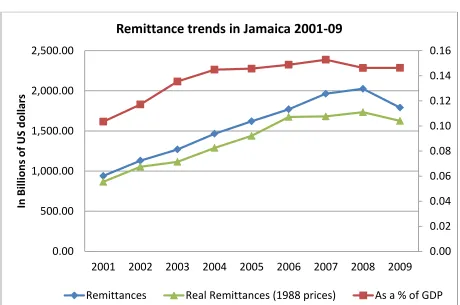
importance of studying the effects of remittances on recipients’ behavior. As seen in Figure 1,
real remittances grew between 2001 and 2006 before leveling off through 2008 and falling
slightly in 2009, likely the result of the global recession. As a percentage of GDP, aggregated
remittances consistently comprised more than 10 percent since 2001 and more than 14 percent
[image:27.612.71.531.223.528.2]for the last 5 years.
Figure 1
Remittance trends
Source: Bank of Jamaica (www.boj.gov.jm, accessed on June 23, 2011)
This study is also motivated by the state of the labor market in Jamaica. As Figure 2
shows, Jamaica has one of the largest unemployment rates in the Caribbean region, with an
urban unemployment rate of 19.4 percent for the period 1980-2000 (James Heckman & Pages,
2003). More recent data indicate that higher than average unemployment in Jamaica persists.
Although the rate equaled the Caribbean and Latin American average in 2003, the decline
0.00 0.02 0.04 0.06 0.08 0.10 0.12 0.14 0.16 0.00 500.00 1,000.00 1,500.00 2,000.00 2,500.00
2001 2002 2003 2004 2005 2006 2007 2008 2009
In Bi lli on s of US d ol la rs
Remittance trends in Jamaica 2001-09
between 2003 and 2006 in Jamaica fell short of the region’s decline, leaving Jamaica with a rate
above ten percent while the rest of the region averaged nine percent. Jamaica receives greater
remittances both in terms of absolute and per capita terms than other Caribbean countries, again
suggesting a link between remittances and labor behavior.
Figure 2
Trends in Unemployment
Source: IMF International Financial Statistics7 (2009)
A third reason for studying remittances in Jamaica is the “barrel children” phenomenon.
The term describes families in which the parents migrate and remit goods for the children and
other family members, often in large barrels through freight services. Items shipped are often
7
Countries included are: Argentina, Brazil, Chile, Colombia, Ecuador, Jamaica, Mexico, Trinidad and Tobago, Uruguay and Venezuela.
0 2 4 6 8 10 12 14 16
2001 2002 2003 2004 2005 2006
Unem
p
loym
en
t
Rat
e
%
Year
Unemployment trends
Caribbean & Latin America
Jamaica
those unavailable in local markets or priced significantly higher in Jamaica than comparative
costs in the parents’ host countries. Many Jamaicans believe, however, that the migration of
parents from Jamaica has resulted in detrimental side effects for Jamaica, with the absence of
parents adversely affecting children’s schooling and behavior. Anecdotal evidence suggests that
this is not a far-fetched causal relationship, and some empirical research suggests negative
effects on children (Lu & Treiman, 2005). This negative effect, however, disappears once
positive amounts of remittances are received by those caring for the children. A better
understanding of the labor impact of remittances may provide information that is useful in
analyzing the barrel children issue in further research.
The final motivation for this research arises from an interest in studying non-labor
income in a developing country, a topic often limited by the availability of data. Examples of
non-labor income include interest on savings, capital gains, welfare payments from the
government, and as discussed thus far, remittances. Arguably, it is welfare payments from the
government that are most analogous to remittances. While substantial research exists on the
effect of non-labor income on household labor supply in developed countries, less is known
about this relationship for households in less developed countries such as Jamaica.
Overall, the issue of how remittances affect labor supply is important for any developing
country to understand. Changes in policies that either ease or restrict the flow of remittances
could have substantial effects on labor markets and expenditures in the recipient countries. Such
changes could include taxing remittances similarly to income in an attempt to make the tax
Main Contributions
The sheer magnitude of remittance flows to a small developing country such as Jamaica,
combined with the availability of data, makes Jamaica a reasonable choice for the study of
remittances, as demonstrated by its frequent selection by scholars (Alleyne, Kirton, McLeod, &
Fiqueroa, 2008; Bussolo & Medvedev, 2007; Kim, 2007; Kirton, 2005). Although the country of
Jamaica is not a unique choice, the theory applied and empirical methods selected in this essay,
as described in more detail below, offer a new perspective on the relationship between
remittances and labor supply.
The main contributions of this paper are to provide an update of the influence of
remittances on the labor market in the context of a small developing country heavily reliant on
remittances and to evaluate outcomes when we assume remittances are endogenous. If we
believe that remittances are to some degree determined by the wages received of the recipient or
other unobservable factors that contribute both to the level of remittances and the labor of the
household (such as the local labor market condition), then neglecting to account for the
endogeneity of remittances may result in biased estimates. Generally speaking, the lack of
information on those individuals remitting funds has prevented other scholars from
implementing more advanced empirical techniques (Bussolo & Medvedev, 2007; Kim, 2007).
As most of the literature does not control for endogeneity, it is important to add to the evidence
with a more appropriate methodology.
To suggest remittances are endogenous, however, is insufficient without further
describing the existing literature and theory pertaining to this topic. In the following section, we
delve more deeply into the previous literature, elaborating on the findings and methods, before
Review of the Literature
The Determinants and uses of Remittances
Research on remittances tends to follow one of two paths – either the determinants of
remittances (that is, why people send money from the host countries or urban centers to others)
or the uses of remittances (how recipients choose to use the money in the developing country or
rural area). Only one paper, Rapoport and Docquier (2006), attempt to provide a complete
picture of the impact of remittances by looking at both their determinants and uses.
The determinants literature seeks to assess the various motivations and reasons for
sending remittances. In one such paper, these reasons are grouped into two broad categories:
individualistic and familial motivations (Rapoport & Docquier, 2006). The individualistic
motives are essentially driven by self-interest, although there is some element of other-regarding
preferences that come into play. This set of motives includes altruism and inheritance motives,
where individual remitters have a vested interest in sending remittances. (Perhaps they wish to
inherit property following a family member’s death). The familial arrangements are either
insurance or investments intended to reduce household income uncertainty or to expand total
household income respectively, where some informal ‘contract’ is agreed upon prior to
migration. Such agreements are potentially huge in Jamaica given that migration is expensive
and may be subsidized by relatives with the explicit understanding of repayment in the future.
Another study by Stark and Lucas (1985) classifies the reasons for remittances into three
categories rather than two, namely: pure altruism, pure self-interest, and tempered altruism /
enlightened self-interest. In this case, the third is not merely a combination of the first and
the home country, similar to that in the familial arrangement motivation mentioned above. This
contract may require the migrant to remit to the household in repayment of the household’s
investment in the migrant, whether in the form of funding migration costs or providing education
for the migrant.
The determinants discussed above are microeconomic in nature, but some authors have
suggested macroeconomic determinants such as exchange rates, interest rates and wage (or
income) differences (Alleyne, et al., 2008). While interesting, we omit these macroeconomic
determinants, given their lack of variability across individual recipients in the same nation. These
variables affect how much the country receives in total remittances but may not explain person to
person differences, our primary area of interest in this essay.
In addition to existing studies on the motivation behind remitting, a second literature
examines the effects of remittances on recipients’ behavior. Like other forms of transfers, the
aim of remittances is expected to alleviate the economic hardships of recipients. Any resulting
economic growth for the native country is of secondary concern to the donor and recipient.
Therefore, we assess the impact of remittances at the microeconomic level, where we focus on
the household units (Acosta, 2006; Adams, 2006).
The Microeconomic Effect of Remittances on Labor Supply
Although there are several studies specifically on how the receipt of remittances
influences labor, empirical results suggest a relatively large range of effects (Acosta, 2006;
Bussolo & Medvedev, 2007; Kim, 2007). In this section, we will summarize existing work,
compare the findings, and highlight factors that may explain why previous findings can be
Remittance transfers ensuing from migration are expected to affect labor supply in two
ways (Acosta, 2006; Kim, 2007). First, migration implies an immediate decline in the labor
supply for the home country, often referred to “brain drain.” Legal migrants are not randomly
selected (Borjas, 1987) and tend to be more educated than the average individual from a
developing country. Better skilled individuals are able to more easily satisfy the requirements to
work abroad and are therefore over represented in the migrant population. The selection process
ensures that the most talented migrants are eligible for work permits. Because educated
individuals in the developing country are also more likely than others to be employed if they
remained in the developing country, albeit it at lower wages than if they relocated, their
relocation significantly affects the quality and quantity of the labor force remaining.
Potentially negative changes in the labor supply of the developing country may be
partially offset by the receipt of remittances and theoretically higher wages for those that remain,
particularly those that are educated, if this group is disproportionately affected by a loss in labor
market competition. Such flow of labor may also be advantageous to the developing countries,
where shortages, such as those in nursing, may be filled by foreign-born individuals (Buerhaus,
Staiger, & Auerbach, 2003). This movement of labor across countries is the main subject of the
“new economics of migration,” a school of thought that focuses on mutually beneficial aspects of
labor flows at both the microeconomic and macroeconomic levels (Massey et al., 1993).
Migration may also result in a second wave of decreased labor supply. Once the migrant
is settled in the host country, she may then decide to send proceeds from her employment back to
her home country in the form of remittances. When this money is received, it can be treated as
any other non-labor income, with the usual income and substitution effects resulting in increased
decline in labor. Such theory, however, ignores the complexity of remittances, particularly if
motivated by investment. Suppose that the remittances are used for investment and business
expansion purposes by the recipient, in which case remittances could actually be associated with
increased labor if the result is a larger, stronger entrepreneurial effort. A negative relationship
between remittances and labor supply predicted by simple economic models is not a foregone
conclusion, and many scholars have attempted to measure both the direction and magnitude of
this relationship.
Ariola (2005) determines that like other sources of unearned income, remittances reduce
total labor hours. He estimates income elasticity in the range -0.006 to -0.03. Similarly, Kim
(2006) finds a 3.6 percent reduction in hours worked due to remittances, and this remains robust
to cross-sectional and panel data specifications. Bussolo and Medvedev (2007) use a general
equilibrium model and also find an overall negative effect of remittances on labor force
participation for Jamaica. Acosta (2006) concludes that there are negative effects of remittances
on labor for females, but remittances are positively related to labor supply for middle-aged men,
suggesting that remittances may be creating work opportunities in self-employment.
Kim (2007) separates the decision to enter the labor market from the decision of hours
worked. Specific to Jamaica, a country with increasing real wages coupled with persistently high
unemployment, Kim (2007) determines that hours per week conditional on working does not
differ between households across remittance status, but that the receipt of remittances reduces the
probability of entering the labor market, thereby reducing total hours worked for the country.
This may reflect workers’ inability to freely vary hours of work, often confined to non-optimal
part-time or full-time hours. Kim (2006) claims in a previous paper that the receipt of
less likely to work. Coupled with increased migration of skilled labor, increased remittances
seem to exacerbate the phenomenon of high wages along with high unemployment, a symptom
of a poorly functioning labor market (Kim 2006).
Kim (2007, 2006) and Bussolo and Medvedev (2007) each use Jamaica as a case study,
making their findings most relevant to the current paper. Their findings, however, differ,
perhaps a result of differences in methodology. Kim (2006, 2007), for example, does not adjust
for the endogeneity between wages, non-earned income such as remittances, and hours worked.
Failing to correct for this problem in OLS models could bias results (Heckman, 1974).
Several studies looked at additional effects of remittances on household behavior. Lu
and Treiman (2007) find that benefits may accrue for black children in South Africa who are in
households receiving remittances, controlling for expenditures on education. Specifically, the
researchers find lower levels of child labor in households receiving remittances (Lu & Treiman,
2007). (They also find that children in households where a parent has migrated but has not
remitted funds may be worse off than children in non-migrant households because of the
negative effect of out-migration without the positive economic effect.) Overall, while
remittances reduce labor supply, the finding that remittances reduce child labor is probably one
instance in which a reduction in labor is a positive change.
The importance of understanding how remittances affect labor supply is essential for
governments interested in changing policies that permit the flow of remittances. For example, if
we link remittances to labor supply changes, then policies that either ease or restrict the flow of
the next section, we further elaborate on the role of remittances as a non-labor income source for
households and the relevant research.
Remittance as a form of Income Transfer
Remittances are often excluded from labor supply research because of their small effect
on labor in developed countries. However, the receipt of remittances in developing countries is
sometimes a major part of income and can affect the long term growth path of developing
countries (Giuliano & Ruiz-Arranz, 2009) . While labor supply studies in developed countries
understandably omit remittances, revision of theoretical and empirical approaches may be
needed when looking at less developed countries.
In the case of Jamaica, evidence seems to suggest that there is a greater reliance on
remittances than government aide. On average, government transfers are reported by eight to ten
percent of households, and for these recipients, the transfers account for 59 percent of their total
expenditure, according to data from the Survey of Living Conditions. On the other hand,
approximately sixty percent of households receive remittances and for these recipients,
remittances represent almost 30 percent of total expenditure.
Receipt of remittances is also distributed more equally across income groups than
government assistance, as we would expect. In Table 1, the population is divided into quintiles
based on annual expenditures. Receipt of government assistance, known in Jamaica as PATH,
decreases with expenditures. Receipt of remittances, however, varies from 59.97 to 62.54
percent.
The failure of the welfare system in Jamaica to reach the neediest households has been
program will do a better job than its predecessors, but the data suggests that of the lowest income
households, less than 20 percent receive funding, while a small fraction of the wealthiest
households still do. This means remittances may remain as the key income source for some of
these lower income households.
Table 1
Distribution of Welfare and Remittance Receipts by Expenditure Quintiles
Expenditure Quintile
First Second Third Fourth Fifth
Path Recipients 17.89% 13.18% 11.52% 9.81% 4.74%
Remittance Recipients 61.19% 59.97% 62.54% 61.03% 61.48%
Source: Author’s calculation from The Jamaica Survey of Living Condition.
Theoretical Model of Labor Supply.
Level of Decision Making
One of the key considerations in labor market studies is the level of decision making. In
the literature, we usually look at either a unitary utility function or a collective utility function
(Chiappori, 1992). The unitary utility approach treats the household as one agent with one set of
preferences. Collective utility, on the other hand, allows for different preferences within the
household with each member relying on the other(s). Although the decisions to work and how
much to work are influenced by the entire household, we still observe the agents individually.
Since we are interested in the observed behavior rather than the actual decision process, it seems
logical to use individual labor supply functions for each agent in the household, following the
household members is still factored into the model, however, by controlling for the spouse’s
income.
The household’s problem is to:
i i i i i iL H T and PC L
T W N to subject L
C
MaxU , ( ) (1)
where, C is household consumption spending, the remittance benefit is included in N, non-labor
income, W is the wage rate, Ti is the total non-sleep time endowment of person i, Li is person i's
leisure hours, and Hi is person i’s hours worked.
Assuming Cobb Douglas preferences, a well behaved utility function is given by:
( )
(2)
Where, C is consumption of goods and services within a year, and L is leisure.
This is subject to time and financial constraints given by:
( ) (3)
where, wL is Leisure times its price and pC is Consumption times prices of goods and services.
On the income side, wT is wage times total time available to the household and includes the
opportunity cost of working and (1-t)R is remittances net of transaction costs.
Solving for C and L, we set up the following Lagrangian function:
The first order conditions are given by:
⁄
(5)
⁄ ( )
(6)
With the third being the budget constraint.
Equating the λs from (6) and (7) and substituting into (4) yields the following:
( ) =( )( )
(7)
( )
(8)
( ) (9)
( )( ( ) ) (10)
( )( ( ) ) (11)
( ) ( )( ) (12)
and
The optimality conditions provide an idea of the determinants of optimal leisure and
consumption. In the case of consumption, individuals increase consumption following increases
in real income, regardless of whether from earned income (wages) or remittances. The extent to
which the two income streams affect consumption, however, is analyzed in the following essay.
More relevant to the study at hand, however, is the optimality condition in Equation (12).
It suggests optimal leisure is positively related to time endowments, as to be expected. Increases
in wages, or the price of leisure, decreases leisure, and increases in remittances increase leisure,
ceteris paribus. It is important to note that both remittances and wages need to be among the
explanatory variables as it is their ratio that matters most. An individual receiving $100 in
remittances while facing a wage of $5 per hour will choose the same amount of leisure as an
individual with identical preferences receiving $20 in remittances and earning a wage of $1 per
hour.
In the sections that follow, we develop an empirical approach that estimates the effects of
remittances and wages (along with welfare payments not presented in the theoretical model) on
labor, the difference between time endowments and leisure. Additional covariates including
household composition and household head characteristics are included as controls and assumed
to affect , the household’s weighting of consumption versus leisure in its utility function.
Before providing this model, however, we first detail our empirical approach and additional
econometric problems addressed in this analysis.
Empirical Issues
A number of problems arise when estimating labor market participation and hours
that might arise. As a result, this section is dedicated to discussing empirical issues, and the
following section identifies methodologies which properly address these concerns.
Self-selection
The first potential problem is self-selection. Self-selection bias arises from the use of
either a truncated or a nonrandom sample of variables to estimate the treatment effect for the
entire population. The self-selection in labor models is well documented (James Heckman,
1974; J. J. Heckman, 1979). Wages, the decision to work, and hours worked cannot be viewed
as independent of one another.
Endogeneity of Key Variables
A second problem is the potential endogeneity of some of the key explanatory variables.
Firstly, wages are likely endogenous in the hours worked equation (Mroz, 1987). One source of
this endogeneity is an omitted variable, such as ability, which is correlated with not just hours of
work but also the potential wage rate of the individual. It is also possible that there is an element
of reverse causality between wages and hours worked, if individuals willing to work full-time or
over-time are rewarded with higher wages.
Second, remittance receipt is likely endogenous as well, also a result of omitted variables.
For example, poor health by the recipient may encourage migrants to send remittances and cause
the recipient to work fewer hours. The decrease in hours worked, however, is not strictly due to
the remittances. The appropriate model will instrument for remittances and determine the extent
A third variable in our model of labor supply which may be endogenous is wife’s
education. This is because missing ability and aptitude may affect participation in the labor
market as well as hours worked for those how do participate.
To effectively handle the endogeneity, we need variables which correlate with each of the
endogenous variables but are not correlated with labor supply, except through other variables
already in the regression. The criteria, while straight-forward, are not easy to satisfy, although we
propose instruments for each of the endogenous variables in the Methodology section.
The Methodology
The nature of the dependent variables, labor market participation and hours worked,
combined with the problems outlined in the previous section, require careful selection of an
econometric approach. We begin by adapting an older and often relied upon labor supply model
(Mroz, 1987).
Labor Force Participation
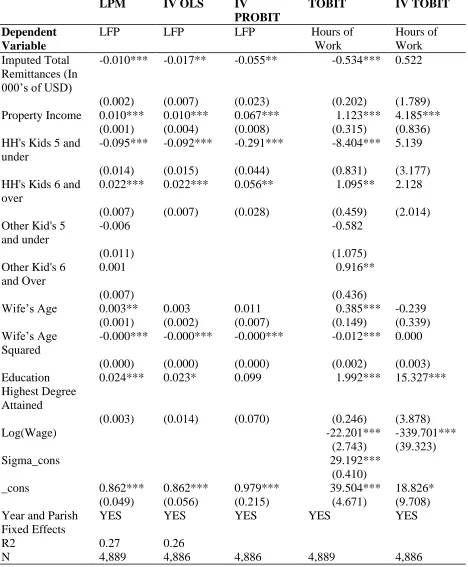
Our first model begins with a simple linear probability model predicting the effects of
select covariates on labor force participation. We then progress to a probit model, which more
appropriately depicts the distribution of the dichotomous dependent variable. Finally, we
We then can define labor force participation (LFP) as:
LFP = {
(14)
The probability of being in the labor force is then given by:
( | ) ( )
( )
(15)
where X includes wife’s education, total remittances, property income, kids 5 years old and
under as well as kids 6 and over, wife’s age and wife’s age squared and wife’s work experience.
Hours of Work
The second dependent variable is hours worked. The static hours worked equation can be
given as:
( ) ( )
( )
( )
(16)
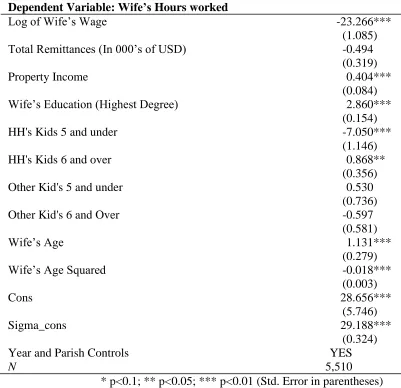
where is hours worked per week by the women in a long term relationship, and the vector
includes: total remittances, the natural log of the woman’s wage, wife’s education, kids 5 and
under (separated into own child versus other); kids 6 and over (again separated into own child
versus other), property income, wife’s age and wife’s age squared. The endogenous variables
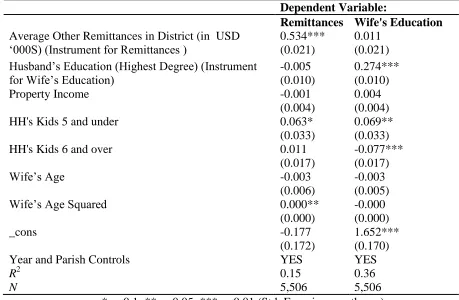
form as a function of all exogenous variables, Zi. TheZi vector also includes two variables which
are not included in Xi, namely: non-biological children in the home who are 5 and under and the
number of non-biological children 6 and over, as well as the instrumental variables, average
remittances to others in the enumeration district, husband’s education, and participation in the
job market 5 years ago. These variables serve as the exclusion restrictions.
The following section further discusses the usage of these instruments.
Instruments
Although we have discussed possible endogeneity and briefly introduced the instruments
we will use, this section is devoted to further elaboration on these instruments. For remittances,
Acosta (2006) uses village level characteristics, such as the propensity of migration, to
instrument for remittances (Acosta, 2006). Districts with a history of high migration are expected
to be positively correlated with remittance receipts but not necessarily correlated with their
dependent variable, in that case, child labor. Abdih, Chami et al (2008) estimate the causal
relationship between home country institutions, such as the level corruption, and remittances
(Abdih, et al., 2008). They use whether or not the area is located in the coastal regions. If yes,
then this is expected to be positively correlated with remittances and not necessarily correlated
with the level of corruption
For remittances, we use the sum of remittance receipts in the enumeration district, a
geographic district created for political purposes. We then subtract the household’s own
remittances from that total, and average this value based on the number of other household’s in
the enumeration district. This value likely reflects the migration from an area. It may be
correlated with a household’s level of remittances received but not necessarily participation
Two additional variables are endogenous in the hours worked model. First, wage is
endogenous, again a result of omitted variables. We include work experience in the labor market
as an instrument for wage. The second endogenous variable is the wife’s education, as a factor
such as ability is likely correlated both with education and labor market participation. Therefore,
we use husband’s education as an instrument. Although not a perfect instrument (Wooldridge
2002), a preferable instrument is not available and using husband’s education is a common
solution.
Having briefly discussed the methods, we now introduce the available data, including the
variables used and potential instruments, and present summary statistics for the sample.
The Data
We use two data sources, namely the Survey of Living Conditions (SLC) and the
Jamaican Labor Force Survey (LFS). The SLC in Jamaica began in 1988 as part of a larger
study of living standards in developing countries, with a greater emphasis on evaluating
immediate effects of public policy (Development Research Group 2002). The data collection
and sampling frame of the SLC are based on the larger LFS. From the LFS, a smaller sample is
randomly selected for inclusion in the more detailed Survey of Living Conditions. The Survey
of Living Conditions is administered by the Statistical Institute of Jamaica, but the principal
investigator is the Planning Institute of Jamaica, both governmental departments. Surveyors ask
questions pertaining to education, crime, and health, but specific modules also focus on food and
non-food expenditures as well as remittances.
Though the surveys are conducted quarterly (January, April, July and October) with the
is the April quarter. For this reason, the data used for the official labor force statistics and in our
analysis are from the April quarter. Key to our analysis is that the Survey of Living Conditions
collects information on remittances. Using data from 2001-2007, we can assess the
characteristics of those households receiving remittances and look at differences in labor supply
behavior between those families receiving remittances and those not receiving remittances. The
household identification variable is used to link the Survey of Living Standards to the Jamaican
Labor Force Survey.
The data are self-weighted, meaning that the means and other statistics from the sample
in the survey can be taken to reflect the entire population without the need for sample weights.
However, even the best of samples still suffers from missing data issues which affect this
self-weighted attribute. This self-self-weighted feature remains true for all the years after using ‘raising
factors’. These raising factors are made up of two sample weights: first, to account for
non-response, an enumeration district weight (edwght) is used, and secondly in order to improve the
parish representativeness, a parish weight (parwght) is used.
Data Cleaning
Given that the data span several years, our task is complicated by changes in the survey
over time. For instance, the Statistical Institute of Jamaica revised the labor force questionnaire
in 2004, and thus, we readjust certain variables in the later years to make them compatible with
2001-2003 data. In some instances, the change amounts to a renaming of the variable. For
example, some variables are named according to the question number, and when the survey adds
or deletes questions, the names of these variables change. Specifically, the question: “What were
Similar adjustments are needed for almost all variable names when merging the 2001-03 and
2004-2007 data.
Other changes in the survey require more effort to address. Some variables changed
types over the years, going from a categorical variable to a numerical (interval) response. One
such question important in this paper’s analysis is “How many hours did you work during last
week?” Even though the question remains the same, it was recorded as a categorical variable
(None, less than 9 hours, 9-16 hours, 17-24 hours, 25-32 hours, 33-40 hours, 41-49 hours, and
over 49 hours) in 2001-2003, but as a numerical variable starting in 2004. For years 2001-2003,
the following process is used.
Within each category, a normal distribution is assumed. Respondents are then randomly
assigned a value within the category, with the largest probability that they receive the mean
hours worked from the category indicated. The only exception to this procedure is the category
33-40 hours, where clustering likely occurs at 40 hours per week. As a result, we do not assume
a normal distribution within this category and skew the distribution such that respondents have a
near one probability of working 40 hours per week.
In 2005, 2006, and 2007, the survey questions pertaining to remittances were also
changed. Surveyors started asking respondents to provide more detail on the source of their
remittance receipts. In addition, the 2006 survey included a module focused on remittance, and
hence, additional questions were asked this year. The main difference, however, is that
households were asked to distinguish between cash and in-kind transfers when answering each of