ScholarWorks @ Georgia State University
ScholarWorks @ Georgia State University
Educational Policy Studies Dissertations Department of Educational Policy Studies
Spring 5-26-2012
Decision Making in Intercollegiate Athletics: One Institution's
Decision Making in Intercollegiate Athletics: One Institution's
Journey to Maintain Title IX Compliance
Journey to Maintain Title IX Compliance
John W. Rowland Georgia State University
Follow this and additional works at: https://scholarworks.gsu.edu/eps_diss
Recommended Citation Recommended Citation
Rowland, John W., "Decision Making in Intercollegiate Athletics: One Institution's Journey to Maintain Title IX Compliance." Dissertation, Georgia State University, 2012.
https://scholarworks.gsu.edu/eps_diss/92
ACCEPTANCE
This dissertation, DECISION MAKING IN INTERCOLLEGIATE ATHLETICS: ONE INSTITUTION’S JOURNEY TO MAINTAIN TITLE IX COMPLIANCE, by JOHN ROWLAND, was prepared under the direction of the candidate’s Dissertation Advisory Committee. It is accepted by the committee members in partial fulfillment of the
requirements for the degree Doctor of Philosophy in the College of Education, Georgia State University.
The Dissertation Advisory Committee and the student’s Department Chair, as representatives of the faculty, certify that this dissertation has met all standards of excellence and scholarship as determined by the faculty. The Dean of the College of Education concurs.
___________________________ ___________________________
Philo Hutcheson, Ph.D. Jennifer Esposito, Ph.D.
Committee Chair Committee Member
__________________________ ___________________________
Michael J. Fulford, Ph.D. Walter R. Thompson, Ph.D.
Committee Member Committee Member
__________________________ Date
__________________________ William L. Curlette, Ph.D.
Chair, Department of Educational Policy Studies
__________________________ R. W. Kamphaus, Ph.D.
AUTHOR’S STATEMENT
By presenting this dissertation as a partial fulfillment of the requirements for the
advanced degree from Georgia State University, I agree that the library of Georgia State University shall make it available for inspection and circulation in accordance with its regulations governing materials of this type. I agree that permission to quote, to copy from, or to publish this dissertation may be granted by the professor under whose direction it was written, by the College of Education's director of graduate studies and research, or by me. Such quoting, copying, or publishing must be solely for scholarly purposes and will not involve potential financial gain. It is understood that any copying from or publication of this dissertation which involves potential financial gain will not be allowed without my written permission.
NOTICE TO BORROWERS
All dissertations deposited in the Georgia State University library must be used in
accordance with the stipulations prescribed by the author in the preceding statement. The author of this dissertation is:
John Rowland 6200 Golden Maple Court
Hoschton, GA 30548
The director of this dissertation is:
Dr. Philo Hutcheson
Department of Educational Policy Studies College of Education
VITA
John Rowland
ADDRESS: 6200 Golden Maple Court
Hoschton, GA 30548
EDUCATION:
Ph.D. 2011 Georgia State University Educational Policy Studies
M. Ed. 1997 Georgia State University Mathematics Education
B.S. 1991 Georgia State University Mathematics
PROFESSIONAL EXPERIENCE:
2010-Present Teacher / Head Cross Country and Track Coach Gwinnett County School System
2009-2010 Data Specialist / Project Manager Quality of Life Enterprises, Inc.
2009 Assistant Athletic Director / Senior Head Coach Georgia State University
1993-2009 Director of Women’s and Men’s Cross Country and Track Georgia State University
1997-2005 Instructor
Keller Graduate School of Management 1996 Team Leader and Spotter
Atlanta Olympic Broadcasting
1991-1993 Assistant Cross Country Coach / Facilities Manager Georgia State University
PROFESSIONAL SOCIETIES AND ORGANIZATIONS:
ABSTRACT
DECISION MAKING IN INTERCOLLEGIATE ATHLETICS: ONE INSTITUTION’S JOURNEY TO MAINTAIN
TITLE IX COMPLIANCE by
John Rowland
The allocation of resources and participation opportunities in intercollegiate
athletics has been a debate among researchers for nearly 40 years. Title IX and
traditionally male-dominated budgeting practices continue to be opposing forces that
shape the financial and gender makeup of university athletic departments. In fact, the
need to be Title IX compliant often dominates discussions when structural changes occur
in athletic departments. This case study analyzed the decision making process of
distributing resources and participation opportunities at Division I University from 1998
to 2007 based on John Rawls’ arguments about distributive justice. Division I University
administrators focused on the substantiality proportionality clause of the three-part test as
the only method to comply with Title IX. The Equity in Athletics Disclosure Act and
other gender equity reports completed during certification play an important role in the
decision making process. The analysis of the decision making process showed that Title
IX was used as a political tool to deflect the controversy of program elimination. This
analysis also showed that program elimination was not necessary in order to maintain
Title IX compliance. Thus, the decision to eliminate sports was a violation of Rawlsian
DECISION MAKING IN INTERCOLLEGIATE ATHLETICS: ONE INSTITUTION’S JOURNEY TO MAINTAIN
TITLE IX COMPLIANCE by
John Rowland
A Dissertation
Presented in Partial Fulfillment of Requirements for the Degree of
Doctor of Philosophy in
Educational Policy Studies In
the Department of Educational Policy Studies in
the College of Education Georgia State University
Copyright by John Rowland
ACKNOWLEDGMENTS
This dissertation is the culmination of more than 10 years of work. Throughout the process, there were many individuals who gave their time to help me complete this endeavor. I want to thank each of them from the bottom of my heart. I am indebted to my major advisor, Dr. Philo Hutcheson, for his guidance and friendship. Dr. Hutcheson mentored me through many academic and professional hurdles… and he did it with patience and humor. I needed that positive communication at times during this process. I want to thank my dissertation committee for challenging me to view my research from multiple perspectives, even though I was resistant at times. My committee members were honest and fair in their critique of my work, which resulted in an improved dissertation.
I want to thank Jessica for all of her support, both academically and
professionally. I have met very few individuals that can match the level of integrity and kindness that Jessica displays. Thank you, Kim for your support through this journey. We finished this together as we said we would.
I could not have completed this dissertation without the support and love of my family. I am very lucky to have supportive parents, siblings, and extended family members. I often wonder what I have done to deserve so much love and support. I love my family very much.
Finally, there are no words to describe the joy and satisfaction that I receive from having Taren and Jacob in my life. I love you both, and I will try each day to give you as much joy as you have given me.
This dissertation is dedicated to all individuals who stand up for justice and fairness… and especially those individuals who speak out against injustice even when it affects them negatively.
List of Tables ...v
Abbreviations ... vi
Chapter 1 THE PROBLEM ...1
Introduction ...1
Statement of the Problem and Research Questions ...7
Goals of the Research ...8
Definitions of Terms ...10
2 TITLE IX AND INTERCOLLEGIATE ATHLETICS ...13
The Title IX Saga ...14
Equity in Athletics Disclosure Act ...22
Title IX and College Football ...24
The Politics of Title IX Compliance. ...28
3 DISTRIBUTIVE JUSTICE AND INTERCOLLEGIATE ATHLETICS ...37
John Rawls and Distributive Justice ...39
Morton Deutsch and Distributive Justice ...43
Distributive Justice and Intercollegiate Athletics ...45
The Politics of Distributive Justice ...48
4 METHODOLOGY/METHODS ...56
Defining the Case Study ...57
Selection of Interviewees ...59
Secondary Analysis ...61
Data Analysis ...63
The Self Interview and Institutional Review Board Approval ...68
5 ANALYSIS OF THE EVIDENCE ...71
Decision Making and Title IX before 1998 ...72
The Elimination of Wrestling and Athletic Board Involvement: Decision Making 1997-1998 ...76
Women’s Track and Field and the Equity in Athletics Disclosure Act: Decision Making from 1999-2005 ...83
The Addition of Football and the Elimination of Men’s Indoor Track: Decision Making after 2005...90
Playing the Title IX Numbers Game ...98
Gender Equity Reporting: A Self Regulating Process ...102
6 CONCLUSION & RECOMMENDATIONS ...106
The Self Interview and Evaluative Lens ...107
Playing the Title IX Numbers Game and Distributive Justice ...111
Gender Equity Reporting: The Problem with Self-Regulation ...114
Decision Making in Athletics: The Politics of Fairness ...117
Limitations of the Study...119
Recommendations for Further Research ...121
Is Program Elimination Necessary? ...124
References ...127
LIST OF TABLES
Table Page
1 Pseudonym Chart ...60
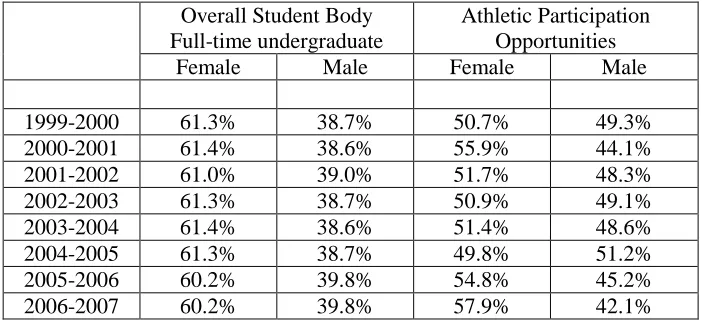
2 Comparison of Enrollment Data and Athletic Participation Opportunities at Division I University by Gender ...86
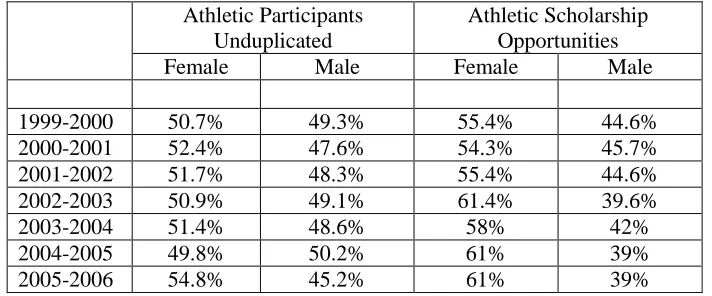
3 Comparison of Athletic Participation Opportunities (Unduplicated) and Athletic Scholarship Opportunities at Division I University by Gender ...87
ABBREVIATIONS
JMU James Madison University
EIA Equity in Athletics
QU Quinnipiac University
NCAA National Collegiate Athletic Association
HEW Department of Health, Education, and Welfare
OCR Office of Civil Rights
EADA Equity in Athletics Disclosure Act
IRB Institutional Review Board
SACS Southern Association of Colleges and Schools
CHAPTER 1
THE PROBLEM Introduction
University administrators continually struggle to allocate athletic resources and
participation opportunities in a distributive manner that is just.1 The rising commercial
popularity of college sports, particularly football and men’s basketball, contributes to the
difficulty of this distribution task. On the one hand, administrators focus resources on the
most visible sports to satisfy the demands of avid fans and boosters. These demands have
resulted in financial investments to athletic departments that outpace overall university
spending.2 On the other hand, federal laws mandate that university leaders distribute
resources and participation opportunities to a diverse population of students.
Additionally, due to the benefits that students receive from competing in athletics
(Pascarella & Smart, 1991; Pascarella et al., 1999; Porto, 2003; Salter, 1996; Samuels,
2003; Suggs, 2005), most administrators feel an obligation to provide a wide range of
participation opportunities. When resources are scarce, the competing forces discussed
above make distribution decisions a daunting task. How, then, do university
administrators make these decisions, and, can they make them fairly?
___________________________
1
The terms just and justice are used in this study to determine whether distribution decisions made by college administrators are fair. Justice as a form of fairness is defined by John Rawls in A Theory of Justice (1971) and Justice as Fairness: A Restatement (2001).
2The amount of resources that college athletic departments are spending in relation to total university
spending has been studied extensively. See the Knight Foundation report A Call to Action: Reconnecting College Sports and Higher Education (2001) and the Presidential Task Force on the Future of Division I Intercollegiate Athletics report The Second-Century Imperatives –
Presidential Leadership and Institutional Accountability (2006).
Historically, football and men’s basketball have received the majority of the
resources in college athletics (Curtis & Grant, 2005; Mahony & Pastore, 1998; National
Collegiate Athletic Association, 2008). This distribution method awards the majority of
the resources to the sports that produce the most revenue. Title IX of the Educational
Amendments of 1972 became the first piece of legislation to significantly challenge this
type of distribution. This landmark law states that “no person in the United States shall,
on the basis of sex, be excluded from participation in, be denied benefits of, or be
subjected to discrimination under any education program or activity receiving federal
financial assistance” (Title IX, 1972). After the passage of Title IX, sex discrimination in
college athletic departments became illegal. Therefore, the male-dominated budgeting
practices that historically focused most of the resources on football and men’s basketball
began to be challenged. Today, when university leaders discuss making structural
changes to athletic departments (i.e., the addition or deletion of sports teams), Title IX
compliance is always a factor. The following two cases are examples of the controversy
that surrounds athletic department decision making.
The leaders of James Madison University (JMU) and Quinnipiac University are
dealing with the consequences of making significant structural changes in their athletic
departments. Title IX played a role in these decisions. In 2007, James Madison
eliminated ten sports. In a memo dated November 2, 2006, Vice President Charlie King
wrote, “I want you to hear directly from me that this decision was made because JMU
simply had to make changes to comply with Title IX.” President Linwood Rose echoed
this sentiment in a New York Times article stating,
enlightened citizens. I don’t know how you create a model of citizenship if you are blatantly in violation of the law. (Pennington, 2006, p. 1)
The public statements made by the JMU administration portray the idea that sport
elimination is the only solution to the Title IX compliance problem. JMU officials
emphatically deny that financial concerns played a role in the decision, an interesting
exception because reduction of finances is commonly used as a reason for program
elimination.
The response to JMU’s decision to eliminate the sports has been harsh and
widespread. There were leading articles in USA Today and The New York Times casting a
critical tone on the decision. Jennifer Chapman, a women’s cross country and track
member and president of the university’s student advisory council at the time of the
program cuts, condemned JMU’s administration for focusing the cuts on men’s
nonrevenue sports by stating, “Athletic departments have become a business run by
accountants, not a place of opportunity run to educate students. What are they saying to
young boys?...You better play football or basketball, because if you run track or swim,
you don’t matter” (Pennington, 2006, p. 2). The Women’s Sports Foundation released a
report criticizing JMU for politicizing Title IX to defend the cuts. The report highlights
that redirecting excessive spending on football and men’s basketball would enable JMU
to add women’s opportunities to satisfy Title IX compliance (Women’s Sports
Foundation, 2008). JMU was sued by a group called Equity in Athletics (EIA) in
response to eliminating the sports teams (Equity in Athletics, 2008). In January 2010,
EIA’s lawsuit alleging equal protection violations was dismissed in federal court.
However, as of the writing of this dissertation, the 4th United States Circuit Court of
2010). The leaders of James Madison University have been fighting the legal challenge to
the elimination of those ten sports for over four years.
JMU’s leaders made the decision to eliminate sports instead of redistributing
resources and opportunities to resolve their Title IX compliance issues. Due to the history
of Title IX litigation following program cuts in college athletics, the JMU leaders must
have realized that strong opposition was a possibility. If saving money was not a factor in
the decision, then JMU could have simply increased women’s opportunities. This type of
distribution satisfies the intent of Title IX and is certainly a less controversial decision.
Quinnipiac University (QU) officials also made significant structural changes in
their athletic department in 2009. In a memo dated March 4, 2009, Vice President Lynn
Bushnell announced the elimination of three sports: men’s golf, men’s outdoor track, and
women’s volleyball. Although Title IX was not specifically referenced in the memo,
Bushnell mentioned on two occasions that providing gender-equitable opportunities were
one of several reasons for the cuts. The players and coach of the women’s volleyball team
immediately filed a Title IX lawsuit against the university. They also requested an
injunction that would require the university to reinstate the team until the lawsuit was
resolved. Due to the fact that women student-athletes were underrepresented in
comparison to the overall student body at QU, the volleyball team believed that QU was
guilty of sex discrimination for denying them athletic participation (Cloutier, 2009).
During the injunction hearing, Robin Sparks, the head volleyball coach, testified that
coaches manipulated roster spots to allow the athletic department to appear gender
balanced (Associated Press, 2009). For example, the women on the cross country team
country runners were not counted in indoor and outdoor track. QU defended this by
stating that it sponsored indoor and outdoor track for woman and not for men. QU’s
athletic director testified that roster changes did occur in some sports, but not to
manipulate gender equity data. Ultimately, Judge Stephen Underhill ordered QU to
reinstate the women’s volleyball team and prohibited the school from reducing financial
support from other women’s teams. The manipulation of roster spots gave the impression
of impropriety and led to Judge Underhill’s decision (Biediger et al. v. Quinnipiac
University, 2009).
On July 21, 2010, Judge Underhill issued a ruling in favor of the players and
coach of the QU women’s volleyball team (Biediger et al. v. Quinnipiac University,
2010). In his decision, Underhill acknowledged the evidence showed that athletic
administrators were requiring coaches to manipulate their rosters in an effort to become
Title IX compliant. However, roster manipulation was not a violation of Title IX because
this was a practice that was allowed under the regulations of the Office of Civil Rights. It
was the quality of the participation opportunities that was the problem. QU was denying
its women participation opportunities equal to its men student-athletes. The evidence
showed that the indoor and outdoor track opportunities provided to the women were not
the same quality of opportunity provided to other sports. In the conclusion of the
decision, Underhill states,
Quinnipiac University had violated Title IX and the regulations
The courts required QU to maintain its women’s volleyball team as well as improve the
quality and number of participation opportunities for women.
QU’s leaders made the decision to eliminate sports instead of redistributing
resources and opportunities to resolve their Title IX compliance issues. Unlike JMU, the
QU administrators used budget problems as a reason for the changes. Ultimately, the
court determined that QU was in violation of Title IX and ordered it to reinstate the
volleyball team as well as provide a plan to eliminate discrimination against its women
student-athletes. The men’s track and golf teams had no legal recourse to protect its
participants because the men were overrepresented in the QU athletic department.
The JMU and QU cases draw attention to the difficulty in administrative decision
making that leads to structural changes in college athletic departments. An analysis of the
cases also highlights issues that are consistent with themes in the literature. First, the
decision making process in college athletic departments is influenced by the need to be
Title IX compliant. Second, there is a debate on how excessive spending on the most
popular sports (i.e., football, men’s basketball) contributes to the elimination of
nonrevenue sports. Finally, many institutions focus on prong one of the three-part test as
the only way to comply with Title IX in order to satisfy the interests and abilities of its
student-athletes. These three themes will guide this study.
Statement of the Problem and Research Questions
The distribution of resources and participation opportunities by university leaders
in intercollegiate athletics is a controversial topic. The JMU and QU cases described in
controversial, the increase of resources and participation opportunities in an athletic
department can cause similar problems. The consequences of distribution decisions
receive the majority of research and media attention. However, there is an important part
of the distribution story that receives minimal attention and will be the focus of this
study. Specifically, how did the decision making process evolve? Although this question
is broached in the two cases described in the introduction, the question was answered
superficially and politically. For example, Lynn Bushnell, Quinnipiac’s Vice President,
defended the administration’s choice of which sports teams were eliminated in her March
4, 2009 memo by stating,
All athletic programs were reviewed within the context of conference, NCAA [National Collegiate Athletic Association], and federal guidelines. The review considered projected cost savings, facility and scheduling issues, gender equity, and programs’ competitive aspirations.
In this statement, the evolution of the decision making process is largely ignored.
This study will analyze the decision making process used to distribute athletic
resources and participation opportunities at one university. The review of the literature
reveals three themes that will guide this research. These themes are the interaction of
Title IX compliance and the decision making process, the role that excessive spending on
popular sports play in the elimination of nonrevenue sports, and the focus on the
proportionality prong of the three-part test to determine whether institutions are satisfying
the needs and abilities of its students (this test will be described in the literature review
section).
The decision to restructure an athletic department is a laborious and controversial
task. There are many factors that influence this decision. The research questions that will
changes in a college athletic department, how did the decision making process evolve?
Secondary research questions are:
1. How did Title IX influence the decision making process?
2. What were the roles of key leaders (i.e., university administrators, athletic
administrators, and athletic board members) in the decision making process?
3. What distribution principles were used to make the decisions?
Goals of the Research
University leaders are constantly trying to distribute resources and participation
opportunities in a fair manner. Due to the popularity of college sports and the pressures
from fans and boosters, athletic department spending is constantly under the microscope.
From the Knight Foundation Commission on Intercollegiate Athletics (2001) to the
Presidential Task Force on the Future of Division I Intercollegiate Athletics (2006),
institutional control over the “arms race” of athletic spending is the focus of university
leaders. However, athletic department spending continues to outpace revenues at most
institutions resulting in the need for university subsidies to balance athletic budgets
(Presidential Task Force on the Future of Division I Intercollegiate Athletics, 2006).
When resources become limited, decision making in athletics becomes a difficult task.
The legal mandate to provide nondiscriminatory athletic opportunities often comes into
conflict with an administrators’ commitment to increase funding to the most popular
sports. This interaction complicates the decision making process of distributing athletic
The goal of this study is to provide detailed account of how the decision making
process evolves at one college. This study will also provide a model for decision making
that will minimize the negative consequences on the university community. The QU case
highlights how uninformed decision making can result in serious negative consequences.
The two reasons given for the decision to eliminate sports at QU were to reduce funding
and provide equitable participation opportunities. The elimination of men’s outdoor track
does very little to reduce resources because QU also sponsors men’s cross country and
indoor track. The outdoor track coaches and student-athletes are the same individuals that
make up the cross country and indoor track teams.
Therefore, there are no savings in scholarship, coaching salary, uniform, or
facility costs. There are minimal savings for travel expenses because the men and
women’s track teams travel together at QU. Due to its small number of participants, the
elimination of men’s golf does little to save money or help in proportionality. The
elimination of women’s volleyball was the most confusing decision, especially since QU
struggles with satisfying proportionality. The decision to eliminate volleyball was the
most controversial and led to a lawsuit that highlighted how QU was discriminating
against its female students with respect to providing comparable athletic participation
activities. I hope this study will aid university leaders in their decision making when
faced with financial challenges in collegiate athletics.
By taking a comprehensive look at the decision making process at one university,
there is an opportunity to understand how to minimize the negative consequences of
distributive decisions. There are many institutions that deal with the same issues when it
generalizing beyond the case in this study can be problematic, institutions and individuals
in similar situations may benefit from this research.
Definitions of Terms
The terms just and justice are used in this study to determine whether college
administrators’ distribution decisions are fair. Therefore, these terms will be used
interchangeably. Justice as a form of fairness is defined by John Rawls in A Theory of
Justice (1971) and Justice as Fairness: A Restatement (2001). The determination of
whether a distribution decision is just or fair is largely based on an administrators attempt
to achieve reflective equilibrium (reflective equilibrium will be defined later in the
study).
It is not unusual for terms to become so commonplace when debating certain
topics that sometimes they can cause confusion. This is certainly the case when debating
the interaction between Title IX enforcement and intercollegiate athletics. The term
gender equity is used so frequently in the debate that many individuals are unsure what it
means. What is meant by the term gender equity?
First, there must be a distinction made between sex and gender. Sex refers to
biological differences and gender describes characteristics that are socially constructed.
Therefore, while sex should be the same across cultures, the meaning of gender can
differ. Eckert (1998) explains the relationship by stating, “Like age, sex is a biological
category that serves as a fundamental basis for the differentiation of roles, norms, and
expectations in all societies. It is these roles, norms, and expectations that constitute
whether there was a motivational difference between women and men with respect to
competing in athletics. Early opponents of Title IX argued that men should receive more
participation opportunities since men were motivated to participate in athletics in greater
numbers. Proponents of Title IX argued that sports motivation is an engendered role,
norm, and expectation that women have not had the opportunity to develop. Many of
these proponents started using the term gender to focus the debate on trying to eliminate
the social stigma of women competing in athletics in order to increase motivation.
Proponents argued that women’s motivation would increase once the participation
opportunities existed.
Next, the distinction between equality and equity is important. In the literature,
many researchers use the terms equality and equity interchangeably. However, in this
study, equality will refer to having the same or similar opportunities with respect to
quality and quantity. The term equity will be associated with fairness and justice.
Proponents of the current Title IX enforcement are not arguing for the same
opportunities. These proponents recognize that diversity exists. Therefore, the same
sports do not have to be offered in order to eliminate sex discrimination in college
athletics. In fact, Title IX allows for the institutions to sponsor separate sports for each
sex. Sex discrimination only exists when there is not equal access to resources and
participation opportunities as defined by law.
The term gender equity has evolved over time in the debate of Title IX
enforcement. Today, the NCAA refers to gender equity as “an environment in which fair
and equitable distributions of overall athletic opportunities, benefits, and resources is
interesting that gender is not mentioned once in the words of Title IX. However, gender
CHAPTER 2
TITLE IX AND INTERCOLLEGIATE ATHLETICS
On June 23, 1972, President Nixon signed Title IX of the Educational
Amendments into law. Title IX was initially intended to eliminate discrimination against
women in the academic domains of educational institutions. However, the elimination of
discrimination in the male-dominated athletic institutions soon became the focus of Title
IX advocates. In 1972, women received only 15% percent of the participation
opportunities and less than 1% of athletic spending (Curtis & Grant, 2005).
Comparatively, women were 42% of the total enrollment at institutions of higher learning
at this time (U.S. Department of Education, 2002). Prior to the enactment of Title IX,
women were victims of sex discrimination by college athletic departments. Today, there
is considerable debate not only about who is being discriminated against, but whether the
current compliance method is just. These issues contribute to the difficulty in distributing
athletic resources and opportunities.
The debate over Title IX is an emotional one. Nearly everyone agrees that Title
IX is necessary to eliminate sex discrimination. However, there has been very little
agreement on the proper implementation and enforcement of the law; even 30 years after
the passage of Title IX, the debate on Title IX enforcement continued. On June 27, 2002,
United States Secretary of Education Ron Paige created the Secretary’s Commission on
Opportunities in Athletics to “collect information, analyze issues, and obtain broad public
input directed at improving the application of current federal standards for measuring
equal opportunity for men and women and boys and girls to participate in athletics under
Title IX” (United States Department of Education, 2003, p. 2). This commission was
created in response to vocal individuals who questioned the federal government’s
effectiveness in enforcing and measuring equal opportunity, especially with the
distribution of resources and participation opportunities between women and men. Open
to All:Title IX at Thirty (United States Department of Education, 2003)was released by
the commission a year later and highlighted the issues in the current debate. This report
focused on three issues: the validity of current Title IX compliance methods and the
effect on athletic department decision making, the elimination of sports teams as a
method to comply with Title IX, and the excessive spending on men’s revenue producing
sports (i.e., football, basketball). The three issues in the Title IX debate discussed by the
Secretary’s Commission on Opportunities in Athletics are identical to the themes that
emerged when analyzing the JMU and QU cases highlighted in the introduction. These
three issues are the reason for the controversy that still exists in college athletics as a
result of Title IX enforcement.
The Title IX Saga
When a friend and colleague told Bernice Sandler, “You come on too strong for a
woman,” she was unaware that this statement would be the impetus for a campaign that
would change the face of intercollegiate athletics (Sandler, 2002). The year was 1969 and
Bernice Sandler was a part-time instructor at the University of Maryland. Although
department. Sandler was a victim of sex discrimination in an educational institution and
her friend’s comment reflected that discriminatory behavior. During this time, women
were denied the opportunity to participate in certain male-dominated domains at
institutions of higher learning. Title VI of the Civil Rights Act prohibited discrimination
in federally assisted programs, but sex was not included in its coverage. Title VII of the
Civil Rights Act prohibited sex discrimination in employment, but “educational
institutions and their educational activities” were excluded (Sandler, 2002; Suggs, 2005).
The Fourteenth Amendment of the Constitution, which guarantees “equal protection of
the laws,” was useless at this time because the Supreme Court had never decided in favor
of women in cases relating to discrimination in education (Sandler, 2002). Therefore, no
laws prevented sex discrimination in educational institutions. Bernice Sandler had no
legal avenue to protect herself from the discriminatory behavior she experienced at
Maryland, nor did millions of women who wanted access to competitive collegiate
athletics. The fight to eliminate sex discrimination in public educational institutions had
just begun.
After two years of legal action that began with a 1970 class action lawsuit that the
Women’s Equity Action League filed on behalf of Sandler against Maryland and other
institutions of higher learning, Title IX of the Education Amendments of 1972 became
law. Bernice Sandler and all women now had legal protection from sex discrimination.
Nevertheless, gender equity in athletics was far from realized.
Title IX passed without much fanfare as many colleges and universities thought
the bill would mainly cover undergraduate admissions (Sandler, 2002; Acosta &
coverage of the law. Sandler (2002) recognized this and stated, “Educational institutions
were not aware that the bill would cover athletics….We were beginning to understand
that Title IX would open up opportunities for girls and women to participate in sports,
although we did not fully understand what that would mean” (p. 9). The attitudes at
institutions of higher education were changing with respect to a woman’s right to equal
admission and access to previously dominated academic domains. The
male-dominated athletic departments, however, did not push their university administrators to
lobby against the bill because they could not see its coverage of athletics.
In 1972, the passage of Title IX guaranteed women legal protection from
discrimination within educational institutions. However, these male-dominated
institutions were not ready to give equal opportunity and resources to women in athletics.
Upon enactment, educational institutions were given a six-year period in order to work
toward compliance and also allow for the federal regulations to be written (Carpenter &
Acosta, 2005). It took three years for the Department of Health, Education, and Welfare
(HEW) to interpret Title IX and provide its initial regulations. The regulations of 1975
were an omnibus attempt to provide guidance to educational institutions on how to
eliminate sex discrimination. Although the law applies to all aspects of educational
institutions that receive federal funding, the small section on athletics in the regulations
generated the most debate. Over 90% of the more than 10,000 comments during the draft
regulations review process applied directly to athletics (Carpenter & Acosta, 2005). The
importance of athletics in American society was echoed by Casper Weinberger during
until the comment period that athletics is the single most important thing in the United
States” (Sigelman & Wahlbeck, 1999, p. 1).
The regulations of 1975 articulate what athletic departments are required to do in
order to eliminate sex discrimination. There is a section of the regulations which
mandates that each institution designate an employee whose responsibility includes
communicating with the university community about the proper procedure for filing and
investigating any in-house complaints. Additionally, the regulations require institutions to
provide comparable facilities to each sex, but do not specify how to measure comparable
facilities. The regulations also require institutions to provide reasonable opportunities for
athletic scholarships for members of each sex that is in proportion to the number of
students in their intercollegiate athletic department. The vagueness of reasonable
opportunities and the lack of direction on what was considered an appropriate
proportional breakdown between genders caused confusion. The groundbreaking section
of the regulations allows institutions to sponsor separate teams for each sex provided that
equal opportunity is achieved. This section is different from previous civil rights
legislation which does not allow for separation of the sexes in other areas. This section
also parallels the Javits Amendment and acknowledges that unequal spending alone does
not constitute sex discrimination.
The Javits Amendment allows for differential spending between men’s and
women’s sports and states that athletic departments are allowed “reasonable provisions
considering the nature of particular sports” (Salter, 1996, p. 52). For example, the overall
uniform costs of football players may exceed that of any other female sport due to the
athletics was a focus of the regulations, the lack of measurement components for
comparable facilities, reasonable opportunities, and equal opportunity resulted in little
progress for women in intercollegiate athletics.
In 1978, the six-year mandatory compliance date passed and women had made
minimal progress in gaining equitable treatment in athletics. The HEW had received over
100 complaints of sex discrimination against more than 50 institutions of higher learning
(Carpenter & Acosta, 2005). HEW investigators began to realize the confusion that was
caused by the vagueness of the regulations. Therefore, in 1979, the HEW provided policy
interpretations that clarified its earlier regulations. APolicy Interpretation: Title IX and
Intercollegiate Athletics was to “explain the regulations so as to provide a framework
within which the complaints can be resolved, and to provide institutions of higher
education with additional guidance on the requirements for compliance with Title IX in
intercollegiate athletic programs” (Office for Civil Rights, 1979). Specifically, the
interpretations clarified the meaning of “equal opportunity” and be separated into the
following three categories: (a) Athletic Financial Assistance (Scholarships); (b)
Equivalence in Other Athletic Benefits and Opportunities; and (c) Effective
Accommodation of Student Interests and Abilities.
Category one simply requires that institutions provide financial assistance for
members of each sex in proportion to their participation ratio within the intercollegiate
athletic department. A participant is defined as an individual who receives coaching or
financial support from the institution, participates in organized practice, or is listed on a
National Collegiate Athletic Association (NCAA) eligibility or squad list. The second
diem expenses, assignment and compensation of coaches and tutors, and equipment and
supplies, as well as those benefits that are not financially measurable. The benefits that
are difficult to measure financially are the scheduling of practice and game times,
assignment of locker rooms, practice and competition facilities, provision of medical and
training services, provision of housing and dining services, and publicity. The final
section requires an institution to effectively accommodate the interest and abilities of the
underrepresented sex. Athletic departments can effectively accommodate the interest and
abilities of men and women in one of the following ways:
(1) Where intercollegiate level participation opportunities for male and female students are provided in numbers substantially proportionate to their respective enrollments (substantial proportionality prong or prong one); or (2) Where the members of one sex have been and are underrepresented among
intercollegiate athletes, whether the institution can show a history and continuing practice of program expansion which is demonstrably
responsive to the developing interests and abilities of the members of that sex (prong two); or
(3) Where the members of one sex are underrepresented among intercollegiate athletes, and the institution cannot show continuing practice of program expansion such as that cited above, whether it can be demonstrated that the interest and abilities of the members of that sex have been fully accommodated by the present program (prong three). (Office for Civil Rights, 1979)
This section of the regulation has become known as the three-part test and initially
generated the majority of the litigation that surrounded this policy interpretation. This is
also the three-part test discussed in the introduction of this dissertation.
After the implementation of the 1979 policy interpretation, women and girls
slowly began to make headway in gaining access to the male-dominated athletic
institutions. However, the 1980s turned out to be a tumultuous decade for gender equity.
In Grove City College vs. Bell (1984), the Supreme Court determined that the term
dollars. Since most athletic departments did not receive this type of funding directly, they
were not covered under Title IX. This decision was a tremendous blow to the campaign
to eliminate sex discrimination in athletics. As Carpenter and Acosta (2005) state,
Within weeks of the decision, scholarships for female athletes were canceled at several colleges across the nation, women’s teams were slated for termination at others, OCR [in 1980, the Office of Civil Rights (OCR) replaced the HEW in investigating Title IX complaints] complaints were closed, and lawsuits were dismissed. (p. 121)
It took four years for Congress to pass legislation that would overturn the Grove City
decision. In 1988, the Civil Rights Restoration Act was enacted over the veto of President
Ronald Reagan and it identified “program” to encompass the entire institution rather than
the subunit. The damage had been done with the Grove City case, but the Civil Rights
Restoration Act would start the process of eliminating sex discrimination in college
athletics again.
The 1980s ended with the issuance of the Title IX Athletics Investigators Manual
(1990) that was used to investigate complaints (Bonnette & Daniel, 1990). The manual
used several statistical procedures for determining compliance, which led to a focus on
the lack of quantitative data in the Title IX debate. In 1991, the NCAA began surveying
its member institutions regarding differences in expenditures in women’s and men’s
athletic programs and the disparity in spending and participation between women and
men shocked Title IX proponents (National Collegiate Athletic Association, 2002). The
results of these early surveys caused these proponents to push for more transparency in
the distribution of athletic resources and participation opportunities. It also shifted the
focus of Title IX compliance towards substantial proportionality. It took only three years
Athletic Disclosure Act (EADA). This required all coeducational institutions of higher
education that receive federal student financial aid and sponsor intercollegiate athletics to
report specific information about these programs. This law will be described in detail
later in this chapter. The passage of the EADA forced university leaders to pay close
attention to how they make distribution decisions.
Historically, the quantitative measures have painted a dismal picture for women in
college athletics. From 1972 to 1982, women went from 29,977 (15% of athletic
population) participation opportunities to 74,239 (30% of the athletic population)
opportunities at NCAA institutions (United States Department of Education, 2003;
National Collegiate Athletic Association, 2004). Women were 42% of the total
enrollment in higher education in 1971 (3,741,640) and 51% of the total enrollment in
1981 (6,394,396) (United States Department of Education, 2002). In the first decade of
Title IX, women student-athletes made minimal gains with respect to the overall
enrollment. More recently, the picture brightened but did not show equity. In 2008,
women were 43% (180,374) of the athletic population compared to 57 % (9,299,115) of
the total college enrollment (United States Department of Education, 2010; United States
Government Accountability Office, 2007; National Collegiate Athletic Association,
2010). The financial picture was less promising after the passage of Title IX. In 1972,
women received less than 1% of what men received at Division I institutions for athletic
spending. By 1982, women were receiving slightly over 10% of the total athletic
spending at Division I institutions ($502,000 versus $4,308,000) (Curtis & Grant, 2005).
In 2005, women received 32% of the recruiting budgets, 38% of the operating budgets,
Foundation, 2008). Title IX proponents use the proportional imbalances described above
as proof that sex discrimination still exists in college athletic departments.
Women have continued to see improvements in access to resources and
participating opportunities over the last 10 years as a result of Title IX. However, the
current debate has shifted. The tough economic times have resulted in cuts to women and
men’s sports teams. The Secretary’s Commission for Opportunity in Athletics discussed
in the introduction of this chapter is a response to the new debate. The debate has shifted
to whether the current Title IX enforcement is just. Hence, the Title IX debate is a long
way from being settled.
The story of Bernice Sandler highlights the struggle that women have when
fighting for access to institutions of higher learning. Sandler was fighting sex
discrimination in educational institutions and had little idea that her campaign would
influence intercollegiate athletics. Since the enactment of Title IX, women’s athletic
opportunities have improved. However, there is still a debate on whether discrimination
exists in college athletic departments. The Title IX mandate requires institutions to
distribute resources and participation opportunities in a manner that is nondiscriminatory.
The 1979 policy interpretation clarifies this obligation, but in times of economic
difficulty, how do athletic administrators distribute athletic resources and participation
opportunities in a nondiscriminatory manner while simultaneously excessively funding
the most popular sports?
Equity in Athletics Disclosure Act
Although great strides were made to eliminate sex discrimination beginning with
lack of organized statistical data on college athletic spending and participation made it
difficult to determine equitable treatment between women and men. The investigators
manual that the Office for Civil Rights (OCR) used as a guide to evaluate complaints
relied heavily on data analysis. However, during the investigation of complaints, the data
were collected, organized, and analyzed simultaneously. This resulted in administrators
being surprised about Title IX compliance violations. Additionally, the 1979 regulations
allowed for athletic scholarships and participation to be provided to student-athletes in
proportion to the gender makeup of the athletic department and the university
respectively. Before 1990, there was essentially no tool to provide data in an organized
and consistent manner.
Title IX proponents believed that many institutions had only made superficial
gender equity improvements by the early 1990s. By legally forcing college athletic
departments to provide financial and participation data, women’s advocates hoped that
distribution changes would occur in a response to public pressure. In fact, the initial data
from the 1991 NCAA surveys confirmed that most institutions had made minimal
improvements with respect to proportionality. Additionally, the surveys of the early
1990s had a low response rate and were ignored by many institutions that were believed
to have the greatest inequity (National Collegiate Athletic Association, 2002). In 1994,
the EADA was passed to provide transparency for how athletic resources and
participation opportunities are distributed between women and men. This act requires all
federally funded educational institutions to report athletic financial and participation data
The creation of the EADA survey was a collaborative effort between the NCAA
research and federal relations staff, members of the Committee on Women’s Athletics,
and the Office of Civil Rights. These groups redesigned the instrument that was created
in 1991 to ensure that accurate and appropriate data were being collected. In June of
1996, the NCAA sent out the EADA form with a cover letter indicating that its
completion would satisfy the requirements of the EADA pursuant to the Higher
Education Act and the NCAA gender-equity survey (National Collegiate Athletic
Association, 2002).
Currently, the EADA report is the most comprehensive public survey that
provides data on the distribution of resources and participation opportunities in college
athletic departments. This report is published online for each institution in an aggregate
format on a yearly basis. The EADA report will be major part of the data analysis process
in this study.
Title IX and College Football
Football is the most popular sport in college athletics. The need to satisfy the
demands of fans and boosters can cause university administrators to make distribution
decisions that result in a tremendous amount of controversy. Researchers have been
writing for decades about the negative impact that football has on the academic integrity
of institutions of higher learning (Kliever, 1990; Knight Foundation Commission, 2001;
Shulman & Bowen, 2001; Sperber, 2000). Fulford (2008) criticizes the administrators at
the University of Georgia for sacrificing academic integrity to cater to their football team,
the University of Georgia were unapologetic for their handling of the athletic department,
an attitude that many believed led to the resignation of President Fred Davison.
Presidents are in the most powerful position to challenge the excessive spending
on football, but many shy away from confronting the issue due to political pressures from
boosters. It appears that many presidents act as Duderstadt (2000) suggests, that “true
reform of intercollegiate athletics cannot be driven from within the enterprise….it may
require action from beyond the campus and the current college sports establishment” (p.
260). If the most powerful educational leader at an institution of higher learning is
unwilling to make decisions to curtail spending in major college sports, then college
football will continue to impact the entire university community.
The popularity of college football also influenced the evolution of Title IX. From
the beginning, Title IX was seen as a threat to college football. On May 20, 1974, Senator
John Tower introduced an amendment to exempt revenue-producing sports when
determining Title IX compliance. Eventually, this amendment was rejected for the sake
of the Javits Amendment. The purpose of the Javits Amendment was to allow for
differential spending between men and women’s teams provided educational
administrators could show any differences to be nondiscriminatory.
The interaction between Title IX enforcement and the support of college football
also makes decision making in college athletics difficult. In 1996, the Office of Civil
Rights issued a clarification letter to institutions of higher learning that allowed them to
use the proportionality prong as a “safe harbor” to accommodate the interests and
abilities of its students. Beveridge (1996) highlights that there is no women’s sport that
programs carry over 60 players and have expenditures in the millions of dollars. Athletic
departments with football programs have to add multiple women’s sports to make sure
they are complying with Title IX. However, during tough economic times, university
leaders have to decide where to cut back. The popularity of college football generally
protects it from cuts and leads to the disproportional reduction of resources and
participation opportunities in men’s nonrevenue sports. Recently, women’s nonrevenue
sports have also been reduced during difficult economic times as the QU case study
shows.
Opponents of recent Title IX enforcement argue that opportunities for men are
being eliminated at a disproportionate rate than women as a result of athletic departments
using prong one of the three-part test that measures interest accommodation (McBride,
Worcester, & Tennyson, 1999; Shelton, 2000). In addition to prong one being classified
as a “safe harbor,” the Office of Civil Rights 1996 clarification letter also defends an
institution’s choice to eliminate or cap men’s teams to comply with the proportionality
prong of the three-part test. Shelton (2000) states that colleges and universities are using
the “Secretary’s now overt invitation to eliminate male athletic opportunities as a means
of achieving Title IX compliance” and “men’s athletic teams in the so-called nonrevenue
or Olympic sports were eliminated at an alarming rate” (p. 3). McBride et al. (1999)
quantifies this by showing that 471 women’s programs were added and 115 men’s
programs were eliminated at the Division I level between 1978 and 1996. Sabo (1998)
found similar results in his study. The elimination or capping of men’s teams is one
method that athletic administrators use to become Title IX compliant and has been
many lawsuits which challenge the legitimacy of the substantial proportionality clause of
the three-part test (Beveridge, 1996; Carpenter & Acosta, 2005; Shelton, 2000).
Proponents of current Title IX enforcement argue that excessive spending on
football and men’s basketball forces athletic departments to eliminate men’s nonrevenue
sports to remain compliant with Title IX (Curtis & Grant, 2005; Marburger &
Hogshead-Marker, 2003; Sigelman & Wahlbeck, 1999). The revenue producing sports typically
receive the highest coaching salaries, the best facilities, the majority of the support staff’s
time, and lavish travel arrangements. In an effort to rebuke the notion that Title IX
enforcement leads to the elimination of men’s sports, Marburger and Hogshead-Marker
(2003) argue that men’s opportunities are only being decreased at the Division I level.
This is a puzzling finding because major Division I institutions have the revenues to
subsidize the nonrevenue sports. There is actually an increase of participating
opportunities at the Division II and Division III levels. Therefore, Marburger and
Hogshead-Marker (2003) concluded,
If the analysis provided in this study is correct, weakening the
proportionality component of Title IX will not spare men’s nonrevenue sports at the Division I level. Rather it will only serve to further accelerate the arms race, with men’s and women’s nonrevenue sports experiencing equivalent budgetary casualties. (p. 93)
Finally, Samuels (2003) is concerned that the current debate on whether Title IX
enforcement leads to the elimination of men’s teams is misdirecting attention from the
most important issue: the continued improvement of women’s opportunities. This was
ultimately the intent of Title IX legislation.
Administrators at most Division I institutions struggle to balance the pressures of
three forces dominate the debate on decision making at major universities. The JMU case
highlighted in the introduction is an example of this struggle. JMU eliminated ten sports
in an attempt to become Title IX compliant, yet continue to pour resources into football.
The Politics of Title IX Compliance
In 1972, Bernice Sandler and the other individuals who were fighting for
women’s rights understood that an important part of the struggle to eliminate sex
discrimination in educational institutions would be fought through the legal system. After
nearly 40 years, the legal system continues to be the arena that determines whether sex
discrimination still exists in college athletics. The political commentator Will (2007)
recognized the proliferation of Title IX legal cases by stating, “Title IX has given rise to a
huge ‘gender equity’ industry of lawyers, sensitivity-trainers and consciousness-raisers”
(p.347). This statement was in an opinion piece that criticized federal Title IX
regulations. Will believes that Title IX has become a political tool for particular groups.
These groups push an agenda that has resulted in the creation of a new market: The Title
IX market. The legal system and changing federal regulations have also created an
environment that pushes decision makers at institutions of higher learning to make
structural changes to their athletic departments in order to comply with prong one of the
three-part test. These structural changes in many instances result in eliminating
participation opportunities for the overrepresented sex. As in the QU and JMU cases, the
deletion of sports teams in tough economic times in many situations leads to legal
There was little disagreement among many scholars and advocates of gender
equity that discrimination against women existed in athletic departments in the 1970s.
Title IX passed with tremendous support. Yet, the goal of finding a consensus on how to
implement and enforce the law remains controversial. The 1975 federal regulations and
1979 policy interpretation were an attempt to form a consensus on a fair method to
enforce Title IX in college athletics. The most controversial aspect of Title IX
enforcement was to determine if institutions were accommodating the interest and
abilities of its students. The dilemma for federal regulators was this: How to give
educational leaders the flexibility to structure their athletic departments as they see fit and
at the same time guarantee equitable opportunity. The answer was the three-part test.
Proponents of the test contend that it allows institutions the opportunity to be compliant
in three distinctively different ways. Opponents argue that prong one, the substantial
proportionality prong, is the only realistic way for most institutions to guarantee
compliance. University administrators argue that the OCR and the federal courts
interpretation of the three-part test has been a moving target over the last two decades. As
readers of this dissertation will see, the formation of a consensus on a fair method to
accommodate the athletic interest and abilities of students is far from realized.
The focus on the substantial proportionality prong of the three-part test as a
compliance method was precipitated by a collection of events in the early 1990s. First,
the 1991 NCAA survey showed a large disparity in athletic participation and spending
between women and men among its member institutions. The study found that men
received 70 % of the participation opportunities and scholarship budget, 77 % of the
the college population (National Collegiate Athletic Association, 2002, 2008a). Next, the
Supreme Court ruling in February of 1992, Franklin v. Gwinnett County Public Schools,
made monetary damages available to Title IX plaintiffs for the first time. In the year
following Franklin, Auburn University, Colgate University, Colorado State University,
The University of Texas at Austin, and the entire California State University System
fought lawsuits that alleged sex discrimination (Gavora, 2002). The arguments in these
cases focused on the athletic population being disproportionate to the student body with
respect to sex. The plaintiffs were successful in securing some form of injunctive or
financial remedy in every case. Gavora (2002) states,
[after Franklin] Lawsuits alleging discrimination on the basis of sex exploded in colleges and universities. Eager trial lawyers and women’s groups scoured the country for aggrieved female athletes, and found them – or manufactured them….In [most of] these cases, female athletes charged that statistics – not any invidious policy or hostile act on the part of the schools – proved they were victims of illegal discrimination. (p.25-26)
Finally, the election of President Bill Clinton and his appointment of Norma Cantu as the
head of the OCR would lead to a new direction in Title IX enforcement. Cantu promised
to end the reactive approach to civil rights enforcement that highlighted the Reagan and
Bush administrations and start a proactive enforcement plan (Gavora, 2002). Gavora
(2002) quantifies this new approach by stating,
In the first nineteen months of Cantu’s tenure, OCR began 240 reviews of schools from which no civil rights complaints had been filed. In addition, she instructed her ten regional officers to double the number of complaints they investigated – in effect setting a goal for Title IX actions. (p.25)
These events intensified the controversy that has surrounded the substantial
Throughout the early 1990s, Cantu and the OCR felt political pressure from
university decision makers regarding confusion surrounding the three-part test. In 2010,
the Office for Civil Rights released Clarification of Intercollegiate Athletics Policy
Guidance: The Three-Part Test in order to “respond to requests for specific guidance
about existing standards that have guided the enforcement of Title IX in the area of
intercollegiate athletics” (p.1). The clarification gives a detailed explanation of how
institutions can satisfy each part of the test followed by several case studies. In her “Dear
Colleague” letter that precedes the clarification, Cantu lauds the flexibility of the
three-part test and responds to controversies raised by opponents of the test. Cantu’s tone also
seems to admonish the opponents of the test. In a move that increased the controversy
surrounding the three-part test, the OCR designated the proportionality prong of the test
as a “safe harbor” that would guarantee institutional compliance. Opponents believed the
focus on prong one as a safe harbor established arbitrary quotas for participation numbers
(McBride et al., 1999; Sabo, 1998; Shelton, 2000). For example, institutions would be
automatically compliant if they could show the underrepresented sex in its athletic
department was within a few percentage points of the overall student body. The other two
parts of the test were given no quantifiable measures for compliance that could be used as
a safe harbor. Next, as stated earlier, the letter defends an institution’s choice to eliminate
or cap men’s teams to comply with the proportionality prong. Opponents argued that this
gave university decision makers carte blanche authority to eliminate men’s opportunities
(Beveridge, 1996; Shelton, 2000). Finally, Cantu reaffirmed the OCR’s commitment to
the 1979 policy interpretation and, specifically, the three-part test due to its “bipartisan
athletics.” The 1996 clarification reassured university leaders that the three-part test gave
them choice in how they structured their athletic departments. It would not, however,
deter opponents of the test.
The election of President George W. Bush would bring another examination of
the three-part test. During the late 1990s and early 2000s, men’s minor sports were being
eliminated at alarming rates and the substantial proportionality prong was to blame
(McBride et al., 1999; Sabo, 1998). In 2002, Secretary of Education Rod Paige created
the Secretary’s Commission on Opportunities in Athletics to look for ways to improve
the application of the current compliance standards for measuring equal participation in
athletics. Following the publication of Open to All: Title IX at Thirty, the OCR released
another “Dear Colleague” letter entitled Further Clarification of Intercollegiate Athletics
Policy Regarding Title IX Compliance (Office for Civil, 2003).
In the letter, the OCR reassured university decision makers that all three prongs of
the test were sufficient ways to comply with Title IX, even though the substantial
proportionality prong was the only part described as a safe harbor. The OCR vowed to
start a campaign to educate policy makers on the flexibility of the three-part test and to
give examples of how schools can comply. Finally, the letter stated that the elimination of
sports teams is a disfavored practice and not in the spirit of Title IX. There are distinct
differences in the way the 1996 and 2003 Clarification letters are written. The 1996 letter
tends to be gender specific and the 2003 is gender neutral. For example, women are the
underrepresented sex in every case study given in the 1996 letter. Additionally, men are
sports teams. The 2003 letter does not mention sex when discussing this practice. These
differences shed a light on the OCR’s philosophy behind enforcing Title IX compliance.
In 2005, the OCR responded to the controversy surrounding prong three of the
three-part test by releasing another “Dear Colleague” letter. Prong three requires an
institution to demonstrate that the underrepresented sex has been fully accommodated if
there is not a plan to expand opportunities for that group. The method for determining full
accommodation is typically accomplished partially through the use of survey tools. In
Additional Clarification of Intercollegiate Athletics Policy: Three-Part Test – Part Three
(Office for Civil, 2005), the OCR provided a model survey for university leaders to use in
order to assess student interest in a particular area. The letter states, “Based on the
analysis of the OCR cases and other information, the User’s Guide provides a web-based
prototype survey that, if administered consistent with the recommendations in the User’s
Guide, institutions can rely on as an acceptable method to measure students’ interest in
participating in sports.” The criticism of this letter was immediate.
The NCAA Executive Council passed a resolution that urged schools not to use
the survey. Many opponents of this method of compliance argued that non-compliance of
an online survey should not be considered evidence of non-interest. Therefore, the survey
received minimal support from university leaders. In 2010, the OCR released
Intercollegiate Athletics Policy Clarification: The Three-Part Test – Part Three, which
withdrew the 2005 letter and all of its documents. Although the three-part test allows for
flexibility in complying with Title IX, federal regulators continue to disagree on how to