C
t
1
I
S[]~[lE~E"'ir~
PAGE 109VOLUME 4
FlJJIJ~Er1TI[JE
NUMBER 6Sep. 15, 1982 INTERNATIONAL COMPUTER USERS NEWSLETTER
Copyright (C) 1982 by Sorcer-er~s Apprentice - All rights reserved $3.00
IN THIS ISSUE -Random IiO ••••••••••••••••• 109
Speech Synthesis •••.••... 110 Northstar to Vista Conv •.•. 114 *EXTMOFF .•.•.•••••••••••••• 117 More 56k Modification . . . . • • 118 In the P~bli~ Domain .••..•• 120
. .
C-80 Review . • • . . • . . . • • • • 122 STS Review .•••.••.•••••••.• 123 Classified Ads •.•.•..•.•.•• 125 TRS-80 Update •.•••.••.••••• 132 1983 Renewal Form ••••••••.• 134
*
MEMOFF. • • • • . • • • • • • • • • • • • • • 135: , :
-Random I/O By Don Gottwald As all of you already know
Ralph LaFlamme has gone on to more important matters and will not be able to continue as Editor. Yours truly has been elected again to fi I the void until we can arrange for someone else to take over. I have al-ready relinquished many of my duties to other people - you~l
no doubt hear from them 1n the near future.
The reason for the dot matrix printing ~s, Ralph~s computer is down aga1n and he was therefore unable to print this issue. If his computer is repaired in time
for the ne}~t issue - we ~..,ill
again have the nice print. I~ve
decided to run this issue in full print~ without reduction to assure better readability. The next issue will again be a double issue. so we can get caught up and· stay that way for
ne}~t year.
I would like to thank Mike Patterson of California for keying in some of the articles in th1s issue, despite the fact that he was moving at the time. Thanks are also in order for all the people who have contributed articles in the last few weeks. Please don~t be upset if your article did not make this issue
- it~ll probably be in the next
one. We still need more articles so we can have enough available for editing, which will enable us to be on time with each issue.
Many of you have responded verv positively to my last ar-ticle. We will continue to pro-vide the newsletter as long as the interest is there.
Challenge Systems Co. of Richardson Texas. indicated that three companies· are .currently negotiating for the manu-facturing rights to the Sor-cerer. A company in India, and a company in Peru will probably be manufacturing the Sorcerer in the near future. The third nego-tiations are with the designer of the Sorcerer II for the rights in North America. All .the people involved appeared to be very confident that an agreement can be reached very soon. I will
keep you posted.
Jerry Rudet 13730 W. Park Dr ••
Magalia, CA 95054 wants to contact people who are in-terested in software dealing with Electrical Engineering, as well as Civil and Mechanical Engineering. He~s also interested in finding a supplier of TTY parts in the Northern California area.
Jerry Chapin of 74 Garfield Ave •• Colonia, NJ 07067 repre-sents a growing group of Sor-cerer owners living in Northern New Jersey all' with a 48k Sorcerer. they would like to establish contact with other Sorcerer users and programmers to exchange information and to try to overcome the software shortage for the Sorcerer.
<:::
..
A
SPEECH SVNTHESIZER
FOR THE EXIDV SORCERER
Using the Votrax SC-01
by Dave Trzcinski 15516 Centralia Redford, Mich. 48239
(313-534 2993)
Soon after obtaining a used
Sorcerer and becoming familiar
with it~s operation, I decided
i t was time to begin working on
a peripheral device. First I
wanted to build something that I
could use later to improve my
machine language programming
skills. Second i t had to be
reasonably simple to interface,
since thlS was my first try.
Finally I wanted l t work with
the parallel output port. A
local electronics parts supplier had a listing in his catalog for
a single chip speech
synthe-sizer. At the tlme I nadn~t
heard of the Votrax SC-Ol but I
did know Votrax was involved in
early research of electronic
speech synthesis. The idea of
interfacing a speech synthesizer
with the Sorcerer seemed like
such an interesting project that I drove over to the supplier and
got all the data he had on the
SC-01.
The Votrax SC-01 synthesizer
is a single 22 pin CMOS chip
that synthesizes the sounds of human speech by producing sounds
called "phonemes" (said
fo-neems). Phonemes are the
funda-mental sounds that we use in
producing speech. The SC-Ol
contains the coding required to produce 64 of these sounds. Also
on the list are codes for 2 no
sound wait words, and 1 stop
word.
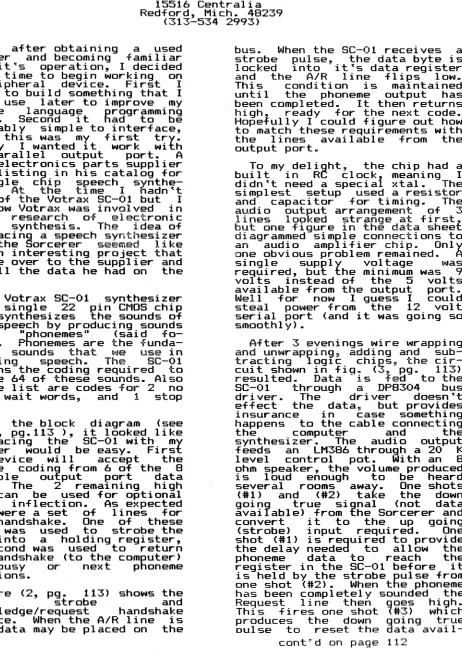
From the block diagram (see
fig. 1, pg.113 ), i t looked like
interfacing the SC-Ol with my
Sorcerer would be easy. First
the device will accept the
phoneme coding from 6 of the 8
available output port data
lines. The 2 remaining high
bits can be used for optional
voiced inflection. As expected
there were a set of lines for
data handshake. One of these
lines was used to strobe the
data into a holding register,
the second was used to return
the handshake (to the computer)
for busy or next phoneme
conditions.
Figure (2, pg. 113) shows the
data strobe and
acknowledge/request handshake
sequence. When the A/R line is
high data may be placed on the
bus. When the SC-01 receives a
strobe pulse, the data byte is
locked lnto it~s data register
and the A/R line flips low.
This condition is maintained
until the phoneme output has
been completed. It then returns
hight ready for the next code.
Hope~ully I could figure out how
to match these requirements with
the lines available from the
output port.
To my delight, the chip had a
built in RC clock meaning I
didn~t need a special xtal. The
simplest setup used a resistor
and capacitor for timing. The
audio output arrangement of 3
lines looked strange at first~
but one figure in the data shee~
diagrammed simple connections to
an audio amplifier chip. Only
one obvious problem remained. A
single supply voltage was
required, but the minimum was 9
volts instead of the 5 volts
available from the output port.
Well for now I guess I could
steal power from the 12 volt
serial port (and i t was going so smoothly) •
After 3 evenings wire wrapping
and unwrapping, adding and
sub-tracting 10glC chips, the
cir-cuit shown in fig. (3t ~g. 113)
resulted. Data -is ~ed to the
SC-Ol through a DP8304 bus
driver. The driverdoesn~t
effect the data, but provides
insurance in case something
happens to the cable connecting
the computer and the
synthesizer. The audio output
feeds an LM386 through a 20 K
level control pot. With an 8
ohm speaker, the volume produced
is loud enough to be heard
several rooms away. One shots
(#1) and (#2) take the down
going true signal (not data
available) from the Sorcerer and
convert i t to the up going
(strobe) input required. One
shot (#1) is required to provide
the delay needed to allow the
phoneme data to reach the
register in the SC-Ol before i t
is held by the strobe pulse from
one shot (#2). When the phoneme
has been completely sounded the
Request line then goes high.
This fires one shot (#3) WhlCh
produces the down going true
Dulse to reset the data
avail-cont'd on page 112
c'
[image:2.612.93.555.87.740.2] [image:2.612.54.328.116.724.2] [image:2.612.313.559.123.740.2]c
. _ - - - - F O R
THE EXIDY
SORCERER™ _ _ _ _
-..
• •
...
::: .:
I···
.:.', ',-:-:.•
• •
A Dogfight in Space
.. a real-time graphics game for two players
• written in machine language for the Exidy Sorcerer™
•
• graphics characters continually redrawn for smooth, high-resolution movement
• each ship realistically accelerates, rotates, and fires
• 16K required
• $20.00 for cassette (includes shipping)
III
VISAI
We think you'll like it!
P.O. B 0)( 1 91 0 0 E U G ENE, 0 REG 0 N 97440 o. (503) 689 - 7 4 0 9
able flip flop in the Sorcerer.
The software monitors this
change and begins sending the
next phoneme code. Bypass
capacitors are provided to help
keep each power voltage clean.
The 39 k resistor from the SC-01
A/R line to ground, provides a
pull down for the one shot. I
tried a voltage divider and a
series drop resistor arrangement
here (since I am driving 5 volt
logic with 12 volts), but this
worked the best.
I built my synthesizer on a
small piece of perf. board.to
which I epoxied a 30 pin
connec-tor edge from a scrap PC board.
I try to standardize on
connec-tor pin assignments, because
after I get an S-100 DOX built,
I~ll just plug the board in.
Program #1 shows a Basic
lis-ting for saying the alphabet.
Lines (2) thru (9) are for
editing and p-rinting purposes.
BeginnIng at lOr decimal data is
read in. It IS then placed on
the output port (output 255
1
A).Statement 40 (WAIT 254,64, 91)
causes the sorcerer to monitor
the data accepted line for a
reset. If you stop program
execution whIle a phoneme is in
progress the phoneme will not
stop, typing (OUT255,63) (CR>
will turn off the sound.
For demonstrations I run
pro-gram #2. This program uses the
synthesizer to describe my
sys-tem to those present.
I paid $55 dollars for my
Votrax SC-Ol (see note 1), which at first seems like a lot for a
chip, But for the ease of
installation and programming the
pric.e isn ~t that bad. If
re-quested, Westland Electronics
will provide a dictionary filled
with word to phoneme code
con-versions. I found the
dictio-nary very helpful for encoding
words that weren~t even listed.
5 6 10 20 30 40 50 55 60 70 80 90 100 110 120 130
Program #1:
REM--THIS IS IIABC II
REM--SPEAK ABC~S
READ L .
IF L=63 THEN RESTORE OUT 255 L
WAIT 254,64,191 GOTO 10
REM-ONE LTRISTATEMENT DATA 6,33 41,62
DATA 14,60,41,62 DATA 31,60,41,62 DATA 30,60,41,62
DATA 60
1
41_62DATA 2 29 62
DATA 30,26,60,41,62 DATA 62,62
140 150 160 170 180 ;[90 200 210 220 230 240 250 260 270 280 290 300 310 320 330 340 350 360 370 380 390 400 410 420 430 5 6 10 20 30 40 50 55 60 DATA DATA DATA DATA DATA DATA DATA DATA DATA DATA DATA DATA DATA DATA DATA DATA DATA DATA DATA DATA DATA DATA DATA DATA DATA DATA DATA DATA DATA DATA 6,33,41,42,16,62 21,0~9~41,62 30,2b,U~6,33,41,62 25~0.6,..)3,41,62 2,0,35,24.62 2.1.12.62" 2~/~13i62 5_,~3,-,5,62 37,60,41,62 62.62 25~34,54,55,55,62 ~li4ji5~262 . 42,60,33,41,62 34,54,55,55,62 15,60,33,41,62 30,50,14,35,24,34, 54,55 62
2.1.1,,25~3L31162
4~,,,-1,Ui"f~4 ,62 18,60,4 ,b2
62,62,62,62,62,62 31,60,41,62
62 62
21:0 9 41 62 13,22,53,55,62 121..21! 41 ~ 62 .
6 ~3 41 b2 . 14,60,4i,62 31,60,41,18
62,62,62,62,62,62, 63
Program #2:
REM-THIS IS IIVOICE II REM-VOICE DESCRIBES THE
48K SYSTEM READ L
IF L=63 THEN RESTORE OUT 255,L
WAIT 254,64,191 GOTO 10
REM--ONE WORD/STATEMENT DATA 27,2,35,24,35,53,
55,62
65 DATA 30,32,33,15,62,62,
62
70 DATA
80 DATA
90 DATA
100 DATA
57,11,31,62
11 9 18 62
41:52,52 43 62 29,43,2,0,13,30,24
41 62 .
110 DATA 2~0~28~3,18,11,9,
30,41,b2
120 DATA 31,53~52~43,31,58,
581..3,~8,b2
122 DATA 3L~ .
125 DATA 2~,50,12,37,34,54,
55,42,58,62
140 DATA 31,37,60,33,25,10, 20,62
42,54,55,55,62 34,54_55,55,62,62 62 62'62
150 160 165 170 180 190 200 DATA DATA DATA DATA DATA DATA DATA
12:21:0 41 62 57,61,42,31,62 21,49,58,62
25,35,35,13,42,6,
33,41113~30,62
210 DATA 11,9 3 b2
220 DATA 29~52152L43L42~41,
5'~1..4 i4L26L,2~,0,
6,>3~,4 ,6
225 DATA 6~
230 DATA 14,35,8,41,42,31, 62
(DB-ZS) (~'Z.S)
sEF-,\f\L ?t-RAl\...I:.L
\'
c_
) C)
~
T
'!>~'2.
G.)r})~
I
I
I
"PoRT
'3 f - - - : : - 1
4 ' - - - " : 1 51---.'"'-1
~ L - - - " ' i = _ _ l
7~---~:f-I
E I _ _ _ _ ----;~~,
,... 1 - - - : : : - - 1
, ?
I - - - " " - iI
I
+5I
ICo )2,~I
10KI
.01 I~OI~-.----;
Iii-rl
13 \ 6~
n.-u, A·JO'\ C¥ _ , I Ci' 5
1/I---,--'-t'A,
,
(I) A\(Z} .Pho"'e,...~
C"d~ G,B,l.
It\f''.Jt~
f\aure. \
J
c.\ "'c.. \c..
i:\M~ c ... tt,.. ... -t
+Ic
+12
LM3B<D
\10.\\6-i ) ...
'*'c..
t'lllo.\i~
x==:x.
1. ... """'\'0St.ok
i.
j;=~)
CPVNSTAR:
A Utility to Convert Northstar Disks to Vista Format
B~ Larry Conklin
10~ Riverglen Road Liverpool, N. Y.
(315)652-3564 When I was ready to add a disk
drive to my Sorcerer, Exidy was not yet se ling a disk system of their own. A note in the system manual recommended the Northstar 5-100 controller. Since I inten-ded to add the S-100 expansion chassis to my system anyway, the Northstar system looked quite attractive. The operating system is very good~ and is well sup-ported by thIrd party software vendors. The other a ternative was the Vista disk system, running under CP/M. At that time Vista had not announced their Sorcerer compatible controller, but they were offering a cus-tomized version of CP/M that was ready to run on the machine. The combInation of CP/M and the larger disk capacity (204.8 K
vs. 179.2
K)
pursuaded me that Vista had more to offer, and that is the system that I ended up buying. I have been very well pleased with the choiceaAs anyone. who has ever read a Lifeboat catalog can attest~
there are dozens of 5" diSK formats, none of which is com-patible with any of the others. Unfortunately, the Vista disk format is not well supported. Very few software vendors make. theIr products available on Vista compatible disks. I was surrounded by tempting CP/M
software~ but had no way to jump the "medIa gap". I was beginning to think I would have been better off with the Northstar system after all. I could have purchased CP/M for that system and, in contrast to the Vista format almost everybody that sells CP/M software supports the Northstar disk format. It has come as close as any to becoming a standard format for 5" drives. In reading through the technical manual for ~he Vista controller, I discovered a statement that i t was "similar to the Northstar disk con-troller". It occurred to me that if they were similar enough, you ought to be able to persuade the Vista controller to read a Northstar disk. As i t turns out, you can. Figuring out how to do It turned ou~ to be harder than I had expected. CPYNSTAR is the result of that effort. It will copy the entire contents of a
Northstar double density disk to a Vista disk. As written two drives are required. but since t~e copy is made one track at a tIme, the
program could be modified for use on a single drive system.
The first step was to find out exactly what the respective disk formats were, and how they differed. A friend who had a Horizon system provided me with information from the Northstar documentation that described the disk format. I had to dig the corresponding information for the Vista format out of the listings they provided for their CP/M BDOS. FIgure 1 compares the formats.
Northstar Sector hole
32 bytes of zeros FB (start of
FB data bytes) 512 data bytes CRC check byte
Figure 1
Vista Sector hole 24 bytes of zeros
01
55 (start of data byte) track no. sector no. 512 data bytes CRC check
~Ate
24 bytes of FF
In addition to the differences that are apparent in the figure, the CRC check bytes are cal-culated different y. On a Nort~
star disk each data byte IS excluxive OR'ed to the CRC byte and the result is rotated left. On a Vista disk the data byte is added to the CRC byte and the result is rotated right.
Having determined what the respectIve recording formats were,the next step was to figure out how to read a Northstar disk with the Vista controller. To do that. you have to understand how the Vista controller gets in sync with the serial data stream coming in off the disk. After a sector hole is encountered. the controller uses the strin~ of zeros to get in phase with the
cont'd on page 116
r
''---r--.
I
\
... -.. ~
r
--- - - - - --- --
---GOODBYE
FoDoSo
r---'---NO 5100 NEEDED
8" DRIVES
5" DRIVES
DOUBLE SIDED DRIVES
5" CAPACITY (55) MAX NO OF DRIVES
COMPLETE SINGLE USER FACILITY
HARDWARE DOC
USER GUIDE
TPA SIZE (MKII I
WARRANTY
DIGITRIO
yes
yes
35,40,77,&80
yes 350K
4
yes
yes
40 pages
40K
12 months
EXIDY FD5
yes
no
77 track
no
308K
3
no
none
10 pages
39K
3 months
$425
includes: -"controller >'(CP/M 2.2
;(Sorcerer cable ;cextra utilities ;cdocumentation >'(shipping costs
i V/SA* ,
DEALER ENQUIRIES SOLICITED
Digitrio's new disk controller is the most versatile way to attach floppy disk drives to the Sorcerer. First released in June 1982 the Digi trio controller is now being used by satisfied customers throughout Australia.
For further information contact Dr. D. Trussell at:
DIGITRIO, BOX 4553, MELBOURNE, VIC 3001, AUSTRALIA
* * * * * * * * * * * * * * * * * *
TERCENTENNIAL TECHNICAL
. Video and Data Communications
Technical Services
* * * * * *
* * * * *
*
*
*
* * * *
For quality Service on the following equipment: Exidy Sorcerer Computers - Expansion Interface & Box
Radio Shack ••• all models - Zenith/Heath - Atari Leedex, Sanyo, Electrohome ..•••... and other brand monitors
Micropolis, Vista, Shugart, Percom, MPI .•• and other drives Modems, Dot Matrix Printers •....•.••••...•.. most brands Memory upgrades and new Monitor 1.1 PROM's available. Services available on most home entertainment electronics:
Solid State Television, foreign and domestic brands. Video Recorders---Video Cameras---Video Monitors Stereo Receivers---Audio Recorders---Record Changers Video Switchers-- -Time/Date Generators-- - Video Disc Systems
Video Games: Atari and others.
For above services (Tech. lic. #8228), or consultation, call or write: Jack MacGrath
TERCENTENNIAL TECHNICAL P.O. Box 5
70 Tercen tennial Drive Billerica MA 01821
Phone, after 6:00 pm EDT, (617)667-8272
data. As the data is received i t is shifted bit by bit through a register in the contrcll~r. The controller is looking for the first 1 t6 appear in what would be the carry bit of the register. When the 1 is seen. the controller knows that th~
start of the data byte is in the register, and that each 8-bit group that follows will represent another data byte. Apparently the Northstar controller uses a different scheme for recognizing the start of the data since the all important synchronization brte required by the Vista control er is missing. As a consequence. when the Vista controller attempts to read a Northstar disk, the first non-zero bit seen as the "carry" bit is the MSB of the first start of data byte (FB). At this point bits
7-1 of the data register contain bits 6-0 of the flrst start of data byte and bit 0 contains bit 7 of the second start of data byte. The controller thinks i t is in sync with the data however every subsequent byte will be "over-shifted" by one bit.
The solution to this dilemma is to read each byte from the controller register and then rotate i t right through the carry bit. The result of this operation is to shift bits 6-0 down into their proper position in the data byte. Bit O~ as read from the controller reglster2 is
the MSB of the byte that follOWS in the data stream. The rotate through carry operation captures this bit and saves i t for next time. The bit that is rotated into bit 7 of the data byte from the carry bit, is the MSB of the current data byte which was saved from the preceding byte read from the controller. Figure 2 illustrates what is going on.
The only byte that cannot be recovered in this manner is the initial start of data byte. Since we already know what we expect to see in this byte when the controller sync's up, this
isn't a problem. The program reads each 512 byte sector lnto a buffer, correcting for the "phase error" as i t goes. The CRC check byte is then computed from the contents of the buffer and compared with the value read from the disk. If all is well. the buffer is added to the contents of BIGBUF until ten sectors have been accumulated. The contents of BIGBUF are then written on the output disk in Vista format.
Aside from the "phase
,
correctiona logic just
de-?cribed~ the_rest of the program
I S stralght-+orward~ However. I
did make calls to low-level routjnes in Vista's disk driver
softwa~~ (SEEK. WSEC. SELDSK.
and MHOME). If ~our in~tallatioh
of Vista's CP/M is configured f?r a diffe~ent memory size than mIne (54 k) you WIll have to change the four calling addresses by redefining the corresponding equates. Unless Vista has released a new version of their BDOS, you should be able to compute the new addresses by biasing the entry points by the difference in memory size. In any case, I used Vista-s names for the entry points and you should be able to find them in the VISTA BDOS listing.
The program is self prompting and very easy to use. You are asked for an offset value and whether the input disk is in Lifeboat CP/M format. As far as I am aware, everyone who sells CP/M software on Northstar disks uses the same logical to physi-cal sector mapping scheme. The offset value determines where each sector will be located on the output disk relative to where i t was on the input disk. The offset is in terms of logical (512 bvte) sector num-bers. The CP/M directory on a Vista disk is located on sector 6 of track 1, but on a Northstar disk1 i t is in the first sector
of track 2. Thus the required offset for a CP/M conversion is -4. The flexibility provided by being able to speclfy an offset, and to enable or disable the logical to physical sector map-ping allows the program to be used to do a straight conver-sion. I have written another utility that will convert North-star DOS files on a Vista format disk to CP/M files, but that is another story.
There are a few vendors that only supply their programs on single density disks. There is no way to directly convert these. since the Vista
(
",--..
*EXT MOFF and *MEM OFF Modifications for Sorcerer I by Eric Moyer
For those users of disk drives with the Sorcerer I who want to or have already expanded their computers to support 48K inter-nally (See the March 1, 1981
issue_~of_Sorcerer~s Apprentice,
pp. ~~-~~) and want to be able
to use the disk drive without the bootstrap interfering with other memory here is a modi-fication which will disable the RAM at the location of the boot-strap. With this modification, the boot program is positioned at the top of RAM (BFOO-BFFF hex for 48K or DFOO-DFFF he~-~ if you also choose to build the RAMPAC modification). As some may re-member, i t was necessary to cut the trace from the E~{pansion Bus connector J3 pin #45 (see Exidy tech note number 2) to enable the disk drive to function cor-rectly. This is the pin which the FDS or DDS sends the nega-tive-logic (hereafter referred to as not-) EXT MOFF signal to the Sorcerer on to tell i t to turn off the RAM at the boot-strap location. With the ad-dition of three gates and some
jumpers. the Sorcerer I can cor-· rectlr interpret this signal and disab e the proper RAM. The to-tal cost for this modification is about 50 cents for a 74LS08.
(See diagram below).
The OR gate labelled lOA is the existing OR gate on the circuit board. the three others are the additional ones needed for this modification. The sin-gle 74LSOO gate is one left over from the 48K modification (see page 118 of this issue) while the 74LS08 is the only addi-tional part needed. The pin numbers near the gates cor-respond to the IC pin numbers, the 74LSOa can be added to a small piece of perforated PC board. The not-ROMPRE line is connected to pin 23 of the ROMPAC socket; while the not-EXT MOFF line is connected directly to pin 45 of the Expansion Bus connector J3.
NOTE: The numbering for the ROMPAC socket is INCORRECT. Be sure to use the numbering on the ROMPAC itself in the pOSition i t would be installed in the com-puter. Also note the two loca-tions where traces must be cut. Use a sharp X-acto knife or equiv. to make two cuts about
1/16" apart, and then remove the
cut out portion of the trace. For these modifications i t may be necessary to remove the main PC board; do so carefully.
If you have not yet done the 48K mod. you can replace two of the 74LSuo gates (on~s wi~h pi~
# 8 connected to pin #-s lL
and 13) with a single 74LS08
~a~et whi~h p~t~ ~he to~a~~p~rts
~OJnL at ~ ChlP~ Insteau u, ~.
When the modification is com-plete and you turn on your Sorcerer and disk drive. you should get a message saving that the top of RAM ~s BEF~_for 48K or DEFF for 56\<:.. Notice that this is 256 bytes lower than before. the memory location is now b~ing used by the disk
drive~s bootstrap PROM, and the
256 bytes of RAM are now inactive.
ROMPRE
EXTMOFF
From IC 9B
pin 6
2
1
4
5
From 48K mod 10
10A
Cutx ____ ~----~9~
'---~
LS08 3 MEMOFF 9
LSOO 10
From IC 10B
pin 2
LS08 6
CutX:~ ______ L -______ ~~~T~o~i~n~2~1
ROMPAC jack
Diagram 1
*-
*- *- *- *-*- *-
*-
*-
C~~~~~ti~g th~ S~~~~~~~
t~ 5 6 K th~ E~~y W~y
by Bob Al e~·: ander 4675 Holycon Circle
San Jose, Ca 95136
(with Model I mods and notes by Eric Moyer) I had been looking for a way
to add more memory to the Sor-cerer for some time, since many applications required it, as well as several languages I was interested in learning. So what follows is a description of a method that will get you going with a minimum of fuss and casn outlay.
I had a spare EPROM PAC laying around, and decided to use the new HItachi 6116-3 2K static RAMs which have been available for some time now at a rela-tively modest cost as well as being pin compatible with the 2716 EPROM. If you use the stan-dard Exidy ROMPAC don~t dis-pair, as the modi1ication will work equally well for either.
If trying to figure out the jumpers on the card keeps you awake at night mumbling to your-self, as It does to me, you're in good company! Don~t worry
-we don~t use 'em! All wiring is
point to point to keep changes on different versions of the card to a minimum.
EPROM PAC modifications: 1. Cut the traces (if present) to pins 26 and 27 at the con-nector. This removes +12V and -5V from the card.
2. Locate the bypass capacitors that are on these two lines. and remove them. You should wind up with only one electrolytic cap and four ceramic caps (all on the +5V line only) when
finished.
3. Cut any jumpers in the pad areas associated with pins 19, 20, and
21-4. Check the connections to the above pins to insure they~re not shorted to each other. and that the individual pins are . connected to all four sockets. 5. Jumper pin 21 of the sockets to pin 28 of the connector
-this is the WRITE enable signal. 6. Jumper pin 20 of the sockets to ground.
8. Plug in the 6116 static RAMs. The only precaution here is to make sure the static RAM speed is as fast as your system RAM. I ran into a problem with this.
NOTE: On some of the older ROM PACS pin numbers 28. and 30 on the edge connector are connected together (actually i t is one BIG pin). For that PAC to work correctly with the RAMPAC modifications. i t is necessary to cut these apart. Using a sharp knife make two lengthwise slits a third of the way In from either side of the big pin, and scrape out all the trace in between the two slits. This should result in the big pin being converted into two normal sized pins, with a gap of bare board the width of a p~n tra~e
in between them. ThIS modI-fication is necessary on ALL EPROM/ROM pacs •. NOT just the ~ne
with the statIC RAM In ltD
(E. M. )
This completes the mods neces-sary to the EPROM PAC.
Model I modifications: The only modifications
necessary for the main PC board (for non-disk users) is to cut one trace and install one
jumper.
1. Locate IC 9B (a 74LS21). Cut the trace connecting to
pin 3 (yes, its on the bottom).
2. Run a jum~er from pin 3 of RAM chip Ie 1~A (this is
the WR signal there may be a closer place
to
pick i t up. butI used this) to pin 28 of the ROMPAC connector.
NOTE: The numbering of the ROMPAC connector is WRONG. Refer to the numbering on a properly inserted ROMPAC itself.
That~s i t for the Model I mods. For disk users. see the EXT MOFF modification. and the controller board reconfiguration for the Model II below.
Model II modifications:
/' .. -...."
(
'- "
7. Make sure pin 19 of the sockets goes to pin 20 of the connector. If not, wire i t in.
There are two areas on the
C~
main board that need to bechanaed and nnp ~wi~rh nn ~hp
C:
A NEW
MONITOR
FOR THE
SORCERER
At last, here's a revised version of Exidy's operating system that has full terminal functions. EXMON2 will increase the flexibility of your Sorcerer computer and open the door to many excellent software applications that require special terminal features.
These New EXMON2 routines can be used directly from your Sorcerer keyboard and are easy to use in BASIC programs:
• Direct cursor positioning • Clear to end of line
• Clear to end of screen • Delete line
e Text highlight onloff o Reverse ASCII characters
EXMON2 has many additional features that give your Exidy Sorcerer even greater flexibility:
• Define and reserve top of screen
It Search memory for hex or ASCII string It Parallel and serial printer drivers
with or without line feeds
• A properly working serial port
(for modems, etc.)
• A f-a-s-t keyboard status routine that's CP/M compatible
• And there's more ...
Each EXMON2 set comes complete with two burnt-in, fully-tested Eproms and an accompanying user's manual with easy-to-understand installation instructions. 1 set (2 Eproms & manual) ... $65.00 u.S. + postage* Group l (5 to 9 sets) ... $55.25 U.S. + postage" discounts f (10 or more) ... $52.00 u.S. + postage" * Add $5.00 U.S. with the first set, $3.50 U.S. with each
additional set for postage and handling. Please make cheques payable to:
H.A. LAUTENBACH, and mail to: P.O. BOX 1173, STN. B, DOWNSVIEW, ONTARIO, CANADA M3H 5V6
•••••••••••••••
• TO ORDER EXMON2: •
III - -
Please send more information on EXMON2. •I have enclosed my certified \;heque/money order • for $ ; please sen!j me __ EXMON2 set(s). •
• Company/Club •
• Name ________ . _________ ._. _______ .. ____ •
II
Address______ . ___ .. _. __ . ____ . __ ._ . •II --- ... ---.-.-- .--... --.----.---.-. _ .. ---. •
III
!II •
II
I) (IDIPI1 II II II II • • •
disk-controller card.
1. Locate Ie 9A ... i t ' s the 74LS08 near the main RAM. ThEt-e is a spare positive AND gate at pins 4~ 5~ and 6 that we will Llse.
2. Run a jumper from 9A-5 2F-1 (EXT MOFF -low true) to 3. Locate and cut the trace going to 10A-8 (ROMRD15)
4. Jumper lOA-8 to 9A-4
5. Jumper 9A-6 to the trace you cut from 10A-a which goes to pin 21 of the ROMPAC connector.
6. Locate E1a and E19 and jumper them together. These are near the ROMPAC connector and may be hard to read. If so. just wire 6H-5 (WRITE - low trLle) to pin 28 of the ROMPAC connector. 7. The ne}:t step wi 11 require that you open up the disk drive cabinet and locate the a pole DIP switch near the left-rear corner of the controller card. Set switch 3 'on' and make sure all others are 'off'. This is the boot address switch. If you own one of the older controllers without the switch. make the following mods to th~
controller card.
A. Cut 5D-12 and 13 (74LS04) B. Cut 3F-7 (74LS241)
C. Jumper 3F-5 to 3D-3
D. Jumper 5D-13 to 3F-7 E. Jumper 50-12 to 3D-2
That~s it~ No software changes
should be necessary. Although the changes here are specific to the Mod I 'B' and the Mod II 'C-2' boards, they should be ap-plicable to all others as well.
Also, the Word Processor Pac will not work now. but the ROM-PAC BASIC and Dev·Pac should if you issue a 'GO COOO' upon cold-booting the system. The new disk boot address is now at DFOO.
I haven't included any mods for the Micropolis system, since I am unfamiliar with its oper-ation •
Total cost will run between $30-60 unless you need to pur-chase an extra EPROM card, which was. at last check, around $50 from Exidy. but since I never use the ROMPAC BASIC any longer: I decided to use that card. AL anv rate, I haven~t seen add-on memory for less than $135 or so which means you'll save
$25-lob.
even if you need to buy tt-.,ee}~tra .card.
I N THE P U B L I C DOMAIN
by Bruce Blakeslee CP/M - Micropolis Librd~ian
906 Crestwood Road - West Westfield New Jersey 07090
(201)-23:3-3185 (Evenings) This, the third installment,
will focus on the SIG/M User~s
Group. The Special Interest Group for CP/M software was for-med about 18 months ago by the ACGNJ <Amateur Computer Group of New Jersey) because i t was felt that a ne\..., outlet for publ ic do-main software was necessary. The CP/MUG had become somewhat in-active, rarely releasing new disks of software. and l t was felt that another voice was ne-cessary. In the 18 months they have been in existence, 69 disks
of public domain software have been released. With 4 to 8 new disks a month this is a very active and dynamic group eager to publish good software. The following is a listing of the software available on their disks. I am able to provide a much more extensive catalbg of CP/MUG and SIG/M· software on disk if this article whets your interest. Note the end of this article for particulars on ordering software.
****************$t***************
*
Notations Used Below*
*
n
• 1
=
A Volume Most Will Want*
• 2=
Of Interest From The*
*
Point of Software*
*
Development.*
*
3=
Of Limited Interest*
** ••••••••••••••••••••••••••••
***
Volume 1 •••••Volume 2 ••••• Volume 3 .•••• Volume 4 ..••• Volume 5 ••••. Volume 6 ••••• Volume 7 .•••• Volume 8 ••.•. Volume 9 ••••• Volume 10 ••••• Volume 11 ••••• Volume 12 ...•• Volume 13 •..•• Volume 14 ••••• Volume 15 •..•• Volume 16 •..•. Volume 17 ••••• Volume 18 .•.•• Volume 19 ••••• Volume 20 ••••• Volume 21 ••••. Volume 22 • . . . . Volume 23 ••.•• Volume 24 .•••• Volume 25 ••••• Volume 26 ••••• Volume 27 .•.•• Volume 28 ••.•• Volume 29 ••••• Volume 30 ••.•• Volume 31\ Through
Volume Volume Volume Volume Volume
\
/
38/
39 •••••
40 ••••• 41 •...• 42 . . .
Original 350 Point Adventure (8080) Adventure Source Code (Fortran) Expanded Adventure - 500 points Miscellaneous CP/M Utilities 8080/8085 Memory, rCOM Disk Diag. 6502 Simulator for Z80
RBBS and CP/M Utilities
PASCAL and Communications Utilities CP/M Utilities
Utilities!. Games, Disassembler Expanded Adventure for
zao
Cross Reference index of CP/MUG Volumes 1-47 and SIG/M Vol.'s 1-11. HELP system, FIGFORTH 1.1
HELP system
Catalogs of CP/MUG Volumes 1-47 and SIG/MUG Volumes 1-3.
CP/M Utilities
&
Communications CP/M UtilitiesCP/M Utilities
Pascal Z User~s Group Volume 1 Pascal Z User's Group Volume 2 Pascal Z User~s Group Volume 3 Pascal Z User~s Group Volume 4 Pascal Z User's Group Volume 5 Pascal Z User's Group Volume 6 Pascal Z User's Group Volume 7 Games. Mail Label
Advanced Terminal Systems-Confidence Tests.
Games~ Billing System, Home Remote Control Programs
Various DOC, READ-ME, and Abstracts More of the above
The Yale Catalog of Bright Stars
Language Analyzer
Misc. System Support Utilities Cromemco CDOS-CP/M System Support SD Sales Hard Disk Support
cont'd on page 121
(1) (3) (1)
(1)
(3) (2) (2)
(3)
(1)
(1) (1) (3) (1)
(1)
(3) (1)
(1) (1) (1) (1) (1) (1) (1) (1)
(1) (1) (3) (1)
(3) (3)
(3)
(1) (2)
(3) (2)
o.
'1
CPfM-86 BIOS~ TINCMP Compiler CPt!"1 Uti I i ties
Dungeon - Original Fortran Code tvlore Dungeon
c'
Volume 43 ••.•. Volume 44 .•••. Volume 45 ••••• Volume 46 .•.•• Volume 47 •.••• Volume 48 •.••• Volume 49 •.••.
l'1ore Dungeon
CP/M and Communication Utilities Accounts Payable/Receivable.and Master DataBase System
(2) (1) (3)
(3)
(3) (1) (1)
Volume 50 • . . . . Volume 51 ••.•• Volume 52 ••••• Volume 53 ••••• Volume 54 ••••• Volume 55 ••••• Volume 56 ••••• Volume 57 ••••• Volume 58 ••••• Volume 59 ••••• Volume 60 .•••• Volume 61 ••••. Volume 62 ••••• Volume 63 ••.•• Volume 64 ••••• Volume 65 ••••• Volume 66 . • . . . Volume 67 .•••• Volume 68 ••••. Volume 69 •••••
DTC Hard Disk Bios, Voice Synthesis System
1981 Information Catalog
Updated Disk Cataloging System Updated SAM76 Language
Z80 CCP Replacement
Documentation Addendum #3 . Musicraft Music System
More Musicraft More Musicraft
PISTOL (FORTH like) Language CP/M Utilities
Dan's Information Management System Pascal Z User's Group Volume 10 Pascal Z User's Group Volume 11 Pascal Z User's Group Volume 12 Updated Bulletin Board System Support, Utilities.
Updated Bulletin Board System Updated Bulletin Board System CP/M Utilities
Pascal Z User's Group Volume 13
(1) (3) (1) (1)
(1)
(3)
(1) (1)
(1) (1) (1) (1) (1)
(l)
(1) (1)
(1) (1)
(1) (1)
As you can see there is a lot here. In the future SIGtM is supposed to release tiny ADA as featured in 5-100 Microsystems among other thin9s. What can I say, order the Catalog disk from me and get a more detaIled picture of what's in these disks. In future months I will an-nounce additional volumes of the CPtMUG and the SIGtM Users Group. I will also be. discussing individual volumes which I feel are of si9nificant interest to Sorcerer Users. (Some of the languages and . utIlity disks fall into this category.) I would also like to publish the
L
r . remar ks of others about pieces of pub Ii c domai n software you have usedand liked or found poorly written. This is how we move ahead and progress. I would now like to announce the first in a series, I hope, of
o
Sorcerer User Group disks. These disks are made up of software, Sorcerer users have either written themselves or significantly rewritten to run on the Sorcerer. It is all Public Domain. As I have lndicated before, If you contribute to the Sorcerer Users Group I will send you a disk of software of your choice. (One disk for each disk or partial disk contri-buted.> I hope this will encourage many of you to contribute.
The Sorcerer User's Group (SUG)
SUG Volume 01 ••• Software discussed by Brian Lewis in Volume
4~ #3. This includes, MSPEED, ASCIIFY, LIFE, MODEM7X, etc.
SUG Volume 02 ••• TIP FIX and BASIC PAC programs. This inclUdes ~6K-MOD. 8304PROB.TIP, MX-80.TIP, SERIAL. DOC, MX80PLOT.BAS, etc •
SUG Volume 03 ••• PAC BASIC programs. These are tu be used by systems which can run both PAC BASIC and the disk system together. This includes, STARTREK, 5 Astronomy programs, BOWLS5, CHKR5 (Cneckers), etc.
SUG Volume 04 ••• More TIP, FIX, MOD, and DOC files as well as a program for the Hayes Smartmodem •
....
,."
...
,
...
,
... .
• PRICES •
•
>X 1. $3.00 + postage if you suppl y the•
•• media already formatted. •
*
•
• 2. $8.00 + postage if I supply the media •
#- •
C / B < J R E V I E W
by Robert Hageman C, a compiler language
deve-loped at Bell Laboratories by Dennis M. Ritchie and Brian W. Kernighan. runs faster than BA-SIC and' allows faster-easier program development than assem-bler. C/BO, a subset of stan-dard C (here read BDS/C), was written by Walt Bilofsky of The Software Toolworks. based on Ron
Cain~s Small C compiler as pub-lished in Dr. Dobb~s Journal.
C/BO for the Exidy Sorcerer is distributed by Triangle Systems at a price of $49.00.
As one might. expect of a sub-set, C/BO does not support some
of the nifty features to be found in the full language. Then too, C/BO does not support the "nif~y ?" price tag to be found on the full language (try
Whitesmiths~ C Compiler @$600).
The most obvious feature missing from C/BO is floating point math, which is the most costly to develop.
I found C a promising language for file manipulation, the best covered examples in wnat I read. I know, C has become the second language on RCPMs for public domain programs; utilities such as SQueeze, USQueeze~ and TYPESQ were all written in L.
The language is designed for structured programming. The ru-les that control syntax also lead one to write orderly and readable programs. This makes debugging less of a chore as the program can be written in modules and each module debugged separately. C/80 allows the use
of machine language subroutines. Routines may be included in the C program e1ther as a part of the source file or as a sepa-rate file you teil the compiler to include. This means you can have special keyboard drivers, port drivers. etc. included in any program . you need them in.
Indeed. other C programs can be included as subrout1nes in a new program.
The "User~s Guide" supplied with C/80 is just that - a guide. It will serve the purpose of informing the programmer already familiar with C of the differences between standard C and C/80. It is not and was never intended an in depth ma-nual for learning the language. The guide does try to steer you to some good references; The C Programming Language, An Intro-duction to the C Programming
Language, Dr. Dobbs Journal. Version 1.5 C/SO Manual. ana Structured Design. The ~anual
was written bv Walt Bilofsky, the writer of t/80.
I found CIBO was not directly compatible with BDS/C programs. The problem arises from those missing features which BDS/C takes for granted. This is not to say BDS/C programs can not be run on C/BO. but rather that the
programs will require. editing and rewriting to make them work.
I would recommend C/80 to those:
1. wanting to try a new language without losing an arm and a leg.
2. wanting a language easier than assembler but with most of the speed of machine code. 3. wanting a faster language
than BASIC but not too much harder to learn.
I would not recommend i t to those:
1. knowing their interests are in the BDS/C programs to be found on some RCPMs.
2. knowing they NEED floating point math for the prog~ams
they intend to write.
3. who have worked in a larger C compiler and are therefore comfortable with the
features.
* * *
* *
*
*
*
* *
* *
EDITORS NOTE:Triangle Systems is no longer supporting the Exidy Sorcerer with any kind of software. If any of you have sent mane, to them and have not received any merchandise, or if you received defective merchandise we suggest you contact Wim Plaat of Tr1angle Systems at the following address:
Triangle Systems 1690 West Lane Avenue
Columbus. OH 43221 Tel. (614)486-3527
The telephone is normally answered by an automatic answering machine and callbacks are very seldom made.· We strongly suggest that you use certified ma11 in any dealings with them. Should you receive no satisfaction via this method -contact the Attorney General of the State of Ohio. DO NOT send original documentation; have a copy notarized!
f '
I \ '
-..
q
o
C)
o
SORCERER TELECOMMUNICATIONS SYSTEM
A review by Tom Bassett
Remote computer systems, CBBS's. and data-base systems have proliferated of late. All that software there for the taking~ For t~e Sorcerer user without a CP/M disk system. though. i t ' s been "look but don't touch"; read the mail but don't download a file 'cause your terminal program can't handle it.
Enter STS
The Sorcerer Telecommunica-tions System Version 2.1 was written by Jonathan E. Burnett to make a cassette-based Sor-cerer with a serial modem behave
like a CP/M system running a version of Ward Christiansen's MODEM program. With STS, files can be downloaded and uploaded. The program is written in
z-so
assembly language, and will run on any Sorcerer (16K or more of memory is desirable). The STS program is being sold by the Sorcerer's Apprentice for $30, which buys the tape and the documentation.I have a CP/M disk system with a serial modem (a Novation D-Cat) and I've been running a version of the MODEM pr09ram for some time. I was furnIshed a copy of the STS program to test and review. I shut off the disk drives, booted the Sorcerer monitor, and gave STS a good run. Here's what happened.
Documentation
First. of course I read the documentation supplied with the tape. There's a table of con-tents, which is handy for later reference. The documentation reads almost like a "walk-through" instruction; once or twice through i t and the user has a good grasp of the system.
The tape loaded try at 1200 baud save is furnished the tape, and STS running with a cation parameter"
on the first (a 300 baud also). I LOS"d came up and nice "communi-selector.
Parameters
The parameters are pre-set for the most common situation. but the user can change any para-meter by merely typing the num-ber of that parameter as shown on the selector menu. Typing the number "toggles" the selection. and the current selection of each parameter is indicated by a reverse video display. Typing
the number 2 several times will toggle the baud rate back and forth between 300 and 1200. for
e~{ample. The parameters that may
be selected are (1) full or half duplex; (2) baud rate 300 or 1200; (3) 1 or 2 stop hi ts; (4) 7- or a-bit words. (5) even.
o~d, or no parity; (6) auto Ilnefeed on or off; (7) echo mode on or off; (S) control code displav on or off; and (9) error display on or off.
Menu-Driven
The parameters were pre-set the way I wanted them. so after playing with the selector for a while I hit return and STS dis-played a master menu. The menu allows seven different func-tions. Once in a selected func-tion the user can return to the master menu by typing the escape key. Very nice; In fact. it"s a better setup than most of the MODEM versions I've used.
The master menu selections available are (1) set parameters (as described above); (2) ter-minal modei (3) save to tape.
(4) load ~rom tape; (5) block file transfer; (6) ASCI I fi Ie
transfer; ana (7) directory display.
I typed a 2 to get into the terminal mode, and dialed the number of tne Sorcerer remote system in Detroit. The remote signed on booted its CP/M sys-tem, and
sts
behaved exactly the way I hoped i t would; that is, i t gave me full control of the remote just as an intelligent terminal should. From the remote CP/M A) prompt I typed SD (a sorted director program) and got a directory of the A: disk. Typing SD B: brought up a dlrectory of the B: disk. Calling In the MINICBBS system, I dumped a few messages. Every-thing worked just fine.Block File Transfer
Now i t was time to test the block file transfer mode. While still in the terminal mode I
typed XMODEM S FILENAME.EXT. This called the XMODEM program in the remote system, with instructions to S(end) the named file. XMODEM signed on, and I hit the escape key to go back to the master menu of STS. The menu appeared instantly. and I typed a 5 to go to the block file transfer mode. A sub-menu of-fered me the choice of S(end) or R(eceive). I typed an R. and the
screen showed me the RAM for storage of being received. and responding number of sectors available.
available the file the cor-CP/M disk
Why show the number of CP/M sectors available? Simply be-cause XMODEM, when i t slgns on in the SCend) mode, dlsPlars that information for the fi e being sent, and in fact the file is sent in sector-sized blocks. Showing . the sector count available to STS is a nice touch, as i t allows the user to make a direct comparison to the available RAM in his system. If i t ' s evident that the available RAM is not enough to hold the file being downloaded, the user can escape back to the master menu, enter the terminal mode, and abort the file transfer, thus saving connect time (which, of course? saves money if i t ' s a toll callI.
As the file was being down-loaded from the remote system, STS displayed the sector beirig transferred, and t~ ~ error count. I recei ved the ", 'i 1 e wi th no errors until I dellberately knocked on the telephone handset with a pencil to introduce some garbage into the reception. STS recovered nicely, retransmitting the offending bock.
Data Verification
STS assumes that the sending program will use the CRC data verlfication method. However, if after 10 seconds STS has not received a CRC confirmation sig-nal i t will automatically switch to the checksum data veri-fication method~ and display a message to tha~ effect. A nice touch.
STS allows 10 errors or time-outs on anyone sector being transmitted. If the errors ex-ceed 10 STS automatically aborts the block transfer mode and returns to the master menU.
When the block file transfer was completed, STS announced that fact and returned to the master menu. Ty~ing a 7 dis-played the STS file directory, showing the file just downloaded and the beginning and ending memory addresses of the file. STS can hold up to nine files; the memory available for them is equal to the Sorcerer memory size minus 6919 bytes (the size of the STS program).
Uploading
Back to the terminal mode (type a 2 from the master menu).
The ne>~t test was for
trans-mission of a file from my system to the remote. I decided to re-transmit the file I had just downloaded. While in the ter~
minal mode I typed XMODEM r '
FILENAME. EXT. Thi s loaded th\...~.
remote modem program in the receive mode. TYPlng escape got me back to the master menu, and typing a 5 again (block transfer mode) brought up the sub-menu. I typed an S to indicate I was sending a file, and STS asked for tne file number to send. Since I had only the one file in memory I typed a 1 and we were off and running. The file transferred without error, and, when finished, STS went back to the master menu. I typed a 2 to get back into the terminal mode, and. when the remote showed me the"A) prompt, I typed BYE to terminate the seSSlon with the remote.
Tape Save
Now that I had a file in memory, I wanted to save i t to tape. I typed a 3 from the master menu (save to tape)? and was shown a directory dlsplay listing all the files in memory and tne number of each. STS asked me to type the number of the file I wanted to save (I typed a 1) and the usual 5-character file name. Then ( selected the 1200 baud option, __ / started the tape recorder in the record mode, and hit the return key. The flle was written to tape, and STS asked if I wanted to make another copy. I answered N(o), and STS then asked if I wanted to dump more files. I answered N again, and the master menu reappeared.
Of course, saving a file to tape is not as fast as saving a file to disk. But in all other aspects the STS program runs as fast as most versions of the MODEM program, and is really easier to use. The master menu, and the interactive p,rompts, are more "user-friendly' than the command lines required in the MODEM program.
Tape Load
I tested the tape load option (4 on the master menu) by loading the program I had just saved. This demonstrated the memor¥-clear feature of STS. On the irst tape load attempt following a tape save or any file transmission. STS wil assume that you" have ei thF..----.' saved all the flIes in memory c.~/ have transmitted them all • . and no longer need them. The program will automatically purge all
cont'd on page 125
files, making the whole memory available to load new files. On subsequent tape loads (with no intervening tape saves or file transmissions) 5TS will load the additional tape files without purging memory. up to a ma~{imum
of nine files· or memory ca-pacity.
This automatic purge feature is good, but i t is necessary that the user understand it. A file could be lost if the cor-rect sequence of loads, trans-missions. and saves is not followed: Perhaps a cautionary "are rou sure?" message would be usefu here.
Now that we have saved a downloaded file to tape, what do we do with it? Well, first of all we have to know where in memory i t should be loaded. The file 1S saved to tape? and will be reloaded, at ~he memory addresses at which i t resides after being downloaded. If the file is a program, this will probably not be the run address. So after we reload the program i t must be moved with the monitor to the correct address and resaved on tape. Likewise, a text file may have to be moved to the correct load address for the word processor pac. The STS documentation does not mention any of this, and i t probably should. although anyone familiar with tne Sorcerer will be fa-miliar with these requirements.
ASCII Files
STS has another feature that~s
really frosting on the cake. The CP/I"I MODEM programs are designed to transfer binary and text files in the block mode, as is STS. But STS also incorporates a fi Ie transfer option that wor-ks
in a mode similar to that em-ployed by the PLINK CP/M public domain programs. In this mode, 7-bit ASCII files are trans-ferred without data veri-fication. This allows STS to operate with remote systems having little or no transfer software at the remote end. The documentation explains the protocols necessary, and gives step-by-step procedures. This mode will allow "capture" of interactive communicat10ns with the host computer, such as the dialog that appears on your screen when in contact with a CBBS system. !"Iost of the CP/M MODEM programs don't have this feature, although the latest versions (MODEM7, for example) have incorporated it.
STS allows you to "mix" recei ved f i I es; that is., you
might receive a file block mode. then receive in the ASCII mode. then in the block mode,· etc.
in the another a third
The STS documentation provides directions for customizing STS so that the program LOGs 1n the desired configuration. This makes i t unnecessary to select the desired communication parameters at the beginning of each session.
The documentation also provides a listing of key-press
I he}~ code / character display
or function. And, for· the benefit of the first-time user of a communications system, the documentation has a glossary of communications terms.
It~s Good~
STS is a major programming effort, and is light-years ahead
0+ any other communications software available for a cassette-based Sorcerer. I like
it; it~s easy to learn and use.
Some of the communications software available for CP/M disk systems could take a lesson in user-friendliness from STS.
l;<
*
>'.< >'.<*
*'
*
~{*'
'Is.*'
}:t),1( FOR SALE! tJ.
*
---
---
'Is.*
*
);t lX
*
fJ.* *
>:<*
'Is.*
Sorcerer I wI 32k RAM and BASIC ROMPAC, $500.00. Len Crane, 87070 Dukhobar Rd., Eugene, OR 97402. (503)485-3516, 10-6
=
==
=
=
= = = = =
• * •
*
*
a a •
*'
*
Sorcerer I w/32k RAM B&W monitor. programs •.• $650.00 or best offer. Leland Womack, 14567 Kittery Street, Poway, CA 92064,
(714)486-1388.
*' *' •
'Is.*
'Is.* *
*
*'
Several requests have been received for the address and telephone number of Micromint (mentioned in the article on Speech Synthesis? SA Vol. 4, issue #3, page 64J:
Micromint Inc. 917 Midway Woodmere, NY 1598 Tel. (516)374-6793
(800)645-3479
*
*
*
*
* *
*
*
* •
0100
0100 [3 0115
C93D CBFl C777 C747 DB50 D900 E23D 0005 ODOA OOOC 0103 00 0104 00 0105 0000 0107 00 0108 00 0109 00 010A 00 010B 0000 010D 06 010E 00 010F
OE02 11 OOOC CD 0005 OE09
11 032A CD 0005 CD 0317 OE09 11 03DF CD 0005 CD 02EC 3A 010E FE05 30EE 21 010F 7E FE2D 2001 23 CD E23D 3A 010F FE2D 2006 16FF 7B ED44 5F
tttt •• *t.tt~~*tt*t"*"t'*~""ft*t****t*****.
t CPYNSTAR - utility to copy ail 35 tracks
*
t from a Northstar double density disk on ti drive A to a second disk on drive 0, in t
t Vista format. Unformatted sectors on the t
*
source disk are output as zero-filled tt sectors.
*
l Version 2.0 - 3/21181 t
*i ••••
f.*.**'f.f.********i.*********************
.PABS .LOC 100H JMP START
jSENERATE ABSOLUTE OBJECT MODEL ;ORI6INED AT 100H FOR COM FILE iJUMP AROUND SCRATCH AREA
;PR06RAM VARIABLES AND EgUATES
~EEK=OC93DH
WSEC=OCBFlH SELDSK=OC777H MHOME=OC747H INDAT=ODB50H REBOOT=OD900H ASCHEX=OE23DH CPMIO=5 CRLF=ODOAH ERASE=OCH TRACK: .BYTE 0 SECTOR: .BYTE 0 BIAS: • WORD 0 SKWFLS: .BYTE 0 CRTRY: .BYTE 0 CRC: .BYTE 0 ERRCD: .BYTE 0 BI6PTR .WORD 0 CMDBUF: .BYTE 6 .BYTE 0 .BLKB 6jSEEK
&
TRACK SECTOR (VOSi jWRITE IN VISTA FORMAT (VOS) jSELECT DRIVE (VOS)JHOME THE HEAD (VOS) :DATA INPUT ADDRESS iREENTRY INTO CPIM
jCONVERT ASCII TO BINARY (EXIDY) jCP/M 1/0 ENTRY ADDRESS
:CARRIAGE RETURN/LINE FEED iCLEAR SCREEN, HOME CURSOR jCURRENT TRACK NUMBER jCURRENT SECTOR NUMBER jABSOLUTE SECTOR BIAS JSET IF SKEWED READ jRETRY COUNTER JCRC CHECK BYTE 'ERROR CODE
;TRACK BUFFER POINTER 'COMMAND ENTRY BUFFER
;CPfM RETURNS CHARACTER COUNT HERE
;PRINT OPERATOR INSTRUCTIONS AND WAIT FOR CARRIAGE RETURN
~TART:
MVI C 2 j2=WRITE A CHARACTERLXI D~ERASE jFORM FEED CHAR CALL CrMIO 'SEND TO CRT
MVI C,9 ~9=PRINT A BUFFER
LXI DLMSGI ;OPERATOR PROMPT MESSAGE
CALL CrMIO 'SEND TO CRT
CALL WAIT ;NAIT FOR CARRIA6E RETURN INPT: MVI C 9
LXI D'MSG3 jREQUEST BIAS FROM OPERATOR CALL CPMIO
CALL INPUT ;NAIT FOR OPERATOR ENTRY LDA CMDBUF+l j6ET NO. CHARACTERS ENTERED CPI 5 ;TEST FOR TOO MANY
JRNC INPT 'TRY AGAIN IF SO LXI H,CMDBUF+2;POINTS TO ENTRY MOV A,M
PCI a_" ; WAS ENTRY NEGATIVE? JRNZ IPTl j IF SO CONTINUE
INX H -IF NOT ADVANCE POINTER PAST "-" IPTl: CALL ASCHEX ;CONVERT ENTRY TO BINARY --) (DEi
LDA CMDBUF+2 j6ET FIRST CHARACTER AGAIN CPI u_u j TEST FOR MINUS
JRNZ IPT2 'BRANCH IF NOT MVI D,OFFH ;ELSE NESATE (DE)
MOV A,E
NEG
E A
0115 0117 011A 0l1D 011F 0122 0125 0128 012A 012D 0130 0133 0136 0138 013A 013D 013E 0140 0142 0143 0146 0149 014B 014D 014F 0150 0152 0153 0157 0159 015C 015F 0162 0164 0167 0169 016BED53 0105 IPT2: MOV SDED MVI
LXI
aiAS 'SAVE BIAS VALUE
;NOW ASK FOR SKEWiNO SKEW 'SET HESSASE POINTER ;PRINT THE PROMPT MESSAGE jWAITFOR RESPONSE
OE09 IPT5:
11 0402 CD 0005 CD 02EC 0600 3A10I0F
FE:J9 2806 FE4E CALL CALL MVI LDA CPI JRZ CPI C,9 Di MSS4 CrMIO INPUT B 0 CkDBUF+2 ·Y· IPT3 "N"
jPICK UP ENTRY CHAR
cont'd on page 127