T
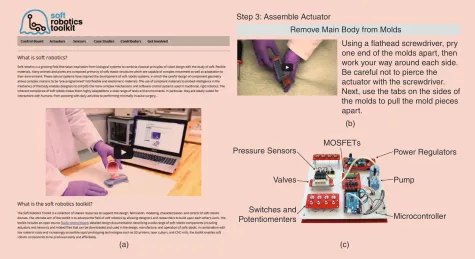
he Soft Robotics Toolkit (SRT) is an open-access website containing detailed information about the design, fabrication, and characterization of soft-robotic components and systems (Figure 1). Soft robotics is a growing field of research concerned with the development of electromechanical technology composed of compliant materials or structures. The SRT website hosts design files, multimedia fabrication instructions, and software tutorials submitted by an international community of soft-robotics researchers and designers. In this article, we describe the development of the SRT and some challenges in developing widely disseminated robotic-hardware resources. Our attempts to overcome these challenges in the development of the toolkit are discussed by focusing on strategies that have been used to engage participants ranging from K–12 grade students to robotics researchgroups. A series of design competitions encouraged people to use and contribute to the toolkit. New fabrication methods requiring only low-cost and accessible materials were developed to lower the entry barriers to soft robotics and instructional materials and outreach activities were used to engage new audiences. We hope that our experiences in developing and scaling the toolkit may serve as guidance for other open robotic-hardware projects.
The SRT was originally conceived as a resource for under-graduate engineering students in project-based robotic design classes. In our research on engineering design education, we found that students require access to detailed documentation of previous designs [1], [2], because the interpretation and reuse of previous design solutions is an important element in design activity in general and in design education in particular. Professional designers rely on a repertoire of previous prob-lems and solutions to guide their work, and that requires an ability to make analogies between past experiences and
© photocredit
By Dónal Holland, Colette Abah, Marielena Velasco Enriquez, Maxwell Herman, Gareth J. Bennett, Emir Vela, and Conor J. Walsh
Strategies for Overcoming Obstacles to the Wide
Dissemination of Soft-Robotic Hardware
current problems and to use that knowledge to generate new solutions [3]. Comparisons of expert and novice designers have found that experts are more likely to refer to previous designs than novices [4]. Reusing previous designs is not a matter of simply copying a design from one situation to anoth-er. It requires an understanding of the similarities and differ-ences between the current and previous contexts and an ability to use that understanding to identify potential issues that must be addressed [5]. However, this type of context-dependent judgment is underserved by most engineering education pro-grams, which tend to focus on abstraction and generality [6]. Therefore, it is essential that students have opportunities to rehearse interpreting and using previous designs. A primary motivation in developing the SRT was to address these needs by providing students in project-based robotics courses with example designs to use when tackling their own projects.
In the past decade, there has been an increase in the avail-ability of online databases containing design documentation that is relevant to robotics. Open-source software is computer software provided under a license that allows users to run, study, modify, and redistribute the software source code as they wish. Open-source projects such as the Robot Operating System (ROS) provide a modular and reconfigurable platform to support the rapid implementation of new designs [7]. Open hardware takes a similar approach to the distribution of design information related to physical artifacts. The Arduino microcontroller is a project that combines open-source soft-ware and open electronic hardsoft-ware in a tool that was
original-ly developed for use by design students and has become extremely popular in the robotics community. In our research with engineering design students, we found that open-source software and open electronic hardware projects provided an ideal source of the detailed design information required for meaningful learning. We therefore decided to meet the needs of our students by developing a comparable resource focused on the mechanical design of robotic systems.
Challenges in the Wide Dissemination of Mechanical Designs
[image:2.567.45.520.57.316.2]Compared to open-source software and open electronic hardware, there are challenges to sharing mechanical hard-ware designs in a way that supports wide adoption and modification. Our research in mechanical design class-rooms revealed that students rarely make use of resources such as online libraries of solid model files. Our research participants reported that, unlike software source code files or electronic circuit schematics, engineering drawings or solid model files alone are rarely useful. Mechanical design is concerned with particular morphologies that depend on factors that are external to the design itself. Using a previous design inevitably involves making modifications, but modi-fying a solid model file can be a complicated task because interoperability between different computer-aided design environments remains an issue, and information about how to actually manufacture a design cannot typically be inferred from such documentation.
Figure 1. The SRT. (a) The home page of the toolkit website. (b) An excerpt from a multimedia fabrication protocol describing the casting and assembly of a soft pneumatic actuator. (c) An open-source fluidic control board which allows users to control and test a wide variety of soft actuators.
Step 3: Assemble Actuator
Remove Main Body from Molds
Using a flathead screwdriver, pry one end of the molds apart, then work your way around each side. Be careful not to pierce the actuator with the screwdriver. Next, use the tabs on the sides of the molds to pull the mold pieces apart.
(b)
Power Regulators Pressure Sensors
Valves
Switches and Potentiomenters
Pump
Microcontroller MOSFETs
As a result, open mechanical hardware projects typical-ly involve sharing a larger quantity of information, includ-ing models, drawinclud-ings, bills of materials, and written fabrication instructions. Examples of open hardware proj-ects that successfully share mechanical designs include the RepRap, a low-cost three dimensional (3-D) printer, and the Yale OpenHand Project, a robotic hand [8], [9]. How-ever, these projects have a very particular focus. Whereas the ROS and Arduino can support software and electronic design for a wide range of devices and applications, simi-larly broad hardware platforms to support mechanical design are rare. This is because mechanical design typical-ly involves specialized parts that are selected or custom-ized to suit a particular application. Thus, modifying complete mechanical system designs to create new devices or applications is not a straightforward task.
Rather than focusing on a specific device or application, the SRT is intended as a broad platform comparable to some open-source software and electronic hardware projects. Our approach to achieving this has been to focus on design at the component, rather than system, level. The nature of soft robotics is amenable to this approach. The behavior of soft-robotic devices is determined by the morphology of custom-made actuators and sensors that are typically custom-made from low-cost elastomers cast in molds created with rapid proto-typing technologies. By providing an online database of design information related to soft component technologies, we aim to support a broad range of design activities. The aim is not just to let a user replicate a particular design but to also provide a platform to enable them to design their own soft components and devices based on the designs on the site. The documentation set for each component contains download-able design files, tutorials describing the mold design process, multimedia fabrication protocols, testing case studies, and finite element method modeling tutorials [Figure 1(b)] [10]. Thus, the SRT empowers users to vary both the design of the component itself and the system that incorporates the com-ponent. The hardware required to operate fluidic soft devices (including the pressure source, pressure regulator, valves, and microcontroller) is largely interchangeable between systems. The SRT website includes an open-source control board that can be used to control a wide variety of soft-robotic devices [Figure 1(c)].
To ensure clarity of the content, the tutorials and proto-cols were evaluated with undergraduate students enrolled in nonengineering majors. Feedback from these trials was used to improve the documentation. The SRT was then used by a cohort of students in an electromechanical design class, and website analytics data and weekly surveys were used to track student use of the resource [2]. Throughout their semester-long projects, the students rated the SRT as more useful than both textbooks and other online databas-es. The website analytics data indicated that students made frequent short visits to the website when first learning about soft robotics and defining their design concepts and less frequent but longer visits during the detailed design of
their devices. This indicates that the SRT can support mul-tiple types of design activities.
The Role of Community in Open Mechanical Hardware
The success of open-source software and open electronic hardware is due in large part to active online communities of users who contribute to the resources and make use of them. When a large amount of users make small modifications to a design and these changes are accumulated, it leads to rapid progress in the development of a technology. A necessary component in developing such a resource is therefore a com-munity of “user producers.” Thus, an important question in developing the SRT was how to build a community of engi-neers around the project.
The growth of soft robotics as a research field is a relatively recent phenomenon, and there are many technical challenges that must be addressed for the field to develop [11]. Soft-robotics researchers have acknowledged a need for shared design tools and standards to ease knowledge transfer. The SRT was developed as a platform that could meet these needs while also addressing the educational needs of engineering students. Framing the toolkit as a resource to support the soft-robotics research community—rather than solely as an instructional tool—was intended to provide the incentive required to build a community of user producers.
The initial content of the SRT website was developed in col-laboration with six soft-robotics research groups at Harvard. Interviews and observations were used to understand the design, fabrication, testing, and modeling required for soft component technologies. The fabrication process was decom-posed into steps, and for each step, a verbal explanation was written and a video demonstrating the step was made. Supple-mentary images, including labeled photographs and diagrams, were also created. In September 2014, the resulting SRT web-site was publicly launched. In its first four months, the webweb-site had over 149,000 page views by 29,382 users in 158 countries and received substantial media coverage. However, during that time, only one external research group contributed material to the website. In addition, the approach used to develop the ini-tial website content, which involved the SRT team working intensively with robotics groups to create documentation, was not scalable due to the severe time requirements. A new approach was required to expand the community of user pro-ducers, who are essential to the success of the project.
Expanding the Community Through Competitions
produce a collection of case studies describing soft-robotic systems based on the component technologies documented on the SRT. The research award was intended to incentivize research groups to contribute to the website. It rewarded the most significant recent contribution to soft-robotics research documented on the toolkit website as determined by an inter-national panel of experts recruited from leading soft-robotics research groups. For both categories, cash prizes were offered, and the judging of entries was based entirely on documenta-tion submitted to the website.
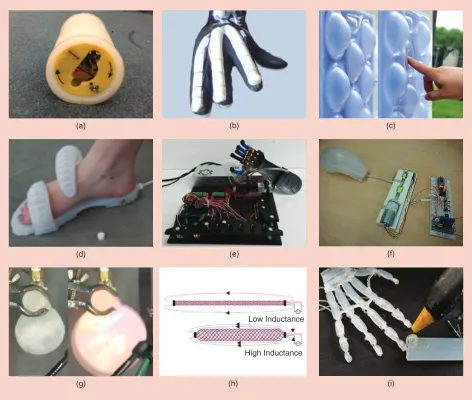
The first year of the competitions saw 82 projects sub-mitted by 243 participants. Entries in the design category included work completed by undergraduate students as part of robotics classes, projects undertaken by high school students for science fairs, and low-cost robotic systems designed by and for hobbyists. Applications included assis-tive devices, functional apparel, children’s toys, architectural
features, locomotion, and electropneumatic control hard-ware [Figure 2(a)–(f)]. The winning entry described the design and fabrication of an untethered pneumatic wheel robot. Fifty-one robotics research groups registered for the research category. Applications included new approaches for modeling and controlling soft actuators, new manufac-turing methods, and novel designs for soft sensors and actu-ators [Figure 2(g)–(i)]. The winning entry consisted of a self-sensing technique for pneumatic artificial muscles [12].
During the second year of the competitions, the categories were modified to better reflect the demographics of the entrants. For example, some of the most original entries to the design category in the first year came from high school students. Howev-er, most high school students do not have access to the same facil-ities and knowledge as their undergraduate competitors, which puts them at a disadvantage. The 2016 competitions therefore consisted of three categories: one was for design by high school
(a) (b) (c)
Low Inductance
High Inductance
(g) (h) (i)
[image:4.567.48.520.273.673.2](d) (e) (f)
students, another was for “college-level” design that included stu-dents and hobbyists, and the last was for a research award that aimed to attract contributions from robotics labs.
The second year of competitions attracted 96 entries from 228 participants. Entries in the high school category included a novel locomotive robot and new types of soft sensors. Proj-ects in the college-level category included a bioinspired manta ray robot and a novel soft manipulator. Submissions for the research award included a 3-D-printed tactile sensor, as well as a new type of soft actuator that harnesses the power of instability to trigger instantaneous movement [15], [16].
While the response to the competitions has been positive, it has also highlighted some entry barriers faced by potential community members. In particular, high school participants have reported difficulties in using the toolkit information due to complex manufacturing methods and a requirement for specialized machine tools and expensive consumables. Thus,
we identified a need for new instructional materials based on manufacturing methods that are less complex, more reliable, and require only low-cost and easily-accessible materials.
More Accessible Manufacturing Methods and Instructional Materials
Our focus in developing new manufacturing methods has been on actuators rather than sensors or control hardware and, in particular, on fluidic soft actuators. Such actuators can achieve complex motions due to mechanical programming using only fluidic pressure as a simple input. Soft fluidic actuators consist of airtight chambers surrounded by materials of varying stiff-ness. Upon pressurization, the channels in the soft actuator expand in the direction of lower stiffness. A variety of motions, including extension, contraction, bending, and twisting, can be programmed into the actuator through the morphology and materials used in the construction of the fluidic chambers.
i)
ii)
iii)
iv)
v)
(a)
Top-Layer Mold Bottom-Layer Mold
Glue Layer
i)
ii)
iii)
(c) Thread
Acetate Insert
i)
ii)
iii)
iv)
v)
vi)
(b)
Mold Insert
[image:5.567.46.524.61.306.2]Elastomer Plugs
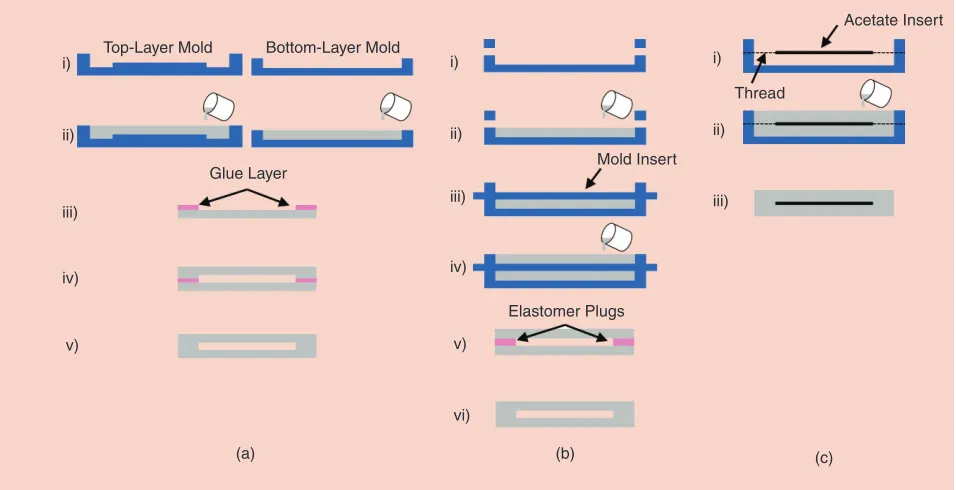
Figure 3. The comparison of three methods for manufacturing of soft fluidic actuators. (a) The two layers are cast separately and then glued together using a layer of silicon rubber. (b) A mold with an insert is used for casting. The insert is later removed and the bladder is plugged at both ends to create an airtight chamber. (c) A sacrificial acetate layer is held in the middle of the mold with thread, and it acts as a zero-thickness air chamber.
Top View
2 cm
(a) (b) (c)
[image:5.567.47.523.583.690.2]Most of the actuators documented in the SRT consist of silicone rubbers cast in complex, multipart molds produced using 3-D printers or other rapid manufacturing tools. The silicone rubbers themselves, which are commonly used in model-making and special effects, are affordable and easy to obtain. However, the requirement for rapid prototyping equipment remains to be a barrier for many. To address this issue, we have designed molds that can be built from acces-sible materials such as paper and cardboard. One advantage
of this approach is that mold designs can be shared via two-dimensional templates that can be printed on paper, adhered to a sheet of cardboard, and cut out to create com-ponents that can then be assembled into 3-D molds. This approach has the potential to drastically lower the entry barriers to soft robotics and to thereby support the wide dis-semination of robotic-hardware designs.
The challenge when designing molds for fluidic actuators is creating airtight chambers. Common approaches include
(a)
(b)
(c) (e) (f)
2 cm
2 cm
2 cm
2 cm
2 cm 2 cm
(d) Top
View BottomView
Top
View BottomView
Top View
[image:6.567.44.521.185.655.2]Bottom View
casting layers separately and subsequently gluing them togeth-er [Figure 3(a)] or using a mold instogeth-ert during casting that can be removed and plugged afterward [Figure 3(b)]. Both meth-ods require multiple casting steps and are time-consuming. The molding technique presented here requires fewer steps and is more accessible for novice users [Figure 3(c)]. This tech-nique produces simple airtight bladders that serve as building blocks for more complex actuators. Our approach uses a sacri-ficial insert made of acetate sheet that creates a zero-thickness air chamber. The acetate layer is suspended between card-board walls using thin thread (Figure 4). A two-part silicone rubber is cast in the mold. Once the silicon rubber is cured, the thread is removed. The sacrificial acetate layer remains in the bladder but does not stick to the walls of the bladders, thereby creating the fluidic chamber.
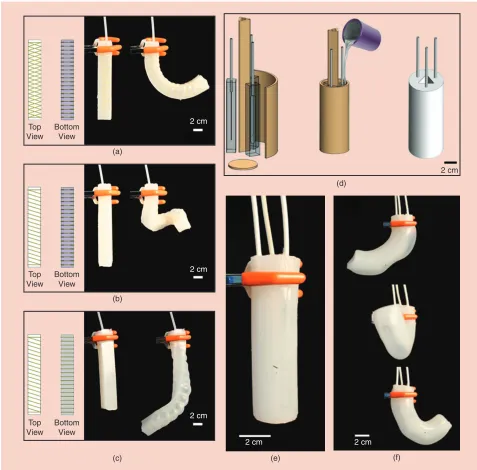
The bladders produced using this technique can be assem-bled in different combinations to create a variety of actuators. For example, external reinforcement layers can be used to mechanically program the motion of an actuator in response to internal fluid pressure [17]. Kevlar thread wrapped around the circumference of the actuator restricts its radial expan-sion. Layers of fabric prevent axial expansion in parts of the actuator. Figure 5(a)–(c) shows three examples of actuators that can be achieved from identical bladders simply by vary-ing the placement of these reinforcement layers. These varia-tions can take place along the length of a single bladder, yielding multiple segments that each perform different motions. This technique has been used to produce patient-specific actuators that mimic the motions of human fingers for an assistive soft orthotic glove [18]. Other approaches involve combining multiple bladders in assembly to create a single actuator. In the example shown in Figure 5(d)–(f), three identical bladders are cast in a surrounding matrix of
silicon rubber. By selectively inflating individual bladders, it is possible to trace a spherical cap with the free end of the actua-tor as shown in Figure 5(f). By assembling N such actuaactua-tors in a series, it is possible to achieve a tentacle with 2N degrees of freedom [19]. In addition to the two examples discussed here, it is possible to use this molding technique as a low-cost and easy means of replicating a wide variety of component technologies from the soft-robotics literature.
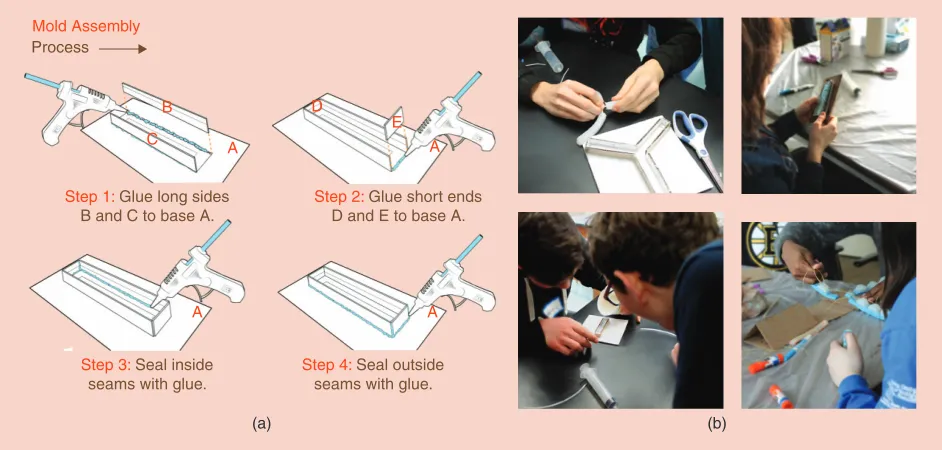
The new manufacturing technique was developed to meet the needs of educators and students who wanted to develop their own soft-robotic devices. The approach presented here eliminates the need for specialized equipment and substantial-ly reduces the cost and time required to construct soft-robotic components. It allows a user to create a mold and actuator in less than one hour, while the methods previously documented on the toolkit site take at least three hours. To share the new methods with potential users, we have developed a collection of instructional materials and created a new “Education” sec-tion on the SRT website. The instrucsec-tional resources consist of illustrated descriptions of the manufacturing techniques, printable mold templates, and suggested class projects accom-panied by soft robot case studies to serve as examples for stu-dents. Figure 6(a) shows an extract from a student handout describing soft actuator fabrication using a cardboard mold. The instructional materials have been tested and refined through robotics workshops with over 100 students in the United States, Peru, and Ireland [Figure 6(b)].
Conclusions
This article describes the development of the SRT and efforts taken to address issues commonly faced by open mechanical hardware projects in robotics. The wide dissemination of mechanical design information is not a straightforward task
Process Mold Assembly
Step 1:Glue long sides B and C to base A.
Step 2:Glue short ends D and E to base A.
Step 3: Seal inside seams with glue.
Step 4:Seal outside seams with glue. C
B
A
A
D
E A
A
[image:7.567.49.520.56.281.2](a) (b)
because of the level of detail required to enable a wide audi-ence to replicate a physical design. To ensure that the project documentation was sufficiently detailed, it was developed to meet the needs of students and tested with novice roboticists. This approach allowed us to identify the essential informa-tion that must be shared, which is often not intuitive for domain experts. Involving nonexperts in the development and pilot testing of design documentation can help to improve its clarity for all users.
Mechanical design typically involves multiple parts that are custom-designed for a particular application and is not conducive to the development of broad platforms for varied applications. The SRT addresses this issue by focusing on component-level design and separating general hardware from parts for particular applications. While soft robotics is particularly well-suited to this strategy, other open hardware projects may also benefit from a similar approach.
The success of an open-source project depends in large part on its ability to attract a community of user producers who review and contribute to the shared resources. Convincing robotics experts to contribute the documentation of their mechanical designs is a challenge given the level of detail required. Hosting design competitions related to the project has proven to be an effective means of engaging participants rang-ing from high school students to research groups. Again, other open hardware projects may benefit from adopting this strategy.
Finally, the emergence of low-cost rapid prototyping tech-nologies has the potential to accelerate the growth of open mechanical hardware projects, but it should be recognized that these technologies are still beyond the reach of many potential users. Developing alternative design and manufac-turing methods that do not rely on specialized equipment or materials could enable open hardware projects to increase their impact and expand their communities.
Acknowledgments
This research was supported by the National Science Founda-tion (Grants #1526327, #1317744, and #14-20570), a Har-vard-Universidad de Ingeniería y Tecnología (UTEC) Faculty Grant,the Harvard John A. Paulson School of Engineering and Applied Sciences, and the Wyss Institute for Biologically Inspired Engineering at Harvard University. We wish to thank all those who have contributed to the Soft Robotics Toolkit, participated in the soft-robotics competitions, and took part in our workshops and provided feedback on manufacturing methods and instructional materials.
References
[1] D. P. Holland, C. J. Walsh, and G. J. Bennett, “An assessment of stu-dent needs in project-based mechanical design courses,” in Proc.120th Amer. Soc. Eng. Educ. Annu. Conf. Exposition, Atlanta, 2013, pp. 23.153.1–23.153.11.
[2] D. P. Holland, E. J. Park, C. J. Walsh, and G. J. Bennett, “The devel-opment and testing of the Soft Robotics Toolkit: An educational resource for mechanical engineering design,” in Proc.6th Research in Engineering Education Symp., Dublin, 2015, pp. 596–604.
[3] B. Lawson, “Schemata, gambits and precedent: Some factors in design expertise,” Des. Stud., vol. 25, no. 5, pp. 443–457, 2004.
[4] S. Ahmed, K. M. Wallace, and L. T. M. Blessing, “Understanding the differences between how novice and experienced designers approach design tasks,” Res. Eng. Des., vol. 14, no. 1, pp. 1–11, 2003.
[5] F. Deken, M. Kleinsmann, M. Aurisicchio, K. Lauche, and R. Brace-well, “Tapping into past design experiences: knowledge sharing and creation during novice-expert design consultations,” Res. Eng. Des., vol. 23, no. 3, pp. 203–218, 2012.
[6] L. L. Bucciarelli, “Design knowing & learning: A socially mediated activity,” in Design Knowing and Learning: Cognition in Design Educa-tion, C. M Eastman, W. M. McCracken, and W. C. Newstetter, Eds. Kidlington, Oxford, UK: Elsevier Science, 2001, pp. 297–314.
[7] M. Quigley, K. Conley, B. Gerkey, J. Faust, T. B. Foote, J. Leibs, R. Wheeler, and A.Y. Ng, “ROS: An open-source robot operating system,” in
Proc. Int. Conf. Robotics Automation Workshop Open Source Software, 2009. [8] R. Jones, P. Haufe, E. Sells, P. Iravani, V. Olliver, C. Palmer, and A. Bowyer. “RepRap–the replicating rapid prototyper,” Robotica, vol. 29, no. 1, pp. 177–191, 2011.
[9] R. R. Ma, L. U. Odhner, and A. M. Dollar, “A modular, open-source 3D printed underactuated hand,” in Proc.2013 IEEE Int. Conf. Robotics Automation, Karlsruhe, pp. 2737–2743.
[10] D. P. Holland, E. J. Park, P. Polygerinos, G. J. Bennett, and C. J. Walsh, “The soft robotics toolkit: Shared resources for research and design,” Soft Robot., vol. 1, no. 3, pp. 224–230, 2014.
[11] C. Majidi, “Soft robotics: a perspective—Current trends and prospects for the future,” Soft Robot., vol. 1, no. 1, pp. 5–11, 2013. [12] W. Felt, C. D. Remy, and K. Y. Chin, “Contraction sensing with smart braid McKibben Muscles,” IEEE/ASME Trans. Mechatron., vol. 21, no. 3, pp. 1201–1209, June 2016.
[13] M. Loepfe, C. M. Schumacher, and W. J. Stark, “Design, perfor-mance and reinforcement of bearing-free soft silicone combustion-driven pumps,” Ind. Eng. Chem. Res., vol. 53, no. 31, pp. 12,519–12,526, 2014. [14] L. Wang and F. Iida, “Physical connection and disconnection con-trol based on hot melt adhesives,” IEEE/ASME Trans. Mechatron., vol. 18, no. 4, pp. 1397–1409, 2013.
[15] L. Cramphorn, B. Ward-Cherrier, and N. F. Lepora, “Tactile manipulation with biomimetic active touch,” in Proc.2016 IEEE Int. Conf. Robotics Automation, Stockholm, pp. 123–129.
[16] J. T. B. Overvelde, T. Kloek, J. J. A. D’haen, and K. Bertoldi, “Ampli-fying the response of soft actuators by harnessing snap-through insta-bilities,” Proc. Nat. Acad. Sci., vol. 112, no. 35, pp. 10,863–10,868, 2015. [17] P. Polygerinos, Z. Wang, J.T. Overvelde, K.C. Galloway, R.J. Wood, K. Bertoldi, and C.J. Walsh. “Modeling of Soft Fiber Reinforced Bend-ing Actuators,” IEEE Trans. Robot., vol. 31, no. 3, pp. 778–789, 2015. [18] R.V. Martinez, J.L. Branch, C.R. Fish, L. Jin, R.F. Shepherd, R. Nunes, Z. Suo, and G.M. Whitesides. “Robotic tentacles with three-dimensional mobility based on flexible elastomers,” Adv. Mat., vol. 25, no. 2, pp. 205–212, 2013.
[19] P. Polygerinos, Z. Wang, K. C. Galloway, R. Wood, and C. J. Walsh, “Soft robotic glove for combined assistance and at-home rehabilita-tion,” Robot. Auton. Syst., vol. 73, pp. 135–143, Nov. 2014.
Colette Abah, Harvard University, Cambridge, Massachusetts. E-mail: [email protected].
Marielena Velasco Enriquez, Harvard University, Cambridge, Massachusetts, and Universidad de Ingeniería y Tecnología, Lima, Perú. E-mail: [email protected].
Maxwell Herman, Harvard University, Cambridge, Massachu-setts. E-mail: [email protected].
Gareth J. Bennett, Trinity College Dublin, Ireland. E-mail: [email protected].
Emir Vela, Universidad de Ingeniería y Tecnología, Lima, Perú, and University of New Mexico, Albuquerque. E-mail: [email protected].