A MODIFIED PROCESS WRITING PROCEDURE TO LOWER
STUDENTS’ WRITING ANXIETY IN SENIOR HIGH SCHOOL
(A Thesis)
By
IHYAUL LAYLI HASANAH
MASTER IN ENGLISH LANGUAGE TEACHING LANGUAGE AND ARTS EDUCATION DEPARTMENT
TEACHER TRAINING AND EDUCATION FACULTY UNIVERSITY OF LAMPUNG
ABSTRACT
A MODIFIED PROCESS WRITING PROCEDURE TO LOWER STUDENTS’ WRITING ANXIETY IN SENIOR HIGH SCHOOL
By
IHYAUL LAYLI HASANAH
This study aims at 1) investigating the effectiveness of Modified Process Writing Procedure to lower students’ writing anxiety; 2) finding out the effectiveness of Modified Process Writing Procedure to foster students’ writing achievement; 3) figuring out the causes of writing anxiety mostly felt by the students.
This study employed mixed-methods approach. The samples of the study were thirty eleventh graders in a public senior high school in Pringsewu. The data were obtained from the questionnaires, writing test and interview. Quantitative statistical procedures were used to analyze the data by means of descriptive statistics and paired sample t-test. The interview data were transcribed and used to answer one of the research question.
The findings revealed that 1) the tobt (10.597) is higher than the tcrit (2.045), then null hypothesis was rejected and Modified Process Writing Procedure is successful to help students lower students' writing anxiety. 2) The tobt (7.88) is higher than the tcrit (2.045), then null hypothesis is rejected and Modified Process Writing Procedure is successful to help students foster their writing achievement. 3) The causes which were mostly felt by the students are linguistic difficulties, low self-confidence in writing, and insufficient writing practice, which also felt by the Asian students who learn English as second or foreign language (Zhang, 2011; Younas, 2014)
A MODIFIED PROCESS WRITING PROCEDURE TO LOWER
STUDENTS’ WRITING ANXIETY IN SENIOR HIGH SCHOOL
By:
IHYAUL LAYLI HASANAH
A Thesis
Submitted in a partial fulfillment of The requirements for S-2 Degree
MASTER IN ENGLISH LANGUAGE TEACHING LANGUAGE AND ARTS EDUCATION DEPARTMENT
TEACHER TRAINING AND EDUCATION FACULTY UNIVERSITY OF LAMPUNG
ii
CURRICULUM VITAE
As the last daughter in her family, Ihyaul Layli Hasanah was
born in Pringsewu, Lampung on September 1, 1988. She
finished her Elementary level in SD Muhammadiyah I
Pringsewu in 2001. Then, she continued her study to SMP
Muhammadiyah 1 Pringsewu in 2001 and graduated in 2004. Afterward, she
started her Senior High level in SMA Negeri 2 Genteng, East Java in 2004 and
graduated in 2007. After that, she continued her study in Indonesia University of
Education (UPI) majoring English Education in 2007. Before she graduated from
UPI, she had married to Muhammad Ismail in 2011. In 2012, she gave birth her
first lovely baby named Alea after finishing her S1 degree.
In 2015, she continued her study in University of Lampung and is about to get her
master degree in 2017. Now, she has been working in Ganesha Operation as an
DEDICATION
This thesis is dedicated for my beloved people:
Mama Chotimatus Suryani and Papa Hasan Toblawi.
My dearest Muhamad Ismail.
My girl Iftita Qarira Azalea.
My little baby in my womb, Atta.
My lovely niece Zurrotun Nafisah.
All my friends of the 3rd batch of Master in English Language Teaching.
iv
MOTTO
“
And seek help through patience and prayer, and indeed, it is difficult
except for the humbly submissive [to Allah ]”
(Q.S. Al Baqarah: 45)
Narrated Anas: The Prophet (peace be upon him) said, “The real
patience is at the first stroke of calamity”
ACKNOWLEDGMENT
Alhamdulillah, I say to Allah SWT, the only One who allows me to
accomplish this thesis entitled A Modified Process Writing Procedure to Lower
Students’ Writing Anxiety in Senior High School. Salutes always be upon to
Muhammad SAW, the Greatest Leader in the world who gives me inspiration
through my days.
This thesis is composed originally for the purpose of partially fulfilling the
requirement of Master degree. I realize that finishing the thesis is not as easy as I
thought. There are many experiences I get from the beginning to the end of the
writing process. Thus, I would like to say my thankfulness to the following people
who have helped, motivated, and guided me during writing process:
Dr. Flora, M. Pd., as the Chief of Master of English Education Program and the
main supervisor who gives me best support and input during the research
process.
Dr. Muhammad Sukirlan, M.A., as the co-supervisor who is patient in giving
and sharing the knowledge about my research. Thank you for your kindness.
Prof. Dr. Patuan Raja, M. Pd., as the first examiner who gives me another
vi
Ujang Suparman, M.A, Ph. D., as the second examiner who helps me wrap up
my thesis.
All of lecturers of Master of English Education Program who have given me
much valuable knowledge for about two years.
The Headmaster and the English teachers of SMAN 2 Pringsewu. Thank you
so much for the support and the sharing moments during the research process.
All my friends wherever you are. Thanks for your helps and attention.
The allies of my research: Khairun Nisa, Kak Yuniati Al Aida, Kak Rina
Slammet, the students of XI MIA 6, the seniors and the juniors, thank you for
the prayers and the support you gave to me.
All of English Education Master Students, especially MPBI B 15, thank you
for the moment shared.
As I know that there are many drawbacks in this research, I appreciate comments
and suggestions for the future studies. Hopefully, this thesis can give a beneficial
contribution for the better life of education.
Bandar Lampung, March 30th, 2017 The Author,
LIST OF CONTENT
ABSTRACT i
CURRICULUM VITAE ii
DEDICATION iii
MOTTO iv
AKNOWLEDGMENT v
LIST OF CONTENT vii
LIST OF TABLES x
LIST OF FIGURES xii
LIST OF APPENDIXES xiii
I. INTRODUCTION
1.1 Background 1
1.2 Research Questions 7
1.3 Objectives 7
1.4 Uses 7
1.4.1 Theoretical Uses 8
1.4.2 Practical Uses 8
1.5 Scope 8
1.6 Definition of Terms 9
II. LITERATURE REVIEWS
2.1 The Concept of Writing 10
2.2 Types of Writing Approach 12
2.3 The Concept of Teaching Writing 13
2.4 Process Writing Procedure 14
2.5 Process Writing Procedures in Teaching Writing 15
2.6 The Concept of Modifying Process Writing Procedures 16
2.6.1 Being motivated to write 17
2.6.2 Being guided to write 17
viii
2.6.4 Planning and outlining 18
2.6.5 Making notes 18
2.6.6 Making a first draft 19
2.6.7 Revising, replanning, redrafting 19
2.6.8 Editing and getting ready for publication 19
2.7 Students' Writing Anxiety 20
2.8 The Types of Students’ Writing Anxiety 20
2.9 The Level of Students’ Writing Anxiety 21
2.10 The Causes of Students’ Writing Anxiety 21
2.11 Theoretical Assumption 22
2.12 Hypotheses of The Study 23
III. RESEARCH METHODS
3.1 Research Design 26
3.2 Population and Sample 27
3.2.1 Population 27
3.2.2 Sample 28
3.3 Research Instrument 28
3.3.1 Interview guides 28
3.3.2 Questionnaires 29
3.3.3 Writing test 31
3.4 Data Collection 33
3.4.1 Conducting pre-research interview 33
3.4.2 Administering SLAWAI questionnaires and CSLWAI
questionnaires before and after the treatment 33
3.4.3 Conducting writing pre-test and post-test 34
3.4.4 Conducting the interview before, during, and after
the treatment 34
3.5 Data Analysis 34
3.6 Data Treatment 35
3.6.1 Test of normality 35
3.6.2 Test of validity of the questionnaire 37
3.6.3 Test of validity of the writing test 37
3.6.4 Test of reliability of the questionnaire 38
3.6.5 Test of reliability of the writing test 39
3.7 Hypothesis Testing 40
IV. RESULTS AND DISCUSSIONS
4.1 The Implementation of Modified Process Writing Procedure
in Teaching Writing 42
4.2 The Effectiveness of Modified Process Writing
Procedure in lowering Students’ Writing Anxiety 47
4.2.1 Pretest score of students’ writing anxiety 48
4.2.2 While score of students’ writing anxiety 49
4.2.4 The Difference between students’ writing anxiety
in pretest, while test, and posttest 54
4.2.5 Hypothesis testing 56
4.3 The Effectiveness of Modified Process Writing
Procedure in Fostering Students’ Writing Achievement 57 4.3.1 Pretest score of students’ writing achievement 57 4.3.2 Students’ writing using modified process writing
procedure 61
4.3.3 Posttest score of students’ writing achievement 67 4.3.4 The difference between students’ writing achievement
in pretest and posttest 70
4.3.5 Hypothesis testing 72
4.4 The Causes of Writing Anxiety Felt by The Students 72
4.4.1 Questionnaire 73
4.4.2 Interview 75
4.5 Discussion 76
4.5.1 The effectiveness of modified process writing procedure
in lowering students’ writing anxiety 77
4.5.2 The effectiveness of modified process writing procedure
in fostering students’ writing achievement 79
4.5.3 The causes of writing anxiety felt by the students 81
V. CONCLUSION AND SUGGESTION
5.1 Conclusion 84
5.2 Suggestion 86
REFERENCES 87
x
LISTS OF TABLES
Table 2.1 The Comparison of Hedge’s Process Writing
Stages and Modified Process Writing Procedure 16 Table 3.1 Table 3.2 Table 3.3 Table 3.4 Table 3.5 Table 3.6 Table 3.7 Table 3.8
The Guideline of Interview 29
Table of Specification of SLWAI 30
Table of Specification of CSLWAI 31
Rating Scales of Writing Assessment 32
The Content Validity of Writing Test 37
The Guideline for Describing Alpha Value 39
The Correlation between Pretest Score Given by
Rater 1 and Rater 2 40
The Correlation between Posttest Score Given by
Rater 1 and Rater 2 40
Table 4.1 Table 4.2 Table 4.3 Table 4.4 Table 4.5 Table 4.6 Table 4.7 Table 4.8 Table 4.9 Table 4.10 Table 4.11
The Schedule of Data Collection of Students' writing
anxiety 42
The Description Statistics of Students' Writing Anxiety
in Pretest 48
The Level of Students’ Writing Anxiety in Pretest 49 The Description Statistics of Students' Writing Anxiety
During the Treatment 50
The Level of Students' Writing Anxiety During the
Treatment 50
The Descriptive Statistics of Students’ Writing
Anxiety in Posttest 51
The Level of Students’ Writing Anxiety in Posttest 52 The Result of Paired Samples Statistics of Pretest,
While Test, and Posttest Score 54
The Result of Paired Differences between Pretest,
While Test, and Posttest Score 55
The Descriptive Statistics of Students’ Writing
Achievement in Pretest 58
Table 4.12
Table 4.13 Table 4.14
Table 4.15
Table 4.16
Table 4.17
The Descriptive Statistics of Students’ Writing
Achievement in Posttest 67
The Level of Students’ Writing Achievement in Posttest 68 The Result of Paired Samples Statistics of Pretest and
Posttest Score 71
The Result of Paired Differences between Pretest and
Posttest Score of Writing Achievement 71
The Descriptive Statistics of Causes of Students’
Writing Anxiety 73
xii
LIST OF FIGURES
Figure 1.1 Hedge’s Writing Stages 3
Figure 2.1 Figure 2.2
Producing a Piece of Writing 11
Being Guided to Write 17
Figure 3.1 Explanatory Sequential Design 26
Figure 4.1
Figure 4.2 Figure 4.3 Figure 4.4 Figure 4.5 Figure 4.6 Figure 4.7 Figure 4.8
The Comparison of the Students’ Levels of Writing
Anxiety in Pretest, While Test, and Posttest 53
The Example of Student’s Writing Pretest 59
The Example of Student’s Outline 61
The Example of Student’s First Draft 62
The Example of Student’s Second Draft 65
The Example of Student’s Final Draft 66
LISTS OF APPENDIXES Appendix 1 Appendix 2 Appendix 3 Appendix 4 Appendix 5 Appendix 6 Appendix 7 Appendix 8 Appendix 9 Appendix 10 Appendix 11
Surat ijin penelitian 92
Surat balasan ijin penelitian 92
Pre-research interview transcription 93
Lesson plan 95
Material 95
The photos of students’ activities 106
The captures of students e-pal profile 106
Interview guide 109
Interview transcription before the treatment 114 Interview transcription during the treatment 115 Interview transcription after the treatment 116 Second language of writing anxiety inventory (SLWAI)
English version 118
Second language of writing anxiety inventory (SLWAI)
Indonesian version 121
CSLWAI English version 123
CSLWAI Indonesian version 124
SLWAI filled by the students before, during and
after the treatment 125
CSLWAI filled by the students 125
Pretest and posttest writing instrument 125
The students’ writing pretest, process, and posttest 126
Reliability of the SLWAI questionnaire 127
Reliability of the CSLWAI questionnaire 127
Normality of the data 127
The students’ score of SLWAI 128
The students’ score of CSLWAI 128
I. INTRODUCTION
This chapter explains the introduction of the study and begins with the
background of the study. The research questions, objectives, and uses are also
elucidated in this chapter. The scope and definitions of terms are presented in the
end of this chapter as well.
1. 1. Background
Writing has a unique position in language teaching since its acquisition involves a
practice and knowledge of other three language skills, such as listening, reading
and speaking (Klimova, 2014). Writing is also one of the important tools by
which students actively change the passive knowledge and information in their
minds into their own language (Hashemnezhad & Hashemnezhad, 2012). It seems
to be important to master the skill although as stated by Nunan (1999: 271),
producing a coherent, fluent, extended piece of writing is possibly the most
difficult thing to do in language. The students should think, compose and create
ideas; check their connection to each other and to the main idea of the topic;
memorize and recall lexical items thought to be more relevant than others; select
and discard irrelevant ideas; and organize these ideas according to their
the students do not have the necessary knowledge and experience of language that
writing demand, which is stated by Brown & Hood (1993: 3) as one of major
barriers to student confidence, it will lead them to writing anxiety (Shawish &
Abdelraheem, 2010).
Anxiety or apprehension is a feeling of nervousness, worry, and uneasiness, which
is a reaction to a situation or an event that is happening or might happen in the
future (Jang & Choi, 2014). Huwari & Al Shboul (2016) state that students feel
anxious in writing when teachers ask them to compose a text. Anxiety in writing
can lead the students to be demotivated in writing which then may cause them to
have negative attitudes towards writing (Huwari & Aziz, 2011). Kostic-Bobanovic
(2016) also states that the complexity of writing as a task tends to heighten
students’ anxiety levels. Thus, to minimize the students’ anxiety in writing,
teachers should modify their teaching instruction as suggested by Huwari & Al
Shboul (2016).
One of teaching writing approaches which is considered suitable to lower
students’ writing anxiety is process writing approach. By using process writing
approach, the teacher has a space to help the students to produce a piece of writing
by guiding them follow the steps of writing. As stated by Nunan (1999: 312) that
process writing approach is an approach to writing pedagogy that focuses on the
steps involved in drafting and redrafting a piece of work. Traditionally, many
ESL/EFL teachers have emphasized the need for ESL/EFL writers to be as correct
as possible while writing in English, fundamentally concerned with the final
product of writing (Kang, 2006). The teacher marks their writing and gives it back
3
contradictory to what Abbas (2016) suggests that teachers should focus on
teaching writing as a process not as a product. Moreover, Hedge (2005: 10) states
that writing activities which have whole texts as the students’ outcome relate
appropriately to the ultimate goals of those students who need to write in their real
life. Teachers, she adds, have a responsibility to build communicative potential by
providing them a context where they can produce whole pieces of communication,
link and develop information, ideas or arguments for a particular reader or group
of readers.
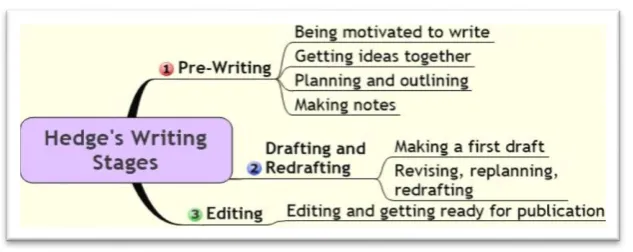
One of process writing procedures is developed by Hedge (2005). The Hedge’s
procedure in writing was developed from her experience and investigation
towards her intermediate students in writing class. From the investigation, she got
information about the different strategies students adopted and the problems that
some poorer students experienced. Then, she arranged writing stages which
consist of three major steps and seven minor steps as shown in the following
[image:21.595.156.473.543.669.2]figure:
Figure 1.1 Hedge’s Writing Stages
(Source: Hedge, 2005: 51)
Hedges (2005: 52) asserts that although writing involves these overall stages, the
characterize writing as a recursive activity in which the students move backwards
and forwards between drafting and revising. Moreover, the other merit of Hedge’s
writing stages is that she puts ‘being motivated to write’ as one of activities in
pre-writing stage. This activity helps students realize that writing needs goals and
audience. Hedge (2005: 52) emphasizes two questions before writing which she
puts in her first step (being motivated to write): what the purpose of the writing is;
and who the writer is writing for. The answers of these two questions, she adds,
provide the writer with a sense of purpose and a sense of audience which will give
the writer a writing context that influences the composition processes. Here,
giving motivation means giving the students a context before writing.
However, based on pre-research interview, the students do not only need
motivation to write English composition. They also need guidance in pre-writing
activity to aid them generating and elaborating their ideas, which is not clearly
explained by Hedge. It means that putting ‘being guided to write’ after ‘being
motivated to write’ is deliberately needed by the students. Thus, the process
writing procedure is begun by giving the students motivation and guidance in
form of modeling writing and guided writing. This additional step is inspired by
Seow’s (2002) statement, which states that teachers should model the writing
process at every stage and teach specific writing strategies to students through
meaningful classroom activities.
Several previous studies have been conducted around the world dealing with
process writing approach and its contribution in learning process. Bayat (2014)
has investigated the effect of the process writing approach on writing success and
5
students. He employed a quasi-experimental design. As a result of the statistical
analysis, the study finds that the process writing approach has a significant effect
on writing success and anxiety. Based on this finding, he suggests that the use of
process writing approach is recommended for written expression studies.
In the same year, Alodwan & Ibnian (2014) from Jordan has done a study aimed
at investigating the effect of using the process approach to writing on developing
university students’ essay writing skills. The sample of the study consisted of 90
non-English major students classified into two classes, one served as an
experimental group and the other one as control. The results of the study show
that the process approach to writing has positively affected the students’ essay
writing skills in EFL.
Furthermore, Faraj (2015) investigated the effect of teacher’s scaffolding with
teaching writing process on improving students’ writing skills. For this
investigation, he employed 30 students all native speakers of Kurdish language in
the twenty-to-twenty-three-year age studying at English Language. They were
only one experimental group. Pre-test and post-test were conducted for assessing
how much students achieved from what had been taught. The result is that
students’ achievement in post-test compared to pre-test reveals significant
improvement. Also, he concludes that scaffolding students’ writings through
writing process approach meets the students’ needs in EFL writing, and then it has
improved their writing skill.
The opposite result regarding process writing was revealed by Klimova (2014).
Tourism in their third year of study at FIM. They were asked to write an abstract
of their final Bachelor paper. At the beginning of the experiment students were
divided into two groups, each comprised 7 students. One group (A) was then
taught the writing of abstracts through the product approach by being provided
model abstracts of British provenience and the other group (B) was taught through
the process approach to writing. The result shows that neither of process approach
and product approach is more appropriate for the learning and teaching of writing
skills. The product approach to writing is slightly better for the teaching of writing
skills.
Previously, Gomez et al (1996) conducted a study examining the effectiveness of
free writing versus structured writing instruction with a group of 48 low-achieving
limited English proficient (LEP) Hispanic students in an intensive 6-week summer
program. Structured Writing samples show significant growth in five of nine
scores and Free Writing only one. Tests between treatments show significant
differences on just one score, in favor of Structured Writing. From this research,
they suggest that structured writing is better than free writing.
The elaboration of the ideas above led the researcher to investigate the
effectiveness of a modified process writing procedure proposed in this study to
support or to weaken the previous research. Moreover, the results of the study
hopefully help students lower their writing anxiety so that they can foster their
writing ability to reach better writing achievement in senior high school. This
achievement may also lead them to have better chance in their near future then
7
1. 2. Research Questions
Based on the problems elaborated in the background, the study persuades three
research questions as follows:
1. How is the effectiveness of Modified Process Writing Procedure in
lowering students’ writing anxiety?
2. How is the effectiveness of Modified Process Writing Procedure in
fostering students’ writing achievement?
3. What are the causes of writing anxiety mostly felt by the students?
1. 3. Objectives
The objectives of the study are as follows:
1. Investigating the effectiveness of Modified Process Writing Procedure
in lowering students’ writing anxiety.
2. Examining the effectiveness of Modified Process Writing Procedure in
fostering students’ writing achievement.
3. Finding out the causes of writing anxiety mostly felt by the students
1. 4. Uses
A process writing procedure modified in this study is expected to give its
1.4.1. Theoretical Uses
The results of this study are expected to:
a. Be a useful and scientific reference to further research and development
dealing with process writing approach and students’ writing anxiety
b. Support or weaken the previous research dealing with process writing
approach and students’ writing anxiety.
1.4.2. Practical Uses
In terms of practical uses, there are at least three educational components that are
expected to gain the benefits of this study practically. Those are the students, the
English teachers, and the school.
a. The students can develop their writing achievement and lower their
writing anxiety guided by their teachers using Modified Process Writing
Procedure.
b. The teacher can apply Modified Process Writing Procedure in teaching
writing to their students in order to lower their writing anxiety and foster
their writing achievement.
c. The related school can use the result of the study as stepping stone to
other further research concerning process of English teaching and
learning.
1. 5. Scope
In order to investigate and develop the variables more deeply, delimitation is
needed in this study. The process writing procedures modified in this study came
9
study is based on the second language writing anxiety inventory developed by
Cheng (2004) and the causes of second language writing anxiety inventory
developed by Rezaei & Jafari (2014).
1. 6. Definitions of Terms
Keeping away from the possibility of misinterpretation dealing with the key terms
in the title and variables, here are the definitions of the terms.
a. Modified Process Writing Procedure is a series of process writing stages
modified from Hedge’s writing stages.
b. Writing anxiety is a fear of the writing process that controls over the
expected gain from the ability to write, which may eventually lead to
relatively enduring predispositions to dislike, evade or fear writing
(adapted from Tadesse, 2013).
c. Writing achievement is the students’ final score of writing after being
taught using modified process writing procedure.
This chapter has explained the background of the study, the research questions,
objectives, the uses, the scope and the definitions of terms. The next chapter will
II. LITERATURE REVIEWS
This chapter elaborates the literature reviews of the study and begins with the
concept of writing and types of writing approach. The concept of teaching writing,
process writing procedure, process writing procedure in teaching writing, the
concept of a modified process writing procedure, students’ writing anxiety, the
types of students’ writing anxiety, the levels of students’ writing anxiety, and the
causes of students’ writing anxiety are also elucidated in this chapter. Theoretical
assumptions and hypotheses are presented in the end of this chapter as well.
2.1. The Concept of Writing
Producing a coherent, fluent, extended piece of writing is probably the most
difficulty thing there is to do in language (Nunan, 1999: 271). Writing has a
unique position in language teaching (Klimova, 2014) that is one of the important
tools by which students actively change the passive knowledge and information in
their minds into their own language (Hashemnezhad & Hashemnezhad, 2012).
11
consciously because most exams, whether they are testing foreign language
abilities or other skills, often rely on the students’ writing proficiency in order to
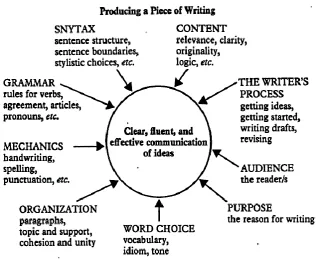
measure their knowledge. (Harmer, 2004: 3). Raimes (1983: 6) provides the
picture about producing a piece of writing. There are several ‘things’ which must
be concerned. Those are content, the writers’ process, audience, purpose, word
[image:29.595.149.469.280.547.2]choice, organization, mechanics, grammar, and syntax.
Figure 2.1 Producing a Piece of Writing
(Source: Raimes, 1983: 6)
Raimes (1983: 3) suggests that the fact that people have to communicate with
each other in writing is not the only reason to put it as parts of the English
syllabus. The other important reason, she adds, is that writing helps the students
learn. Writing reinforces the grammatical structures, idioms and vocabulary that
have to be taught by the teacher. When the students write, they also have a chance
say. Also, when writing, the students necessarily become very involved with the
new language. The effort to express ideas and the constant use of eye, hand, and
brain is a unique way to reinforce learning (ibid). Therefore, training students to
write demands the care and attention of language teachers.
2.2. Types of Writing Approach
There are at least three types of writing approach: product writing, process writing
and creative writing. Product writing is one of the most practiced approaches in
schools around the world (Palpanadan et al, 2014). This writing approach
encourages students to produce an end product which may be likened to a model
essay or the essay normally provided by teachers (ibid). Klimova (2014) states
that the product writing usually involves the presentation of a model text, which is
discussed and analyzed. The steps of product writing are: familiarization,
controlled writing, guided writing, and free writing (Palpanadan, 2014).
Meanwhile, process writing is a finished paper as the result of the complex
interaction of activities which include several stages of development (Williams,
2003: 106). Raimes (1983: 10) states that in the writing process, the students do
not write on a given topic in a restricted time and hand in the composition for the
teacher to ‘correct’ – which usually means to find the errors. Rather, she adds,
they explore a topic through writing, showing the teacher and each other their
drafts, and using what they write to read over, think about, and move them on to
new ideas. The steps of process writing are: being motivated to write; planning
and outlining; making notes; making a first draft; revising, replanning, redrafting;
13
The last but not least is creative writing. Creative writing is one area where the
imagination has a chance to run free (Harmer, 2004: 40). Harmer (2004: 41)
points out that the teachers concern with the tasks that provoke the students to go
beyond the everyday, take some chances, and use the language to express more
personal, complex thoughts and images.
In this research, process writing approach is chosen as the focus of the study. The
consideration of choosing this approach is that by a modification and adjustment,
this approach may help students reduce their writing anxiety.
2.3. The Concept of Teaching Writing
Raimes (1983: 5) states that there is no answer to the questions of how to teach
writing in ESL classes. Harmer (1998: 79) provides the reason why teachers teach
writing. Harmer (1998) proposes four reasons to teach writing to students of
English as a foreign language: reinforcement, language development, learning
style, and writing as a skill. It seems to suggest that the teacher should provide the
activities which involve those four things which are useful for the students to help
them write a composition. The teacher should also teach or introduce the aspects
of writing (content, organization, vocabulary, language use, and mechanics) to the
students in order that they have good basic in writing.
In another book, Harmer (2004) also provides the teacher’s tasks in teaching
writing. Those are demonstrating; motivating and provoking; supporting;
responding; and evaluating (p. 41-42). These activities may be very helpful for the
students because of Sundem’s (2006: 64) statement that one successful technique
support the students as they attempt their writing on their own. Thus, the teacher
is expected to be a good writer in order that she can model the procedure of
writing in front of the students. She/he is also expected to provide an appropriate
writing procedure which the students can follow and apply.
2.4. Process Writing Procedure
There are many ways to teach writing based on process writing approach. Harmer
(2004: 4-6) suggests four main elements in writing process: planning, drafting,
editing and final version. He states that these steps are not linear, but rather
recursive. It means that the students plan, draft, revise and can go back to re-plan
and re-draft. The probable weakness of this writing process is Harmer only
provides the core of process writing approach in his steps. He elaborates several
activities that the students may do in each step. Yet, he does not specify which
activity is better than the others.
In 2006, Sundem proposed more specific steps in writing process. There are six
stages of writing process: prewriting; drafting; self-revising; peer/adult revising;
editing; and publishing (p. 42). Here, the students are asked to create publishable
product started by generating ideas; choosing and organizing these ideas; writing
and revising their pieces; and formatting them for publication. However,
motivation to write was not put by Sundem in his steps of writing. Motivating to
write means leading the students to decide what they write and who they write for.
15
teacher’s roles is to provide an environment in which students will learn about
writing, see models of good writing, get plenty of practice in writing, and receive help during the writing process (Hedge, 2005: 55). In other words, the teacher should set up classroom writing activities which are able to encourage students to go through a process of planning, organizing, composing, and revising.
2.5. Process Writing Procedure in Teaching Writing
Some previous studies have been conducted around the world dealing with
process writing approach and its contribution in teaching writing. Bayat (2014)
has investigated the effect of the process writing approach on writing success and
anxiety. The participants in this study were first-year Turkish preschool teaching
students. He employed a quasi-experimental design. As a result of the statistical
analysis, the study has found that the process writing approach has a significant
effect on writing success and anxiety. Based on this finding, he suggested that the
use of process writing approach is recommended for written expression studies.
In the same year, Alodwan & Ibnian (2014) from Jordan have done a study aimed
at investigating the effect of using the process approach to writing on developing
university students’ essay writing skills. The sample of the study consisted of 90
non-English major students classified into two classes, one served as an
experimental group and the other one as control. The result of the study shows
that the process approach to writing has positively affected the students’ essay
writing skills in EFL.
Furthermore, Faraj (2015) has investigated the effect of teacher’s scaffolding
with teaching writing process on improving students’ writing skills. For this
the twenty-to-twenty-three-year age studying at English Language. They were
only one experimental group. Pre-test and post-test were conducted for assessing
how much students achieved from what had been taught. The result is that
students’ achievement in post-test compared to pre-test reveals significant
improvement. Also, he concludes that scaffolding students’ writings through
writing process approach meets the students’ needs in EFL writing, and then it has
improved their writing skill.
2.6. The Concept of Modified Process Writing Procedure
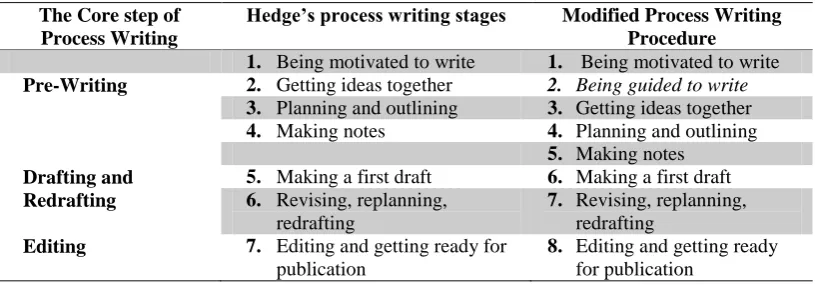
As stated in the background, the modification of the Hedge’s process writing
stages lies on the first sub-step of pre-writing. ‘Being guided to write’ is put after
‘being motivated to write’. This additional step is based on pre-research interview
to some students who state that motivation is not enough for them to start writing.
They said that they would be very happy and helpful if the teacher provided them
writing guidance. Hence, the modified process writing procedure is as follows:
Table 2.1 The Comparison of Hedge’s Process Writing Stages and Modified Process Writing Procedure
The Core step of Process Writing
Hedge’s process writing stages Modified Process Writing Procedure
1. Being motivated to write 1. Being motivated to write Pre-Writing 2. Getting ideas together 2. Being guided to write
3. Planning and outlining 3. Getting ideas together 4. Making notes 4. Planning and outlining
5. Making notes Drafting and
Redrafting
5. Making a first draft 6. Making a first draft 6. Revising, replanning,
redrafting
7. Revising, replanning, redrafting
Editing 7. Editing and getting ready for
publication
8. Editing and getting ready for publication
[image:34.595.109.517.530.673.2]17
2.6.1 Being motivated to write
In motivating the students to write, the teacher plays the role as a motivator.
Motivation is still needed by the students in writing in order that the students
know what and who they are writing for. The students are guided to find out the
function of writing for their real life and where and when they can use their
writing.
2.6.2 Being guided to write
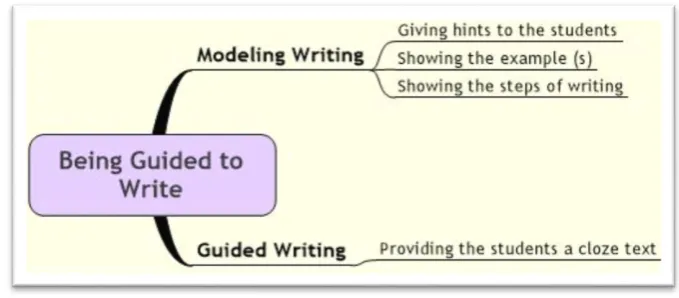
There are at least two activities in this step: modeling writing and guided writing.
Modeling writing is conducted by the teacher whereas guided writing is done by
the students. The activities which are done by the students and the teacher are
[image:35.595.141.481.467.616.2]shown in the following figure:
Figure 2.2 Being Guided to Write
The first activity is modeling writing. In modeling writing, the teacher’s role as a
guide is really required. As shown in the figure above, the first activity is giving
students some tips for writing, explain briefly about organization of the text which
wants to write and illustrating the uses of certain vocabulary, phrases, and
expressions related to the text. Afterwards, the teacher shows the example(s) of
certain writing and guides the students to identify the organization of the text and
the use of vocabulary, expressions, and phrases in the text. Then, the last is that
the teacher shows how to write a certain kind of text in front of the students.
The last activity of this step is guided writing activity. Here, a cloze text is
provided for the students to help them practice to write before drafting. This is not
the individual activity. The students are provided the cloze text in the display then
they are asked to fill in the blank together like playing the game.
2.6.3 Getting ideas together
In this step, the teacher asks the students to work in pair and brainstorm about the
ideas of writing. Their ideas should be different but they may give their pair
suggestion to find out the other ideas. Here, the teacher acts as a facilitator.
2.6.4 Planning and outlining
After each student gets their own idea of writing, they are guided to plan what
they want to write by making an outline. They may use their own ideas or search
for additional information in internet. Here, the teacher acts as a guide and a
facilitator.
2.6.5 Making notes
When the students search for additional information from reading text(s), they
19
is needed. Hence, this activity is useful for students to filter the information they
read. Here, the teacher plays the role as a facilitator.
2.6.6 Making a first draft
Nothing is perfect for a first draft. This statement will motivate the students not to
fear to write. A first draft is written based on the outline and notes planned in the
previous steps. The important thing of this step is ensuring the students that
writing is a process activity. There will be revising, replanning, and redrafting.
2.6.7 Revising, replanning, redrafting
After the students finish their first draft, the next step is revising. The first reviser
is their pair. This activity is called pair correction. The students will read and
correct their pair’s writing. Then, they give some suggestion (if any) to make the
text better.
Based on the pair correction and suggestion, the students re-plan and redraft their
writing. The draft will be their second draft. The second draft then is read and
corrected by the second reviser, the teacher. This activity is called teacher
correction. The teacher gives correction and suggestion based on the aspects of
writing (grammar, vocabulary, mechanics, fluency, and relevance). The revision
of this draft is the final draft of writing. Here, the teacher acts as a reviser
2.6.8 Editing and getting ready for publication
Editing is the post-writing activity. The final draft is edited after being graded by
the teacher. Here, the teacher acts as an editor. The last but not least is publication.
www.penpalworld.com. The body of the letter written by them about their life is
uploaded as their profile for their account. Then, they can start writing a letter for
their new pal.
2.7. Students’ Writing Anxiety
Writing anxiety or apprehension is a serious problem faced by the most EFL/ESL
learners because their writing in the mother tongue is different than writing in the
foreign language (Huwari & Al-Shboul, 2016). Writing anxiety refers to a
situation and subject specific individual differences associated with a person’s
tendencies to approach or avoid situation to potentially enquire writing
accompanied by some amount of perceived evaluation (Kostic-Bobanovic, 2016).
It encompasses a fear of the writing process that controls over the expected gain
from the ability to write, which may eventually lead to relatively enduring
predispositions to dislike, evade or fear writing (Tadesse, 2013).
Individuals with high apprehension/anxiety of writing would fear evaluation of
their writing (Daly & Miller, 1975). They add that the individuals avoid writing
when possible and when forced to write exhibit high level of anxiety. If most of
the students have high level of writing anxiety, this condition may influence their
writing learning process and their writing achievement. The teacher, as the
responsible one in a class, should provide a writing technique to reduce the
anxiety.
2.8. The Types of Students’ Writing Anxiety
Cheng (2004) has developed a questionnaire of writing anxiety and divided it into
21
behavior. Cognitive anxiety refers to the mental aspect of anxiety experience,
including negative expectations, preoccupation with performance, and concern
about others’ perceptions (Cheng, 2004). Whereas somatic anxiety refers to one’s
perception of the physiological effects of the anxiety experience, as reflected in
increased autonomic arousal and unpleasant feeling states such as nervousness
and tension (Cheng, 2004). Meanwhile, avoidance behavior deals with reflection
in avoidance in writing.
2.9. The Level of Students’ Writing Anxiety
Rezaei & Jafari (2014) provide the rating scale to measure students’ level of
anxiety. They divide the level into three: high, moderate, and low. This level is
based on SLWAI score which is ranged from 22 – 110. The students’ level is
categorized as high if a total score is above 65 points. If the total score is between
65 – 50, it indicates that the students’ level is in moderate level. If the total of
students’ score is below 50, it means that the students’ level is low.
2.10. The Cause of Students’ Writing Anxiety
The cause of students’ writing anxiety is the term used by Rezaei and Jafari
(2014) to define the students’ anxiety in composing a writing product. Based on
their research, there are some causes of students’ writing anxiety such as fear of
teacher’s negative comment; fear of writing tests; insufficient writing practice;
insufficient writing technique; problems with topic choice; linguistic difficulties;
pressure for perfect work; high frequency of writing assignments; time pressure;
and low self confidence in writing. Those categories of the causes are the basis of
2.11. Theoretical Assumption
As stated by Nunan (1999: 271) that producing coherent, fluent, extended piece of
writing is possibly the most difficult thing to do in language. It is also felt by
Indonesian students who learn English as a foreign language. Based on
pre-research interview, the students have difficulties in organizing and elaborating the
ideas. They also tend to feel that they do not have necessary knowledge and
experience of language that writing demand, which is stated by Brown & Hood
(1993: 3) as one of major barriers to students’ confidence. As the result, these
problems may lead them to writing anxiety.
Huwari & Al Shboul (2016) state that students feel anxious in writing when
teachers ask them to compose a text. Anxiety in writing can lead the students to be
demotivated in writing which then may cause them to have negative attitudes
towards writing (Huwari & Aziz, 2012). Kostic-Bobanovic (2016) also states that
the complexity of writing as a task tends to heighten students’ anxiety levels.
Thus, to minimize the students’ anxiety in writing, teachers should modify their
teaching instruction as suggested by Huwari & Al Shboul (2016).
In this study, a modification was made towards Hedge’s writing stages, which are
based on a process writing approach. Bayat (2014) has investigated the effect of
the process writing approach on writing success and anxiety. The result is that the
process writing approach has a significant effect on writing success and anxiety.
Then, he suggests that process approach can be applied to lower writing anxiety. It
is also suggested that writing should be introduced and taught as a process
23
skill mastery, and also to build confidence and motivation (Puengpipattrakul,
2014).
The modification itself was based on pre-research interview which shows that
Indonesian students do not only need motivation to write. In fact, they also need
guidance to compose a good writing. Hence, ‘being guided to write’ activity,
which is not clearly explained by Hedge, is considered being added after ‘being
motivated to write’ as part of modified Hedge’s writing stages. This additional
step is inspired by Seow’s (2002) statement, which states that teachers should
model the writing process at every stage and teach specific writing strategies to
students through meaningful classroom activities.
Based on the framework of the study above, it is assumed that a modified process
writing procedure seems to be able to lower students writing anxiety and foster
students achievement since this procedure provides the students guidance in
pre-writing activity and allow students to revise, re-plan, and re-draft their pre-writing.
2.12. Hypotheses of the study
According to research questions proposed in this study, there are four hypotheses
in this study. The first hypothesis deals with the first research question about the
effectiveness of modified process writing procedures in lowering students' writing
anxiety. The hypothesis is as follows.
H0 : A modified process writing procedure is not effective to
lower students’ writing anxiety.
Moreover, the second hypothesis deals with the second research question about
the effectiveness of modified process writing procedures in fostering students'
writing achievement. The hypothesis is as follows.
The third hypothesis deals with the third research question about the causes of
students’ writing anxiety. The hypothesis is as follows:
The possible causes of writing anxiety which are mostly perceived by the
students can be fear of teacher’s negative comment; fear of writing tests;
insufficient writing practice; insufficient writing technique; problems with
topic choice; linguistic difficulties; pressure for perfect work; high
frequency of writing assignments; time pressure; and low self confidence in
writing.
This chapter has elaborated the literature reviews of the study which consist of the
concept of writing, types of writing approach, the concept of teaching writing,
process writing procedure, process writing procedure in teaching writing, the
concept of a modified process writing procedure, students’ writing anxiety, the
types of students’ writing anxiety, the causes of students’ writing anxiety, lower students’ writing anxiety.
H0 : A modified process writing procedure is not effective to
foster students’ writing achievement.
H1 : A modified process writing procedure is effective to
25
theoretical assumptions and hypotheses. The next chapter will explain about the
III. RESEARCH METHODS
This chapter deals with the research methods used in modifying process writing
procedures. They consist of research design, population and sample, research
instruments, data collection, data analysis, data treatment, and hypothesis testing.
3.1 Research Design
This study employed mixed-methods approach in form of explanatory sequential
design. As stated by Creswell (2012: 542), the explanatory sequential design
consists of first collecting quantitative data and then collecting qualitative data to
[image:44.595.132.513.637.699.2]help explain or elaborate on the quantitative results. The design is as follows:
Figure 3.1 Explanatory Sequential Design
(Sources: Adapted from Creswell, 2012: 542) Quantitative data
collecting and analysis
Qualitative data collecting and
27
A quantitative approach employed in this study is pre-experimental design by
means of one-group pretest-posttest design. The researcher only uses one
experimental class so that the notation is as follows:
𝑇1× 𝑇2
Note:
T1 = Pretest
T2 = Posttest
X = Treatment (Modified Process Writing Procedure)
To follow up the results of the quantitative data, the researcher uses qualitative
approach by means of interviews to support the quantitative results regarding
student writing anxiety before, during, and after the treatment.
3.2 Population and Sample 3.2.1 Population
The population of this study was the eleventh-grade students of SMAN 02
Pringsewu. The eleventh graders were chosen with the assumption that their
English writing skill is in intermediate level so that the process writing procedure
could be applied for the student. Moreover, they were chosen since based on the
curriculum, they have already studied most of tenses and grammar lesson.
Meanwhile, the school was chosen since based on the interview, the students’
3.2.2 Samples
The samples of the study were thirty of eleventh-grade students of SMAN 02
Pringsewu. There are nine classes of the eleventh graders and the sample was
chosen randomly based on their classroom. The names of the samples was coded
into numbers. It was done in order to ensure the privacy of research data as
Creswell (2012: 23) suggests that names of the participants should be removed
from all data collection forms and assign a number or letter to each form.
Meanwhile, the participants of the interview were chosen purposively as
suggested by Creswell (2012: 206). The participants were chosen based on their
writing anxiety level. It was planned to choose two students for each level of
writing anxiety, which were low, moderate, and high. However, after conducting
the pretest and analyzing the data, it was found that there was none of them who
got low score of writing anxiety. Finally, six students from moderate and high
level were chosen as the participants of the interview. The identity of them was
also concealed and renamed.
3.3 Research Instruments
In this study, the instruments which were used to collect the data are interview
guides, questionnaires and writing test. The following subchapters provide the
further explanation concerning the instruments.
3.3.1 Interview Guides
Interview guides were used to gain the data regarding students' writing anxiety.
The type of the interview was semi-structured interview in which a written list of
questions as a guide is used, but the questions can be modified to get more
29
the process of collection data through interview with a group of people (Creswell,
2012: 218). The interview was held three times: before, during, and after the
treatment towards six students. The interview before the treatment was used as
data to answer the third research question while the interview during and after
the treatment were used as clarification for the first and second research
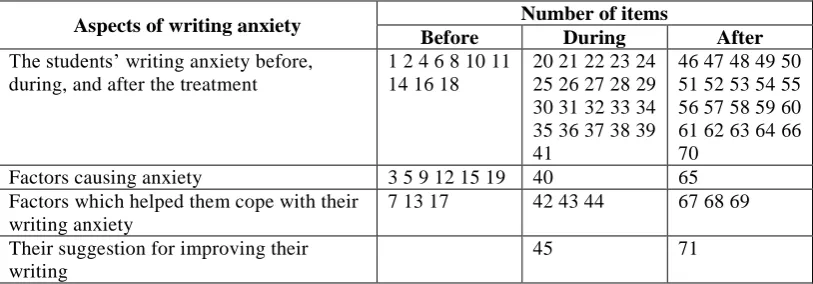
[image:47.595.109.516.298.440.2]question. The guideline of interview is adapted from Demirel (2011) as follows:
Table 3.1 The Guideline of Interview
Aspects of writing anxiety Number of items
Before During After
The students’ writing anxiety before, during, and after the treatment
1 2 4 6 8 10 11 14 16 18
20 21 22 23 24 25 26 27 28 29 30 31 32 33 34 35 36 37 38 39 41
46 47 48 49 50 51 52 53 54 55 56 57 58 59 60 61 62 63 64 66 70
Factors causing anxiety 3 5 9 12 15 19 40 65
Factors which helped them cope with their writing anxiety
7 13 17 42 43 44 67 68 69
Their suggestion for improving their writing
45 71
(Source: Adapted from Demirel, 2011)
3.3.2 Questionnaire
The questionnaires used in this study were second language writing anxiety
inventory (SLWAI) developed by Cheng (2004) and causes of second language
writing anxiety inventory (CSLWAI) developed by Rezaei & Jafari (2014). Those
two questionnaires were employed to gain the data dealing with the students'
writing anxiety. Those two instruments were translated into Bahasa Indonesia (see
Appendix 7: 127 – 133)
SLWAI consists of 22 items, scored on a Five-point Likert scale ranging from 1
(strongly disagree) to 5 (strongly agree). The 22 items of the modified SLWAI are
17, 20, 21), Somatic Anxiety (2, 6, 8, 11, 13, 15, 19), and Avoidance Behavior (4,
5, 10, 12, 16, 18, 22). For each item, respondents were required to respond with an
answer: strongly agree (5), agree (4), uncertain (3), disagree (2), and strongly
disagree (1). Yet, there were seven items which should be counted reversely (1 for
strongly agree to 5 for strongly disagree). Those are the items number 1, 4, 7, 17,
18, 21, and 22. Thus, higher score shows higher level of writing anxiety (see
Appendix 7: 127). The following is the table of specification of SLWAI adopted
[image:48.595.116.515.339.459.2]from Cheng (2004):
Table 3.2 Table of Specification of SLWAI
Aspects of writing anxiety Example Number of items
Cognitive anxiety “While writing English compositions, I feel worried an uneasy if I know they will be evaluated”
1 3 7 9 14 17 20 21
Somatic anxiety “I feel my heart pounding when I write English compositions under time constraint”
2 6 8 11 13 15 19
Avoidance behavior “I usually do my best to avoid writing English composition”
4 5 10 12 16 18 22
(Source: Adopted from Cheng, 2004)
Moreover, CSLWAI is 10-item questionnaire developed by Rezaei & Jafari
(2014) on the basis of causes of writing anxiety (including fear of teacher's
negative comment, fear of writing tests, insufficient writing practice, insufficient
writing technique, problems with topic choice, linguistic difficulties, pressure for
perfect work, high frequency of writing assignments, time pressure, and low self
confidence in writing). One item was added (item number 2), which is about the
fear of getting bad score, to complete the questionnaire. This questionnaire was
also the root of conducting the interview (see Appendix 7: 133).
31
Table 3.3 Table of Specification of CSLWAI Aspects of causes of
writing anxiety
Example Number of items
Fear of teacher's negative comment
“I worry about the negative comments and evaluation of the
teacher”
1
Fear of getting bad score (additional)
“I worry about getting bad score from teacher.”
2
Fear of writing tests “I’m afraid of writing tests.” 3 Insufficient writing practice “I have lack of sufficient English writing
practice which makes me feel anxious.”
4
Insufficient writing technique
“I don’t have a good command of English writing techniques which makes me feel anxious.”
5
Problems with topic choice “I don’t know what to write on the topic given by the teacher so I feel upset.”
6
Linguistic difficulties “I often encounter some linguistic problems such as inadequate mastery of vocabulary, sentence structures, grammatical errors, etc.”
7
Pressure for perfect work “I’m under pressure to offer a perfect work which makes me upset.”
8
High frequency of writing assignments
“I feel anxious due to high frequency of writing assignments”
9
Time pressure “I feel worry when I have to write under time constraints.”
10
Low self confidence in writing
“I have a low-confidence in English writing.”
11
(Source: Adapted from Rezaei and Jafari, 2014)
3.3.3 Writing Test
Writing test was conducted before and after the treatment. This instrument was
used to know the effectiveness of the modified process writing procedure. The
topic was chosen based on the Curriculum of 2013, school syllabus, and teacher's
suggestion, which is personal letter. The aspect of writing assessed are content,
organization, vocabulary, language use, and mechanics.
In assessing the students' writing, impression method is used to get the reliable
results of students' writing test as suggested by Heaton (1990: 147). Impression
method refers to one or more markers/raters awarding a single mark based on the
rater/marker is Muhammad Fadli S. Pd. He is a professional teacher in one of the
best English course in Bandar Lampung. He has taught English, especially
Grammar, since 2008. Now, he is continuing his master degree in Lampung
University. The aspects of writing assessing from the students' writing was
adapted from Heaton (1990: 146) as follows:
Table 3.4 Rating Scales of Writing Assessment
Content (30)
Excellent to very good 30 – 27
Good to average 26 – 22
Fair to poor 21 – 17
Very poor 16 – 13 Message is clear,
precise, and shows insight. Letter includes all parts of a letter, also encourages a response from the reader.
Message is clear. Letter includes six parts of a letter
Message is mostly clear. Letter includes five parts of a letter,
Message is not focused. Ideas wander. The reader may have to infer at times.
Organization (20)
Excellent to very good 20 – 18
Good to average 17 – 14
Fair to poor 13 – 10
Very poor 9 – 7 All ideas are expressed
in clear and organized way. It is easy to figure out what the letter is about. The ideas are elaborated well
Most ideas are expressed in a pretty clear manner, but they could have elaborated better
[image:50.595.109.508.272.750.2]Ideas are somewhat organized, but are not very clear. It takes more than one reading to figure out what the letter is about
The letter seems to be a collection of unrelated sentences. It is very difficult to figure out what the letter is about.
Vocabulary (20)
Excellent to very good 20 – 18
Good to average 17 – 14
Fair to poor 13 – 10
Very poor 9 – 7 Letter is sophisticated
range, uses effective words, phrases, and expressions.
Letter is adequate range, uses occasional errors of words, phrases, and expressions, meaning is not obscured. Letter is limited range, uses frequent errors of words, phrases, and expressions.
Letter is like translation, little knowledge of English vocabulary. Language use (25)
Excellent to very good 25 – 22
Good to average 21 – 19
Fair to poor 18 – 11
Very poor 10 – 5 Sentence and
paragraphs are complete, well-constructed and of varied structure.
Most sentences are complete and well-structures. Paragraphing is generally done. Some sentences are complete and well-constructed. Paragraphing needs some work. Many sentence fragments or run-on sentences and paragraphing needs lots of work. Mechanics
(5)
Excellent to very good 5
Good to average 4
Fair to poor 3
33
Letter has excellent punctuation, spelling, and grammar with no more than 5% of errors
Letter has very good punctuation, spelling, and grammar with no more than 10% of errors Punctuation, spelling, and grammar slightly distract the reader. There are no more than 15% of errors Punctuation, spelling, and grammar significantly distract the reader. There are more than 15% errors.
(Source: Adapted from Heaton, 1990)
3.4 Data Collection
There are several steps in collecting the data. Those are conducting pre-research
observation and interview, administering SLWAI questionnaire and CSLWAI
questionnaire and conducting writing pre-test and post-test.
3.4.1 Conducting Pre-Research Interview
The interview was conducted in the early beginning of the research to clarify the
students' problem. The data of the pre-research were interview transcriptions.
3.4.2 Administering SLWAI Questionnaire and CSLWAI Questionnaire Before and After the Treatment
SLWAI and CSLWAI questionnaire in this study refer to a students' self-report
for investigating the students' writing anxiety and the causes of the students'
writing anxiety. For SLWAI, it was held three times, before, during, and after the
treatment, towards 30 students of XI graders as the samples (one class). Before
filling the questionnaire, the students were given a brief explanation about the
aims of the study and the direction of how to fill the questionnaire. They were also
informed that this questionnaire would not affect their grades. The data of this