Journal of Chemical and Pharmaceutical Research, 2013, 5(7):7-20
Research Article
ISSN : 0975-7384
CODEN(USA) : JCPRC5
Bio- analytical method development and validation of Valsartan by
precipitation method with HPLC-MS/MS: Application to a pharmacokinetic
study
Venkata Suresh. P
a,b*, Rama Rao Nadendla
aand B. R. Challa
c*a
Chalapathi Institute of Pharmaceutical Sciences, LAM Guntur, Andhrapradesh, India
b
Krishna University,
Machilipatnam, Andhrapradesh, India
c
Nirmala College of Pharmacy, Madras Road, Kadapa, Andhrapradesh, India
_____________________________________________________________________________________________
ABSTRACT
The most suitable bio-analytical method based on Precipitation method has been developed and validated for quantification of Valsartan in Rat plasma. Valsartan D9was used as an internal standard for Valsartan. Thermo Hypurity C18 (4.6mm x 150 mm, 5.0 µm) column provided chromatographic separation of analyte followed by detection with mass spectrometry. The method involved simple isocratic chromatographic condition and mass spectrometric detection in the positive ionization mode using an API-4000 system. The total run time was 3.0 minutes. The proposed method has been validated with the linear range of 0.50 – 20000.00 ng/mL for Valsartan. The intra-run and inter-run precision values were within 1.3 to 2.5% and 2.1 to 3.2% respectively for Valsartan. The overall recovery for Valsartan and Valsartan-D9 was 86.9% and 86.7% respectively. This validated method was successfully applied into the pharmacokinetic study of rat plasma.
Keywords: HPLC-MS/MS; Valsartan; Rat Plasma, Precipitation extraction; Pharmacokinetic study.
_____________________________________________________________________________________________
INTRODUCTION
Valsartan is chemically described as N-(1-oxopentyl)-N-[[2´-(1H-tetrazol-5-yl) [1,1-biphenyl]-4- yl]methyl]-L-valine. Its empirical formula is C24H29N5O3. Its molecular weight is 435.5. Valsartan peak plasma concentration is reached 2 to 4 hours after dosing. Valsartan shows biexponential decay kinetics following intravenous administration, with an average elimination half-life of about 6 hours. Absolute bioavailability for the capsule formulation is about 25% (range 10%-35%). Food decreases the exposure (as measured by AUC) to valsartan by about 40% and peak plasma concentration (Cmax) by about 50%. Valsartan, when administered as an oral solution, is primarily recovered in feces (about 83% of dose) and urine (about 13% of dose). Valsartan is highly bound to serum proteins (95%), mainly serum albumin. Following intravenous administration, plasma clearance of valsartan is about 2 L/h and its renal clearance is 0.62 L/h(1-14).
Among all only one method [17], reported in rat plasma for quantification. The reported method [17] in rat plasma developed by using Solid phase extraction method.
The main aim of the present research is to develop and validate simple, selective, rugged and reproducible method in rat plasma for clinical pharmacokinetic studies.
EXPERIMENTAL SECTION
Valsartan and Valsartan D9 (Fig.1) were obtained by VARDA Biotech (P) Ltd. Mumbai. LC grade methanol, acetonitrile were purchased from J.T. Baker Inc. (Phillipsburg, NJ, USA). Reagent grade formic acid was procured from Merck (Mumbai, India).
2.1. Instrumentation
HPLC system (1200 series model, Agilent Technologies, Waldbronn, Germany), Mass spectrometry API 4000 triple quadrupole instrument (ABI-SCIEX, Toronto, Canada) multiple reaction monitoring (MRM) with positive ionization mode was used. Data processing was performed on Analyst 1.4.1 software package (SCIEX).
2.2. Detection
2.3.Chromatography
Ascentis Express C18 (4.6mm x 50 mm, 2.7 µm) was selected as the analytical column. Column temperature was set at 30°C. Mobile phase composition was 0.1% formicacid: methanol (25:75, v/v). Source flow rate was 600 µL/min without split with injection volume of 20 µL. Valsartan and Valsartan D9 were eluted at 1.4 ± 0.2 min, with a total run time of 3.0 min for each sample.
2.4. Calibration curve and quality control samples
Two separate stock solutions of Valsartan were prepared for bulk spiking of calibration curve and quality control samples for the method validation exercise as well as the sample analysis. The stock solutions of Valsartan and Valsartan D9 were prepared in milli-Q-water at free base concentration of 1000 µg/mL. Primary dilutions and working standard solutions were prepared from stock solutions using 75% methanol solvent mixture. These working standard solutions were used to prepare the calibration curve and quality control samples. Blank rat plasma was screened prior to spiking to ensure it was free of endogenous interference at retention times of Valsartan and internal standard Valsartan D9. Eleven point standard curve and four quality control samples were prepared by spiking the blank plasma with an appropriate amount of Valsartan. Calibration samples were made at concentrations of 5.00, 10.00, 50.00, 100.00, 500.00, 1000.00, 2000.00, 4000.00, 6000.00, 8000.00 and 10000.00 ng/mL and quality control samples were made at concentrations of 5.00, 15.00, 3000.00 and 7000.00 ng/mL for Valsartan.
2.5. Sample preparation
Precipitation extraction method was used to isolate valsartan, and its respective IS from Rat plasma. For this, 50 µL of IS (1000.00 ng/mL) and 100 µL of plasma sample (respective concentration) was added into labeled polypropylene tubes and vortexed briefly after that 350 µL of acetonitrile was added and vortexed for approximately 3 minutes followed by centrifuged at 14000 rpm for approximately 3 min at ambient temperature. 100 µL of Supernatant from each sample was transferred to labeled ria vial tube containing 100 µL of 0.1% formic acid and vortexed briefly and then transferred the sample into auto sampler vials for injection.
2.6. Selectivity
Selectivity was performed by analyzing the six different rat blank plasma samples to test for interference at the retention times of analyte.
2.7. Matrix effect
Matrix effect for Valsartan and IS was evaluated by comparing peak area ratio in post-extracted plasma sample from 6 different drug-free blank plasma samples and aqueous reconstitution samples. Experiments were performed at LQC and HQC levels in triplicate with six different plasma lots with the acceptable precision (%CV) of ≤ 15%.
2.8. Precision and accuracy
It was determined by replicate analysis of quality control samples (n = 6) at lower limit of quantification (LLOQ), low quality control(LQC), medium quality control (MQC), high quality control (HQC) levels. The % CV should be less than 15%, and accuracy should be within 15% except LLOQ where it should be within 20%.
2.9. Recovery
The extraction efficiencies of Valsartan and Valsartan-D9 were determined by analysis of six replicates at each quality control concentration level for Valsartan and at one concentration for the internal standard Valsartan-D9. The percent recovery was evaluated by comparing the peak areas of extracted standards to the peak areas of non extracted standards.
2.10. Stability
control samples. Six aliquots each of LQC and HQC concentration levels were used for the freeze–thaw stability evaluation. For long term stability evaluation the concentrations obtained after 45 days were compared with initial concentrations.
2.11. Application of method
The validated method has been successfully used to analyze Valsartan concentrations in rat plasma. The study was conducted according to current GCP guidelines. Before conducting the study it was also approved by an authorized animal ethics committee. There were a total of 9 blood collection timepoints including the predose sample. The blood samples were collected in separate vacutainers containing K2EDTA as anticoagulant. The plasma from these
samples was separated by centrifugation at 3000 rpm within the range of 2–8 °C. The plasma samples thus obtained were stored at –30 °C till analysis. Post analysis the pharmacokinetic parameters were computed using WinNonlin® software version 5.2 and 90% confidence interval was computed using SAS® software version 9.2.
RESULTS AND DISCUSSION
3.1. Method development
During method development, different options were evaluated to optimize mass spectrometry detection parameters, chromatography and sample extraction.
3.1.1. Mass spectrometry detection parameters optimization
Electro spray ionization (ESI) provided a maximum response over atmospheric pressure chemical ionization (APCI) mode, and was chosen for this method. The instrument was optimized to obtain sensitivity and signal stability during infusion of the analyte in the continuous flow of mobile phase to electrospray ion source operated at a flow rate of 20µL/min. Valsartan gave more response in positive ion mode as compare to the negative ion mode. The predominant peaks in the primary ESI spectra of Valsartan and Valsartan-D9 correspond to the MH+ ions at m/z 436.2 and 445.3 respectively. [Fig.2a, Fig2c]. Product ions of Valsartan and Valsartan-D9 scanned in quadrupole 3 after a collision with nitrogen in quadrupole 2 had an m/z of 235.1 for both respectively. [Fig.2b, Fig2d].
3.1.2. Chromatography optimization
Initially, a mobile phase consisting of ammonium formate and acetonitrile in varying combinations was tried, but a low response was observed. The mobile phase containing acetic acid: acetonitrile (30:70, v/v) and acetic acid: methanol (25:75, v/v) gave the better response, but poor peak shape was observed. A mobile phase of 0.1% formic acid in water in combination with methanol and acetonitrile with varying combinations was tried. Using a mobile phase containing 0.1% formic acid in water in combination with methanol (25:75, v/v), the best signal along with a marked improvement in the peak shape was observed for Valsartan and Valsartan D9. Short length columns, such as Symmetry Shield RP18 (50mm x 2.1 mm, 3.5 µm), Inertsil ODS-2V (50mm x 4.6 mm, 5µm), Ascentis Express C18 (50mm x 4.6 mm, 2.7 µm)and Hypurity Advance (50mm x 4.0 mm, 5 µm) YMC basic (50mm x2 mm, 5µm), Zorbax Eclipse Plus C18, (2.1mm x 50 mm, 3.5 µm) were tried during the method development. The best signal and good peak shape was obtained using the Ascentis Express C18 (50mm x 4.6 mm, 2.7 µm), column. It gave satisfactory peak shapes for both Valsartan and Valsartan D9. Flow rate of 0.6mL/min without splitter was used and reduced the run time to 3.0 min. Both drug and internal standard were eluted with shorter time at 12 min. For an LC-MS/MS analysis, utilization of stable isotope-labeled or suitable analog drugs as an internal standard proves helpful when a significant matrix effect is possible. In our case, Valsartan D9 was found to be best for the present purpose. The column oven temperature was kept at a constant temperature of about 30°C. Injection volume of 20µL sample is adjusted for better ionization and chromatography.
3.1.3. Extraction optimization
optimized detection parameters, chromatographic conditions and extraction procedure resulted in reduced analysis time with accurate and precise detection of Valsartan in rat plasma.
3.2. Method validation
A thorough and complete method validation of Valsartan in rat plasma was done following US FDA guidelines [58-59]. The method was validated for selectivity, sensitivity, matrix effect, linearity, precision and accuracy, recovery, reinjection reproducibility and stability.
3.2.1. Selectivity and sensitivity
Representative chromatograms obtained from blank plasma and plasma spiked with a lower limit of quantification (LOQ) sample are shown in Fig. 3 and Fig. 4., for Valsartan and Valsartan D9. The mean % interference observed at the retention time of analytes between six different lots of rat plasma, containing K2EDTA as an anti-coagulant
3.2.2. Matrix Effect
The CV % of ion suppression/enhancement in the signal was found to be 1.26% at LQC level and 2.04% at HQC level for Valsartan, indicating that the matrix effect on the ionization of analyte is within the acceptable range under these conditions.
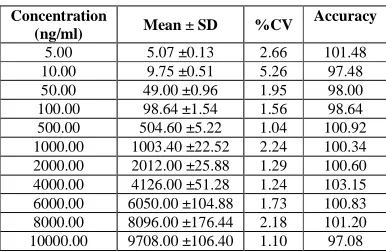
3.2.3. Linearity
Table 1. Calibration curve details
Concentration
(ng/ml) Mean ± SD %CV
Accuracy
5.00 5.07 ±0.13 2.66 101.48 10.00 9.75 ±0.51 5.26 97.48 50.00 49.00 ±0.96 1.95 98.00 100.00 98.64 ±1.54 1.56 98.64 500.00 504.60 ±5.22 1.04 100.92 1000.00 1003.40 ±22.52 2.24 100.34 2000.00 2012.00 ±25.88 1.29 100.60 4000.00 4126.00 ±51.28 1.24 103.15 6000.00 6050.00 ±104.88 1.73 100.83 8000.00 8096.00 ±176.44 2.18 101.20 10000.00 9708.00 ±106.40 1.10 97.08
3.2.4. Precision and accuracy
[image:11.595.99.500.339.426.2]The inter-run precision and accuracy were determined by pooling all individual assay results of replicate (n = 6) quality control over five separate batch runs analyzed on four different days. The inter-run, intra-run precision (% CV) was ≤5% and inter-run, intra-run accuracy was in between 85-115% for Valsartan. All these data presented in Table 2 indicate that the method is precise and accurate.
Table 2. Within-Run and Between-Run Precision and Accuracy
Spiked plasma concentration
(ng/ mL) Within-run
n=6
Between-run n=36 Mean ± S.D. Precision
(CV %) Accuracy Mean ± S.D.
Precision
(CV %) Accuracy 5.00 4.79±0.27 5.68 95.83 4.88±0.39 8.00 97.54 15.00 13.97±0.48 3.44 93.11 14.06±0.57 4.04 93.73 3000.00 2878.33±65.85 2.29 95.94 2903.33±58.15 2.00 96.78 7000.00 6691.67±97.45 1.46 95.60 6713.67±103.01 1.53 95.91
3.2.5. Recovery
Six aqueous replicates (samples spiked in reconstitution solution) at low, medium and high quality control concentration levels for Valsartan were prepared for recovery determination, and the areas obtained were compared versus the areas obtained for extracted samples of the same concentration levels from a precision and accuracy batch run on the same day. The mean recovery for Valsartan was 96.23%, and the mean recovery for Valsartan D9 was 91.67%. This indicates that the extraction efficiency for the Valsartan as well as Valsartan D9 was consistent and reproducible.
3.2.6. Reinjection reproducibility
Reinjection reproducibility exercise was performed to check whether the instrument performance remains unchanged after hardware deactivation due to any instrument failure during real sample analysis. The change was less than 2.5% for LQC and HQC level concentration; hence batch can be reinjected in the case of instrument failure during real subject sample analysis. Furthermore, samples were prepared to be reinjected after 25.5 hours, which shows % change less than 2.1% for LQC and HQC level concentration; hence batch can be reinjected after 25.5 hours in the case of instrument failure during real subject sample analysis.
3.2.7. Stabilities
Table 3: Stability of the samples
Spiked plasma concentration
(ng/ mL)
Bench-top stability Autosampler stability Long term stability Freeze & thaw stability
24 hr 65 hr 45 Days Cycle 3 (48 hr)
Concentration measured (n=6) (ng/ mL) (mean ±S.D) CV (%) (n=6) Concentration measured (n=6) (ng/ mL) (mean ± S.D)
CV (%) (n=6)
Concentration measured (n=6)
(ng/ mL) (mean ± S.D)
CV (%) (n=6)
Concentration measured (n=6)
(ng/ mL) (mean ± S.D)
CV (%) (n=6) 15.00 14.28 ± 0.25 1.74 14.65 ± 0.27 1.87 14.63 ± 0.43 2.92 14.75 ± 0.52 3.56 7000.00 6845.00 ± 168.26
2.46 6791.67 ±
206.24
3.04 6636.67 ±
129.72
1.95 6861.67 ±
101.47
[image:12.595.158.399.254.460.2]1.48
Table.4. Mean pharmacokinetic parameters of Valsartan in rat plasma after intravenous administration of 2.88mg/200g male rat.
Pharmacokinetic
Parameter Valsartan Cmax (ng/ mL ) 7039.51 AUC0-t (ng · h/ml) 56139.55
AUC0-∞ (ng · h/ml) 56365.29 Kel (h_1) 0.08913 Tmax (h) 0.25 Thalf (h) 7.78
AUC0—∞: area under the curve extrapolated to infinity;
AUC0—t: area under the curve up to the last sampling time;
Cmax: the maximum plasma concentration; Tmax: the time to reach peak concentration; Kel: the apparent elimination rate constant.
3.3. Application
femoral vein at specific time intervals for 60 h. Plasma samples were stored at -30 ◦C until analysis. The study was carried out after approval from an independent animal ethics committee. The pharmacokinetic parameters evaluated were Cmax (maximum observed drug concentration during the study), AUC0-60(area under the plasma concentration–time curve measured 60 hours, using the trapezoidal rule), Tmax (time to observe maximum drug concentration), Kel (apparent first order terminal rate constant calculated from a semi-log plot of the plasma concentration versus time curve, using the method of least square regression) and T1/2 (terminal half-life as determined by quotient 0.693/Kel). Pharmacokinetic details were shown in Table 4. The mean concentration versus time profile of Valsartan in rat plasma is shown in Fig.5.
CONCLUSION
The proposed bio-analytical method is most specific, highly sensitive, rugged and reproducible. The major advantage of this method is rapid analysis time (3.0 min), less plasma volume (0.1 ml) usage for analysis, suitable internal standard usage. This method was successfully applied in Pharmacokinetic study to evaluate the plasma concentrations of Valsartan in healthy male rats.
Acknowledgments
The authors are grateful to the Indian Institute of chemical technology, Hyderabad for Literature survey and AZIDUS, Chennai, India for their Lab facility of this research work.
REFERENCES
[1]Challa VR, Ravindra Babu P, Challa SR, Johnson B, Maheswari C. Drug Dev Ind Pharm. 2012 Jun 7. [Epub ahead of print]
[2]Yan F, Hu Y, Di B, He PL, Sun G. J. Pharm Pharm Sci. 2012 , 15(2), 208-20.
[3]Jones HM, Barton HA, Lai Y, Bi YA, Kimoto E, Kempshall S, Tate SC, El-Kattan A, Houston JB, Galetin A, Fenner KS. Drug Metab Dispos. 2012 ,40(5),1007-17.
[4]Jiang J, Tian L, Huang Y, Xie S, Xu L, Liu H, Li Y. Int. J Clin Pharmacol Ther. 2011 ,49(12),756-64.
[5]Duan J, Chen J, Yin Q, Karan R, Meiser K, Smith HT, Sunkara G. Int J Clin Pharmacol Ther. 2012 , 50(1),33-43.
[6]Habtemariam B, Sallas W, Sunkara G, Kern S, Jarugula V, Pillai G. Drug Metab Pharmacokinet.
2009,24(2),145-52.
[7]Flesch G, Müller P, Lloyd P. Eur J Clin Pharmacol. 1997, 52(2), 115-20.
[8]Waldmeier F, Flesch G, Müller P, Winkler T, Kriemler HP, Bühlmayer P, De Gasparo M. Xenobiotica. 1997 , 27(1), 59-71.
[9]Iqbal M, Khuroo A, Batolar LS, Tandon M, Monif T, Sharma PL. Clin Ther. 2010 , 32(3), 588-96. [10]Spínola AC, Almeida S, Filipe A, Neves R, Trabelsi F, Farré A. Clin Ther. 2009, 31(9), 1992-2001. [11]Zakeri-Milani P, Valizadeh H, Islambulchilar Z, Nemati M. Arzneimittelforschung. 2010, 60(2), 76-80. [12]Zaid AN, Cortesi R, Qaddomi A, Khammash S. Sci Pharm. 2011 ,79(1), 123-35.
[13]Sechaud R, Graf P, Bigler H, Gruendl E, Letzkus M, Merz M. Int J Clin Pharmacol Ther. 2002 , 40(1), 35-40. [14]Dixit AR, Rajput SJ, Patel SG. AAPS Pharm SciTech. 2010 , 11(1), 314-21.
[15]Mehta S, Shah RP, Singh S. Drug Test Anal. 2010, 2(2), 82-90.
[16]Ibrahim HK, El-Setouhy DA. AAPS Pharm SciTech. 2010 , 11(1),189-96. [17]Kesting JR, Huang J, Sørensen D. J Pharm Biomed Anal. 2010 ,51(3),705-11.
[18]Gonzalez O, Iriarte G, Rico E, Ferreirós N, Maguregui MI, Alonso RM, Jiménez RM. J. Chromatogr B Analyt Technol Biomed Life Sci. 2010 , 878(28),2685-92.
[19]Salvadori MC, Moreira RF, Borges BC, Andraus MH, Azevedo CP, Moreno RA, Borges NC. Clin. Exp Hypertens. 2009 , 31(5), 415-27.
[20]Ramani AV, Sengupta P, Mullangi R. Biomed Chromatogr. 2009 , 23(6), 615-22.
[21]Lu CY, Chang YM, Tseng WL, Feng CH, Lu CY. J. Pharm Biomed Anal. 2009 , 49(1), 123-8.
[22]Zhang D, Du X, Liu M, Li H, Jiang Y, Zhao L, Gu J. J. Chromatogr B Analyt Technol Biomed Life Sci. 2008 ,863(2), 223-8.
[23]Ferreiros N, Dresen S, Alonso RM, Weinmann W. Ther. Drug Monit. 2007, 29(6), 824-34.
[25]Koseki N, Kawashita H, Hara H, Niina M, Tanaka M, Kawai R, Nagae Y, Masuda N. J. Pharm Biomed Anal.
2007, 43(5), 1769-74.
[26]Kristoffersen L, Øiestad EL, Opdal MS, Krogh M, Lundanes E, Christophersen AS. J. Chromatogr B Analyt Technol Biomed Life Sci. 2007 ,850(1-2), 147-60.
[27]Krishnaiah Ch, Reddy AR, Kumar R, Mukkanti K. J. Pharm Biomed Anal. 2010 ,53(3), 483-9. [28]Sharma RN, Pancholi SS. Acta. Pharm. 2012 , 62(1), 45-58.
[29]Li Z, Chen F, Wang X, Wang C. Biomed Chromatogr. 2012 Jun 26. doi: 10.1002/bmc.2784. [Epub ahead of print]
[30]Czerwińska K, Mazurek AP. Acta Pol Pharm. 2011, 68(6), 831-7.
[31]Bianchini RM, Castellano PM, Kaufman TS. J Pharm Biomed Anal. 2011,56(1), 16-22. [32]Ahmed S, Atia NN, Mohamed NA. Talanta. 2011 , 84(3), 666-72.
[33]Rao K, Jena N, Rao M. J Young Pharm. 2010 , 2(2), 183-9.
[34]Helbling DE, Hollender J, Kohler HP, Singer H, Fenner K. Environ Sci Technol. 2010 , 44(17), 6621-7. [35]Kokil SU, Bhatia MS. Indian J Pharm Sci. 2009 , 71(2), 111-4.
[36]Rane V, Patil K, Shinde D. Pharmazie. 2009 , 64(8), 495-8.
[37]Tian DF, Tian XL, Tian T, Wang ZY, Mo FK. Indian J Pharm Sci. 2008 , 70(3), 372-4. [38]Tatar S, Sağlík S. J. Pharm Biomed Anal. 2002 , 30(2), 371-5.
[39]Satana E, Altinay S, Göğer NG, Ozkan SA, Sentürk Z. J. Pharm Biomed Anal. 2001 , 25(5-6), 1009-13. [40]Francotte E, Davatz A, Richert P. J. Chromatogr B Biomed Appl. 1996 , 686(1), 77-83.
[41]Sampath A, Reddy AR, Yakambaram B, Thirupathi A, Prabhakar M, Reddy PP, Reddy VP. J. Pharm Biomed Anal. 2009 , 50(3), 405-12.
[42]Kul D, Dogan-Topal B, Kutucu T, Uslu B, Ozkan SA. J .AOAC Int. 2010 , 93(3), 882-90. [43]Lu Y, Chen J, Chen B, Yao S. Se Pu. 2009 , 27(1), 44-9.
[44]Rao RN, Bompelli S, Maurya PK. Biomed Chromatogr. 2011 Feb 10. doi: 10.1002/bmc.1599. [Epub ahead of print]
[45]Ferreiros N, Iriarte G, Alonso RM, Jiménez RM, Ortíz E. J .Sep Sci. 2008 , 31(4), 667-76.
[46]del Rosario Brunetto M, Contreras Y, Clavijo S, Torres D, Delgado Y, Ovalles F, Ayala C, Gallignani M, Estela JM, Martin VC. J. Pharm Biomed Anal. 2009 , 50(2), 194-9.
[47]Ferreirós N, Iriarte G, Alonso RM, Jiménez RM. Talanta. 2007 ,73(4):748-56.
[48]Nie J, Zhang M, Fan Y, Wen Y, Xiang B, Feng YQ. J. Chromatogr B Analyt Technol Biomed Life Sci. 2005 ,828(1-2), 62-9.
[49]Piao ZZ, Lee ES, Tran HT, Lee BJ. Arch. Pharm Res. 2008 , 31(8), 1055-9.
[50]Iriarte G, Gonzalez O, Ferreirós N, Maguregui MI, Alonso RM, Jiménez RM.J Chromatogr B Analyt Technol Biomed Life Sci. 2009 , 877(27), 3045-53.
[51]Gonzalez O, Iriarte G, Ferreirós N, Maguregui MI, Alonso RM, Jiménez RM.J. Pharm Biomed Anal. 2009 ,50(4), 630-9.
[52]Iriarte G, Ferreiros N, Ibarrondo I, Alonso RM, Itxaso Maguregui M, Jiménez RM. J. Sep Sci. 2007 , 30(14), 2231-40.
[53]Iriarte G, Ferreirós N, Ibarrondo I, Alonso RM, Maguregi MI, Gonzalez L, Jiménez RM. J. Sep Sci. 2006 , 29(15), 2265-83.
[54]Koçyigit-Kaymakçoglu B, Unsalan S, Rollas S. Pharmazie. 2006 , 61(7), 586-9.
[55]Macek J, Klíma J, Ptácek P. J. Chromatogr B Analyt Technol Biomed Life Sci. 2006 , 832(1), 169-72. [56]González L, López JA, Alonso RM, Jiménez RM. J. Chromatogr A. 2002 , 949(1-2), 49-60.
[57]Daneshtalab N, Lewanczuk RZ, Jamali F. J. Chromatogr B Analyt Technol Biomed Life Sci. 2002 , 766(2), 345-9.
[58]Guidance for industry: bioanalytical method validation, U.S. Department of Health and Human Services, Food and Drug Administration, Center for Drug Evaluation and Research (CDER), Center for Biologics Evaluation and Research (CBER), May 2001.
[59] Guidance for industry Food- effect bio availability and Fed Bio equivalence studies. U.S Department of Health and Human services Food and Drug Administration Centre for Drug Evaluation and research (CDER) December
2002.