The Future of Virtual Environments: The Development of
Virtual Technology
Hiu-fai Lau
,*, Kung-wong Lau, Chi-wai Kan
Institute of Textiles and Clothing, The Hong Kong Polytechnic University, Hung Hom, Kowloon, Hong Kong, People’s Republic of China
*Corresponding Author: [email protected]
Copyright © 2013 Horizon Research Publishing All rights reserved.
Abstract
Although the application of virtual technology is experiencing an exponential growth during the last three to four decades, researchers still did not catch up with a clear development direction of virtual technology. There is an urge to seek the direction of virtual technology development in the future. Based on previous studies of VR and the virtual technology development process, this study aims to investigate: (1) if the direction of virtual technology development changed throughout the long process or it remained consistent over time; and (2) if there was predictable direction of virtual technology development. To understand the phenomenon, this research studies the events of virtual technology development process diachronically from 1950s to present. Our team presents findings from the development process describing four periods of virtual technology development, namely telepresence, interactivity, connectivity and synthesis. The four period of development could describe the condition of the virtual technology development. These relationships are situated within the historical contexts of the virtual technology development. With the analysis of virtual technology development in historical context, this article forecasts the future of VR development. The findings will contribute to future creation of stereoscopic virtual worlds.Keywords
Virtual technology, Telepresence, Interactivity, Connectivity1. Introduction
The application of virtual reality (VR) is becoming increasingly common. The popularity of virtual technology is not only limited in the field of information technology, but also derives from applications in various social fields, such as economics, education, entertainment, communication and manufacturing; and various applications, such as Smartphone, classroom, workplace and shopping activities. In the current paper, our team seeks to provide the reader an analysis in explaining the development of virtual technology.
The aim of the paper is to provide a restatement that put virtual technology in a systematic analysis of its historical development. The very heart of the virtual technology development is influenced deeply by the events of technology development; events such as the wide spreading of the Internet, the establishment of real-time interactive technology and the synchronization system of devices. These events of technology development have reshaped the condition of VR technology development. Therefore, instead of indulging in an ideological concept or theory, this study would be far more productive to begin by understanding the situation of the historical development that affects the horizons of the users’ everyday lives in using virtual technology.
2. Flowing on the Virtual Reality
Development Process
social science research, rather than the situation and events of virtual technology development. Damer [5] reviewed the origins, evolutions and futures of virtual worlds, suggesting that they originated from multi-player games, and explored the application of virtual worlds in the area of education, business, science and engineering. Damer finally suggested the future development, in particular, of the virtual world’s medium rather than the VR technology and the interaction of the VR technology and VR user. Porter [6] provided a typology of virtual communities. This classification system contributed to theory construction and provided an understanding of virtual communities for the researcher and the practitioner. Nash et al. [7] reviewed the literature relating to the concept of presence and performance in virtual environments. Nash et al. [7] provided a general framework for the potential relationship of presence and the tasks performed by VR users in virtual environments. This research provided a depth and breadth of both quality and quantity in various VR studies. The above theme of studies focus on the investigation of VR concepts, theories and insights in specific VR topics from research and ideological concept, but rather from the situations of the virtual technology development process.
On the other hand, numerous studies have focused on the historical development of virtual technology. Carlson [8] investigated the development of various virtual technologies from 1950s, the establishment of Morton Heilig’s Sensorama; the study descripts the development of various virtual technologies. Blade and Padgett [9] also investigated VR development that started from the science fiction The Veldt,
which was written by Ray Bradbury in 1950, to the VR technology development in the late 1990s. They suggested five areas of VR application, namely scientific visualization, architecture and design, education and training, entertainment, manufacturing and medicine and study the technological aspects of these areas. Mazuryk and Gervautz [10] explained the fundamental concept of VR, from its basic nature, the application of technology and a historical overview of virtual technology. As well, Schroeder [11] provided a historical overview of virtual technology and focused on the education and entertainment aspects of virtual technology.
Those scholars suggest that the concept of VR is shaped from the events of the technology development that a more advanced immersive virtual environment could induce a more advance telepresence experience [12]. Following the above studies developed, three main study areas of this research are generated: (1) to investigate the events of virtual technology development which is in line with the technology’s trend (What kinds of VR technology); (2) to investigate the condition of developing virtual technology (How to develop the virtual technology); and (3) to investigate the social field of applying VR technology (Where and when to apply virtual technology). To understand this phenomenon, the research gap is identified from the above study areas as “To understand the VR technology development direction in the society”.
Following this, the research further investigates if the direction of VR technology development is changing throughout the long process or remains consistent over time; and if there is a structure in the developmental direction(s) of VR technology.
The study is organized into three sections. First, the events of VR technology are outlined to investigate the condition of virtual technology development. Second, a discussion of the direction of virtual technology development is given which is based on the condition of virtual technology development. Third, the article is concluded with the suggestion of future research.
3. Investigating the Situation and Events
of VR technology Development
Process
Based on the above defined research intention, this study starts to investigate the events of virtual technology development from 1950s, which was the period of the first establishment of virtual technology as we shall soon see. 3.1. In Search of the Telepresence Experience – A
Starting Point
Numerous research been mentioned that one of the aims of virtual technology development is to embody the experience of telepresence [13-18], which brings the experience of “being there” [12] to the user in the computer-mediated environment. In 1956, Morton Heilig, a cinematographer, developed a machine called as Sensorama and patented it in 1962 which came to be known as the earliest VR technology. The appearance of Sensorama was like an arcade game of the 80s, being big and bulky. It was able to provide multimodal experiences, including 3D views, smells, sounds and vibration systems, which only supported a single user. The business community found that it was difficult to sell, as the cost of production was too high. Nevertheless, Sensorama embodied the immersive virtual experience and brought the telepresence experience to the user. When users experienced this earliest VR machine, they became immerse into the computer-mediated environment, with a shutter on the machine that shut out the user’s awareness of the outside environment, to create the sense of “being there” in the mediated virtual environment. Sensoramaenabled the experience of telepresence with the simulated environment and provided sensorial stimuli by using multimodal technology. This experience of telepresence provided by Sensorama gave the user the perception of “being there” in the mediated virtual environments. Following the invention of this very first VR technology, the embodied telepresence experience subsequently became a condition of virtual technology development.
pursue the experience of presence in a simulated environment had already existed long before. He explained this by using the example of the embodied presence experience in “trompe-l'œil”. Trompe-l'œil began in the Baroque period and its aim was to embody an immersive simulated environment. The term is a French word which means “deceive the eye” [20]; the artist or painter applied realistic imaginary to create optical illusions of 2D depicted objects existing in three dimensions. Applying trompe-l'œil to dome paintings immerses the perceiver in a mediated environment with an experience of presence.
Nevertheless, in order to create the experience of presence, people have invested a lot of effort in creating mediated immersive environments. In 1915, Edwin Porter and William Waddell presented a test of 3D film in cinematic experience with the application of red-green anaglyph technology. In the 1950s, 3D film became prominent in America [21]. The first color stereoscopic featuring a 3D movie in a cinematic experience was produced, written and directed by Arch Oboler in 1952 and was named Bwana Devil. 3D movies were popular in the 1950s and 1960s [21], produced by companies including 20th Century Fox, MGM, and Warner Bros. Although there has been a long history of attempts to create immersive technology and to pursue the experience of presence, it was not until the development of the Sensorama that the experience of telepresence in virtual technology became embodied as a perceived virtual experience and was incorporated into all aspects of virtual technology development.
3.2. Real-Time Interactivity of VR Technology
Although Sensorama embodied the sense of telepresence, VR was not possible for the user to interact with the immersive environment until the establishment of Sutherland’s head-mounted display (HMD) in 1968. The real-time interactive virtual experience was embodied in the virtual technology for the first time by means of Sutherland’s HMD. The HMD developed by Sutherland was called “the Sword of Damocles”. The helmet-like digital device conceives seven subsystems, including matrix multiplier, head position sensor, perspective generator, clipping divider, general-purpose computer, headset, and vector generator [22]. It made it possible to track the physical movement of users and to generate the digital composed surroundings from the user’s gaze in accordance with the physical movements tracked in real-time interaction.
The embodiment of real-time interactive experiences in virtual technology caused a revolutionary breakthrough. In 1970, the artificial reality laboratory “Videoplace” was established by Myron Kruger. The Videoplace enabled to surround the users and render the digital surroundings of VEs, according to the users’ action and movements [23]. The Videoplace was aimed to achieve a certain degree of transparency in the interaction between VR technology and the user by means of reducing the encumbering technology
hardware, which did not required the users to wear goggles or gloves. Scholars began to develop the system with a high level of interactivity. In 1974, the NASA Ames Research Center created Maze War, which was the first example of the first-person shooter (the user was able to travel around a 3D maze shooting others), which established the stage for the beginning of being “in a (virtual) world”. This simulated game embodied the experience of interactivity in a connective sense of experience. Another interactive virtual technology, DataGlove, was invented by Thomas Zimmerman in 1977. This was the first commercial “virtual gloves”, operated by a programming language developed by Jaron Lanier. In 1987, Nintendo Entertainment designed a controller accessory, known as The Power Glove, which was seen as a design idea originating from the DataGlove. The Power Glove incorporated ultrasonic and magnetic hand position tracking technology applied to game systems with the aim of increasing real-time interactivity between the VR technology and VR user.
Furthermore, Eric Howlett designed the Large Expanse Extra Perspective (LEEP) optical system in 1979. This provided an expanded wide stereoscopic image of the HMD system. The LEEP system enables to create tremendous sensation of the depth of the view on the display, which is able to render a realistic digital surrounding to the users. In 1985, the NASA Ames Research Center Scott Fisher redesigned the LEEP system and established the first NASA first virtual reality installation, the VIEW (Virtual Interactive Environment Workstation). The establishment of VIEW was intended to enhance the application of VR technology for NASA; it was a modification of the VR system developed by Sutherland in the late 1960s which was quite expansive. Later on, in 1981, Furness developed a virtual flight simulator for pilots, which provided a simulated training environment within a secure environment. In the same year, Jaron Lanier and Jean-Jacques Grimaud founded VPL Research, Inc. This was the first commercial company to produce and sell VR products with state-of-the-art human interface devices.
Following the process of development, it can be seen that the development of HMD embodied the experience of real-time interactivity. In the next 20 years, there was a considerable increase in the emergence of virtual technology embodying interactive experiences. Interactivity had become a condition in developing VR technology.
3.3. Global Connectivity of Virtual Worlds on the Internet
In the last decade, people have been urged to investigate the underlying structure of the Virtual Worlds (VWs) and its relationship with human beings. Sustainable operation of VWs depends on the nature of the connectivity, and the user’s desire to experience not only a sense of telepresence and interactivity, but also a connective experience in virtual communities. The expansion of the Internet to the general public has enabled VR technology to embody the experience of connectivity which directly or indirectly popularizes the VWs, including Second Life, The Sims, World of Warcraft and Diablo. These VWs inhabitants are fascinated by experiencing within virtual communities; they can construct different self-identities to inhabit in the connected virtual communities.
The debut of the World Wide Web as a publicly available service on the Internet is commonly marked as having occurred 1991. In the following years, the connection of the Internet induced a tremendous level of technology development in different realms, including communication, business, information architecture, social networking and entertainment. In communication, chat rooms prevailed since the development of MSN and ICQ in 1995 and 1996, and Skype was developed in 2003. In the realm of marketing and commerce, the Internet enabled the ascent of Amazon and eBay, encouraging the future development of online shopping and online auctioning. During the age of Web1.0, people were enthusiastic to discuss Yahoo and Google, which started in 1994 and 1998. During this period, some popular entertainment video games were developed which supported multiple gaming through the Internet. The earliest of these, in 1998, was Dreamcast, which had a built-in modem and external broadband adapter, followed by PlayStation 3 (2006), Xbox (2001), and Wii (2006), which all enabled the connection of Internet multiple players, and the expansion of social networking started from 2004 as Facebook debuted, followed by YouTube in 2005 and Twitter in 2006.
The Internet provides tremendous potential for VR technology development. The World Wide Web has enabled VR technology to attain a high level of connectivity, on the basis of which it is possible for users to embody the experience of connectivity in virtual worlds (VWs) and virtual communities. At the same time, the expansion of virtual worlds and virtual communities has inspired the use of VR technology in business, communications, information management, entertaining experience and social networking. At the outset of the development of VR technology on the Internet, Silicon Graphic produced a lower cost 3D graphic engine, called a reality engine. This development helped to extend the application of VR technology, in which high quality visual experiences could be developed by lower production costs. VR technology was applied to commercial and entertainment uses for the general public. In 1993, the establishment of the video game, Doom, enabled the features
of two multiplayer modes which were playable over a network, and the r version of Doom enabled two to four players to compete against each other. In 1994, a Web-based browser virtual tour, Dudley Castle, was introduced. Dudley Castle is a ruined tower in England which was built in 1070 and used until 1750. In 1994, Queen Elizabeth II opened the visitor center in Dudley Castle, where a computer simulation displayed was able to demonstrate the digitally reconstructed castle as it was in 1550 by using a Web-based browser system, which was the first use of the virtual tour concept.
In 1995, the VR Modeling Language (VRML) was proposed by Dave Raggett to support the application of VR in the World Wide Web. VR technology embodied the experience of connectivity in a more common way. Worlds Chat was the very first three-dimensional avatar world to become widely available on the Internet in 1995. Using the avatars’ interaction capacities, users interact in virtual worlds and formulate different virtual communities. In the same year, another virtual world, Alpha World, was also established, in which the user was able to build and own the 3D object, the world and the universe within the virtual environment. The World Wide Web boosted the entertainment business by applying VR technology, especially in the video game field. In 1998, the video game Mankind, the first massive multiplayer online real-time strategy (MMORTS) game, was established. This supported multiple players to interact within the same connected persistent virtual world.
In the following 10 years, some famous VWs were developed, including Diablo, Second Life and the World of Warcraft. There was a boost in massive multiplayer online role-playing games (MMORPG). Virtual worlds as entertainment, such as Second Life and The Sims, and online video games moved into the arena of business practice, is which users are able to consume virtual products or even actual products within the virtual worlds. As mentioned before, the VWs did draw insights from the development of technology; therefore these VWs developed good systems in the realm of business practice, information management, communication, and social networking, thanks to the contribution of Internet developments that enable users to experience connectivity.
Today, According to KZero [24], there was a total of 1,921m registered virtual world accounts. KZero’s report [24] showed that the global market size of virtual worlds had actually reached $7bn in 2011. These catered for products and services in virtual worlds, including decorative virtual goods (e.g. virtual clothes for game characters or avatars), behavioral virtual goods (e.g. avatar animation, such as male walking, avatar gesture), functional virtual goods (e.g. virtual car, weapon of games, lands in virtual worlds), and virtual currencies (Linden Dollar ($L) in Second Life, which can be exchanged for real-world money). KZero [24] also listed 186 famous brands in virtual worlds, including popular fashion brands Armani and Calvin Klein in Second Life,
DKNY in Stardoll, H&M and Diesel in The Sims, and other brands in different virtual worlds including BMW, Benz,
3.4. Synthesizing the Virtual Worlds and the Actual World
In the year 1992, Tom Caudell coined the phrase Augmented Reality (AR) [25]. He referred to the technology of an electronic display of aircraft which blended the real environment with virtual graphics. With the boost of portable electronic products enhancing technological power, it was expected that the use of augmented reality would become increasingly widespread. Caudell addressed three aspects of the aims of AR. First, it aims to provide a virtual reference between reality and virtuality, where the user can manipulate virtual objects in a digital simulation of an actual environment in real-time. AR aims to augment the virtual experience in real-time; the user can attain additional information about the actual environment in real-time recordings. Also, AR aims to achieve real-time interactivity between the virtual world and the actual world, enabling the user to experience interactions in a situation-dependent environment. To provide a synthesizing overview of AR technology, this study addressed navigation, entertainment, business and professional application aspects of AR technology.
With the boost of the portable electronic product, the general public now commonly uses navigation systems based on AR technology. Navigational information can be displayed on mobile phones, including the distance and direction of a destination, the weather at the location, traffic conditions and information about the road. Electronic devices make it easier for a user to calculate the more convenient path of travelling, hence helping to avoid encountering potential hazards. For instance, Google Map is a famous AR web mapping system service application. Compared with traditional map systems, Google Map enables the power of AR technology, which provides street views and aerial view of cities to show 360-degree panoramic street-level views, roads and street features. In 2012, Apple Inc. also established a similar map application called Maps which enables 3D views of the selected cities to appear. The street view and 3D view in the map application aim to create the sense of “being there in the actual environment” and provide augmented information and experience to the user, while the AR user manipulates the composed virtual environment corresponding to the actual environment. As the application provides a reference between reality and virtuality, the user is essentially concerned with the richness of the information and the accuracy of the reference. One complaint that users have made about Maps is that it lacks navigational information, accuracy and street-view features [26].
In entertainment and gaming technology, augmented reality is powerful in combining the virtual experience with the actual environment to enhance the user’s experience. AR technology normally enables webcam to capture the actual environment and to add virtual information to the actual environment on display, which augments the user’s experience of entertainment. In sport telecasting,
broadcasting sports programs enables see-through and overlaying augmentation, including the game information and commercial advertisements, to enhance the audience-viewing experience [27]. The augmented experience not only constrains the visual sensory experience, but also other sensorial channels. AR technology in the gaming experience is an example of creating advanced telepresence and a hedonic user experience. For instance, recent video game controllers have enabled the AR experience to advance the user’s controlling experience, for example PlayStation’s game controller PlayStation Move, Xbox’s Kinect and Nintendo’s Wii Remote control. To compare the traditional game controller and the AR technology, the traditional controller, most commonly the gamepad, focuses mainly on the functional and technological aspect to provide input to a video game; on the other hand, AR technology enables transparency between the user’s experience of the virtual world and the actual world to synthesize both experiences. AR technology as the controller enhance the user’s sensory perception experience, insofar as it is not only a device enabling information input, but is also able to detect the user’s body gestures as a kind of input that creates the advanced immersive experience as if the user’s actual body gestures are combined with the computer-mediated environment. For instance, PlayStation Move is a wand-like handheld motion controller for Sony’s PlayStation 3. PlayStation Move enables the wand position to be tracked and its motion detected, thus creating an intuitive sensorial experience and natural feelings in the game environment [28]. The advanced immersive experience has helped to create business opportunities and, in November 2012, the sales figures for PlayStation Move attained 15 million [29]. Another example is Xbox’s game controller Kinect. This is a webcam style device which is able to track the user’s position and provide a natural user interface; users input their commands without holding the tangible gamepad and control the game environment by spoken command and gestures. The transparency between the AR user and the computer-mediated environment, without the constraint of the technology hardware, is able to enhance the experience of synthesizing the virtual world experience and the physical immediate environment. Kinect is another example which provides business opportunities for creating profit. By January 2012, the Microsoft company had shipped 18 million units of Kinect sensor [30].
The AR try-on technology enables digitally composed products to be combined with the user’s actual environment. In the example of the fashion industry, the UK leading retailer John Lewis piloted two virtual fashion mirrors produced by the Cisco Company, named StyleMe [31], in 2012. This virtual try-on digital mirror enabled the consumer to virtually try on different styles of clothes and see them displayed in the mirror. The digital mirror is able to capture the consumer’s body dimension and recognize the body gesture. According to the consumer’s movements, the digital mirror is able to render corresponding movements of virtual clothing, which induce the consumer to engage with the dressing and styling experience. StyleMe was established in the John Lewis store for a six-weeks pilot, which attracted over 1,000 consumers to try it [31]. This shows that the consumer is willing to use this fashion try-on under the public gaze, and it is easier to try different fashion outfits [31]. Other than the fashion industry, there is also another product type and brand that potentially uses a similar AR promotion strategy through the Internet. In 2008, the American sunglasses brand Ray-Ban established the Ray-ban Virtual Mirror, which enabled customers to try on different styles of sunglasses through the Internet; in 2010, the luxury Swiss watchmaker Tissot provided a watch simulator in which the customer could try on Tisssot’s watch with a corresponding QR-code bracelet, and in 2011, an online shop from Australia, called Boutique Accessories, provided a virtual try-on of different styles of jewelry products through an Internet-connected webcam. There are so many examples of AR application as sales tools to be found on the Internet, that it is not possible to describe the full range here. However, the thematic overview shows that the powerful AR technology sales tools can be categorized into three aspects: first, it enhances the consumer’s experience by providing a feeling of fun when using novel AR technology; some brands even establish game-like applications which induce the consumer’s hedonic experience; second, AR technology is able to enrich information by adding virtual information to the actual environment and product, which can provide advanced customization experiences and detailed product information; third, AR technology can reduce limitations of time and space, as the consumer can virtually try on the digital composing product through an Internet-connected webcam at any time.
Numerous professional operations have applied VR technology in order to enhance its effectiveness; examples include medical, military, manufacturing, and architecture. The powerful AR technology enables the provision of a 3D reference from reality to virtuality and from virtuality to reality, which inserts additional information in real-time interactivity. For medical operations, telesurgery has been available commercially since 1992. The invention of telesurgery led to the current real-time interactive telemanipulators. Two major telesurgerical operators were developed from research, the da Vinci ® Surgical System and the ZEUS ® system [32]. Telesurgery is a form of
telepresence, which enables remote locations, which perform surgery even though the doctor is not physical in the location. Therefore, it benefits patients worldwide. Though the teleoperator, the surgeon is able to operate the interactive robotic arms of the telesurgerical robot. As well as performing telesurgery operations, it also facilitates training in medical education, providing a secure place for medical students in training. For the military, the helmet-mounted display enables networked communication systems and provides a battlefield perspective from the user’s viewpoint through the display attached to the helmet [33]. The application of the helmet-mounted display has refined contemporary warfare. It also enables soldier navigations to be rendered and data to be transmitted to command centers [33]. In automotive mechanic manufacture, BMW service uses augmented reality techniques to support a number of new applications [34]. Using data goggles and a wireless computer system, BMW provides enhanced information for technicians, to help them to carry out car repairs using the data glasses. The technician is able to acquire 3D visual images of the car-repairing procedural steps on the display of the data glasses. Moreover, augmented reality provides ideal support in many ways. In archaeological research, AR technology helps in virtually rebuilding landscapes of historical remains. In architecture, it supports 3D visualization combined with real-life locations which augment the local view of the actual property. In the field of education, augmented reality supports virtual classrooms and virtual tours, enabling the teacher and student to interact with the teaching object within the augmented digital composed environment in a multimedia format, which enlarges the learning experience.
Augmented reality allows the users’ perception of synthesizing virtual worlds and the actual world. The combining of the virtual world and the actual world blurs the boundaries of the AR user’s experiences. AR technology benefits users in navigation; they can use map applications to engage in the VEs to acquire location information from the actual world through the virtual information in map application. The actualization process turns the virtual information in VEs to the notice of the actual world. The actualization process of augmented technology enhances the AR user’s experience in the field of business, sport and entertainment, thus giving an advanced hedonic experience. On the other hand, augmented reality also intensifies the effectiveness and quality of many professional operations, including medicine, automotor repairing, archeology, architecture and education.
4. The Conditions of Virtual Technology
Development
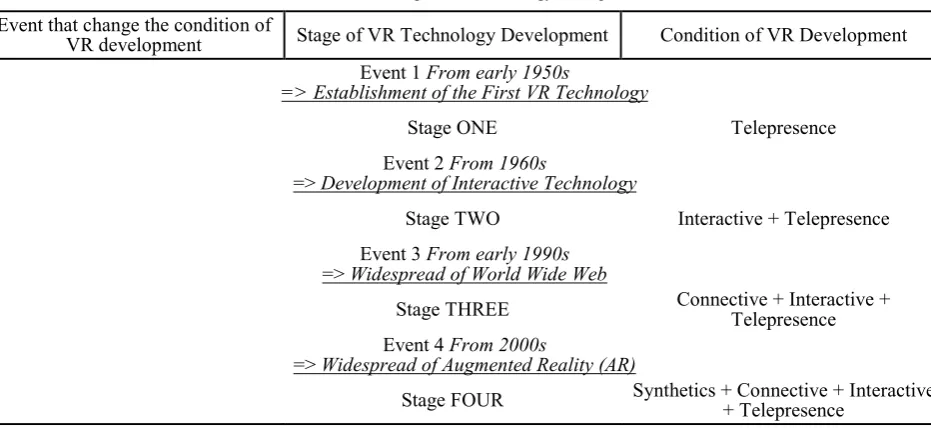
Four stages of virtual technology development have been constructed diachronically, namely telepresence, real-time interactivity, connectivity and synthesis. The analysis reveals the conditions for developing virtual technology which emerged in different stages of development process and to acuminate throughout the process of development (Figure 1). In the earliest stage of the emergence of VR, researcher of VR aimed to pursue the experience of telepresence in virtual technology. Although the developed VR technology did not developed well in interactivity, connectivity and synthesis, telepresence has been the key element of developing virtual technology. Since the establishment of the first VR machine, telepresence sustains
[image:7.595.72.538.519.733.2]as a key element and condition of developing virtual technology until today. In the second stage of virtual technology development, the interactive technology was invented and VR users started to pursue both telepresence and interactive experience; in the third stage, the Internet was spreading widely, and the users started to pursue the experience of telepresence, interactivity and connectivity. Currently, the experience of telepresence, interactivity, connectivity and synthesis all together form the essential conditions for developing VR technology, which provides a direction for establishing virtual technology in different social fields in the future.
Figure 1. Acumination of virtual technology development
Table 1. Four stages of VR technology development
Event that change the condition of
VR development Stage of VR Technology Development Condition of VR Development Event 1 Fromearly 1950s
=> Establishment of the First VR Technology
Stage ONE Telepresence
Event 2 From 1960s
=> Development of Interactive Technology
Stage TWO Interactive + Telepresence Event 3 From early 1990s
=> Widespread of World Wide Web
Stage THREE Connective + Interactive + Telepresence Event 4 From 2000s
=> Widespread of Augmented Reality (AR)
5. Conclusion
This study provides an investigation of the events of virtual technology development diachronically. The situation of virtual technology development process conceives four stages with different condition sets, namely telepresence, interactivity, connectivity and synthesis. The conditions are acuminating throughout the process of virtual technology development which are revealing the virtual technology development direction. This study links the conditions of VR technology development in different stages and then situates these relationships within the historical and social contexts with the explanation of the example of applications in different social fields. The understanding of the direction of virtual technology development is a continual remainder that VR development is a historically shaped mode of practice and emerges with a direction.
Our research team has demonstrated the importance of virtual technology development conditions. Telepresence is closely related to the user’s psychological states, some research have been conducted on the user perception [13-15], user engagement [18, 35], sensorial experience [36, 37]; interactivity also present the micro-level behaviors on the virtual worlds, such as human-avatar relationship [38-40], shopping activities [18, 41] and interactivity of body experience [42-44]; research may also interested in understanding connectivity within virtual community, such as virtual identity [45], nature of virtual community [46], the interaction within virtual community [47-49]; also, with the boost of AR technology development, which enhance the enforcement of synthesizing the experience between virtual world and actual world, such as mixed-reality technology [50-52] and user sensation within AR environment [53, 54].
Also, besides the technological development condition, there are also possible explorations of technological application. Virtual technology enables powerful ability in providing navigation function, such as map application and navigation in virtual worlds [55-57]; providing hedonic experience in business and entertainment context, such as shopping experience [58-61]; providing educational application, such as creativity in design training [62-64], teacher development [65]; also providing possibility in professional application, such as medical operation and training [66, 67] and mechanical engineering
The article is aimed to contribute for the future development of stereoscopic 3D virtual worlds. Our team suggests that the future of virtual technology development could focus on the mentioned directions. To enhance the experience of telepresence, future VR development should focus on the application of stereoscopic 3D technology; with the high level of interactivity, future VR should provide more humanness interaction, such as enhancing the human-avatar interactivity; through the widespread usage of the Internet, VR enable connectivity to connect VR user all over the world; and with the application of AR technology, it could synthesizing the perception between the virtual worlds and the real world of VR user. Although we have provided a
rich body of the development of VR, there are still a mass of questions and research directions which are possible for further research.
Acknowledgements
Our research team is very grateful to experts for the appropriate and constructive suggestions to improve this research.
REFERENCES
[1] U. Schultze. Embodiment and presence in virtual worlds: A review, Journal of Information Technology, Vol.25, No.4, p. 434-449, 2010.
[2] P.R. Messinger, E. Stroulia, K. Lyons, M. Bone, R. Niu, K. Smirnov, and S. Perelgut. Virtual worlds--past, present, and future: New directions in social computing, Decision Support Systems, Vol.47, No.3, p. 204-228, 2009.
[3] P.R. Messinger, E. Stroulia, and K. Lyons. A typology of virtual worlds: Historical overview and future directions, Journal of Virtual Worlds Research, Vol.1, No.1, p. 1-18, 2008.
[4] J. Fox, D. Arena, and J.N. Bailenson. Virtual reality: A survival guide for the social scientist, Journal of Media Psychology: Theories, Methods, and Applications, Vol.21, No.3, p. 95-113, 2009.
[5] B. Damer. Meeting in the Ether: A brief history of virtual worlds as a medium for user-created events, Journal of Virtual Worlds Research, Vol.1, No.1, p. 1-17, 2008.
[6] C.E. Porter. A Typology of Virtual Communities: A Multi-Disciplinary Foundation for Future Research, Journal of Computer-Mediated Communication, Vol.10, No.1, p. 00, 2004.
[7] E.B. Nash, G.W. Edwards, J.A. Thompson, and W. Barfield. A review of presence and performance in virtual environments, International Journal of Human-Computer Interaction, Vol.12, No.1, p. 1-41, 2000.
[8] W. Carlson Virtual Reality. A critical history of computer graphics and animation, 2003.
[9] R.A. Blade and M.L. Padgett, Virtual Environments: History and Profession, in Handbook of Virtual Environments, K.M. Stanney, Editor 2002, Lawrence Erlbaum Associates: Mahwah, New Jersey. p. 1167-1179.
[10] T. Mazuryk and M. Gervautz Virtual reality: History, applications, technology and future. 1996.
[11] R. Schroeder. Virtual reality in the real world: history, applications and projections, Futures, Vol.25, No.9, p. 963-973, 1993.
[12] R. Schroeder. Being there together: social interaction in virtual environmentsOxford University Press. London, 2011. [13] A. Haans and W.A. IJsselsteijn. Embodiment and
Framework, Interacting with Computers, Vol.24, p. 211-218, 2012.
[14] M.Y. Hyun and R.M. O'Keefe. Virtual destination image: Testing a telepresence model, Journal of Business Research, Vol.65, No.1, p. 29-35, 2012.
[15] A. Faiola, C. Newlon, M. Pfaff, and O. Smyslova. Correlating the effects of flow and telepresence in virtual worlds: Enhancing our understanding of user behavior in game-based learning, Computers in Human Behavior, Vol.29, No.3, p. 1113-1121, 2013.
[16] F.F.H. Nah, B. Eschenbrenner, and D. DeWester. Enhancing Brand Equity Through Flow and Telepresence: A Comparison of 2D and 3D Virtual Worlds, MIS Quarterly-Management Information Systems, Vol.35, No.3, p. 731, 2011.
[17] S.-E. Lee, T. Domina, and M. MacGillivray. Exploring consumers' flow experiences in virtual shopping: an exploratory study, International Journal of Electronic Marketing and Retailing, Vol.4, No.2, p. 165-182, 2011. [18] A. Mollen and H. Wilson. Engagement, telepresence and
interactivity in online consumer experience: Reconciling scholastic and managerial perspectives, Journal of Business Research, Vol.63, No.9, p. 919-925, 2010.
[19] R. Shields. The VirtualRoutledge. New York, 2003.
[20] N.J. Wade and P. Hughes. Fooling the eyes: Trompe l'oeil and reverse perspective, Perception, Vol.28, No.9, p. 1115-1120, 1999.
[21] J. Jockenhövel. What is it if it's not real? It's genre - Early color film and digital 3D, Cinemascope, Vol.7, No.15, p. 1-14, 2011.
[22] I.E. Sutherland. A Head-Mounted Three-Dimensional Display. in Fall Joint Computer Conference. 1968.
[23] M.W. Krueger. Responsive Environments. in National Computer Conference. 1977.
[24] KZero, Slideshare Universe presentation, Q1 2012, 2012. [25] T.P. Caudell and D.W. Mizell. Augmented reality: An
application of heads-up display technology to manual manufacturing processes. in System Sciences, 1992. Proceedings of the Twenty-Fifth Hawaii International Conference on. 1992.
[26] Q. Fottrell, In Apple-Google maps war, consumers lose, in MarketWatch2012.
[27] C. Marlow, Hey, hockey puck! NHL PrePlay adds a second-screen experience to live games, in Digital Media Wire2012.
[28] B. Crecente, Playstation Move Review: The Motion Controller Wars Start Now, in Kotaku2010, Gawker Media. [29] Y.-P. Wesley, PlayStation 3 hits 70 million units shipped
worldwide mark six years after launch, in Eurogamer2012. [30] D. Takahashi, Xbox 360 surpasses 66M sold and Kinect
passes 18M units, in venturebeat2012.
[31] L. Fretwell, Cisco® StyleMe™ Virtual Fashion Mirror Pilot a Success for John Lewis, in Cisco Blogs2012.
[32] J. Wall and J. Marescaux, History of Telesurgery, in Telemicrosurgery - Robot assisted microsurgery, P.A. Liverneaux, S.H. Berner, M.S. Bednar, S.J. Parekattil, G.M. Ruggiero, and J.C. Selber, Editors. 2013, Springer: Paris. p. 15-18.
[33] J. Rabin and R. Wiley. Dynamic visual performance: Comparison between helmet-mounted CRTs and LCDs, Journal of the Society for Information Display, Vol.3, No.3, p. 97-100, 2012.
[34] Z. Li. Survey on Computer Virtual Combination Technology in Product Series Design, Applied Mechanics and Materials, Vol.182-183, p. 743-747, 2012.
[35] K. Song, A.M. Fiore, and J. Park. Telepresence and fantasy in online apparel shopping experience, Journal of Fashion Marketing and Management, Vol.11, No.4, p. 553-570, 2007.
[36] A. Gaggioli, Using virtual reality in experimental psychology, in Towards cyberpsychology : mind, cognition and society in the internet age, G. Riva and C. Galimberti, Editors. 2001, IOS Press: Amsterdam. p. 157-174.
[37] C.L.D. Reinhard. Interviews within experimental frameworks: How to make sense of sense-making in virtual worlds, Journal of Virtual Worlds Research, Vol.3, No.1, 2010.
[38] B.S. Hasler, P. Tuchman, and D. Friedman. Virtual research assistants: Replacing human interviewers by automated avatars in virtual worlds, Computers in Human Behavior, Vol.29, No.4, p. 1608-1616, 2013.
[39] J. Fox, J.N. Bailenson, and L. Tricase. The embodiment of sexualized virtual selves: The Proteus effect and experiences of self-objectification via avatars, Computers in Human Behavior, Vol.29, No.3, p. 930-938, 2013.
[40] K.S. Suh, H. Kim, and E.K. Suh. What If Your Avatar Looks Like You? Dual-Congruity Perspectives for Avatar Use, Management Information Systems Quarterly, Vol.35, No.3, p. 711-729, 2011.
[41] J. Kim, A.M. Fiore, and H.-H. Lee. Influences of online store perception, shopping enjoyment, and shopping involvement on consumer patronage behavior towards an online retailer, Journal of Retailing and Consumer Services, Vol.14, No.2, p. 95-107, 2007.
[42] N. Bianchi-Berthouze. Understanding the role of body movement in player engagement, Human-Computer Interaction, Vol.28, No.1, p. 42-75, 2012.
[43] C. Schrader and T. Bastiaens. Relations Between the Tendency to Invest in Virtual Presence, Actual Virtual Presence, and Learning Outcomes in Educational Computer Games, International Journal of Human-Computer Interaction, Vol.28, No.12, p. 775-783, 2012.
[44] D. Dion, L. Sitz, and E. Rémy. Embodied Ethnicity: The Ethnic Affiliation Grounded in the Body, Consumption, Markets & Culture, Vol.14, No.3, p. 311-331, 2011. [45] D. Abfalter, M.E. Zaglia, and J. Mueller. Sense of virtual
community: A follow up on its measurement, Computers in Human Behavior, Vol.28, No.2, p. 400-404, 2011.
Applications, J. Kisielnicki, Editor 2008, Information Science Reference: Hershey, PA. p. 8-14.
[47] C.-P. Lin. Learning virtual community loyalty behavior from a perspective of social cognitive theory, International Journal of Human-Computer Interaction, Vol.26, No.4, p. 345-360, 2010.
[48] C. Mathwick, C. Wiertz, and K. De Ruyter. Social capital production in a virtual P3 community, Journal of Consumer Research, Vol.34, No.6, p. 832-849, 2008.
[49] A.P. Afonso, Communities as context providers for web-based learning, in Managing learning in virtual settings : the role of context, A.D. Figueiredo and A.P. Afonso, Editors. 2006, Information Science Pub.: Hershey, PA.
[50] I. Wagner, W. Broll, G. Jacucci, K. Kuutii, R. McCall, A. Morrison, D. Schmalstieg, and J.J. Terrin. On the role of presence in mixed reality, Presence: Teleoperators and Virtual Environments, Vol.18, No.4, p. 249-276, 2009. [51] A.D. Cheok, M. Haller, O.N.N. Fernando, and J.P. Wijesena.
Mixed Reality Entertainment and Art, The International Journal of Virtual Reality, Vol.8, No.2, p. 83-90, 2009. [52] J.W. Creswell. Research design: Qualitative, quantitative,
and mixed methods approaches, 3 edSage Publications, Inc. Thousand Oaks, CA, 2009.
[53] A. Hill, J. Schiefer, J. Wilson, B. Davidson, M. Gandy, and B. MacIntyre. Virtual transparency: Introducing parallax view into video see-through AR. in 2011 10th IEEE International Symposium on Mixed and Augmented Reality (ISMAR). 2011.
[54] P. Song, H. Yu, and S. Winkler. Vision-based 3D finger interactions for mixed reality games with physics simulation, The International Journal of Virtual Reality, Vol.8, No.2, p. 1-6, 2009.
[55] B. Balakrishnan and S.S. Sundar. Where am I? How can I get there? Impact of navigability and narrative transportation on spatial presence, Human-Computer Interaction, Vol.26, No.3, p. 161-204, 2011.
[56] S.S. Liu, R. Melara, and R. Arangarasan. The Effects of Store Layout on Consumer Buying Behavioral Parameters with Visual Technology, Journal of Shopping Center Research, Vol.14, No.2, p. 63-72, 2007.
[57] J.H. Couture, H.A. Colle, and G.B. Reid. Navigation fidelity in 3D perspective displays for web-based shopping: From nodes to views, International Journal of Human-Computer Interaction, Vol.19, No.2, p. 181-200, 2005.
[58] L. Wang, R. Villamil, S. Samarasekera, and R. Kumar. Magic Mirror: A virtual handbag shopping system. in Computer Vision and Pattern Recognition Workshops (CVPRW), 2012 IEEE Computer Society Conference on. 2012.
[59] C.-k. Shen and S. Liu. Study of Virtual Reality (VR) being Used in the Online Shopping, Science & Technology Information, Vol.1, p. 112, 2012.
[60] H.F. Lau, K.W. Lau, and C.W. Kan. Exploring Consumers’ Virtual Shopping Experience in Virtual Reality. in The 2012 International Congress on Engineering and Information (ICEAI 2012). Shanghai. 2012.
[61] K.W. Lau, P.Y. Lee, and C.W. Kan. From distance shopping to virtual shopping, International Journal of Design Sciences and Technology, Vol.17, No.2, p. 77-90, 2010.
[62] K.W. Lau. A study of students' learning experiences in creativity training in design education: an empirical research in virtual reality, Journal of Design Research, Vol.10, No.3, p. 170-188, 2012.
[63] K.W. Lau. Implementing Creativity Training in Higher Design Education: Suggestions for Actual Implementation, The Design Journal, Vol.12, No.2, 2009.
[64] K.W. Lau. Rethinking the role of creativity training in design education, Design Journal – Praxes, Vol.No.2, p. 8-25, 2008.
[65] M.A. Johnston, Object-oriented virtual environments as a medium for teacher professional development, 2004, George Mason University. p. 286.
[66] Y.J. Kang, J. Ku, K. Han, S.I. Kim, T.W. Yu, J.H. Lee, and C.I. Park. Development and Clinical Trial of Virtual Reality-Based Cognitive Assessment in People with Stroke: Preliminary Study, CyberPsychology & Behavior, Vol.11, No.3, p. 329-339, 2008.