http://dx.doi.org/10.4236/aer.2016.42004
How to cite this paper: Blandine, M.K.L., Serge, N.E. and Clergé, T. (2016) Partial Purification and Characterization of Pro-tease from Abrus precatorius Linn. (Fabaceae) from Cameroon. Advances in Enzyme Research, 4, 35-43.
http://dx.doi.org/10.4236/aer.2016.42004
Partial Purification and Characterization of
Protease from
Abrus precatorius
Linn.
(Fabaceae) from Cameroon
Mezajoug Kenfack Laurette Blandine
*, Ngangoum Eric Serge, Tchiégang Clergé
Bioprocess Laboratory, Unit of Food Sciences and nutrition, University Institute of Technology, University of Ngaoundere, Ngaoundere, Cameroon
Received 2 March 2016; accepted 24 May 2016; published 27 May 2016
Copyright © 2016 by authors and Scientific Research Publishing Inc.
This work is licensed under the Creative Commons Attribution-NonCommercial International License (CC BY-NC).
http://creativecommons.org/licenses/by-nc/4.0/
Abstract
Crude enzyme extracts were prepared from leaves and stems of Abrus precatorius Linn. (Fabaceae) from Cameroon under optimized conditions. Proteolytic enzymes were precipitated with ammo-nium sulfate at 35% (w/v) saturation and assayed for enzyme activity. The effects of temperature, pH, incubation time and substrate specificity were studied. SDS-PAGE was used to determine mo-lecular weight of precipitated protease. Results indicated that proteolytic activity of crude extract was 35.20 U/ml compared to 51.03 U/ml of partial purified extract. The optimum enzyme activity was found to be at 40˚C, while 50% of activity was maintained at 60˚C after 60 min incubation. Partial purified crude extract exhibited two optimum pH (2.75 and 9.0). The highest enzyme activ-ity towards Bovine Serum Albumine (25.9 U/ml) was noted. SDS-PAGE gels exhibited molecular weight between 40 - 60 KDa. This result confirms that partial purified extract of A. precatorius contains proteases and could be a promising source for proteolytic enzyme extraction.
Keywords
A. precatorius, Cameroon, Proteases, Partial Purified Extract, Proteolytic Activity
1. Introduction
A. precatorius is an edible crop legume plant belonging to the Fabaceae family. It is distributed in the Adamawa Region in Cameroon where it is commonly known as danrai. Their leaves and stems are used for their amylasic
properties during the fermentation of a local alcoholic beverage named bili-bili by local population in Adamawa Region [1]. They are also used for medicinal purposes [2]. Crude extract contains streptomycine and it is used to treat abdominal pain [3]. In Northern part of Cameroon, crude extract from stems are used to developed sugar savor of baby’s cereal [1]. Crude extract from leaves and stems of A. precatorius exhibited proteolytic activity
[4]. In India, A. precatorius is an underutilized food legume commonly known as gundumani. It is now natura-lized in all tropical countries and Andaman Islands, having good nutritional properties, receiving more attention as an alternative protein source [5]. The seeds are brightly colored, they are boiled and eaten during the extreme famine in tropical zones and in Andaman Island in India [6].
Proteases constitute the most important group of industrial enzymes used in the world today and have several applications in the food industries [7]. They are widely used in industrial processes, biotechnology and pharma-cology. Most industrial proteases are derived from microbial and animal sources, but the application of animal proteases has encountered limitations due to religious requirements from certain quarters [8]. Thus, proteases like papain, bromelin and ficin are currently used to soften meats, for beverages and cheese industries [9]. De-mand for the proteolytic enzyme in the global market will be more than 3.0 billion USD in 2005 [10]. Plants proteases used in Cameroon are imported [11].
Recent studies showed that crude extract from A. precatorius could be a potential source of proteases after their purification [4]. As far as our knowledge is concerned, no work has been conducted on purification and characterization of this extract. To make available plants proteases in Cameroon, one alternative is to valorize extracts of leaves and stems from A. precatorius by measuring the proteolytic activity of partially purified ex-tracts and characterizing their proteolytic enzymes by SDS-PAGE.
2. Materials and Methods
2.1. Plant Material
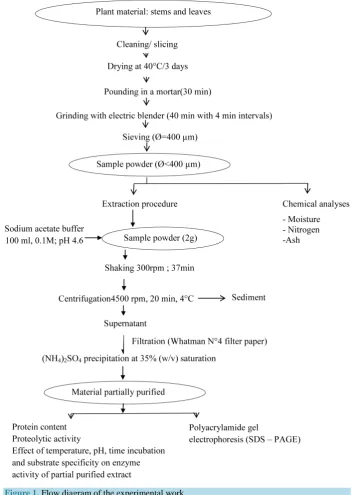
Leaves and stems of A. precatorius were harvested in Ngaoundere Cameroon (Adamawa region; longitude: 13˚15'0" East, latitude: 6˚49'59" North). Samples were cleaned, cutted and dried at 40˚C for 3 days. Dry samples were pounded together in the mortar for 30 min before grinding with a household flourmill (Moulinex, France) during 40 min at 4 min intervals. Powder obtained was sieved at 400 µm size (AFNOR). Powder with particles size lower than 400 µm was used for crude extracts and chemical analyses. Figure 1resumes the experimental work.
2.2. Chemical Analyses
Moisture, nitrogen and ash contents of powder from A. precatorius were determined following the methods de-scribed by AOAC [12].
2.3. Extraction Procedure and Ammonium Sulfate Precipitation of Crude Extract
Crude enzyme extract was obtained using optimal conditions [4]. Powder of A. precatorius (2.2 g) was sus-pended in 100 ml of sodium acetate buffer solution (pH 4.6) prepared in 2% (w/v) and homogenized in magnetic stirrer (37 min at 4˚C) at 300 rpm. After centrifugation (4500 rpm, 20 min at 4˚C) and filtration through What-man paper N˚4, the extract was treated with ammonium sulphate at 35% (w/v) saturation (Mezajoug Kenfack et al., 2014). The precipitated protein fraction collected were dialysed in desalting columns containing Sephadex G -25 Medium (17-0851-01) at 4˚C to eliminate excess of salt in the extract.
2.4. Protein Contents of Crude and Partial Purified Extracts
The protein contents of the crude enzyme extracts was determined [13].
2.5. Proteolytic Activity of Crude and Partial Purified Extracts
Figure 1.Flow diagram of the experimental work.
acid (4% w/v) and then centrifuged (4500 rpm) at 4˚C for 25 min. The absorbance of the supernatant was meas-ured at 280 nm. One unit of proteolytic activity (U) was arbitrarily defined as the amount of enzyme required for the production of 1 µmol of L-tyrosine per minute under assay conditions.
2.6. Characterization of Enzyme in Partial Purified Extract of Leaves and Stems from
A. precatorius
2.6.1. Effect of Temperature
precatorius protease, the activity values of the partial purified extract was measured at various temperatures (25˚C - 80˚C). The thermal stability of protease was performed by incubating partial purified crude extract in 50 mM phosphate buffer (pH 7) for 1 h at various temperatures. The residual activity was measured [15].
2.6.2. Effect of pH
The effect of pH on the activity of the proteases toward casein as substrate was measured using the following buffers: 0.05 M KCl-HCl (pH 1.0 - 1.5), 0.05 M glycine-HCl (pH 2.0 - 3.5), 0.05 M citrate sodique (pH 4 - 5.5), 0.05 M phosphate sodique (pH 6 - 7.5), 0.05 M Tris-HCl (pH 8 - 10), 0.05 M NaHCO3-NaOH (pH 11) and 0.05
M KCl-NaOH (pH 12 - 13). The assay was done [16]. For each pH, the incubation is done for 1h at 35˚C and the activities were measured.
2.6.3. Effect of Incubation Time
The effect of time on enzyme activity was determined by measuring the hydrolytic activity of 120 µL enzyme on 3 mL casein solutionat 35˚C. The incubation times were 15 min, 30 min, 45 min, 60 min, 75 min and 90 min. A plot of relative enzyme activity versus time was constructed to obtain the optimal time for maximum enzyme activity.
2.6.4. Polyacrylamide Gel Electrophoresis in Presence of Sodium Dodecyl Sulfate (SDS-PAGE)
Polyacrylamide gel electrophoresis was performed on A. precatorius crude extract saturated at 20; 25; 30; 35 and 40% (w/v) to confirm if precipitated proteins were proteases. SDS-PAGE gel was prepared using 16% po-lyacrylamide gel. 10 µl of aliquots from reaction mixture and molecular weight markers were applied on the gel. Molecular masses of the polypeptides were calculated using the Novex® Sharp Protein standard with molecular masses ranging from 3.5 KDa to 260 KDa. Protein samples (100 mg) were dissolved in 10 ml of sample buffer pH 6.5 (250 mM Tris-HCl, 10% SDS, 50% glycerol and 7.5% β-mercaptoethanol). For reducing conditions, 10 µl of β-mercaptoethanol (5%) was added and samples were heated at 100˚C for 5 min. Gels were fixed and stained with Coomassie Brilliant Bleu [17].
2.6.5. Effect of A. precatorius partial Purified Extract on Bovine Serum Albumin and Gelatin
The effect of Bovine Serum Albumin (BSA) (1%: w/v) and gelatin (1%: w/v) prepared in 50 mM tris-HCl pH 6.0 in A. precatorius partial purified extract was investigated. Enzyme and test sample were incubated for 30 min at 25˚C. Enzyme activities towards substrates were measured [15].
2.7. Statistical Analyses
All experiments were repeated three times. Analyses of variance (ANOVA) were performed and differences in means values were determined using Duncan’s test at P < 0.05. Sigma software (version 11) was used to plot curves.
3. Results and Discussion
3.1. Proximate Composition
Protein content (Nx6.25) of A. precatorius powder (10.21% DW) was comparable to value obtained by Meza-joug Kenfack et al. [4] but lower than that indicated by Glew et al. [1]. A. precatorius from India exhibited 19.34% DW of proteins [5]. Ash and crude fiber contents of powder from A. precatorius were 7.14% and 8.52% DW respectively. Sample from Cameroon was rich in crude fibers compared to sample from India 6.24% DW [18].
3.2. Proteolytic Activity of Crude and Partially Purified Extracts
value obtained with the leaves of Artocarpus integer (Moraceae) extracts [20].
3.3. Effect of Temperature on Proteolytic Activity
Figure 2 shows the effect of temperature on enzyme activity of A. precatorius obtained by mixing 120 µl of
enzyme extract with 3 ml of casein solution 1% (w/v). The initial activity of the protease in partial purified crude extract from A. precatorius was high with temperature range from 30˚C - 40˚C, and negligible activity at 80˚C. The optimum temperature was found to be at 40˚C. The increase of the activity within 30˚C - 40˚C could be explained by an increase concentration of enzyme-substrate complex activated when the reaction system was heated. The decreased activity after 40˚C could be the consequence of either a steric obstruction, a phenomenon of enzyme autolysis, or thermal denaturation due to molecular agitations that result in the destruction of low energy bonds and destabilization of the three-dimensional structure of enzymes [21]. Optimal temperature of the enzymatic activity of A. precatorius extract was 40˚C as on the viscera of Tilapia nilotica [7]. The result was different to that reported by Duarte et al. [22] who indicated 55˚C as optimal temperature from proteases of Ja-caratia corumbensis extract.
For the stability, the initial activity was taken as 100% before incubation for various temperatures. When in-cubated for 60 min at various temperatures at pH 7.0, protease of partial purified extract from A. precatorius
maintained its initial activity between 20˚C - 40˚C and had about 50% of its activity at 60˚C, but it was com-pletely inactivated at 80˚C (Figure 2). Protease of partial purified extract from A. precatorius is heat labile.
3.4. Effect of pH on
A. precatorius
partial Purified Extract
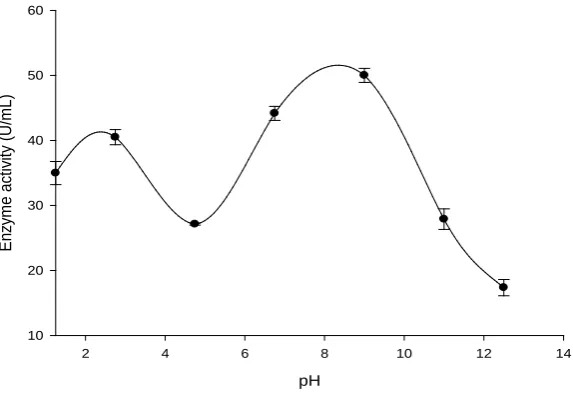
[image:5.595.153.479.484.696.2]Enzyme activity is highly influenced by the nature of functional groups at the level of the active sites of their io-nized form and that of the substrate. Generally, an enzyme possesses an optimum pH zone where it’s activity is a maximum. On both sides of this zone which is more or less narrow, the enzyme is gradually inactivated [23]. The pH activity profile of A. precatorius protease exhibited maximum values at pH 2.75 and 9 (Figure 3). The two optimum pH suppose that both acidic and alkaline proteases were observed, indicating the presence of an aspartic and a serine protease in partial purified extract from A. precatorius [9]. At pH 4.75 and 11, the activity decreased to 67% and 55% respectively and the enzyme showed low activity at pH 12.5. These results corrobo-rate with those reported by Michail et al. [19] who pointed out the presence of acid and alkaline proteases in trout (Salmo gairdnerii) crude extracts. The protease of partial purified crude extract from A. precatorius could contain alkaline protease as Bacillus proteolyticus CFR 3001 alkaline protease and Bacillus cereus MCM B-326 protease which exhibited optimum pH at 8 [24].
Figure 2. Effect of temperature on the activity (U/mL) and stability (%) of partial puri-fied protease from A. precatorius leaves and stems.
Temperature (°C)
30 40 50 60 70 80 90
Figure 3. Effect of pH on proteolytic activity of partial purified protease from A. precatorius.
3.5. Effect of Incubation Time on Enzyme Activity
Proteolytic activity of partial purified extract from A. precatorius was measured after action of 120 µL crude ex-tract on 3 mL of casein (1% w/v) solution at 35˚C. Figure 4 shows that hydrolysis of casein by A. precatorius
partial purified extract is influenced by incubation time. The velocity of hydrolysis increases for the first mo-ments of the reaction due probably to the reaction between substrate and enzyme, then follows the stabilization phase after 60 min. Corresponding values of tyrosine hydrolyze is 10.78 µg/mL. The stabilization phase could be due either to a retro-inhibition of the enzyme by the products or to probable saturation of the enzyme [25] or to an inhibition by excess of substrate and the enzyme becoming inalienable with the time. This inhibition by excess of substrate could receive different explanations according to the studied system. In some cases, the sub-strate with high concentration could be placed in the active site with an abnormal orientation, prohibiting with the reaction to occur. In other cases, the substrate in excess could react with zones of protein apart from the site, causing reversible disorders or not [25].
3.6. Substrate Specificity on the Enzyme Activity
Substrate specificity of partial purified protease from A. precatorius against different proteins was active on a variety of natural proteins such as Bovin Serum Albumin (BSA) (1%: w/v) and gelatin (1%: w/v). Protease ex-hibited highest activity toward BSA (25.09 ± 0.75 U/ml) and lowest activity toward gelatin (2.22 ± 0.10 U/ml). It is known that acid and basic amino acids (26.2 and 23.7 g/100 g of proteins) are more represented in BSA. Neutral amino acids are more represented in gelatin proteins (39.7 g/100 g of proteins). This result indicated that partial purified enzyme from A. precatorius could react more with protein rich in basic and acidic amino groups.
3.7. SDS-PAGE Gel
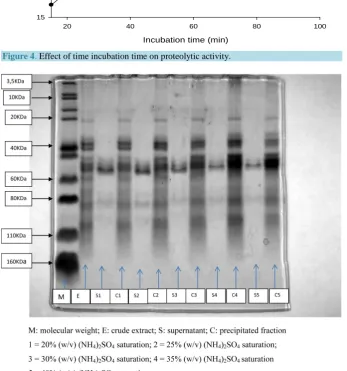
The electrophoretic patterns of A. precatorius crude extract was performed to see electrophoretic proteins bands at different ammonium sulfate saturation (20%; 25%; 30% and 40%: w/v) (Figure 5). Electrophoretic bands were observed in all analyzed samples (supernatants and precipitated fractions) between 20 to 110 KDa. For each ammonium sulfate saturation, bands were more observed in precipitated fractions than in the corresponding supernatant, indicating that protease were more concentrated in precipitated fractions. Dark bands were observed at 40 KDa both in crude extract and in all precipitated fractions, between 40 - 60 KDa of all precipitated frac-tions. Figure 5 also shows that electrophretic bands in each supernatant decrease with the concentration of satu-rated ammonium sulfate. One could observed that supernatants S4 ((NH4)2SO4 35% (w/v)) and S5 ((NH4)2SO4
40% (w/) presented only two bands. Results obtained in this study revealed that the majority of protease on the crude extract from A. precatorius could be precipitated at 35% (w/v) ammonium sulfate saturation. These results
pH
2 4 6 8 10 12 14
E
n
zym
e
a
ct
ivi
ty
(U
/m
L
)
Figure 4. Effect of time incubation time on proteolytic activity.
Figure 5. SDS–PAGE Gel of A. precatorius crude extract precipitated at 20%; 25%; 30%; 35% and 40% (w/v) ammonium sulfate saturation.
confirm those obtained by Mezajoug Kenfack et al. [4] who indicated 35% (w/v) of ammonium sulfate satura-tion as precipitasatura-tion solusatura-tion of the majority of protease from A. precatorius.
4. Conclusion
Optimum enzyme activity of partial purified extract was found at 40˚C, pH 2.75 and 9. 50% of the activity was
Incubation time (min)
20 40 60 80 100
E
n
zym
e
a
ct
ivi
ty
(U
/m
L
)
[image:7.595.141.489.238.610.2]maintained at pH 7 between 20˚C - 40˚C. The activity of partial purified extract increased with incubation time until 60 min. Serum Bovin Albumin exhibited highest activity with partial purified extract compared to gelatin. SDS-PAGE gel revealed band at 40 KDa for all precipitated and supernatant fractions.
References
[1] Glew, H.R., Kramer, G.K.J., Hernandez, M., Pastuszyn, A., Jennifer Ernst, J., Djomdi, N.N. and Vanderjagt, J.D. (2010) The Amino Acid, Mineral and Fatty Acid Contents of Three Species of Human Plants Foods in Cameroon. Food, 4, 1- 6.
[2] Tchanatcha, R. and Pranee, A. (2011) Extraction and Characterization of Mucilage in Ziziphus mauritiana Lam. Inter-national Food Research Journal, 18, 201-212.
[3] Bobbarala, V. and Vadlapudi, V. (2009) Abrus precatorius L. Seed Extracts Antimicrobial Properties against Clinically Important Bacteria. International Journal of Pharm. Tech. Research, 1, 1115-1118.
[4] Mezajoug Kenfack, L.B., Ngangoum, E.S., Linder, M. and Tchiégang, C. (2014) Proteolytic Enzymes from Abrus precatorius Linn., Burnatia enneandra Micheli. And Ziziphus mauritiana Lam: Optimization of the Extraction Process by Response Surface Methodology. The Journal of Bioprocess Technology, 100, 453-451.
[5] Tressina, S.P. and Mohan, R.V. (2012) Comparative Assessment on the Nutritional and Antinutritional Attributes of the Underutilized Legumes, Canavalia gladiate (JACQ.) DC, Erythrina indica LAM. And Abrus precatorius L. Trop-ical and SubtropTrop-ical Agrosystems, 15, 539-556.
[6] Janardhanan, K., Vadivel, V. and Pugalenthi, M. (2003) Biodiversity of Indian Underexploited Tribal Pulses. In: Jaiwal, P.K. and Singh, R.P., Eds., Improvement Strategies for Leguminosae Biotechnology, Kluwer Academic, Great Britain, 353-405.
[7] El-Beltagy, A.E., El-Adaway, T.A., Rahma, E.H. and El-Bedawey, A.A. (2004) Purification and Characterization of an Acidic Protease from the Viscera of Bolti Fish (Tilapia nilotica). Food Chemistry, 86, 33-39.
http://dx.doi.org/10.1016/j.foodchem.2003.08.009
[8] Bonne, K. and Verbeke, W. (2008) Muslim Consumer Trust in Halal Meat Status and Control in Belgium. Meat Science, 79, 113-123. http://dx.doi.org/10.1016/j.meatsci.2007.08.007
[9] Gonzalez-Rabade, N., Badillo-Corona, J.A., Aranda-Barradas, J.S. and Maria del Carmen, O.S. (2011) Production of Plant Proteases in Vivo and in Vitro. Biotechnology Advances, 29, 983-996.
http://dx.doi.org/10.1016/j.biotechadv.2011.08.017
[10] Godfrey, T. (Godfrey T. and West S., Eds.) (1996) Industrial Enzymology. Stocklom Press, New York, 1-7.
[11] Libouga, D.G., Vercaigne-Marko, D., Sana, L.D., Choukambou, I. And Ebangi, A.L. (2006) Mise en évidence d'un agent coagulant utilisable en fromagerie dans les fruits de. Balanite aegyptiaca. Tropicultura, 24, 229- 238.
[12] A.O.A.C. (1990) Official Methods of Analysis. 15th Edition, Association of Official Analytical Chemists, Washington DC.
[13] Lowry, O.H., Rosebroughi, N.J., Farr, A.L. and Randall, R.J. (1951) Protein Measurement with the Folin Phenol Rea-gent. Journal of Biological Chemistry, 193, 265-275.
[14] Thomàs, E.G., Hernàndez-Gutirrez, Rodolfo, G.H., Juan, D.M., Georgina, F.S., Luis, G.C., Ingrid, B.R., Juan, D.M., Georgina, F.S., Luis, G.C. and Santiago, T.G. (2009) Proteolytic Activity in Enzymatic Extracts from Carica papaya L. cv. Maradol Harvest By-Products. Process Biochemistry, 44, 77- 82. http://dx.doi.org/10.1016/j.procbio.2008.09.013
[15] Liang, T.W., Hsieh, J.L. and Wang, L.S. (2012) Production and Purification of a Protease, a Chitosane and Chitin Oli-gosaccharides by Bacillus cereus TKU022 Fermentation. Carbohydrate Research, 362, 38-46.
http://dx.doi.org/10.1016/j.carres.2012.08.004
[16] Balqis, S.Z. and Rosma, A. (2011) Artocarpus integer Leaf Protease: Purification and Characterization. Food Chemi-stry, 129, 1523-1529. http://dx.doi.org/10.1016/j.foodchem.2011.05.135
[17] Bernardino-Nicanor, A., Scilingo, A.A., Aňón, C.M. and Dávila-Otíz, G. (2006) Guava Seed Storage: Fractionation and Characterization. LWT, 39, 902-910. http://dx.doi.org/10.1016/j.lwt.2005.06.006
[18] Abdu, B.S., Hassan, R.M., Adamu, Y.H. and Yashim, M.S. (2011) Effect of Level of Ziziphus mauritiana Leaf Meal Inclusion in Concentrate Diet on Rumen Degradation Characteristics. World Journal Life Science and Medical Re-search, 1, 117-121.
[19] Michail, M., Vasiliadou, M. and Zotos, A. (2006) Partial Purification and Comparison of Precipitation Techniques of Proteolytic Enzymes from Trout (Salmo gairdnerii) Heads. Food Chemistry, 97, 50-55.
http://dx.doi.org/10.1016/j.foodchem.2005.03.022
[21] Shaheen, M., Shah, A.A., Hameed, A. and Hasan, F. (2008) Influence of Culture Conditions on Production and Activ-ity of Protease from Bacillus subtilis BS1. Pakistan Journal of Botany, 40, 2161-2169.
[22] Duarte, A.R., Duarte, D.M.R., Moreira, K.A., Cavalcanti M.T.H., Lima-Folho J.L. and Figueiredo, A.L. (2009) Jaca-ratia corumbensis O. Kuntze a New Vegetable Source for Milk-Clotting Enzymes. Brazilian Archives of Biology and Technology, 52, 1-9. http://dx.doi.org/10.1590/S1516-89132009000100001
[23] Kamoun, P. (1997) Appareils et méthodes en biochimie. 2nd Edition, Flammarion, Paris, 80-199.
[24] Bhaskar, N., Sudeepa, E.S., Rashmi, H.N. and Selvi, A.T. (2007) Partial Purification and Characterization of Protease of Bacillus proteolyticus CFR3001 Isolated from Fish Processing Waste and Its Antibacterial Activities. Bioresource Technology, 98, 2758-2764. http://dx.doi.org/10.1016/j.biortech.2006.09.033