http://dx.doi.org/10.4236/jmp.2016.710094
How to cite this paper: Pons, D.J., Pons, A.D. and Pons, A.J. (2016) Energy Conversion Mechanics for Photon Emission per Non-Local Hidden-Variable Theory. Journal of Modern Physics, 7, 1049-1067. http://dx.doi.org/10.4236/jmp.2016.710094
Energy Conversion Mechanics
for Photon Emission per
Non-Local Hidden-Variable
Theory
Dirk J. Pons
1*, Arion D. Pons
2, Aiden J. Pons
31Department of Mechanical Engineering, University of Canterbury, Christchurch, New Zealand 2University of Cambridge, Cambridge, UK
3Rangiora New Life School, Rangiora, New Zealand
Received 27 April 2016; accepted 3 June 2016; published 8 June 2016
Copyright © 2016 by authors and Scientific Research Publishing Inc.
This work is licensed under the Creative Commons Attribution International License (CC BY).
http://creativecommons.org/licenses/by/4.0/
Abstract
Problem-Energy conversion processes in optical phenomena are incompletely explained by wave theory or quantum mechanics. There is a need for ontologically rich explanations at the level of individual particles. Purpose: This paper reports on the application of a non-local hidden-variable solution called the Cordus theory to this problem. The method is directed to the systematic devel-opment of a conceptual framework of proposed causal mechanisms. Findings: It has long been known that the bonding commitments of the electron affect its energy behaviour but the mecha-nisms for this have been elusive. We show how the degree of bonding constraint on the electron determines how it processes excess energy. A key concept is that the span and frequency of the electron are inversely proportional. This explains why energy changes cause positional distress for the electron. Natural explanations are given for multiple emission phenomena: Absorbance; Saturation; Beer-Lambert law; Colour; Quantum energy states; Directional emission; Photoelectric effect; Emission of polarised photons from crystals; Refraction effects; Reflection; Transparency; Birefringence; Cherenkov radiation; Bremsstrahlung and Synchrotron radiation; Phase change at reflection; Force impulse at reflection and radiation pressure; Simulated emission (Laser). Origi-nality: The paper elucidates a mechanism for how the electron responds to combinations of bonding constraint and pumped energy. The crucial insight is that the electron size and position(s) are coupled attributes of its frequency and energy, where the coupling is achieved via physical substructures. The theory is able to provide a logically coherent explanation for a wide variety of energy conversion phenomena.
Keywords
Photon, Light, Electron, Emission, Cordus Conjecture, Physical Interpretation
1. Introduction
Many optical phenomena have ontologically poor explanations at the level of individual photon particles, de-spite satisfactory mathematical representations. Examples are the processes of photon emission, photon absorp-tion, phase change at reflecabsorp-tion, and laser emissions. These are adequately described by the classical electro-magnetic wave theory of light, but that applies to waves and is difficult to extend to individual particles. Quan-tum theory better represents the behaviour of individual particles, but its ontological power of explanation is weak, i.e. it can quantify many phenomena but its explanations are difficult to ground in physical realism. This paper reports on the application of a non-local hidden-variable (NLHV) solution called the Cordus theory to ex-plain several optical phenomena involving energy conversion.
1.1. Need for Richer Explanations
Quantum Mechanics (QM) is built on the premise that particles comprise zero-dimensional (0D) points. This assumption results in a mathematically tractable representation of the photon, but has the detriment that key em-pirically observable variables, such as spin and polarisation, are denied a physical basis. They are instead treated as merely intrinsic variables, and this causes incongruence relative to physical realism. QM is able to show via Feynman diagrams that photon processes occur, and is able to quantify the output channels, but is unable to ex-plain how input particles are transformed into the outputs. QM is unable to exex-plain in an ontologically sufficient manner how the 0D point of the photon is absorbed into the 0D point of the electron, or how a 0D photon sepa-rates into an electron and antielectron (pair production), or how matter and antimatter annihilate back to photons. The latter two processes represent mass-energy equivalence, and thus even this foundational principle lacks an ontologically satisfactory explanation. Some interpretations of QM, such as the Copenhagen, do not see this as a problem, since the quantitative formulation of QM is adequate for most practical purposes. In contrast others expect to see fundamental physics grounded on physical realism. Thus the unnaturalness of QM’s explanations is, from this perspective, an artefact of its 0D premise.
1.2. Hidden-Variable Solutions
Since the 0D point premise is at the root of this problem it follows that theories of physics that describe the in-ternal structure of photons and matter may have a better chance of providing explanations. These are the hidden- variable designs. There was a time in the early development of quantum theory when these were believed to be the way forward, at least for explaining entanglement [1], but subsequent work in the form of the Bell-type ine-qualities [2]-[4] invalidated all local hidden-variable designs and some classes of non-local designs too. How-ever, non-local hidden-variable (NLHV) designs have not been totally eliminated: this is not contentious. The greater problem has been the scarcity of candidate solutions to evaluate. The first theory of substance was the de Broglie-Bohn pilot-wave theory [5][6], but this has progressed only slowly. A subsequent development was the Cordus theory which proposed that particles had a specific internal structure comprising two reactive ends, con-nected but some distance apart [7]. This structure explains wave-particle duality in the double-slit device, and provides a quantitative derivation of optical laws for reflection, refraction, and Brewster’s angle [7]. Other ap-plications of the theory include photon emission from the electron [8], pair production [9], and asymmetrical genesis [10].
Thus the NLHV sector is able to qualitatively and quantitatively explain several energy phenomena. This is a promising start, but there is a need to explain other energy phenomena too. The area under examination in the present paper is the need to explain one category of energy conversion effects, namely the interaction between photons and matter.
2. Methodology
Cor-dus theory.
The methodology used is logical inference in a gedanken (thought) experiment. This method starts with an initial set of lemmas, which are the principles of physics accepted at the outset. These could be based on any theory of physics such as thermodynamics, quantum mechanics, M/string theory, NLHV theory, etc. The start-ing theory here was the Cordus theory. The next stage in the methodology is to determine the logical conse-quences if those lemmas were true. The result of this is an extension to the theory, sometimes with the addition of new lemmas. The logical extension continues until explanations are available for existing physical phenom-ena, which allow a checking and validation of the theory.
This means that the method is potentially able to predicting the underlying mechanisms of physical causality for phenomena not originally encompassed by the founding lemmas. It also has the potential, shown here, of providing entirely new and original explanations for existing physical phenomena, i.e. provides a new concep-tual framework. This is a particularly useful feature of the methodology, especially when prospecting for access ways into possible new physics. The progressive nature of this process of theory development results in a theory with high internal consistency or congruence, and this is an attractive feature of the method. However the re-sulting theory tends to be qualitative if the starting premises are qualitative, and hence it is not always practica-ble to construct quantitative formalisms this way, which is sometimes a disadvantage. In the present case we are primarily interested in providing ontologically rich explanations for a variety of phenomena, and the lack of a formalism is not an issue.
The approach applies this systematic methodology to the existing Cordus theory to infer the photon mechan-ics within this framework. Prior work [8] has proposed the mechanics whereby an electron emits a photon. The present work extracts the underlying assumptions, and then infers a proposed physical causality. These princi-ples are then applied to explain other optical phenomena. As will be shown, the theory is able to provide a logi-cally coherent explanation for a wide variety of optical energy conversion phenomena.
The method is directed to the systematic development of a conceptual framework of proposed causal mecha-nisms. It is an abstract method and results in a conceptual formulation of the system, as opposed to the mathe-matical formalism or quantitative models of other methods. The proposed physical causality is represented using integration definition zero (IDEF0) systems engineering flowchart notation [11].
3. Results
3.1. Relevant Principles of the Cordus Theory
3.1.1. Structure of the Cordus Particule
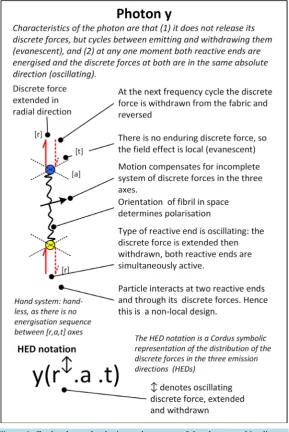
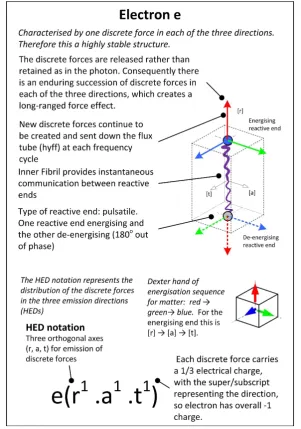
The Cordus theory proposes that a particle consist not of a 0D point but rather two reactive ends that are some distance apart and connected by a fibril. The ends are energised in turn at the de Broglie frequency, during which time they emit discrete forces in three orthogonal directions [7]. These discrete forces are connected in a flux tube and the inward/outward direction of propagation determines the charge, and the handedness of the en-ergisation sequence determines the matter-antimatter attribute [12]. The Cordus literature calls this a particule to differentiate it from the 0D point construct of QM. The photon structure is shown in Figure 1, and the electron in Figure 2.
The internal structures of the proton [15], neutron [16], and neutrino-species [17] have likewise been deter-mined for this theory. Further details may be found in the references.
Importantly, the Cordus theory requires that the span of the matter particules be inversely proportional to the frequency. Thus the span of the electron becomes smaller as its frequency (hence also energy) increases. This is important in what follows regarding emission and absorption.
3.1.2. Remanufacture of Particule Identities at Photon Emission
Figure 1. Cordus theory for the internal structure of the photon, and its discrete field arrangements. The photon is proposed to have a pump that shuttles energy outwards into the fabric. Then at the next frequency cycle it draws the energy out of that field, instantaneously transmits it across the fibril, and expels it at the
opposite reactive end. From [13] reproduced under CC-BY-4.0.
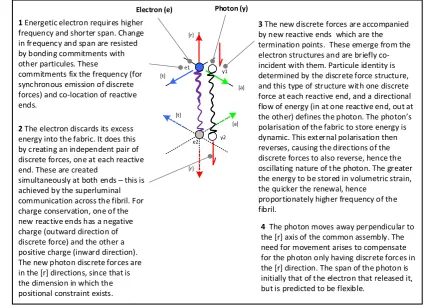
1) An energetic electron, one that has absorbed energy via a prior process, requires higher frequency and also shorter span. However the change in frequency and span are resisted by bonding commitments with other par-ticules. These commitments fix the frequency (for synchronous emission of discrete forces) and co-location of reactive ends. This is a consequence of the synchronous interaction (strong force) [15][18].
Figure 2. The representation of the electron’s internal and external structures. It is proposed that the particle has three orthogonal discrete forces, energised in
turn at each reactive end. Image source [14] reproduced under CC-BY-4.0.
3) The new discrete forces are accompanied by new reactive ends which are the termination points. These emerge from the electron structures and are briefly co-incident with them. In this theory particule identity is de-termined by the discrete force structure [17], and this type of structure with one discrete force at each reactive end, and a directional flow of energy (in at one reactive end, out at the other) defines the photon. The photon ba-sically polarised the fabric to store energy, but the storage is dynamic. This external polarisation then reverses, causing the directions of the discrete forces to also reverse, hence the oscillating nature of the photon. The greater the energy to be stored in volumetric strain, the quicker the renewal, hence proportionately higher quency of the fibril: this is consistent with the observation that higher energy is linearly related to higher fre-quency via the de Broglie relation.
Figure 3. Proposed process of photon emission from an electron. Shown here is only one stage in the larger process, where the photon structures (reactive ends and discrete forces) start to emerge from the electron struc-tures. It is proposed that the photon is emitted because the bonding constraints on the electron cause the locations of its reactive ends to be fixed at a greater span than is congruent with the electron’s internal energy. Image
adapted from [8].
that it follows the paths presented to it by the fabric (e.g. wave guides).
The significance of this finding is that it explains why nature of the chemical bonding of the electron in the substrate affects optical phenomena (reflection, transmission), and laser frequency among other effect. These “bonding constraints affect geometric span of the particule, which affects frequency [and] this constrains the en-ergy that the electron can contain, and explains why the emitted photon has a specific quantum of enen-ergy” [8] (p. 14). That prior work contained a set of diagrams showing how the field structure of the photon particule emerged from the electron. The Cordus theory has elsewhere shown how particule identities arise from the dis-crete field structures, and how changes to these structures result in new particule identities. This has been ap-plied to explain the decay processes [16][17][20], annihilation [12][21], pair production [9], and the genesis production sequence that culminated in asymmetrical baryogenesis [10].
These papers established the principles whereby discrete field structures may be remanufactured and change the particule identities. There are a number of conservation principles involved, and at the detailed level it is necessary to keep track of the number and types of discrete fields. The present paper takes a higher level ap-proach by examining the processes as a whole rather than the detailed transformations.
3.2. A System Model for Optical Energy Conversion
We start with what is already known about the reasons for photon emission. The basic process is that external energy is pushed into the electron as explained in [8]. The electron then responds in one of several ways to that energy. One of those ways is photon emission. Note that the situation under examination is electron-photon in-teractions, but the principles are expected to be applicable to photon interactions with other particules. This sec-tion proposes the situasec-tional constraints that cause those responses, with a particular focus on the causal pathway
[r]
[a] [t]
[a] [t]
[r]
Electron (e) Photon (y)
3 The new discrete forces are accompanied
by new reactive ends which are the termination points. These emerge from the electron structures and are briefly co-incident with them. Particule identity is determined by the discrete force structure, and this type of structure with one discrete force at each reactive end, and a directional flow of energy (in at one reactive end, out at the other) defines the photon. The photon’s polarisation of the fabric to store energy is dynamic. This external polarisation then reverses, causing the directions of the discrete forces to also reverse, hence the oscillating nature of the photon. The greater the energy to be stored in volumetric strain, the quicker the renewal, hence
proportionately higher frequency of the fibril.
1 Energetic electron requires higher
frequency and shorter span. Change in frequency and span are resisted by bonding commitments with other particules. These
commitments fix the frequency (for synchronous emission of discrete forces) and co-location of reactive ends.
2 The electron discards its excess
energy into the fabric. It does this by creating an independent pair of discrete forces, one at each reactive end. These are created
simultaneously at both ends – this is achieved by the superluminal communication across the fibril. For charge conservation, one of the new reactive ends has a negative charge (outward direction of discrete force) and the other a positive charge (inward direction). The new photon discrete forces are in the [r] directions, since that is the dimension in which the positional constraint exists.
4 The photon moves away perpendicular to
[image:6.595.95.526.86.394.2]for photon emission.
3.2.1. Energy Mechanics inside the Particule
It is proposed that, under this NLHV theory, the energy mechanics adhere to the following principles, see Fig-ure 4. The numbers in the following text correspond to functional blocks in the diagram. We start with a case where external energy is pushed into the particule (1). The next effect is a conflict within the particule between its energy and its constraints (2) (elaborated below). This results in the particule responding to the excess inter-nal energy (3). Several outcomes are possible (elaborated below), one set of which lead to the electron emitting a photon (3). The process is described for the electron case, but the principles apply to any photon emission. The emission process itself has been described in detail elsewhere [8].
3.2.2. External Energy Pushed into Particule
[image:7.595.93.541.305.702.2]The external energy may arise from a number of sources. These include: Movement (frequency, phase, or loca-tion) of the host atom or neighbouring electron/atom; Absorption of an incident photon; Interaction with fields and fabric discrete forces including electro-magneto-gravitational forces of remote particules, and the accelera-tion of the particule itself; Disturbance from a transient in the fabric, i.e. a localised dynamic increase in density of discrete forces such as an energetic photon that passes nearby; Energy transferred from other atoms (phonons),
Figure 4. The proposed energy mechanics occurring inside the particule. Electron emits photon (3) Conflict between energy and constraints (2) External Energy pushed into particule (1) (1a) Movement of host
atom or neighbouring electron/atom
(1b) Incident photon (1c) Interaction with fabric discrete forces including EMG forces of
remote particules (includes acceleration)
(1d) Disturbance from transient in fabric (passing interaction), e.g. passing photon
particule with excess energy
(1e) Energy transferred from other atoms (phonons), electrons, or passing photons
photon moves away from electron Energy of
electron is constrained, and to fixed
levels particule seeks to break constraints or release energy combination of energy and constraints is untenable El ec tr on e ne rgy pr ev ai ls Co ns tr ai nt s pr ev ai l U nc ons tr ai ne d el ec tr on Particule responds to excess internal energy (3)
(3b) Displacement or increased kinetic energy (speed) of free electron
(3d) Electron emits photon: dispenses with sufficient energy to snap to next available energy level
(3a) Increased frequency (voltage) of free electron
(3c) Transfer energy through bonds into other atoms (phonons), electrons, or passing photons
(3e) Break the bonds (electron emission, ionisation, photoelectric effect)
(3f) High escape velocity: high expulsion forces due to desynchronisation of strong force
Energy mechanics inside the particule
CM-09-01-04 CM-09-01-03 CM-09-01-02
CM-09-01
Pons, D. J. (2015). Inner process of Photon emission and absorption. Applied Physics Research, 7(4 ), 14-26. doi:http://dx.doi.org/ 10.5539/apr.v7n4p24 Each of these categories accommodates several effects. For example, the
laser is a (1b) or (1c) pumping effect, followed
by a (1d) stimulation effect.
The outcome depends on the strength of the constraints and the size
of the excess energy, and these conflict with
electrons, or passing photons. Each of these categories accommodates several effects. For example, the laser is proposed to be a (1b) or (1c) pumping effect, followed by a (1d) stimulation effect.
In the Cordus theory all energy transfers occur exclusively through the discrete force (field) system, and more specifically the constraints that external discrete forces impose on the position, and emissions of the recipient reactive end.
3.2.3. Conflict between Energy and Constraints
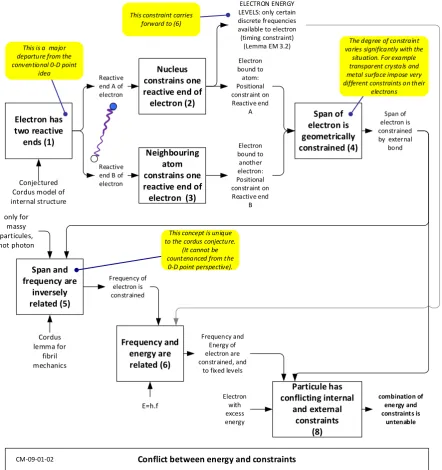
[image:8.595.95.538.220.691.2]The next step is to explain how and why the electron is geometrically constrained at its reactive ends, see Figure 5. The primary components of the constraint model are that the electron has two reactive ends (1), of which one is typically bonded to a nucleus (2), and the other is bonded to the electron in another atom or is a free valence
Figure 5. The particule has conflicting internal and external constraints. This diagram represents several of the underlying
principles of the Cordus theory (see text for elaboration) that give rise to these constraints. Electron has
two reactive ends (1)
Reactive end A of electron
Reactive end B of electron Conjectured
Cordus model of internal structure
Nucleus constrains one reactive end of
electron (2)
Neighbouring atom constrains one reactive end of electron (3)
Span of electron is geometrically constrained (4) Electron bound to atom: Positional constraint on Reactive end A Electron bound to another electron: Positional constraint on Reactive end B Span of electron is constrained by external
bond ELECTRON ENERGY
LEVELS: only certain discrete frequencies available to electron (timing constraint)
(Lemma EM 3.2)
Span and frequency are inversely related (5) Cordus lemma for fibril mechanics Frequency of electron is constrained Frequency and energy are related (6) Frequency and Energy of electron are constrained, and
to fixed levels
Conflict between energy and constraints This is a major
departure from the conventional 0-D point
idea
The degree of constraint varies significantly with the
situation. For example transparent crystals and metal surface impose very different constraints on their
electrons This constraint carries
forward to (6)
This concept is unique to the cordus conjecture.
(It cannot be countenanced from the
end (3). Thus the span of the electron is geometrically constrained (4). Consequently, according to the Cordus theory, the frequency of the electron is also constrained by its bonding arrangements (5), and therefore its energy too (6). These constraints depend on the strength of the bonding obligations. Thus the particule has conflicting internal and external constraints (8).
3.2.4. Particule Responds to Excess Internal Energy
The particule responds to excess internal energy in several ways. The outcome depends on the strength of the constraints and the size of the excess energy, and these conflict with each other. We propose a categorisation of responses based on the constraints: unconstrained electrons; constrained electrons; and situations where the electron breaks the constraints.
1) Unconstrained electron
The first category of events is where the situation involves a free electron, e.g. in an electron gas. In this case the electron is free to change its frequency and span to suit its situation. For example, if the electron receives energy, then it can increase its frequency and reduce its span, hence the two reactive ends will become closer together. Since the reactive ends have no bonding commitments, this is not problematic. Consequently the sys-tem responses are (3a) Increased frequency (voltage) of the free electron, or (3b) Displacement or increased ki-netic energy (speed) of the free electron.
2) Constrained electron
In the situation where the electron has bonds with other particules then the situation is more complex. This is because the nature of bonding, according to the Cordus theory, is that bonded particules co-locate one reactive end from each particule, and then synchronise their emission of discrete forces. Hence the bonding occurs via synchronisation of emissions rather than charge per se, and this “synchronous interaction” [15] is proposed as the explanation for the strong nuclear force. This novel reconceptualisation of the strong force also yields an ex-planation of nuclear structures [18][22].
The complexity arises because frequency and span are coupled variables in this theory. Thus the electron that gains energy needs to increase its frequency, but must also decrease its span. This has two problems for a bonded electron. First, the change in frequency perturbs the frequency synchronisation with the other particule. If the electron is to be allowed to increase its frequency, then the chain of other particules to which it is bonded will also have to increase theirs. Second, the spatial location of the electron’s reactive ends needs to change to accommodate the shortened span, but the assembly of other particules resists this. The assembly, e.g. of the atom, is an extensive polymer of Cordus particules each of which is rod-like, so the assembly has physical vol-ume and high stiffness. These two constraints on the particule, frequency and span, are coupled. The electron in the atom is bonded into an extensive assembly of other particules, all of which are bonded by one synchronous interaction (with harmonics). That atom has similar though more remote bonds with other atoms. Consequently the energetic electron has difficulty changing the frequency of that whole assembly to accommodate its own frequency needs. The assembly imposes a frequency on the electron, and while the electron stays in the assem-bly it must energise at that frequency, because bonding occurs via synchronicity. This imposed frequency is a constraint on the electron, and if this constraint prevails then the electron stays in the assembly but disperses its surplus energy into the assembly via phonons and heat.
Hence the second category of response is where the electron is bonded (is not free) but the synchronicity con-straints of the bonds prevail. In which case the electron’s options are: (3c) Transfer energy through bonds into other atoms (phonons), electrons, or passing photons; or (3d) Electron emits photon: dispenses with sufficient energy to access the next available energy level. The 3d outcome leads to photon emission, whereas the other routes do not. Multiple routes 3a-f may apply sequentially, so photons may be emitted in later processes.
3) Electron energy prevails
the high expulsion forces due to desynchronisation of the strong force.
Note that although the presentation has been in terms of an electron, the principles apply to any massy par-ticule or assembly thereof.
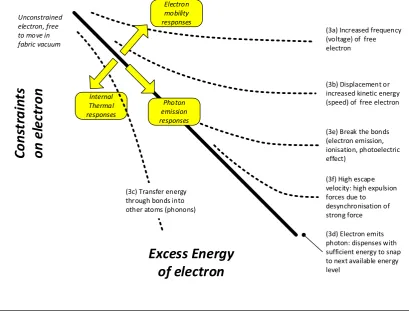
To help make sense of the various ways the electron responds to excess energy, we represent the relationship as two independent variables: the degree of constraint on the electron vs. the extent of the excess energy in the electron. Thus external vs. internal variables, see Figure 6.
The electron responses 3a-f are located on the figure, and proposed to be limited to certain regions. Thus ionisation (3e) requires that the electron receive greater energy than the constraints (bonding energy). On the other side, if the electron’s excess energy is much less than the constraints, then it disperses the energy into the atoms to which it is connected (3c).
Both scales of this diagram are energy units, but the present purpose is not so much to quantify the relation-ships as understand the causality. In that regard, it is useful to categorise the response surface into three regions.
• The region above the diagonal contains electron mobility responses, i.e. the electron does the moving. By implication higher escape velocities at (3f) require stronger mismatch between the constraints and the en-ergy.
• The region below the diagonal is an internal thermal response, i.e. the electron discharges the energy into neighbouring atoms, hence heat.
[image:10.595.122.532.358.670.2]• The diagonal itself corresponds to photon emission responses, i.e. the electron emits a photon. Thus emission is widely available across a range of bonding situations and input energies. This also explains the very wide range of frequencies that an emitted photon can take. The details of the photo emission process itself, and how the photon structures emerge from those of the electron, are already described [8].
Figure 6. Representation of the proposed relationships showing how the electron responds to combinations of bonding
con-straint and pumped energy.
Internal Thermal responses
Co
nst
ra
in
ts
on
el
ec
tr
on
Highly constrained electron, tightly bonded
Unconstrained electron, free to move in fabric vacuum
Excess Energy
of electron
Low excess energy in electron
High excess energy in electron
(3b) Displacement or increased kinetic energy (speed) of free electron
(3d) Electron emits photon: dispenses with sufficient energy to snap to next available energy level
(3a) Increased frequency (voltage) of free electron
(3c) Transfer energy through bonds into other atoms (phonons)
(3e) Break the bonds (electron emission, ionisation, photoelectric effect)
(3f) High escape velocity: high expulsion forces due to desynchronisation of strong force
Electron mobility responses
Photon emission responses
Key to this theory is the concept that the span and frequency (hence energy) of the electron are inversely pro-portional. This explains why energy changes cause geometric spatial distress for the electron. This makes it much easier to explain how bonding affects the behaviour of photons. By comparison the concept of frequency is merely abstract in the conventional QM photon emission model that assumes 0D points, and there is no con-cept of span, nor any dependency between frequency and span.
Summarising this part:
1) The photon emission/absorption processes have been identified for the Cordus theory, based on behaviours of the discrete field elements and internal structures.
2) The functional implications of this have been identified. The two main variables are identified as bonding and input energy.
3) A conceptual theory has been created for how those variables interact to determine what the electron does with its excess energy.
Therefore the first output of the present work is a process model for the energy mechanics within the electron. This is valuable, despite being qualitative, as it provides a means to represent the causality under various con-tingencies, i.e. it shows how various factors cause the different energy conversion outcomes to arise. The next section applies this theory to explain a number of optical energy related phenomena.
3.3. Application to a Variety of Phenomena
This theory is now applied to a variety of known photon emission phenomena. The objective is to check the in-ternal construct validity of the theory by seeing whether it gives logically consistent explanations for these di-verse phenomena. The focus is primarily on photon emission and absorption phenomena.
3.3.1. Absorbance
High-energy photons like X-rays tend not to be absorbed by materials but instead pass through. If they are ab-sorbed, they tend to break chemical bonds and release electrons. Our explanation is that these photons have too high a frequency to readily engage with the electron, and therefore the necessary match cannot be achieved for absorption. When it does, the energy absorbed by the electron forces it to adopt a shorter span (hence also higher frequency) and this severs its bonds with the atom. Thus the positional constraint to energise at a shorter span is stronger than the constraint to bond at a certain location. Hence the electron breaks free from its bond, and ioni-sation occurs in this situation (8e response).
3.3.2. Saturation
Absorption can be saturated by the intensity of light. The usual explanation is that electrons are so excited that they cannot absorb further energy or emit photons fast enough. Our explanation is that saturation occurs because the electron, having absorbed one photon, is attempting to move to a shorter span (also higher frequency). To the extent to which it achieves this, it becomes less receptive to absorbing further photons of the original frequency. So the electron does not absorb electrons indefinitely, hence saturation. This also means that the energy is not cumulative: the energy of many low frequency photons cannot be concentrated within the electron all at one time. If the electron is to be stripped away (ionisation), it requires one photon of sufficient energy rather than many of lesser energy. This also applies to the photo-electric effect (see below).
3.3.3. Beer-Lambert Law
3.3.4. Colour of Materials
Materials may selectively absorb light of certain frequencies, and transmit other frequencies. Our explanation is that absorption requires compatible frequencies between the incoming photon and the electron. In turn, fre-quency is linked to electron span, and span to the bonding commitments of the electron. Thus chemical compo-sition and bonding arrangements determine electron span. Consequently the material preferentially absorbs cer-tain frequencies and reflects others, hence colour of materials.
3.3.5. Transparency
The evidence is that transparent bodies tend to comprise electrically non-conductive materials. Our explanation is that transparent materials such as glass have chemical structures that more tightly constrain the mobility and span-length of the electron. This fixation is also results in low electrical and thermal conductivity. Thus these materials have selective absorption of certain frequencies that match the span constraints of the electrons. Pho-tons with very different frequencies cannot engage with these electrons and therefore pass through, hence high transmissivity.
3.3.6. Quantum Energy States
The Cordus theory qualitatively recovers the quantum energy emission of bound electrons. Photons emitted in these cases have a fixed energy, hence frequency, in discrete though unequal increments, corresponding to the difference in energy states for the electron. Our explanation is that the electron is constrained by its bonding commitments to the nucleus and external electrons to certain geometric configurations and hence frequencies or harmonics thereof. Since the electron can only energise at these specific frequencies, thus the emitted photon will also have an energy determined by the gap between these frequencies.
3.3.7. Direction of Photon-Emission
It is not possible to explain the direction of photon-emission using a quantum theory based on 0D particles with spin being merely a mathematical property. In contrast the concept of fibril orientation in the Cordus theory ex-plains why an emitted photon would have a preferred direction of travel, see [8] for details.
3.3.8. Photoelectric Effect
In the photoelectric effect the photon ejects an electron from the metal substrate. Importantly, this effect depends on the frequency of the light, not its intensity. There is a minimum threshold frequency, which varies with the metal, below which the effect does not occur. Our explanation is that the metal creates a basal level of bonding between the nuclei and the electrons, which depends on the elements and chemical composition. The electron has freedom to move, hence electrical conductivity. For the electron to escape, it needs to absorb sufficient en-ergy to break those bonds entirely. It does this by absorbing an energetic photon, which increases the frequency and decreases the span of the electron. This conflicts with the bonding constraint which seeks to maintain loca-tion of the reactive ends within the matrix of nuclei. If the energy is sufficient, then the electron severs those bonds and escapes. If the input photon has more than enough energy to liberate the electron, then it creates a large mismatch in the bonding constraints and thus high ejection forces, hence kinetic energy of the electron.
From the Cordus theory the reason this does not depend on the number of photons, i.e. light intensity, is that the electron absorbs one photon at a time, and if this is insufficiently energetic to break the bond, then there is no ejection. The electron, having absorbed one photon, becomes saturated against receiving further photons of similar frequency. This because its frequency increases slightly, hence receptivity decreases. The insufficiently energised electron then transfers its slight energy surplus into the substrate, via the unbroken bond. This corre-sponds to the 8c response above, and occurs in the form of phonons (internal vibrations). Hence temperature of the substrate rises. Thereafter the electron reverts to its former span and is ready to receive another photon. In this regard the explanation is similar to that for saturation above.
3.3.9. Emission of Polarised Photons from Crystals
as photons with common orientation.
3.3.10. Refraction Effects
The Cordus theory has previously been used to explain reflection and refraction [7]. However that explanation was mainly in terms of a Cordus photon interacting with a homogenous substrate. Adding the electron side of the theory allows a fuller description of a number of refraction effects. Thus dispersion and chromatic aberration, where refractive index varies with frequency, may now be explained as a consequence of higher frequency pho-tons having less interaction with electrons.
3.3.11. Reflection
The electrons in metals have a high degree of freedom, which gives them freedom to change the orientation and length (hence energy) of their span. Thus such electrons have a high receptivity to engage with incoming pho-tons of various orientations and frequencies. However engagement does not mean absorption, because the mo-bility of the electrons also means they have freedom to move in the surface plane of the substrate instead of ab-sorbing the energy. Consequently the incident photon is momentarily captured by an electron. The electron quickly re-emits the photon, hence emission of a reflected electron. The electron moves in the plane during this interaction. Where the plane of the reflective surface is made very small, then the mobility of the electron is im-peded and the angle of reflection is also changed. This is consistent with the observation that optical surfaces comprising small ridges behave differently to flat surfaces.
3.3.12. Birefringence
Crystals may have two refractive indices, and this is associated with different molecular lattice-spacing in dif-ferent directions. There can also be a frequency dependence of absorption for polarisation, or pleochroism. Bire-fringence also arises where transparent materials have differential internal strain (photoelasticity). Our explana-tion is that the different geometric spacing of the crystal lattice causes the respective bonding electrons to have different orientations of their fibrils, and in the case of pleochroism also different span (hence frequency). Con-sequently the incoming photons interact according to their orientation relative to that of the electron spans, though in this case they are not absorbed but merely re-directed hence refracted. The electrons, being fixed in location, emit discrete fields that are also fixed in direction. The spans of the transmitted photons are re-oriented to align with these fields, and hence the photons become preferentially polarised along one of the available ori-entations. This explanation also accommodates the known effects whereby birefringence arises from strain. The effect is evident whether the strain is induced mechanically as in the freezing of plastic, and photoelasticity, or by electric field (Pockels effect), or magnetic field (Faraday effect). In all these cases we propose there is a change in the alignment of the electron spans in the principal strain directions, and hence two preferred orienta-tions for photon transmission. Hence the polarisation of the transmitted light is correlated to the strain.
Similarly the chromatic effects may be explained by frequency considerations. The chemical composition de-termines atomic spacing, which controls electron span, which dede-termines electron frequency, and hence fre-quency (colour) of emitted light. Hence materials may absorb light differently and show different colours de-pending on the wavelength of light, such that they change colour when the polarisation of the light changes plane (pleochroism).
Explaining birefringence as geometric alignment is not difficult when the electron and photon are permitted to have a Cordus structure. By comparison the orthodox particle perspective labours with abstract concepts, since polarisation and spin have no physical representation for 0D points. Electromagnetic wave theory is thus the usual means of explaining optical effects, but is limited to light en-masse rather than single photons. The Cordus theory makes the original contribution of being able to conceptually explain optical effects at the level of single photons.
3.3.13. Cherenkov Radiation
Charged particles are known to radiate photons when moving with physical speed faster than the speed of light in the dielectric medium. The conventional explanation is that the particle polarises the local molecules, or dis-turbs the bonds, which then release the energy along a shock front due to interference. The effect only occurs with charged particles (not neutral ones), and in dielectric media (not conductive ones).
light. Consequently the emission directions are reoriented away from the forward direction. The discrete forces of the moving particle interact with the electrons in the medium, with two consequences. First, the electron span in the medium is locally realigned to be complementary to the emission direction imposed by the moving parti-cle. Second, the moving particle transfers via the discrete forces, its excess energy to the stationary electrons in the medium. However these electrons cannot move freely to escape their bonding commitments, since it is the nature of a dielectric medium to permit electrical polarisation but not electron mobility. Therefore the electrons re-emit the energy as photons. This sets up the angular alignment for the emitted photon.
3.3.14. Bremsstrahlung and Synchrotron Radiation
In bremsstrahlung the deceleration of an electron (or any charged particle) produces radiation in the form of photons. This typically happens to high-speed electrons that are arrested in matter. In synchrotron radiation it is the acceleration of the particle in a curved path by magnets that produces photons. This typically happens to fast-moving electrons in a synchrotron, hence the name. The emission occurs in the vacuum. The light is strongly polarised. Lighter particles such as electrons, lose more energy than heavier ones. In both cases the ra-diation has a continuous frequency spectrum, and higher-speed electrons produce higher frequency rara-diation. The radiation is only significant at ultrarelativistic speeds. The conventional explanation is incomplete. One of the difficulties with the classical model of the atom is that if an electron orbits round the nucleus, then it should emit a photon (synchrotron radiation) and collapse into the nucleus. Quantum mechanics partly solves this by providing orbitals in which there is only a probability of the electron appearing. However this is an incomplete solution as it does not explain how the electron gets from one location to another, and why it should not emit a photon while doing so.
The Cordus explanation is that any change in speed of the electron, whether acceleration or deceleration, causes the electron’s span to change its alignment relative to the direction of motion. The theory is that as the speed increases so the span orientation becomes progressively perpendicular to the velocity. Hence there is an alignment of spin and self-polarisation of spin as velocity increases. This provides the mechanism for the direc-tionality of the emitted photons. This also explains the Sokolov-Ternov effect. As regards the energy of the photons, the process of acceleration or deceleration of the electron necessarily involves the interaction of the electron’s discrete fields with those of other particules. In the synchrotron case there is an external magnetic field operating, which is created by the discrete force emissions of other moving charges in a coil. These discrete forces exist through the vacuum. In the case of bremsstrahlung the deceleration is caused by the impact of the electron into other matter particules. The latter also emit discrete forces. In both cases the interactions seek to change the position of the reactive ends of the moving electron, hence change its frequency and span. However the same external interaction also constrains the positions of those reactive ends, so the electron cannot accom-modate the energy internally and has to instead emit it as a photon. This theory asserts that even for electrons being braked by a plasma (free-free radiation), there are still constraints created by the interaction of externally imposed discrete fields, so the particules are not really ‘free’. The effect is not frictional but rather reactive in-terference between the discrete force emissions of the moving electron and the external discrete forces.
For slower electrons it is known that the frequency of radiation drops, as does the intensity. The Cordus ex-planation is that for slower electrons there is more time to relax the opposing constraints of the electron and the medium, so a degree of accommodation disperses some of the energy as frictional losses. Thus the electron is partly relieved of the need to eject the energy as a photon. From this perspective, the electron’s emission of a photon is an energy escapement mechanism due to over-constraint on the location of its reactive ends. Such constraints also affect its span-length, fibril orientation, frequency of emissions, and orientation of emissions [8].
3.3.15. Phase-Change Effects
The interaction of a photon and electron is known to result in a phase change in certain situations, particularly when photons are reflected. There is also the curious case of the annihilation of orthopositronium, which can also be interpreted as phase effect. As shown below, the Cordus theory proposes that an electron retards its en-ergisation by half a frequency cycle when emitting a photon, and this is proposed as the common mechanism in all the effects listed below.
3.3.16. Phase Change at Reflection
light reflecting off a denser material (higher refractive index), e.g. air to glass. For reflection off a less dense material, e.g. internal reflection glass to air, then the polarity stays the same.
The earlier Cordus explanation for this [23] was that reflection delays the renewal of the reactive end, but only when the photon has to pass into a denser material. The term transdermis was used to describe the material beyond the interface plane. Thus the nature of the volume beyond the interface plane is important in the reflec-tion effect, even if the reflecreflec-tion itself nominally occurs in the plane. There is no delay in the glass-to-air case, because the cisdermis is the denser material and the delay has already occurred in the form of the refractive in-dex, though this is progressive and does not need a frequency cycle.
We now add another level of explanation. The photon is not so much bounced off the reflection interface as a rigid intact particule, but is instead elastically mangled by its interaction with the electron. That mangling causes the phase change. The extreme interpretation of this, which is easier to represent, is that the photon is totally ab-sorbed and a new one emitted. In which case the process is as follows: the incident photon is wholly, semi-instantly and neatly absorbed into an electron → that electron is free to move in the interface plane → the electron temporarily accepts the component of the photon’s energy that is in the plane of the interface → the electron is not free to move deeper into the transdermis (perpendicular to the interface plane) because of the electrons already there → the electron therefore cannot cope with that component of the photon’s energy that was perpendicular to the interface plane → the electron thus has to elastically return that component → this en-ergy is used at the electron’s next frequency cycle to create a one-time force impulse (per photon) on a neighbouring electron or atom (force in the Cordus model is a constraint on the location of re-energisation) → the in-plane component of energy is also recovered → a new photon is emitted → however that photon is spooled out of the electron half a frequency cycle later (the electron has had the use of the energy in the inter-vening period) → this corresponds to a phase shift or change in polarisation of the reflected photon. This expla-nation is likely to be a simplification of a more geometrically complex and dynamic transformation of the inci-dent photon into the reflected one.
3.3.17. Force Impulse at Reflection, and Radiation Pressure
A mirror surface receives an impulse of up to p = 2E/c = 2hf/c (with photon energy E, Planck constant h, fre-quency of light f, speed of light c). The Cordus explanation is that the electron uses the energy to create an im-pulse, and then returns it to the photon. This explanation also accommodates radiation pressure, where photons are not reflected but instead absorbed by a body. The in-plane and perpendicular components of incident energy cause the absorbing electron (or other structure) to exert a positional constraint on its neighbours, in those direc-tions. Thus the Cordus model suggests a mechanism for transforming energy into discrete force impulses, and thus into momentum of the body as a whole. The phase change at reflection allows the electron to have the use of the photon’s energy for a moment of time, during which it uses that energy to create a momentary force im-pulse. Thereafter the photon returns the energy back to the photon. So this provides an answer to the question of how a photon can cause reaction forces in the substrate, and momentum thereof, while still exiting with its same original energy. There is a time delay, wherein the electron is taking energy from the future: the photon arrives half a frequency cycle later at its eventual destination.
The phase change of the photon at reflection off a denser material is a known effect. The Cordus theory sug-gests that this form of reflection uses a different mechanism to internal reflection. In the former the electron at least partially absorbs the photon and re-emits it after a delay, whereas in the latter the photon stays intact but its locus is bent by the imbalance in the evanescent fields at the interface.
3.3.18. Number of Photons at Positronium Annihilation
The other case for phase change is in the annihilation process. The known annihilation behaviour of positronium is that it produces two photons when the electron and positron have antiparallel spins (parapositronium), and three photons for parallel spins (orthopositronium). Conventional explanations are lacking.
frequency and hence enter the transphasic state. The process of emitting a photon is thought to always changes the phase of the electron by half a frequency cycle, corresponding to changing its phase by 180˚ [8]. In the lan-guage of QM this corresponds to flipping the “spin”. So for orthopositronium one photon is emitted to change the assembly into the parapositronium state, and then the annihilation process itself liberates two photons. In this way the new theory can explain the spin requirement, and the direction thereof. It also accommodates the fact that one of the photons in the case of orthopositronium may be of a different energy. Note that in the annihila-tion case it is the electron or antielectron that makes the phase adjustment, not the photon.
The theory requires that generally an electron will change its phase by half a frequency cycle (change its spin) when it emits a photon, and the photon will be likewise offset in phase. This requirement arises at [8] (Figure 5 therein, note 2.6). We are not yet sure whether the electron has this phase change at every emission, or only when it is over-constrained, being accelerated (includes deceleration), or forced to change its orientation (spin). We tentatively expect the former interpretation and note this as an open question.
3.3.19. Simulated Emission (Laser)
The main features of the laser that differentiate it from conventional incandescent light sources are: a single fre-quency is produced, the photons are all in phase, and the photons all move in the same direction. The conven-tional explanation is that the electron in the gain medium is pumped with energy (electrical or optical). Since the electron is bonded to a nucleus, therefore it cannot take any energy level but can only take one of the specific quantum levels available. Having absorbed the energy, the electron therefore moves to an orbital which accom-modates higher energy. However the electron is not fully stable in that excited state, and will eventually decay back to a lower energy level, and in the process it emits a photon with the energy difference. That emission can be spontaneous (random), or in the case of the laser, it is stimulated by another photon of the same energy. The laser is designed to maximise the chances for this to happen, typically by having mirrors that reflect the light many times. In this way the initial emission of photons recruits the other atoms to also emit photons. The new photons are emitted in the same direction as the stimulating photon, and with the same frequency and phase. However it is difficult to explain emission direction or the recruitment process.
The Cordus explanation is similar to the above but permits further clarification of the processes. The first photon triggers an electron to drop an energy level and emit another photon, and the original photon survives because it engages with the electron only in passing [24], i.e. is not absorbed. We can now expand that explana-tion with insights from the later Cordus work. It is important in what follows to note that in this theory the in-teractions between the photon and electron occur between the discrete forces of the particules, and this occurs before the particules are touching, per the principle of Wider Locality. So particules respond to what is happen-ing in space around them, before they are spatially coincident. By comparison the conventional perspective, in-cluding of quantum mechanics, is that particles are only affected by fields at that one infinitesimally small point where the particle exists. A second important Cordus concept is that the reactive end of the electron energises at a characteristic frequency related to its energy. Third, the reactive end is only available to interact with the dis-crete forces of other particules when it is energising and generating disdis-crete forces itself. Consequently there are timing windows in which interaction events can occur. When these interactions do occur, the particules have a tendency to become aligned and synchronised, which corresponds to phase, spin, or polarisation depending on the situation.
So the Cordus explanation for the stimulated emission is as follows: An initial trigger photon arises and trav-els down the barrel of the laser cavity → the discrete forces of this photon interact with the discrete forces of an electron of compatible frequency → their energy systems start to (briefly) connect via the discrete forces → the electron was previously pumped hence already needing to dispose of a photon → the interaction between the discrete forces of the electron and photon applies a positional constraint on the electron → being fully laden with energy the electron cannot accommodate this constraint and instead dumps the energy by emitting its own photon → this emitted photon is in the same phase as the trigger photon because of the synchronous interlock of discrete forces → the trigger photon also survives though it might be slightly reduced or increased in energy (hence small changes in frequency) → the two photons propagate and disturb electrons in other atoms → a cas-cade emission of photons occurs as a spatial progression through the laser body.
fre-quencies.
The common phase is explained as arising from the electron emitting its photon at the same point in the fre-quency cycle as its engagement with the incident photon. Practical lasers do not always emit in a single polarisa-tion, and since polarisation corresponds to the orientation of a Cordus fibril, we therefore infer that the electron Cordus as a whole does not have to be perfectly aligned with the polarisation of the photons for the synchronous emission to occur. From the Cordus perspective, the incident photon does not have to be totally co-located with the electron to stimulate it, just as long as their discrete forces affect each other. Thus we predict that the emitted photon may be laterally offset from the incident one. It may also be axially offset, and this is consistent with the finite size of the laser bunches.
Also, the theory predicts that the light is not so much amplified as additional photons are recruited from the electrons. This also explains why the power increases exponentially when the device starts to lase: one photon recruits several more from the next layer of atoms, and those again. So there is a growing tree of recruitment, with a constant proportional increase in recruitment at each stage, hence exponential. The gain can therefore be interpreted as a measure of the efficacy of recruitment of electrons.
4. Discussion
4.1. What Has Been Achieved?
This paper makes a number of original contributions. The first is the provision of a conceptual theory whereby the bonding constraints on the electron may be related to the way that it deals with excess energy. This permits a broad-ranging theory to be constructed for how the electron responds to combinations of bonding constraint and pumped energy, and how it emits a photon, summarised in Figure 5. This diagram is novel in providing a com-pact representation of a wide range of phenomena. The crucial insight is the way the electron reactive ends are constrained by bonding commitments. These constraints apply to the reactive ends’ spatial position, frequency, and phase. Hence these become coupled attributes, where the coupling is achieved via physical substructures. In contrast quantum theory treats these as merely independent intrinsic (disembodied) variables, and hence has no mechanism to relate these together.
The second contribution is being able to explain how bonding, hence chemistry, affects photon emission phenomena. Different types of materials, e.g. electron gas, metals, dielectrics, ceramics, crystals, have different chemical bonding arrangements. These bonds are mediated by electrons, hence binding chemistry directly af-fects electron constraints and hence photon emission phenomena. The key component to making this theory work is the idea of the Cordus particule, with its two reactive ends, their energisation frequency, and the inverse relationship between span and frequency. This gives naturally representation for spin and phase. Such constructs are not available to other theories based on 0D point particles or continuum materials.
A third contribution is providing qualitative explanations for a range of emission phenomena: Absorbance; Saturation; Beer-Lambert law; Colour of materials; Quantum energy states; Direction of photon-emission; Pho-toelectric effect; Emission of polarised photons from crystals; Refraction effects; Reflection; Transparency; Bi-refringence; Cherenkov radiation; Bremsstrahlung and Synchrotron radiation; Phase change at reflection; Force impulse at reflection, and radiation pressure; Number of photons at positronium annihilation; Simulated emis-sion (Laser). This is original because a comprehensive set of ontologically rich explanations has not previously been provided by other theories of physics. This also moves the hidden-variable sector forward. The explana-tions are grounded in assumpexplana-tions of physical realism, which cannot be said of all theories.
4.2. Implications
This theory provides insights into the role of the photon in the cosmos. As the theory previously identified, the photon provides an energy escapement mechanism for a massy particule [8]. This is possible because of the (a) the difference in the discrete force emissions of the massy and photon particules, (b) the span of particules, separating two reactive ends, (c) the fabric of discrete forces external to the particule.
decoherent (non-synchronised) interactions, particules affect each other via the electro-magneto-gravitational fields they create. The photon interactions are a third case, where the massy particule discards its extra energy (or absorbs energy). In emitting a photon the particule transfers its energy problem elsewhere in space. By dumping the energy into the fabric, and leaving it to travel there until it intersects another reactive end, the en-ergy is taken out of the present and transferred to the future. There are two important implications of this. One is that the fabric separation creates the macroscopic perception of time [25]. The second is that the emission of photons adds considerably to the number of particules in the universe, and this and the different time delay be-fore each is reabsorbed adds greatly to the number of states for the universe, hence to entropy.
The photon is an astonishingly beautiful and useful feature in the universe: “The photon transfers spare en-ergy around the place. It is an escapement mechanism whereby particules that are over-prescribed in terms of positional constraints on re-energisation can get rid of that energy. The free photon is not quantised, but flexible in its ability to contain whatever energy it is given: like an expandable container. Yet it is sufficiently like a mat-ter particule to be able to inmat-teract with matmat-ter. Further, it has no hand and is therefore predicted to be able to freely interact with, and transfer energy between, both matter and antimatter” [26].
Another profound implication is the role of the photon in inverse problem, which is the formation of the mat-ter universe at genesis. Other work in the Cordus theory has proposed a detail processes for the conversion of a pair of photons into matter (pair production) [9], and a baryogenesis theory for how these products could be asymmetrically transformed into matter [10].
A further implication is that we now have a plausible theory, based on physical realism, for explaining how photons interact with matter to give rise to contextual measurement. Hence the photons used to interrogate a system may cause it to change state as in the Zeno effect. This means it is also possible to explain why electro-magnetic radiation should affect the decay rates of nuclides and unstable particules [27].
4.3. Limitations and Implications for Further Research
The principal limitation of this work is its conjectural foundation. The idea that particules are not 0D points but instead have two reactive ends is a radical one and frequently met with disbelief and an expectation of extraor-dinary proof. However it is not possible to prove this lemma, and it remains a potential limitation. Neither has this paper, which is a conceptual work, presented a mathematical formalism. This is only available for optics [7] and nuclear stability [18]. This is left to future work now that the energy framework has been sketched out.
A more specific limitation, and an area of possible future research, concerns the phase-change effects pre-dicted by the theory. Do all electrons fully change their phase when they emit a photon? We are not fully satis-fied with the explanations so far, and we suspect there may be deeper concepts that need elucidating.
5. Conclusion
This paper has developed a conceptual theory for photon emission and absorption using the Cordus theory. We propose an energy mechanics whereby the electron (or other particule) has multiple mechanisms for dealing with any excess energy that it might have. It has long been known that the bonding commitments of the electron affect its energy behaviour but the mechanisms for this have been elusive. The present theory offers an explana-tion based on the supposiexplana-tion that particles have internal structure. The causal mechanisms have been inferred, and three main categories have been identified whereby the electron responds to excess internal energy. Collec-tively these responses encompass energetic free electrons, transferral of energy to other massy particles, photon emission, and electron escape. This is valuable as it provides a means to represent the causality under various contingencies, i.e. it shows how various factors cause the different energy conversion outcomes to arise. The theory is able to provide a logically coherent explanation for a wide variety of optical energy conversion phe-nomena. These include the direction of photon-emission, photoelectric effect, absorbance and the Beer-Lambert law, emission of polarised photons form crystals, refraction, birefringence, bremsstrahlung & synchrotron radia-tion, and simulated emission (lasers).
Author Contributions
of the ideas and editing of the paper.
Conflict of Interest Statement
The authors declare that there is no conflict of interests regarding the publication of this article. The research was conducted without personal financial benefit from any third party funding body, nor did any such body in-fluence the execution of the work.
References
[1] Einstein, A., Podolsky, B. and Rosen, N. (1935) Physical Review, 47, 777. http://dx.doi.org/10.1103/PhysRev.47.777
[2] Bell, J.S. (1964) Physics, 1, 195-200.
[3] Leggett, A. (2003) Foundations of Physics, 33, 1469-1493. http://dx.doi.org/10.1023/A:1026096313729
[4] Groblacher, S., Paterek, T., Kaltenbaek, R., Brukner, C., Zukowski, M., Aspelmeyer, M. and Zeilinger, A. (2007) Na-ture, 446, 871-875. http://dx.doi.org/10.1038/nature05677
[5] de Broglie, L. (1925) Annales de Physique, 3(10).
[6] Bohm, D. and Bub, J. (1966) Reviews of Modern Physics, 38, 453-469. http://dx.doi.org/10.1103/RevModPhys.38.453
[7] Pons, D.J., Pons, A.D., Pons, A.M. and Pons, A.J. (2012) Physics Essays, 25, 132-140. http://dx.doi.org/10.4006/0836-1398-25.1.132
[8] Pons, D.J. (2015) Applied Physics Research, 7, 14-26. http://dx.doi.org/10.5539/apr.v7n4p24
[9] Pons, D.J., Pons, A.D. and Pons, A.J. (2015) Journal of Nuclear and Particle Physics, 5, 58-69.
[10] Pons, D.J., Pons, A.D. and Pons, A.J. (2014) Journal of Modern Physics, 5, 1980-1994. http://dx.doi.org/10.4236/jmp.2014.517193
[11] NIST (1993) Integration Definition for Function Modeling (IDEF0). http://www.itl.nist.gov/fipspubs/idef02.doc
[12] Pons, D.J., Pons, A.D. and Pons, A.J. (2014) Physics Essays, 27, 26-35. http://dx.doi.org/10.4006/0836-1398-27.1.26
[13] Pons, D.J. (2015) Internal Structure of the Photon (Image License Creative Commons Attribution 4.0). Wikimedia Commons.
[14] Pons, D.J. (2015) Internal Structure of the Electron (Image License Creative Commons Attribution 4.0). Wikimedia Commons.
[15] Pons, D.J., Pons, A.D. and Pons, A.J. (2013) Applied Physics Research, 5, 107-126.
[16] Pons, D.J., Pons, A.D. and Pons, A.J. (2015) Applied Physics Research, 7, 1-11.
[17] Pons, D.J., Pons, A.D. and Pons, A.J. (2014) Applied Physics Research, 6, 50-63. http://dx.doi.org/10.5539/apr.v6n3p50
[18] Pons, D.J., Pons, A.D. and Pons, A.J. (2015) Physics Research International, 2015, Article ID: 651361. http://dx.doi.org/10.1155/2015/651361
[19] Pons, D.J. and Pons, A.D. (2013) The Open Astronomy Journal, 6, 77-89.
[20] Pons, D.J., Pons, A.D. and Pons, A.J. (2015) Applied Physics Research, 7, 1-13.
[21] Pons, D.J., Pons, A.D. and Pons, A.J. (2014) Applied Physics Research, 6, 28-46. http://dx.doi.org/10.5539/apr.v6n2p28
[22] Pons, D.J., Pons, A.D. and Pons, A.J. (2013) Applied Physics Research, 5, 145-174. http://dx.doi.org/10.5539/apr.v5n6p145
[23] Pons, D.J., Pons, A.D., Pons, A.M. and Pons, A.J. (2011) Cordus Optics: Part 2.2 Reflection. http://vixra.org/pdf/1104.0020v1.pdf
[24] Pons, D.J., Pons, A.D., Pons, A.M. and Pons, A.J. (2011) Cordus Matter: Part 3.3 Energy Cycles within Matter. http://vixra.org/pdf/1104.0024v1.pdf
[25] Pons, D.J., Pons, A.D. and Pons, A.J. (2013) Applied Physics Research, 5, 23-47. http://dx.doi.org/10.5539/apr.v5n6p23
[26] Pons, D.J. (2011) Contrasting Internal Structures: Photon and Electron. http://vixra.org/pdf/1109.0045v1.pdf