Int. J. Electrochem. Sci., 7 (2012) 5633 - 5642
International Journal of
ELECTROCHEMICAL
SCIENCE
www.electrochemsci.orgNear Real-Time Electrochemical Analysis of Carcinogenic Cell
Lines Using Planar Microelectrodes
Nahrizul Adib Kadri1,*, Mohd Azhar Abdul Razak2, Fatimah Ibrahim1 1
Department of Biomedical Engineering, Faculty of Engineering, University of Malaya, 50603 Kuala Lumpur, Malaysia
2
Faculty of Electrical Engineering, Universiti Teknologi Malaysia, 81310 UTM Skudai, Johor, Malaysia
*
E-mail: [email protected]
Received: 5 April 2012 / Accepted: 13 May 2012 / Published: 1 June 2012
Physical manipulation of polarizable particles generated by the transient force when placed in non-uniform electrical fields is termed dielectrophoresis. The electrophysiological make-up of the particle and the surrounding medium decides the magnitude of the force; hence specific DEP profile may be acquired for any polarizable particles based on the electrical properties of the membrane and cytoplasm alone. Any changes to these parameters may be detected, in turn, by observing the corresponding DEP spectra. The reason DEP is not applied widely in spite of its non-invasiveness primarily is that the process is time consuming. The proposed DEP-based lab-on-chip application of semi-automated cell electrophysiology characterization allowed concurrent DEP experiments to be conducted serially, which significantly reduced the required experiment time. This capability is achieved via the employment of a planar microelectrode with modified dot microarray geometry. The results showed that the system is capable of producing a complete DEP spectrum profile for K562 leukemic cells between the 1 kHz to 1 MHz frequency range in less than 10 minutes.
Keywords: Lab-on-a-chip; Dielectrophoresis; AC electrokinetics; Cancer
1. INTRODUCTION
DEP is capable of producing specific cellular profiles based on the electrophysiological properties, hence DEP has been employed, among others, to separate live and dead yeast cells [2,3], various bacterial [4-9] and viral [10-14] strains, DNA molecules [15], spores [16,17], and algae [18]. Other types of molecules such as nano-sized latex spheres [19,20] and biopolymers [21] have also been the subject of DEP characterization studies. In addition, numerous studies focused on the use of DEP in characterizing the myriad of mammalian cells, including neurons [22-24], leukocytes [25-27], erythrocytes [28,29], platelets [30,31], and even human spermatozoa [32]. Although this in itself provides a much needed alternative method for cell detecting and sorting assays, a worthier cause of DEP usage would be in detecting and collecting abnormal particles from a given cell population. Similar studies on separating these cells have been conducted as early as the recognition of DEP as marker-less cell sorting technique in the 1980s. A study by Mischel et al. for example, had successfully separated malignant melanocytes from normal cell populations and showed that the electrical behavior of malignant melanocytes is markedly dependent upon the type of cell line, age, and drug treatment (e.g., chlorpromazine) and may be separated from normal cells using DEP [33].
In spite of the advantages, DEP is yet to be adopted by the biotechnology industry, because of two reasons, namely the time-consuming processes involved, and the lack of applications to conduct high volume cell assays [34]. Many studies have focused on reducing the time taken to conduct DEP experiments by automating some experimental processes (e.g. [35,36]), but were limited to recording DEP features on single particles. A semi-automated system well-based DEP system [34], was designed to address the high volume limitation and was successfully used in many DEP-based experimental studies (e.g. [17,34,37,38]). However, it still takes between 120-240 min to construct a statistically acceptable DEP spectrum for a given cell sample.
This study presents the method and development of a semi-automated, DEP application that is capable of conducting DEP studies and the subsequent analyses for carcinogenic cell samples of 1 x 10⁷ cells per ml at a much lesser time. The data point resolution of the DEP spectra will be similar to those acquired when using the aforementioned well-based system. The developed application is also capable of completing DEP studies close to real-time, due to the speed in conducting DEP studies and analyzing the acquired data.
2. THEORY
When exerted on a homogeneous spherical particle, the DEP force (FDEP) is typically expressed as:
23
Re
2 r K Ε
FDEP m (1)
** **2 m p
m p K
(2)
where *p and m* are the complex permittivities of the particle and the medium, respectively. In addition,
* j
(3)
where is the conductivity, the permittivity, and the angular frequency of the electric field.
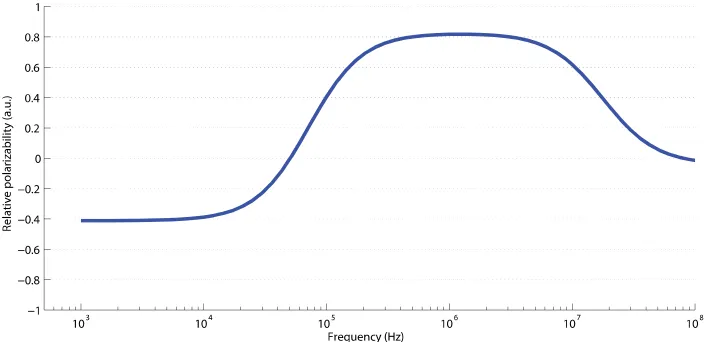
The analytical expressions mentioned above explain the DEP behavior of spheres in a given solution; however, it is considered to be too complex to be expanded in order for the dielectric properties to be directly calculated and correlated in a useful manner [39]. The common method of correlating the relevant cellular electrical parameters with the DEP behavior is by estimating the electrophysiological properties performed by best-fit numerical analysis [40], and has been successfully used in many DEP characterization studies (e.g. [37,38,41,42]). The estimation method has also been shown to be useful in characterizing multiple cell populations within a heterogeneous cell sample [43]. Figure 1 shows a typical DEP spectrum for a sample cell population using the said numerical analysis, with the characteristic ‘crossover’ occurring at about 40 kHz.
Figure 1. A typical shape of the DEP spectrum based on the single shell model
3. METHODS 3.1. Device assembly
[image:3.596.121.474.444.615.2]
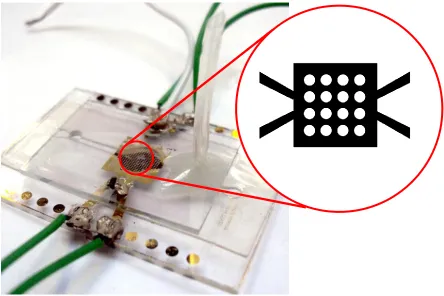
conductive layer was fabricated from Au-plated microscope glass slides, while the top conductive layer was made from indium tin oxide (ITO) coated glass slides of slightly smaller dimensions, and acted as the counter electrode. The DEP chamber was fabricated from UV-sensitive polyresin, and the thickness determined the height of the chamber, which is about 200 µm.
Figure 2. The BioMEMS application assembly, with the schematic design of the electrode overlaid
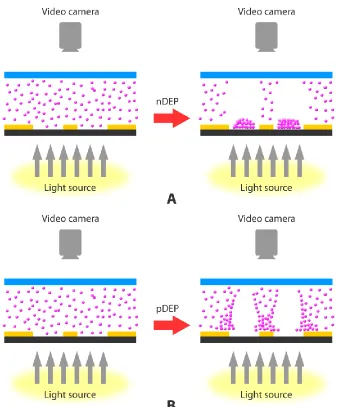
Using typical photolithography methods, a specific microarray design was patterned onto the Au-coated glass slides. The planar electrode geometry used was similar to the dot array design previously used by Fatoyinbo et al. [44], in order to produce axisymmetrical electrical field gradients over each of the dots. The DEP force generated should consequently be axisymmetrical as well, greater at the electrode edge and decreasing in magnitude towards the center of the dot. This should provide a correlation between particle motion and relative particle polarisability; which is determined based upon images captured from a digital camera attached to the microscope.
3.2. Preparation of cell samples
[image:4.596.73.517.170.466.2]
The cell culture medium were prepared using RPMI solution (GIBCO® RPMI Media 1640, Invitrogen Ltd., Paisley, UK), supplemented with 10% heat-inactivated fetal bovine serum (FBS) (PAA, Pasching, Austria), 1% penicillin-streptomycin, and 1% L-glutamine. The cells were cultured at 37oC and 5% CO2, and may be used for experiments once confluence was reached. For DEP experiments, cells were transferred in conductive medium made of 8.5% sucrose and 0.3% dextrose, with the desired conductivity value adjusted using 150 mM KCl solution, verified by a conductivity meter. If the conductivity was set at 10 mS/m, the crossover frequency for K562 cells should lie between 10 to 100 kHz (based on previous findings by e.g. [38,45]). Cell samples were ‘washed’ twice by centrifugation at 180 g for 5 minutes, and subsequently resuspended in the DEP conductive medium. Cell sample concentration was adjusted to about 10 million cells per ml prior to the commencement of DEP experiments.
[image:5.596.130.468.311.718.2]3.3. Experimental procedure and data analysis
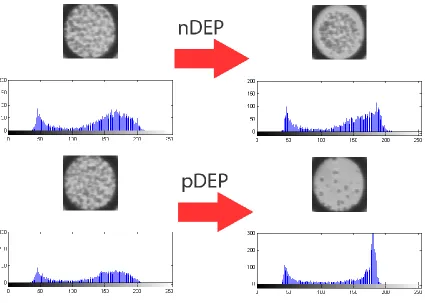
Figure 4. The captured images and the corresponding histogram plots for dots experiencing negative (top) and positive (bottom) DEP
About 15 µl of cell suspension was slowly delivered using a syringe through the inlet of the DEP chamber. If the chamber has been satisfactorily assembled, it should be filled with the solution uniformly via capillary action. The electrode and the ITO were connected to the positive and negative connectors of the signal generator, respectively. The AC signal was applied for 15 seconds at each chosen frequency value to produce the electric fields with the corresponding gradient strength.
[image:6.596.89.514.72.375.2]
4. RESULTS
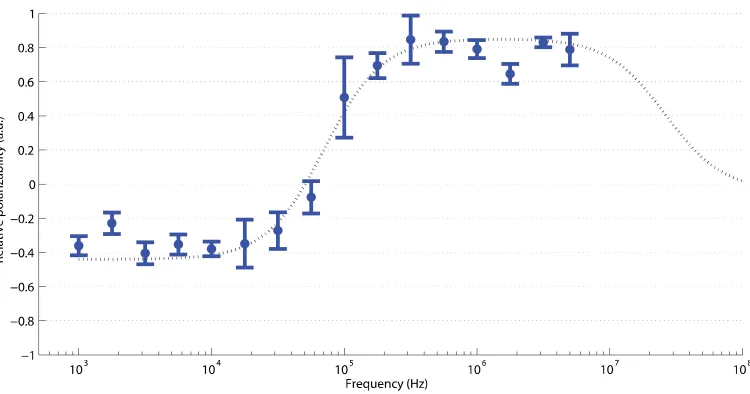
The extent of normalized shifts in the pixel values, when plotted against the frequency at which the images were taken from, was used to construct the corresponding DEP spectrum for the K562 cell population used in the study (Figure 5). The plot showed the typical S-shape associated with DEP electrophysiological profile, which is similar to the previously published data for K562 cells in similar experimental conditions [38,45]. Notably, the crossover frequency occurs at the predicted 10 to 100 kHz range (about 40 kHz in this particular case). From the best-fit model constructed from Equation (1), it is inferred that the electrophysiological properties of the cellular membrane were close to the previously determined values for K562 cells of about 200 S and 7 mF/m2 for conductance and capacitance, respectively.
Figure 5. Typical DEP spectra for K562 cell population (cell concentration 1x10⁷ cells per ml, electrical field 10 Vp-p, KCl conductive medium 10 mS/m). Dotted line indicates best fit model using the real part of the Clausius-Mossotti factor
5. DISCUSSION
[image:7.596.111.486.281.478.2]
that a non-invasive technique be developed and capable of producing the desired outcome in the shortest time possible.
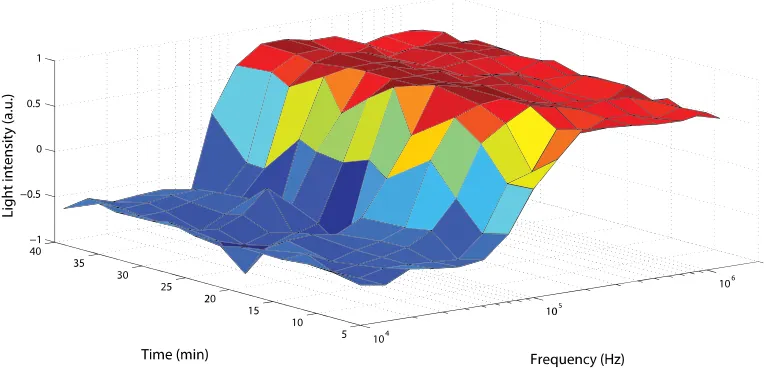
The BioMEMs application discussed in this study is capable of recording DEP events at a resolution of 8-by-n data points between the frequency range of 10 kHz and 1 MHz within 10 min. The hardware components should also be compatible with any lab-on-chip modules utilizing AC electrokinetics and microfluidics. The significant reduction in time to complete DEP experiments should encourage others to conduct real-time DEP experiments and analysis for any carcinogenic cell lines using currently available microengineering techniques. Figure 6 shows an example of the possibility in constructing real-time 3D DEP plots that would be highly beneficial in observing electrophysiological changes occurring in the cellular population, if any. This should subsequently open the possibility of, for example, real-time in situ observation of the effects of newly-developed cancer drug on the cellular membrane of cancerous cells without the need of additional chemical reagents.
Figure 6. Preliminary 3D DEP spectra of K562 cells over 40 minutes, showing gradual changes in DEP profile over time
ACKNOWLEDGEMENTS
This study was supported in part by the High Impact Research Grant (UM/HIR/MOHE/ENG/05). The authors would like to thank Prof. M.P. Hughes, and Drs. H.O. Fatoyinbo and F.H. Labeed from University of Surrey, United Kingdom for useful discussions.
References
1. H. Pohl, J. Appl. Phys., 22 (1951)
2. H. Pohl, I. Hawk , Science, 152 (1966) 647
3. J.S. Crane, H. Pohl, J. Electrochem. Soc.,115 (1968) 584
[image:8.596.103.487.325.509.2]
5. M. Washizu, Y. Kurahashi, H. Iochi, O. Kurosawa, S. Aizawa, S. Kudo, Y. Magariyama, H. Hotani, Ieee T. Ind. Appl., 29 (1993) 286
6. G.H. Markx, Y. Huang, X.F. Zhou, R. Pethig , Microbiol-UK, 140 (1994) 585 7. G.H. Markx, P.A. Dyda, R. Pethig,J. Biotechnol., 51 (1996) 175
8. P. Gascoyne, C. Mahidol, M. Ruchirawat, J. Satayavivad, P. Watcharasit, F.F. Becker, Lab Chip, (2002) 70
9. J. Suehiro, D. Noutomi, M. Shutou, M. Hara, J. Electrostatic, 58 (2003) 229 10.N.G. Green, H. Morgan, J. Phys. D Appl. Phys., 30 (1997) L41
11.M.P. Hughes, H. Morgan, J. Phys. D Appl. Phys.,31 (1998) 2205
12.M.P. Hughes,H. Morgan, F.J. Rixon, J.P.H. Burt, R. Pethig, Bba-Gen Subjects,1425 (1998) 119 13.H. Morgan, M.P. Hughes, N.G. Green , Biophys. J.,77 (1999) 516
14.S. Archer, H. Morgan, F.J. Rixon, Biophys. J., 76 (1999) 2833
15.M. Washizu, O. Kurosawa, I. Arai, S. Suzuki, N. Shimamoto, Ieee T. Ind. Appl., 31 (1995) 447 16.G.P. Archer, W.B. Betts, T. Haigh, Microbios, 73 (1993) 165
17.F.H. Labeed, H.O. Fatoyinbo, M.P. Hughes, S.P. Martin, P. Pashby, J. Environ. Monitor., 9 (2007) 87
18.Y. Hubner, K.F. Hoettges, M.P. Hughes, J. Environ. Monitor., 5 (2003) 861 19.H. Morgan, N.G. Green , J. Phys. Chem. B, 103 (1999) 41
20.Z.Y. Qiu, N. Markarian, B. Khusid, A. Acrivos, J. Appl. Phys., 92 (2002) 2829
21.M. Washizu, S. Suzuki, O. Kurosawa, T. Nishizaka, T. Shinohara, Ieee T. Ind. Appl., 30 (1994) 835 22.T. Heida, W. Rutten, E. Marani, Adv. Anat. Embryol. Cell Biol.,173 (2003) 11
23.T. Heida,W.L.C. Rutten,E. Marani, Ieee T. Bio-Med. Eng., 48 (2001) 921
24.S. Prasad, X. Zhang, M. Yang, Y.C. Ni, V. Parpura , O.S. Cengzis, O. Mihrimah, J. Neurosci. Meth., 135 (2004) 79
25.J. Yang, Y. Huang, X.J. Wang, X.B. Wang, F.F. Becker, P.R. Gascoyne, Biophys. J., 76 (1999) 3307
26.J. Yang, Y. Huang, X.B. Wang, F.F. Becker, P.R. Gascoyne, Biophys. J., 78 (2000) 2680 27.P.R.C. Gascoyne, X.B. Wang, J. Yang, Y. Huang, J. Vykoukal, F.F. Becker, Anal. Chem., 72
(2000) 832
28.J. Auerswald, H.F. Knapp, Microelectron. Eng., 67-8 (2003) 879
29.Y. Hubner, K.F. Hoettges, G.E.N. Kass, S.L. Ogin, M.P. Hughes, Iee P-Nanobiotechnol., 152 (2005) 150
30.J. Rhoads, H. Pohl, R. Buckner , J. Biol. Phys., 4 (1976) 93
31.H.T. Soh, M.S. Pommer, Y.T. Zhang, N. Keerthi, D. Chen, C.D. Meinhart, J.A. Thomson, Electrophoresis, 29 (2008) 1213
32.G. Fuhr,T. Muller, V. Baukloh, K. Lucas, Hum. Reprod., 13 (1998) 136
33.M. Mischel, F. Rouge, I. Lamprecht, C. Aubert, G. Prota, Arch. Dermatol. Res., 275 (1983) 141 34.M.P. Hughes, K.F. Hoettges, Y. Hubner, L.M. Broche, S.L. Ogin, G.E.N. Kass, Anal. Chem., 80
(2008) 2063
35.G. De Gasperis, X.B. Wang, J. Yang, F.F. Becker, P.R.C. Gascoyne, Meas. Sci. Technol., 9 (1998) 518
36.R. Holzel, Bba-Gen Subjects, 1425 (1998) 311
37.F.H. Labeed, H.M. Coley, M.P. Hughes , Bba-Gen Subjects, 1760 (2006) 922 38.F.H. Labeed, H.M. Coley, H. Thomas, M.P. Hughes, Biophys. J., 85 (2003) 2028
39.T.B. Jones, Electromechanics of Particles, Cambridge University Press, Cambridge (1995) 40.Y. Huang, X.B. Wang, F.F. Becker, P.R.C. Gascoyne, Bba-Biomembranes, 1282 (1996) 76
41.L. Duncan, H. Shelmerdine, M.P. Hughes, H.M. Coley, Y. Hubner, F.H. Labeed, Phys. Med. Biol., 53 (2008) N1
44.H.O. Fatoyinbo, K.F. Hoeftges, M.P. Hughes, Electrophoresis, 29 (2008) 3
45.L. Altomare, M. Borgatti, G. Medoro, N. Manaresi, M. Tartagni, R. Guerrieri, R.Gambari, Biotechnol. and Bioeng., 82 (2003) 474
46.F.H. Labeed, L.M. Broche, N. Bhadal, M.P. Lewis, S. Porter, MP. Hughes, Oral Oncol., 43 (2007) 199