R E V I E W
To be or not to be a piRNA: genomic origin and
processing of piRNAs
Adrien Le Thomas
1,2, Katalin Fejes Tóth
1and Alexei A Aravin
1*Abstract
Piwi-interacting RNAs (piRNAs) originate from genomic regions dubbed piRNA clusters. How cluster transcripts are selected for processing into piRNAs is not
understood. We discuss evidence for the involvement of chromatin structure and maternally inherited piRNAs in determining their fate.
Introduction
At the core of diverse RNA interference pathways operat-ing in different species from Bacteria to Metazoa lies a ri-bonucleoprotein complex consisting of a small RNA, responsible for target recognition, and a member of the Argonaute protein family, carrying the effector function. In animals, three major classes of small RNA have been identified: the microRNA (miRNA), the small interfering RNA (siRNA) and the Piwi-interacting RNA (piRNA) [1]. miRNAs and siRNAs have important roles in post-transcriptional regulation of gene expression and defense against exogenous viral agents, respectively [2]. siRNAs and miRNAs are processed from double-stranded or hair-pin precursors by the type III ribonuclease Dicer. The piRNA pathway silences transposable elements (TEs) in the gonads of Metazoa and acts at both the transcriptional and the post-transcriptional level [3-5]. Compared with siRNAs and miRNAs, the biogenesis of piRNAs is far less well elucidated. In mouse andDrosophila, piRNAs are de-rived from long precursor transcripts that originate from distinct genomic regions dubbed piRNA clusters [3]. What marks transcripts from these regions for processing into piRNAs is not fully understood. Here we summarize current knowledge about piRNA sources and biogenesis in mouse and Drosophila, and discuss possible mecha-nisms of how piRNA precursors are discriminated from other cellular transcripts.
* Correspondence:[email protected] 1
California Institute of Technology, Division of Biology, 147-75, 1200E California Blvd, Pasadena, CA 91125, USA
Full list of author information is available at the end of the article
Genomic origin of piRNAs
miRNAs are encoded by specific genes that code for in-dividual or just a few small RNA sequences, resulting in a total of a few hundred different miRNA species in both Drosophilaand mouse. In contrast, piRNAs are very di-verse: hundreds of thousands of unique piRNA se-quences do not show any structure or sequence motif similarities, except for a bias for a uridine residue at the first base [3]. Mapping of these piRNA sequences to the genome revealed that piRNAs come from two types of genomic locations: the first and main source is discrete genomic loci, called piRNA clusters, whereas a smaller fraction of piRNAs map to a handful of protein-coding genes [6]. In Drosophila, piRNA clusters are strongly enriched in repetitive sequences, predominantly trans-poson remnants, and are devoid of protein-coding genes. They can span up to 200 kb and are located in pericen-tromeric and subtelomeric regions. Clusters are arranged in two constellations based on the orientation of their transcription: unidirectional clusters are transcribed in only one direction, whereas bidirectional clusters are transcribed convergently from two ends. Interestingly, the two cluster types differ in their expression pattern. Unidirectional clusters are expressed in the somatic fol-licular cells of the Drosophila ovary, whereas bidirec-tional clusters are transcribed in germline-derived nurse cells. P-element insertion at the beginning of the unidir-ectionalFlamencocluster disrupts piRNA expression up to 200 kb downstream of the insertion site, arguing for the presence of a single promoter responsible for the transcription of the whole cluster [3].
The second, far less abundant, source of piRNAs are
protein-coding genes. Some piRNAs map to the 3′
un-translated region (UTR) of genes. The most prominent genic piRNAs inDrosophilacome from the gene encoding the transcription factor Traffic Jam (tj) [7]. Interestingly, insertion of a heterologous sequence (encoding green fluorescent protein) into the 3′UTR oftjgenerates abun-dant piRNAs from the inserted sequence, indicating that the whole transcript is recognized for processing [8].
In mouse, the piRNA population can be separated into two groups according to the time of their expression during spermatogenesis: pre-pachytene piRNAs resem-ble Drosophila piRNAs and silence TEs [9], whereas pachytene piRNAs, which start to be expressed at the pachytene stage of meiosis, are devoid of transposon se-quences and their function is still unknown [9]. Pachy-tene piRNA clusters are either unidirectional or bidirectional; in the latter case, RNAs are transcribed from a central promoter in two opposite directions. It was recently shown [10] that transcription of both types of pachytene piRNA clusters is triggered by the binding of the transcription factor A-myb to a conserved se-quence motif in the promoter. Combined analysis of high-throughput RNA-sequencing (RNA-Seq), cap ana-lysis of gene expression sequencing (CAGE-Seq) and polyadenylation site sequencing (PAS-seq) data revealed that pachytene cluster precursors contain a 5′cap and a 3′ poly(A) tail and are transcribed by RNA polymerase II, therefore resembling normal genic transcripts [10].
Based on informatic analysis, piRNA clusters in mouse and Drosophila do not show any primary sequence or secondary structure motifs that would clearly identify them as piRNA precursors, raising the question of how transcripts from piRNA clusters are recognized as pre-cursors for piRNA processing.
Processing of piRNAs
As piRNAs can originate from single-stranded RNA pre-cursors, their processing differs from that of siRNAs and miRNAs. miRNA precursors contain hairpin structures, which are recognized and excised by the endonuclease Drosha. Subsequently the miRNAs are excised from the hairpins by Dicer, the same enzyme that processes long double-stranded RNAs into mature siRNAs. Dicer is a type III RNA endonuclease that is specific to double-stranded RNA and absolutely necessary for siRNA and miRNA production [11]. In contrast, processing of piR-NAs is independent of Dicer [12].
The machinery involved in piRNA processing is largely unknown. It was proposed that long single-stranded transcripts are cleaved by an endonuclease to generate the 5′end of the mature piRNAs [13]. Recently, a com-bination of genetic, biochemical and structural data identified Zucchini as a candidate nuclease for piRNA 5′ end processing [14,15] (Figure 1). Zucchini (the fly ortholog of the mouse MitoPLD) is a member of the phospholipase D family of phosphodiesterases and re-sides in the outer membrane of mitochondria. It cleaves the RNA leaving a 5′ phosphate residue characteristic for piRNAs. Following this cleavage, which generates the 5′end of piRNAs, the piRNA precursors are thought to
be loaded into Piwi proteins before their 3′ end is
trimmed by a yet unidentified factor that was named
trimmer [16]. Interestingly, each Piwi protein is associ-ated with piRNAs of a distinct size range [3,17]. It was proposed that trimmer stops when it reaches the region of the RNA protected by the footprint of the Piwi pro-tein, generating piRNAs of different lengths specific to each Piwi protein [16]. After piRNAs are trimmed to the final size, the 3′end of the RNA is 2′–O-methyl-modi-fied by Hen1, resulting in mature piRNAs [18]. piRNAs have a strong bias for a uridine residue as their 5′ nu-cleotide. Currently, the origin of this bias is unknown: it can be caused by preferential cleavage by Zucchini or due to selective incorporation of piRNAs containing a 5′ uridine into Piwi proteins. The latter model is supported by the observation that the 5′ binding pocket of many Argonaute proteins can sense the first base [19,20].
Many proteins that were implicated in piRNA biogen-esis localize to nuage granules, cytoplasmic granular structures that are tightly associated with the outer nu-clear membrane [21]. Accordingly, it is believed that many or all steps of piRNA biogenesis happen in nuage
granules. In Drosophila, nuage granules contain two
cytoplasmic Piwi proteins, Aubergine (Aub) and Argo-naute3 (Ago3). Informatic analysis of piRNAs present in these two proteins revealed that Piwi proteins them-selves can serve as nucleases that generate the 5′end of new piRNAs, in a process that was named the Ping-Pong amplification cycle (Figure 1) [3,22]. Aub-loaded piRNAs recognize complementary transcripts (derived from active TEs or the opposite strand of the same piRNA cluster) and Aub cleaves them 10 nucleotides from the 5′end of the original piRNA. This forms the 5′end of a new piRNA, which is then incorporated into Ago3 and trimmed as described above. Ago3-associated piRNAs can in turn recognize complementary tran-scripts and cleave them, resulting in generation of new piRNAs that are identical in sequence to the initial piRNA that started the circle. Importantly, the Ping-Pong amplification loop is sensitive to target transposon expression and therefore might lead to amplification of piRNAs that target active elements.
It is essential that cells generate a proper pool of piR-NAs that can target potentially dangerous transposons yet inhibit processing of transcripts from normal coding and non-coding genes. Next we discuss possible mecha-nisms that might be responsible for differentiation be-tween sequences that are meant to be processed into piRNAs and other cellular transcripts.
Selection of piRNA precursors
piRNA-producing loci are identified. First, distinct sequence or structure motifs in precursor transcripts or DNA inside or around clusters could signal the biogenesis machinery to process the transcript into piRNAs. Second, the chro-matin structure of piRNA clusters could be marking these genomic regions for differential processing of their transcripts. Finally, piRNAs that are inherited from the previous generation could be responsible for selection of regions for piRNA processing in the progeny.
Caenorhabditis eleganspiRNAs, called 21U-RNAs, are individually encoded by separate genes, all of which con-tain an octamer motif roughly 40 bp upstream of the piRNA sequence that is recognized by the Forkhead family of transcription factors [23]. Transcription by RNA polymerase II starts 2 bp upstream of the 5′end of mature 21U-RNAs, generating capped piRNA precursors that are 26 nucleotides long [24]. Although the
machinery involved in 21U-RNA processing is not known, the unique sequence motif required for their transcription might also signal their biogenesis.
In flies and mice, no unique sequence motifs have so far been identified in or around piRNA clusters. Although A-myb has binding motifs in the promoters of pachytene clusters in mouse, this motif is also present at promoters of several protein-coding genes whose transcripts are not processed into piRNAs, indicating that binding of A-myb cannot be a signal that discriminates piRNA loci. Simi-larly, no distinct structural motifs have been identified within piRNA clusters. Unlike in the case of siRNAs, there is no phasing of piRNAs: although they have a strong pref-erence for uridine at their 5′ base position, piRNAs can start at any nucleotide within the cluster. Insertion of a heterologous sequence into a cluster leads to piRNA pro-duction from this sequence, indicating that any sequence piRNA precursor transcript
Loading, enrichment for 1U biased pri-piRNAs
U 3′
U Piwi/
Aub Piwi/ Aub
Pol II
Nuclear export
Nucleus
5′
3′
3′
U Aub
Ago3 A
Ago3 A U
Aub
Cleavage, 5′ end generation
Nuage
Zucchini
3′ end trimming
P
piRNA cluster transcript TE transcript
Primary piRNA biogenesis
Ping-Pong cycle
[image:3.595.58.541.88.419.2]Mitochondrion
can be processed into piRNAs [8]. These data argue against the existence of distinct sequence or structure motifs in piRNA loci that specify transcripts for piRNA processing in flies and mice, leaving the two alternative hypotheses as the more viable options.
The role of chromatin structure in defining piRNA-producing loci
piRNA-producing loci could be specified by a unique chromatin structure. Chromatin structure has been mostly linked to transcriptional regulation of the underlying DNA. However, chromatin might also have an impact on the post-transcriptional fate of transcripts. How is this pos-sible? Either by regulating processes that happen co-transcriptionally, such as splicing and polyadenylation [25], or by marking newly transcribed RNAs with specific pro-teins or modifications. For example, a recent study showed that in fission yeast transcription from heterochromatic loci (marked by the histone H3 lysine 9 trimethylation (H3K9me3) mark and the associated heterochromatin pro-tein 1 (HP1)) leads to dissociation of HP1 from chromatin and its binding to nascent RNA. This induces the degrad-ation of the heterochromatic transcript [26].
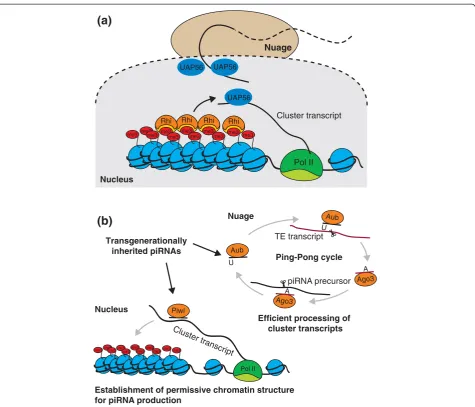
Increasing evidence indicates that piRNA clusters in Drosophila do have a unique chromatin environment. Most piRNA clusters are found at the boundary of eu-chromatic and heteroeu-chromatic regions in the pericen-tromeric and subtelomeric regions of the genome [3]. piRNA clusters show characteristics of heterochromatin, such as an enrichment of the repressive H3K9me3 mark and HP1 [27,28]. More importantly, this heterochro-matic environment seems to be required for proper ex-pression of clusters and their processing into piRNAs. H3K9me3 is deposited on clusters by the histone meth-yltransferase SetDB1 [28]. Mutation or knockdown of SetDB1 leads to loss of piRNAs and concomitant upreg-ulation of TEs and sterility. Despite the necessity of a heterochromatic environment for piRNA production, deposition of H3K9me3 and HP1 cannot be sufficient for identification of clusters, as these features are present on many genomic regions that do not yield piRNAs. Interestingly, a germline-specific homolog of HP1, Rhino, also associates with double-stranded piRNA-producing loci and seems to be absent from other gen-omic loci [29]. Rhino deficiency leads to loss of germline-specific piRNAs and derepression of transpo-sons. In the nucleus, Rhino colocalizes in distinct areas with the nuclear DEAD-box RNA helicase protein UAP56 that binds to piRNA precursors [30]. Nuclear re-gions enriched in Rhino and UAP56 localize close to perinuclear nuage granules, the centers for piRNA pro-cessing. Based on this observation, it was proposed [30] that Rhino specifies precursor transcripts by promoting
their association with UAP56, which then shuttles piRNA precursors to nuage granules (Figure 2a).
Although it seems clear that chromatin has an important role in regulating the expression of piRNA clusters, cur-rently it is not clear whether the chromatin state simply provides a permissive environment for piRNA cluster activ-ity, or whether, at least in some cases, it is by itself sufficient to specify such regions.
The role oftrans-generationally inherited piRNAs in defining piRNA-producing loci
Instead of intrinsic features such as specific sequence sig-nals or a unique chromatin signature, the loci that gener-ate germline piRNAs inDrosophilamight be defined by a molecular memory provided by the pool of piRNAs inher-ited from the previous generation. Piwi proteins and the associated piRNAs expressed in the maternal germline during oogenesis are deposited into the developing egg and are present in the early embryo before the start of zygotic transcription [31]. InDrosophila, such maternally inherited piRNAs are essential for effective piRNA-mediated silencing and fertility of the progeny. Indeed, re-cent studies of a long-known phenomenon called hybrid dysgenesis showed that the absence of piRNAs inherited from the previous generation causes a failure to produce cognate piRNAs in the progeny [32].
genomic regions for piRNA generation. Furthermore, this mechanism guarantees that the pool of piRNAs pro-duced in each generation is adequate to repress transpo-sons (at least the maternally inherited ones), as only flies that are successful at TE repression are fertile and able to transmit their piRNAs to the progeny.
Two possible mechanisms can be envisioned for how piRNAs inherited from the mother might act to start gen-eration of new piRNAs in the progeny (Figure 2b). They might initiate the Ping-Pong amplification loop and thereby lead to processing of cluster transcripts expressed in the embryo that otherwise would be left unprocessed.
Alternatively, inherited piRNAs might induce the
establishment of the distinct chromatin state required for transcription and processing of piRNA precursors on tar-get genomic loci. Indeed, recent studies demonstrated that the nuclear Piwi protein induces deposition of the H3K9me3 mark on target loci, probably through recogni-tion of nascent transcripts by Piwi-bound piRNAs followed by recruitment of the chromatin-modifying ma-chinery [4,5,34]. The two mechanisms are not mutually exclusive, and trans-generationally inherited piRNAs can activate piRNA generation both by inducing chromatin changes and by initiating precursor processing through
(b)
(a)
Efficient processing of cluster transcripts
Establishment of permissive chromatin structure for piRNA production
Piwi
Cluster transcript
me3 me3 me3
me3 me3 me3 me3
me3 me3me3
Pol II me3
Nucleus
U Aub
Ago3 A
Ago3 A
U Aub
piRNA precursor
Ping-Pong cycle Nuage
Transgenerationally inherited piRNAs
Rhi Rhi
me3 me3 me3
me3
me3 me3 me3 me3me3 me3 me3
Rhi Rhi
Pol II
Nucleus
Nuage
Cluster transcript
TE transcript UAP56
[image:5.595.62.538.86.493.2]UAP56 UAP56
the Ping-Pong cycle. It should be noted that these mecha-nisms can only regulate piRNA production in germ cells but not in follicular cells of theDrosophilaovary: piRNAs specific to follicular cells are not deposited into the em-bryo and thus cannot serve as a template for either mech-anism. In addition, follicular cells also lack components necessary for the Ping-Pong amplification loop.
Taken together, recent studies implicate chromatin state and trans-generationally inherited piRNAs as two components that are required for activity of regions that generate piRNAs. Chromatin and inherited piRNAs can act in concert to identify genomic loci for piRNA gener-ation, with chromatin state licensing certain genomic re-gions and inherited piRNAs providing further direction using both the Ping-Pong cycle to initiate processing and a feedback loop to ensure that the compatible chro-matin state is preserved.
Acknowledgements
We thank Evelyn Stuwe for help with figure preparation and members of the Aravin laboratory for discussion. This work was supported by grants from the National Institutes of Health (R00 HD057233, R01 GM097363 and DP2 OD007371A), the Searle Scholar, the Packard Fellowship Awards and the Ellison Medical Foundation New Scholar Aging Award.
Author details
1California Institute of Technology, Division of Biology, 147-75, 1200E California Blvd, Pasadena, CA 91125, USA.2Université Pierre et Marie Curie, Ecole Doctorale Complexité du Vivant, 75005, Paris, France.
Published: 27 January 2014
References
1. Ghildiyal M, Zamore P:Small silencing RNAs: an expanding universe.Nat Rev Genet2009,10:94–108.
2. Malone CD, Hannon GJ:Small RNAs as guardians of the genome.Cell 2009,136:656–668.
3. Brennecke J, Aravin A, Stark A, Dus M, Kellis M, Sachidanandam R, Hannon G:Discrete small RNA-generating loci as master regulators of transposon activity inDrosophila.Cell2007,128:1089–1103.
4. Le Thomas A, Rogers AK, Webster A, Marinov GK, Liao SE, Perkins EM, Hur JK, Aravin AA, Toth KF:Piwi induces piRNA-guided transcriptional silen-cing and establishment of a repressive chromatin state.Genes Dev2013, 27:390–399.
5. Sienski G, Dönertas D, Brennecke J:Transcriptional silencing of transposons by piwi and maelstrom and its impact on chromatin state and gene expression.Cell2012,151:964–980.
6. Robine N, Lau N, Balla S, Jin Z, Okamura K, Kuramochi-Miyagawa S, Blower M, Lai E:A broadly conserved pathway generates 3′UTR-directed primary piRNAs.Curr Biol2009,19:2066–2076.
7. Saito K, Inagaki S, Mituyama T, Kawamura Y, Ono Y, Sakota E, Kotani H, Asai K, Siomi H, Siomi M:A regulatory circuit for piwi by the large Maf gene traffic jam inDrosophila.Nature2009,461:1296–1299.
8. Muerdter F, Olovnikov I, Molaro A, Rozhkov N, Czech B, Gordon A, Hannon G, Aravin A:Production of artificial piRNAs in flies and mice.RNA2012, 18:42–52.
9. Aravin A, Sachidanandam R, Girard A, Fejes-Toth K, Hannon G: Develop-mentally regulated piRNA clusters implicate MILI in transposon control. Science2007,316:744–747.
10. Li X, Roy C, Dong X, Bolcun-Filas E, Wang J, Han B, Xu J, Moore M, Schimenti J, Weng Z, Zamore P:An ancient transcription factor initiates the burst of piRNA production during early meiosis in mouse testes.Mol Cell2013, 50:67–81.
11. Kim V, Han J, Siomi M:Biogenesis of small RNAs in animals.Nat Rev Mol Cell Biol2009,10:126–139.
pathway silences selfish genetic elements in the germline.Science2006, 313:320–324.
13. Haase A, Fenoglio S, Muerdter F, Guzzardo P, Czech B, Pappin D, Chen C, Gordon A, Hannon G:Probing the initiation and effector phases of the somatic piRNA pathway inDrosophila.Genes Dev2010,24:2499–2504. 14. Ipsaro J, Haase A, Knott S, Joshua-Tor L, Hannon G:The structural
biochem-istry of Zucchini implicates it as a nuclease in piRNA biogenesis.Nature 2012,491:279–283.
15. Nishimasu H, Ishizu H, Saito K, Fukuhara S, Kamatani M, Bonnefond L, Matsumoto N, Nishizawa T, Nakanaga K, Aoki J, Ishitani R, Siomi H, Siomi MC, Nureki O:Structure and function of Zucchini endoribonuclease in piRNA biogenesis.Nature2012,491:284–287.
16. Kawaoka S, Izumi N, Katsuma S, Tomari Y:3′end formation of PIWI-interacting RNAs in vitro.Mol Cell2011,43:1015–1022.
17. Aravin A, Sachidanandam R, Bourc’his D, Schaefer C, Pezic D, Toth K, Bestor T, Hannon G:A piRNA pathway primed by individual transposons is linked to de novo DNA methylation in mice.Mol Cell2008,31:785–799. 18. Saito K, Sakaguchi Y, Suzuki T, Suzuki T, Siomi H, Siomi M:Pimet, the
Drosophilahomolog of HEN1, mediates 2′–O-methylation of Piwi- inter-acting RNAs at their 3′ends.Genes Dev2007,21:1603–1608.
19. Frank F, Hauver J, Sonenberg N, Nagar B:Arabidopsis Argonaute MID domains use their nucleotide specificity loop to sort small RNAs.EMBO J 2012,31:3588–3595.
20. Frank F, Sonenberg N, Nagar B:Structural basis for 5′-nucleotide base-specific recognition of guide RNA by human AGO2.Nature2010, 465:818–822.
21. Olivieri D, Sykora M, Sachidanandam R, Mechtler K, Brennecke J:An in vivo RNAi assay identifies major genetic and cellular requirements for primary piRNA biogenesis inDrosophila.EMBO J2010,29:3301–3317. 22. Aravin A, Hannon G, Brennecke J:The Piwi-piRNA pathway provides an
adaptive defense in the transposon arms race.Science2007,318:761–764. 23. Ruby J, Jan C, Player C, Axtell M, Lee W, Nusbaum C, Ge H, Bartel D:
Large-scale sequencing reveals 21U-RNAs and additional microRNAs and en-dogenous siRNAs in C. elegans.Cell2006,127:1193–1207.
24. Cecere G, Zheng G, Mansisidor A, Klymko K, Grishok A:Promoters recognized by forkhead proteins exist for individual 21U-RNAs.Mol Cell 2012,47:734–745.
25. Spies N, Nielsen C, Padgett R, Burge C:Biased chromatin signatures around polyadenylation sites and exons.Mol Cell2009,36:245–254. 26. Keller C, Adaixo R, Stunnenberg R, Woolcock K, Hiller S, Bühler M:HP1(Swi6)
mediates the recognition and destruction of heterochromatic RNA transcripts.Mol Cell2012,47:215–227.
27. Moshkovich N, Lei E:HP1 recruitment in the absence of argonaute proteins inDrosophila.PLoS Genet2010,6:e1000880.
28. Rangan P, Malone C, Navarro C, Newbold S, Hayes P, Sachidanandam R, Hannon G, Lehmann R:piRNA production requires heterochromatin formation inDrosophila.Curr Biol2011,21:1373–1379.
29. Klattenhoff C, Xi H, Li C, Lee S, Xu J, Khurana J, Zhang F, Schultz N, Koppetsch B, Nowosielska A, Seitz H, Zamore PD, Weng Z, Theurkauf WE: TheDrosophilaHP1 homolog Rhino is required for transposon silencing and piRNA production by dual-strand clusters.Cell2009,138:1137–1149. 30. Zhang F, Wang J, Xu J, Zhang Z, Koppetsch B, Schultz N, Vreven T, Meignin
C, Davis I, Zamore P, Weng Z, Theurkauf WE:UAP56 couples piRNA clusters to the perinuclear transposon silencing machinery.Cell2012, 151:871–884.
31. Megosh H, Cox D, Campbell C, Lin H:The role of PIWI and the miRNA machinery inDrosophilagermline determination.Curr Biol2006,16:1884– 1894.
32. Brennecke J, Malone C, Aravin A, Sachidanandam R, Stark A, Hannon G:An epigenetic role for maternally inherited piRNAs in transposon silencing. Science2008,322:1387–1392.
33. de Vanssay A, Bougé A-L, Boivin A, Hermant C, Teysset L, Delmarre V, Anto-niewski C, Ronsseray S:Paramutation inDrosophilalinked to emergence of a piRNA-producing locus.Nature2012,490:112–115.
34. Rozhkov N, Hammell M, Hannon G:Multiple roles for Piwi in silencing
Drosophilatransposons.Genes Dev2013,27:400–412.
doi:10.1186/gb4154