A Cognitive Tool to Support Mathematical Communication in Fraction
Word Problem Solving
AZLINA AHMAD
Faculty of Information Science and Technology
Universiti Kebangsaan Malaysia
MALAYSIA
[email protected]
SITI SALWAH SALIM, ROZIATI ZAINUDDIN
Faculty of Computer Science and Information Technology
Universiti of Malaya
MALAYSIA
Abstract: Word problem solving is one of the most challenging tasks in mathematics for most students. It requires the solver to translate the problem into the language of mathematics, where we use symbols for mathematical operations and for numbers whether known or unknown. From a study conducted on Malaysian school students, it was found that majority of them did not write their solution to the word problem using correct mathematical language. Intrapersonal and interpersonal communications are important in mathematics learning especially in word problem solving. It is therefore the main aim of this paper is to present a model that promotes the use of mathematical language. The model is used as a basis in designing a computer-based learning environment for word problem solving. The cognitive tool named MINDA which incorporates several important necessary steps and activities was developed to facilitate learning. From the experimental analysis conducted on using MINDA, it was found that the mathematical communication and their word problem solving achievement of students have improved.
Key-words: word problem solving, cognitive tool, mathematical communication, intrapersonal communication, interpersonal communication.
1 Introduction
Various studies have indicated that many students worldwide faced difficulties in solving word problem [1], [2], [3]. They have signified that poor performance of students in word problem has been attributed to difficulties in reading comprehension, abstract reasoning and strategy use. Generally, students’ major difficulty in solving mathematics word problems lies in the understanding of the problem and translating the problem into equations. Some factors contributing to students’ difficulty in solving word problems are lack of knowledge of problem type, limited strategies in solving word problems and lack of skills in computational algorithms. There is still the need to find new
approaches to improve students’ achievement in solving word problems.
2 Research Problem
Although a lot of research has been carried out relating to students performance in solving word problems, but there is very little work that has been done which dealt with mathematics as a language [5], [6]. Students’ lack of exposure in learning the language of mathematics creates countless difficulties in learning the subject regardless of the level of education they are in. It is the root of the problem in learning mathematics especially in the area of word problem solving.
3 Communication in Word Problem
Solving
Solving word problems involves the communication of the solution steps effectively within oneself and to others. This part is the most challenging to most students. Students need to learn a written language in order to convey their solutions or ideas. They have to use correct and accurate syntax and grammar of the mathematical language.
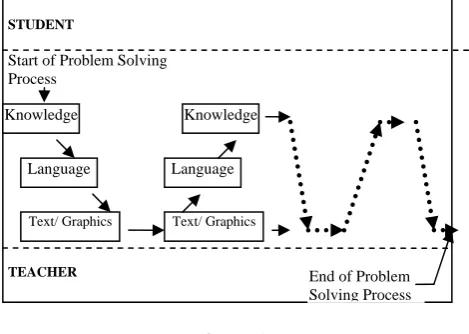
[image:2.595.316.551.259.562.2]Intrapersonal and interpersonal communications are very important in word problem solving. They affect the cognitive process of the problem solvers and help them reflect on their task of finding the solution to the given word problem. The importance of intrapersonal and interpersonal communication in word problem solving was not being given the proper attention before. Communication can be described as a hierarchy of processes. For the purpose of the study, the integration of the hierarchical model of human communications by Losee [7] and the “sawtooth” communication model by Watzlawick [8] has been adopted. Figure 1 depicts this communication model developed. It shows the dynamic nature of communication process in word problem solving.
Figure 1
Communication Model of Word Problem Solving Process
The effective way in improving communication is through writing because formality in using a language can easily be implemented in writing. Therefore, it is important for students to be given training in proper solution writing of word problem so as to ensure successful intrapersonal and interpersonal communication. They need to represent the problem with correct mathematical equation using clearly written and well-defined known and unknown variables. Figure 2 describes a convention used in defining variables and constructing the related equation. The convention promotes effective communication of solution between the problem solver and the teacher.
Defining variables
Inserting known values
Constructing equation
Solving equation
Writing final answer
Problem:
Normah has 7
5
3metres of ribbons. She wants to cut it into equal lengths of
5
2metres. How many
5
2-metre lengths of ribbons will she get?
R= length of ribbon C= length of cut ribbon N= total number of cut ribbons
R= 7
5 3 m
C = 5 2 m
N = R ÷ C
N= 7
5
3÷
5 2
= 5 38 x
2 5
= 19
[image:2.595.50.285.563.730.2]Normah gets 19 cut ribbons altogether
Figure 2
Solution Writing Convention
STUDENT
TEACHER
Start of Problem Solving Process
End of Problem Solving Process
Text/ Graphics
Language Knowledge
Text/ Graphics
Language Knowledge
Word problem solving involves various steps and identification of these steps is needed to formulate the proposed model. Various models formulated for problem solving however, did not take into consideration the frequent changes of strategies used by students when solving word problems. Students must be allowed to apply different strategies that they are comfortable with because a problem can be solved in many ways. An individual masters learning through preferential mode and through discovery and experience. These are the basic principles of experiential learning with different learning styles. According to Kolb’s Experiential Learning Theory [9], there are four stages of learning; the concrete experience; the
WSEAS TRANSACTIONS on COMPUTERS Azlina Ahmad, Siti Salwah Salim, Roziati Zainuddin
ISSN: 1109-2750
reflective observation; the abstract conceptualization; and the active experimentation. Through own experiences over time, individuals tend to develop preferences in specific learning styles. As a consequence, students with different learning styles have preferred ways of processing and organizing information [10]. On the other hand, they must not be deprived of learning the problem solving strategies that they do not know or are less preferred. Taking all these points into consideration to formulate the cognitive-communicative (C-C) based word problem solving process model in this research, the necessary steps involved are identified as displayed in Figure 3.
Figure 3
Steps in Word lving Process
The basis of the model is adopted from Mayer [11] Problem So
which described problem solving process in generalized form as consisting of two major parts, namely 1) Problem Representation, and 2) Search for Solutions. For our study, each major part is broken down further into a number of key steps with various vital activities incorporated in each step to promote learning. The Problem Representation phase consists of three steps which are Comprehension, Extraction and Construction of Equations. Students need to represent a word problem in a way that is meaningful to them so that the problem becomes more accessible. Any form of representations (diagrams or equations) can help students organize their thinking and they can try various approaches that may lead to a clearer understanding in achieving a solution [12].
The Problem Representation phase demands the problem solver to be good in linguistic, semantic, and schema knowledge. The Comprehension step is related to the process of understanding the given problem. Apart from reading the word problem several times to comprehend the semantics of the problem, students need to apply the rewording strategy. They can choose to apply the different ways of rewording the problem such as self-referencing and translating the problem into their first language. Students also have to identify the situational type of the word problem. For the purpose of this study, the four situational types of the word problems emphasized are Quantity of Objects, Money, Weight and Height/Length/Distance. Identification of the situational type of the problem will prompt the students’ mind for the knowledge, schematic structure and experience related to that topic.
The Extraction step is related to the process of identifying the important facts embedded in the problem and to represent them in a diagram which can help the problem solver to clearly visualize the change process of the problem. Each word problem involves some kind of change process as a result of applying mathematical operations on a number in obtaining the solution. For example, in addition operation, the change process is illustrated by the increment to the initial number in generating final answer. The presence of keywords is also noted at the Extraction Step.
The last step for the Problem Representation phase is the Construction of Equation step. Once the student understands the given word problem and knows what need to be solved, he needs to construct the related equation for the word problem. It is at this point that the intrapersonal and the interpersonal communication play important roles in the problem solving process. To ensure effective communication of both types, the student needs to represent the problem with correct mathematical equations using clearly written and well-defined known and unknown variables, relations between variables, mathematical operations and correct sequencing. From many studies and also from the observations made at the preliminary investigation stage of this research, the Problem Representation phase is the most difficult for students and it demands good higher-order thinking skills.
The second part of the word problem solving process is the Search for Solution phase. This phase involves a procedure in solving the equation to get the answer. Good procedural and strategic knowledge are required to perform well at this part
Comprehen- sion
Problem representation
Construc- tion of Equation
Extraction Solving
Equation/s
Answer
Search for solutions
Rephrasing problem for better understanding
of problem Identifying situational characteris-
tics of problem
Using diagrams to visualize the change process in the problem
Selecting and applying appropriate
algorithm
CHECKING CALCU- LATIONS Identifying
what need to be solved
Forming the required equation/
s Reading
and understandi
ng given word problem
Listing down given information-
variables and/ or keywords Major
Parts
Key Steps
V I T A L
of problem solving process. In addition, to maintain good intrapersonal and interpersonal communication, the solution must be written in a systematic manner which obeys the grammar and syntax of the mathematical language. Once the answer is obtained, the student needs to check his calculations. Checking for any errors in solving a word problem requires the student to read through his solution from the initial step of the process. During this error detection step, good intrapersonal and interpersonal communications are accomplished if the written solution is correct in terms of grammar and syntax. Therefore, the student can easily reaffirm the solution obtained to detect any errors through better understanding of the solution.
4 The
Cognitive-Communicative
(C-C) Model
The Cognitive-Communicative (C-C) model is formulated in this work for the purpose of enhancing mathematical communication among learners. The implication of both the theories of learning and theories of communication is obvious in this model. The strategies chosen are rewording, schema and keyword strategy. From the findings of the preliminary investigation conducted on the 57 students, it was observed that most students made mistakes at the problem representation step of the word problem solving. This indicates that most students need assistance in understanding the semantics of the given word problem. Rewording the given problem by restating, personalizing or translating using the first language of the students was found to be helpful for below average students. As for the C-C model, schema of the word problem refers to its situational type which describes the scenario of the problem such as calculations involving distance, money and weight. The use of keyword strategy is also beneficial towards understanding the semantics of the word problem. Certain words in mathematics which appear in the question may indicate the types of operations required in solving the word problem. For example ‘total’ can indicate the required operation for the word problem is addition. However, careful application of this strategy is required to avoid the different interpretation of the keyword based on the context of the word problem.
The instructional approaches selected are graphics/diagrams, worked examples and scaffolding. The graphic representation of the word problem is useful to identify the type of changes that occur in the word problem. From the
graphic representation, the students can get useful information regarding the mathematical operation involved and the required equations to represent the word problem. However, the type of diagram or graphical representation introduced to the students must not be limited to a certain type only. The teacher can introduce to the students one particular type of graphical representation to give them a general idea how to use diagram and graphical representation in solving word problems. With enough understanding, students can represent different types of word problems using different types of diagrams and graphics. Another instructional approach which is popular in learning mathematics is using worked examples. Worked examples in C-C model are different types of mathematical word problems with the complete solutions. Worked examples can reduce cognitive load of students besides giving them various examples of word problems. Through this approach, students can construct and reconstruct the schematic structure related to the various types of word problems. The C-C model also recognizes the importance of scaffolding in learning mathematics especially in solving word problems. Scaffolding strategy prevents students from getting frustrated because of too little or too much help from the teachers. The teacher or the students themselves can determine the amount of support they need during word problem solving process. The students will become matured learners when they can successfully identify the type and amount of assistance they need from the teacher. They can control the learning path they choose to follow in order to solve the word problems. For students to achieve the required level of maturity, students must be taught the various strategies using the various approaches in word problem solving. Figure 4 shows the relationship of each component of the C-C model.
The cognitive and the communicative aspects of the model have significant influence on the steps, strategies and approach of the word problem solving. In other words, the strategies chosen (rewording, schema and keyword strategy) and the instructional approach selected (graphics/diagrams, worked examples and scaffolding) take into account the principles of Cognitive Learning Theory and Communication Theory. Figure 5 shows the components of the C-C model for a computer-based learning environment.
WSEAS TRANSACTIONS on COMPUTERS Azlina Ahmad, Siti Salwah Salim, Roziati Zainuddin
ISSN: 1109-2750
[image:5.595.51.288.82.760.2]
Figure 4 The C-C Model
Figure 5
Components of the C-C Model
5 MINDA: A Learning Environment
for Fraction Word Problems
THEORIES OF LEARNING
Cognitive
Constructivism
Behaviourism
THEORIES OF COMMUNICATION Intrapersonal Interpersonal
LEARNING APPROACH
MULTIMEDIA Text
Audio Animation
Graphics Scaffold Schematic
Process Visualisation
Math as Language PROBLEM
COMPREHENSION
CONSTRUCTION
OFEQUATION
PROBLEM EXTRACTION
SOLVING EQUATION
ANSWER
- - Understanding
- Situational characteristics
- facts given - diagrams
- Question asked - Forming equation/s
- Selecting algorithm
The communication aspect which is being highlighted in this research is the written communication between a learner and himself and communication between the learner and his teacher. Since computer is a good medium for communication, it is thus a good platform to implement the proposed approach in a system that can help students improve their word problem solving skills with advantages of computer technology
A learning environment called MINDA which applies the requirements set by the C-C model is developed for fraction word problems. Basically the environment is a representation of the problem-solver’s mind during word problem solving, thus this justifies the code given name ‘MINDA” since
‘minda’ is the Malay word for ‘mind’. MINDA
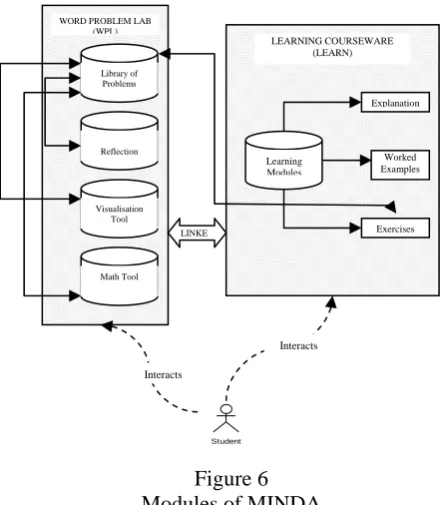
comprises of two main systems namely Word Problem Lab (WPL) and the Learning Courseware (LEARN). Figure 6 displays the modules of MINDA which incorporates several word problem-solving resources and learning tools such as reflection tool, fraction calculator/ converter, mathematics glossary and visualization tool.
Computer-as-tutor
LEARNING ENVIRONMENT
[image:5.595.312.533.417.670.2]Computer-as-tool
Figure 6 Modules of MINDA
WPL is a cognitive tool that focuses on visualisation of the problem solving process. It includes the main five steps in problem solving which are Comprehension, Extraction, Construction of Equation, Solving of Equation and Writing of Answer. Figure 7 depicts the interface of WPL. COMMUNICATION
THEORY
STRATEGIES MULTIMEDIA-BASED
Intrapersonal
Interpersonal
Graphics/Diagrams
Scaffolding
Worked Example Graphics
Text
Animation
LEARNING THEORY
Cognitive Load Theory
Schema Theory
Constructivism
Information Processing Theory
Cognitivism
Behaviourism
Audio Reflection
Courseware
SUPPORT TOOLS
Guidance
Library of Problems
Reflection
Visualisation Tool
Math Tool
Explanation
Worked Examples
Exercises Learning
Modules
Student
Interacts
Interacts
LEARNING COURSEWARE (LEARN) WORD PROBLEM LAB
(WPL)
LINKE
INSTRUCTIONAL APPROACH
Rewording
Schema
Since WPL adopts the client/server architecture, learner and teacher can stay connected during the learning process. Thus, for each step of the word problem solving process, the learner can submit his answer which allows the teacher to view the learner’s written solution on the teacher’s computer. The teacher can give comments on the learner’s answer before he proceeds to the next level of problem solving process. It is through the submission of the problem solution that the learner needs to apply correct mathematical language for successful communication with himself and the teacher. The proposed solution writing convention is used to ensure effective communication.
Figure 7
Print Screen of WPL Interface
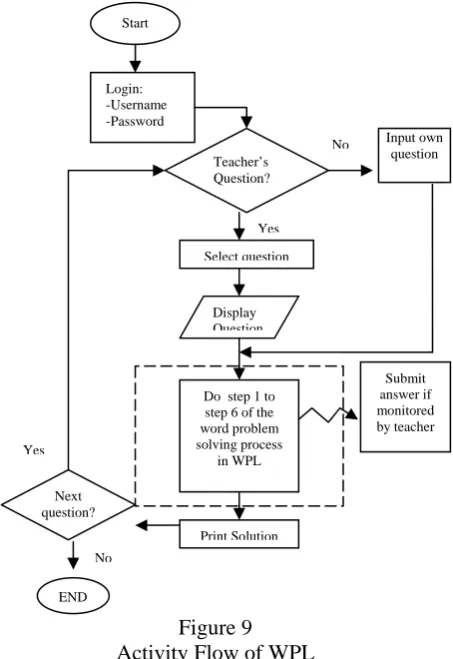
On the other hand, the learning courseware, LEARN is in the form of a tutorial in solving word problems involving fractions. The problems are divided according to their situational types. The four types of word problems included in this study are Quantity of Objects, Height/Length, Money and Weight. Figure 8 displays the main menu of LEARN and Figure 9 presents the flow of activities in WPL.
Figure 8
[image:6.595.320.547.70.400.2]Print Screen of Main Menu of LEARN
Figure 9
Input own question
Submit answer if monitored by teacher Start
Login: -Username -Password
Yes Teacher’s Question?
No
Select question
Display Question
Do step 1 to step 6 of the word problem solving process
in WPL
Print Solution Next
question?
No
END Yes
Activity Flow of WPL
6 Experimental Study and Evaluation
of MINDA
[image:6.595.54.282.257.447.2]Sixty-five students from a local secondary school were involved in experimental study of using MINDA. Potential students to participate in the study were selected through voluntary basis. Initially, there were 65 students who volunteered to participate in the study. However, throughout the experimental study, only 58 students completed all the tests. The students were divided into two groups: the experimental group and the control group. The two groups experienced two different conditions as described in Table 1.
Table 1: Experimental Conditions for the Groups of Students
Description Group
Condition 1 The students are
allowed to interact with MINDA to solve practice problems.
Experimental.
Condition 2 The students applied
their knowledge in fraction word problems without using MINDA to solve practice problems.
Control
WSEAS TRANSACTIONS on COMPUTERS Azlina Ahmad, Siti Salwah Salim, Roziati Zainuddin
ISSN: 1109-2750
[image:6.595.49.280.593.733.2]The experiment consists of a pretest and a posttest. The pretest and posttest booklet consists of twelve single- operation and combined-operation fraction word problems. The word problems in both the pretest and the posttest are very similar in terms of the type of problems (Money, Weight, Height/Length and Quantity), the number of solution steps (single- and combined-operation) and operations involved (addition, subtraction, multiplication and division). The problems followed the format found in standard Malaysian Form One Mathematics Text Book. The students were also required to fill in their background information at the beginning of the pretest such as their experience in using other learning environments.
The experiment is intended to investigate the following hypotheses:
H1: Students in the experimental group performed better in fraction word problem solving than the control group for both the below-average and the above-average groups of students.
H2: The learning gain of the experimental group is higher that the control group for both the below-average and the above-below-average groups.
Initially, all the participants sat for the pretest at the beginning of the session. Before the pretest began, the researcher gave a brief introduction on the purpose of the study. However, the students were not informed of the existence of the experimental and the control groups. The students were asked to write down in detail all the solution steps for each word problem. By the end of the two-hour session, all the students had to submit their answer scripts. For the experimental group, the students attended two types of session as shown in Table 2. For the control group, a revision exercise using the traditional approach was given. The last session involved all the students answering the posttest questions. The session was similar to the pretest conducted earlier.
The scoring system is based on a rubric which is intended to measure students’ achievement in five important attributes in word problem solving process:
• Problem comprehension – measures how well students understand a problem.
• Identification of given facts – measures how well students use given facts
• Problem representation – measures how well students write their equations
• Problem interpretation – measures how well students write their solution
[image:7.595.311.548.567.690.2]• Computation – measures how well students apply procedures to get the answer
Table 2: Sessions for the Experimental Group
Session Purpose Activities Duration
Introduction To familiarize the students with the word problem solving steps used in MINDA.
1) Lecture 2) Question and Answer 3) Exercises
45 min 30 min 45 min
Hands-on Training
To familiarize students with MINDA, to allow students to practice word problem solving using MINDA and to evaluate MINDA
1) Demonstration of MINDA 2) Hands on session/ observation 3) Filling in evaluation form of MINDA
30 min 90 min
30 min
The marking scheme consists of four scales: 3 points, 2 points, 1 point and 0 point. The maximum score for each attribute is 3 points for a very good and accurate response and the minimum score is 0 for no attempt or response by the students. Thus, for each word problem, the students can get a maximum of 15 points.
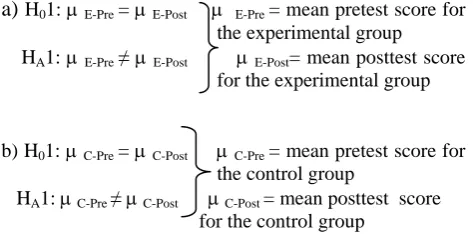
The main analysis is to test whether students in the experimental group perform better in fraction word problem solving than the control group for both the above-average and the below-average students. The test data used for this part of the analysis are the pretest and posttest scores, absolute difference and normalized learning gain. In this analysis, the pretest scores of both the experimental group and the control are compared with the posttest scores. The main aim is to determine whether the differences between means for the two sets of scores (pretest and posttest) are the same or different. Thus, the test is to reject or accept the null or alternative hypothesis below:
a) H01: μ E-Pre = μ E-Post μ E-Pre = mean pretest score for
the experimental group HA1: μ E-Pre ≠ μ E-Post μ E-Post= mean posttest score
for the experimental group
b) H01: μ C-Pre = μ C-Post μ C-Pre = mean pretest score for
the control group
HA1: μ C-Pre ≠ μ C-Post μ C-Post = mean posttest score
for the control group
[image:8.595.53.282.144.210.2]
pretest scores and the mean of the posttest scores for the experimental group.
Table 3: Results of Wilcoxon Signed-rank Test for H1(a)
Group: Experimental
Test Data Mean Statistical
Method
Statistics Sig.
(2-tailed)
Pretest Scores
76.63
Posttest 120.70 Wilcoxon Signed-rank test
Z=-4.721 .000
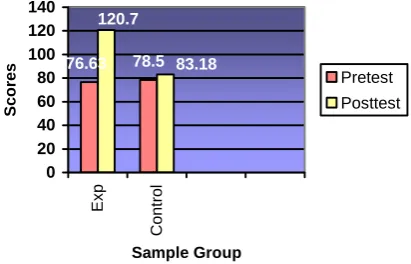
However, for the control group, results shows that at 5% level of significance, t(27)= - 1.035, p> 0.05 (Table 4). The null hypothesis cannot be rejected and there is no significant difference between the mean of the pretest scores and the mean of the posttest scores for the control group.
Table 4: Results of Paired T-test for H1(b)
Group: Control
Test Data Mean Statistical
Method
Statistics Sig.
(2-tailed)
Pretest Scores
78.50
Posttest 83.18
[image:8.595.310.546.459.534.2]Paired t-test t=-1.035 .310
Figure 9 displays the graph comparing the mean scores of the pretest and the posttest for both the experimental group and the control group. The experimental group improved greatly in the posttest scores compared with the control group.
78.5 76.63 83.18
120.7
0 20 40 60 80 100 120 140
Exp
Cont
rol
Sample Group
Sc
or
e
s
Pretest Posttest
Figure 9: Comparison of Mean Scores of Group
The absolute difference in the context of this research is defined as follows:
Absolute Difference = Posttest Scores – PretestScores
Thus,
a) H02: μ E = μ C μ E = mean absolute difference for
experimental group
HA2: μ E ≠ μ C μ C = mean absolute difference for
control group
Another set of data which was analysed to compare students’ performance in the experimental group and the control group is the normalized learning gain. Hake, R. [13 ] defined learning gain as below:
Learning gain(g) = % Gain/ % Gainmax
Learning gain(g) = (% Posttest - % Pretest)
(100% - % Pretest)
The test is to reject or accept H2 below:
(b)H02: μ E = μ C μ EB = mean score for experimental
group
HA2: μ E ≠ μ C μ CB = mean score for control group
Results show that at 5% level of significance, Z= -5.098, p< 0.05 (Table 5). The null hypothesis can be rejected. Thus, Mann-Whitney test revealed that there is a significant difference in the mean of the experimental group in comparison with the control group. Looking at the mean, it can be concluded that experimental group’s achievement in fraction word problem solving is better than the control group
Table 5: Results for Mann-Whitney U Test for H2(a)
Results show that at 5% level of significance, Z= -5.197, p< 0.05 (Table 6). The null hypothesis can be rejected. Thus, Mann-Whitney test revealed that there is a significant difference in the learning gain of the experimental group in comparison with the control group. Looking at the mean of the learning gain of both groups, it can be concluded that experimental group’s achievement in fraction word problem solving is better than the control group. The comparison of the mean in terms of the learning gain between the above-average and the below-average students for both the experimental and control group can be observed in Figure 10.
Test Data: Absolute Difference
Group Mean Statistical
Method
Statistics Sig.
(2-tailed)
Experimental 40.42 Control 17.8
Mann-Whitney U test
Z= -5.098 .000
WSEAS TRANSACTIONS on COMPUTERS Azlina Ahmad, Siti Salwah Salim, Roziati Zainuddin
ISSN: 1109-2750
[image:8.595.68.274.496.628.2]Table 6: Results for Mann-Whitney U Test for H2(b)
Test Data: Normalized Learning Gain
Group Mean Statistical
Method
Statistics Sig.
(2-tailed)
Experimental 0.346 Control 0.110
Mann Whitney U test
Z= -5.197 .000
0.517
0.346
0.034
0.109
0 0.1 0.2 0.3 0.4 0.5 0.6
A
bov
e
-av
e
Be
lo
w
-av
e
V
al
ues Experimental
Control
Figure 10: Comparison of Mean Learning Gain between Groups
From the results of the experiment, we observed that MINDA has a positive effect on the students’ achievement in fraction word problem solving. The achievement made by the experimental group in the posttest is very encouraging. Comparing the learning gain which is measured by the absolute difference and the normalized learning gain, it is observed that the performance of the experimental group has improved greatly.
7 Conclusion
The study on students’ word problem solving performance still creates a huge interest among researchers in mathematics today. The search for new approaches and solutions in various aspects to help students improve their word problem skills will continue. However, we believe that researchers need to include the importance of mathematics as a language in their research design to ensure the effectiveness of their approach. We have taken this move in designing our cognitive-communicative model which has brought about positive effect on students performance in fraction word problem solving.
References:
[1] Bassok, M. Two Types of Reliance on Correlations between Content and Structure in Reasoning about Word Problems. In English, L.
D. (Ed.), Mathematical Reasoning: Analogies,
Metaphors, and Images, Mahwah, New Jersey:
Lawrence Erlbaum Associates, 1997.
[2] Jitendra, A., et al.. An Exploratory Study of
Schema-Based Word-Problem-Solving Instruction for Middle School Students with
Learning Disabilities: An Emphasis on Conceptual and Procedural Understanding. Journal of Special Education. 36(1) (2002). [3] Bottge, B. A.. Effects of Contextualized Math
Instruction on Problem Solving of Average and Below-Average Achieving Students. Journal of Special Education, 33(2): (1999), 81+
[4] Azlina Ahmad, Siti Salwah Salim, Roziati Zainuddin, A Study On Students’ Performance In Solving Word Problems Involving Fractions: Towards The Development Of a Cognitive Tool, Proceedings of International Conference of Computers in Education (ICCE), Melbourne, Australia. 2004
[5] Kolstad, R., et. al. Incorporating Language Arts into the Mathematics Curriculum: A Literature Survey. Education. 116(3), (1996), 423+ [6] Caglar, M., Mathematics and Language. The
Turkish Online Journal of Educational Technology. 2(3). (2003).
[7] Losee, R. M., Communication Defined as Complementary Information Processes. Journal of Information, Communication and Library Science. 5(3): .(1999), 1-15
[8] Watzlawick et al., Pragmatics of Human
Communication. W.W. Norton, New York,
(1967)
[9] Kolb, D.A. (1984). Experiential Learning: Experience as the Source of Learning and Development, Englewoods Cliffs, N.J., Prentice-Hall
[10] Roark, M. B. (1998). Different Learning Styles: Visual vs Non-Visual Learners Mean Raw Scores in Vocabulary, Comprehension, Mathematical Computation and Mathematical Concepts. Research Report. Educational Resources Information Center.
[11] Mayer, Richard E. (1983). Thinking, Problem Solving, Cognition. New York. W.H. Freeman and Company.
[12]Fennell, F., & Rowan, T. (2001). Representation: An Important Process for Teaching and Learning Mathematics. Teaching Children Mathematics. 7: 288+