Beyond ecosystem services : valuing the
invaluable
Gunton, RM, van Asperen, E, Basden, A, Bookless, D, Araya, YH, Hanson, DR,
Goddard, MA, Otieno, G and Jones, GO
http://dx.doi.org/10.1016/j.tree.2017.01.002
Title Beyond ecosystem services : valuing the invaluable
Authors Gunton, RM, van Asperen, E, Basden, A, Bookless, D, Araya, YH, Hanson, DR, Goddard, MA, Otieno, G and Jones, GO
Type Article
URL This version is available at: http://usir.salford.ac.uk/41333/ Published Date 2017
USIR is a digital collection of the research output of the University of Salford. Where copyright permits, full text material held in the repository is made freely available online and can be read, downloaded and copied for noncommercial private study or research purposes. Please check the manuscript for any further copyright restrictions.
1 Opinion piece for Trends in Ecology & Evolution
Beyond ecosystem services: valuing the invaluable
Authors: Richard M. Gunton1,2, Eline van Asperen3, Andrew Basden4, David Bookless5,6, Yoseph Araya7, David R. Hanson2, Mark A. Goddard8, George Otieno9, Gareth O. Jones2
1 School of Biology, University of Leeds, LS2 9JT, UK
2 West Yorkshire School of Christian Studies, Outwood House, Leeds, LS18 4JN, UK 3 Department of Anthropology, Durham University, DH1 3LA, UK
4 Salford Business School, University of Salford, M5 4WT, UK 5 A Rocha International, 89 Worship Street, London, EC2A 2BF, UK 6 Faculty of Divinity, University of Cambridge, CB3 9BS, UK
7School of Environment Earth & Ecosystems, Open University, Milton Keynes, MK7 6AA, UK 8School of Civil Engineering & Geosciences, Newcastle University, NE1 7RU, UK
9School of Arts & Communication, Leeds Trinity University, Horsforth, LS18 5HD, UK
Corresponding author: Gunton, R. M. (rmg@cantab. net)
2
Highlights
• Ecosystem services help itemise how we value natural places, but the concept is not robust. • A more robust framework should focus on aspects of human appreciation of places.
• We propose an ecosystem valuing framework with 12 universal aspects of appreciation. • This can be unambiguously complemented by ecological analyses where necessary.
Abstract
The ecosystem services framework (ESF) is advantageous and widely used for itemising and quantifying ways in which humans benefit from natural places. However, it suffers from two important problems: (i) incoherence of definitions and (ii) a narrow approach to valuation,
inadequate to represent the full range of human motives for conservation and the diverse interests of different stakeholders. These shortcomings can lead to a range of problems including double-counting, blind spots and unintended consequencest. Here we propose an ecosystem valuing framework (EVF) as a broader and more rigorous way to deliver the benefits currently sought from the ESF, without the conceptual problems.
The flawed genius of ecosystem services
The ecosystem services framework (ESF) is a very popular approach to incentivising nature
3
and human wellbeing. As such it supports a consequentialist ethic that can be more successful than deontological approaches (see Glossary) in securing consensus and motivating action [1]. However, criticisms of the ESF as a tool for conservation raise doubts about its effectiveness and legitimacy [2, 3]. The most controversial issue is probably that of monetisation, as laid out recently by Silvertown [4]. One set of responses to such problems would continue using the ESF as a general tool for assessing habitats while recognising its multilayered structure [5], supervising it to avoid unintended consequences [6], perhaps discouraging monetisation [7], and even attempting to subjugate intrinsic value under the category of services [8]. Yet there are more profound problems with the ESF that call for a radical shift if we wish to contribute to conservation as part of a sustainable development agenda. Two outstanding issues are sufficient, in our opinion, to demand an overhaul of the ESF so radical as to require a new name. First, the definitions do not work. The fact that definitions of ‘ecosystem services’ (ES) and of specific categories are often vague, tautologous and/or at variance
with the concepts actually employed is symptomatic of deep-seated problems, as we shall explain. Second, collapsing multiple human value judgments into one or a few numerical values is a form of devaluation. We unpack this claim by exploring the inescapably cultural foundation of valuation processes.
4
What exactly is an ecosystem service?
Definitions of ES [11] range from “the conditions and processes through which natural
ecosystems…sustain and fulfil human life” [12] through “the outputs of ecosystems from which
people derive benefits” [13] to “the benefits people obtain from ecosystems” [14]; cf [15]. The variety of focal nouns in this sample of definitions (conditions, processes, outputs and benefits) reveals the difficulty of finding a logical category for things that motivate humans to protect natural habitats and places [16]. Fisher, Turner and Morling [17], affirming that ES must both be ecological and lead to human benefits, define ES as “the aspects of ecosystems utilized (actively or passively)
to produce human well-being”. We find ‘aspect’ a more useful term, though not for something ‘utilized’. In fact, a minimal set of commonly-studied ES cannot logically be covered by any of the
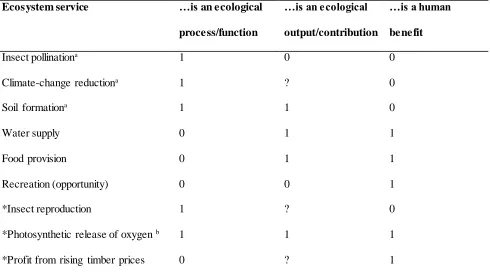
above definitions (Table 1) – and some studies [18] seem unconstrained by any of them. A
definition encompassing all of these definitions would have to be very broad – something like “those ecological processes and their effects that certain humans appreciate”. But thanks to the existence of
appreciative ecologists, such a definition would have unlimited scope.
Some other posited ES cannot be construed in a way that fulfils any of the above definitions. For example, animal welfare is considered in the UK National Ecosystem Assessment [13], yet its beneficiaries are not human unless we consider the satisfaction of concerned humans (in which case any ecological state of affairs that makes someone happier is an ES). Meanwhile, the biodiversity of an area [19] is sometimes considered an ES, and a subtle semantic shift from ‘biological diversity’ as an index (an intangible metric of diversity) [20] to ‘biodiversity’ being an actual aggregate (almost a synonym for ‘assemblage’) [21] allows biodiversity to be simultaneously presented as also
underpinning all other ES and having ‘existence value’ [5]. The value of such concepts of
5
Looking at the definitions of categories of ES, problems are multiplied. Take the four categories of the Millennium Ecosystem Assessment [22], three of which also form the basis of the Common International Classification of Ecosystem Services [23]. Perhaps ‘provisioning services’ is unproblematic – indeed a good model for ES, since beneficiaries in this case are consumers who consciously value the foodstuffs and raw materials that come under this category. ‘Regulating
services’ might raise the question as to where a target value or set point for regulation can come from
[24] – short of accepting something like the Gaia Hypothesis [25]. Presumably the term is simply meant to denote ecological effects that mimic the regulation that one might wish for, or that generally slow environmental change [26]. Regulating services are not clarified by the tautology engendered when the word ‘regulation’ is normally repeated within the definitions of examples –
apart from pollination [22], the ‘regulatory’ sense of which remains unclear to us. ‘Supporting services’ [2] and ‘cultural services’ [27], meanwhile, are simply too broad. The former potentially
includes every conceivable ecological process, since benefits for the well-being of someone can always be posited, while the latter potentially includes every positive human attitude to any element of the environment. The breadth of these categories exacerbates the risk of double-counting, while the vagueness makes a balanced audit elusive: how could one ever assess the ‘supporting disservices’ or ‘cultural disservices’ of an ecosystem? Below we argue that these last two categories of ES
represent complementary but contrasting approaches to motivating nature conservation: each can ground a whole framework for analysis.
Parallel problems emerge for other concepts that might be used in a definition of ES, such as ‘processes/functions; structural components; goods; human uses; securities’ [11]. The hope is
6
into a single semantic category. The examples under ‘Valuing Ecosystems’ below suggest how they
may continue fostering blind spots, unintended consequences and mistrust until the confusion is resolved.
How do humans value?
‘Value’ is a multivalent English word that can hinder logical analysis. Before advocating its use as a
verb, we outline three of its divergent meanings as a noun that are highly relevant : economic, ethical and numerical. There is, firstly, an unavoidable economic aspect to nature conservation, in that some kind of prioritisation has to be made in the face of competing land-use claims. This in turn should reflect people’s values – their ethics – and need not entail monetisation, or any common currency of
assessment at all. A single numerical value, therefore, cannot capture the diverse ways in which people may value a given place, important though it is to quantify these. A prominent strand of value theory (Box 1) argues for the irreducible plurality of evaluative concepts, and everyday
experience shows that people both perceive and value such goods as health, utility, diversity, beauty and generosity in different ways [28]. Compressing assessments of such distinct ‘values’ onto a smaller number of axes ignores the intrinsic dimensionality of the situation and is a form of devaluation [2]. It may also produce category errors, helping to explain the definitional problems outlined above. By reducing a broad range of human motives to the category of services, the ESF reveals the influence of the rational-choice paradigm of microeconomics [29] and fails to do justice to the reality of human attitudes towards places and their conservation. This we explore in the next section.
Further complexity is added by the plurality of stakeholders. Beneficiaries are often specified on an ad-hoc basis, without regard to their socio-economic status [2] or not at all, as if everyone
7
independently of actual beneficiaries. Rather, benefits arise from particular people's interactions with particular places [31], often with technological input, communication, legal facilitation and many other cultural factors [32]. It is too easy to conceive of ES emanating from abstract classes of habitat, overlooking the uniqueness of places that can make them valuable to particular people. Yet surveys of stakeholders tend to emphasise cultural ES associated with the distinctiveness of places [33]. Only when interest groups are poorly or narrowly specified or when certain groups are excluded from the process is it possible to proceed to a summary valuation. “The current campaign
to define the world as an immense collection of service commodit ies” [34] then allows marketisation and legislation that, one might suspect, enable owners of capital to be served as the ultimate
beneficiaries [2]. The emerging discipline of political ecology is bringing important scrutiny of conservation agendas in the light of considerations of equity and power.
Valuing ecosystems
Valuation must be seen as a complex human cultural process – and not merely in assessing cultural ES [35]. Indeed, the ubiquitous yet vague ‘cultural services’ category probably derives from “perceptions of culture as opposed to nature, biased towards globalized Eurocentric leisure-time
concepts”, etc, reflecting the captivity of Western thought to a dualism of the immaterial and the subjective vs. the material and the objective [36]. It can be argued that all ES, insofar as they motivate conservation, are psycho-socio-culturally mediated [2, 34]. For example, even the provisioning of wheat by the world’s major agroecosystems is an ES only in virtue of consumers’
8
remain acutely important for understanding disagreements, potential disbenefits and conflicts of interest [35].
We end our critique by mentioning some examples of conservation motivations that are difficult to capture in the ESF. Several studies have documented how people appreciate places by serving them and their constituent organisms rather than considering themselves served by an ecosystem [38] and by giving up time to protect or improve them [39, 40]. To these we add a brief example of
stakeholder exclusion in conservation negotiations. Grazing on the Sinai Peninsula is said to damage scarce vegetation, and domestic grazing in the St Katherine Protectorate has been outlawed and in some areas physically prevented, despite being central to the livelihoods of people who traditionally graze their flocks in these habitats [41]. A conservation-oriented analysis of this complicated situation should recognise how the Bedouin people benefit from these arid lands in ways that are apparently disregarded by interventions focusing on the interests of other beneficiaries. It should also consider the contested ecology of the situation, where local people claim that their grazing actually improves survival in grazed species [42].
What is needed is a framework that consistently distinguishes ecological processes from human modes of appreciating them. A proper treatment should be intrinsically multi-dimensional and recognise mutual human–environment relationships [10] involving diverse stakeholders.
Beyond services: introducing the Ecosystem Valuing Framework
9
human experience provides the starting point for analysing the full range of ways in which
ecosystems may be appreciated. This may be seen as a strategy of developing the ‘cultural services’ category; in closing we will briefly consider what can still be done with the popular approach of starting with ecological processes.
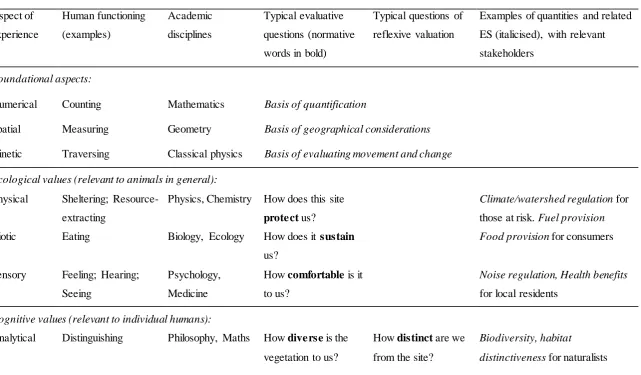
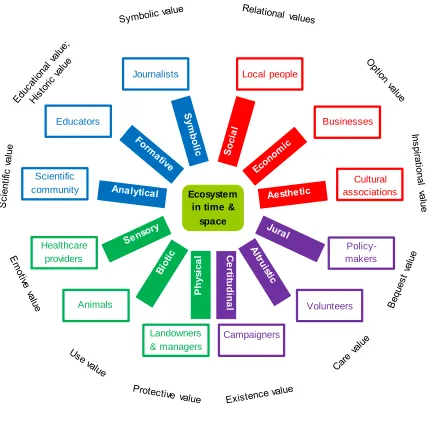
To understand ecosystem valuation we ideally need a comprehensive set of logically-distinct possible ways in which people may value natural places, and we find a candidate suite of axes in aspectual theory. This philosophical framework (Box 1) proposes distinct, mutually-irreducible aspects of reality that are experienced by humans (Table 2). Taking the first three of these aspects as foundational, our proposal is that the remaining 12 aspects (Fig. 1) be used to capture the range of ways in which humans may stand in evaluative relationships with natural places. These 12
dimensions collectively cover ecological, cognitive, communal and ideological aspects of valuation, and there are philosophical reasons to believe that they are both comprehensive and mutually exclusive (Box 1). For a given real place and a specified stakeholder, then, we ask how the
stakeholder appreciates the place in these kinds of ways. That is, the aspects are adverbs rather than nouns. Table 2 illustrates how these aspects cover and exceed the range of the ESF.
We suggest that an ecosystem valuing framework (EVF) such as this provides the flexibility and simplicity needed for handling a complex multidimensional problem. It is designed to maintain the pragmatic, pluralistic orientation of the ESF while improving on it in important ways (Box 2). Clearly this proposal calls for considerable inter-disciplinary collaboration and public engagement. Fig. 1 suggests how each of the 12 aspects tends to be the focal concern of a particular group of stakeholders, and how it connects with a recognised category of value.
10
There are several further reasons why the EVF should have intuitive appeal for scientists, policy-makers and practitioners. First, it has the potential to meet various recommendations previously made for implementation of the ESF, including resilience, promotion of interdisciplinary
collaboration and involvement of stakeholders [11], focus on direct human encounters with ecosystems and attention to both local and off-site effects [43]. Second, the EVF should function well in non-Western cultures (often found in parts of the world of great conservation importance [38]) by downplaying the ‘humans vs. nature’ [44] and ‘cultural vs. material’ [36] dualisms typical of Western worldviews and recognising instead how people’s cultural identity and well-being may
be closely bound up in relationships with the non-human world [10]. Finally, the independent
philosophical foundations of the EVF should give confidence in its robustness and universal validity. Adopting the twelve aspects of valuation would provide a standard that should assist in comparison among studies, although ongoing work will be required to apply them through developing protocols and metrics (see Outstanding Questions).
11
for interpreting ecological effects analyses. After all, direct human perception is the foundation of scientific research as well as environmental appreciation.
Acknowledgments
This work was shaped in discussion with Martin Kaonga, Arthur Jones and Deepa Senapathi in a working group funded by the Marsh Christian Trust and the West Yorkshire School of Christian Studies. We are grateful to Jonathan Chaplin, Paul Craze and an anonymous reviewer for comments on a draft.
[48-56]
References
1 Pearson, R.G. (2016) Reasons to Conserve Nature. Trends in Ecology & Evolution 31, 366-371 2 Lélé, S., et al. (2013) Ecosystem services: origins, contributions, pitfalls, and alternatives. Conserv. Soc. 11, 343-358
3 Schröter, M., et al. (2014) Ecosystem services as a contested concept: A synthesis of critique and counter-arguments. Conserv. Lett. 7, 514-523
4 Silvertown, J. (2015) Have Ecosystem Services Been Oversold? Trends in Ecology & Evolution 30, 641–648
5 Mace, G.M., et al. (2012) Biodiversity and ecosystem services: a multilayered relationship. Trends in Ecology & Evolution 27, 19-26
6 Wilson, K.A. and Law, E.A. (2016) How to Avoid Underselling Biodiversity with Ecosystem Services: A Response to Silvertown. Trends in Ecology & Evolution 31, 332-333
7 Potschin, M.B., et al. (2016) Have Ecosystem Services Been Oversold? A Response to Silvertown. Trends in Ecology & Evolution 31, 334-335
8 Schroter, M. and van Oudenhoven, A.P.E. (2016) Ecosystem Services Go Beyond Money and Markets: Reply to Silvertown. Trends in Ecology & Evolution 31, 333-334
9 anonymous (2012) The Natural Capital Declaration. www.naturalcapitaldeclaration.org/the-declaration/
10 Chan, K.M.A., et al. (2016) Why protect nature? Rethinking values and the environment. Proceedings of the National Academy of Sciences of the United States of America 113, 1462-1465 11 Nahlik, A.M., et al. (2012) Where is the consensus? A proposed foundation for moving
ecosystem service concepts into practice. Ecological Economics 77, 27-35
12 Daily, G. (1997) Nature's Services: Societal Dependence On Natural Ecosystems. Island Press 13 UK National Ecosystem Assessment (2011) The UK National Ecosystem Assessment Technical Report. UNEP-WCMC
14 Millennium Ecosystem Assessment (2003) Ecosystems and Human Well-being: A Framework for Assessment. Island Press
15 Costanza, R., et al. (1997) The value of the world's ecosystem services and natural capital. Nature 387, 253-260
12
17 Fisher, B., et al. (2009) Defining and classifying ecosystem services for decision making. Ecol. Econ. 68, 643-653
18 Costanzo, A. and Barberi, P. (2014) Functional agrobiodiversity and agroecosystem services in sustainable wheat production. A review. Agronomy for Sustainable Development 34, 327-348 19 Eigenbrod, F., et al. (2009) Ecosystem service benefits of contrasting conservation strategies in a human-dominated region. Proceedings of the Royal Society B-Biological Sciences 276, 2903-2911 20 Nations, U. (1992) Convention on Biological Diversity, Article 2: Use of Terms. UNEP
www.cbd.int/convention/articles/default.shtml?a=cbd-02
21 Gunton, R.M., et al. (2016) How scalable is sustainable intensification? Nature Plants 2, 16065 22 Millennium Ecosystem Assessment (2005) Ecosystems and Human Well-being: Synthesis. Island Press
23 Haines-Young, R. and Potschin, M. (2013) Common International Classification of Ecosystem Services (CICES): Consultation on Version 4, Aug-Dec 2012.
24 Kirchner, J.W. (2002) The Gaia hypothesis: Fact, theory, and wishful thinking. Clim. Change 52, 391-408
25 Lovelock, J.E. and Margulis, L. (1974) Atmospheric homeostasis by and for the biosphere: the Gaia hypothesis. Tellus 26, 2-10
26 Cardinale, B.J., et al. (2012) Biodiversity loss and its impact on humanity. Nature 486, 59-67 27 Chan, K.M.A., et al. (2012) Rethinking ecosystem services to better address and navigate cultural values. Ecological Economics 74, 8-18
28 Cooper, N., et al. (in press) Aesthetic and spiritual values of ecosystems: Recognising the ontological and axiological plurality of cultural ecosystem ‘services’. Ecosyst. Serv.
29 Spash, C.L. and Vatn, A. (2006) Transferring environmental value estimates: Issues and alternatives. Ecological Economics 60, 379-388
30 Cowling, R.M., et al. (2008) An operational model for mainstreaming ecosystem services for implementation. Proceedings of the National Academy of Sciences of the United States of America 105, 9483-9488
31 Fischer, A. and Eastwood, A. (2016) Coproduction of ecosystem services as human-nature interactions: An analytical framework. Land Use Pol. 52, 41-50
32 Spangenberg, J.H., et al. (2014) Provision of ecosystem services is determined by human agency, not ecosystem functions. Four case studies. International Journal of Biodiversity Science, Ecosystem Services & Management 10, 40-53
33 Darvill, R. and Lindo, Z. (2016) The inclusion of stakeholders and cultural ecosystem services in land management trade-off decisions using an ecosystem services approach. Landscape Ecology 31, 533-545
34 Robertson, M. (2012) Measurement and alienation: making a world of ecosystem services. Trans. Inst. Br. Geogr. 37, 386-401
35 Scholte, S.S.K., et al. (2015) Integrating socio-cultural perspectives into ecosystem service valuation: A review of concepts and methods. Ecological Economics 114, 67-78
36 Pröpper, M. and Haupts, F. (2014) The culturality of ecosystem services. Emphasizing process and transformation. Ecological Economics 108, 28-35
37 Kellert, S.R. and Wilson, E.O. (1995) The Biophilia Hypothesis. Island Press
38 Comberti, C., et al. (2015) Ecosystem services or services to ecosystems? Valuing cultivation and reciprocal relationships between humans and ecosystems. Glob. Environ. Change-Human Policy Dimens. 34, 247-262
39 Garcia-Llorente, M., et al. (2016) The value of time in biological conservation and supplied
13
41 Gilbert, H. (2013) 'Bedouin overgrazing' and conservation politics: Challenging ideas of pastoral destruction in South Sinai. Biological Conservation 160, 59-69
42 Thompson, K. and Gilbert, F. (2013) The effects of grazing on the endangered Sinai Thyme (Thymus decussatus) in a hyper-arid environment. J. Arid. Environ. 99, 14-22
43 Seppelt, R., et al. (2011) A quantitative review of ecosystem service studies: approaches, shortcomings and the road ahead. Journal of Applied Ecology 48, 630-636
44 Schroeder, H.W. (2007) Place experience, gestalt, and the human-nature relationship. J. Environ. Psychol. 27, 293-309
45 Bohan, D.A., et al. (2016) Networking our way to better ecosystem service provision. Trends in Ecology & Evolution 31, 105-115
46 Natural Capital Project (2012) InVEST. http://www.naturalcapitalproject.org/ 47 Mace, G.M. (2014) Whose conservation? Science 345, 1558-1560
48 Dooyeweerd, H. (1953) A New Critique of Theoretical Thought: The General Theory of the Modal Spheres. H.J. Paris
49 Dooyeweerd, H. (1979) Roots of Western Culture: Pagan, Secular and Christian options. Wedge 50 Ouweneel, W. (2014) Wisdom for Thinkers: An Introduction to Christian Philosophy. Paideia Press / Reformational Pub Project
51 Clouser, R.A. (2005) The Myth of Religious Neutrality: An essay on the hidden role of religious beliefs in theories.
52 Jax, K., et al. (2013) Ecosystem services and ethics. Ecological Economics 93, 260-268 53 Orsi, F. (2015) Value Theory. Bloomsbury Publishing
54 Thomson, J.J. (1997) The right and the good. J. Philos. 94, 273-298
55 Anderson, E. (1995) Value in Ethics and Economics. Harvard University Press
56 UN Sustainable Development Platform (2015) Transforming Our World: The 2030 Agenda for Sustainable Development.
14
Table 1: A selection of ecosystem services and their qualification under some prominent definitions (1 = qualifies; 0 = does not; ? = may qualify in some situations). The last three rows are
counterfactual test cases: phenomena that are not (to our knowledge) considered as ES yet appear to fulfil some of the definitions.
Ecosystem service …is an ecological
process/function
…is an ecological
output/contribution
…is a human
benefit
Insect pollinationa 1 0 0
Climate-change reductiona 1 ? 0
Soil formationa 1 1 0
Water supply 0 1 1
Food provision 0 1 1
Recreation (opportunity) 0 0 1
*Insect reproduction 1 ? 0
*Photosynthetic release of oxygen b 1 1 1
*Profit from rising timber prices 0 ? 1
a While not themselves human benefits, these three items may lead to benefits. Yet the first two may clearly
also lead to human disbenefits: some destructive species rely on insect pollination, and some people stand to
benefit from climate change.
b Our Web of Science search in July 2016 did yield 15 empirical studies (all of Chinese sites) that considered
oxygen production, which was dropped from the Millennium Assessment’s list of examples between [14] and
[image:15.596.58.548.183.458.2]15
Table 2. Aspects of experience, with examples for human functioning in each, correlated academic disciplines for collaboration, typical evaluative questions that should be asked concerning a natural site, and examples of specific variables to assess (drawn from the ESF where possible). Aspect of experience Human functioning (examples) Academic disciplines Typical evaluative questions (normative
words in bold)
Typical questions of
reflexive valuation
Examples of quantities and related
ES (italicised), with relevant
stakeholders
Foundational aspects:
Numerical Counting Mathematics Basis of quantification
Spatial Measuring Geometry Basis of geographical considerations
Kinetic Traversing Classical physics Basis of evaluating movement and change
Ecological values (relevant to animals in general):
Physical Sheltering;
Resource-extracting
Physics, Chemistry How does this site
protect us?
Climate/watershed regulation for
those at risk. Fuel provision
Biotic Eating Biology, Ecology How does it sustain
us?
Food provision for consumers
Sensory Feeling; Hearing;
Seeing
Psychology,
Medicine
How comfortable is it
to us?
Noise regulation, Health benefits
for local residents
Cognitive values (relevant to individual humans):
Analytical Distinguishing Philosophy, Maths How diverse is the
vegetation to us?
How distinct are we
from the site?
Biodiversity, habitat
[image:16.842.85.727.128.503.2]16 Formative Developing; Teaching Historical studies,
Engineering,
Education
How richly developed
is the site?
How can we develop
ourselves in it?
Educational opportunities for local
people
Symbolic Communicating;
Naming
Linguistics,
Cultural studies
How meaningful is
the site to us?
How do we get
information from it?
Information functions (e.g. on food
supply) for land-based people
Communal values:
Social Respecting Sociology How socially
appropriate is the site
to us?
How well can we
socialise at the site?
Shared recreational opportunities
for locals, tourists, etc
Economic Choosing; Trading;
Optimising
Economics How valuable is the
site to us?
How do we prioritise
the site?a
Economic opportunities for local
people/investors
Aesthetic Appreciating; Joking Arts, Design How beautiful is the
site to us?
How do we enjoy the
site?
Artistic inspiration, leisure
opportunities for tourists, etc
Ideological values:
Jural Allocating; Doing
one’s duty
Law, Politics What do we deserve
from the site?
What do we owe
others from the site? b
Benefits (climate regulation, etc)
for other people
Altruistic Caring; Loving Ethics How caring are we of
the site?
How does it enable us
to love/care?
Conservation action by volunteers
Certitudinal Trusting; Knowing Religious and
cultural studies
How transcendental
does the site seem?
How do we know
ourselves here?
Spiritual services for interested
parties
a This is one of the typical aims of a whole ecosystem valuation exercise.
17
Figure 1: The suite of aspects for valuing ecosystems is shown as rays emanating from an ecosystem (site) of interest, with the physical (reading clockwise) and certitudinal (reading anticlockwise) as alternative foundations of interpretation (Box 2). Although written as adjectives to save space, the aspect labels should be converted to adverbs: “Physically how does stakeholder S value place P?” etc. The ecological category is indicated in green, cognitive in blue, communal in red and
ideological in purple. Examples of stakeholders specialising in each kind of valuation are named in boxes, and some categories of value associated with each aspect around the periphery. An
assessment ought to consider all the aspects for (i) a specific place and relevant stakeholders, or (ii) specific stakeholders and all relevant places.
C e rt itu d in a l P h y s ic a l Campaigners Policy-makers Volunteers Cultural associations Businesses Local people
Journalists Educators Scientific community Healthcare providers Animals Landowners & managers Ecosystem in time &
[image:18.596.79.507.89.510.2]18
Glossary
Aspect: In aspectual theory: a fundamental mode of being and functioning, and a limit to the process of abstraction. Each aspect (of which 14–17 are typically posited) has a core meaning that can be evoked but not defined. In human experience any object functions in all the aspects, each one providing a sphere of meaning in which things are conceptualised. Ethical norms are to be discerned in the analytical and subsequent aspects.
Certitudinal: In aspectual theory: describing the fundamental notion of certainty, conviction or commitment; the way in which something motivates action.
Consequentialist: An approach to ethics evaluating the moral rightness of choices by the
consequential increase or decrease in goodness brought about by them. Different strands of consequentialism define ‘goodness’ differently: utilitarianism, for example, classically considers an aggregate of well-being summed across all persons.
Deontological: An approach to ethics evaluating the moral rightness of choices by their conformity with norms. Deontological ethics is arguably more concerned with right actions than with bringing about a good state of affairs.
Formative: In aspectual theory: describing the fundamental notion of free creative
innovation; the way in which something can be historically new. Dooyeweerd saw differentiation, rather than mere innovation, as the central norm in this aspect.
19
Box 1: Backgrounds to aspectual theory and value theory
Aspectual theory:
Aspectual theory is a postulate of the reformational philosophical tradition, which was established in the first half of the 20th century by Herman Dooyeweerd and Dirk Vollenhoven [49] as an alternative to the dualistic thought that pervades Western culture [50]. It is a phenomenological framework to account for, among other things, how humans abstract from the integral everyday experience of reality and analyse objects or situations by abstracting selected aspects, which can be seen as fundamenta l ly distinct modes of being and functioning [51]. Dooyeweerd and Vollenhoven identified fiftee n mutually- irreducible aspects, although such a list is open to empirical revision. Aspects provide an intuitive categorisation of the diversity of meanings that can be ascribed to an object, phenomenon or situation. Reformational philosophy eschews reductionist claims about either an underlying substance (‘matter’) or social constructivism to explain our shared perceptions and posits instead a suite of natural
laws that cause similar aspects and norms to be discernible at all times and across all cultures. Conflating the aspects is a common source of paradoxes, such as Zeno’s (reducing the kinetic aspect to the spatial) and Theseus’ (conflating the physical aspect with others such as the formative).
20 Value theory:
Whereas traditional ethical theorising focuses on how a person may choose the “right” course of
action, value theory (related to axiology)focuses on how people attribute ‘goodness’ to different entities or situations according to their properties [53]. While this approach avoids the traditional dichotomy between consequentialist and deontological ethics, it raises its own questions about extrinsic vs intrinsic, and conditional vs unconditional, values [54]. A strand of thought aligned with our proposal sees values as context-dependent. For example, Judith Thomson [55] argues that ‘good’ is meaningless without a context: one must understand some way in which a thing X is good, such as “for purpose P” or “for the wellbeing of subject S” – so that we can understand the
contrasting senses of attributions like “good for cane toads” and “good for killing cane toads”, as
well as divergent forms of goodness such as generosity, justice and beauty. Accepting the
fundamental multiplexity of goodness actually makes a consequentialist analysis problematic, since divergent values cannot be reduced to a common currency in order to assess the “best” course of
action [56].
21
Box 2: The Ecosystem Valuing Framework
The ecosystem valuing framework (EVF) proposed here is a set of 12 categories for a systematic analysis of how specified stakeholders value a place or ecosystem. Each category evokes a distinct aspect of the place, as outlined in Fig. 1 and Table 2. Below is a summary of the framework and some of the advantages it offers over the ESF:
The EVF is a tool to consider the ways in which sites may be appreciated holistically, without
applying the consumeristic category of services: it entails asking ‘how’ rather than ‘what’ people
appreciate. The starting assumption is that any stakeholder will value any given place to varying degrees (including negatively) in each of the 12 aspects, and an evaluation therefore consists in attributing relative scores on as many as possible of these axes of valuation. They would naturally be presented graphically on a radar diagram.
It is essential to specify at the outset which stakeholders are being considered. This necessitates
consultation or at least empathy (e.g. if any non-human animals’ values are to be considered [57]). Dialogue and diplomacy may then be required for reaching a consensus for action. In practice, evaluations might be either site-focused (e.g. for prioritisation exercises, considering
all interested stakeholders) or stakeholder-focused (e.g. for policy development, considering many sites and various spatial and temporal horizons).
For translating between the ESF and the EVF it may be helpful to conceive of most regulating
services initially in terms of the physical aspect of appreciation and of provisioning services in terms of the physical and biotic aspects. However, the EVF does not directly cover the notions of services or benefits: thus timber as a commodity or CO2 as a disutility, for example, cannot be directly considered. Meanwhile, the ambiguity of ‘cultural services’ can be lessened by using the
22
Recognising the coherence among the aspects can help interpret the divergent perspectives of
different stakeholders. For example, religious or existential convictions underlying a person’s
certitudinal and altruistic evaluations may shed light on their evaluations in the preceding aspects.
The EVF intrinsically makes the normative nature of conservation explicit, facilitating the
identification of negative as well as positive considerations, and “maintaining a plurality of
23
Outstanding Questions
1. What variables should be used to implement the axes of the EVF?
As indicated in Fig. 1, we propose that the latter 12 of the 15 commonly-accepted aspects provide comprehensive coverage of the range of fundamentally-distinct ways in which people may appreciate natural places. Some of these aspects readily evoke common assessments: the physical, biotic, sensory, analytical, social, aesthetic and economic (albeit sometimes under different names) are largely familiar from the ESF and other environmental assessment frameworks. The formative, symbolic, jural, altruistic and certitudinal aspects, however, are less often considered and will need careful consideration: how can they be quantified? Also, as indicated in Table 2, the post-ecological aspects in the list have a reflexive side: e.g. how humans not only form and develop a place,
historically, but also form themselves through a place, educationally. Thus overall there could be up to 21 evaluative questions. But one might ask if some of these should be combined or downplayed.
2. How should scientific understanding of ecological processes be combined with the EVF?
24
3. How do the axes of the EVF tie in with sustainable development goals in general?
Each of the United Nations’ 17 sustainable development goals (SDGs) [57] may be characterised by
one or more of the EVF aspects, and many map largely onto a single aspect (e.g. those concerning energy and climate, hunger, well-being, education, communities, justice and the various economic goals). Comprehensive assessments of natural places in terms of these aspects should therefore foster integration with the SDGs, but the best ways of combining them will require extensive