2099
Design Of Mathematics Module Based On Rme
To Improving The Problem-Solving Ability
Melvinasari, SuparmanAbstrac:t: This study aims to develop teaching materials in the form of modules based on the Realistic Mathematics Education learning model to improve students' problem solving abilities. This research is a development research with ADDIE development model, namely Analysis, Design, Development, Implementation, and Evaluation. The subjects of this study were mathematics teachers and VII grade students. I Data collection instruments include interview guides, class observations, and tests. Interview guidelines are used to determine the difficulties and interest in learning students in the learning process. Guidelines for observation are carried out to obtain information about the curriculum and learning resources used. The test results are used to determine students' problem solving abilities. The module design produced is based on the RME according to the curriculum, material, characteristics of students, and formulate objectives. This research will then be developed into the steps of Development, Implementation, and Evaluation that will produce finished products.
Index Terms: ADDIE, Algebra, Development Research, Module, Problem Solving, RME.
—————————— ——————————
1 INTRODUCTION
Problem solving skills are students' skills in completing tasks without knowing how to solve them beforehand [1]. The ability to solve mathematical problems is one of the standard processes in mathematics learning [2]. Problem solving ability is the main factor that can affect student achievement [3]. The low student learning achievement is caused by the ability of students in solving mathematical problems inadequate [4]. Students generally are accustomed to solving mathematical problems only without interpreting them with real-world problems [5]. Problem solving ability is also one of the main goals of education, and it is believed that improving problem solving skills will encourage students to do research and share what they have learned from each other [6]. Problem solving makes it easy for students to understand concepts and relationships between concepts [7]. Problem solving ability is a very important aspect to be developed [8]. The ability to think critically, logically, analytically, systematically, and creatively can also be obtained by developing problem solving skills in the world of mathematics [9]. The ability to solve problems is also important in other disciplines and everyday life [10]. By studying problem solving in mathematics, students will have thinking skills, a high sense of curiosity, and confidence in something new that helps them in various life classes [11]. Solving problems is not only the purpose of learning mathematics but also the main means of doing it [12]. Problem solving is used to get the right solutions to the problems faced by using the knowledge, skills and understanding obtained previously [13]. Students with low problem solving skills will get less than optimal learning outcomes, this also happens in Muhammadiyah 1 Junior High School in Depok. Based on the results of interviews and observations on October 1, 2018 with teachers and students, students' problem solving abilities were still low.
This resulted in students experiencing difficulties in the learning process, especially in algebraic material so that the learning outcomes obtained were not maximal. Teaching materials that can be a means to improve students' problem solving skills are modules. Modules are one of the teaching materials that contain material, exercises and assignments, and summaries and evaluations are presented systematically and interestingly [10]. Modules also have characteristics that is, according to the development of science and technology, flexible, friendly to users, and easier for users to access information [10]. The use of modules in the learning process makes students more independent. Students are directed to find their own understanding of concepts through problem solving activities [11]. This results in students being able to adjust the speed of learning according to their abilities and can measure the level of mastery of a material so that bisaint gets maximum learning outcomes [12]. Realistic Mathematics Education (RME) is an innovative learning model that makes mathematics as part of human life and initial learning must be done in a real-world context [13]. RME is one approach that is suitable in mathematics learning because this approach is in accordance with the curriculum applied in the school. Train students' abilities in high-level thinking such as: creating their own understanding, training in critical thinking, practicing creative thinking, and training in problem solving, this is the reason for that thinking. [14]. In learning with the RME approach, students do not only passively receive the knowledge given by the teacher. In the learning process, consider how the role of students in building lessons and understanding so that learning becomes maximal [13]. Students themselves build their own knowledge and students can solve realistic problems so students are easier to understand concepts and solve mathematical problems they face [15]. There are four steps in learning based on the RME approach, namely understanding contextual problems, solving contextual problems, comparing and discussing answers, and concluding [16]. Based on the explanation above, the purpose of this research is to develop the design of an Algebra module based on the Realistic Mathematics Education approach for seventh grade students of SMP to improve students' problem solving abilities.
2 METHOD
This type of research is development research. The product developed in this study is a mathematical module of RME ____________________________________
• Melvinasari, Master’s Degree Program of Mathematics Education in Ahmad Dahlan University, Indonesia. E-mail: [email protected]
2100 (Realistic Mathematics Education) based algebra material to
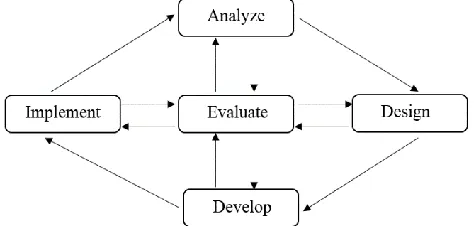
improve students' problem solving abilities. The research model uses the ADDIE development model (Analysis, Design, Development, Implementation, and Evaluation). This research is limited only to the design development stage. The research subjects were mathematics teachers and seventh grade students of Muhammadiyah Junior High School 1 Depok, Indonesia. The curriculum used, evaluation of teaching materials, student characteristics and formulate objectives became the object of this study. The instruments of data collection include interview guides, class observations, and tests. Interview guidelines are used to determine the difficulties and interest in learning students in the learning process. Guidelines for observation are carried out to obtain information about the curriculum and learning resources used. The test results are used to determine students' problem solving abilities. The development flow can be seen in Figure 1.
Fig. 1. ADDIE Development Model [21]
3 RESULT AND DISCUSSION
3.1 Analysis
Development of module design using ADDIE research models. The first development stage is the analysis phase. In this stage, the researcher conducts curriculum analysis, material analysis, analyzes the characteristics of students and formulate objectives to provide an overview of the teaching materials to be developed [4]. Based on the results of interviews and observations conducted at Muhammadiyah Junior High School 1 Depok the researchers found that first, in curriculum analysis found that the curriculum used was the 2013 curriculum. The curriculum had accommodated the ability to solve student problems. Second, teaching materials used have not facilitated students' problem solving abilities to the fullest. Students do not like teaching materials that are used because students feel difficulties in using teaching materials. This is because in the teaching material is too much writing and lack of understanding of the language used. Third, students feel difficulties in algebraic material. Especially in understanding story solving. This is because the ability to solve student problems is still low. The low problem solving ability of students is seen from the results of student observations based on interviews with teachers and the results of working on algebraic material problems. Finally, students need teaching materials that can improve students' problem solving skills and can facilitate the learning process. The teaching material must be in accordance with the applicable curriculum, in accordance with the material at the junior high school level, according to the characteristics of the students, and in accordance with the formulation of learning objectives..
Based on the results of the analysis, an Algebra module based on the Realistic Mathematics Education approach was developed for VII grade junior high school students to improve students' problem solving abilities.
3.2 Design
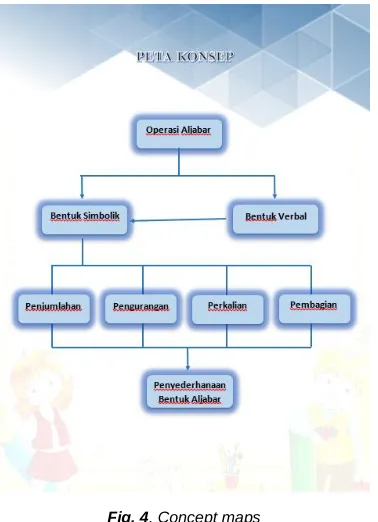
The next step is design. After conducting the analysis phase, in the form of curriculum analysis, material analysis, analysis of student characteristics and formulating learning objectives. In this stage the researcher outlines the contents of the module, designs the contents of the module, and arranges an assessment instrument. The module outline contains the initial plan of what was written and in what order the presentation of the material. The module contents adjust the learning process according to the learning steps of Realistic Mathematics Education. The module design is then made validated by material experts and media experts using the module assessment instrument. Module design validation is used to assess the validity of the module design developed. In this case, the module design that is developed must be in accordance with the results of the analysis at an early stage of researchThe module design is divided into three parts, namely: introduction, content, and closing. The introductory section of the module consists of Cover Module, Module page, Identity page, Preface, Presentation of module contents, Module table of contents, Core Competencies and Basic Competencies, Concept Map, Introduction: description, prerequisites, module instructions, learning objectives. The core part of the module contains learning activities with RME learning steps, summaries, and evaluations. The concluding section consists of the answer key, glossary, and bibliography. The introductory part of the module design can be seen in Figure 2, Figure 3, and Figure 4.
The front cover page consists of: title with RME approach, 2013 curriculum logo, material title, user target, author's name, institutional logo and agency name. The back cover page contains the biography of the author.
2101 The contents of the module contain supporting information
about the display and contents of the module, to make it easier for users to know the location of the material in the module.
The module concept map contains the structure of learning activities that module users will learn.
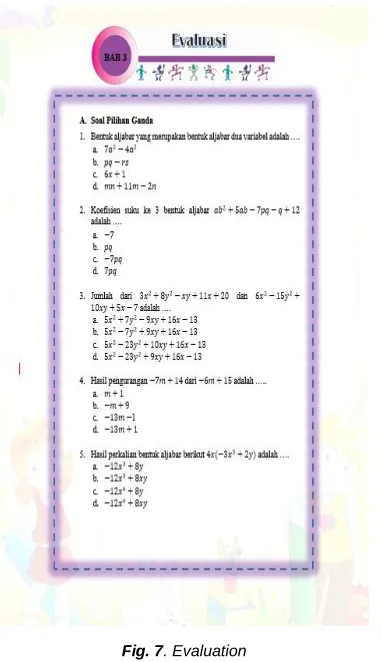
The introduction section consists of: descriptions, prerequisites, module usage instructions, and learning objectives. At the core section, there are four learning activities namely, learning activities 1: algebraic forms, learning activities 2: addition and subtraction of algebraic forms, learning activities 3: multiplication in algebraic forms, learning activities 4: division in algebraic forms, learning activities 5: simplifying algebraic forms (mixed operations algebraic form), learning activities 6: solving problems related to algebraic forms and operating algebraic forms, summaries, and evaluations. The core part of the module can be seen in figure 6 and figure 7.
The module content section of the learning activity will be developed based on the steps in RME learning, namely understanding contextual problems, resolving contextual problems, comparing and discussing answers, and concluding. Fig. 3. Presentation of module content
Fig. 4. Concept maps
Fig. 5. Preface
2102 The evaluation contains 20 multiple choice questions and 5
essay questions. These questions are arranged in order to hone students' abilities in understanding the overall algebraic material that has been learned. The final part is the closing section. In this section it contains the answer key, glossary, and bibliography. The answer key presents the completion of the practice answers and evaluation questions. The glossary contains the terms contained in the module. The table of contents contains a number of references used in compiling the module. The final part of the module can be seen in Figure 8.
Fig. 8. Glossary
After designing the module the next step is to validate the design of the module contents. The validation of the module design aims to know the validity of the module design developed. The suitability of this validation includes aspects of the appearance and suitability of the material. The validation instrument was formulated in several items that had previously been approved by a supervisor. Then the module design was validated by two senior math teachers namely Mr. Muhammad Ferry Irwansyah, S.Si, M.Pd. and Ms. Sri Yuni Astuti, S.Pd.Si. The following are input and suggestions from the validator summarized in table 1.
TABLE1
INPUTS AND SUGGESTION FROM VALIDATORS
The input and suggestions from the validator are then revised. Furthermore, the feasibility of module design is assessed by two validators. The following are the results of the calculation of instruments regarding the feasibility of instructional media by the material experts shown in Table 2.
TABLE2
RESULTS OF CALCULATION OF FEASIBILITY QUESTIONNAIRE BY
VALIDATOR
2103 Based on Table 2, it can be seen that from the first validator
Muhammad Ferry Irwansyah, S.Si, M.Pd. get a score of 40 in a good category. Whereas from the second validator Sri Yuni Astuti, S.Pd.Si. get a score of 45 with a very good category. The average score rated by the validator is 42.5. These results indicate that the module design developed is in a very good category. This shows that the learning module design is deemed feasible as a guideline for making learning modules with revisions according to the comments and suggestions from the validator.
4
CONCLUSION
The results of this study are the design of mathematical modules based on the RME learning model in accordance with the suitability of the curriculum, material, characteristics of students and formulate objectives. The expected results of the module design that is designed are able to improve students' problem solving abilities. Modules are developed with the ADDIE development model. The module component developed consists of three parts, namely the introducing part, the content section, and the final part. This research will then be developed into the steps of Development, Implementation, and Evaluation that will produce finished products.
ACKNOWLEDGMENT
The author thanks Ahmad Dahlan University for giving the opportunity to facilitate the author in completing this research. Thanks also to schools and teachers who have allowed us to do this research.
REFERENCES
[1] Jonsson, B., Norqvist, M., Liljekvist, Y., & Lithner, J. (2014). Learning mathematics through algorithmic and creative reasoning. The Journal of Mathematical Behavior, 36, 20-32.
[2] Rusyda, N. A., Kusnandi, K., & Suhendra, S. (2017, September). A Cognitive Analysis of Students’ Mathematical Problem Solving Ability on Geometry. In Journal of Physics: Conference Series (Vol. 895, No. 1, p. 012081). IOP Publishing.
[3] Yurt, E., & Sünbül, A. M. (2014). A Structural Equation Model Explaining 8th Grade Students' Mathematics Achievements. Educational Sciences: Theory and Practice, 14(4), 1642-1652.
[4] Widodo, S. A. (2017). Development comic based problem solving in geometry. International Electronic Journal of Mathematics Education, 12(3), 233-241.
[5] Malik, M. A. (2018, June). Internet-Based Learning Management Model to Improve the Student’s Mathematic Problem Solving Ability. In Journal of Physics: Conference Series (Vol. 1028, No. 1, p. 012128). IOP Publishing
[6] Korkmaz, Ö. (2018). The effect of scratch-and lego mindstorms Ev3-Based programming activities on academic achievement, problem-solving skills and logical-mathematical thinking skills of students. MOJES: Malaysian Online Journal of Educational Sciences, 4(3), 73-88.
[7] Yulianawati, D., Hasanah, L., & Samsudin, A. (2018, May). A case study of analyzing 11th graders’ problem solving ability on heat and temperature topic. In Journal of Physics: Conference Series (Vol. 1013, No. 1, p. 012042). IOP Publishing.
[8] Widodo, S. A. (2017). Development of Teaching Materials
Algebraic Equation to Improve Problem Solving. Infinity Journal, 6(1), 59.
[9] Surya, E., & Putri, F. A. (2017). Improving Mathematical Problem-Solving Ability and Self-Confidence of High
School Students through Contextual Learning
Model. Journal on Mathematics Education, 8(1), 85-94.
[10]Darma, I. K., Candiasa, I. M., Sadia, I. W., & Dantes, N. (2018). The effect of problem based learning model and authentic assessment on mathematical problem solving ability by using numeric ability as the covariable. In Journal of Physics: Conference Series (Vol. 1040, No. 1, p. 012035). IOP Publishing.
[11]Dina, N. A., & Amin, S. M. (2018, January). Flexibility in Mathematics Problem Solving Based on Adversity Quotient. In Journal of Physics: Conference Series (Vol. 947, No. 1, p. 012025). IOP Publishing.
[12]Wulandari, R. D., Lukito, A., & Khabibah, S. (2018, January). The Elementary School Students’ Mathematical Problem Solving Based on Reading Abilities. In Journal of Physics: Conference Series (Vol. 947, No. 1, p. 012050). IOP Publishing.
[13]Yanti, Y. R., Amin, S. M., & Sulaiman, R. (2018, January). Representation of Students in Solving Simultaneous Linear Equation Problems Based on Multiple Intelligence. In Journal of Physics: Conference Series (Vol. 947, No. 1, p. 012038). IOP Publishing.
[14]Yulastri, Asmar, dkk (2017). Developing an Entrepreneurship Module by Using Product-Based Learning Approach in Vocational Education. International Journl of Environmental and Science Education, 12(5), 1097-1109.
[15]Arbi, Yr, Sumarmin, R, and Putri, D H (2018). Development Module Oriented Science Technoloy Society Indue Science Litery Assessment for 7th-Grade Junior High School Students in 2nd-Semester. IOP Conf. Series Materials Science and Engineering 33.
[16]Elok Norma Khabibah, Mohammad Masykuri, Maridi. (2017). The Effectiveness of Moodule Based Discovery Learning to Increase Generic Science Skills. Journal of Education and Learning, 11 (2), 146-153.
[17]Mulbar, Usman and Ahmad Zaki (2018). Design on Realistic Mtahematics Education on Elementary School Students. IOP Conf. Series: Journal of Physics: Conf. Series 1028.
[18]Palupi, E L W and Khabibah, S (2018). Developing Workshop Module Of Realistic Mathematics Education: Follow-up Workshop. IOP Conf. Series: Materials Science and Engineering 296.
[19]Mahendra, R, Slamet I and Budiyono (2017) Problem Posing With Realistic Mthematics Education Approach in Geometry Learning. IOP Conf. Series: Journal of Physics: Conf. Series 895.
[20]Athiha, H, Mardiyana and Pramudya, I (2017). Think Pair Share Using Realistic Mtematics Education Approach in Geometry Learning. IOP Conf. Series: Journal of Physis: Conf. Series 895.