© 2017, IRJET | Impact Factor value: 5.181 | ISO 9001:2008 Certified Journal
| Page 3065
An Stepped Forward Security System for Multimedia Content Material
for Cloud Computing
VRUNDA JAYANT KULKARNI
1, S.D.SATAV
2, DARSHANA PATIL
31
PG Student, Dept of Computer Engineering, Sawant College of Engineering, Pune, Maharashtra, India,.
2Assistant Professor, Dept of Information Technology, Jayawantrao Sawant College of Engineering, Pune,
Maharashtra, India.
3
Assistant Professor, Dept of Computer Engineering, Jayawantrao Sawant College of Engineering, Pune,
Maharashtra, India.
---***---Abstract -
The planned multimedia system ContentProtection System For Cloud Computing, a new approach for securing a multimedia system contents .The system supports a price potency, quick development, deployment, scalability and snap for equalization a work on a cloud infrastructure .This system will used a for shielding a special kinds of multimedia system contents sort of a audio file, 2D video, 3D Video, images, songs, music files. Achieving a security system follows 2 levels 1) Creates a signatures of a 3D videos 2) Distributed matching Engine for multimedia system objects. for each multimedia system objects a separate signature are going to be created and this technique creates a robust and representative signatures for the 3D Videos ,that checks the content by content to find out modified copy .The second level Distributed matching Engine have a high measurability and it's designed to support for various kinds of multimedia system objects. of 3D videos, whereas our system detects quite ninety eight of them. This comparison shows the necessity for the planned 3D signature technique, since the progressive industrial system wasn't ready to handle 3D videos The system can run on private clouds, public clouds, or any combination of public-private clouds proposed system is scalable and cost effective and relates to the detection of copied and modified material using cloud systems, and more particularly to a system and in an online environment for the detection of duplicated, copyright material
Key Words
:
SIGNATURE, 3D, 2D, DISTRIBUTED MATCHING ENGINEAdvances in process and recorder of multimedia system content additionally because the show of free online hosting sites have created it comparatively simple to duplicate copyrighted materials like videos, images, and music clips. Illegally redistributing
multimedia system content over the web can result in important loss of revenues for content creators. Finding illegally-made copies over the web is a advanced and computationally valuable operation, because of the sheer volume of the offered multimedia content over the web and therefore the quality of comparison content to spot copies. We current a unique system for multimedia system content protection on cloud infrastructures. The system can be used to secure various multimedia system. content types, together with regular 2D videos, new 3D videos, images, audio clips, songs, and music clips. The system will run on personal clouds, public clouds, or any combination of public-private clouds. Our models achieves rapid deployment of content protection systems, as a result of it's supported cloud infrastructures that may quickly give computing hardware and software resources. the planning is value effective as a result of it uses the computing resources on demand. The design will be scaled up and right down to support varied amounts of multimedia system content being protected. The proposed system is fairly complicated with multiple parts, including: (i) Crawler to download thousands of multimedia system objects from online hosting sites, (ii) Signature technique to make representative fingerprints from multimedia system objects, and (iii) distributed matching engine to store signatures of original objects and match them against inquiry objects. we have propose novel ways for the second and third components, and that we utilize off-the-peg tools for the crawler. we have developed a whole running system of all parts and tested it with over 11,000 3D videos and 1 million pictures. We deployed components of the system on the Amazon cloud with varied range of machines (from 8 to 128), and the different components of the system were deployed on our personal cloud. This deployment model was used to show the flexibleness of our system, that allows it to with efficiency utilize varied computing resources and minimize the value, since cloud providers provide totally different rating models for computing and network resources. Through in depth experiments with real preparation, we have shown the high accuracy (in terms of precision and recall) likewise as the scalability and physical property of the planned system.
© 2017, IRJET | Impact Factor value: 5.181 | ISO 9001:2008 Certified Journal
| Page 3066
2.
LITERATURE REVIEW :1.
Cloud based multimedia contents protection system :Author states that The Proposed Multimedia Content Protection System For Cloud Computing is a new approach for securing a multimedia contents .The system supports a cost efficiency, Fast development, deployment, scalability and elasticity for balancing a workload on a cloud infrastructure .This system can used a for protecting a different types of multimedia contents like a audio file, 2D video, 3D Video, images, songs, music files. Achieving a security system follows two levels 1) Creates a signatures of a 3D videos 2) Distributed matching Engine for multimedia objects. For Every multimedia objects a separate signature will be created and this method creates a robust and representative signatures for the 3D Videos ,that captures a depth signals of that video and it is efficient for computing and compare and it requires a small amount of storage .The second level Distributed matching Engine have a high scalability and it is designed to support for different types of multimedia objects. of 3D videos, while our system detects more than 98 percent of them. This comparison shows the need for the proposed 3D signature method, since the state commercial system was not able to handle 3D videos
2 . Robust Video Fingerprinting for Content-Based Video Identification
A singular video fingerprinting method based totally at the centroid of gradient orientations is proposed. The proposed video fingerprinting approach is not best pair accurately unbiased however additionally robust towards common video processing steps together with loss compression, resizing, body fee trade, international change in brightness, color, gamma, and so on. The problem of reliable fingerprint matching is approached by assuming the fingerprint as a awareness of a desk bound ergodic method. The matching threshold is theoretically derived for a given fake alarm price using the assumed stochastic model, and its validity is experimentally verified
3. Comparing feature sets for content {based image retrieval in a medical case database
The prevailing healing organization has proven to be effortlessly adaptable for the use in medical applications. it's far free of price and the supply code is to be had and may easily be tailored. the base gadget can without a doubt no longer be used for effigy retrieval in a medical mount however with some small changes the retrieval performance improves substantially. The retrieval fine received is excessive enough for the use in a case database such as complement the regular textual content based hunt , particularly for principle and resolution exciting cases. students can also net from the applied science
whilst exploring big photo depositary . For the use in device for case primarily based reasoning or in grounds based totally medicine, a greater detailed scientific assessment in specialized domains might be vital and more unique function article can come to be essential.
4. Motion Vector Based Features for Content Based Video Copy Detection
We suggest a movement vector based totally function set for content material based totally reproduction Detection (CBCD) of video clips. movement vectors of picture frames are one of the signatures of a given video. however, they may be now not descriptive sufficient whilst consecutive image frames are used due to the fact maximum vectors are too small. to conquer this hassle we calculate movement vectors in a decrease body price than the real body charge of the video. As a end result we obtain longer vectors which shape a sturdy parameter set representing a given video.
5. Video fingerprinting for copy identification: from research to industry application.
Research in video fingerprinting has come an extended manner since it started a decade in the past and evolved into a generation this is followed through the enterprise. Key regions of studies encompass designs of video signatures, fingerprinting and fingerprint matching algorithms. the various big number of designs, video signatures can be labelled into spatial, temporal, shade, and rework-area signatures. although none is best, spatial signatures are located to be the general winner in phrases of robustness, , compactness, and computational complexity. Temporal and shade signatures can provide more advantageous discriminability . Fingerprint matching via exhaustive seek has a linear time complexity in regards to the size of reference database. thankfully, powerful approximation techniques had been advanced that offer a dramatic reduction in computational complexity, dashing up fingerprint queries via several orders of value over an exhaustive seek with a negligible loss in accuracy. This made it possible to build sensible fingerprint matching systems that are scalable.
3.
EXISTING SYSTEM© 2017, IRJET | Impact Factor value: 5.181 | ISO 9001:2008 Certified Journal
| Page 3067
appropriate for already-released content while notwatermarks in them. The watermarking approach is a lot of appropriate for the somewhat controlled environments, like distribution of multimedia system content on DVDs or used special sites and custom players. Watermarking may not be effective for the speedily increasing online videos, especially those uploaded to sites like YouTube and compete back by any video player. Watermarking isn't the focus of this paper. The focus of this paper is on another approach for protecting multimedia system content, that is content based copy detection (CBCD) [16]. during this approach, signatures (or fingerprints) are extracted from original objects. Signatures are created from question (suspected) objects downloaded from online sites. Then, the similarity is computed between original and suspected objects to search out potential copies. Many previous works planned completely different wsays for making and matching signatures. These ways can be classified into four categories: special, temporal, color and transform domain. special signatures (particularly the block-based) square measure the foremost wide used. However, their weakness is that the lack of resilience against giant geometric transformations. Temporal and color signatures are less strong and may be used to enhance special signatures. Transform-domain signatures are computationally intensive and not wide used in observe. For a lot of details, see surveys for audio procedure [5] and second video procedure [14]. Youtube Content ID [13], Vobile VDNA and Mark Monitor [16] area unit a number of the examples use fingerprinting for media protection, whereas ways like [1] maybe remarked becaus e the academic progressive. unlike previous works, the contribution of this paper is method a large-scale system to search out copies that may be used for various methods multimedia content and might leverage multicloud infrastructures to reduce the value, expedite distribution, and dynamically rescale and down. That is, we have method our system specified previous content-based copy detection ways for making and matching signatures is implemented inside our system.
Disadvantage Of Existing System:
1 .Watermarking approach may not be suitable for already-released content without watermarks in them. Watermarking may not be effective for the rapidly increasing online videos, especially those uploaded to sites such as YouTube and played back by any video player.
2. Spatial signatures weakness is the lack of resilience against large geometric transformations. Temporal and color signatures are less robust and can be used to enhance spatial signatures. Transform-domain signatures are computationally intensive and not widely used in practice..
4. PROPOSED SYSTEM
The goal of the suggested system for multimedia system content protection is to search out illegally created copies of multimedia system objects over the web. In general, systems for multimedia system content protection area unit large scale and complex with multiple concerned parties. during this section, we have begin by characteristic the look goals for such systems and our approaches to realize them. Then, we have present the high-level design and operation of our proposed system.
A. Model Goals and Approaches:
A content protection system has three main parties: (i) content house owners (e.g., Disney), (ii) hosting sites (e.g. YouTube), and (iii) service suppliers (e.g., loud Magic). The primary party is interested in protective the copyright of a no of its multimedia system objects, by finding whether or not these objects or components of them area unit posted on hosting sites (the second party).The third party is that the entity that provides the copy finding service to content house owners by checking hosting sites. In some cases the hosting sites supply the copy finding service to content house owners. An example of this case is YouTube, that offers content protection services. And in other, less common, cases the content owners develop and operate their own protection systems. We specify and justify the subsequent four goals because the most significant ones in multimedia system content protection systems.
B. Accuracy:
The system become have high accuracy in terms of finding all copies (high recall) whereas not coverage false copies (high precision).Achieving high accuracy is difficult, as a result of derived multimedia objects generally go through numerous modifications (or transformations). as an example, copied videos is subjected to cropping, embedding in alternative videos, ever changing bit rates, scaling, blurring, and/or ever-changing frame rates. Our approach to realize this goal is to extract signatures from multimedia system objects that are robust to as several transformations as probable.
C. Computational Efficiency:
The system become have short reaction time to report
copies, specially timely multimedia
© 2017, IRJET | Impact Factor value: 5.181 | ISO 9001:2008 Certified Journal
| Page 3068
signatures compact and quick to figure and comparewithout sacrificing their strength against transformations. approach to realize this goal is to create the signatures compact and quick to figure and compare without sacrificing their strength against transformations.
D.Scalability and Reliability:
The system become scale (up and down) to completely different range of multimedia system objects. Scaling up suggests that adding additional objects as a result of observation additional online hosting sites, having more content owners applying the system, and the incidence of events. Conversely, it's additionally attainable that the set of objects handled by the shrinks, because, example, some content owners might terminate their contracts for the protectionservice.approach to handle scalability is model a distributed system which will utilize varied amounts of computing resources. With large scale distributed systems, failures often times occur, that need the content protection system to be reliable face of various failures. on high of the Map Reduce programming framework, that offers resiliency against totally different types of failures.
E. Cost Efficiency:
system should minimize price of required computing infrastructure. Approach to realize this goal is model our system to effectively utilize cloud computing infrastructures (public and/or private). Building on a cloud computing infrastructure additionally achieves the measurability objective mentioned higher than and reduces the direct price of the computing infrastructure.
Advantages:
(i) Computational effectiveness.
(ii) Adaptability Furthermore unwavering quality.
(iii) Cost effectiveness.
[image:4.595.315.550.419.544.2]5.
SYSTEM ARCHITECTURE :
Fig. 1. Proposed cloud-based multimedia content protection system
In proposed system, User will do the registration with the system, It provides the key to each and every content owner to access the multimedia objects. Content owner upload the video signature get created for every object for security. The proposed system functions as follows. Content owners specify multimedia system objects that they're curious about protective. Then, the system creates signatures of those multimedia system objects (called reference objects) and inserts (registers) them within the distributed index. this will be just once method, or never-ending method wherever new objects square measure periodically . for instance, for video objects, it will transfer videos that have a minimum variety of views or belong to specific genre (e.g., sports). The signatures for a question object square measure created once the Crawl part finishes down-loading that object and also the object itself is removed. when the Crawl part downloads all objects and also the signatures square measure created, the signatures square measure uploaded to the matching engine to perform the comparison. Compression of signatures are often performed before the transfer to avoid wasting information measure. Once all signatures square measure uploaded to the matching engine, a distributed operation is performed to match all question signatures versus the reference signatures within the distributed index
© 2017, IRJET | Impact Factor value: 5.181 | ISO 9001:2008 Certified Journal
| Page 3069
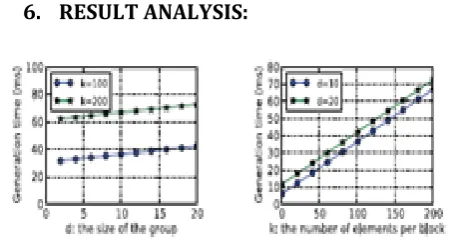
Here shows the result analysis, impact of signature generation shown in first graph.signature generation time impact,As it shows proposed system shows the better results than existing.In graph 2, impact of size of the group on auditing time and number of elements per block,auditing is nothing but the varification of videos whether it is modified or not.In graph 3 , Impact of d on communication cost.By this above result analysis ,Proposed System shows the better results than the Existing System.In every aspect,It shows the better results,Generates the signature for every multimedia object to make it unique,by this we can able to find out modified video through auditor by using signature which is unique for every object and by providing authentication to cloud make it more secure.
Comparing Existing System with Proposed System
Plot the comparison results in above figure, The results shows that the proposed matching engine produces high accuracy.
Scalability and Elasticity of Our Engine: conduct multiple experiments to show that our engine is scalable and elastic. Scalability means the ability to process large volumes of data, while elasticity indicates the ability to efficiently utilize various amounts of computing resources. Both are important characteristics: scalability is needed to keep up with the continuously increasing volumes of data and elasticity is quite useful in cloud computing settings where computing resources can be acquired on demand
7.
CONCLUSION
In this paper, given a replacement model for multimedia system content protection systems using multi cloud infrastructures. The planned system supports completely different multimedia content varieties and it is deployed on personal and/or public clouds. two key elements of the planned system area unit given. the primary one may be a new technique for making signatures of 3D videos The second key part in our system is that the distributed index, that is used to match multimedia system objects characterized by high dimensions. The system will detect the illegal distributed files for that system have used a signature matching algorithm.
8.
FUTURE SCOPE
Future direction for the work among that paper is according to graph signatures for current then complicated formats over 3D videos certain as much multi view plus depth. A multi view summation depth video has multiple field or deep components, which permit users to view a scene out of distinctive angles. Signatures because of certain movies would need in imitation of capture that complexity, while existence efficient according to compute, compare, and then store
ACKNOWLEDGEMENT
It is with the profound sense of gratitude that I acknowledge the constant help and encouragement from our Guide Prof S.D.Satav sir and Prof.D.R.Patil mam and HOD sir Computer Engineering department, also PG Coordinator sir and principal sir JSCOE, Hadapsar for their sterling efforts, amenable assistance and inspiration in all my work. They have given in depth knowledge and enlightened me on this work.
REFERENCES:
[1]
Mohamed Hefeeda , Senior Member, IEEE, Tarek ElGamal , Kiana Calagari, and Ahmed Abdelsadek “Cloud based multimedia Contents protection System” IEEE Transaction Multimedia, VOL. 17, NO. 3, March 2015 [2]. H. Liao, J. Han, and J. Fang, “Multi- dimensional index on hadoop distributed file system,” in Proc. IEEE Conf. Newt., Archit. Storage(NAS’10), Macau, China, Jul. 2010, pp. 240–249.© 2017, IRJET | Impact Factor value: 5.181 | ISO 9001:2008 Certified Journal
| Page 3070
IEEE 5th International Conference on in Cloud Computing (CLOUD '12)2012991992
[5]. S. Ioffe, “Full-length video fingerprinting. Google Inc.,” U.S. Patent 8229219, Jul. 24, 2012.
[6]. A. Hampapur, K. Hyun, and R. Bolle, “Comparison of sequence matching techniques for video copy detection,” in Proc. SPIE Conf. Storage Retrieval Media Databases (SPIE’02), San Jose, CA, USA, Jan. 2002, pp. 194–201. [7]. A. Abdelsadek, “Distributed index for matching multimedia objects,” M.S. thesis, School of Computer Sci., Simon Fraser Univ., Burnaby, BC, Canada, 2014.
[8]. A. Stupar, S. Michel, and R. Schenkel, “Rankreduce - processing k-nearest neighbor queries on top of mapreduce,” in Proc. Workshop Large-Scale Distrib. Syst. Inf. Retrieval (LSDS-IR’10), Geneva, Switzerland, Jul. 2010, pp. 13–18.
[9]. S. Ioffe, “Full-length video fingerprinting. Google Inc.,” U.S. Patent 8229219, Jul. 24, 2012.
[10]. J. Deng, W. Dong, R. Socher, L. Li, K. Li, and L. Fei-Fei, “Imagenet: A large-scale hierarchical image database,” in Proc. IEEE Conf. Comput. Vis. Pattern Recog. (CVPR’09), Miami, FL, USA, Jun. 2009, pp. 248–255
[11] K. Tasdemir and A. Cetin, “Motion vector based features for content based video copy detection,” in Proc. Int. Conf. Pattern Recog. (ICPR’10), Istanbul, Turkey, Aug. 2010, pp. 3134–3137.
[12] J. Lu, “Video fingerprinting for copy identification: From research to industry applications,” in Proc. SPIE, 2009, vol. 7254, pp. 725402:1–725402:15
[13] A. Kahng, J. Lach, W. Mangione-Smith, S. Mantik, I. Markov, M. Potkonjak, P. Tucker, H. Wang, and G. Wolfe, “Watermarking techniques for intellectual property protection,” in Proc. 35th Annu. De-sign Autom. Conf. (DAC’98), San Francisco, CA, USA, Jun. 1998, pp. 776–781 [14] W. Lu, Y. Shen, S. Chen, and B. Ooi, “Efficient processing of k nearest neighbor joins using MapReduce,” in Proc. VLDB Endowment (PVLDB), Jun. 2012, vol. 5, no. 10, pp. 1016–1027.
[15] H. Müller, W. Müller, D. Squire, S. Marchand-Maillet, and T. Pun, “Performance evaluation in content-based image retrieval: Overview and proposals,” Pattern Recog. Lett., vol. 22, no. 5, pp. 593–601, Apr. 2001
Ms. Vrunda Jayant Kulkarni is currently
pursuing M.E (Computer) from
Jayawantrao Sawant College of
Engineering, Pune, India. Savitribai Phule Pune University, Pune, Maharashtra, India - 411028.received her B.E (IT)degree from
SVERI’s College Of Engg,
Pandharpur,Solapur
University,Solapur,Maharashtra,India -
416004. Her area of interest is Information
and Cyber Security, Cloud Computing.
Asst Prof. Sandip Satav received the M.E (CSE/IT) degree from Department of
Computer Engineering, Vishwakarma
Institute of Technology, Pune, MAH, India in 2004. He is currently working as Asst. Professor with Department of Information Technology, Jayawantrao Sawant College of Engineering, Pune, MAH, India. His
research interests include Image
Processing, Networking.
Mrs.Darshana Patil working as Assistant
Professor in Department of Computer
Engineering ,Jayawantrao Sawant College of Engineering ,Pune ,Mah,India. She pusued her BE (Comp) from North Maharashtra University, Dhule, Mah, India in 2001 and ME (Comp) from D.Y.Patil COE ,Pune, MAH ,India.Her research interests include Network & information Security.