© 2017, IRJET | Impact Factor value: 5.181 | ISO 9001:2008 Certified Journal | Page 10
CRITICAL ANALYSIS & PERFORMANCE EVALUATION OF C.I. DIESEL
ENGINE USING BIO DIESEL
Prof. J.S.GITAY
1, Dr. G.R.SELOKAR
21
P.G Scholar, PhD Mechanical, Department of Mechanical Engineering, SSSUTMS, Sehore, M.P., India
2Professor, Department of Mechanical Engineering, SSSUTMS, Sehore, M.P., India
---***---Abstract -
The increase in use of alternate fuel which isrenewable and sustainable, the biodiesel demand increasing rapidly over the diesel. The effects of biodiesel on engine performance and emission are going on since past years. Biodiesel, derived from the trans-esterification of vegetable oils or animal fats, is composed of saturated and unsaturated long-chain fatty acid alkyl esters. In spite of having some application problems, recently it is being considered as one of the most promising alternative fuels in internal combustion engine. The aim of the present paper is to make comparative study between biodiesel and diesel by observing engine performance and emission. The present study also investigates the performance of four types of diesel fuels in a 6 HP single-cylinder compression ignition (CI) engine. The fuels of interest here are waste vegetable oil (WVO) biodiesel, no. 2 diesel fuel, Soy biodiesel, and Canola oil (SVO) etc. The higher brake specific fuel consumption and lower brake horsepower is achieved by use of biodiesel and vegetable oil.
Key Words: Engine, Biodiesel, Brake specific fuel consumption, Brake thermal efficiency.
1. INTRODUCTION
Due to environmental concerns, biodiesel has become increasingly important as it shows significant environmental benefits. The diesel engines can be run directly by biodiesel which are made up from renewable oils. These fuels contains higher oxygen hence reduces emissions form a cleaner bum it also possess similar properties like fossil diesel oils. The aim of this research is to analyze the behavior of different types of biodiesels in a diesel engine, and compare this with the behavior of conventional diesel. Biodiesel changes the emission characteristics in a diesel engine in different ways, depending on the type of biodiesel. In this study two different types of biodiesels are used, a first generation biodiesel and a second generation biodiesel.
These have different fuel properties such as cetane number, energy content, viscosity and density. Biodiesel can be produced by various methods, such as: alkali catalysis, acid catalysis, lipase catalysis etc. There is need to develop the strong production process for biodiesel which will be time efficient, economical and environment friendly and which can be used for large scale production. The recently developed biodiesel production technologies are power ultrasound, hydrodynamic cavitation and super critical
methanol etc. The mentioned methods have large potential for biodiesel production at large industrial scale. Due to the depletion of the world’s petroleum reserves and the increasing environmental concerns, there is a great demand for alternative sources of fossil fuels.[1]
The Biodiesel is best substitute for the diesel fuel because of its cleanness, it is environment friendly etc. and also it can be used without modification. Since the cost of feedstock for biodiesel raw materials accounts about 75-90% of the total cost of production, choosing a right feedstock is very important. The straight vegetable oil, animal oil/fats, and tallow and waste oils are used to produce biodiesel. The basic paths for biodiesel production are:
1) Base catalyzed trans-esterification of the oil. 2) Direct acid catalyzed trans-esterification of the oil. 3) Conversion of the oil to its fatty acids and then to biodiesel.
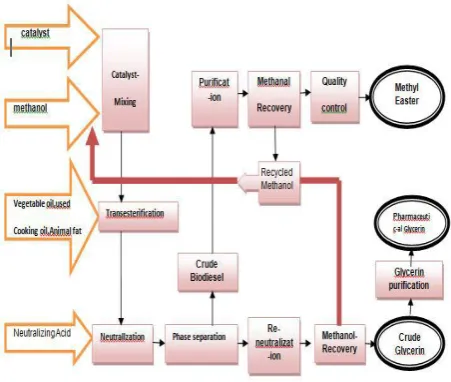
The reaction of a triglyceride with alcohol forms esters and glycerol, this process is Trans-esterification. A triglyceride has a glycerin molecule as its base with three long chain fatty acids attached. The nature of the fatty acids attached to the glycerin the characteristics of the fat. The nature of the fatty acids can in turn affect the characteristics of the biodiesel. The triglyceride is reacted with alcohol in the presence of a catalyst called as esterification process. The alcohol reacts with the fatty acids to form the mono-alkyl ester, or biodiesel and crude glycerol [2].
In most of the production process ethanol or methanol is used as the alcohol (methanol produces methyl esters, ethanol produces ethyl esters) and is base potassium or sodium hydroxide is used as catalyst. Potassium hydroxide has been found to be more suitable for the ethyl ester biodiesel production; either base can be used for the methyl ester. The Rape Methyl Ester (RME) produced from raw rapeseed oil reacted with methanol produced from the trans-esterification process.
© 2017, IRJET | Impact Factor value: 5.181 | ISO 9001:2008 Certified Journal | Page 11 Fig 1. Process of Production of biodiesel
2. AIM AND OBJECTIVE
General objectives of the research will mainly focusing to study and identify the emission features of biodiesel respectively the Performance in Internal Combustion Engines on the use of selected blends of biofuels. Corresponding to the general objectives of the research the specific objectives of the study are as follows:
1)To compares the performance of various biodiesels with fossil diesel in multiple engine applications such as combined cooling heating and power (CCHP) systems, turbo charging, and the use of biodiesel as a transportation fuel. 2)To test the use of biodiesel in integrated cooling, heating system and single cylinder test engine.
3) To determine the performance of CCHP for suitability of biodiesel for stationary diesel engine cogeneration plants. 4) To test the selected engines in VRDE for selected blends of biofuels to identify exhaust gas emissions.
5)To compare the and represent the numerical data obtain from calculations using fuel surrogates.
3.
PROBLEM
STATEMENT
There has been plenty of research done so far on emissions testing and biodiesel production. The inventions in biodiesel are towards making it more economical, environmentally flexible, decreasing the production cost etc. Where the research has been lacking is in relation to the better characterization of the performance of these fuels in all possible diesel applications
4.
SCOPE
OF
PRESENT
WORK
The paper gives the comparison between performance of various biodiesels with fossil diesel in multiple engine applications such as combined cooling heating and power (CCHP) systems, turbocharging, and the use of biodiesel as a transportation fuel. The goal of this work is to determine the usefulness of various biodiesels in a fully integrated combined cooling heating and power (CCHP) system, as well as in a single cylinder test engine. The performance of CCHP will help to determine the suitability of biodiesel for stationary diesel engine cogeneration plants. The turbocharger installed in the diesel engine for the CCHP system will be instrumented and the turbocharger efficiency will be monitored. The performance data of biodiesel in single cylinder test engines is studied using PV diagrams.
5. RESEARCH METHODOLOGY
5.1 Experimental engine research: To find out how different types of fuels affect the emissions in diesel engines, experimental engine research is essential. Experimental engine research refers to any experiment done with any type of engine to determine how emission measurements, cylinder pressure measurements and engine torque measurements are done during experiments. While running engine experiments, emissions were collected from the exhaust, cylinder pressure can be measured inside the combustion chamber and the engine torque was measured from the crank shaft. There are several techniques and different equipment to use, and with stricter emissions standards more is required from the measurement equipment. The simulations were done using two different surrogate fuels for conventional diesel, n-heptane and a mixture of n-decane and 1–methylnaphthalene. But also methyldecanoate as a surrogate for biodiesel, Experimental study on biodiesel in engine test rig to identify Combustion and Nitrogen oxides emissions using gas analyzer (Horiba)
© 2017, IRJET | Impact Factor value: 5.181 | ISO 9001:2008 Certified Journal | Page 12
6. OUTLINE OF THESIS
This thesis is beginning with chapter 1 of introduction of the research which thorough walkthrough of the relevant theory. Aim and Objective, Problem Statement, Scope of Present Work, and Research methodology includes Experimental engine research and Numerical engine research. Chapter 2 Literature Review is of First with the theory of the combustion engine and Emissions in Diesel engines then narrows down to diesel engine emissions, Fuel Properties and Emissions and biofuel theory respectively. Then it terms the theory behind experimental and numerical engine research is discussed. Chapter 3 is provided a Methodology and Experiments. Experimental Setup for Single-Cylinder Diesel Engine, including the main components, instrumentation, and data acquisition systems (DAQ) and goes through the procedures and setup for the engine experiments, the numerical simulation and the processing of the resulting data and Experiment Equipment and Setup for Testing Internal Combustion Engines which includes Water-Brake, Water-brake system setup, Sensors, etc. further details of Experiment Test Procedure Simulation and data processing. CCHP Tests with a Four-Cylinder Diesel Engine with Experimental Setup, Procedure and DAQ. Chapter 4 is of Results and Discussion which includes Results of Emission in Internal Combustion Engines and Experimental Results of Engine Performance Using Biodiesel Fuels. The thermodynamic analysis of the CCHP system is shown, including two heat recovery methods (steam generating and hot water heating) as well as the enthalpy changes associated with the turbocharger. The experiments in this thesis are performed with a modern turbocharged diesel engine, the engine conditions are simulated using the software LOGE soft, and all gathered data is processed using Matlab. The report finishes with a presentation of the results. The experimental results are presented in section respective, before the simulated results in separate section. Lastly, the concluding remarks are given in Chapter 5 which includes Conclusions of Emission in Internal Combustion Engines Using Biodiesels and Conclusions of Engine Performance with Biodiesel. At the end of the thesis References and Appendix are give.
7.ACTUAL EXPERIMENTAL SET-UP
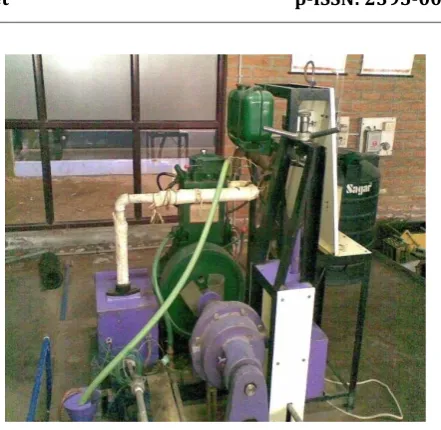
[image:3.595.326.547.72.287.2]A single cylinder 4-stroke water-cooled compression ignition engine manufactured by Rocket Engineering Corp. Ltd., Udhyam nagar, Kolhapur was used in the present experimental investigation as shown in Fig.
Fig 2. Experimental Setup
Engine Following instruments were used to measure various parameters of performance and emission characteristics of the said engine.
8. EXPERIMENTAL PROCEDURE
The engine was started with neat diesel as fuel at no load by pressing the inlet with decompression lever and it was released suddenly when the engine was hand cranked at sufficient speed and it was allowed to run about half an hour till the steady state conditions reached. The engine was then loaded gradually from no load to full load (i.e. 0% to 100%) in the step of 20% keeping the speed within the permissible range and the observations of different parameters were recorded. With the fuel measuring apparatus and stop watch the time elapsed for the fuel consumption for 25 cc of fuel was measured. The other observations recorded were brake load reading, engine speed, exhaust gas temperature, cooling water inlet & outlet temperatures etc. Besides these parameters, CO (carbon monoxide), HC (hydro carbon) emissions were also measured. This experiment was taken into account to prepare base line data for neat diesel. The various blends of jatropha oil methyl ester, ethanol with diesel that was tested on same engine in the same manner as described above are as follows
© 2017, IRJET | Impact Factor value: 5.181 | ISO 9001:2008 Certified Journal | Page 13 Table-1
Sr. No. Brake Load Speed
Time for 100cc fuel Consu.
Cooling water
Exhaust Gas Temp
Exhaust Emissions
Inlet
Temp. Outlet temp. CO HC
Unit Kg RPM Sec 0C 0C 0C % Ppm
1 0 1570 760 30 35 72 0.008 10
2 3 1560 560 30 37 75 0.02 30
3 6 1530 370 30 38 91 0.028 33
4 9 1520 280 30 40 110 0.047 41
5 12 1510 270 30 42 120 0.049 45
Table-2
Sr. No. Brake Load Speed
Time for 100cc fuel Consu.
Cooling water
Exhaust Gas Temp
Exhaust Emissions
Inlet
Temp. Outlet temp. CO HC
Unit Kg RPM Sec 0C 0C 0C % Ppm
1 0 1570 770 30 32 73 0.01 12
2 3 1560 550 31 35 81 0.02 14
3 6 1530 340 32 38 96 0.03 15
4 9 1520 306 35 44 105 0.03 17
© 2017, IRJET | Impact Factor value: 5.181 | ISO 9001:2008 Certified Journal | Page 14 Table-3
Sr. No.
Brake Load (W)
Speed
(N) Brake Power Fuel Cons.
Brake Spec. fuel Cons.
Brake Spec. energy Cons.
Brake Thermal Eff.
Exhaust Gas Temp.
Exhaust Emissions
CO HC
Unit Kg PRM KW gm/hr gm/kW hr kJ/Kw Hr % 0C % ppm
1 0 1560 0 420 0 0 0 70 0.00 10
2 3 1550 0.936 552.72 539.08 24338.51 15.79 75 0.01 30
3 6 1520 1.975 865 486.67 18958.8 19.98 91 0.02 30
4 9 1510 2.59 1186.20 369.32 15526.57 26.76 124 0.03 40
5 12 1500 3.51 1266.67 324.46 12875.47 29.17 129 0.05 43
Table-4
Sr. No.
Brake Load (W)
Speed
(N) Brake Power Fuel Cons.
Brake Spec. fuel Cons.
Brake Spec. energy Cons.
Brake Thermal Eff.
Exhaust Gas Temp.
Exhaust Emissions
CO HC
Unit Kg PRM KW gm/hr gm/kW hr kJ/Kw Hr % 0C % ppm
1 0 1560 0 409 0 0 0 72 0.00 11
2 3 1550 0.966 562.22 598 24544.6 15.82 81 0.01 13
3 6 1520 1.885 926.67 495.11 20369.9 18.84 93 0.02 16
4 9 1510 2.99 1039.11 338.96 14021.24 36.75 117 0.03 18
© 2017, IRJET | Impact Factor value: 5.181 | ISO 9001:2008 Certified Journal | Page 15
9. RESULTS AND DISCUSSION
a) Brake Specific Fuel Consumption:
0 100 200 300 400 500 600 700
0 0.956 1.875 2.79 3.71
B
SF
C
(
gm
/kWHr
)
Brake Power (kW)
Fig 2 B.S.F.C.(gm/kW-hr) Vs B.P.(kW)
Brake Specific Fuel Consumption (B.S.F.C.) is the fuel consumed by the engine per unit of power output or produced. For fuel tested, decrease in B.S.F.C. was found with increase in brake power. It can be seen from this graph that as Brake Power increases, B.S.F.C. decreases to minimum at full load condition. By observing related results at full load engine condition, the value of B.S.F.C. for D70B20E10 blend is minimum. As compared to diesel, calorific value of biodiesel is less, so slight rise in Brake Specific Fuel Consumption was found in the blends D80B15E5, D70B20E10, D70B25E5 than Diesel fuel.
b) Brake Specific Energy Consumption:
Brake Specific Energy Consumption (B.S.E.C.) is the energy used by the engine to produce unit power. For fuel tested, decrease in B.S.E.C. was found with increase in brake power. It can be seen from this graph that as Brake Power increases, B.S.E.C decreases to minimum at full load condition by observing related results at full load engine condition, the value of B.S.E.C. for D70B20E10 blend is minimum. As compared to diesel
0 5000 10000 15000 20000 25000 30000 35000
0 0.956 1.875 2.79 3.71
B
SE
C
(k
J/
kWH
r)
Brake Power (kW)
Fig 3 B.S.E.C.(kJ/kW-hr) Vs B.P.(kW)
Calorific value of biodiesel is less, so slight rise in Brake Specific Energy Consumption was found in the blends D80B15E5, D70B20E10, D70B25E5 than Diesel fuel.
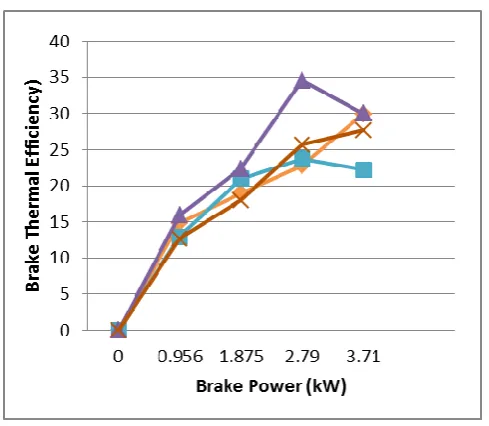
c) BRAKE THERMAL EFFICIENCY:
Fig 4 BRAKE THERMAL EFFI (%) Vs B.P. (kW)
[image:6.595.308.550.97.277.2] [image:6.595.52.284.129.345.2] [image:6.595.307.552.413.626.2]© 2017, IRJET | Impact Factor value: 5.181 | ISO 9001:2008 Certified Journal | Page 16
10. ENGINE EMISSION GRAPHS & DISCUSSIONS
a) Hydro Carbon (Hc): Fig. HC (ppm) Vs B.P. (kW)At different load conditions, Hydrocarbons (HC) were recorded by “Gas Analyzer” for various blends of diesel, biodiesel and ethanol i.e. D80B15E5, D70B20E10 and D70B25E5. The partially decomposed and oxidized fuels in exhaust, which are unburnt species, are collectively known as unburnt hydrocarbon emissions.Fig shows graph for variation of HC emission with respect to brake power for various blends of diesel, bio-diesel and ethanol. HC emission for diesel fuel is slightly higher at low load than other three blends.
0 10 20 30 40 50 60
0 0.956 1.875 2.79 3.71
H
c
(p
p
m
)
Brake Power (kW)
Fig 5 Hc (Ppm) Vs B.P. (kW)
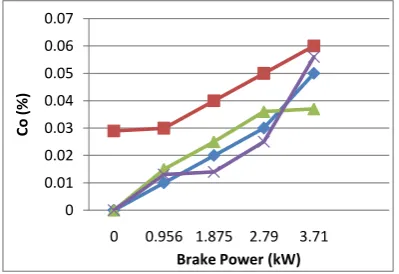
b) Carbon Monoxide (Co): At different load conditions, Carbon Monoxide (CO) was recorded by Gas-Analyzer for various blends of diesel,biodiesel & ethanol i.e. D80B15E5, D70B20E10, D70B25E5. Fig shows graph for variation of CO emission with respect to brake power for various blends of diesel, biodiesel and ethanol. It can be seen from graph that the CO emissions are low for various blends than diesel fuel because the biodiesel has higher cetane number than diesel fuel.
0 0.01 0.02 0.03 0.04 0.05 0.06 0.07
0 0.956 1.875 2.79 3.71
C
o
(%
)
[image:7.595.311.511.103.240.2]Brake Power (kW)
Fig. 6 CO (%) Vs B.P (kW)
11. CONCLUSIONS
The experimental results leads to flowing conclusions,
Engine can be run with biodiesel, ethanol and its diesel blends, i.e. D80B15E5, D70B20E10, & D70B25E5 without any abnormality and engine modification.
As fuel properties point of view density and pour point of all the fuel blends under the standard limits for diesel fuel
Due to higher density, lower calorific value of biodiesel and lower density, lower calorific value of ethanol , brake thermal efficiency of these fuel blends in sequence of D80B15E5, D70B20E10, & D70B25E5 are observed slightly lower compared to diesel & B.S.F.C. and B.S.E.C. are slightly higher for these blends in same sequence.
As biodiesel acts as combustion promoter in engine which has higher cetane no. & more oxygen compared to diesel & ethanol both, which results in to better combustion of fuel so, HC emission for D70B20E10 fuel blend are observed lower than the all fuel/fuel blends & higher in case of D80B15E5 fuel blend.
Concerning CO emissions, they differ with the engine loads. At medium load, CO emission for D70B20E10 fuel blend is observed lower than the other fuel blends.
Compared to diesel & ethanol, biodiesel has higher viscosity so for better combustion nozzle opening pressure should be kept on higher side compared to that in case of diesel when D70B20E10 fuel blend is used.
[image:7.595.38.302.259.445.2]© 2017, IRJET | Impact Factor value: 5.181 | ISO 9001:2008 Certified Journal | Page 17
REFERENCES
[1]. Hazar. H. “Cotton methyl ester usage in a diesel engine
equipped with insulated combustion chamber”, Applied Energy, 87, 2010, pp.134-140.[2]. Radinko G., Jeremija J., Djuro B., and Velimir P. “Potential and limitations of alternative fuels for diesel engine”, Thermal Science, Vol. 13, No.3, 2009, pp. 175-183.
[3]. Lapuerta M., Armas O., Garcia- Gontreras R, “Stability of diesel-bioethanol blends for use in diesel engines”, Fuel, 86, 2007, pp. 1351-1357.
[4]. Wen Z., Virginia Co-operative Extension, (Consumer Report ISSN: 0010-7174),2006, pp. 1-3.
[5]. Quan B., “The effect of ethanol blended diesel fuels on emission from a diesel engine”, Atmospheric Environmeny, August-2003, pp.4965-4970.
[6]. Dipl.-Ing. Dominik R., Dr. Rainer J., “Biofuel Technology Handbook”, 2nd version, January-2008, pp.50-60.
[7]. Hansen A.C., “Ethanol-diesel fuel blends- a review”, ELSEVIER, Bio-Resource Technology, June-2004, pp.277- 284.
[8]. Valente A., “Effect of Soyabean Oil Ethyl Ester/Diesel Fuel Blends on Engine Efficiency.”, Spain Energy Fuels, 2009, 23(6), pp.3227-3235.
[9]. Mohanan P., “Evaluation of Performance and Emission Characteristics of 4-Stroke Single Cylinder Direct Injection Diesel Engine Fuelled with Sesame Methyl Ester and Diesel Fuel Blends”, ICAER-BOMBAY-IIT, 2007, pp.1-18.
[10]. Tiwari D.N. “Report of the committee on development of bio-fuel” , April-2003,pp.49-53.
[11]. Pathak S.C., Soni S. L., “Performance and Emission Characteristics of Direct Injection Diesel Engine using Neem- Diesel Blends.”IE(I) Journal . MC-vol-86,pp.77-83.