© 2017, IRJET | Impact Factor value: 6.171 | ISO 9001:2008 Certified Journal
| Page 1542
Use of Fly ash and Plastic in Paver Block
1
Sarang Shashikant Pawar,
2Shubhankar Anant Bujone
1,2
student, Dept. of project construction management (MBA), MIT College of Management,
Pune, Maharashtra, India
---***---
Abstract
-
use of concrete paver block is now a day becoming popular, they are used for paving of approaches, paths and parking area and also the pre-engineering building and pavements. This paper discusses the result of an experimental study conducted on fly ash, plastic sag strip and wire plastic. The concrete for paver block which is made up by adding plastic in concrete help to reduce plastic bag and also improve the tensile properties of the paver block. Using this type of the plastic and fly ash will reduce the cost of the paver block.Key Words — Compressive strength, use of waste plastic, fly ash concrete, paver blocks.
1. INTRODUCTION
Now a days concrete plays an important role in every construction industries practices. Paver block is an attractive engineering and economical alternative to both flexible and rigid pavement in various countries. Interlocking concrete pavements are special dry mix precast piece of concrete commonly used in exterior landscaping pavement applications. For better look, easy laying and finish paver block are ideal material. The strength, durability and aesthetically pleasing surfaces have made paving blocks attractive for many commercial, municipal and industrial applications such as parking areas, pedestrian walks, traffic intersections, container yards and roads. Stone sub based and levelling bed of is needed to install interlocking paver block. Concrete paver blocks are made with concrete basically consisting of cement, fine aggregates, coarse aggregates (10 mm and below), water, chemical pigments, etc. Overall performance of concrete paver blocks used are mainly governed by properties of materials, water cement ratio, mixing process and curing process. For outdoor flooring versatility in application interlocking paver are modern day solutions. To suit the imagination of landscape architectures and nature’s paver are having various shape, size and colour. They are placed in variety of pattern. There are many advantages of choosing outdoor paving tile to finish off a patio design or to tidy up your garden. They do not absorbed water when it is placed in places like garden and patio area.
Use of waste plastic in household is increases with time. The large component of plastic waste is
polyethylene, which contain polypropylene, polyethylene terephthalate and polystyrene. If we use this type of the plastic in our construction purposed it will help to recuse of waste materials.as the plastic has longer life and longer services we can use it in paver block. Because the amount of mineral aggregates required in concrete is large, the environmental benefits are not only related to the safe disposal of bulk waste, but also to the reduction of environmental impacts arising from the extraction of aggregates.
The use of wastage plastic in concrete paver blocks is aimed at reducing aggregates content and leading to better economy and durability. It will also help in safeguarding the environment effects and contribute towards the solution for safe disposal of wastage plastic.
2. OBJECTIVE
The present study aims at evaluating the performance of plastic concrete for paver blocks for use in pavements and other application areas. As compressive and durability are the most significant properties for concrete paver blocks, the same have been studied for various concrete mixes with varying percentages of material.
3. NEED
Why Plastics:Plastic has a number of properties, which exploited alone or together, which fulfil construction needs.
[1] Corrosion resistant.
[2] Good Insulation for cold, heat and sound saving
energy.
[3] It is economical and has a longer life.
[4] Maintenance free (such as painting is
minimized)
[5] Hygienic and clean
[6] Ease of processing / installation
[7] Light weight
© 2017, IRJET | Impact Factor value: 6.171 | ISO 9001:2008 Certified Journal
| Page 1543
water is required to fly ash compare to the Portlandcement.
[1] Low cost.
[2] Easily available.
[3] Can be used as an admixture.
[4] Great workability. [5] Reduces CO2 emissions
.
4. MATERIALS USED AND THEIR PROPERTIES
Cement
:
Cement used for the test was ordinary Portland cement of 43 grade confirming to IS 8112-1989.Table -1: Properties of cement
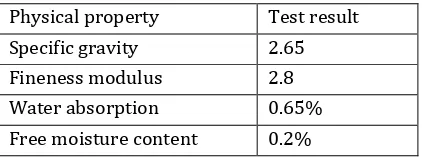
Fine Aggregate: Natural river sand was used as fine aggregate. The properties of sand conducting tests as per IS2386 (Part- I).
Table -2: Properties of Fine aggregate
Physical property Test result Specific gravity 2.65 Fineness modulus 2.8 Water absorption 0.65% Free moisture content 0.2%
Water: Portable water free from impurities and salt used for casting and curing the concrete blocks as per IS – 456-2000.Water cement ratio is 0.45.
[image:2.595.54.265.549.628.2]Plastic: Pieces Polyethylene bag which are commonly used for the packaging and carrying goods are used in concrete.
Table -3: Properties of plastic
Property NCA PCA
Specific gravity 2.74 0.9 Crushing value 28 2
Density 3.14 0.81
Fly ash: low cost by-product of burned coal. It is obtained from Thermal Power plant.
5. METHODOLOGY
Materials used for making the normal case paver block are
Cement
Dust (crushed aggregate sand) Stone chips (size ¼)
The materials we use in the concrete mix of the paver blocks are in the ratio 1: 2: 4 (cement: dust: stone chips)
For the purpose of making six block of paver of size 100 x100 x 100 mm size we need 2kg of cement, 4kg of
crushed aggregate sand and 8kg of stone chips.
Step 1: Take one pan, weight it on machinethen add the material as 2kg of cement, 4kg of crushed aggregate sand and 8kg of stone chips.
Step 2: Make ready the block of 100x 100 x100 mm by oiling it on its inner surface for the easy remoulding of the block.
Step 3: Mix the material with the help of shovel, after that add the water of 800 ml to it i.e. (0.4%) as per the IS code-15658-2006 requirement.
Step 4: While mixing the material simultaneously fill the bottom layer of the block by the cement slurry up to 4mm (slurry of cement n water in ratio 1:1) and let that slurry set for 10 minutes.(if required we can add color with the slurry)
Step 5: After that add that concrete in three levels with the tamping of 25 blows on each level for the purpose of compaction.
Step 6: After filling the blocks with the concrete keep it on the compactor machine for removing air voids from it. Step 7: After 24 hrs. remold the block n keep it for curing for 3days and 7 days.
In the same way we test it for replacement with plastic, fly ash with cement and aggregate.
Physical property Test result Standard consistency 28.7% Initial setting time 60 min Final setting time 600 min Specific gravity 3.21 Compressive strength in 3
days 30.5
Compressive strength in 7
© 2017, IRJET | Impact Factor value: 6.171 | ISO 9001:2008 Certified Journal
| Page 1544
6. EXPERIMENTAL INVESTIGATION
Environmental problems are created by using plastic bags which are used for carrying goods become a waste. Every year large amount of plastic waste produced. Recycle and reused of plastic require vast manpower and processing cost thus the very small amount of plastic recycled and reused and rest going into landfills, incinerators and dumps. To improve the properties of concrete, we use these plastic sag strips in a concrete as a plastic fibre. Use of plastic has both the advantages that it solves the problem of disposal of plastic up to some extent also cost of material is low.
7
.
RESULT
To calculate the compressive strength of paver block the universal testing machine is used. Compressive strength is calculated by following formula:
Compressive Strength = Load/area
7.1 CASE 1 - Normal Case
Material used – Cement Dust (crushed aggregate sand) Stone chips (size ¼)
Day of curing -3 days
Compressive strength for 3days -15 KN/M2
Compressive strength for 7days-18 KN/M2
CHART –1: Comparison of compressive strength for 3 days and 7 days curing of paver block
7.2 CASE 2 – Replacement Of 10% Fly Ash with
Cement
Material used -Cement + 10% fly ash Dust (crushed aggregate sand) Stone chips (size ¼)
Day of curing -3 days and 7 days
Compressive strength for 3days -14.3 KN/M2
Compressive strength for 7days -17.6 KN/M2
CHART -2: Comparison of compressive strength for 3 days and 7 days curing of paver block
7.3 CASE 3 - Replacement Of 20% Fly Ash with
Cement
Material used -Cement + 20% fly ash Dust (crushed aggregate sand) Stone chips (size ¼)
Day of curing -3 days& 7 days
Compressive strength for 3days -16.4 KN/M2
Compressive strength for 7days-19.8 KN/M2
CHART - 3 Comparison of compressive strength for 3 days and 7 days curing of paver block
7.4 CASE 4 - Replacement Of 30% Fly Ash with
Cement
Material used -Cement + 30% fly ash Dust (crushed aggregate sand) Stone chips (size ¼)
12 14 16 18 20
3 DAYS 7 DAYS
Co
mp
ress
iv
e
str
e
n
gth
(K
N
/m2
)
Days of curing
CASE 1 - NORMAL CASE
0 10 20
3 DAYS 7 DAYS
C
o
mpress
iv
e
str
en
gth
(K
N
/m2
)
Days of curing
Replacement of 10% Fly ash with
cement
0 10 20 30
3 DAYS 7 DAYS
C
o
mpress
iv
e
str
e
n
gth
(K
N
/m2
)
Days of curing
© 2017, IRJET | Impact Factor value: 6.171 | ISO 9001:2008 Certified Journal
| Page 1545
Day of curing -3 days & 7 daysCompressive strength for 3days -13.4KN/M2
Compressive strength for 7days-15.2KN/M2
CHART - 4: Comparison of compressive strength for 3 days and 7 days curing of paver block
7.5 CASE5 - Replacement Of 10% Plastic with
Crush Aggregate
Material used - Cement Dust (crushed aggregate sand) Plastic sag strips
Stone chips (size ¼)
Day of curing -3 days & 7 day
Compressive strength for 3days -19.3 KN/M2
Compressive strength for 7days -22.1 KN/M2
CHART - 5: Comparison of compressive strength for 3 days and 7 days curing of paver block
7.6 CASE 6-Replacement Of 20% Plastic With
Crush Aggregate
Material used – Cement
Dust (crushed aggregate sand) Plastic sag strips
Stone chips (size ¼)
Day of curing -3 days & 7 day
Compressive strength for 3days -21.2KN/M2
Compressive strength for 7days -24.4KN/M2
CHART - 6: Comparison of compressive strength for 3 days and 7 days curing of paver block
7.6
CASE 6 - Replacement Of 20% Plastic with
Crush Aggregate
Material used - Cement Dust (crushed aggregate sand) Plastic sag strips
Stone chips (size ¼)
Day of curing -3 days & 7 day
Compressive strength for 3days - 22.1KN/M2
Compressive strength for 7days - 25.7KN/M2
CHART - 7: Comparison of compressive strength for 3 days and 7 days curing of paver block
12.5 13 13.5 14 14.5 15 15.5
3 DAYS 7 DAYS
Co m p re ssi ve str e n gth (K N /m 2)
Days of curing
Replacement of 30% fly ash with
cement
17 18 19 20 21 22 233 DAYS 7 DAYS
Co
mp
ress
iv
e
str
e
n
gth
(K
N
/m2
)
Days of curing
Replacement of 10% plastic with crush
aggregate
19 20 21 22 23 24 253 DAYS 7 DAYS
C
o
mpress
iv
e
str
en
gth
(K
N
/m2
)
Days of curing
Replacement of 20% plastic wire with crush aggegate 20 21 22 23 24 25 26
3 DAYS 7 DAYS
C
o
mpress
iv
e
str
e
n
gth
(K
N
/m2
)
Days of curing
© 2017, IRJET | Impact Factor value: 6.171 | ISO 9001:2008 Certified Journal
| Page 1546
7.8 Overall Results of Compressive Strength Of
Paver Block
CHART - 8: Comparison of compressive strength for 3 days and 7 days curing of paver block for all above cases
8. CONCLUSION
We can conclude from the above discussion that the use of plastic can be possible to improve the properties of concrete which can act as a one of the plastic reusable method.
[1] Eco friendly
By using waste plastic in paver block 20 – 40% of plastic may reduce, it is also dangerous to environment and wildlife
[2] Strength increases up to 30-35%
Strength could be increased by using this plastic in the paver block by 30 to 35% by normal paver block and also help in reducing waste by 20 to 40%.
[3] Economical
As the plasticizer are not used in plastic concrete paver block the cost of plasticizers is reduces also plastic is zero cost material hence it also reduces the cost of plastic at some extend.
[4] Increases properties of concrete
9. REFFERNCES
[1] Neville, A. M., Properties of concrete, 4th edition,
Addison Wesley Longman, London, 1997
[2] Shetty, M. S., Concrete Technology, S. Chand and
company, New Delhi, 2005
[3] Gambir, M. L., Concrete Technology, 3rd edition,
Tata McGraw-Hill, New Delhi, 2007
[4] IS: 516-1959, Methods of test for strength of
concrete, Bureau of Indian Standards, New Delhi, 1959
[5] IS: 1199-1959, Methods of sampling and
analysis of concrete, Bureau of Indian Standards, New Delhi, 1959
[6] IS: 2386-1963, Methods of test for aggregates of
concrete, part I, III & IV, Bureau of Indian Standards, New Delhi, 1963
[7] IS: 383-1970, Specification for coarse and fine
aggregate, Bureau of Indian Standards, New Delhi, 1970
[8] Zoorob, S., E., Suparma, L., B., Laboratry design
and investigation of the properties of continuously graded Asphaltic concrete containing recycled plastics aggregate replacement (Plastiphalt), Cement and Concrete Composites, Vol 22, Issue 4, pp. 233-242, 2000
[9] Zainab, Z. I., Enas A. AL-Hasmi, Use of waste
plastic in concrete mixture as aggregate replacement, Waste Management, Vol 28, Issue 11, pp. 2041-2047, 2008
[10] Nabajyothi, S., Jorge, B., Use of plastic waste as
aggregate in cement mortar and concrete preparation: A review, Construction and Building Materials, Vol 34, pp. 385-401, 2012
[11] Al-Manaseer AA, Dalal TR, 1997, ‘Concrete
containing plastic aggregates’, Concrete International, vol. 19, no. 8, pp. 47–52.
[12] Avila AF, Duarte MV, 2003, ‘A mechanical
analysis on recycled PET/HDPE composites’, Polym Degrad Stabil, vol.80, no. 2, pp. 373–82.
[13] Baboo R, Tabin-Rushad S, Bhavesh KR, Duggal
SK, 2012, ‘Study of waste plastic mix concrete with plasticizer’, International Scholarly Research Network, ISRN Civ Eng, pp. 1–5.
[14] Batayneh M, Marie I, Asi I, 2007, ‘Use of selected
waste materials in concrete mixes’, Waste Management, vol. 27, no. 12, pp. 1870–1876.
0 5 10 15 20 25 30
1 2 3 4 5 6 7
COM
PRE
SS
IVE
S
R
EN
GTH
(K
N
/M
2)
DAYS OF CURING
© 2017, IRJET | Impact Factor value: 6.171 | ISO 9001:2008 Certified Journal
| Page 1547
[15] Brahim S, Mohammed S, Djamila A & Madani M,
2013, ‘The use of plastic waste as fine aggregate in the selfcompacting mortars: Effect on physical and mechanical properties’, Construction and Building Materials, vol. 43, pp. 436–442.
[16] Choi YW, Moon DJ, Chumg JS & Cho SK, 2005,
‘Effects of waste PET bottles aggregate on the properties of concrete. Cem Concr Res, vol. 35, pp. :776–81.
[17] Ferreira L, Brito JD & Saikia N, 2012, ‘Influence