IJEDR1603161
International Journal of Engineering Development and Research (www.ijedr.org)1011
Strategy For Resource Allocation Technique Using
Load Matrix Method In Wireless Cellular Systems
1
Mubashir Yaseen ,
2Matiur Rehman
1Research scholar, 2Lecturer
1Department of Electronics and Communication Engineering, Al-falah University ,Dhauj ,Faridabad, Haryana, India
______________________________________________________________________________________________
Abstract—Resource allocation is one of the greatest challenges in wireless cellular communication. The resource allocation schemes avoid wastage of resources by allocating resources to a mobile terminal over a short period of time, providing quality of service over wireless networks is the most stressing point for service providers. In general a high degree of sharing is efficient, but requires service protection mechanisms to guarantee the QoS (Quality of Service) for all services. In this paper we address the multi cell interference on overall radio resource utilization and propose a new strategy for resource allocation in multi cell systems. we also propose a joint management of interference within and between cells for allocation of radio resources,Simulation results are showing that there is a significant improvement in the resource utilization so that overall network performance. Several interference reduction techniques have been suggested in past and proved to be effective in reducing the interference to some extent and thereby increase system capacity. But, in a highly loaded system, the problem of intercellular interference remains an important issue. Thus, the intercellular interference problem of scheduling process is to be overcome by introducing a new and efficient resource allocation strategy called Load Matrix (LM). The proposed algorithm is to evaluated with existing resource allocation for performance evaluation. The suggested algorithm is to be developed on Matlab tool for its realization.
Key words—
:
Resource Allocation, QOS, Load Matrix, Interference Management.________________________________________________________________________________________________________
I.INTRODUCTION
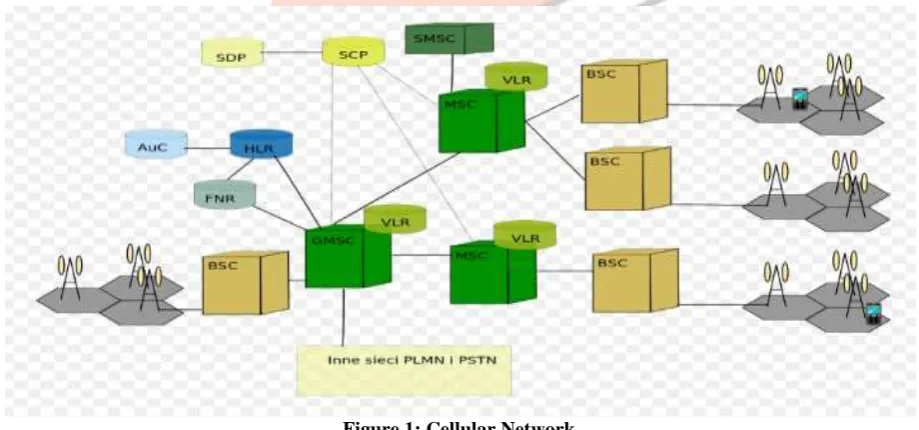
A cellular network is a radio network distributed over land through cells where each cell includes a fixed location transceiver known as base station. These cells together provide radio coverage over larger geographical areas. User equipment (UE), such as mobile phones, is therefore able to communicate even if the equipment is moving through cells during transmission.
Figure 1: Cellular Network
Demand for mobile communication has been increased these days and to meet this demand, allocation of the resources has become one of the important tasks. Allocation of the available bandwidth is the key factor in allocating the resources across the wireless cellular networks. Applications like multimedia require heavy bandwidth for the transmission. To increase the spectrum utilization and to maintain reasonable QoS, the efficient scheduling and allocation of resource should be adopted in order to satisfy this demand.
IJEDR1603161
International Journal of Engineering Development and Research (www.ijedr.org)1012
among the n number of cells. The only solution for the best resource allocation strategy is that the effective utilization of radio spectrum and this is required to meet the better QoS standards.II.RESOURCE ALLOCTION
In next generation networks a variety of services with different requirements , like real time communications, broadband Internet access, email services are expected. Consequently, packet scheduling mechanisms and resource allocation techniques for QoS guarantees will play a key role. The Radio resource allocation is a challenging problem in wireless networks due to different channel conditions of user and the main aim of resource allocation is to assign radio resources to individual users in order to achieve maximum capacity while meeting the required quality of service. A contiguous resource allocation scheme is defined for both the uplink and the downlink.
In uplink the distributed and centralized allocation schemes reduce the complexity of network. The resource allocation problem in these systems causes inefficient use of radio spectrums and to utilize multiple and maximize the system capacity, but they have to consider admission and access control in conjunction with resource allocation mechanism, subcarriers in wireless systems such as OFDM (orthogonal frequency division multiplexing). Allocating different number of subcarriers intelligently, the inefficiency issue can be handled. In order to provide various choices of scheduling performance and signaling overhead, multiple resources allocation types are defined. In multiuser OFDMA systems, multiuser diversity can be easily achieved by the allocation of subChannels to users, and these channels are independent for each user, with this the resource allocation problem for multiuser OFDMA systems has been extensively investigated. The quality of resource allocation can be assessed by overall throughput and fairness. In a wireless network environment the trade-off between throughput and fairness is important for scheduling. Due tothe nature of resource allocation (time and frequency), transmissions suffer no interference from within the cell and further see minimal interference from neighbouring cells.
III.GOAL AND DESIGN ISSUES
In an UMTS, the uplink cell capacity is basically limited by the total received uplink power at the base station due to the transmit power limitation of user terminals. In decentralized scheduling, each base station assigns radio resources to its users on a priority basis until the estimated Rise over Thermal noise (RoT) level reaches a pre-defined target. Recent studies in Enhanced Uplink UTRA (HSUPA),shows that the decentralized scheduling has better performance compared with centralized one.In theperformance of centralized packet scheduler of the UMTS system is evaluated while in the performance of a decentralized scheduling is evaluated and compared with the centralized one in. The basic advantage of decentralized over centralized approach is due to its fast response to dynamic and fast varying environment of mobile systems for resource allocation. But, the decentralized scheduling algorithms have an inherent shortcoming, due to their vulnerability to intercell interference. In other words, considerable proportion of RoT at the base station is made up from multiple access intercell interference which the base station has little knowledge about or control upon. This in turn may lead the system to interference outage and poor resource utilization particularly when interfering cells have similar traffic load variations. Antenna beam forming, and their combinations have been extensively proved to be effective in mitigating interference to someextent and thereby increase system capacity. In a highly loaded system, the problem of intercell interference remains an important issue and MUD with Minimum Mean Square Error (MMSE) detection MMSE-MUD is recognised as an effective interference suppression technique for increasing the system capacity. But it has been demonstrated that MMSE-MUD performs approaches that of a single user band in a fully loaded system. Although intercell interference problem is more severe in decentralized scheduling, it is also present in centralized scheduling due to the fact that the intercell interference impact of a scheduled user is not known and therefore has not been considered by the central scheduler. In this intercell interference problem of scheduling process addressed by introducing a new and efficient resource allocation strategy called Load Matrix (LM). In order to prove the concept, HSUPA(High Speed Uplink Packet Access)
system is used as a case study. It should be noted that although HSUPA system is used to demonstrate the performance of the Load Matrix, the concept is generic for single carrier spread spectrum based systems where cell RoT is widely used as a good load indication directly linked to cell load. In multi-carrier systems, the load on subcarriers can differ significantly and therefore RoT (averaged) is no longer a good measure for load over all subcarriers.The introduction of effective SINR (signal to interference noise ratio) inmulticarrier systems to provide a better and more accurate link system mapping.
IV.RESEARCH METHODOLOGY
Load matrix concept
The Load Matrix (LM) concept has the facility to joint management of interference within and between cells while allocating radio resources to users and this concept proposed intakes the intercell interference information into account in order to avoid RoT outage. In a multicell system one of the main challenge in resource allocation is the control of intercell interference. LM is a centralized scheduler, uses a database containing the load contribution of all active users in the network and it assigns radio resources to all active users in the network.The basic problem in the uplink scheduler is to assign appropriate transmission rate and time to all active users, result maximum radio resource utilization across the network while satisfying the QoS requirements ofall the users.
The important factor in the resource allocation is the users transmit power. The constraints to be satisfied for a network of M users and N cells are
Constraint1: This constraint states that the maximum user power Pi,max . For each active user i in the network, its transmit power Pi must be maintained in an acceptable region defined as
IJEDR1603161
International Journal of Engineering Development and Research (www.ijedr.org)1013
Constrain2: The total received power at base station should be kept below a certain threshold for all N base stations in the network it uses Rise over Thermal noise (RoT) to represent the interference constraints.RoTj ≤ RoT target J ε {1,….,N} (II)
RoTj is the total in band received power fixed target value to maintain uplink interference level at the base station j (BSj ) over thermal noise. The RoTj for M active users in the network given below is used to estimate RoT of cells, can be written as
(III)
Constraint3 : The signal to noise plus interference ratio required at the serving base station j if rate k is being assign to the user to achieve a given frame error rate is SINRtarget,k . For each user, depending on its channel type and speed, each rate k has a minimum required SINR called SINRtarget,k . This constraint satisfies only by considering SINRtarget,k as SINR.
SINR i,j ≥ SINRtarget,k i ε{1,….,M}, k ε {1,…,K} (IV)
Figure 2. Centralize LM Scheduling in a 3G LTE System.
LM scheduling can be implemented in both centralized and decentralized strategies. In a central scheduler entity assigns radio resources to all the users in the network where as in decentralized scheduling each base station implemented with identical LM scheduling, Figure. 2 is implementation of LM scheduling for the 3rd Generation Long-Term Evolution (3G LTE).
V.RESULT AND DISCUSSION
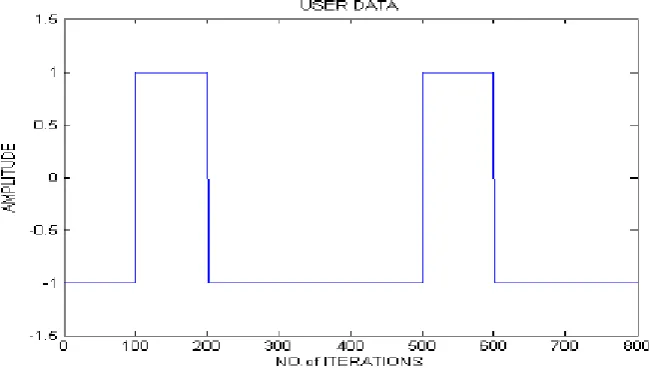
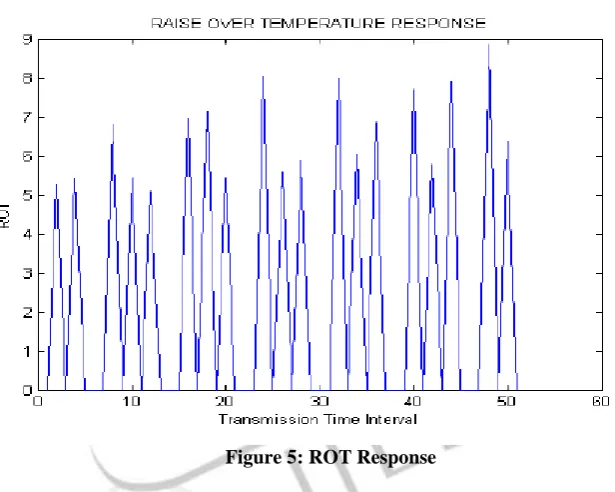
In this thesis, To evaluate the performance of the LM concept a HSUPA system simulator is used in a simulation scenario consisting of 16 cells with 8 users in each cell randomly and uniformly distributed. The RoT is set at 5.23dB with carrier frequency of 2GHz and simulation time 20 sec. LM scheduler has the capability to maintain RoT not to exceed its target. LM scheduling is compared with Benchmark algorithm to show effictiveness of Load Matrix concept and to carry the performance of resource allocation in terms of interference outage probability and average cell throughput. The user data, BPSK modulated signal and RoT response have been
IJEDR1603161
International Journal of Engineering Development and Research (www.ijedr.org)1014
Figure. 3 User dataFigure 4. BPSK Modulated Signal
Figure 5: ROT Response
VI.CONCLUSION
In this paper we have evaluated system capacity and fairness performance of several transmission schemes with LM scheduling. LM concept is presented specifically to provide an efficient resource allocation by jointly considering inter cell and intracellular interferences before allocating radio resources. A novel approach towards efficient uplink scheduling is presented. The importance of resource allocation mechanisms is discussed. We have developed a system level simulator for HSUPA system based on the proposed simulation conditions. The effect on the scheduling performance can be observed in the simulation results provided and these results indicate that selection of RoT as well as transmit power significantly affect the performance. By incorporating a new concept of separate margins for inter cell and intra cell interferences in the LM has better control over interferences results high overall network performance.
VII.FUTURE SCOPE
This work focus on the development of a resource allocation algorithm for wireless channel based on the raise of thermal (RoT), this work can be incorporated with the other scheduling scheme such as frequency and time slotting for the efficient usage of the resource in the channel.
REFERENCES
[1] Mohammad Abaii, Yajian Liu, and Rahim Tafazolli, An Efficient Resource Allocation Strategy for Future Wireless Cellular Systems, IEEE Transactions on wireless communications, Vol. 7, No. 8, AUGUST 2008‘.
[2] Mohamed kadhem karray,yasir khan(2012) “Evaluation and comparison of resource Allocation strategies for new streaming services in wireless cellular networks”, IEEE 2012.
IJEDR1603161
International Journal of Engineering Development and Research (www.ijedr.org)1015
[4] L. Wu and Z. Tian, “Capacity-Maximizing Resource Allocation for Data-Aided Timing and Channel Estimation”IEEEInternational Conference on Acoustics, Speech and Signal Proceeding, Montreal, Canada, vol. 4, pp. 525–528, May 2004.
[5] Khan, F., “A time-orthogonal CDMA high speed uplink data transmission scheme for 3G and beyond,” IEEE Communication Magazine, pp. 88–94, Feb. 2005
[6] Hannes Ekstrom, Anders Furuskar, Stefan Parkvall, “Technical Solutions for the 3G Long-Term Evolution,”IEEE Communications Magazine, pp 38-45, March 2006.