© 2017, IRJET | Impact Factor value: 5.181 | ISO 9001:2008 Certified Journal | Page 253
Determination of variability of properties of bituminous mixes on
variation of shape of the particles
Akshay J
1, Inchara K P
21
Assistant Professor, Dept. of Civil Engineering, KIT, Karnataka, India
2Assistant Professor, Dept. of Civil Engineering, KIT, Karnataka, India
---***---Abstract -
A pavement is a structure constructed with anobject of providing safe, durable and good riding surface over a desirable period with minimum maintenance .This obviously makes the pavement to meet certain functional and structural requirements during its lifetime. The ability to characterize asphalt pavement materials in terms of fundamental properties is becoming increasingly more important.
The need of accurate, consistent volumetric of HMA has become increasingly important in few years. This change has come about because more and more states are utilizing volumetric measurements to design the HMA mixtures and then to evaluate them during constructions. Since volumetric measurements are now widely used for quality assurance, hence it has become the major concern for the contractor to measure these properties with accuracy and reliability.
In the HMA mix it is also important to assure the quality of bitumen and aggregates in the mixture. The shape and surface texture of aggregates in the mixture must be of suitable quality with angular shaped and rough textured. The physical properties of coarse aggregates are more significant in new generation bituminous mixtures. The strength and serviceability requirements of bituminous mixture such as Stability, Flow, Voids in Mineral Aggregate (VMA), Voids Filled with Bitumen (VFB), Air Voids (Va) highly depend on the physical properties of aggregates.
Combined Index is an important physical property of mineral aggregates which affects the quality of bituminous mixes. In this study, the influence of Combined Index aggregates on the properties of most commonly used bituminous mixes in India such as Dense Bituminous Macadam (DBM) mixes are analysed with different proportions of Combined Index aggregate and conclusions are drawn.
Key Words: Stability, Flow, Voids in Mineral Aggregate (VMA), Voids Filled with Bitumen (VFB), Air Voids (Va), Ministry of Road Transport and Highways (MoRTH).
1. INTRODUCTION
The design of bituminous mixture by Marshall Method involves the proportioning of the aggregates and bitumen to produce a mix that will have the optimum qualities and properties. The purpose is to develop a design, by trial mean, which will contain optimum amount of bitumen, having adequate voids, satisfactory flow properties
and possess a planned combination of stability, durability and flexibility, based on the climatic condition, traffic density and loads it is intended to carry.
HMA is one type of premix widely used in road construction worldwide. It is considered by many highway engineers as premier material. Term of “hot mix “comes from aggregate and bitumen dried and heated for proper mixing and workability and mix together with desired temperature.
The aggregate and asphalt will be combined in an asphalt mixing plant in which it will be proportioned , heated , and mixed to a desired paving mixture. This mixture must consist of minimum combined index aggregates so as to with stand the preliminary compacter load and also for future upcoming heavy loads of traffic. After the plant mixing is complete, the mix is transported to site and spread with paving machine in loosely compacted layer to uniform, Smooth surface then the mix will be compacted by heavy roller to produce smooth and well consolidated course.
Compaction is one of major issues in HMA and important criteria in process to produce good quality of hot mix asphalt. Temperature controls asphalt cement viscosity which affect its ability to coat and provide adequate lubrication for aggregates and slides with each other and pack into dense mass compaction.
2. PRESENT INVESTIGATION
In the present study, the mix type chosen is Dense Bituminous Macadam. The Mix Design is done based on Marshall Method to meet the requirements as specified in MoRTH (IV revision) Specification.
2.1 Main Constituents of HMA Mix
Mixture stiffness can be varied by the temperature, speed of loading, level of compaction and type of bitumen. ● Coarse Aggregates: Offers compressive and shear strength and shows good interlocking properties. Material retained on 2.36mm IS sieve is taken as coarse aggregates.
© 2017, IRJET | Impact Factor value: 5.181 | ISO 9001:2008 Certified Journal | Page 254 ● Filler: Fills the voids between the fine aggregates, stiffens
the binder and offers permeability. Lime or Quarry dusts are majorly used as filler materials.
● Binder: Fills the voids, cause particle adhesion. Bitumen is the binder material.
2.2 Gradation of aggregates
The aggregate gradation for Dense Bituminous Macadam mix Grading-I mid limit gradation was chosen as per table 500-10, of MoRTH (4th revision) specifications. Table 2.1: Gradation of aggregates as per MoRTH Specification
Sieve Size(mm) % Passing Specified Mid limit
45 100 100
37.5 95-100 97.5
26.5 63-93 78
13.2 55-75 65
4.75 38-54 46
2.36 28-42 35
0.30 7-21 14
0.075 2-8 5
2.3 Laboratory Investigations
In order to assess the quantitative and qualitative improvement in Marshall Stability, following Laboratory investigations were carried out:
1. Basic Tests on 60/70 grade Bitumen are carried out such as penetration test, softening point, Ductility Test, Specific Gravity Test, Flash point test.
2. Basic Tests on Aggregates are carried out such as Aggregate impact value test, Shape Test, Specific Gravity and Water absorption Tests, Aggregate Crushing Value. 3. Marshall Stability Tests on Dense Bituminous Macadam with 60/70 grade bitumen to determine optimum Binder content.
4. To Determine Marshall Properties on varying percentages of combined index particles in the mix. 2.4 Design of Dense Bituminous Macadam Mixes
The Main Objective of the Mix Design is to produce a bituminous mix by proportioning various components so as to have:
Sufficient Bitumen to ensure a durable pavement. Sufficient strength to resist shear deformation under
traffic at high temperature.
Sufficient Air Voids in the compacted specimen to allow for additional compaction by Traffic.
Sufficient Workability to permit easy placement without segregation.
Sufficient Flexibility to avoid premature cracking due to repeated bending by Traffic.
Not very High Stiffness at low temperatures to prevent shrinkage cracks.
2.4.1 Grain Size Analysis for proportioning of Materials The Grain Size Analysis was carried out by combining three sizes of materials into A, B, C varieties and the results are tabulated:
Table 2.2: Material A (5 kg of material was taken and sieved) IS sieves (mm) Weight of aggregate Retained (kg) Cumulative Weight Retained (kg) Cumulative % of material retained Cumulative % finer
45 0 0 0 100
37.5 2.80 2.8 56 44
[image:2.595.306.558.406.638.2]26.5 2.20 5.0 100 0
Table 2.3: Material B (5 kg of material was taken and sieved) IS sieves (mm) Weight of aggregate Retained (kg) Cumulative Weight Retained (kg) Cumulative % of material retained Cumulative % finer
26.5 1.03 1.03 20.6 79.4
13.2 3.52 4.55 91 9
4.75 0.445 5.0 100 0
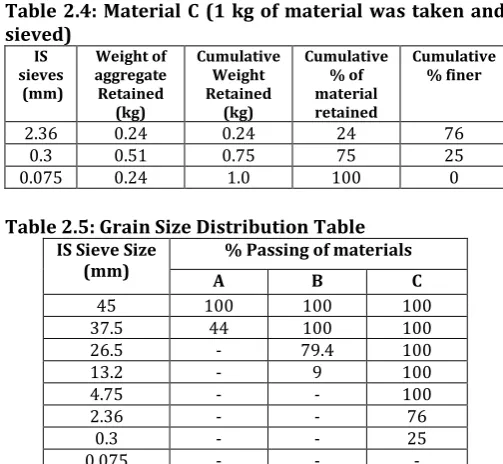
Table 2.4: Material C (1 kg of material was taken and sieved) IS sieves (mm) Weight of aggregate Retained (kg) Cumulative Weight Retained (kg) Cumulative % of material retained Cumulative % finer
2.36 0.24 0.24 24 76
0.3 0.51 0.75 75 25
0.075 0.24 1.0 100 0
Table 2.5: Grain Size Distribution Table IS Sieve Size
(mm) A % Passing of materials B C
45 100 100 100
37.5 44 100 100
26.5 - 79.4 100
13.2 - 9 100
4.75 - - 100
2.36 - - 76
0.3 - - 25
0.075 - - -
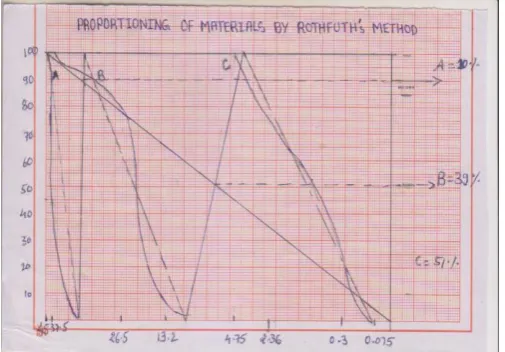
2.4.2 Proportioning of materials by Rothfutch’s method
This method may be used when a number of materials have to be mixed together for obtaining a design gradation. Procedure
© 2017, IRJET | Impact Factor value: 5.181 | ISO 9001:2008 Certified Journal | Page 255
On a graph paper, with y- axis representing percent passing and x- axis representing particle size, a diagonal line is drawn from a point corresponding to 100 percent passing to a point corresponding to zero percent passing.
The different sizes are marked on x- axis by using the mean values taken from the desired gradation table.
The grain size distribution curves of the four materials A, B and C are plotted on this chart.
Draw balancing straight lines for A, B, C allowing only minimum of the areas on either side of the balancing lines.
The opposite ends of the balancing straight lines of A and B are joined. This is done by joining zero percent passing of material A with 100 percent passing of B. Similarly the opposite ends of the B and C are joined; same is done for C and D.
Mark the points where the balancing lines meet the desired gradation line. These lines represent the proportions in which the materials A, B, C and D are to be mixed. These values may be read from the y-axis by projecting the points of intersection.
Calculate the obtained gradation by using the obtained proportions of the three materials A, B, C and D.
The obtained gradation should satisfy the requirements of desired gradation; otherwise the proportions are to be changed by trial and error method till the obtained gradation satisfies the requirements of desired gradation.
JOB MIX FORMULA
Table 2.6: Proportioning of Materials by Job Mix Formula
IS Sieve
Size (mm)
% Passing of
materials Obtained Gradation from Job Mix Formula obtained
from graph (0.1A+0.39B+0.51C)
Specified Gradation according MoRTH DBM:GRADE-1
MID LIMIT A B C
45 100 100 100 100 100 100
37.5 44 100 100 94.4 95-100 97.5
26.5 - 79.4 100 81.97 63-93 78
13.2 - 9 100 54.51 55-75 65
4.75 - - 100 51 38-54 46
2.36 - - 76 38.76 28-42 35
0.3 - - 25 12.75 7-21 14
0.07 - - - 5
Material A: 10% Material B: 39% Material C: 51%
MARSHALL STABILITY TEST
The Marshall Stability test is applicable to hot bituminous mix design using bitumen and aggregates with maximum size of 37.5mm.
In this method, the resistance to plastic deformation of cylindrical specimen of bituminous mixture is measured when the same is loaded. This test procedure is used in designing and evaluating bituminous paving mixes. The test procedure is extensively used in routine test programmed for paving jobs.
There are 2 major features of the Marshall method of designing mixes namely,
1. Density void analysis 2. Stability flow tests
The Marshall Stability of the mix is defined as maximum load carried by a compacted specimen at a standard test temperature at 60 degree Centigrade. The flow value is the deformation, the marshall test specimens undergoes during the loading up to the maximum load in 0.25mm units.
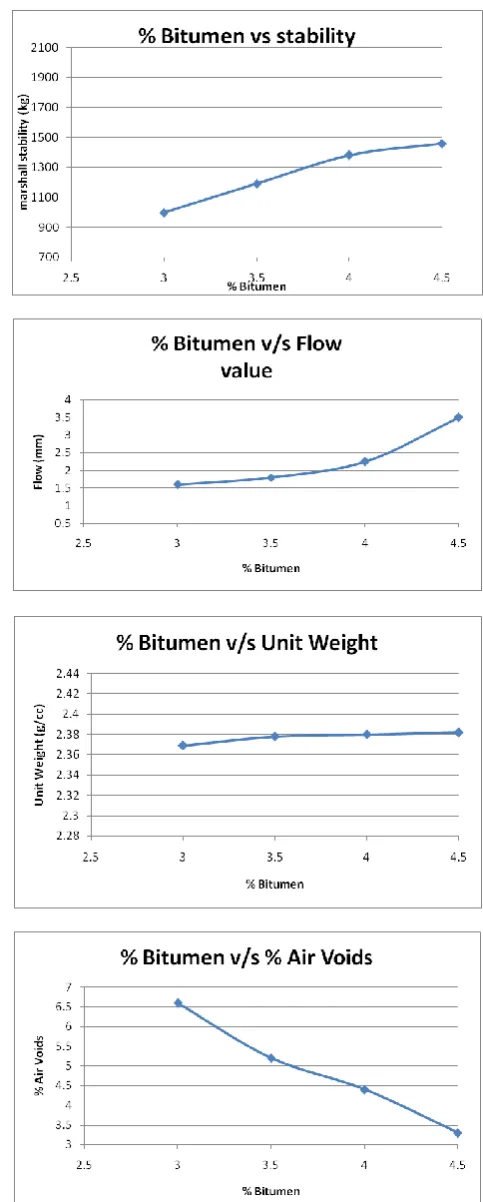
Marshall Test specimens were prepared by adding 3.0, 3.5, 4.0 and 4.5% of Bitumen. The compacted specimens were removed from moulds after 24 hours. The specimens were kept in thermostatically controlled water bath maintained at 60 degree Centigrade for 30 minutes. Graphs are plotted taking bitumen content (%) on X-axis and Marshall Stability value, flow value, bulk density, percentage of Air voids and percentage of voids filled with bitumen on Y-Axis.
The optimum Binder content for the mix is found by taking the average of following three bitumen contents from the graphs of the results:
[image:3.595.36.289.544.720.2]© 2017, IRJET | Impact Factor value: 5.181 | ISO 9001:2008 Certified Journal | Page 256
3. TEST RESULTS AND OBSERVATIONS
3.1 Aggregates
[image:4.595.79.550.122.767.2]The following basic tests were conducted on aggregates and results are presented in the below table: TABLE-3.1: Results of tests on Physical Properties of Aggregates
Sl
No. Description of Tests Results Test
Requirement as per MoRTH Specifications
1 Aggregate Impact Value % 24.45 Maximum:27%
2 Aggregate Crushing Value % 27.58 Maximum:30%
3 Combined Index % 36.64 Maximum:30%
4 Water Absorption % 0.675 Maximum:2%
5
Aggregate Specific Gravity
2.5-3
Coarse Aggregate 2.76
Fine Aggregate 2.72
Dust 2.85
3.2 Bitumen
The Bitumen used in this study is 60/70 grade bitumen. The Basic tests were conducted and the results are presented in the below table:
TABLE-3.2: Results of tests on physical properties of bitumen
Sl
No. Description of Tests Results Test Requirements as per IS: 73-2002
1 Bitumen Penetration 69 60-70
2 Specific Gravity 1.02 0.99(minimum)
3 Softening Point(◦C) 45 45-55
4 Ductility in cm 75 75(minimum)
5 Flash Point(◦C) 195 175(minimum)
Marshall Properties of DBM mix
TABLE 3.3: Marshall test results at 60◦c for 60/70 grade bitumen
Bitumen Content
%
Marshal Stability (kg)
Flow Value (mm)
Bulk
Density-Gb (g/cc)
Total Air Voids (Vv)%
Voids Filled with
Mineral
Aggregate-VMA%
Voids Filled with
Bitumen-VFB%
3.0 998.19 1.60 2.369 6.6 12.76 51.83
3.5 1190.08 1.80 2.378 5.2 13.02 59.89
4.0 1382.41 2.25 2.380 4.4 14.89 69.00
4.5 1459.20 3.50 2.382 3.3 15.02 75.00
[image:4.595.310.552.130.732.2]© 2017, IRJET | Impact Factor value: 5.181 | ISO 9001:2008 Certified Journal | Page 257 The optimum Binder content for the mix is found by
taking the average of following three bitumen contents from the graphs of the results:
1. Bitumen content corresponding to maximum stability. 2. Bitumen content corresponding to maximum unit weight. 3. Bitumen content corresponding to maximum 4% air voids.
Hence the optimum Bitumen Content is (4.5+4.5+4.45) / (3) = 4.5%
TABLE-3.4 shows Marshall Properties Values at Optimum Bitumen Content
Marshall
Properties DBM Grade-1 Results of Mix
Requirements as per MoRTH Specifications Optimum Binder
Content,% 4.5 Min 4.5%
Stability( kg) 1459.20 900
Flow Value(mm) 3.5 2 to 4
Bulk
Density(g/cmӠ) 2.382 -
Air Voids(Vv) 3.3 3 to 6
VMA (%) 15.02 Min 12.5%
VFB(%) 75.00 65 to 75%
Variation in Marshall Properties at varying
Percentages of combined index Aggregates at
Optimum Binder Content in the HMA Mix
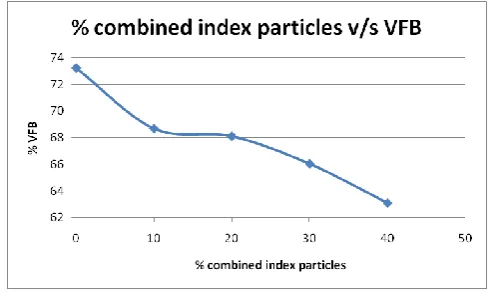
TABLE-3.5 shows Marshall Properties Values at varying percentages of combined index Aggregates
Combine
Index% Stability Marshal (kg)
Flow Value (mm)
Bulk Densit y-Gb (g/cc)
Total Air Voids (Vv)%
Voids Filled with Mineral
Aggregate-VMA%
Voids Filled with
Bitumen-VFB%
0 1892.20 3.70 2.378 4.11 14.60 73.21
10 1701.70 3.62 2.362 4.75 15.17 68.68
20 1677.80 3.58 2.359 4.87 15.27 68.10
30 1435.10 2.99 2.348 5.32 15.67 66.04
40 1216.00 2.52 2.331 6.00 16.28 63.11
© 2017, IRJET | Impact Factor value: 5.181 | ISO 9001:2008 Certified Journal | Page 258
4 DISCUSSIONS AND CONCLUSIONS
4.1 Discussions
Use of sub-standard aggregates leads to premature failure of pavements. Aggregates are responsible to decrease the magnitude of traffic wheel loads on the lower sub grade and earth mass by providing a load dispersion medium and hence traffic load is dispersed on wider area in lower layers. Aggregates may fail to serve the purpose under heavy wheel loads due to impact, crushing, abrasion and also due to breaking down of aggregates if excess flaky and elongated particles are there in the mix.
4.2 Conclusions
[image:6.595.38.284.99.245.2]1. Results of physical properties of the aggregates used in this study were tested and are presented in table-4.1 and test results are satisfying the requirements as per Table 500-8 of MoRTH(IV revision) specifications. 2. The physical properties of the plain binder used for this
study was tested and are presented in table-4.2 respectively and test results are satisfying the requirements as per IS: 73-1992 for plain Bitumen. 3. MARSHALL TEST PROPERTIES:
For Marshall Mix Design, optimum bitumen content was 4.5% for a DBM mix and it was meeting the requirement as per the MoRTH specification Table 500-11.
The parameters such as stability, flow, voids filled with bitumen and tensile decrease with increase in proportion of Combined Index aggregates for both DBM mixes.
The parameters such as air voids and voids in mineral aggregate increases with increase in proportion of Combined Index aggregates for DBM mixes.
Flakiness index up to 30% for DBM can be permitted without compromising the Specification requirements.
It’s not only the mere responsibility of the contractor to take care of the physical properties of aggregates before road construction even I want to stress on a point that it must be also the responsibility of the
crusher owners and operators to take care of the quality of aggregates produced by them, they would need to change their Crusher’s liner or the bit at regular intervals after breaking the specified quantity of rocks, if not which may result in the production of poor quality aggregates.
REFERENCES
[1] IRC “Specifications of Road and Bridge Works of Road
Transport and Highways”(MoRTH),Fourth Edition.2001.
[2] S.K. Khanna and Justo.C.E.G, “Highway Engineering” 8th Edition, Nemchand and Brothers Publications Roorkee 2001.
[3] S.K.Khanna and C.E.G.Justo-A.Veeraragavan, “Highway Materials and Pavement Testing”, Nemchand and Brothers Publications Roorkee 2001.
[4] IS 73-2002, “Paving Bitumen-Specification (Second Revision), Bureau of Indian Standards, Manak Bhavan, New Delhi.
[5] Freddy L Roberts,Prithvi S Khandal, ”Hot Mix Asphalt
Materials, mixture design and construction”-(2nd
Edition),National Asphalt Pavement Association Research and education Foundation, Maryland, USA.
[6] “Bituminous Materials in Road Construction”-HMSO,