© 2017, IRJET | Impact Factor value: 5.181 | ISO 9001:2008 Certified Journal | Page 1848
Implementation of an Efficient Smart Home System using MQTT
B.S.S.Tejesh
1, S. Neeraja
21
B.S.S.Tejesh, P.G. Student, Dept. of ECSE, KL University, Guntur.
2S.Neeraja, P.G Student Dept. of ECSE, KL University, Guntur.
---***---Abstract -
This paper aims to provide a smart system whichscales down the workload of working staff, contributing additional services, integration with the home environment by employing a community broker. The home environment consists of a smart home controller, sensors, devices that transfer information for the purpose of enhancing security. The community end consists of a central server, element like a personal computer which has the ability of associating with the devices that are in remote locations. The interface devices are employed so as to avoid the confusion between the functionality and user interface. The paper aims on both MQTT as well as HTTP services. The MQTT desires to implement services in smart home systems. The HTTP governs the transferring of location based data.
Key Words: Community broker, MQTT, HTTP, cloud
services, Smart Systems.
1.
INTRODUCTION
Day by day so many technologies are developing. In that the smart home systems are having a tremendous growth of normal network to home automation. Though the smart home technologies are being used currently but they are limited to individual houses. With the era of IoT, the traditional controlling systems are transforming to smart home systems. The smart home technologies are integrating with the IoT.
For best performance, to provide more services, effective management the cloud based services are coordinating with the smart home technology. The energy management systems in the home environments are equipped both inside and outside environments of the home. There may be issues regarding management. In real world approach the facilities like data and service sharing schemes among several entities is only possible by the community broker system. The community broker is a significant feature in this research.
The facilities like managing devices in the home environment is possible with the aid of community broker. The community broker provides many services like electronic services, labor requirement is eliminated. The location based services are implemented with the combination of community services and cloud services operating together. The MQTT protocol to provide control features in the smart home system. The HTTP protocol employed for transferring location based information.
2. RELATED WORK
In this paper the smart devices, multiple displays, cloud based services are the three classifications which are discussed below.
2.1 Smart devices
The Home energy management systems studies are being transformed from energy management in simple electrical appliances or devices to major or complex electrical appliance energy management. The data from home devices integrates with the cloud platform for deliberately increasing more services and security [1-3]. The Renewable energy like solar energy which is produced by the solar panels are causing issues with community spaces and HEMS spaces. It may also lead to overlap the operations and maintenance [4-6]. The smart home system provides the features like storing the data as well as access the information. The Safety in the home environment is mostly needed. The safety can be provided by integrating various sensors in the home environment [7-12]. In the smart home the functionalities like health care services can also be implemented with the use of cloud servers [13-15]. The sensor technology can facilitate more facilities like recognition of hand-gesture, activities involving in the detection of photos, recognition of emotion in the videos are some of the features enhanced in the sensor technology [16-19].
2.2 Multiple displays
Many display devices are there in this modern world. According to the convenience of the user, the user may utilize devices like tablet, PC, Phones. The user can operate or see the data of the devices with the display system [20], [21]. In the conventional interfaces the Televisions serve as home display devices. The integration of various sensors, enhancing of additional services is the new approach for multiple display [22], [23].
2.3 Cloud based services
© 2017, IRJET | Impact Factor value: 5.181 | ISO 9001:2008 Certified Journal | Page 1849 integrated for data communication, software must be timely
updated so that additional features can be provided, security must be enabled for data sharing between groups, local servers are employed for the fault diagnosis [26-277].
3. Proposed system Architecture
3.1Architecture of the overall system
In the smart home systems, the system is integrated in a single home with various sensors. The community networking facilitates the integration of single smart homes into a cloud server with the internet. The cloud platform provides added services by the integration of global services. The information can be transmitted by using wired or wireless connection between the home controller and other devices. The community management system provides all the facilities that a mart home requires.
3.2 Proposed System architecture
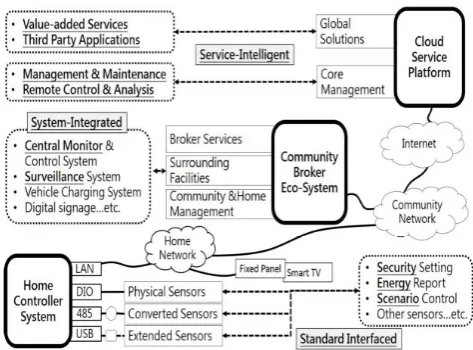
[image:2.595.319.562.235.398.2]The Figure 1 which describes the components that proposed architecture consists. The proposed architecture consists of a home controller system, community management system, cloud platforms. The conversion of sensors, to enable security, reporting the energy consumption are done with the Home controller system along with the digital input and output lines, USB cable, RS 485 wiring system. The features like home management, communication with cloud platform, central control system are managed in the community management system. The cloud platform enables the remote control and analysis of data from the devices. The smart services can be enhanced by integrating additional services and third party modules.
Fig -1: Proposed System Architecture.
3.3 Setting of devices at home
The figure 2 Shows the common interface, device settings, which are done in the home environment. Some common interfaces like LAN, digital input, output, Universal serial bus, RS 485 are equipped with the home controller system. By
Local Area Network the home Network can be employed with the community network.
[image:2.595.44.281.497.672.2]The physical devices such as magnetic reed switches, gas sensor are interfaced with the digital input and output lines of the controller systems. With the use of relays the light and curtain control mechanism is employed. The Rs-485 system used for analog Input and output conversions for the power meters, water meters, Temperature sensor, fire sensor, CO2 sensor. The Universal serial bus enables to extend the wireless devices by implementing the Zigbee protocol.
Fig -2: Predefined Interfaces of the system.
3.4 Functions in the community system
The figure 1 describes the detailed functions in the community management system. The community management acts like a gateway for providing services and also as a home management module. The security guards in the home are provided with the administrative role for managing residential affairs with a Graphical user interface. The GUI is used for creating logs of all the operations, also enabling security system, automating system.
© 2017, IRJET | Impact Factor value: 5.181 | ISO 9001:2008 Certified Journal | Page 1850
Fig -3: Platform services and modules on a cloud.
4. Implementation results and discussion
The home controller system consists of a total of six digital input devices, five digital output devices, RS-485, Universal bus interface. An integrated cabinet is used to maintain the overall performance of the home controller system, Water meter, power meter, network devices, relays and the required power supplies. The home controller system is the main element in the developed system, water meter and power meter are used to log the readings of power and water consumed, The network devices are used to enable communication with the outside world, the relays are used for voltage conversions. A touch panel is arranged at the entry of the door with all the functionalities of the devices. The magnetic reed switches are arranged at the doors and windows to enhance the security. The magnetic reed switches are activated whenever the doors or windows are opened. The activity of the magnetic reed switches is uploaded into the web server so that users can manage remotely. With the employment of PIR sensor more security enhancements are done. The PIR sensor is activated whenever there is a movement in the surroundings. The Emergency buttons are equipped with all the rooms. Whenever users, presses the emergency buttons the security alerted. The details of buttons are also logged into the web server. To prevent accidents due to any conditions in the home environment, the sensors like temperature sensor, fire sensor, CO2 are used. The temperature sensor measures the room temperature and logs all the measured data into the web server. The fire sensor is activated whenever the sensor detects any fire flame in the surroundings. The CO2 sensor measures are there any poisonous gases in the home environment. The data of these sensors are logged into the web server and also can send to the user via the mobile phone. The context-aware home automation facilitates users with the remote ON/OFF of electrical appliances, OPEN/CLOSE of curtains in the rooms.Fig -4: Web Server Results.
The Figure 4 represents the data from the devices and sensors into the web server. The 0’s represent the Magnetic switch, IR, PIR, CO2 sensor is in off state or not activated. The 1’s represent that the IR, PIR CO2 sensors are in on state or Activated. The temperature sensor logs the values on the Web server. The Meter readings of power and Water are also logged in the web server. The lights, Curtains, emergency button’s state are represented by either 0’s or 1’s. The 0’s state results in OFF state and 1’s represents the ON state. All the devices and sensor values are updated with the time stamps.
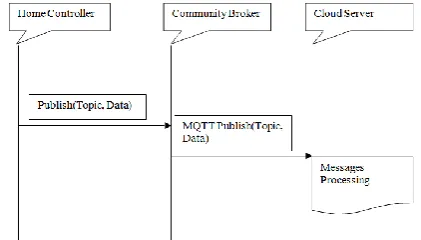
[image:3.595.328.539.367.487.2]Fig -5: MQTT status updating on the cloud server.
Fig -6: MQTT request and reply from the cloud
server.
[image:3.595.322.545.527.653.2]© 2017, IRJET | Impact Factor value: 5.181 | ISO 9001:2008 Certified Journal | Page 1851 latency between MQTT and HTTP, the MQTT servers has
lower latency and perform dynamically than the HTTP servers. The MQTT servers operate on low data traffic, but HTTP operates and consumes high data traffic. On the basis of the above comparison, it can be concluded that the MQTT architecture is more beneficiary. As the devices in the home may be increased or decreased this may reflect in the load on the community broker. In comparison with the traditional client-server architecture, the implemented client-server architecture can be scaled. The bandwidth of the core network and computational capacity of the cloud are managed efficiently in the proposed architecture.
5. Conclusion
The proposed smart home system is very efficient, it reduces manual labor, provides electronic services to the users. The system functionalities can further be enhanced by the implementations of more services. The MQTT and HTTP protocols are also compared based on the energy consumption, latency, data traffic. This system has a simple Graphical user interface where children, old people can easily understand. The developed system is not only confined to the experimental setup, but can also cope up in real world applications.
ACKNOWLEDGEMENT
The Authors B. S. S. Tejesh, S. Neeraja are greatly thankful to the KL University authorities for providing necessary infrastructure facilities to carry out this project work.
REFERENCES
[1] S. Gupta, M. S. Reynolds, S. N. Patel, "Electrisense: Single-
point sensing using EMI for electrical event detection and classification in the home", Proc. ACM International Conference on Ubiquitous Computing, pp. 139-148, Sep. 2010.
[2] Hyunho Park, Hyeong Ho Lee, "Smart WLAN discovery
for power saving of dual-mode terminals", ETRI Journal, vol. 35, no. 6, pp. 1144-1147, Dec. 2013
[3] J. Han, C. S. Choi, W. K. Park, I. Lee, and S. H. Kim,
"PLC-based photovoltaic system management for smart home energy management system," IEEE Trans. Consumer Electron., vol. 60, no. 2, pp. 184-189, May 2014.
[4] B. Lee, J. Byun, M. I. Choi, B. Kang, and S. Park,
"Degradation diagnosis system of photovoltaic panels with mobile application," IEEE Trans. Consumer Electron., vol. 60, no. 3, pp. 338-346, Aug. 2014.
[5] U.S. Department of Energy, "Energy Saver Booklet: Tips
on Saving Energy & Money at Home", May. 2009.
[6] N. Strother, B. Gohn, "Home energy management", Pike
Research Report, 2012.
[7] R. Streubel, B. Yang, "Identification of electrical
appliances via analysis of power consumption", in Proceedings of the International Universities Power Engineering Conference, pp. 1-6, 2012.
[8] H. C. Jo, S. Kim, and S. K. Joo, "Smart heating and air
conditioning scheduling method incorporating customer
convenience for home energy management system," IEEE Trans. Consumer Electron., vol. 59, no. 2,pp. 316-322, May 2013.
[9] V. Sundramoorthy, Q. Liu, G. Cooper, N. Linge, J. Cooper,
"DEHEMS: A user-driven domestic energy monitoring system", 2010 Internet of Things (IOT), pp. 1-8, Nov. 2010.
[10] H. Hassan, R. A. Bakar, A. T. F. Mokhtar, "Face
recognition based on auto-switching magnetic door lock system using microcontroller", 2012 International Conf. System Engineering and Technology (ICSET), pp. 1-6, Sep. 2012.
[11] S. Abbate, M. Avvenuti, F. Bonatesta, G. Cola, P. Corsini, A.
Vecchio, "A smartphone-based fall detection system", Pervasive and Mobile Computing, vol. 8, no. 6, pp. 883-899, Dec. 2012.
[12] H. Y. Tung, K. F. Tsang, H. C. Tung, K. T. Chui, and H. R.
Chi, "The design of dual radio ZigBee homecare gateway for remote patient monitoring," IEEE Trans. Consumer Electron., vol. 59, no. 4, pp. 756764,Nov.2013.
[13] T.L. Chien, K.L. Su, Guo Guo, "The Multiple Interface
Security Robot—WFSR-II", IEEE International Workshop on Safety Security and Rescue Robotics, pp. 69-74, 2005.
[14] S. Huynh, D. Parry, A. C. M. Fong, and J. Tang, "Novel
RFID and ontology based home localization system for misplaced objects," IEEE Trans. Consumer Electron., vol. 60, no. 3, pp. 402-410, Aug. 2014.
[15] D. He, S. Wu, "Security flaws in a smart card based
authentication scheme for multi-server environment", Wireless Personal Communications, vol. 70, no. 1, pp. 323-329, 2013
[16] P. Wojtczuk, A. Armitage, T. D. Binnie, T. Chamberlain,
"Recognition of simple gestures using a PIR sensor array", Sensors & Transducers, vol. 14, no. 1, pp. 83-94, Mar. 2012.
[17] Y. Tian, W. Wang, X. Gong, X. Que, and J. Ma, "An
enhanced personal photo recommendation system by fusing contextual and textual features on mobile device," IEEE Trans. Consumer Electron., vol. 59, no. 1, pp. 220-228, Feb. 2013.
[18] G. A. Reyes del Paso, W. Langewitz, L. J. M. Mulder, A. Van
Boon, S. Duschek, "The Utility of Low Frequency Heart Rate Variability as An Index of Sympathetic Cardiac Tone: A Review with Emphasis on A Reanalysis of Previous Studies", Psychophysiology, vol. 50, no. 5, pp. 477-487, May. 2013.
[19] J. Jo, S. Lee, and J. Kim, "Software-defined home
networking devices for multi-home visual sharing," IEEE Trans. Consumer Electron., vol.60, no. 3, pp. 534-539, Aug. 2014.
[20] P. Moreno, J. Torrente, Y. G. Hsieh, W. T. Lester,
"Usability testing for serious games: making informed design decisions with user data.", Advances in Human-Computer Interaction., vol. 2012, 2012.
[21] C. Liao, Q. Liu, B. Liew, L. Wilcox, "Pacer: fine-grained
interactive paper via camera-touch hybrid gestures on a cell phone", Proceedings of the 28th international conference on human factors in computing systems(CHI), pp. 2441-2450, 2010
[22] K. Wang, S. Lian, and Z. Liu, "An intelligent screen system
© 2017, IRJET | Impact Factor value: 5.181 | ISO 9001:2008 Certified Journal | Page 1852 IEEE Trans. Consumer Electron.,vol.61, no.1,pp. 1-9,Feb.
2015.
[23] N. Cao, C. Wang, M. Li, K. Ren, W. J. Lou,
"Privacy-preserving multi-keyword ranked search over encrypted cloud data", Proceedings of IEEE INFOCOM 2011, pp. 829-837, 2011
[24] P. A. Cabarcos, F. A. Mendoza, R. S. Guerrero, A. M. Lopez,
and D.Diaz-Sanchez, "SuSSo: Seamless and ubiquitous single sign-on for cloud service continuity across devices," IEEE Trans. Consumer Electron., vol. 58, no. 4, pp. 1425-1433, Nov. 2012.
[25] L. Zhou, N. Xiong, L. Shu, A. Vasilakos, S.-S. Yeo,
"Context-Aware Middleware for Multimedia Services in Heterogeneous Networks", IEEE Intelligent Systems, vol. 25, no. 2, pp. 40-47, Mar. 2010.
[26] T. Tzyy-Kuen, T. Chih-Shen, C. Shih-Chieh, Y. Chingwei,
"Power minimization for dynamic PLAs", Design Automation Conference 2005. Proceedings of the ASP-DAC 2005, vol. 2, pp. 1010-1013, 2005.
[27] W. Zhu, C. Luo, J. Wang, S. Li, "Multimedia cloud
computing: an emerging technology for providing multimedia services and applications", IEEE Signal Processing Magazine, vol. 28, no. 3, pp. 59-69, May 2011.
BIOGRAPHIES
B.S.S.Tejesh was born in Vijayawada. He completed his B.Tech ECE in Vignan University in 2015. He is currently doing M.Tech on Embedded Systems, 2nd year in
KL university.
S.Neeraja was born in Guntur. She completed her B.Tech ECE in Nalanda College in 2015. She is currently doing M.Tech on Embedded Systems, 2nd year in KL