Mario Raul Moya* Department of Teacher Education, Institute of Research in Education (IREd),
University of Bedfordshire, UK (Received 01/07/14; final version received 05/03/15)
Abstract
This article discusses the use of reflection in the development of pre-service teachers’ skills in school placements, as utilised in a Teacher Training College in Bedford, England, following the views of Schön (1987), Dewey (1988), and Eraut (1994) in relation to the use of reflection to inquire into teaching practice. Such reflective process is facilitated by the model of cognitive apprenticeship (Collins, Brown & Newman, 1989) and by the technique of structured debriefing (Gibbs, 1988) for the identification of areas for improvement, the implementation of interventions, and the assessment of outcomes. The use of reflection enables teaching to be reinterpreted as a critical practice with the potential to produce transformative learning whilst also promoting communities of practice based on inquiry and action research.
Resumen
Este artículo considera el uso de la reflexión en el desarrollo de competencias profesionales en la formación docente inicial en un curso de formación docente en Bedford, Inglaterra, siguiendo los postulados de Schön (1987), Dewey (1988) y Eraut (1994) como un instrumento de interpelación de la práctica profesional. Este proceso es facilitado por el modelo de aprendizaje y formación cognitivos (cognitive apprenticeship) (Colli, Brown & Newman, 1987) y por la técnica de la charla estructurada (Gibbs, 1988) que promueven la identificación de fortalezas y necesidades, la implementación de estrategias de intervención y la evaluación de resultados. El uso de la reflexión permite que el proceso de enseñanza se reinterprete como una práctica crítica con el potencial para producir aprendizajes transformativos y promover comunidades de prácticas basadas en la interpelación y la investigación acción.
Keywords:
Palabras clave:
teacher training; reflective practice; cognitive apprenticeship; structured debriefing; communities of practice.
formación docente; práctica reflexiva; aprendizaje cognitivo; charla estructurada; comunidades de práctica.
* Corresponding author, e-mail: [email protected]
Cognitive apprenticeship and structured debriefing as tools to develop
reflective practice in initial teacher education
THIS ARTICLE IS underpinned by the experience of the author as a tutor in a Postgraduate Certificate in Education (PGCE) course, run by the Department of Teacher Education at the University of Bedfordshire in England. This 38-week course includes university-taught sessions and two school placements, and confers the award of Qualified Teacher Status (QTS)—a licence to teach in state-run schools. The award is regulated by the Department for Education (DfE) and comprises a series of competences summarised in eight professional standards ( https://www.gov.uk/government/publications/teachers-standards), which students (hereafter referred to as trainees) are required to attain in order to gain QTS. Each school placement runs for eight weeks, and trainees have to develop a set of reflective skills so as to plan their own training path, which is both functional and individualised. The training process begins with a mentor teacher who models teaching, supervises trainees’ progress and indicates targets to be achieved. Further stages in the training include coaching, scaffolding, articulation, reflection and exploration, all of which are a part of the model of cognitive apprenticeship (CA).
Literature review
In a teacher-training model based on the notions of situated learning (Lave, 1988) and learning in a community of practice (Lave & Wenger, 1991) CA becomes fundamental owing to the fact that it is a means of coaching trainees through authentic activities, tools and culture so that they can effectively perform targeted tasks on their own (Collins, Brown & Newman, 1989). Apprenticeship implies that trainees acquire knowledge and skills from an expert (i.e. the mentor teacher), partly as a result of direct teaching (through instructional demonstration, practice and feedback) and partly by incidental observation of what the expert does. Collins, Brown & Newman (1989) describe the stages of the CA model as follows:
1. Modelling: an expert carries out a task so that the learners can observe and build a conceptual model of the processes required to accomplish a task.
2. Coaching: involves an expert observing a novice whilst they carry out a task, offering hints, feedback, modelling, reminders and new tasks aimed at bringing their performance closer to the expert performance. 3. Scaffolding: refers to the support provided to help the novice carry out
a task, taking the form of suggestion or help.
4. Articulation: includes any method of getting the novice to articulate their knowledge, reasoning or problem-solving in a particular domain. 5. Reflection: enables the novices to compare their own problem-solving
internal cognitive model of expertise.
6. Exploration: involves pushing novices into a mode of problem-solving on their own. Exploration is the natural culmination of the fading of support from the expert.
Learning in a CA occurs through legitimate peripheral participation (Lave & Wenger, 1991)—a process in which newcomers (i.e. trainees) enter on the periphery of a community of practice (i.e. a community of teachers in an educational setting) whilst gradually moving towards full participation. This is characterised by an interactive process in which the apprentice engages by simultaneously performing in several roles, namely status subordinate, learning practitioner, sole responsible agent in minor parts of the performance, aspiring expert and so forth—each of which implies a different set of role relations and interactive involvement (ibid, p.18).
The CA model is built upon the foundations of Vygotsky’s (1978) socio-constructivist theory where the support provided by the mentor teacher, acting as the more experienced one, progressively fades away as the trainees develop competences and respond effectively to the multiple situations emerging in a learning environment. It is then that this environment provides both mentors and trainees with a curriculum for training, which is not prescribed but negotiated. The assumption is that learning is a product of shared cognition (Rogoff, 1995), understood as a negotiated process between the mentor and trainee, which emerges in a community of practice (Lave & Wenger, 1991).
Practice, in this sense, not only refers to teaching (i.e. the professional activity), but also to the reflective activity where both mentor and trainee jointly inquire their teaching.
The concept of reflective practice stems from Dewey (1988), who contrasted routine action with reflective action. According to Dewey, routine action is guided by factors such as tradition, habit and authority, as well as by institutional definitions and expectations. Eraut (1994) describes a process of routinasation in order to explain why teachers and other professionals often seem to operate on autopilot, such as when aspects of their practices are repeated regularly and seemingly automatically in their daily routines. Routine actions are relatively static and thus unresponsive to changing priorities and circumstances. Reflective action, on the other hand, involves a willingness to engage in constant self-appraisal and development. Reflective action, in Dewey’s view, involves the ‘active, persistent and careful consideration of any believer for all supported form of knowledge in the light of the grounds that support it’ (1933, p.9). Teachers who are unreflective about their teaching tend to accept the status quo in their schools and simply “concentrate on finding the most efficient means to solve problems that have largely been defined for them” by others (Zeichner & Liston, 1966, p.17).
professional occupations, emphasising that most professionals face unique situations requiring the use of knowledge and experience so as to inform actions. This is an active, experimental and transactional process, which Schön refers to as professional artistry. This is the “kind of professional competence which practitioners display in unique, uncertain and conflicted situations of practice” (p.22). Schön, therefore, came to distinguish between reflection-on-action, which looks back to evaluate, and reflection-in-action, which enables immediate action. Both contribute to the capabilities of a reflective teacher enabling the exercise of informed judgement in deciding how to act. This capability makes reflective teaching a complex and highly skilled activity, as argued by Pollard (2014), who asserts that high quality teaching and, indeed, students’ learning, are dependent upon the existence of such professional expertise.
Various others, such as Solomon (1987), Petty (2010) and more recently, Bolton (2014), have made a powerful case for reflection as a social practice, in which the articulation of ideas emerging in a group is central to the development of an open, critical perspective. The support of colleagues and mentors is extremely helpful in building understanding, ideas that have been extended further with concepts such as the culture of collaboration (Honigsfeld & Dove, 2010), community of enquiry (Cigman & Davis, 2009) and network learning (Veugelers & O’Hair, 2005).
Reflective practice is applied in a cyclical or spiralling process, coinciding with the process of action research in which teachers monitor, evaluate and revise their own practice on a continuous basis; this is evident in the thinking of Dewey, Schön and others, through the specific conception of a classroom-based, reflective process stemming from the teacher-based, action research movement of which Stenhouse is a key figure. He argues that teachers should act as researchers of their own practices and should develop the curriculum through practical inquiry (Stenhouse, 1975). Various alternative models have since become available (Costello, 2011; McNiff, 2013; Mertler, 2013), and although there are some significant differences in terms of design, they all preserve a central concern with self-monitoring and reflection using a cyclical approach to facilitate inquiry (Alritchter et al., 2013).
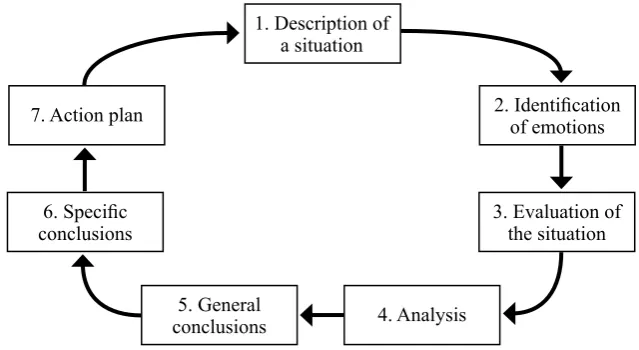
1. Description of a situation
2. Identification of emotions
3. Evaluation of the situation
4. Analysis 5. General
conclusions 6. Specific
conclusions 7. Action plan
The mentors and trainees receive training on how a structured debriefing can be conducted before the beginning of the school placement. Initially, some guidance, in the form of clued statements for example, is provided to facilitate the flow of discussion; however, its use becomes less frequent as confidence and experience in participating in this type of conversation grow. In order to maintain a register and to review highlights at a later stage, the conversation is recorded using a Dictaphone or, alternatively, notes are made, which are then used to generate action plans.
This discussion has been reported to benefit both mentor teachers and trainees alike. In the case of mentors, the use of the structured debriefing as a tool for continuous professional development enables them to revisit their practice and, for the trainees, the professional discussion of their teaching with the mentors facilitates the identification of areas of strengths and those for further development. Structured debriefing, as a tool for reflection, becomes a very useful technique when seeking to inquire into teaching, as well as when undertaking action research, as it encourages the transformation of practice instead of its routine reproduction and mere perpetuation. This is another benefit associated with reflective practice, which Garrison & Akyol (2013) link to the development of metacognitive skills. They argue that:
[image:5.442.59.379.88.263.2]Through cognitive presence [discussion], students have an increased understanding and awareness of the inquiry process, (i.e. metacognition) which, in turn, helps them improve their regulation of cognition by enabling them to select the appropriate learning strategies corresponding to the level seven stages, as shown below:
Metacognition then becomes a necessary tool to develop learning autonomy and, as such, it should underpin the curriculum for professional training and the development of expertise.
Using the Model of Cognitive Apprenticeship and the Technique of Structure Debriefing in the Creation and Development of Communities of Transformative
Learning
Qualitative data generated by surveys, questionnaires, and reflective journals, garnered from the mentors and trainees who have used this model of professional training over a period of four years has been positive, and outcomes clearly show that mentors and trainees have developed a clear ownership of their own professional development, as indicated by the course’s external examiners and other stakeholders, such as the Office for Standards in Education (OfSTED) and the Quality Assurance Agency for Higher Education (QAA). This then gives us some ground from which to speculate about the possibilities this training model offers if applied to a larger setting, where all teachers in an educational environment participate. In principle, cognitive apprenticeship requires collaboration amongst teachers for the mutual development of professional skills, knowledge and understanding, and also creates a community of learning in which practice becomes the inquiry of teaching where the ultimate goal is to learn how to teach.
Barthes (1990, p.9) defines a community of learning as “a place where students and adults alike are engaged as active learners in matters of special importance to them and where everyone is thereby encouraging everyone else’s learning”. This seems to lead to a further advantage, as argued by Zhao (2013), who maintains that professional learning communities move teachers away from a view of teaching as a solitary activity to one where each teacher in a school is responsible for honing not only their own practice, but also the practice of their colleagues.
Nevertheless, we are aware of the challenges the CA model poses for teachers and educational organisations: for example, the use of structured debriefing, within a learning community, requires the re-conceptualisation of concepts such as ‘school’ as a setting where teaching and learning take place. This means, for example, abandoning traditional concepts that are culturally rooted, where the teacher is considered to be the one who teaches and where learners are defined as those who acquire information. The new concept of school is therefore that of a place where both teachers and learners are engaged in learning, one from the other. In order for teachers to learn, it is necessary that they inquire into their teaching, thus becoming researchers of their own practice as part
of their own lifelong learning.
We are also aware of the tensions apparent between the personal perspectives and beliefs of teachers and institutional cultures. The use of reflection challenges the notion that teaching is a solitary activity as it requires willingness for teachers to collaborate with other colleagues, as well as openness to critique each other’s teaching, providing and receiving developmental feedback. This framework is not only novel, but also transformative in nature as it lends itself to the promotion of a culture of collaboration (Honingsfeld & Dove, 2010), the development of a community of enquiry (Cigman & Davis, 2009) and network learning (Veugelers, O’Hair & John, 2005).
Finally, we maintain that reflecting in a community of learning is an emancipatory practice where teachers break free from ritualistic teaching as they are effective problem-solvers, creative and innovative. In order to encourage such a perspective, it is necessary to ensure that educational leaders understand that collaboration, reflection and action research are instances of lifelong learning, promoting continuous professional development whilst enhancing professional learning. This perception then has the potential to transform school into a learning school (Middlewood, Parker & Beere, 2005).
Conclusion
In this article, we have presented a very succinct account of a model for teacher training based on reflective practice, and have reviewed various sources that support such practice. In particular, we have considered the benefits of cognitive apprenticeship and the technique of structured debriefing in developing both the competences of trainee teachers in the early stages of their professional training and the enhancement of the expertise of mentors. We have also used our experience as lecturers in a PGCE course, where the model is currently implemented, and have speculated about the benefits of reflection if applied within a community of learning in the context of being a collaborative activity centred on encouraging transformative learning. Furthermore, we have argued that one of the advantages of reflection is the development of metacognitive skills, which enables mentors and trainees to identify strengths and areas for future development. Moreover, we have also indicated a number of the challenges posed by reflective practice, and have further argued that there is a need to develop a renewed mindset that permits us to see teachers and teaching from a different perspective, abandoning traditional conceptions.
References
Altrichter, H., Feldman, A., Posch, P., & Somekh, B. (2013). Teachers investigate their work: An introduction to action research across the professions. Oxon: Taylor and Francis.
Barthes, R. (1990). Writers, teachers, intellectuals. In R. Barthes, Image, music, text (pp. 190–216). London: Fontana Paperbacks.
Bolton, G. (2014). Reflective practice: Writing and professional development. London: Sage Publications.
Cigman, R., & Davis, A. (2009). New philosophies of learning. Malden, MA: Wiley-Blackwell.
Collins, A., Brown, J. S., & Newman, S. E. (1989). Cognitive apprenticeship: Teaching the crafts of reading, writing, and mathematics. In L. B. Resnick (Ed.), Knowing, learning, and instruction: Essays in honor of Robert Glaser (pp. 453–494). Hillsdale, NJ: Lawrence Erlbaum Associates.
Costello, P. J. (2011). Effective action research: Developing reflective thinking and practice. London: Continuum.
Department for Education (2011, July 1). Teachers' standards - Publications - GOV.UK.
Retrieved June 12, 2014, from https://www.gov.uk/government/publications/ teachers-standards
Dewey, J. (1988). Experience and education. In J.A. Boydston (Ed.) John Dewey: The middle works, 1899-1924. Carbondale, IL: Southern Illinois University Press. Eraut, M. (1994). Developing professional knowledge and competence. London: Taylor
& Francis.
Garrison, D., & Akyol, Z. (2013).Toward the development of metacognition construct for communities of inquiry. Journal of Internet and Higher Education, 7(1), 84– 89. DOI: 10.1016/j.iheduc.2012.11.005.
Gibbs, G. (1988). Learning by doing: A guide to teaching and learning methods.
London: Sage.
Honigsfeld, A., & Dove, M. G. (2010). Collaboration and co-teaching: Strategies for English learners. Thousand Oaks, CA: Corwin Press.
Lave, J. (1988). Cognition in practice: Mind, mathematics, and culture in everyday life.
Cambridge: Cambridge University Press.
Lave, J., & Wenger, E. (1991). Situated learning: Legitimate peripheral participation.
Cambridge: Cambridge University Press.
McNiff, J. (2013). Action research: Principles and practice. London: Routledge. Mertler, C. A. (2013). Action research 4e + digging deeper into action research. London:
Sage Publications.
Paul Chapman Publishing.
Petty, G. (2010). Evidence based teaching: A practical approach. Cheltenham: Nelson Thornes.
Pollard, A. (2014). Reflective teaching in schools. London: Bloomsbury.
Rogoff, B. (1995). Observing sociocultural activity in three planes: Participatory appropiation, guided participation and apprenticeship.In J. D. Wertsch, P. del Río & A. Alvarez (Eds.). Sociocultural studies of mind (pp.139–164). Cambridge: Cambridge University Press.
Schön, D. (1987). Education the reflective practitioner. San Francisco, CA: Jossey-Bass. Solomon, J (1987). New thoughts on teacher education. Oxford Review of Education,
13(3), 267–274.
Stenhouse, L. (1975). An introduction to curriculum research and development. London: Heinmann.
Veugelers, W., & O'Hair, M. J. (2005). Network learning for educational change.
Maidenhead: Open University Press.
Vygotsky, L. (1978). Mind in society: Development of higher psychological processes.
Cambridge, MA: Harvard University Press.
Zeichner, M. K. & Liston, D.P. (1996). Reflective teaching. An introduction. Mahwah, NJ: Lawrence Erlbaum Associates.