Reboost Image Segmentation using Genetic Algorithm
Ashutosh Jaiswal
Computer Science Department IMS Engineering College,
Ghaziabad, U.P., India
Lavika Kurda
Computer Science Department IMS Engineering College,
Ghaziabad, U.P., India
Vijai Singh
Computer Science Department IMS Engineering College,
Ghaziabad, U.P., India
ABSTRACT
This paper present a Improved Algorithm for Image Segmentation System for a RGB colour image, and presents a proposed efficient colour image segmentation algorithm based on evolutionary approach i.e. improved Genetic algorithm. The proposed technique, without any predefined parameters determines the optimum number of clusters for colour images. The optimal number of clusters is obtained by using maximum fitness value of population selection. The advantage of this method lies in the fact that no prior knowledge related to number of clusters is required to segment the color image. Proposed algorithm strongly supports the better quality of segmentation. Experiments on standard images have given the satisfactory and comparable results with other techniques.
General Terms
Digital Image Processing, Algorithm, Image Segmentation, Genetic Algorithm.
Keywords
Color image segmentation, Genetic algorithm, Clustering.
1. INTRODUCTION
1.1 Image Segmentation
The goal of image segmentation is to cluster pixels into salient image regions, i.e., regions corresponding to individual surfaces, objects, or natural parts of objects. Some works have applied genetic algorithms (GA) to image processing [34] and to segmentation particularly [33, 32, 30, 31]. Indeed, GA is particularly efficient when the search space is really important and when the criterion to optimize is numerically complicated which is always the case in image processing. The main advantages of using GA for segmentation lie in their ability to determine the optimal number of regions of a segmentation result or to choose some features such as the size of the analysis window or some heuristic thresholds. In this paper we deal with various approaches for color image segmentation using GA along with many image segmentation techniques. We have tried to describe general segmentation techniques in this paper. In next section, we illustrate M-estimators algorithm (genetic algorithm), followed by comparison of various approaches led by researchers. Finally we end our work by giving the conclusion and perspectives.
Fig.1: Flow Chart of Image Processing System
1.2 Genetic Algorithm
Genetic algorithms are based on natural selection discovered by Charles Darwin [40]. They employ natural selection of fittest individuals as optimization problem solver. Optimization is performed through natural exchange of genetic material between parents. Offspring’s are formed from parent genes. Fitness of offspring’s is evaluated. The fittest individuals are allowed to breed only. In computer world, genetic material is replaced by strings of bits and natural selection replaced by fitness function. Matting of parents is represented by cross-over and mutation operations.
A simple GA (Figure 1) consists of five steps [29]
1. Start with a randomly generated population of N chromosomes, where N is the size of population, l – length of chromosome x.
2. Calculate the fitness value of function φ(x) of each chromosome x in the population.
3. Repeat until N offspring’s are created:
a. Probabilistically select a pair of chromosomes from current population using value of fitness function.
b. Produce an offspring yi using crossover and mutation operators, where i = 1, 2, …, N.
4. Replace current population with newly created one.
5. Go to step 2. Image Segmentation
Process
Feature Extraction Process
Object Recognition
Process
Segmentatio n Parameter
Set
Genetic Algorithm
for Parameter Adaptation
Learning for new Object Feature
Object Model Acquisition
Fig.2: Flow Chart of Genetic Algorithm
2. LITERATURE REVIEW
Segmentation of a colour image composed of different kinds of texture regions can be a hard problem, namely to compute for an exact texture fields and a decision of the optimum number of segmentation areas in an image when it contains similar and/or unstationary texture fields. In this work, many researchers have proposed their algorithms for the same.
Vitorino Ramos, Fernando Muge [22] proposed an improvement of the k-means clustering algorithm. This algorithm uses minimum distance criteria as the fitness function. The minimisation is based on the different belonging combinations, of all points in the feature space. Naturally that, such task will be simply if the number of colours in one image to segment is low; however for high number of points in this 3D colour space (i.e., the different number of colours) this minimisation is hard to compute. The respective computer time for segmentation were 14.96, 12.76 and 37.02 minutes when string lengths were 124, 64 and 468 bits long.
ISODATA algorithm [28] proposed by Mohamad Awad, Kacem Chehdi, and Ahmad Nasri has some further refinements by splitting and merging of clusters. Clusters are merged if either the number of members (pixel) in a cluster is less than a certain threshold or if the centres of two clusters are closer than a certain threshold. Clusters are split into two different clusters if the cluster standard deviation exceeds a predefined value, and the number of members (pixels) is twice the threshold for the minimum number of members. 2) ISODATA is the only unsupervised classification method that
P. Scheunders [37] proposed a genetic c-means algorithm which is an improvement to c-means clustering algorithm combining it with genetic algorithm. It is shown that this algorithm is less sensitive to the initial conditions than CMA. Furthermore GCMA is compared to several classical color image quantization algorithms, and its performance is shown to outperform the others, an effect which affects the visual image quality.
The GA-based GAHSI segmentation scheme [23] is a novel and simple approach to robustly segment an outdoor field image into plant and background regions under variable lighting conditions. The GAHSI obtained an equivalent segmentation performance to that obtained by applying cluster analysis to images acquired under specific lighting conditions. To further improve segmentation robustness, different imaging devices and color transformations as well as GA coding and operators need to be investigated in future research.
Li Zhuo et al [38] presented a mew GA based wrapper feature selection method GA-SVM for hyper-spectral data. The results showed that the GA-SVM method could significantly reduce the computation cost while improving the classification accuracy. The number of bands used for classification was reduced from 198 to 13, while the classification accuracy increased from 88.81% to 92.51%. The optimized values of the two SVM kernel parameters were 95.0297 and 0.2021, respectively, which were different from the default values as used in the ENVI software.
3.
GENETIC
ALGORITHM
BASED
CLUSTERING
The searching capability of GA’s can be used for the purpose of appropriately clustering a set of unlabeled points in N-dimension into K clusters [1]. In our proposed scheme, the same idea can be applied on image data. We consider a colour image of size mxn and every pixel has Red, Green and Blue components. The basic steps of the GA-clustering algorithm for clustering image data are as follows:
3.1 Encoding
Each chromosome represents a solution which is a sequence of K cluster centres. For an N dimensional space, each cluster centre is mapped to N consecutive genes in the chromosome. For image datasets each gene is an integer representing an intensity value of the three components Red, Green and Blue.
3.2 Population initialization
Population is initialized in various rounds randomly and in each round the best chromosome survives for the next round processing.
3.3 Fitness computation
The fitness computation is accomplished in two steps. First, the pixel dataset is clustered according to the centres encoded in the chromosome under consideration, such that each intensity value xi(r,g,b) of colour image combined with three component red, green and blue (24 bit), i = 1, 2, ..., mxn is assigned to cluster with centre zj(r,g,b), j = 1, 2, ..., K,
If Begin Optimization
Generate Random Population
Calculate Fitness ф(x)
Select Pair of Chromosome
Form an Offspring yi
END ?
Replace Old Population
Done ?
End Optimization
N
Y
N
The next step involves adjusting the values of the cluster centres encoded in the chromosome, replacing them by the mean points of the respective clusters. The new centre Zi(r,g,b) for the cluster Ci is given by
Now the fitness metric is computed by calculating the sum of intra cluster spread, i.e. finding the sum of Euclidean distance between the pixels and their respective cluster, given by
The fitness evaluation of a chromosome is givenby -
f = 1/M …..(1), thus our aim is to minimise the value of f.
3.4 Selection
Initially the fittest chromosome in every round of random population generation is moved to next generation, in the subsequent processing the fittest chromosome directly holds the 40% of the entire population and the rest of the population is hold by the chromosomes in the decreasing order of there fitness value.
3.5 Termination Criterion
[image:3.595.50.558.305.697.2]We perform the population generation, fitness computation, crossover and selection for a predetermined number of generations, thus the algorithm is computed for the fixed number of generations and the best solution seen in the entire generation proceeds to final result.
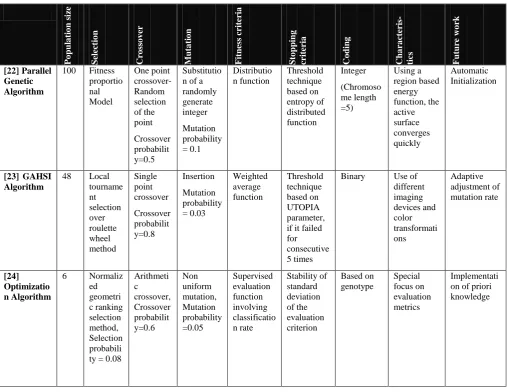
Table 1. Analysis of Various Algorithms
Po
p
u
la
ti
o
n
siz
e
S
elec
tio
n
Cr
o
ss
o
v
er
Mu
ta
ti
o
n
Fi
tn
ess
c
riter
ia
S
to
p
p
in
g
cr
iter
ia
Co
d
in
g
Cha
ra
cte
ris
-tics Fu
tu
re
wo
rk
[22] Parallel Genetic Algorithm
100 Fitness proportio nal Model
One point crossover- Random selection of the point
Crossover probabilit y=0.5
Substitutio n of a randomly generate integer
Mutation probability = 0.1
Distributio n function
Threshold technique based on entropy of distributed function
Integer
(Chromoso me length =5)
Using a region based energy function, the active surface converges quickly
Automatic Initialization
[23] GAHSI Algorithm
48 Local tourname nt selection over roulette wheel method
Single point crossover
Crossover probabilit y=0.8
Insertion
Mutation probability = 0.03
Weighted average function
Threshold technique based on UTOPIA parameter, if it failed for consecutive 5 times
Binary Use of different imaging devices and color transformati ons
Adaptive adjustment of mutation rate
[24] Optimizatio n Algorithm
6 Normaliz ed geometri c ranking selection method, Selection probabili ty = 0.08
Arithmeti c crossover, Crossover probabilit y=0.6
Non uniform mutation, Mutation probability =0.05
Supervised evaluation function involving classificatio n rate
Stability of standard deviation of the evaluation criterion
Based on genotype
Special focus on evaluation metrics
[25, 26] Hybrid Genetic Algorithm
31 Expected value plan and Elitist plan are two selection strategies Unordere d Subseque nce Exchange Crossover (USXX) and Ordered Crossover , Crossover Probabilit y=0.6 Remove and Reinsert, Mutation Probabilit y=0.03 Linear Scaling function Threshold Technique based on hybrid function GA+SA+H GAPSA (Genetic Algorithm, Sequential Algorithm, Hybrid Genetic Algorithm with Parallel Simulated Annealing Distributed environment with Remote Method Invocation concept Removal of ambiguity in the population size. And more than two meta-heuristic algorithms may be interpreted to improve the solution space. [27] Adaptive Genetic Algorithm
100 Proportio nal selection method
Crossover Probabilit y, 0.5 < pc < 1.0
Mutation Probabilit y, 0.001 < pm < 0.05
average fitness value f -
maximum fitness value (fmax – f)
Sub-averaging the fitness value Based on Schema Theorem i.e. Binary Coding GA repeatedly converges to almost same fitness values To resolve the problem of getting stuck in the local optimum when the population is scattered. [28] ISODATA Algorithm
90 Roulette wheel method Cluster centre replaceme nt method Crossover probabilit y = 0.6
Random substitutio n Mutation probability = 0.1 Objective Function Stability of fitness values for 20 iterations Bit level coding Usage of multicompo nent features Parallel cooperation with more segmentation methods, such as FCM
[36] Dynamic GA based clustering (GADCIS)
30 Roulette Wheel selection Single point crossover Crossover probabilit y=0.9 Substitutio n Mutation probability =0.01 Cluster validity criteria based on Gaussian distribution Fixed no. of iterations
Integer No prior knowledge required Work on generation of optimal no. of cluster centres [37] Genetic c-means clustering (GCMA) No. Of Clu ster s Roulette wheel selection One point crossover Crossover probabilit y-=0.8 Insertion of single bit Mutation probability =0.05 Inverse of MSE Stability of MSE Binary or other Develops a hybrid algorithm combining CMA and GA Data clustering methods [38] GA (based on SVM)
20 Stochasti c uniform Single point crossover Crossover probabilit y=0.8 scattered Scale=1.0 Shrink=1. 0 Rank (fitness normalizati on) Fixed no. of iterations
Binary Classifies the given input data based on a set of training examples Improvement in classification accuracy [39] Elastic contour method
200 3 level contour function One point crossover Crossover probabilit y=0.6 Substitutio n Mutation probability =0.0001 Normalized histogram function Fitness value ranging around 500-570
4. PROPOSED WORK
The proposed new segmentation algorithm can produce a better result according to the segments created by optimal number of dynamic clusters. We consider a colour image f of size m x n. The proposed algorithm is:
1. Repeat step 2 to 4 till fixed no. of generations.
2. Randomly generate the cluster set using the randperm function.
3. Each pixel of the image is associated with the cluster number using min distance function which uses Euclidean formula as criteria.
4. We calculate fitness value of the chromosome by adding the distances of each pixel.
5. The chromosome with maximum fitness value is considered as the solution.
5. RESULT
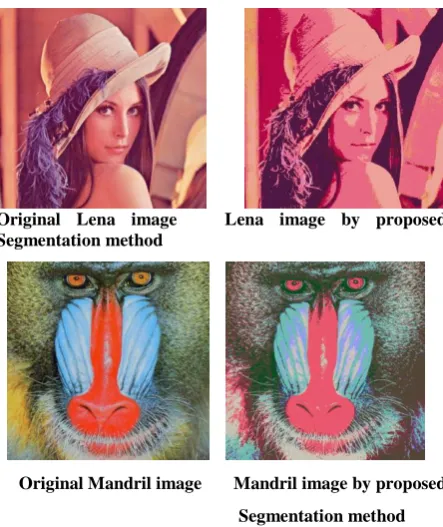
Testing of proposed algorithm with standard color images, it has given satisfactory results, a tabular comparison between different clustering techniques are presented below. Column 2 of table gives the optimal range of clusters as proposed by [12]. Assumptions for segmenting the images are as follows: 20 rounds are processed for generating the initial population each generating random cluster from range 2 to 8 in RGB space, from each round cluster with maximum fitness value is passed to next generation and at each next iteration fitness value is being compared with fitness value of next cluster set. Each next generation contains the maximum fitness value, cluster set and also the cluster numbers. An iteration to 20 generations has been done to create the final results.
Original Lena image Lena image by proposed Segmentation method
Original Mandril image Mandril image by proposed
[image:5.595.307.548.112.227.2]Segmentation method
[image:5.595.56.278.445.709.2]Fig.3: Original Image and Segmented Image of Lena & Mandril
Table 2. Comparison of different Image Segmentation Algorithm
Image Optimal
range
Proposed method
DCPSO
using v
SNOB
Mandril 5 to 10 5.32 6 39
Lena 5 to 10 4.47 6.85 31
Peppers 6 to 10 6.13 6.25 42
Jet 5 to 7 4.39 5.3 22
6. FUTURE WORK
The preceding sections provide an overview of the field of image segmentation, the review shows that many current algorithms are able to produce reasonable results on images of moderate complexity; several of these algorithms are efficient enough that they can be used as a pre-processing stage for higher level vision tasks such as recognition and tracking. The GAHSI algorithm [23] has its own characteristics; still it has scope of improvement in adaptive adjustment of mutation rate. Elastic contour method [39] can be improved by automatic deviation of no. of variants. In ISODATA algorithm [28], a parallel cooperation with various segmentation algorithms like FCM is required for further improvement. Still, there is some scope of improvement. Reviewing the existing algorithms, we conclude that absence of prior knowledge about the image’s contents, it is in general not possible to determine how many regions are required for a reasonable segmentation. This problem manifests in two forms, Under-segmentation, which occurs when parts of the image that actually correspond to different objects, or to an object and the background, are assigned to the same region; and over-segmentation, which occurs when parts of the image corresponding to a single object are split apart.
7. CONCLUSION
matching problem in which a non-decreasing M-estimator serves as an error measure.
8. ACKNOWLEDGMENT
Our thanks to expert (Vijai Singh), who has guided us to propose a new fast algorithm for image segmentation using genetic algorithm, thus we present our sincere thanks to him and all the others who have contributed towards completion of this paper.
9. REFERENCES
[1] W. Frei and C. Chen, "Fast Boundary Detection: A Generalization and New Algorithm," IEEE Trans. Computers, vol. C-26, no. 10, pp. 988-998, Oct. 1977.
[2] J. Canny, “A computational approach to edge detection,” IEEE Trans. Pattern Analysis and Machine Intelligence, Vol. 8, No. 6, pp. 679-698, Nov. 1986.
[3] R. C. Gonzalez and R. E. Woods, Digital Image Processing. Upper Saddle River, NJ: Prentice-Hall, 2001, pp. 572-585.
[4] W. K. Pratt, Digital Image Processing. New York, NY: Wiley-Interscience, 1991, pp. 491-556.
[5] Suryakant, Neetu Kushwaha, “Edge Detection using Fuzzy Logic in Matlab,” ISSN: 2277 128X, Volume 2, Issue 4, April 2012.
[6] Gonzalez and Woods, "Digital image processing", 2nd Edition, prentice hall, 2002.
[7] Kenneth R. Castelman, "Digital image processing", Tsinghua Univ Press, 2003.
[8] Du Gen-yuan,Miao Fang,Tian Sheng-li,Guo Xi-rong.,"Remote Sensing Image Sequence Segmentation Based on the Modified Fuzzy C-means", Journal of Software, Vol. 5, No. 1, PP.28-35, 2009.
[9] N. Senthilkumaran and R. Rajesh, “Edge Detection Techniques for Image Segmentation - A Survey”, Proceedings of the International Conference on Managing Next Generation Software Applications (MNGSA-08), 2008, pp.749-760.
[10] Sharmishtha Mitra, Amit Mitra and Debasis Kundu, “Genetic algorithm and M-estimator based robust sequential estimation of parameters of nonlinear sinusoidal signals”, Commun Nonlinear Sci Numer Simulat, October 2010.
[11] Jiun-Hung Chen, Chu-Song Chen, and Yong-Sheng Chen, “Fast Algorithm for Robust Template Matching With M-Estimators”, IEEE TRANSACTIONS ON SIGNAL PROCESSING, VOL. 51, NO. 1, JANUARY 2003.
[12] Jun Zhang, Kitakyushu Jinglu Hu. “Image Segmentation Based on 2D Otsu Method with Histogram Analysis” Computer Science and Software Engineering, 2008 International Conference
[13] Leo Grady and Eric L. Schwartz “Isoperimetric Graph Partitioning for Image Segmentation”Pattern Analysis and Machine Intelligence, IEEE Transactions.
[14] Pateek Gupta, Sargam Saxena, Sonali Singh, Saumya Dhami and Vijai Singh, “Color Image Segmentation: A
Computational Intelligence Research ISSN 0973-1873 Volume 8, Number 1 (2012), pp. 17-25 © Research India Publications.
[15] Utkarsh Kumar Shah and Prof. A. Mukherjee, ”BTP REPORT Image segmentation by region growing”, April 15, 2010.
[16] Shilpa Kamdi1, R.K.Krishna2,1,2-Rajiv Gandhi College of Engineering,Research and Technology, “Image Segmentation and Region Growing Algorithm” , feb 1, 2012,
[17] S.Beucher, F.Meyer,“The morphological approach to segmentation: The watershed transform”, in Mathematical Morphology Image Processing, E. R. Dougherty, Ed. New York Marcel Dekker, 1993, vol. 12, pp. 433–481.
[18] A. N. Moga, M. Gabbouj, "Parallel image component labeling with watershed transformation”, IEEE Trans. Pattern Anal. MachineIntell. vol. 19, pp. 441–450. J. M Gauch, “Image segmentation and analysis via multi-scale gradient watershed hierarchies”, IEEE Trans Image Processing, vol. 8, pp. 69–79, 2000
[19] O. F. Olsen, M. Nielsen, “Multi-scale gradient magnitude watershed segmentation”, in ICIAP’ 97–9th Int Conference on Image Analysis and Processing, ser. Lecture Notesin Computer Science. Berlin, Germany: Springer-Verlag, 2001, vol. 1310, pp. 6–13.
[20] JL. Vincent, “Morphological gray scale reconstruction in image analysis: Applications and efficient algorithms”, IEEE Trans. Image Processing, vol. 2, 1993.
[21] Mandeep Kaur, Gagandeep Jindal, “Medical Image Segmentation using Marker Controlled Watershed Transformation”, IJCST Vol. 2, Issue 4, Oct . - Dec. 2011.
[22] Faguo Yang 3, Tianzi Jiang and Yong Fan , “A Parallel Genetic Algorithm for Cell Image Segmentation” 1;2, 4 National Laboratory of Pattern Recognition, Institute of Automation Chinese Academy of Sciences, Beijing 100080, P. R. China David J. Evans 5 Department of Computing, Nottingham Trent University Nottingham, NG1 4BU, UK.
[23] L. Tang, L. Tian, B. L. Steward , “COLOR IMAGE SEGMENTATION WITH GENETIC ALGORITHM FOR IN-FIELD WEED SENSING”.
[24] S. Chabrier, C. Rosenberger, B. Emile Laboratoire Terre-Oc´ean Universit´e de la Polyn´esie francaise B.P. 6570 98702 FAA’A, Tahiti - Polyn´esie Franaise, Laboratoire GREYC ENSICAEN - Universit´e de Caen – CNRS 6 Boulevard Mar´echal Juin, 14000 Caen cedex, France EURASIP journal on Video and Image processing (2008) 1-23.
[25] Thamilselvan Rakkiannan and Balasubramanie Palanisamy, “Hybridization of Genetic Algorithm with Parallel Implementation of Simulated Annealing for Job Shop Scheduling” American Journal of Applied Sciences 9 (10): 1694-1705, 2012.
[27] M. Srinivas, and L. M. Patnaik, Fellow, “Adaptive Probabilities of Crossover and Mutation in Genetic Algorithms” IEEE TRANSACTIONS ON SYSTEMS, MAN AND CYBERNETICS, VOL. 24, NO. 4, APRIL 1994.
[28] Mohamad Awad, Kacem Chehdi, and Ahmad Nasri , “Multicomponent Image Segmentation Using a Genetic Algorithm and Artificial Neural Network”, IEEE GEOSCIENCE AND REMOTE SENSING LETTERS, VOL. 4, NO. 4, OCTOBER 2007.
[29] Falkenauer, E., “Genetic Algorithms and Grouping Problems”, John Wiley & Sons, Boston, 1998.
[30] Peng-Yeng Yin, “A fast scheme for optimal thresholding using genetic algorithms” Signal Processing, (72):85–95, 1999.
[31] Minglun Gong and Yee-Hong Yang, “Genetic-based multiresolution color image segmentation” Vision Interface, pages 141–148, 2001.
[32] D.N. Chun and H.S. Yang, “Robust image segmentation using genetic algorithm with a fuzzy measure” Pattern Recognition, 7(29):1195–1211, 1996.
[33] B. Bhanu and S. Lee, “Genetic Learning for Adaptive Image Segmentation” Kluwer Academic Press, 1994.
[34] Y. Delignon A. Marzouki and W. Pieczynski, “Estimation of generalized mixtures and its application in image segmentation” IEEE Transactions on Image Processing, 6(10):1364–1375, October 1997.
[35] Zhenyu Wu and Richard Leahy, “An Optimal Graph theoretic approach to data clustering: Theory and its Application to Image Segmentation”, IEEE Transactions on pattern analysis and machine intelligence, Vol. 15 No. 11, Nov. 1993.
[36] Amiya Halder and Nilavra Pathak, “An Evolutionary Dynamic Clustering Based Colour Image Segmentation”, International Journal of Image Processing (IJIP), Volume (4): Issue (6).
[37] P. Scheunders, “A GENETIC C-MEANS CLUSTERING ALGORITHM APPLIED TO COLOR IMAGE QUANTIZATION”, Vision Lab, Dept. of Physics, RUCA University of Antwerp, Groenenborgerlaan 171, 2020 Antwerpen, Belgium.
[38] Li Zhuo, Jing Zheng, Fang Wang, Xia Li, Bin Ai and Junping Qian, “A GENETIC ALGORITHM BASED WRAPPER FEATURE SELECTION METHOD FOR CLASSIFICATION OF HYPERSPECTRAL IMAGES USING SUPPORT VECTOR MACHINE”, School of Geographical sciences, Guangzhou University, Guangzhou 510006, China) Commission VII, WG VII/3.
[39] S.Cagnoni, A.B. Dobrezeneicki, R.Pauli, J.C. Yanch, “Genetic algorithm based interactive segmentation of 3D medical images”.
AUTHORS’ PROFILE
Ashutosh Jaiswal is a B.Tech Student in Department of Computer Science, IMS Engineering College, Ghaziabad, U.P., India.
Lavika Kurda is a B.Tech Student in Department of Computer Science, IMS Engineering College, Ghaziabad, U.P., India